AI Maturity Assessment: Evidence, Ownership, and the Next Decision
An AI maturity assessment evaluates whether an organization can repeatedly make sound AI investment decisions, deliver appropriate solutions into production, govern risk, operate systems reliably, and learn from evidence. It measures organizational capability across multiple initiatives-not the outcome of a single project.
AI maturity is not determined by the number of AI tools purchased, pilots launched, size of the AI budget, number of employees using generative AI, adoption of a particular vendor, or creation of an innovation lab. A mature organization can explain what it is doing, why it matters, who owns it, what evidence supports it, what controls apply, and what decision comes next.
This comprehensive framework is written for mid-market and enterprise leadership teams evaluating whether their organization is progressing from disconnected AI experimentation toward repeatable, governed, and measurable business use. The audience includes executives, technology leaders, operations leaders, data owners, security leaders, product leaders, and transformation owners.
The practical consequences of low maturity are significant: disconnected experiments, repeated discovery work, weak ownership, inconsistent data access, unclear architecture, security reviews arriving late, pilots that never reach production, production systems without monitoring, and activity reported as business value. Research supports this-MIT CISR's 2025 survey of 152 companies found that organizations in early maturity stages report financial performance below industry average, while those reaching the third stage of governed production see substantial improvement.
From this article, readers will gain:
-
An evidence-based evaluation framework for AI maturity across 10 dimensions
-
A four-stage AI maturity model with clear characteristics and evidence requirements
-
A practical assessment table linking dimensions to evidence, gaps, ownership, and decisions
-
Guidance on interpreting results and selecting the next improvement
-
Leadership questions that drive real decisions rather than maturity labels
Understanding AI Maturity vs AI Readiness
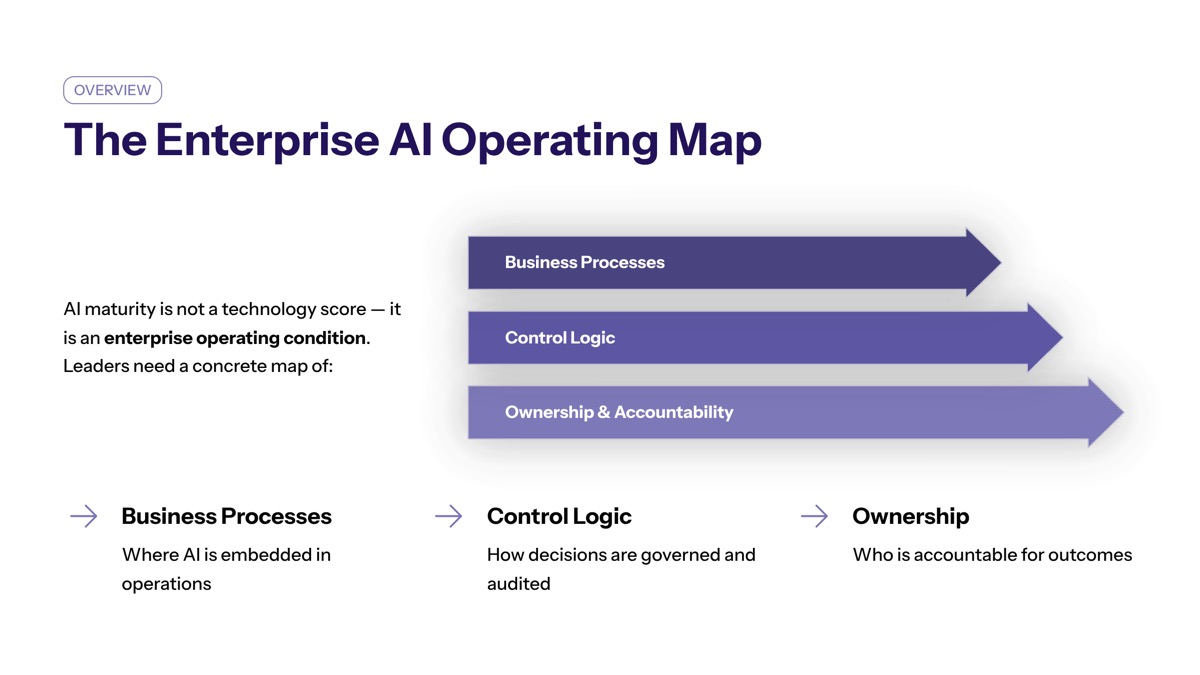
AI maturity is the organizational capability to consistently create conditions for successful AI initiatives across multiple projects. It encompasses strategy, data, architecture, governance, delivery, operations, measurement, and learning-evaluated through observable evidence rather than aspirational statements.
AI readiness, by contrast, asks whether the conditions exist for one specific initiative. Does the team have data access? Is leadership support present? Are legal and compliance requirements understood for that particular use case? An organization could demonstrate strong organizational readiness for a single pilot while lacking the maturity to scale or govern multiple AI initiatives simultaneously.
Consider practical examples: a low-maturity organization may deliver one successful AI project through heroic individual effort, exceptional vendor support, or favorable conditions. A higher-maturity organization can repeat good decisions and operating practices across different teams, use cases, and time periods. Similarly, an organization can be technically capable-strong engineering, modern infrastructure-but weak in ownership or measurement. Another may have strong governance policies but poor delivery capability, unable to move solutions from assessment to production.
These distinctions matter because they determine different paths forward. Readiness gaps can often be addressed project by project. Maturity gaps require organizational investment in practices, roles, and evidence systems that persist across initiatives.
Evidence-Based Maturity Foundation
Every maturity judgment should be supported by observable evidence. This is the principle that separates a useful maturity assessment from a self-congratulatory scoring exercise.
Evidence means concrete artifacts: approved decision records, named owners with clear accountability, a use-case portfolio with documented selection criteria, data classifications, architecture diagrams, security reviews, test results, production logs, incident records, user-adoption evidence, outcome measurements, stop or change decisions, and post-implementation reviews. AI maturity can be assessed using evidence such as policies, AI inventories, and performance metrics-but these must be verified, not merely stated.
Policy statements alone are not sufficient evidence. A governance policy that exists as a document but has never been applied to a real decision provides no maturity signal. Tool inventories demonstrate purchasing activity, not capability. The question is always: what evidence shows this capability exists in practice, not just in intent?
This evidence-based approach connects directly to practical decision making. When leaders can see where evidence exists and where it does not, they can determine which investments will strengthen multiple AI initiatives and which gaps represent the highest risk. The full AI maturity assessment takes approximately 80 hours of participation and the process typically spans around 6 weeks-reflecting the depth of evidence review required to produce valuable insights rather than surface-level scores.
The 10 Dimensions of AI Maturity
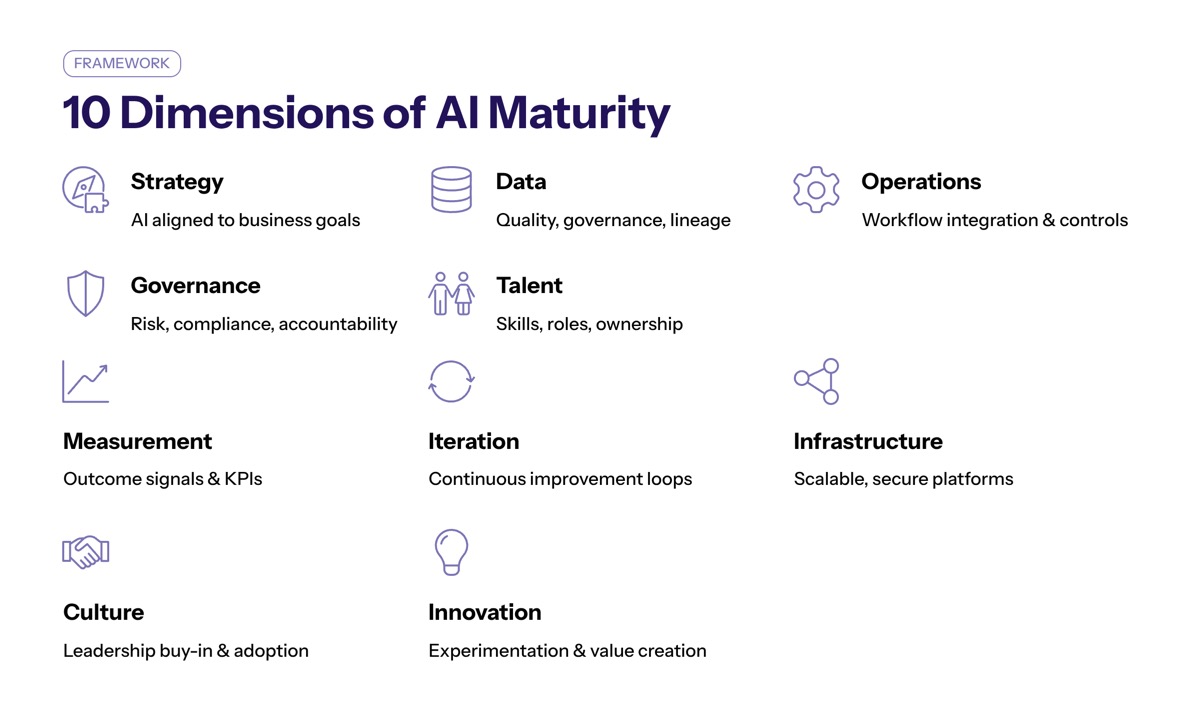
This comprehensive framework evaluates AI maturity across 10 interconnected dimensions covering business outcomes through production operations. AI maturity models evaluate capabilities across seven core pillars in many published frameworks-strategy, data quality, technology infrastructure, governance policies, people, processes, and measurement. The framework presented here expands to 10 dimensions to provide more granular evidence requirements, particularly around ownership, adoption, and production operations, which research consistently identifies as underweighted in traditional models.
These dimensions interconnect. Architecture decisions constrain what can be built. Data quality limits what can be trusted. Governance determines what can be operated responsibly. Ownership determines whether anyone acts on the evidence. An organization may be at different maturity levels across different dimensions-and understanding that variation is more useful than any aggregate score.
88% of organizations use AI in at least one business function. The question is no longer whether organizations are using AI technologies, but whether they can do so repeatedly, responsibly, and with measurable impact.
Business and Strategic Dimensions
Dimension 1 - Business Outcomes and Portfolio Focus
Evaluate whether the organization begins with business problems, defines intended business outcomes, selects a bounded portfolio, understands opportunity cost, stops weak ideas, connects AI initiatives to accountable leaders, and distinguishes experimentation from committed production work.
Evidence to inspect: prioritized use-case portfolio, business cases with defined outcomes, decision records including rejected use cases, named executive sponsors, stop or change decisions, resource allocation linked to strategic objectives.
Warning signs: every department launches independent pilots with no coordination, tool adoption is treated as AI strategy, no use case is ever stopped or retired, every idea is labeled strategic, and activity volume is reported as progress.
Dimension 2 - Use-Case Selection
Evaluate whether the organization consistently assesses business value, AI fit, feasibility, data availability, architecture requirements, risk, ownership, adoption likelihood, and an evidence plan for each proposed initiative. Organizations should prioritize AI initiatives based on maturity gaps and demonstrated capability rather than enthusiasm alone.
Maturity evidence: standard evaluation questions applied across use cases, comparable use-case records, explicit assumptions documented before development begins, defined approval conditions, and documented rejection decisions. A gap assessment identifies what is needed to improve AI maturity at the use-case level before committing resources.
Organizations with mature use-case selection can explain not only why they pursued an initiative but why they chose it over alternatives-and what evidence would cause them to stop. This connects conceptually to opportunity assessment practices without duplicating those frameworks.
Dimension 3 - Data
Evaluate data ownership, access paths, quality standards, classification, privacy controls, lineage, retention policies, permissions, representative testing data, and ongoing maintenance processes. IDC's 2025 study of 1,213 organizations found that data readiness-including classification, lineage, and quality-was among the strongest predictors of successful enterprise AI scaling, with organizations demonstrating mature data practices leading by 20–30 percentage points across scaling metrics.
Maturity evidence: named data owners, approved access paths, data-quality checks with defined thresholds, classification records, retention rules, and a repeatable test-data process separated from production data.
Warning signs: every project renegotiates data access from scratch, available data is assumed to be usable without validation, no one owns data quality, and production data enters experiments without clear controls or privacy review.
Technical and Operational Dimensions
Dimension 4 - Architecture and Integration
Evaluate architecture standards, model and vendor selection criteria, APIs, identity and access design, integration patterns, retrieval systems, portability, logging, monitoring, reliability, and supportability. AI requires deliberate, explainable architectural choices-not a single architecture for every use case.
Maturity evidence: current architecture records, approved integration patterns, reusable components, defined environments (development, staging, production), integration ownership, and documented production operating requirements. KPMG identifies architecture as one of five structural friction areas that block organizations from scaling AI after successful pilots.
Organizations that lack architecture maturity frequently discover integration problems late-after a pilot succeeds but before production deployment, creating costly rework and implementation challenges that could have been anticipated.
Dimension 5 - Security and Governance
Evaluate data boundaries, identity and access controls, permissions, vendor risk assessment, model behavior oversight, human oversight policies, logging, change control, incident response, and risk acceptance processes. The NIST AI Risk Management Framework supports risk management throughout the AI lifecycle and provides a useful reference for structuring governance practices.
Maturity evidence: repeatable review process applied to each initiative, named risk owners, recorded exceptions with justification, tested response procedures, production monitoring for security events, and review after material changes. Effective AI governance implementation requires these practices to be operational, not merely documented.
Rising regulatory pressure-particularly the EU AI Act and standardization efforts like ISO/IEC 42001-is pushing governance maturity into sharper focus. The Trustworthy AI Maturity Model (TAIMM) , published in 2026, maps ethical principles to assessment items across design, development, and operation stages, finding that governance gaps are often highest during the operation stage even when design and development show reasonable alignment.
This article does not claim compliance assurance. Governance maturity improves the conditions for responsible operation; it does not guarantee regulatory compliance.
Dimension 6 - Ownership and Operating Model
Evaluate whether each initiative has named ownership for: business outcome, product or workflow, data, architecture, security, delivery, user adoption, measurement, production operation, and incident response.
Shared participation across functions is valuable, but shared accountability without a decision owner creates ambiguity. When something goes wrong in production-or when measurement shows an initiative isn't delivering value-someone must have the authority and responsibility to act. Organizations should review their current AI operating model as a first step when beginning a maturity assessment.
Maturity evidence: named owners documented in RACI or equivalent, decision rights defined, escalation path clear, operating cadence established, and responsibility explicitly continuing after implementation-not dissolving when the project team disbands.
MIT CISR case studies of companies like Guardian Life and Italgas demonstrate that strong ownership roles -such as Chief AI Officer or data governance councils-and investment in production operations are what separate scaling-capable organizations from those adding more pilots without value.
Delivery and Performance Dimensions
Dimension 7 - Delivery Capability
Evaluate whether the organization can move consistently from problem definition through research, use-case assessment, architecture, bounded testing, validation, production preparation, deployment, support, and improvement or retirement.
Maturity evidence: clear stage decisions with defined criteria, acceptance criteria established before testing begins, reusable delivery practices across initiatives, documented handoffs between teams, production requirements included early in the process, and retained test evidence.
Warning sign: a successful demonstration automatically becomes a production initiative without architecture review, security assessment, production readiness evaluation, or defined ownership. This pattern is among the most common enterprise AI implementation challenges .
Dimension 8 - User Adoption
Evaluate user participation in design, workflow integration, training quality, trust in AI outputs, human review processes, feedback mechanisms, accessibility, escalation paths, consequences of incorrect use, and evidence of actual adoption quality.
Maturity is not measured by account activation counts or training attendance alone. Evidence should show whether users can apply the system safely and whether the workflow produces useful results in practice. This means inspecting usage patterns against intended use, trust surveys, workflow maps, escalation of misuse, and evidence of error handling.
Organizations that treat AI adoption as a rollout event rather than an ongoing process find that usage numbers mask low-quality adoption-people logging in without trusting outputs, or using tools in ways that create risk rather than value.
Dimension 9 - Production Operations
Evaluate monitoring, logging, availability metrics, cost visibility, model and configuration change management, support processes, incident response, vendor dependencies, system retirement planning, and business continuity.
Maturity evidence: named production owner, runbooks, alerting thresholds, change records, incident response process, review schedule, exit or replacement plan, and cost attribution by initiative. Organizations frequently underestimate the operational demands of AI systems-where model drift, data changes, vendor updates, and usage patterns require ongoing attention that traditional software operations may not cover.
Dimension 10 - Measurement and Learning
Evaluate whether the organization measures business evidence, user outcomes, technical performance (precision, latency, fairness, drift), risk events, operating cost, adoption quality, assumption validity, and produces explicit reasons to continue, change, or stop each initiative.
Mature organizations retain negative evidence and use it to improve future decisions. Research from systematic literature reviews of AI maturity models confirms that organizations tracking failures and negative evidence learn faster and avoid repeating mistakes.
Warning signs: reporting only the number of pilots, treating usage as value, hiding failed tests, and continuing initiatives because funding has already been spent rather than because evidence supports continuation.
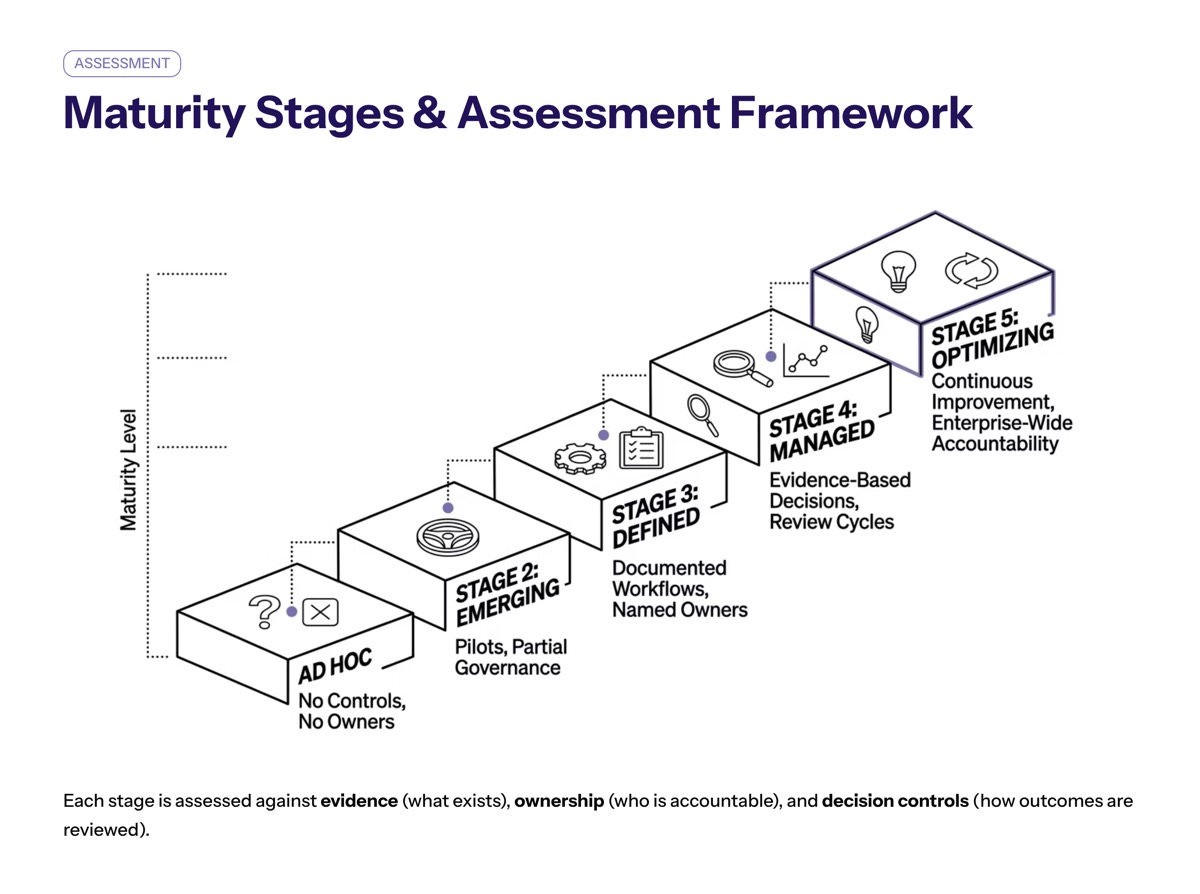
AI Maturity Stages and Assessment Framework
Organizations typically progress through stages from initial awareness to optimizing and transforming their AI capabilities. The following four-stage model synthesizes patterns from academic research, practitioner frameworks, and empirical data to describe how organizations develop AI capability. Organizations are grouped into five AI maturity stages in many published models-Foundational, Emerging, Operational, Scaled, and Transformational-though the framework here consolidates into four stages for practical assessment clarity.
Stage 1 - Experiment-Driven (Foundational)
AI activity is fragmented. Decisions depend on individual enthusiasm. Ownership, data access, security review, and measurement vary by project. The Foundational stage involves ad hoc experimentation with limited coordination. Some departments may launch pilots independently; there is no inventory of use cases and no formal measurement. This is the first stage most organizations experience, and it is not shameful-it is simply the starting point.
Stage 2 - Bounded and Repeatable (Emerging)
The organization has started using common assessment criteria for use cases, some repeatable practices in architecture and data governance, and named owners for some initiatives. But capability is not consistent across teams, and operational delivery remains fragile. Current capabilities may be sufficient for bounded projects but not for scaling AI across the enterprise.
Stage 3 - Governed Production (Operational/Scaled)
AI initiatives use repeatable selection, architecture, security, delivery, measurement, and production practices. Ownership continues after launch. Governance, monitoring, and change control are operational, not aspirational. The Scaled stage features AI capabilities deployed across functions with measurable ROI. MIT CISR's data shows the sharpest financial performance improvement occurs when organizations move from Stage 2 to this third stage-making it the most consequential transition for most organizations.
Stage 4 - Managed Portfolio and Learning (Transformational)
Leadership manages AI as a portfolio. Evidence informs resource allocation, reusable AI capabilities reduce repeated work, and systems are improved, limited, or retired through explicit decisions. Cross-initiative sharing occurs. The Transformational stage reshapes decision making and competitive advantage. Organizations at this stage even shape external standards and industry practices.
Important clarifications:
-
These are educational stages for assessment purposes, not an official industry standard or certification
-
Organizations may be at different stages across different dimensions-and that differential maturity is normal
-
A higher stage does not remove risk; it improves the conditions for managing risk
-
More AI activity does not automatically mean greater maturity
-
Very few organizations reach Stage 4 across all dimensions, per empirical research
AI Maturity Assessment Table
The following table provides an assessment structure. For each dimension, identify the evidence to inspect, judge the current stage based on that evidence, note material gaps, identify the accountable owner, and determine the next decision. Developing a roadmap includes actions, owners, and target dates based on this assessment.
A gap assessment helps prioritize AI initiatives effectively by making the distance between current state and target maturity level visible.
|
Dimension |
Evidence to Inspect |
Current Stage |
Material Gap |
Accountable Owner |
Next Decision |
|---|---|---|---|---|---|
|
Business Outcomes & Portfolio |
Prioritized portfolio, business cases, decision records, named sponsors, stop decisions |
[Evidence note] |
[Specific gap] |
[Named owner] |
[Specific action] |
|
Use-Case Selection |
Standard evaluation criteria, comparable records, documented assumptions, rejection decisions |
[Evidence note] |
[Specific gap] |
[Named owner] |
[Specific action] |
|
Data |
Named owners, access paths, quality checks, classification, lineage, test-data process |
[Evidence note] |
[Specific gap] |
[Named owner] |
[Specific action] |
|
Architecture & Integration |
Architecture records, approved patterns, reusable components, defined environments |
[Evidence note] |
[Specific gap] |
[Named owner] |
[Specific action] |
|
Security & Governance |
Review process, risk owners, exceptions, response procedures, production monitoring |
[Evidence note] |
[Specific gap] |
[Named owner] |
[Specific action] |
|
Ownership & Operating Model |
Named owners per function, decision rights, escalation, post-launch responsibility |
[Evidence note] |
[Specific gap] |
[Named owner] |
[Specific action] |
|
Delivery Capability |
Stage gates, acceptance criteria, reusable practices, handoffs, production readiness |
[Evidence note] |
[Specific gap] |
[Named owner] |
[Specific action] |
|
User Adoption |
Workflow integration, training evidence, trust data, feedback, actual usage quality |
[Evidence note] |
[Specific gap] |
[Named owner] |
[Specific action] |
|
Production Operations |
Monitoring, alerting, change records, incident process, cost attribution, exit plan |
[Evidence note] |
[Specific gap] |
[Named owner] |
[Specific action] |
|
Measurement & Learning |
Business impact data, technical metrics, risk events, assumption reviews, stop criteria |
[Evidence note] |
[Specific gap] |
[Named owner] |
[Specific action] |
Every stage judgment requires a short evidence note-not a self-assessed confidence level. If evidence does not exist, the stage judgment is "insufficient evidence," which is itself a finding.
Do not create a universal weighted score. Do not claim that a total score predicts performance. Aggregated scores risk hiding critical gaps-an organization scoring well on architecture but poorly on governance or ownership faces real risk that no average can represent.
AI maturity assessments require about 80 hours of participation across stakeholders to complete this level of evidence review thoroughly. The assessment process typically spans around 6 weeks to allow adequate time for evidence gathering, interviews, and analysis.
Interpreting Assessment Results
Assessment results should drive specific actions rather than generate a maturity label. Use these decision-oriented outcomes to interpret findings:
Stabilize - Resolve material ownership, data, security, or production gaps before expanding AI activity. If governance or operations evidence is missing for current production systems, adding more initiatives increases risk without improving capability.
Standardize - Create repeatable assessment, architecture, delivery, and review practices that can be applied across initiatives. This is the work of moving from Stage 1 to Stage 2 and represents adopting best practices for consistency.
Produce Evidence - Run a bounded initiative explicitly designed to test a material capability or assumption. Use it to generate the evidence needed to assess readiness for scaling.
Scale Selectively - Reuse proven capabilities only where business value and operating ownership remain clear. Scaling AI works when the underlying practices and infrastructure support it-not when a single success is extrapolated across the organization.
Stop or Retire - End initiatives that lack value, evidence, ownership, adoption, or a defensible operating model. Stopping is a maturity signal, not a failure signal.
An organization does not need to improve every dimension simultaneously. Select the next improvement based on:
-
Material business constraint (what is blocking the most value)
-
Repeated delivery friction (where projects consistently stall)
-
Risk exposure (where lack of governance or operations creates liability)
-
Number of AI initiatives affected (where one improvement strengthens multiple use cases)
-
Available ownership (where someone can be accountable for the improvement)
-
Reusability (where the improvement creates lasting organizational capability)
Continuous reassessment of AI maturity is vital for tracking progress and improvements. A practical maturity assessment involves defining objectives, inventorying current activity, and identifying gaps-then repeating this process as the organization's level changes.
Common AI Maturity Assessment Mistakes
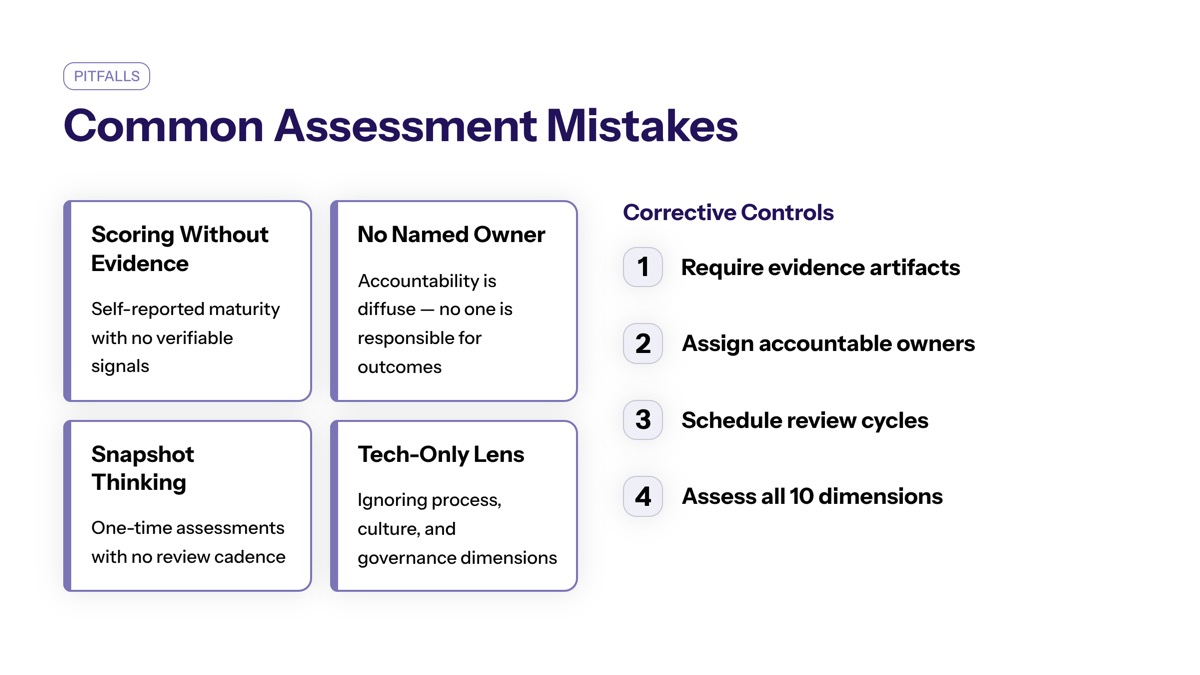
Counting tools and pilots instead of evaluating capability. The number of AI tools deployed or pilots launched measures activity, not maturity. An organization with 30 pilots and no production systems may be less mature than one with three governed, measured production deployments.
Treating policy publication as implementation evidence. A governance policy exists; that is not the same as a governance process that has been applied, tested, and followed. Policies without evidence of application provide false confidence.
Copying another organization's maturity model without context. Frameworks developed for financial services may not apply to manufacturing. Models designed for enterprises with 10,000 employees may not fit mid-market organizations. Context matters-industry, regulatory environment, organizational structure, and current capabilities all shape what maturity looks like.
Scoring without evidence or averaging away critical gaps. Self-assessed scores without supporting evidence are unreliable. Averaging scores across dimensions hides the specific weaknesses that create the most risk. A score of 3.5 across 10 dimensions tells leaders nothing about where to invest.
Ignoring ownership and production operations. Many assessments evaluate strategy, data, and technology but underweight the question of who is accountable after deployment and whether production operations can sustain the system. These operational gaps are where initiatives most frequently fail.
Confusing adoption metrics with business value. Login counts, training completion rates, and usage statistics measure engagement, not outcomes. Maturity requires evidence that AI adoption produces measurable impact on business outcomes.
Using maturity language to justify predetermined spending decisions. If the assessment conclusion was determined before the assessment began-"we need to buy X platform"-the exercise has become rationalization rather than evaluation. A maturity assessment should identify gaps and let the evidence determine what specific actions are warranted.
Leadership Questions and Next Decisions
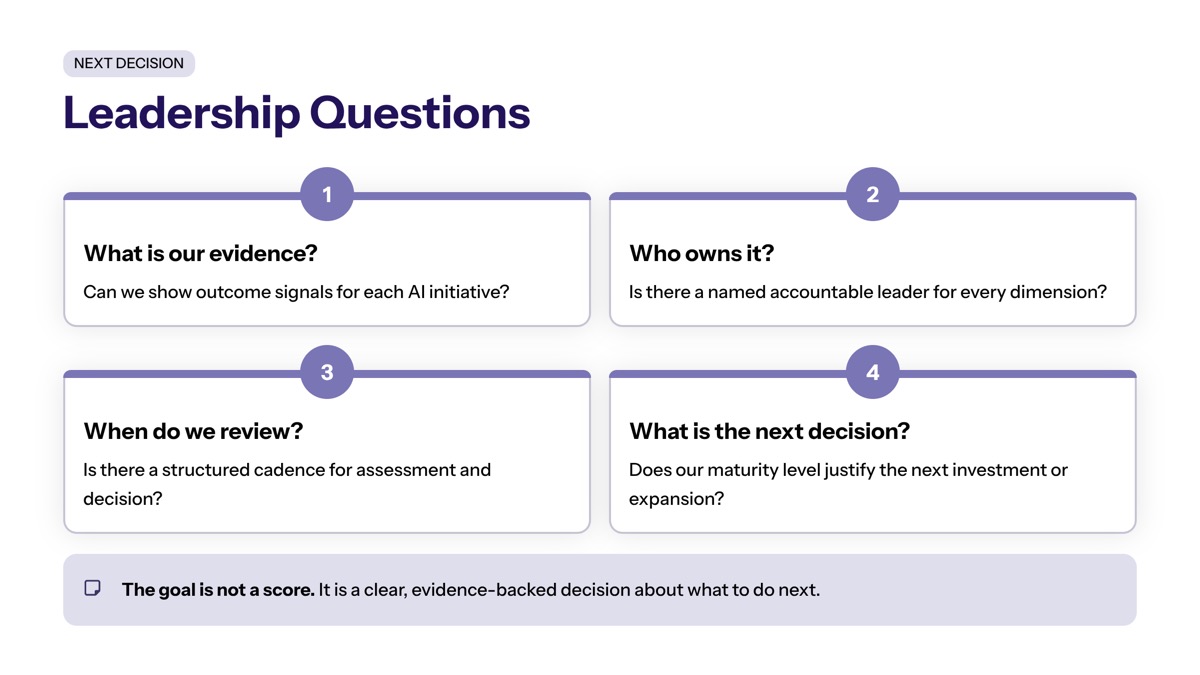
Strategic questions for leaders conducting or commissioning an AI maturity assessment:
-
Which AI decisions can we repeat reliably across teams and initiatives?
-
Where do projects repeatedly stall-and is the friction structural or situational?
-
Which controls exist only on paper, and which have been applied to real decisions?
-
Who owns outcomes after deployment, and what authority do they have?
-
What evidence would change our funding decisions for current AI initiatives?
Operational questions that connect assessment findings to specific actions:
-
Which AI capabilities can be reused across initiatives rather than rebuilt?
-
Which initiatives should be stopped because they lack value, evidence, ownership, or a viable operating model?
-
What is the smallest improvement that would strengthen multiple use cases simultaneously?
-
Where is the organization's level of maturity creating risk that leadership has not explicitly accepted?
-
What decision must leadership make next-and who is accountable for making it?
AI maturity assessments help align investments with business objectives by making these questions answerable with evidence rather than opinion. The goal is not to assess for the sake of assessment but to determine the plan that moves the organization from its current state toward its target maturity level across the dimensions that matter most.
Conclusion and Next Steps
AI maturity is the ability to make, execute, govern, and revise AI decisions using evidence. It is not measured by technology inventory, pilot count, or budget allocation. It is demonstrated by whether an organization can identify gaps, assign ownership, produce evidence, operate responsibly, and learn from both success and failure across multiple initiatives.
Immediate next steps for leadership:
-
Conduct an evidence review using the assessment table above-identify which dimensions have observable evidence and which rely on assumptions or policy documents alone
-
Identify accountable owners for each dimension where ownership is currently unclear or shared without decision rights
-
Select one dimension for improvement based on where the gap creates the greatest constraint across the most initiatives
-
Define the evidence that would demonstrate improvement-not the activity, but the artifact that proves capability exists
AI maturity assessments identify gaps in organizational capabilities and help prioritize investments and initiatives. This connects to broader organizational assessments: AI strategy and implementation readiness evaluates conditions for specific initiatives, opportunity assessment evaluates individual use cases, and maturity assessment evaluates the organization's repeatable capability across all of them.
For a structured, decision-oriented approach to building these capabilities, explore Cognativ's RAPID framework by downloading the RAPID chapter .
Additional Resources
-
MIT CISR Enterprise AI Maturity Model - Four-stage empirical model based on surveys of 700+ companies
-
IDC 2025 AI Maturity Study - Data readiness and infrastructure findings from 1,213 organizations
-
Systematic Literature Review of AI Maturity Models - Academic synthesis of 15 peer-reviewed maturity frameworks
-
RAPID Transformation Services - Cognativ's structured approach to digital and AI transformation
-
AI Software Development Services - Enterprise AI development and implementation