AI Security Assessment: A Complete Guide for Enterprise Organizations
An AI security assessment is a systematic evaluation of AI systems-including models, data pipelines, infrastructure, APIs, and deployment environments-designed to identify vulnerabilities, validate security controls, and ensure alignment with regulatory and governance requirements. Unlike traditional cybersecurity audits, these assessments address threat categories unique to artificial intelligence: adversarial attacks, data poisoning, prompt injection, model drift, and supply chain compromise across the AI lifecycle.
This guide covers the foundational concepts behind AI security assessments, the frameworks and standards that inform them, a structured implementation process, and the challenges organizations face when operationalizing these evaluations. It does not cover basic cybersecurity fundamentals like network hardening or endpoint protection, except where those intersect directly with AI-specific risks. The target audience is mid-market and enterprise technology leaders, security teams, and compliance officers who need to evaluate AI risk management across multiple systems and business functions.
AI security assessment is a structured process that evaluates AI systems for vulnerabilities-such as adversarial attacks, data poisoning, and model manipulation-while ensuring compliance with emerging regulations like the EU AI Act, ISO/IEC 42001, and the NIST AI Risk Management Framework.
By the end of this guide, you will understand:
-
How AI security assessments differ from traditional cybersecurity audits and why that distinction matters
-
Which frameworks and standards apply to your organization's AI ecosystem
-
How to implement a structured assessment process from scoping through remediation
-
Common obstacles organizations encounter and practical solutions for each
-
How to establish continuous monitoring that keeps pace with emerging threats
Understanding AI Security Assessment Fundamentals
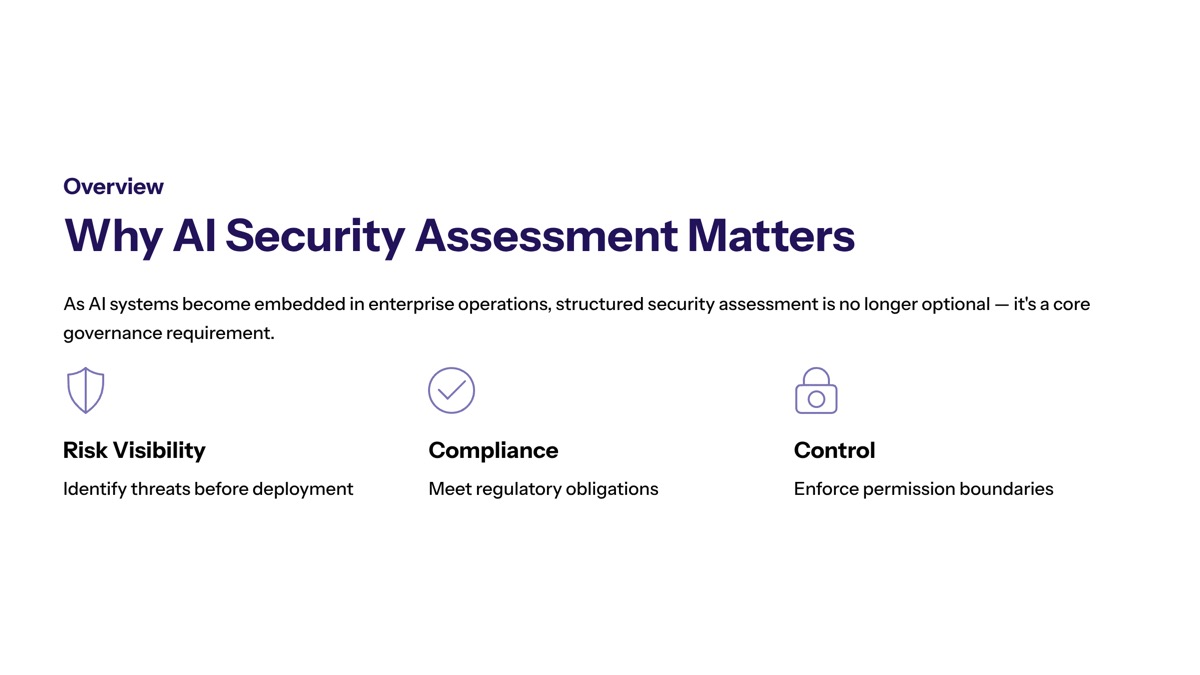
AI security assessment refers to the comprehensive, structured evaluation of every component in an AI system-from training data and model architecture to inference endpoints and operational governance-to identify vulnerabilities, threats, and control gaps. AI security requires moving beyond traditional IT security methods because the threat surface for AI extends well beyond the confidentiality-integrity-availability triad. Traditional audits focus on network perimeters, identity management, software patching, and access controls. AI assessments must also examine model behavior under adversarial conditions, training data integrity, bias amplification, explainability, and governance over model lineage and data provenance.
This distinction matters because enterprise AI adoption is accelerating, and the consequences of insecure AI deployment now include regulatory penalties, reputational damage, intellectual property leakage, and business disruption at scale. AI security assessments identify vulnerabilities in AI systems that conventional tools simply cannot detect.
Unique AI Risk Categories
AI systems face unique attack vectors that require specialized evaluation methods:
Technical vulnerabilities include adversarial attacks (crafted inputs designed to cause misclassification), model poisoning (inserting corrupted training data to alter model behavior or introduce backdoors), prompt injection attacks (manipulating large language models to bypass filters, reveal sensitive data, or execute unintended actions), and data extraction through repeated inference queries. Prompt injection and jailbreaking are critical vulnerabilities evaluated in LLMs, and adversarial manipulation can compromise AI outputs in ways that are difficult to detect without specialized testing. AI security assessments must cover model tampering and data poisoning as core evaluation criteria.
Operational and governance risks include bias amplification-where bias present in training data gets magnified in model outputs, particularly in high-stakes decision making like lending or healthcare-model drift, where AI models gradually diverge from their training distributions and produce degraded or unsafe results, explainability gaps that prevent organizations from tracing or justifying AI decisions, and governance failures such as unclear ownership, missing documentation, and absent incident response procedures for AI-specific events.
Traditional security tools cannot address these risks because they were not designed to evaluate model behavior, detect adversarial inputs, or assess the integrity of AI models throughout their lifecycle . AI security overlaps with conventional cybersecurity risks and controls, but the AI-specific threat surface demands dedicated assessment capabilities.
Regulatory and Compliance Drivers
Regulatory pressure is increasing for AI risk management across every major jurisdiction. The EU AI Act (Regulation (EU) 2024/1689) imposes obligations on "high-risk" AI systems beginning December 2, 2027 for domains including biometrics, critical infrastructure, education, and employment, with additional requirements for AI in products like robotics taking effect August 2, 2028. High-risk systems must undergo risk assessment before deployment, maintain technical documentation, implement post-market monitoring, and ensure human oversight.
The NIST AI Risk Management Framework provides structured methodologies for AI security through four core functions-Govern, Map, Measure, Manage-offering voluntary but comprehensive guidance for operationalizing trustworthy AI. ISO/IEC 42001 establishes management system requirements for AI security, published in December 2023, and aligns with ISO/IEC 27001 structures that many enterprises already use. HITRUST offers up to 44 harmonized controls for AI security, providing a control-based approach familiar to healthcare and regulated industries.
These AI-specific requirements layer on top of existing compliance frameworks. Organizations using AI to process EU personal data must satisfy GDPR; AI in clinical decision support implicates HIPAA; financial services AI must address fair lending and AML/KYC obligations. AI security assessments help organizations comply with these regulatory requirements by surfacing compliance gaps before they become enforcement actions.
Understanding these regulatory drivers is essential context for selecting and implementing the right assessment framework-the subject of the next section.
AI Security Assessment Frameworks and Standards
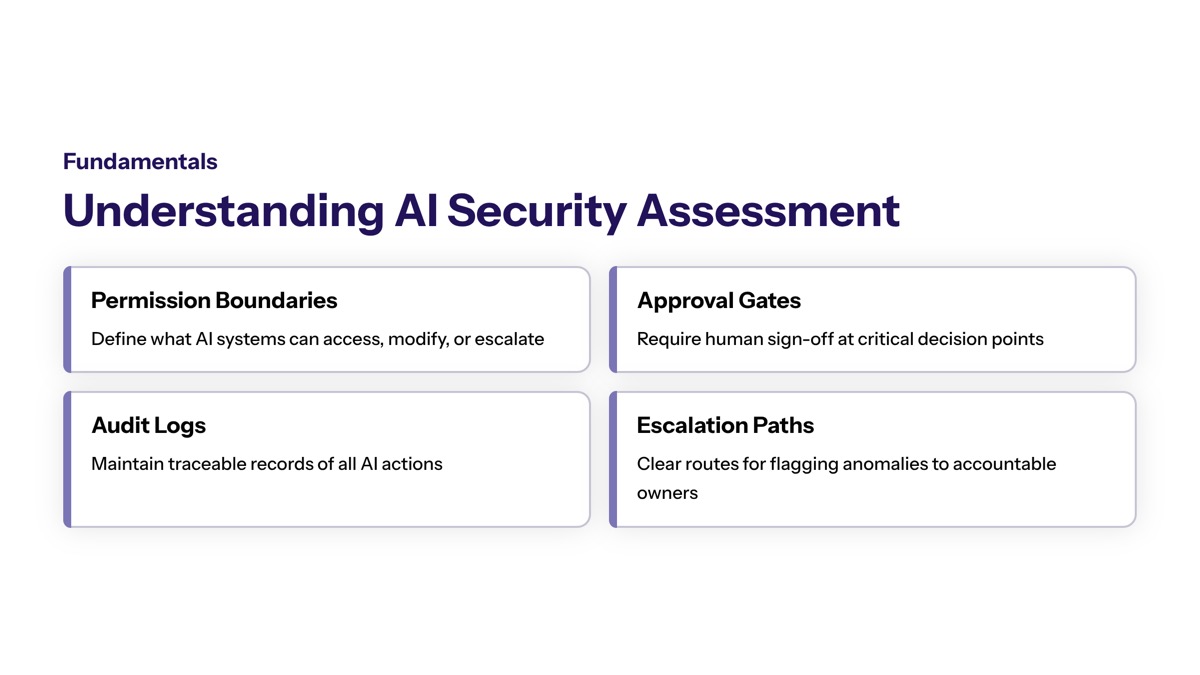
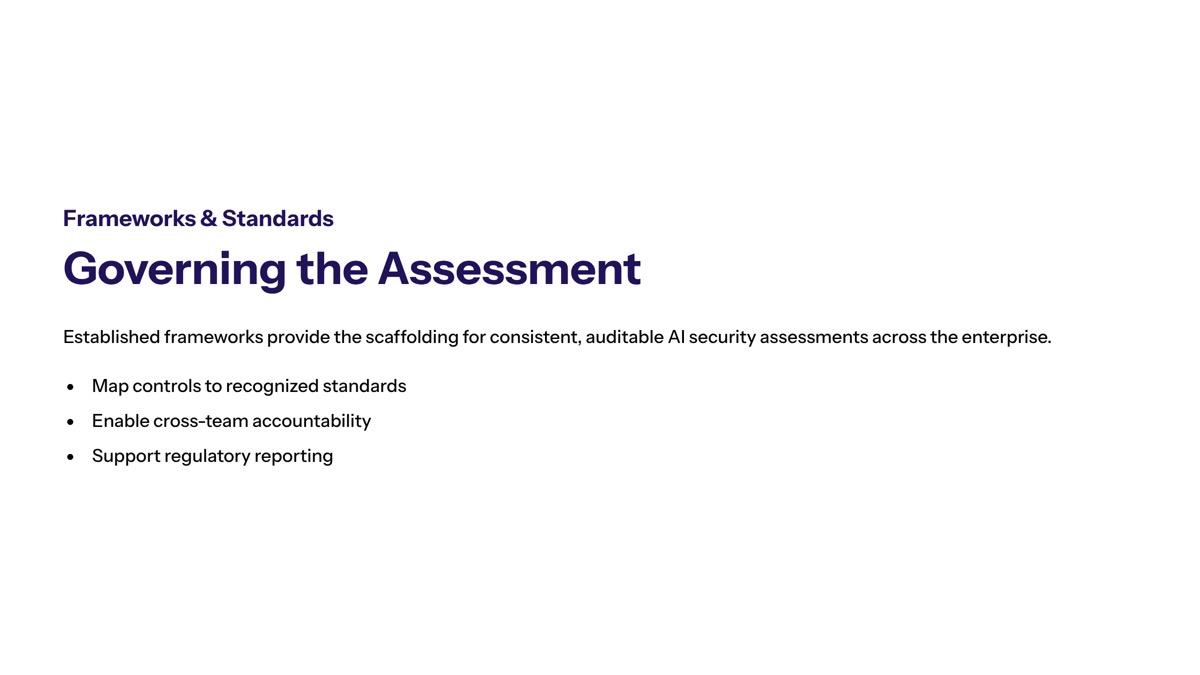
Selecting the right framework depends on organizational maturity, regulatory obligations, and the specific AI threats most relevant to your industry. Most enterprises benefit from combining multiple frameworks-using one for governance structure, another for technical threat modeling, and industry-specific guidelines for compliance alignment.
NIST AI Risk Management Framework
The NIST AI RMF organizes risk management into four core functions, each broken into categories and subcategories with suggested actions in its companion Playbook :
-
Govern establishes policies, oversight structures, risk tolerance thresholds, AI system inventories, roles, and decommissioning plans
-
Map defines context-intended uses, risk scenarios, stakeholders, and the legal environment surrounding each AI system
-
Measure quantifies risks through benchmarks and metrics for trustworthiness characteristics including fairness, robustness, and transparency
-
Manage covers risk treatments, incident response, continuous monitoring, and prioritization of control implementation
For mid-market organizations, the framework's flexibility is its greatest strength. It integrates with existing enterprise risk management processes rather than requiring a parallel governance structure. NIST has also published a Generative AI Profile (AI-600-1) addressing risks specific to large language models and generative AI solutions, and is developing a profile for critical infrastructure AI deployments.
MITRE ATLAS and Threat Modeling
MITRE ATLAS is a living knowledge base that captures adversary tactics, techniques, and mitigations specific to AI systems across the AI lifecycle. It currently enumerates 15 tactics, approximately 173 techniques, and roughly 35 mitigations-far exceeding the AI coverage of the traditional ATT&CK framework. The Spring 2025 update alone added 19 new techniques addressing emerging threats like RAG poisoning, LLM prompt obfuscation, and model tampering via supply chain attacks.
ATLAS provides the technical foundation for threat modeling AI systems and data pipelines. Security teams use it to map potential attack vectors across every stage-data ingestion, training, deployment, inference, and supply chain-creating threat models that identify where security controls are needed. MITRE's collaboration with Microsoft has extended ATLAS coverage to generative AI vulnerabilities, with documented case studies including prompt injection via ChatGPT plugins and poisoned models distributed through public model hubs.
The SAFE-AI framework bridges ATLAS and NIST SP 800-53 Rev. 5 by mapping ATLAS threat techniques to specific security controls. This enables organizations to systematically select and validate comprehensive controls against AI-specific threats-including adversarial inputs, bias, supply chain risks, and privacy leakage-while maintaining residual risk discussions that inform resource allocation.
Industry-Specific Guidelines
Different requirements apply across regulated sectors. Healthcare organizations must address HIPAA, PHIPA (in Canada), and FDA guidance for AI/ML-based medical devices, which require validated clinical performance, model drift detection, data provenance, and explainability when AI decisions affect patient care. Financial services face fair lending laws (ECOA), AML/KYC requirements, and regulatory expectations from bodies like OSFI, FCA, and the SEC-all demanding transparency, bias testing, and robust audit trails for AI-powered decision making.
|
Framework |
Type |
Best For |
Certifiable |
|---|---|---|---|
|
NIST AI RMF |
Voluntary governance framework |
Building internal AI risk programs |
No |
|
ISO/IEC 42001 |
Management system standard |
EU AI Act alignment, formal certification |
Yes |
|
MITRE ATLAS |
Technical threat knowledge base |
Threat modeling, red teaming |
No |
|
SAFE-AI |
Control-mapping framework |
Linking threats to specific technical controls |
No |
|
HITRUST AI Assessment |
Harmonized control framework |
Healthcare and regulated industries |
Yes |
AI security controls should align with NIST and ISO standards, but framework selection ultimately maps to your organization's regulatory exposure, technical maturity, and industry context. Most enterprises find that combining a governance framework (NIST AI RMF or ISO 42001) with a technical threat framework (MITRE ATLAS) and industry-specific guidance produces the most effective coverage.
With frameworks selected, the next step is translating them into a structured assessment process.
Structured Assessment Implementation Process
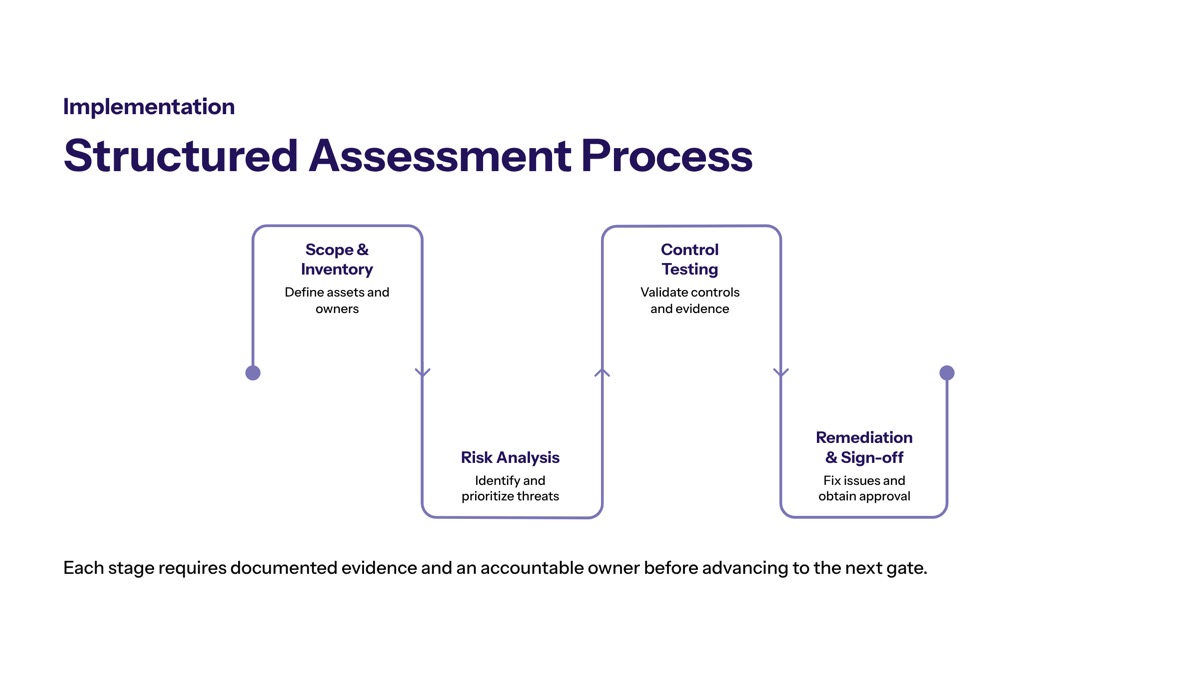
AI security assessments follow a six-phase evaluation framework for effective evaluation: scoping, asset discovery, threat modeling, testing, risk scoring, and remediation planning. Governance frameworks must complement AI security controls for effective deployment-frameworks tell you what to assess, but the implementation process determines how effectively you identify and address risks.
Assessment Planning and Scoping
Comprehensive assessment is needed when deploying AI into production environments, validating model behavior before release, preparing for regulatory compliance, or responding to a security incident. Focused evaluations may suffice for lower-risk AI usage or incremental model updates.
-
Define assessment objectives and success criteria. Establish what the assessment must achieve-whether that's zero critical vulnerabilities before AI deployment, compliance scoring thresholds for the EU AI Act, or bias measurement below defined limits. Success criteria must be measurable and tied to business outcomes.
-
Inventory AI assets, models, and data pipelines. Asset discovery is vital for mapping all AI assets within an organization. Catalog every AI system in use or planned: proprietary and third-party AI models, datasets, inference endpoints, APIs, agents, and AI platform dependencies. This inventory becomes the foundation for risk calculation across the entire AI ecosystem.
-
Establish assessment team roles and responsibilities. AI assessments require multidisciplinary teams: data scientists, security engineers, ML engineers, legal and compliance officers, privacy experts, and product owners. Consider whether external red teaming or specialized AI security consultants are needed for adversarial testing capabilities your team may lack.
-
Set timeline and resource allocation. Plan phases for initial inventory, threat modeling, testing, and remediation. Allocate budget for adversarial testing tools, code review, explainability analysis, and remediation execution. Establish periods for periodic reassessment-quarterly cycles are becoming industry standard for organizations with active AI deployments.
Assessment Execution Methods
AI security assessments require a six-phase cycle for effective evaluation, with execution methods varying based on organizational maturity and risk profile:
|
Method |
Focus Area |
When to Use |
Resource Intensity |
|---|---|---|---|
|
Threat modeling (MITRE ATLAS) |
Attack vector mapping across AI lifecycle |
Every assessment; foundational step |
Medium |
|
Adversarial testing / red teaming |
Prompt injection, data poisoning, API abuse |
Pre-deployment and periodic reviews |
High |
|
Bias and fairness testing |
Disparate impact, protected class analysis |
AI systems affecting decisions about people |
Medium |
|
Explainability audits |
Traceability of outputs, failure mode documentation |
Regulated or high-impact AI systems |
Medium |
|
Supply chain audits |
Model provenance, dataset verification, dependencies |
Any use of third-party or open-source AI models |
Medium |
|
Vulnerability scanning |
Secure code review, API security, access controls |
Every assessment as baseline |
Low–Medium |
Evaluating supply-chain risks is important in securing AI models and data-organizations using pre-trained models or open-source datasets must verify cryptographic signatures, check model provenance, and assess whether dependencies introduce latent vulnerabilities. A recent case demonstrated this when a provincial hospital deploying a RAG-based clinical decision support tool embedded identity access controls aligned with source documents and ran adversarial testing focused on indirect prompt injection as part of its assessment process.
Utility metrics for AI systems should include attack success rates and unauthorized actions. When enterprise AI systems are tested under adversarial conditions, research shows that 90% could be breached within 90 minutes -underscoring why adversarial testing is not optional.
Risk Scoring and Prioritization
A risk-based remediation plan prioritizes findings based on various factors including likelihood, business impact, regulatory exposure, and feasibility of mitigation. AI-specific risk matrices should account for:
-
Business impact : revenue disruption, customer data exposure, regulatory fines, reputational damage
-
Trustworthiness dimensions : robustness against adversarial attacks, fairness across protected classes, reliability, and transparency
-
Residual risk : what remains after existing controls are applied, which maps risks to where additional investment produces the greatest risk reduction
Access controls protect AI systems from unauthorized access and should be evaluated alongside model-level vulnerabilities. Role based access to model training environments, inference APIs, and data pipelines prevents unauthorized modifications that could compromise model integrity.
Teams should use control mapping-linking identified threats (via MITRE ATLAS) to specific controls (NIST SP 800-53, ISO 42001, HITRUST's up to 44 tailored controls)-to ensure coverage and estimate control efficacy. This structured approach enables confident resource allocation and clear accountability for remediation.
Common Challenges and Practical Solutions
Even organizations with mature security programs encounter significant obstacles when executing AI security assessments. These challenges reflect the novelty of AI-specific threats and the organizational complexity of governing AI across enterprise environments.
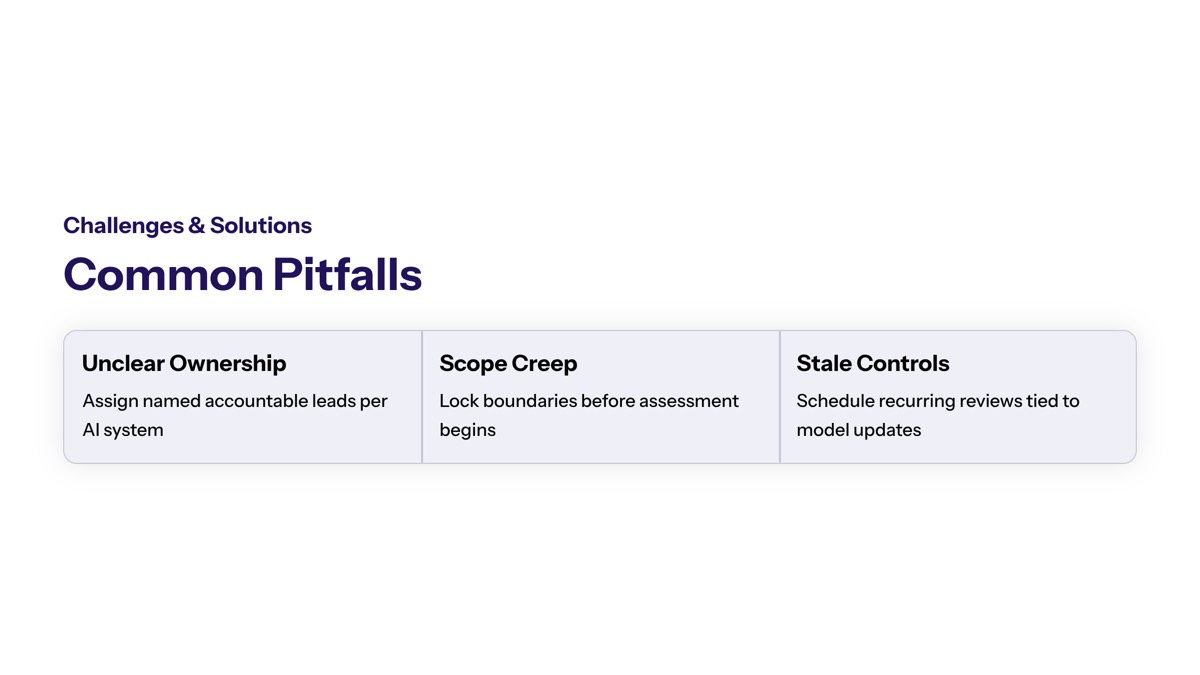
Incomplete AI Asset Inventory
Shadow AI-department-level models, unapproved SaaS integrations, open-source toolkits deployed without IT oversight-is pervasive. Many organizations simply do not know all the AI systems in use across the enterprise. Implement automated discovery tools (model registries, code scanning, SaaS inventory platforms) and establish mandatory AI project registration processes. Without a complete inventory, you cannot evaluate AI systems comprehensively, and compliance gaps will persist undetected. The scale of the problem is significant: phishing attacks increased by 1,265% due to generative AI, and 40% of all email threats are now AI-enabled-meaning unauthorized AI tools introduce risk far beyond the AI systems themselves.
Lack of AI-Specific Security Expertise
Traditional cybersecurity professionals may lack expertise in adversarial ML, prompt engineering, data bias analysis, or model drift detection. Engage specialized AI security consultants and invest in team training on emerging AI threats. Cross-training security engineers on ML fundamentals and data scientists on security principles builds internal capacity. Collaborative initiatives like contributing to MITRE ATLAS case studies also accelerate institutional learning.
Balancing Security with AI Performance
Hardening AI systems often introduces computational cost, latency, and reduced accuracy. Input sanitization, differential privacy, adversarial training, and content filtering all impact model performance. Adopt a risk based approach: critical and high-impact AI systems-those affecting customer data, financial decisions, or health outcomes-receive strict controls and human oversight, while lower-risk AI usage can accept lighter defenses. This calibration maintains stakeholder trust without unnecessarily constraining AI solutions. Best practices include adopting a zero-trust model and continuous monitoring to detect anomalies without degrading inference performance.
Keeping Pace with Rapid AI Evolution
New threat categories emerge faster than most organizations can update their threat models-agentic AI behavior, LLM jailbreaks, novel supply chain attacks , and RAG poisoning are all recent developments. Establish quarterly assessment cycles and continuous monitoring for new AI deployments. Subscribe to threat intelligence feeds (MITRE ATLAS updates, NIST publications), participate in industry information-sharing groups, and build post-market monitoring into every AI deployment. AI assessments should be continuous throughout the AI lifecycle, not treated as one-time compliance exercises.
Organizations that treat these challenges as operational realities rather than obstacles to avoid will build assessment programs that scale with their AI adoption.
Conclusion and Next Steps
AI security assessment is the foundation of safe, compliant, and resilient enterprise AI adoption. The threat landscape is distinct from traditional cybersecurity-adversarial attacks, model poisoning, prompt injection, supply chain compromise, and bias amplification all require specialized evaluation methods, dedicated frameworks, and ongoing vigilance. With the EU AI Act enforcement timeline approaching and regulatory scrutiny intensifying globally, organizations that delay establishing structured AI security practices face compounding risk.
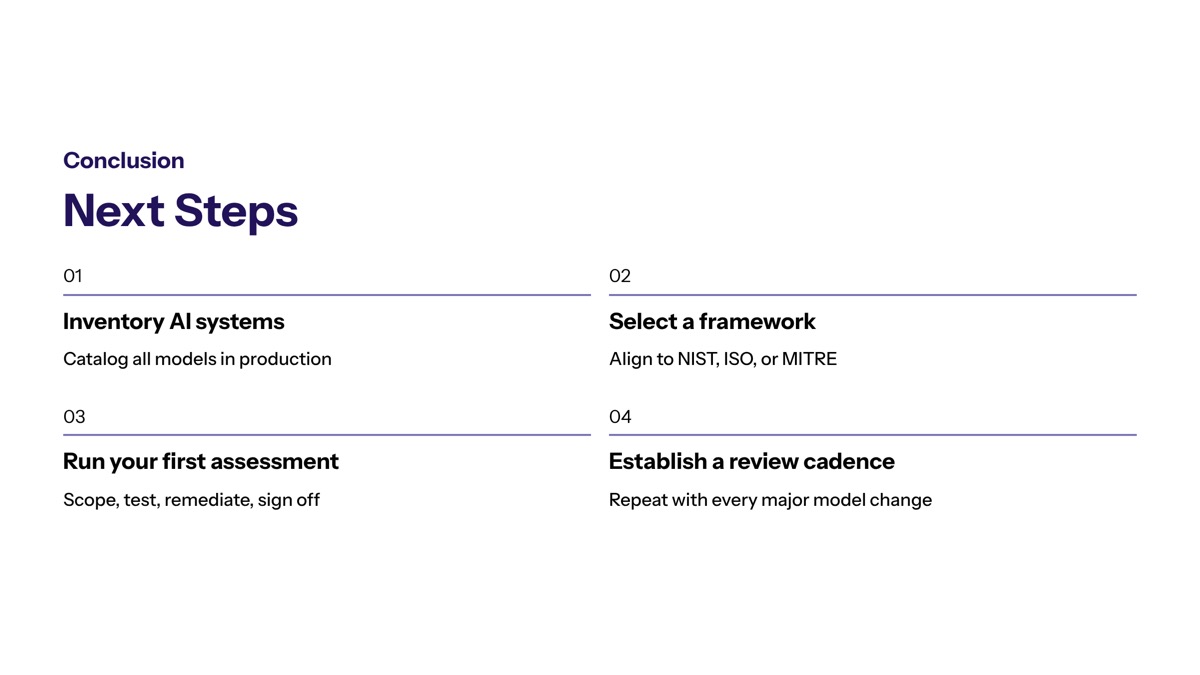
To begin building or strengthening your AI security assessment capability:
-
Conduct a comprehensive AI asset inventory covering all AI models, data pipelines, inference endpoints, third-party dependencies, and AI software across the organization
-
Select and combine appropriate assessment frameworks -pair a governance framework like NIST AI RMF or ISO/IEC 42001 with technical threat modeling via MITRE ATLAS for comprehensive coverage
-
Engage a qualified assessment team with AI-specific security expertise, whether internal, external, or a combination, and define clear accountability for findings and remediation
For organizations building broader AI governance programs , security assessment is one critical component alongside governance implementation, continuous monitoring infrastructure, and incident response planning tailored to AI-specific scenarios.
Additional Resources
-
NIST AI Risk Management Framework (AI RMF 1.0) - Core documentation and companion Playbook for operationalizing AI risk management
-
MITRE ATLAS - Knowledge base of adversary tactics, techniques, and mitigations for AI systems, updated regularly with new threat intelligence
-
SAFE-AI Framework - Control-mapping framework linking MITRE ATLAS threats to NIST SP 800-53 Rev. 5 security controls
-
EU AI Act High-Risk System Guidelines - Official guidance on compliance obligations and enforcement timelines
-
AI Governance Frameworks for Real-Time Risk and Compliance - Practical guidance for integrating governance with AI security assessments