Enterprise AI Governance: Decision Rights, Controls, and Evidence
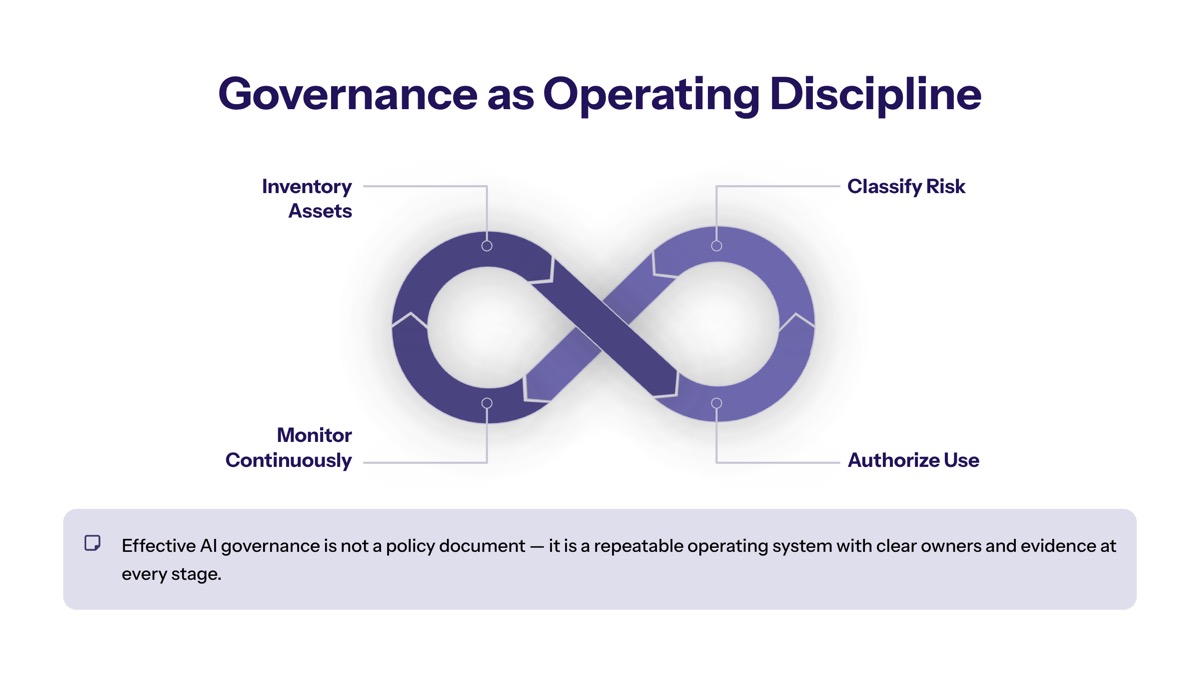
Enterprise AI governance is an operating system that determines who decides what, which evidence is required, when specialist review is needed, and how the organization responds when conditions change. It is not a policy document filed and forgotten. It is a set of decision rights, risk tiers, evidence packages, monitoring protocols, and escalation paths that connect AI adoption to organizational accountability.
This guide covers practical governance frameworks for mid-market and enterprise teams deploying AI systems across business units. It addresses decision-rights structures, risk classification, evidence requirements, monitoring, exception management, and minimum viable governance artifacts. It does not constitute legal, regulatory, privacy, or compliance advice.
The audience includes technology, operations, security, risk, legal, and governance stakeholders in organizations where AI usage spans multiple teams, vendors, and risk levels.
Enterprise AI governance transforms broad ethical principles into explicit decision rights, risk tiers, evidence requirements, monitoring protocols, and escalation paths that named individuals own and execute.
After reading this guide, you will be able to:
-
Distinguish governance principles from operational decision frameworks
-
Build a risk classification system tied to approval authority and evidence thresholds
-
Define decision rights for every stage of the AI lifecycle
-
Establish monitoring, incident response, and exception-management workflows
-
Implement a minimum viable enterprise AI governance framework without creating approval bottlenecks
What Enterprise AI Governance Means in Practice
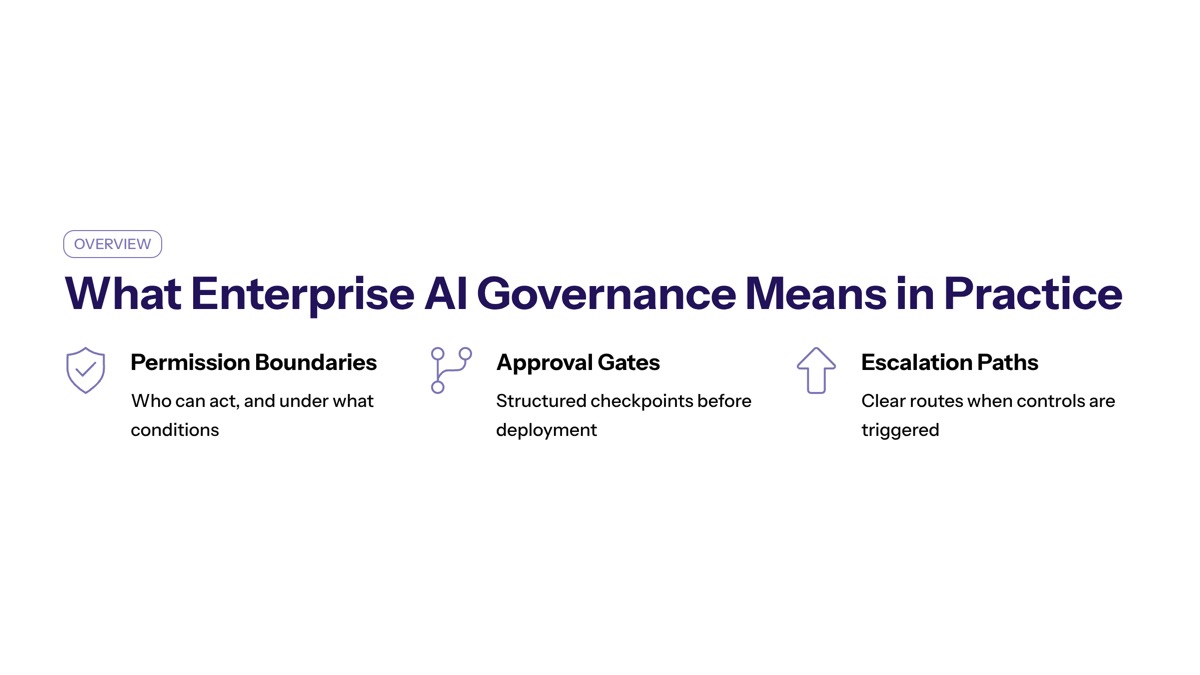
AI governance is a decision-making authority and accountability structure. It specifies who approves a use case, who accepts residual risk, what evidence must exist before deployment, and who responds when an AI system behaves unexpectedly. Governance frameworks such as Helixar's layered model organize this into five operational layers: principles and risk appetite, written policy, lifecycle controls, runtime enforcement, and evidence and assurance.
This structure differs from publishing an acceptable-use policy. A policy expresses intent. A governance framework assigns decision rights to named roles, sets evidence thresholds per risk tier, and defines escalation paths for disagreements or missing information. The distinction matters because 40% of technology executives believe their AI governance is insufficient, according to recent industry surveys, which suggests that many organizations have policies but lack operational decision frameworks.
Governance operates across the entire AI lifecycle. It covers intake and classification of new AI projects, approval and deployment, ongoing monitoring, change management, and retirement. Each stage has defined accountable owners, required contributors, and evidence artifacts. Integration into existing enterprise governance mechanisms (security, privacy, vendor risk, legal) is required; AI governance cannot function as an isolated committee without real decision authority.
Ethical accountability in AI governance clarifies ownership and decision-making responsibilities. Without this clarity, accountability gaps emerge: no one owns the decision to deploy, no one owns the monitoring, and no one owns the response when the system produces harmful outputs. Explicit accountability in AI governance clarifies ownership for harmful AI decisions, which is the operational foundation every subsequent governance control depends on.
Why Policies Alone Do Not Govern AI
Policies define acceptable AI usage, data handling standards, and model development guidelines. They do not define who has authority to approve or reject a specific use case, pick a vendor, accept residual risk, or halt a deployment. Without decision rights, policies are advisory. Teams interpret them differently, and in practice, many AI initiatives proceed without the reviews that policy language requires.
Real-time, high-stakes situations expose this gap. When a model shows bias drift, when training data is compromised, or when a third-party AI tool processes data outside its approved scope, someone must decide what to do within hours, not weeks. Static policy documents lack the escalation paths, evidence triggers, and exception workflows needed for these situations. The Simaba Governance Playbook defines governance as a "decision and evidence service," requiring organizations to specify which evidence and affected-party input is required, and how quickly the decision must be made.
The audit gap compounds the problem. Large organizations frequently have policies but cannot produce, on demand, evidence that any specific system was built, tested, logged, and supervised as those policies require. Ensuring transparency and explainability is crucial for stakeholder understanding of AI decisions, but this requirement is unmet when governance stops at the policy layer. AI governance requires continuous monitoring and policy updates; policies themselves should be reviewed quarterly to remain relevant.
Good governance can paradoxically speed up the deployment of AI across organizations. When approval paths are clear and evidence requirements are known in advance, teams spend less time negotiating with governance bodies and more time building. The obstacle to speed is ambiguity, not oversight.
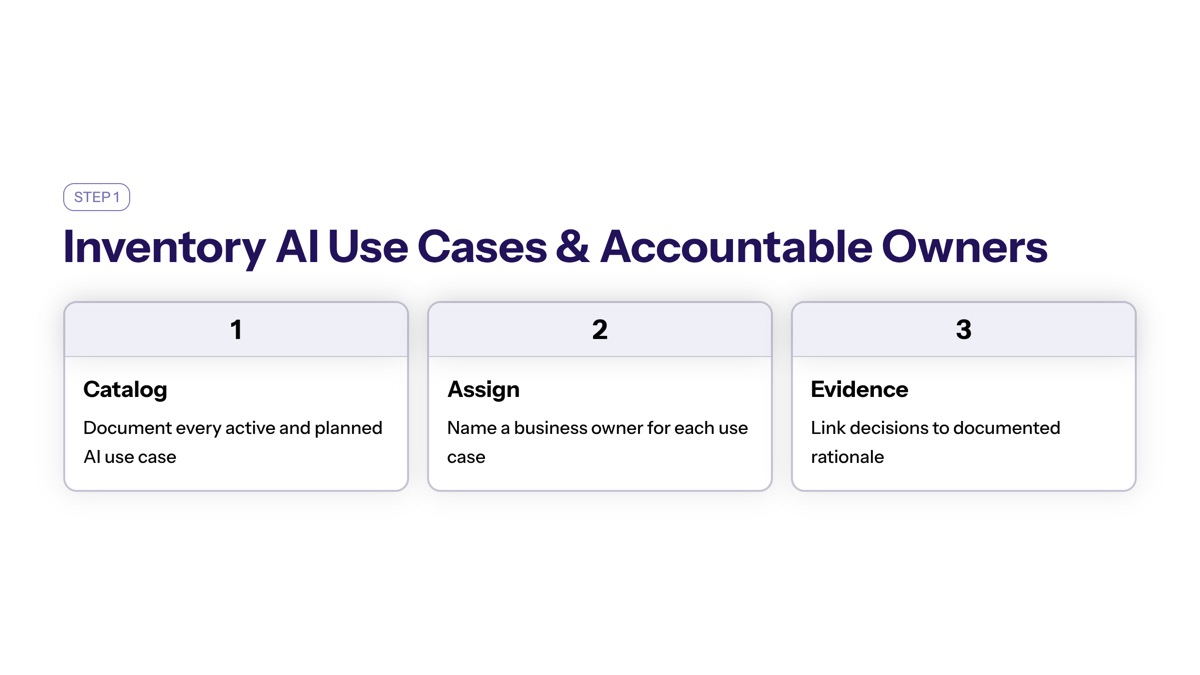
Establish an Inventory of AI Use Cases and Accountable Owners
A comprehensive AI inventory should document all AI usage. This includes AI tools built internally, AI models embedded in third-party SaaS platforms, and shadow AI, meaning unvetted tools adopted by individual teams without security or legal review. Organizations that begin formal inventory work routinely discover embedded AI features in SaaS products that were never reviewed by security or legal.
For each use case, document the following:
-
Purpose and scope : What business objective does this AI system serve? What decisions does it support or automate?
-
Data sources : What training data and operational data does it consume? What consent or legal basis exists?
-
Model type and vendor : Is it a proprietary model, open-source model, or vendor-provided API? What are the known limitations?
-
Level of autonomy : Does the system make automated decisions, or does it support human review?
-
Current controls : What security controls, access controls, and data governance measures are already in place?
-
Regulatory relevance : Does this use case fall under data protection regulations, sector-specific rules, or the EU AI Act?
Assign named business and technical owners for every AI system. The business owner defines value, risk tolerance, and acceptable use boundaries. The technical owner manages build, integration, monitoring, and incident response. Additionally, designate data stewards, security reviewers, and compliance/legal reviewers. Accountability means named individuals; someone specific answers for incidents, evidence gaps, and compliance questions. AI governance requires cross-functional ownership and accountability across the organization.
Organizations should maintain an inventory of all deployed AI systems for governance and auditing. Set a regular review cadence, quarterly or semi-annual, to update the inventory when model behavior changes, vendor contracts change, data sources shift, or systems are retired. Maintaining comprehensive data lineage ensures data integrity and compliance with privacy laws.
Classify Use Cases by Consequence and Risk
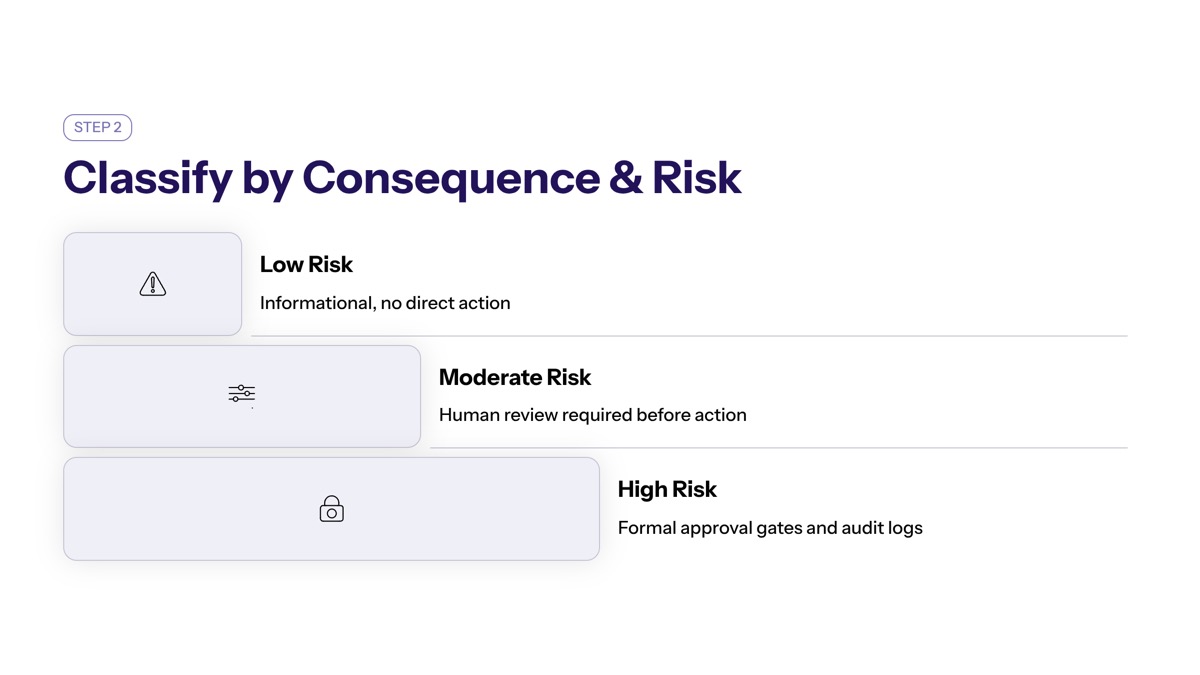
Risk classification connects each AI system to the governance controls it requires. A three-tier framework, high-impact, medium-impact, and low-impact, provides enough differentiation without creating bureaucratic complexity.
Classification criteria
Apply the following factors during initial risk assessment:
-
Regulatory exposure : Does the system operate in healthcare, financial services, employment, or another regulated domain? The EU AI Act defines specific high-risk categories. The FDA regulates AI/ML-enabled medical devices under specific guidelines. U.S. sectoral regulators apply existing frameworks to AI compliance.
-
Data sensitivity : Does the system process personal data, patient records, trade secrets, or protected categories? Does it require compliance with GDPR (where fines can reach €20 million or 4% of global revenue) or other data protection laws?
-
Automation level : Does the system make decisions autonomously, or does it provide recommendations for human oversight? Human-in-the-loop oversight is vital for critical decisions in sensitive domains like healthcare.
-
Individual impact : Can the system's outputs affect an individual's rights, livelihood, credit, or access to services?
-
Scale and reversibility : How many people does it affect, and can harm be reversed?
Alignment with external frameworks
AI governance should align with recognized frameworks like NIST AI RMF and ISO/IEC 42001. The NIST AI Risk Management Framework provides a comprehensive taxonomy of AI risks organized around four functions: Govern, Map, Measure, and Manage. ISO/IEC 42001:2023 establishes the first AI Management System framework and is eventually certifiable. Organizations operating across multiple jurisdictions need governance structures that accommodate regulatory variation; the SCITUS framework (a Canadian adaptation) expanded from 31 to 57 controls between versions v1.0 and v2.0 in mid-2026, reflecting how evolving regulation drives more detailed control requirements.
Document the classification rationale for each AI system: which criteria applied, what factors determined the tier, and what conditions would trigger reclassification. A tiered risk framework helps scale approval requirements based on AI use case risk, ensuring high risk AI systems receive proportional scrutiny while low-risk AI tools move through lighter approval paths.
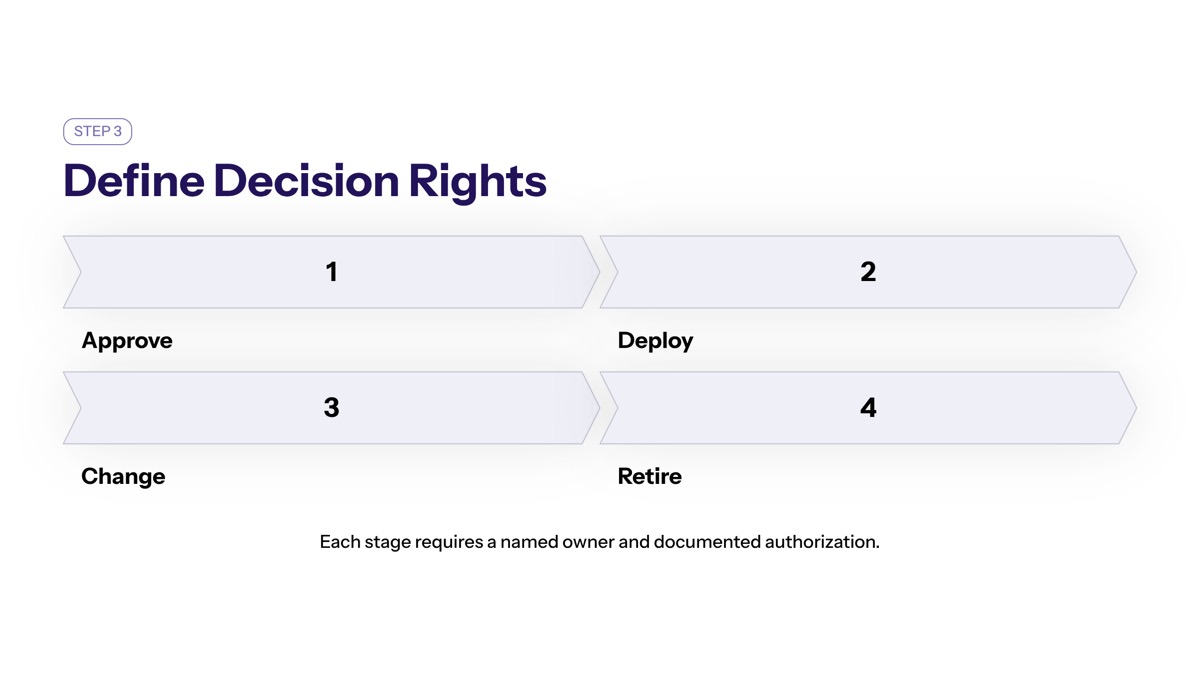
Define Decision Rights for Approval, Deployment, Change, and Retirement
Decision rights specify who is accountable for each type of governance decision, who must contribute, what evidence is required, and what happens when the standard path fails. The following table provides a reference structure:
|
Decision |
Accountable Owner |
Required Contributors |
Required Evidence |
Approval Threshold |
Escalation Path |
Review Trigger |
|---|---|---|---|---|---|---|
|
Approve new use case |
Use case owner |
Security, privacy, legal, business unit lead |
Risk assessment, purpose statement, data sources |
Low risk: team lead; High risk: AI governance committee + legal |
Missing evidence or high residual risk escalates to executive leadership |
Scope change, new data source, regulatory change |
|
Select vendor or model |
Technical owner |
Security, procurement, legal |
Vendor due diligence, model provenance, known limitations |
Low risk: technical lead; High risk: governance committee |
Vendor non-compliance or unresolved IP questions |
Contract renewal, vendor policy change |
|
Deploy to production |
Technical owner + business owner |
Security review, privacy impact assessment, QA |
Pre-deployment evidence package (see next section) |
Low risk: delegated authority; High risk: committee sign-off |
Failed security or fairness review |
Material change to model or data |
|
Change model or data |
Model owner |
Security, privacy, data steward |
Change impact assessment, updated risk classification |
Material change: full governance review; Minor change: technical lead |
Reclassification to higher risk tier |
Change in autonomy level, jurisdiction, or population served |
|
Retire system |
Business owner |
Technical owner, data steward, legal |
Data retention plan, dependency analysis, rollback documentation |
Business owner with governance notification |
Active dependencies or regulatory retention requirements |
System replacement, vendor discontinuation |
Approval workflows by risk tier
Low-risk ai initiatives (internal productivity tools, summarization aids) follow a lightweight path: team lead approval, basic documentation, standard access controls. High-risk ai systems (automated lending decisions, clinical decision support, employment screening) require governance committee review, executive visibility, and pre-deployment evidence packages that include bias testing, fairness analysis, and legal review.
Change management
Model updates, data additions, vendor replacements, and scope expansions require change control. Material changes, such as moving from decision support to automated decisioning, adding data from a new jurisdiction, or expanding the user population, should trigger full governance review and potential reclassification. AI governance frameworks must address evolving regulatory requirements; a model approved under one set of conditions may no longer meet requirements after regulatory changes.
Retirement procedures
Retirement decisions specify data retention obligations, decision-log archival, model-artifact preservation, and dependency removal. A rollback plan should exist for every production AI system. Governance in AI must encompass data usage, risk management, and compliance throughout the lifecycle, including the end of that lifecycle.
Set Boundaries for Data, Models, Vendors, Integrations, and User Access
Governance processes define approved boundaries for what data, models, vendors, integrations, and users may interact with AI systems. These boundaries convert organizational values and risk tolerance into enforceable rules.
Data governance boundaries
Define which dataset types are permitted for each risk tier. Specify consent requirements, legal basis for processing, data retention periods, and destruction procedures. Data quality standards should cover accuracy, completeness, timeliness, and bias detection in training data. Prompt filtering prevents sensitive data from being processed by AI, and data loss prevention (DLP) solutions protect sensitive information from leaking through AI interactions.
Model and vendor boundaries
Model selection criteria should address provenance, known limitations, licensing, intellectual property, and adversarial risk. For generative ai, additional controls cover prompt hygiene, context management in retrieval-augmented generation, and output filtering. Vendor assessments require documented performance claims, bias testing results, and security posture. Rigorous model validation prevents bias and ensures the accuracy of AI systems.
Integration and access controls
Access controls enforce role-based access to AI tools. API access management follows least-privilege principles with identity verification. Comprehensive audit logging captures detailed AI interaction logs, including who accessed which system, when, and what data was processed. Managed gateways centralize AI traffic and enforce compliance with monitoring and logging. Periodic access reviews ensure permissions remain appropriate as roles change.
Organizations implementing secure development practices should extend those controls to AI system integrations, applying the same security controls to AI components as to other production software.
Define Evidence Required Before Production Use
Pre-deployment evidence packages ensure that AI decisions about readiness are based on documented facts, not assumptions. Evidence requirements scale with risk classification.
Pre-deployment evidence by risk tier
All tiers require: purpose documentation, data source inventory, model type and version, access control configuration, basic performance metrics, and named accountable owners.
Medium-risk additions : privacy impact assessment, security review, bias and discrimination testing on production-representative data, explainability documentation, and vendor due diligence (for third-party ai models).
High-risk additions : fairness testing across protected categories, adversarial and robustness testing, regulatory compliance assessment, model cards with known limitations, simulation of failure modes, and executive or board-level visibility. Governance should begin before development to ensure responsible AI lifecycle management.
Approval records
Sign-offs from required reviewers (security, privacy, legal, architecture) must be documented with timestamps and conditions. Conditions might include geographic restrictions ("only used in region X"), data exclusions ("input data must exclude sensitive features"), or monitoring requirements. Clear AI policies should detail acceptable use cases and standards for fairness and accountability.
Quality assurance evidence
Define accuracy, fairness, and robustness thresholds before testing. Create test results on production-like data. The GAIE (Governed AI-Assisted Engineering) framework demonstrates that structured oversight tiers can preserve about 91% of agentic coding velocity while maintaining compliance evidence for regulated functions, showing that evidence collection does not require abandoning speed. Establishing clear governance objectives is crucial for success; evidence requirements that are known in advance eliminate post-hoc scrambling.
Monitor Quality, Incidents, Exceptions, and Material Changes
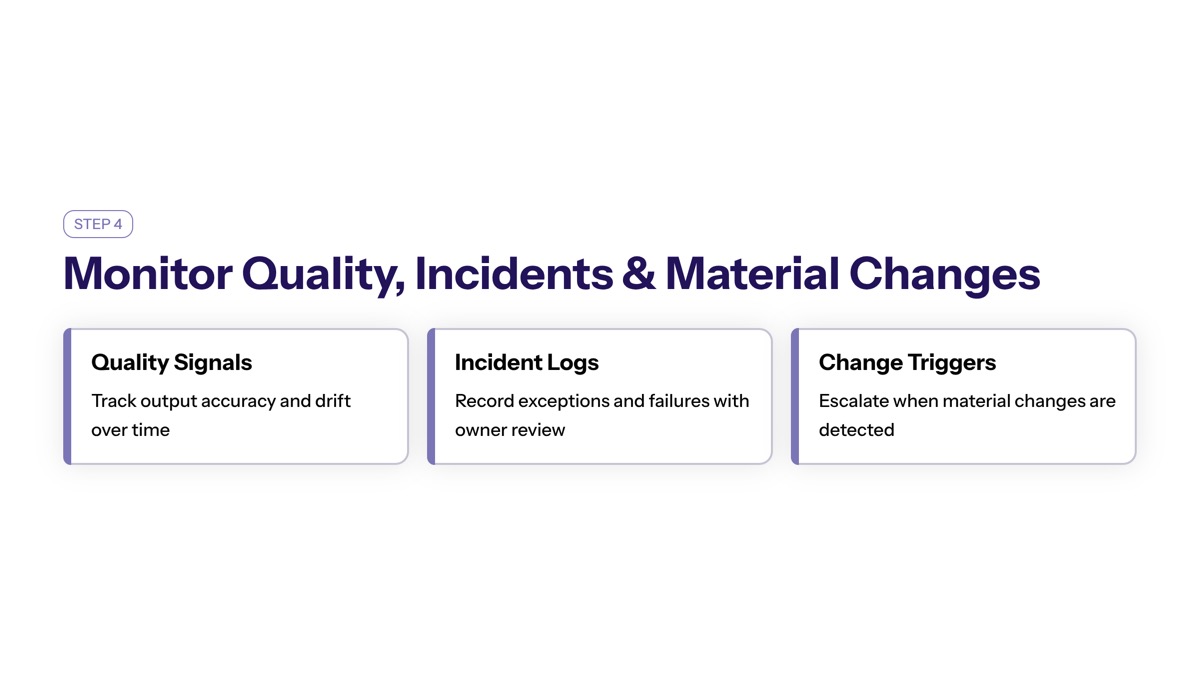
Continuous monitoring of AI systems is necessary to ensure ongoing compliance and performance. Monitoring turns a point-in-time approval into an ongoing assurance mechanism.
Performance and drift monitoring
Track model accuracy, precision, recall, and false-positive/negative rates over time. Monitor data drift (statistical shifts in input distributions) and concept drift (changes in the relationship between inputs and outcomes). Establish thresholds that trigger human review; for example, when accuracy drops below the benchmark established during pre-deployment testing, or when input distributions shift beyond a defined statistical boundary.
AI governance reduces operational penalties by identifying risks like algorithmic bias and data leakage before they cause financial outcomes or reputational damage. 99% of organizations reported financial losses from AI-related risks, which underscores why ongoing monitoring is not optional.
Incident response
Define what constitutes an incident: data breach involving AI-processed information, model misuse, unexpected outputs causing user harm, or regulatory violation. For each incident type, specify notification requirements, remediation steps, root-cause analysis procedures, and rollback capabilities. High risk ai systems should include the ability to halt operation and revert to a known-good state. AI governance aids in maintaining brand reputation by preventing public relations issues from AI errors, but only when incident response procedures exist and are exercised.
Exception tracking
Any AI system operating outside standard governance (experimental pilot under lighter controls, use of a non-approved vendor, temporary data access expansion) must have a documented exception. The exception register captures scope, duration, risk accepted, mitigating controls, and the named individual who accepted the risk. Exception tracking prevents informal workarounds from becoming permanent shadow ai practices.
Material change triggers
Changes in scope, datasets, jurisdictions, vendor relationships, or autonomy level should re-trigger governance review. Otherwise, prior approvals may no longer reflect actual risk. Policies guide AI development and usage across organizations, but those policies are only effective when material changes trigger reassessment.
Create Escalation and Exception-Management Paths
Escalation rules define what happens when standard governance processes cannot produce a clean decision. Missing evidence, disagreement among reviewers, high residual risk, regulatory exposure, or safety concerns should all trigger escalation to higher authority.
Escalation procedures
Specify who escalates to whom. For a high-risk AI system with unresolved bias concerns, the escalation path might move from the technical reviewer to the AI governance committee to executive leadership. For a medium-risk system with missing vendor documentation, the path might move from the procurement reviewer to the vendor risk lead. Each path should have a defined response timeline.
Cross-functional AI governance boards enhance accountability and define roles in AI projects. An AI governance committee with representatives from technology, legal, risk, security, and business units can resolve disputes that single-function reviewers cannot. Establishing an AI Ethics and Governance Board improves oversight of high-risk AI deployments.
Exception management
Exceptions follow a structured process: request, review, conditional approval with time bound, documented mitigating controls, and automatic expiration. Exceptions must not become de facto policies. If the same exception is requested repeatedly, it signals that governance controls need updating, not that exceptions should be permanent.
Risk acceptance authority must be defined by tier. For high-risk systems, only senior executives or the governance committee can accept residual risk. For lower-risk systems, business or technical leads may accept risk within defined parameters. The EU AI Act introduces fines up to €35 million for non-compliance, and GDPR fines can reach €20 million or 4% of global revenue; risk acceptance at the wrong level creates personal and organizational exposure.
Maintain Governance Records Without Creating Unnecessary Bureaucracy
Over-documentation kills governance adoption. Applying the same evidence requirements to a low-risk internal summarization tool and a high-risk automated lending model creates friction that drives teams toward shadow ai rather than compliance. Effective policies address data handling and model development standards, but they must be proportional.
Proportional documentation
Minimum evidence sets should vary by risk tier. A low-risk system might require only a registry entry, named owner, basic performance metrics, and access configuration. A high-risk system requires the full pre-deployment evidence package, ongoing monitoring reports, and incident response documentation. This proportionality is what distinguishes a practical ai governance framework from a bureaucratic one.
Automated record-keeping
Automate where possible: inventory tools that track deployed ai models, model cards generated from training pipelines, drift detection dashboards, API access logs, and vendor record management. Organizations with governance platforms are 3.4 times more likely to achieve high effectiveness in AI governance. Red Hat's recent ASAGO (AI Safety and Governance Orchestration) project represents the direction of AI governance tools : mapping policy requirements to runtime evidence and enforcing controls across model versions, data, and deployments.
Version control and audit trails
Audit trails for model artifacts, data changes, and governance decisions should use versioned repositories with immutable storage. When systems are retired, governance artifacts should be archived with the same retention schedule as the system's operational data. Comprehensive audit logging captures detailed AI interaction logs, providing the evidence base that governance depends on.
Minimum Viable Enterprise AI Governance Framework
A minimum viable enterprise ai governance framework does not require custom software or a new department. It requires decisions about who owns what, documented in forms that can be audited.
Essential governance artifacts
-
AI use-case inventory with business and technical owners identified for every system
-
Risk classification for every use case, with documented rationale
-
Approved boundaries for data, vendors, model types, integrations, and user access
-
Pre-deployment evidence records scaled by risk tier
-
Monitoring and incident management plan with defined thresholds and response procedures
-
Exception register with time-bound approvals and mitigating controls
-
Change-review triggers that specify which modifications require governance re-review
-
Retirement and rollback plans for every production system
Core roles
-
AI governance committee : defines risk appetite, approves high-risk deployments, oversees governance controls, and resolves escalations. The question of who owns ai governance at the organizational level typically falls to this body, led by a chief ai officer or equivalent executive.
-
Use case and model owners : named individuals accountable for individual ai systems, their performance, their evidence, and their compliance status.
-
Technical reviewers : security, privacy, legal and regulatory, vendor risk specialists who contribute to decisions without owning them.
-
Evidence owners : maintain governance artifacts and audit readiness for assigned systems.
Basic workflow
Intake → risk classification → evidence collection → approval (per risk tier) → deployment → ongoing monitoring → periodic review or retirement.
For low-risk systems, this workflow should complete in days. For high-risk systems, it may take weeks, with multiple reviewers and committee approval. Operational efficiency in AI governance streamlines adoption by establishing clear standards; teams that know the path can move through it faster.
Phased implementation
Start with high-risk systems. Identify the AI systems with the greatest regulatory exposure, individual impact, or data sensitivity. Apply full governance controls to those first. Extend governance to medium-risk and low-risk systems in subsequent phases. AI governance frameworks should be continuously monitored and improved; the framework itself is not static.
Success metrics
-
Time to approve use cases per risk tier (measure whether governance enables ai initiatives or blocks them)
-
Number of exceptions requested and average duration before resolution
-
Number of incidents tied to model drift, vendor issues, or governance gaps
-
Audit findings: evidence gaps discovered after the fact
-
Ratio of AI systems with named business and technical owners
-
Percentage of AI systems with current risk classification
Cross-disciplinary literacy among teams is essential for addressing ethical compliance in AI. Governance programs should include training for business units on governance processes, risk assessment criteria, and evidence requirements. Responsible ai practices require that everyone involved in ai development and deployment understands their role in the governance structure.
Governance Questions Leadership Should Answer Now
Executive leadership should be able to answer the following questions. If they cannot, governance gaps exist.
Decision authority : Who has approval rights for high-risk, medium-risk, and low-risk AI systems? Who can halt a deployment? Who accepts residual risk for ai agents and automated decision systems?
Evidence requirements : What documentation must exist before an AI system enters production? Does the organization have pre-deployment evidence packages defined for each risk tier?
Accountability structure : Who owns AI system outcomes? Who owns legal and regulatory risk? Who owns security? Who is responsible for ongoing monitoring and incident response? AI governance systems must include rules, checks, and controls to ensure AI safety and compliance.
Risk tolerance : What level of residual risk is acceptable for different business functions? Has the organization defined risk tolerance for responsible ai development, or is risk acceptance informal and inconsistent?
Resource allocation : What budget and personnel support the governance program? Dedicated staff, tooling, infrastructure (inventory, automation, logs), and training require funding. Governance without resources produces documents; governance with resources produces accountable ai systems.
Escalation protocols : How should governance violations and incidents be managed? Are escalation paths documented, tested, and understood across the organization?
Review cycles : How frequently should governance decisions, risk classifications, and ai governance policies be reviewed? Annual reviews are insufficient for rapidly evolving AI technology; consider event-triggered reviews supplemented by quarterly scheduled reviews. Effective AI governance includes continuous monitoring and improvement processes.
Governance programs should align with existing organizational strategies. AI governance frameworks must address ethical principles like fairness and accountability. AI governance frameworks ensure responsible ai use across organizations, but only when these questions have clear, specific answers.
Cognativ helps organizations connect strategy, AI-first architecture , secure development , operating controls, and implementation evidence for scaling ai initiatives . To discuss how governance structures can support your AI adoption without creating unnecessary bureaucracy, contact Cognativ .