Enterprise AI Implementation: Procurement, Security, and Production Readiness
Enterprise AI implementation is the coordinated work required to connect an AI use case to business ownership, approved data, secure architecture, procurement, integration, production operations, user adoption, measurement, and support. Model performance is necessary but insufficient. A working model that lacks approved data access, security controls, vendor agreements, operational ownership, and production support is not an implementation.
This guide is written for enterprise buying groups evaluating AI initiatives that must pass architecture, data, security, procurement, legal, operational, and production-readiness reviews before reaching production. It does not duplicate a generic AI adoption overview. Instead, it focuses on the cross-functional decisions, evidence requirements, and accountability structures that determine whether an AI initiative moves from pilot to controlled production or stalls between functions.
A successful enterprise AI implementation must answer these questions: Why is this use case being funded? Who owns the business outcome? Which data and systems are involved? What can the AI access or do? Which controls are required? How will the system operate in production? Who supports it? What evidence determines whether it continues?
The target audience includes executive sponsors, business owners, technology leadership, enterprise architects, data leadership, security and risk officers, legal and privacy teams, procurement, finance, product or workflow owners, production operations, and support leadership.
From this guide, readers will gain:
-
A cross-functional decision framework connecting business outcomes to production operations
-
Evidence requirements for each stage gate from business case through production readiness
-
A responsibility structure that names accountable owners for every implementation domain
-
Concrete procurement, security, and architecture review criteria
-
Criteria for distinguishing proof of concept, pilot, and production implementation
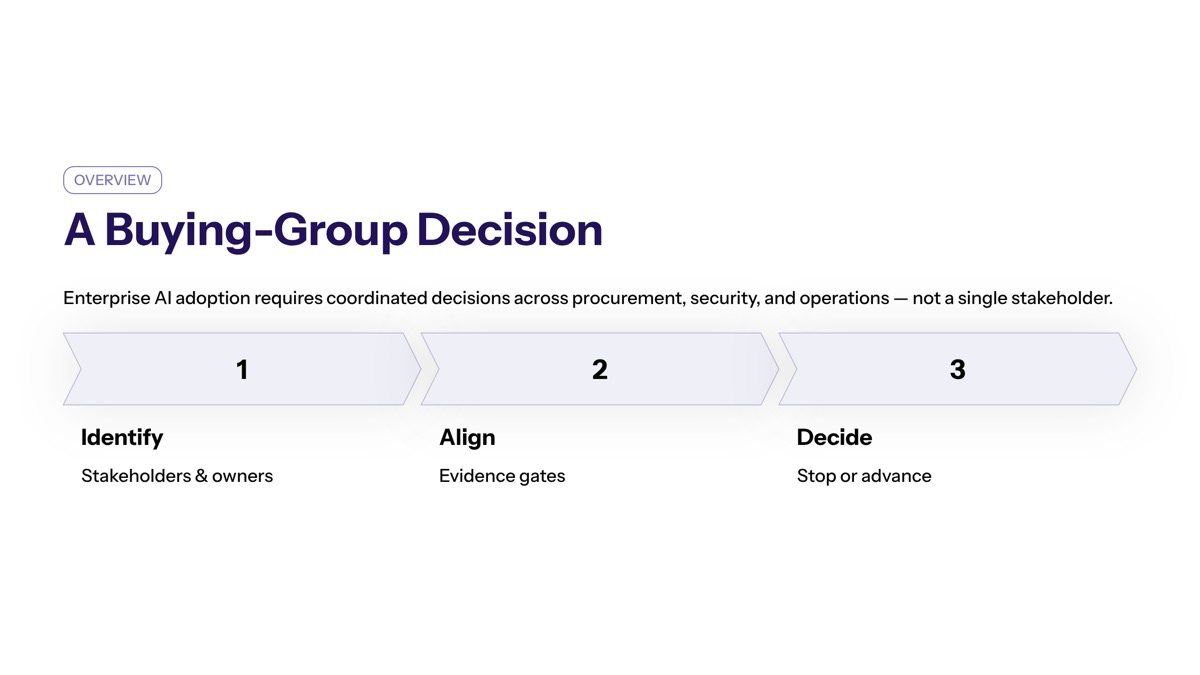
Understanding Enterprise AI Implementation as a Buying-Group Decision
Enterprise AI implementation affects multiple business functions and requires coordinated approval, governance, and operational ownership. AI readiness requires six critical pillars: strategy, infrastructure, data, governance, talent, and culture. Weakness in any single pillar can stall an initiative regardless of model quality. Research from the SIO (Siloed-Integrated-Orchestrated) progression model identifies that global corporate AI investment reached USD 252.3 billion in 2024, yet only approximately 6% of firms reported large financial impact on earnings ( arxiv.org ). The gap between investment and enterprise AI success is not primarily a model performance problem; it is an institutional readiness problem.
Successful AI implementation needs a structured roadmap from strategy to operational impact. Implementing AI in enterprise requires balancing technology, governance, and culture. Unresolved disagreement between the groups described below frequently becomes the source of implementation delay.
Executive Sponsor Perspective
Executive sponsorship is crucial for successful AI project implementation. The executive sponsor sets funding, risk acceptance thresholds, and the link between an AI initiative and broader business objectives. This role approves the business case, defines stop conditions, and reviews whether the initiative continues to justify its investment. AI maturity scorecards assess organizational alignment with business objectives; the executive sponsor is responsible for acting on those assessments. Cultural readiness impacts how employees adapt to AI technologies, and the sponsor owns the organizational change management needed to address that readiness.
ROI expectations must be grounded in baseline evidence and measurable business outcomes, not projected usage metrics. Nearly half of organizations cite limited budgets as a primary challenge for AI projects, with 43% of companies reporting budget limitations specifically. The executive sponsor is accountable for ensuring the funded scope matches the organization's risk tolerance and operational capacity.
Technology and Architecture Perspective
Technology and architecture leadership determines where AI models are hosted (cloud, hybrid, private), how APIs are designed, how data flows across network boundaries, and how ai systems integrate with existing systems. Legacy systems complicate AI integration efforts; architecture decisions must account for current enterprise systems, not only target-state designs.
Build scalable, modular architecture for AI to allow easy piloting and testing. Infrastructure scalability, vendor dependency management, and portability requirements all fall within this perspective. Architecture leadership also owns technical maintainability standards and the evaluation of whether a vendor's ai platform meets enterprise requirements for observability, logging, and business continuity.
Security and Risk Perspective
Security and risk teams evaluate identity management, permissions frameworks, vendor risk assessment, monitoring capabilities, and incident response procedures. AI-specific security considerations include prompt injection prevention, unsafe tool invocation, excessive autonomy of ai agents, retrieval leakage in retrieval-augmented generation architectures, and output disclosure controls.
The F5/NSS Labs framework for evaluating enterprise AI security organizes vendor evaluation across seven capabilities: input threats and instruction control, data exfiltration, system resilience, policy and filter governance, agentic or delegated authority, observability and forensics, and integration interoperability. Buyers should demand quantitative test results rather than architecture descriptions alone. AI risk management requires establishing policies for bias, privacy, and security.
Data exposure controls, residual risk acceptance, and enterprise AI governance frameworks must be documented before production approval.
Legal and Procurement Perspective
Legal teams review contractual structures (MSA, DPA), data use agreements, intellectual property considerations, privacy compliance, retention terms, and jurisdiction-specific obligations. Data privacy compliance is critical for AI systems under regulations like GDPR. Illinois's Artificial Intelligence Safety Measures Act (2026) mandates third-party safety audits for frontier AI developers; enterprises using vendors covered by such laws must verify vendor compliance ( halfteck.com ).
Procurement evaluates commercial terms, vendor onboarding requirements, subcontractor dependencies, cloud provider relationships, pricing structures, and exit provisions. Procurement cycles vary by industry and jurisdiction. A study of U.S. cities found that legacy procurement norms influence AI vendor choices, decision rights, and who can sign off, often delaying or distorting adoption ( arxiv.org ).
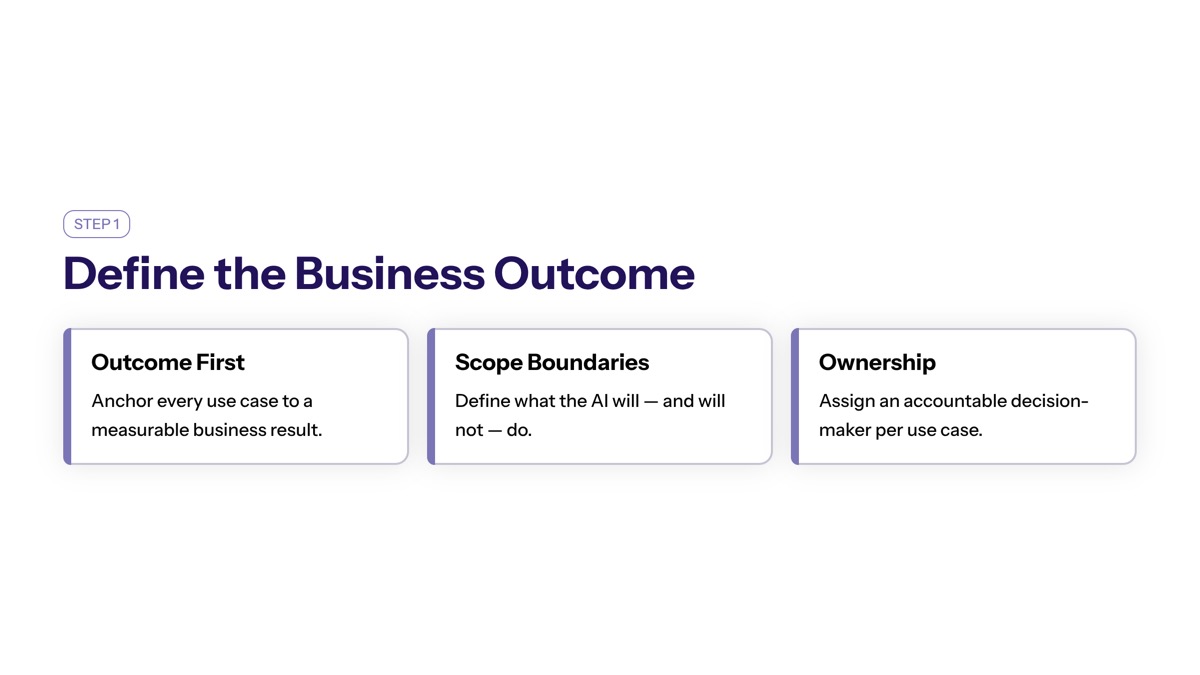
Defining the Business Outcome and Use Case Boundaries
Each stakeholder perspective described above converges on a single requirement: a documented business outcome that justifies the initiative and defines its boundaries. "Deploy AI" is not a business outcome. Companies should start AI projects with well-defined use cases.
Business Outcome Documentation Requirements
The organization must document:
-
The business problem being addressed and why it warrants AI investment
-
Intended user populations and their current workflow
-
Expected improvement, stated in measurable terms (error rate reduction, cycle time, cost, throughput)
-
Baseline evidence against which improvement will be measured
-
Material assumptions that must hold for the initiative to succeed
-
The named decision owner who will approve continuation or termination
-
Success evidence and failure evidence, stated in advance
-
Stop conditions that would trigger project termination regardless of sunk cost
AI enhances decision-making accuracy and timeliness, but only when the decision being enhanced is clearly identified. AI can automate repetitive tasks, freeing up employee time, but this benefit must be quantified against the specific workflow being targeted. Define specific high-impact use cases to focus AI deployment effectively.
Use Case Selection and Bounding
Evaluation criteria for use case selection include business value, AI fit assessment, feasibility analysis, data availability, architecture requirements, security implications, and user impact. A bounded use case narrows scope by:
-
User population (who will interact with the system)
-
Data sources (which enterprise data is required and which is excluded)
-
Workflow boundaries (where the AI sits within existing business processes)
-
Permissions (what the system can access and what it cannot)
-
Systems (which enterprise systems are in scope for data integration)
-
Geography and business unit (jurisdictional and organizational boundaries)
-
Decision consequences (what happens when the AI output is wrong)
A bounded implementation makes risk, evidence, and ownership easier to understand. The Institutional Alignment Readiness framework confirms that even technically viable models stall when institutional boundaries are unclear.
Procurement Readiness and Commercial Structure
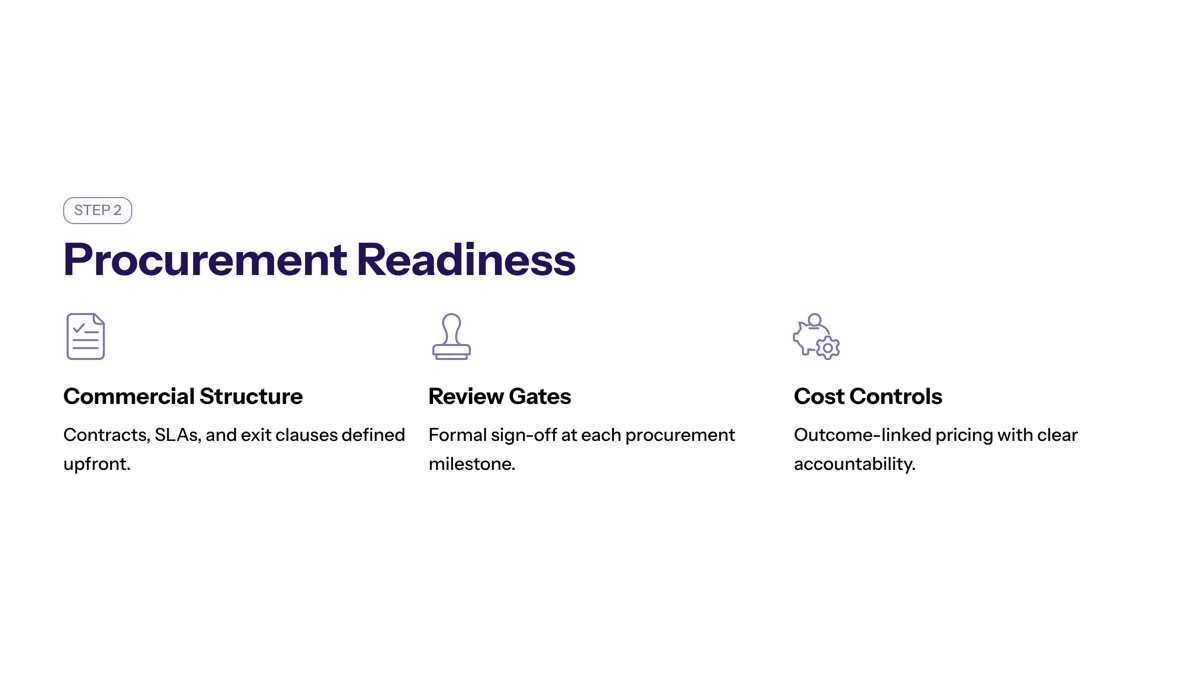
Procurement requirements vary by organization, contract type, industry, jurisdiction, and purchasing route. Enterprises must treat procurement as early-stage risk management rather than late-stage contract negotiation. Selecting technology requires evaluating build vs. buy vs. partner options. Total cost of ownership should include ongoing model retraining and maintenance.
Procurement Review Requirements
-
Vendor identity verification and ownership structure assessment. Who is the legal entity? Who owns the company? Has ownership changed recently?
-
Scope definition and deliverables specification. What is being purchased? What is excluded? How are deliverables verified?
-
Commercial terms evaluation and payment structure analysis. How does pricing scale with usage? Are costs predictable at production volume?
-
Subcontractor and cloud provider dependencies review. Which third parties process enterprise data? What happens when a subcontractor changes?
-
Data handling agreements and service dependency mapping. Where does sensitive data move? How long is it retained? How is deletion verified?
-
Insurance requirements and intellectual property terms. Who owns outputs? Who carries liability for model errors?
-
Support obligations and exit/transition planning. What happens when the contract ends? What data and configuration are returned? What is the transition timeline?
Bristol Myers Squibb reduced procurement cycle time from 90 days to 21 days by deploying agentic AI that handled unstructured and legacy data rather than delaying for perfect data readiness ( kurums.com ). BMS treated the "data readiness trap" as delaying projects for years. This demonstrates that procurement readiness and data readiness are interdependent; resolving one without the other creates bottlenecks.
Cloud Marketplace and Partner Route Considerations
Some enterprise organizations purchase eligible software or services through cloud marketplaces or approved partners. This route introduces specific considerations.
|
Consideration |
Marketplace Route |
Traditional Procurement |
|---|---|---|
|
Existing cloud commitments |
May count toward committed spend (verify with provider) |
Separate budget allocation |
|
Approved vendor channels |
Pre-approved marketplace listing |
Full vendor onboarding required |
|
Security evidence |
Marketplace baseline certifications |
Full security review against enterprise requirements |
|
Commercial terms |
Marketplace-defined structure |
Negotiable terms |
|
Internal approval |
May follow existing cloud purchasing workflow |
Standard procurement workflow |
A marketplace purchase does not replace procurement or security review. Marketplace availability does not guarantee that the vendor's data handling, model behavior, or security evidence meets enterprise requirements. Buyer teams must verify eligibility, internal approvals, vendor offerings, and risk controls independently. Do not assume marketplace purchases automatically count toward cloud commitments without verifying with the specific provider.
Security Review and Risk Assessment Framework
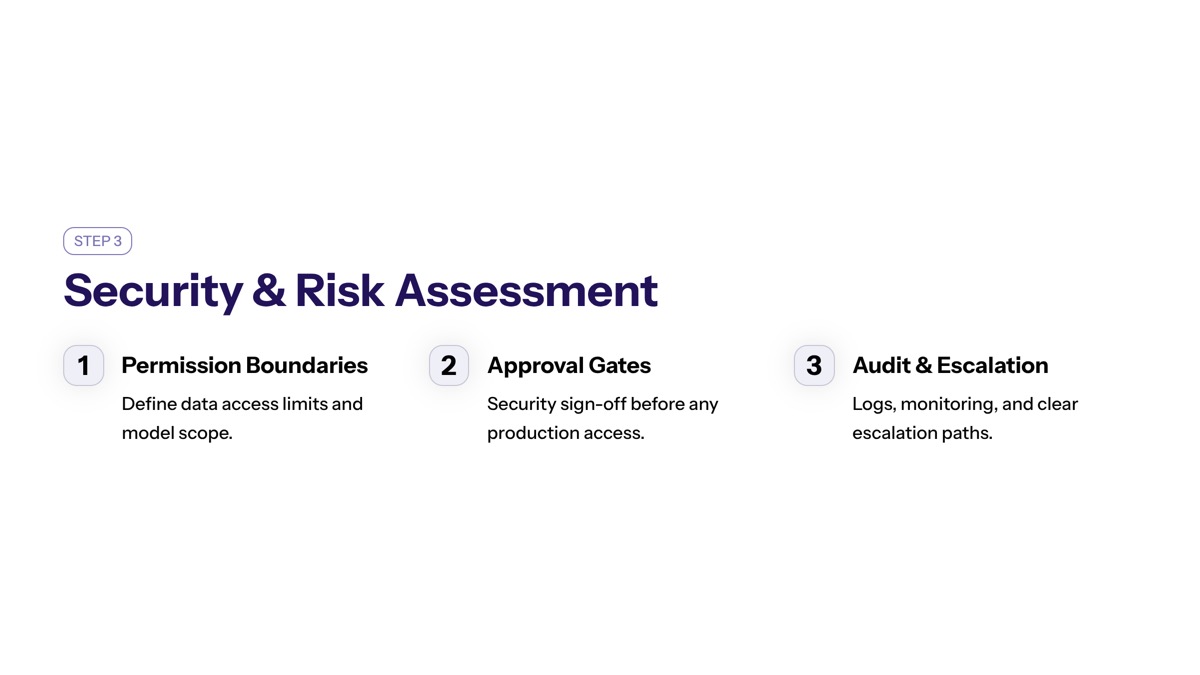
Security review builds on procurement considerations and introduces controls specific to AI systems. Establish relevant AI governance frameworks to manage risks and regulatory compliance. The Production AI Institute's Production Safety Framework (PSF v1.1, 2026) defines eight domains enterprise AI deployments must address: input governance, output validation, data protection, observability, deployment safety, human oversight, security, and vendor resilience. PSF is model-agnostic and cloud-agnostic.
Identity and Access Control Requirements
Enterprises should enforce least-privilege permissions, integrate AI tools with enterprise identity systems (supporting RBAC, ABAC, and service identities), and maintain mechanisms to revoke access. Vendor assessment should include questions about identity, authorization, and the trust boundary between vendor and enterprise infrastructure. TKOResearch notes that passing a security review requires bounded autonomy, explicable permissions, sufficient audit trails, and human-in-the-loop governance.
Credential management, access revocation procedures, and integration with enterprise identity providers are prerequisites. A system where access cannot be revoked within an acceptable timeframe does not meet enterprise security standards.
AI-Specific Security Considerations
AI-specific risks go beyond traditional software security. Enterprises must evaluate:
-
Model and vendor risk. Vendor assessment includes model behavior, data lifecycle, safety, regulatory posture, and operational practices. The GreenHat AI Risk Assessment questionnaire recommends demanding data lifecycle diagrams, subprocessor lists, retention schedules, vendor controls, logging, and incident response documentation. Vague vendor statements are insufficient.
-
Data exposure controls. Input and output filtering, retrieval authorization in RAG architectures, and controls against data exfiltration.
-
Prompt injection prevention. Testing vendor systems against adversarial inputs that attempt to override instructions or extract sensitive data.
-
Unsafe tool use and excessive agency. AI agents that can invoke tools, access databases, or take actions across systems require explicit policies limiting autonomy.
-
Output disclosure controls. Monitoring and validation of what large language models and generative ai models return to users, especially where outputs could contain customer data or proprietary information.
-
Logging and observability. Prompt traces, retrieval traces, tool-call logs, and output logs must support incident investigation, drift detection, and forensic analysis.
-
Human oversight mechanisms. Define where human review is required before AI outputs are acted on. AI augments human work; it does not replace accountability for decisions.
Incident Response and Change Control
Incident response procedures must cover AI-specific scenarios: model degradation, unexpected outputs, vendor model updates that change behavior, data exposure incidents, and system shutdown capabilities. Monitor model performance to detect drift and prevent bias. Continuous monitoring and governance are crucial for AI system optimization.
Material risks, control ownership, and accepted residual risk must be documented. Define accountability for AI decisions to ensure responsible ai and compliance. Establish cross-functional governance for ethical AI use and data compliance.
Architecture and Data Readiness Assessment
Architecture and data readiness determine whether an AI initiative can operate within enterprise constraints. Without architecture diagrams that map data flows, trust boundaries, and authorization models, security reviewers will reject or delay implementation.
Enterprise Architecture Integration
-
Current systems mapping and data flow analysis. Identify every system the AI will read from, write to, or depend on. Map data flows between components, including vendor boundaries.
-
Model and hosting options evaluation. Evaluate cloud, hybrid, and private hosting against use-case consequences, data sensitivity, and enterprise standards. No single hosting model is universally correct.
-
API design and network boundary definition. Define how the AI system communicates with enterprise systems, including authentication, rate limits, and error handling.
-
Integration planning and logging architecture. Seamless AI integration reduces manual handoffs between systems, but requires explicit integration design covering workflow triggers, data transformations, and audit trails. Effective AI integration requires a clear data strategy.
-
Monitoring design and availability requirements. AI integration enables real-time data processing and insights only when monitoring infrastructure supports it. Define availability SLAs, alerting thresholds, and performance baselines.
-
Business continuity and portability planning. Vendor lock-in risk requires evaluation of portability, exit paths, and backup plans. Architecture that cannot be operated without a single vendor's cooperation introduces unacceptable dependency for business-critical ai systems.
Cummins, operating across nearly 190 countries, found that their AI initiative succeeded only after investing in data integrity: discovering where data lived, improving governance, and increasing visibility into data structure and access. The challenge was not the machine learning models but whether data was usable for the intended purpose ( techpoint.org ).
Data Readiness Evaluation
Data preparation can take 60-80% of an AI project's time. 80% of AI work involves data preparation and quality assurance. Data audits evaluate quality, availability, and governance for AI readiness. Available data is not automatically approved or usable data.
|
Data Requirement |
Assessment Questions |
Approval Owner |
|---|---|---|
|
Data ownership |
Which data is required? Who is the data steward? |
Data steward |
|
Access permissions |
Can this data be used for this purpose? Who approved access? |
Data governance lead |
|
Quality standards |
Does data meet model requirements? What are known quality issues? |
Data engineering |
|
Privacy compliance |
Are privacy and residency requirements satisfied? Which vendors receive data? |
Legal/Privacy |
|
Classification and lineage |
How is data classified? Where did it originate? How has it changed? |
Data governance |
|
Retention and residency |
How long is data retained? Where is it stored? How is deletion verified? |
Legal/Data governance |
|
Test vs. production alignment |
Does the production data path match the test environment? |
Data engineering |
Poor data quality is a common cause of AI project failure. A large construction services enterprise used AI to extract parts requisitions from paper, email, and Excel and match items to a structured catalog. They faced OCR errors and inconsistent catalog data, but bounded scope and iteration allowed progress ( digitaleconomy.stanford.edu ). Data readiness is not a one-time assessment; it requires ongoing maintenance as data sources, quality, and regulatory requirements change.
Production-Readiness Gates and Decision Framework
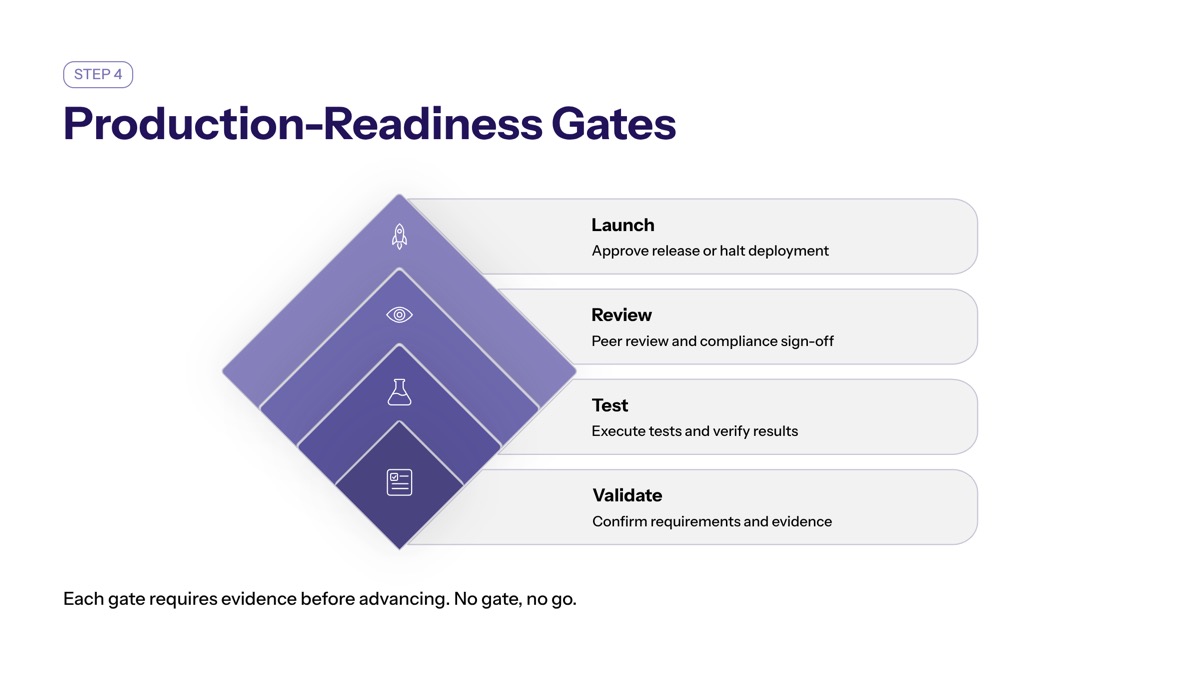
The difference between proof of concept, pilot, and production implementation is not scale. It is the level of evidence, controls, and operational accountability required.
Proof of concept tests whether a bounded concept or assumption works under controlled conditions. It validates model performance and basic integration against a specific hypothesis.
Pilot tests the solution with representative users, real workflow, and operating conditions. Pilot projects help validate AI assumptions before full deployment. User feedback, error rates, and adoption signals are collected.
Production implementation adds approved architecture, security controls, data governance, vendor agreements, monitoring, support ownership, and operational accountability. 88% of AI projects fail to reach production. The gap between pilot and production is where most ai initiatives stall.
92% of structured AI implementations succeed, according to Gartner. The key word is "structured": implementations that follow defined gates, evidence requirements, and accountable ownership.
Stage Gate Progression Framework
Not every gate applies identically to every organization. The table below represents decision points that enterprise buying groups should evaluate and adapt to their governance structure.
|
Gate |
Decision Required |
Evidence Required |
Accountable Owner |
Possible Outcomes |
|---|---|---|---|---|
|
Business approval |
Fund use case development |
Business case, outcome metrics, baseline evidence |
Executive sponsor |
Proceed / Stop / Revise scope |
|
Use-case scope |
Approve boundaries |
User population, data sources, systems, consequences |
Business owner |
Proceed / Narrow scope / Stop |
|
Data approval |
Approve data access and use |
Data governance compliance, lineage, privacy assessment |
Data steward |
Proceed / Correct data issues / Stop |
|
Architecture approval |
Approve technical design |
Architecture diagrams, hosting plan, trust boundaries |
Enterprise architect |
Proceed / Revise design / Stop |
|
Security review |
Accept security controls |
Risk assessment, mitigation plan, residual risk documentation |
Security lead |
Proceed / Add controls / Stop |
|
Privacy and legal review |
Approve contracts and compliance |
MSA/DPA, IP terms, regulatory mapping |
Legal/Privacy |
Proceed / Revise terms / Stop |
|
Procurement |
Execute vendor agreements |
Commercial terms, SLA, exit clauses, support terms |
Procurement lead |
Proceed / Renegotiate / Stop |
|
Integration validation |
Confirm system connectivity |
API tests, data flow verification, error handling |
Integration lead |
Proceed / Correct issues / Stop |
|
User validation |
Confirm workflow fit |
User feedback, error rates, adoption quality evidence |
Business owner / UX lead |
Proceed / Revise workflow / Stop |
|
Production operations |
Confirm operational readiness |
Monitoring, alerting, runbooks, incident ownership, rollback plan |
Operations lead |
Proceed / Add capabilities / Stop |
|
Measurement |
Confirm evidence plan |
Baseline metrics, acceptance criteria, failure criteria, review cadence |
Business owner |
Proceed / Adjust criteria / Stop |
|
Executive go/no-go |
Production authorization |
All gate evidence consolidated, unresolved blockers documented |
Executive sponsor |
Proceed / Proceed with conditions / Stop |
Production Operations Ownership
A system with no named production owner is not ready for production.
Production operations ownership includes monitoring, logging, alerting, availability management, performance tracking, cost visibility, incident response, model updates, vendor management, and support. Integrated AI automates repetitive tasks, improving operational efficiency, but only when someone is accountable for keeping the system running correctly.
Each of these responsibilities must be assigned to a named individual, not a team or department. The named owner is the person who is called when the system fails at 2 AM.
Common Implementation Failures and Risk Mitigation
Implementation failures follow predictable patterns. Successful AI projects require cross-functional teams for effectiveness. AI champions help translate complex concepts for broader understanding. Prioritize change management and employee upskilling for AI adoption. Employee training on AI tools must include understanding limitations and use protocols.
Strategic Failures
Starting with vendor selection before defining business outcomes inverts the decision sequence. The vendor becomes the solution looking for a problem, and the organization's ai maturity assessment is skipped entirely. Unrealistic expectations lead to AI project failures when teams assume a vendor demo represents production capability.
Treating ai pilots as production-ready systems creates technical debt and security exposure. Pilot code, prototype integrations, and temporary data paths become entrenched. Leaving procurement and legal review until deployment phases creates last-minute blockers that delay or kill initiatives that have already consumed budget.
Operational Failures
Ignoring data ownership and data governance requirements means the initiative may be built on data it has no legal right to use, or data whose quality has never been evaluated. Building temporary integrations that become permanent creates systems that no one owns, no one monitors, and no one can safely modify. Assigning no clear business owner or operational accountability means no one is responsible for whether the system delivers real business value.
Building internal AI capabilities enhances project control and knowledge retention. When the original implementation team leaves and no knowledge transfer has occurred, the organization loses the ability to operate, modify, or decommission the system.
Measurement and Scaling Failures
Measuring ai usage (invocations, logins, training attendance) instead of business outcomes (cost reduction, error rate, throughput, customer satisfaction) obscures whether the initiative is working. AI improves customer experiences through personalized services and AI tools can reduce manual labor in supply chain logistics, but these benefits must be measured against baselines.
Scaling ai before evidence of pilot success and user adoption leads to poor ROI. Continuing initiatives due to sunk cost rather than performance evidence compounds losses. AI democratizes data-driven decision-making for all employees only when adoption quality is verified, not assumed.
Conclusion and Executive Decision Framework
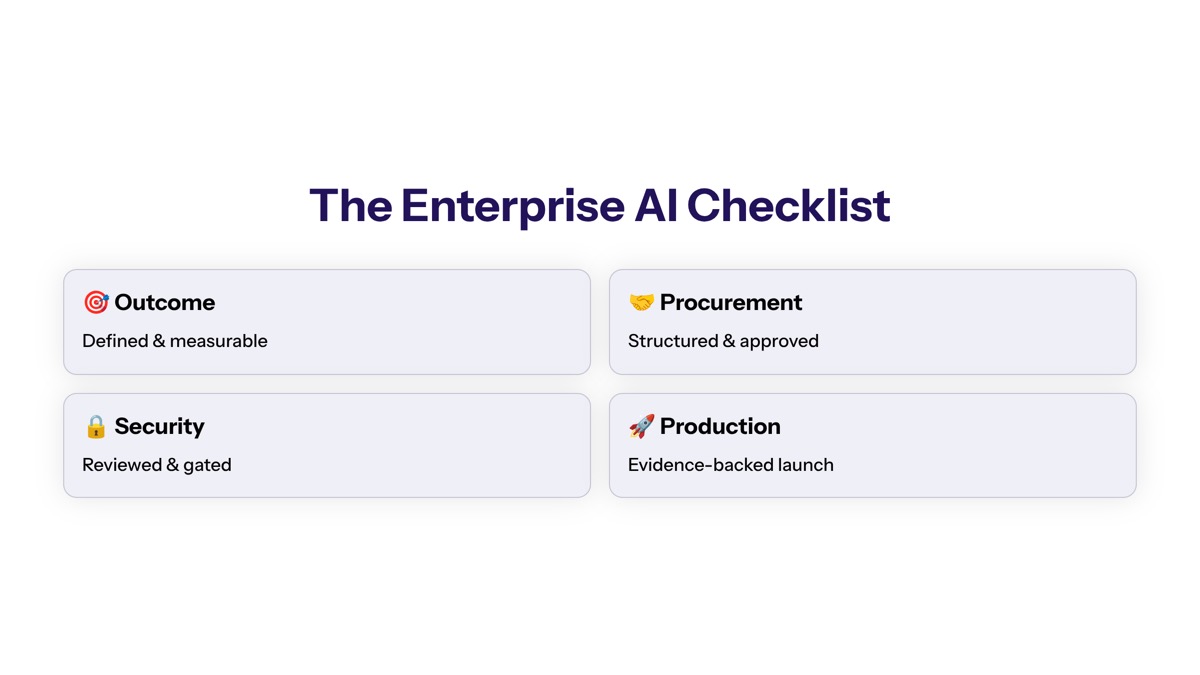
Enterprise AI implementation succeeds as a coordinated operating decision, not a technical deployment alone. The buying group must align on business outcome, data governance, architecture, security, procurement, legal review, production operations, user adoption, measurement, and support before an AI initiative reaches production. Enterprise AI adoption depends on institutional readiness across every pillar, not just model capability.
Leadership questions to answer before proceeding:
-
What business outcome justifies the implementation?
-
Which use case is approved, and what are its boundaries?
-
What evidence supports continuation or expansion?
-
Who owns the result?
-
Which data and systems are involved, and who approved their use?
-
What can the AI access and do?
-
Which risks remain, and who accepted them?
-
What must procurement approve?
-
Who operates and supports the system in production?
-
How will model or vendor changes be managed?
-
What evidence would make us stop?
To discuss enterprise AI implementation aligned with your organization's architecture, security, and production-readiness requirements, start an executive conversation with Cognativ .
Related areas for further exploration: AI-first architecture design , secure development practices , operationalizing AI governance across teams , and digital transformation execution through the RAPID framework .
Additional Resources
-
Enterprise AI readiness assessment framework. Evaluate your organization against the six critical pillars: strategy, infrastructure, data, governance, talent, and culture. Companies should assess AI readiness across these pillars before committing to production implementation.
-
Production-readiness checklist. Use the stage gate table above as a starting template. Adapt gates, evidence requirements, and accountable owners to your organization's governance structure.
-
Responsibility assignment matrix for AI initiatives. Map every implementation domain (business outcome, data, architecture, security, legal, procurement, integration, operations, support, measurement, vendor management, budget) to a named individual. Avoid assigning ownership to teams or departments without a named accountable person.
-
Security review questionnaire for AI vendor evaluation. Request data lifecycle diagrams, subprocessor lists, retention schedules, incident response history, adversarial test results, logging architecture, and human oversight mechanisms. Reference the GreenHat AI Risk Assessment and the Production Safety Framework as starting points for questionnaire design.