

Opaque Recurrence in AI: Recurrent Depth, Hidden Reasoning and Evidence
“Opaque recurrence” is best unpacked into two separate questions: does a model reuse computation internally, and how much of its process is observable? Recurrent depth is an architectural mechanism. Hidden reasoning is an interface or visibility property. One does not establish the other.
“Opaque recurrence” is best unpacked into two separate questions: does a model reuse computation internally, and how much of its process is observable? Recurrent depth is an architectural mechanism. Hidden reasoning is an interface or visibility property. One does not establish the other.
This is a research explainer, not instructions for reproducing a proprietary model. A vendor's undisclosed architecture cannot be inferred from a short answer, a long delay or a report that its reasoning is hidden.
What Recurrent Depth Means
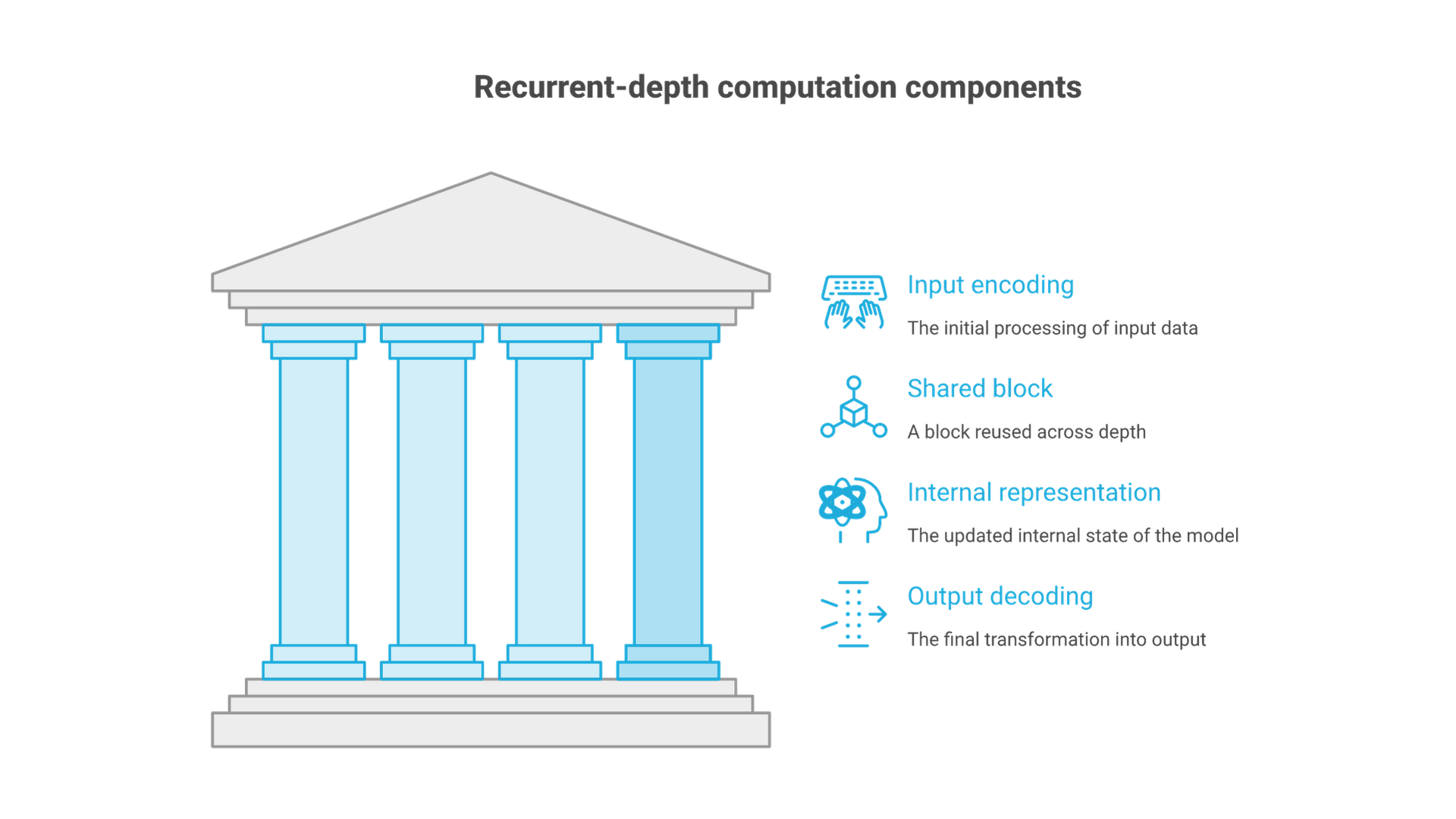
In a recurrent-depth design, a shared computational block updates an internal representation repeatedly. More iterations can allocate more computation without expressing every intermediate step as a new natural-language token. The diagram is conceptual and does not depict any named commercial model.
Geiping and colleagues' recurrent-depth research studies a proof-of-concept language model with this approach. It reports improved performance on selected reasoning tasks with additional computation. That result concerns the studied system and evaluation, not a guarantee that every task improves with unlimited iterations or that a specific vendor adopted the design.
Repeated computation is not the same as storing a new copy of every parameter for each iteration. Conversely, reusing parameters does not make extra computation free: elapsed time and execution resources still matter. Assess the actual implementation and budget rather than converting an “effective depth” description directly into hardware requirements.
Separate Three Often-Conflated Ideas
| Concept | What it describes | What it does not establish |
|---|---|---|
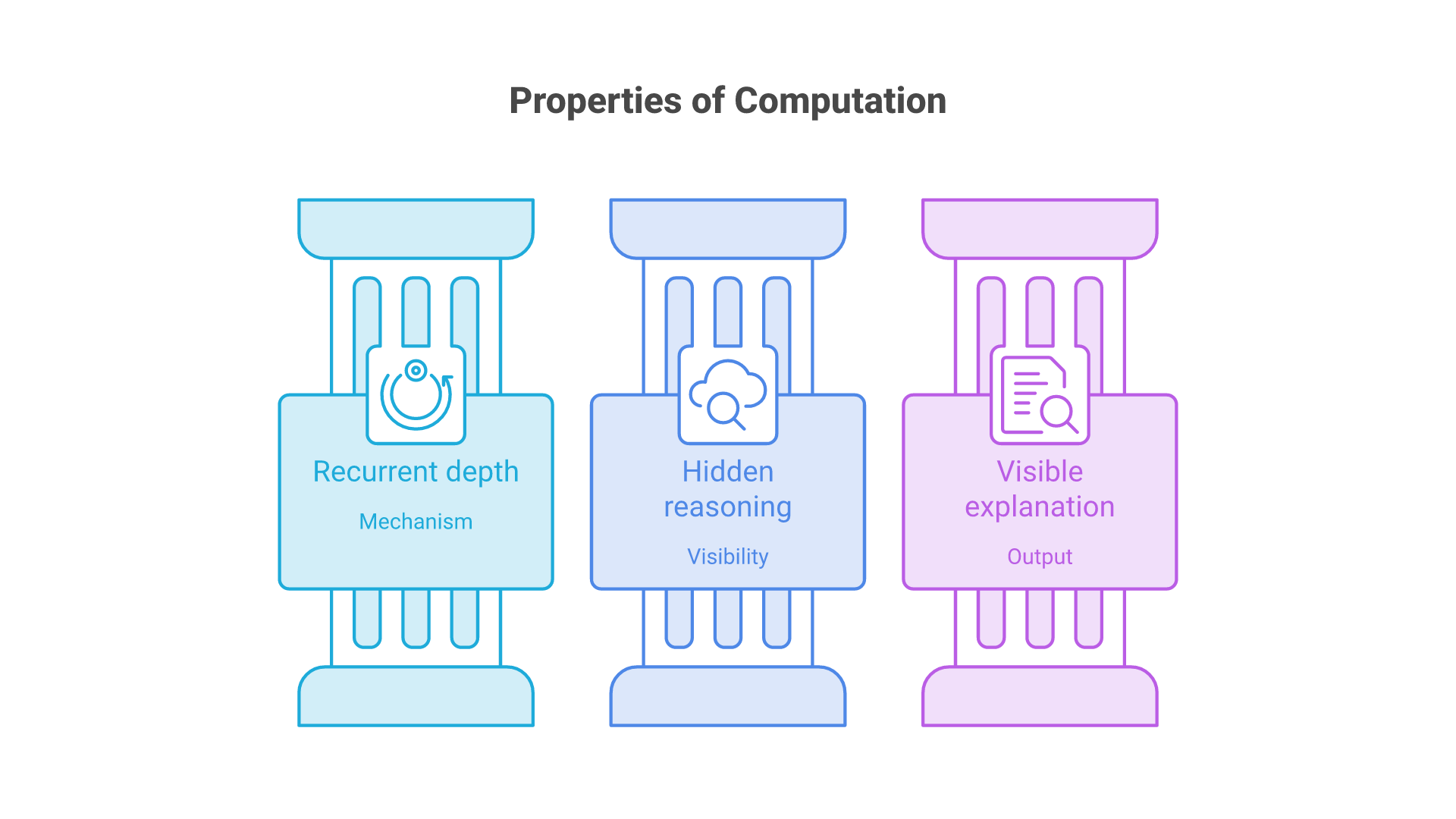
| Recurrent depth | Repeated application of a shared computation to internal state. | Whether intermediate state is human-readable or safe. |
| Hidden reasoning | Reasoning-related content or computation not exposed to the user. | Whether the underlying architecture uses recurrence. |
| Visible explanation | A textual account presented with an answer. | That the account faithfully describes the mechanism that produced it. |
The chain-of-thought faithfulness study by Lanham and colleagues examines how model answers change when reasoning text is intervened on. Its findings vary across tasks and models. The practical lesson is limited but important: a plausible explanation is not automatically a reliable record of the process that caused an answer.
That does not make explanations useless. A concise justification, cited passage or visible calculation can help a reviewer check an answer. Treat it as an object to verify rather than privileged access to the model's internal state.
More Computation Requires a Stopping Policy
A repeated computation needs a rule for when to stop. Possibilities include a fixed iteration budget or a learned/adaptive mechanism. These choices affect evaluation: a system that spends more computation on difficult inputs should be compared under a stated budget, not only by its best answer.
Universal Transformers is earlier research combining recurrence with self-attention and studying dynamic per-position halting. It provides context for the idea, but it is not interchangeable with every later latent-reasoning architecture.
For a conceptual arithmetic task, imagine checking several candidate intermediate states before producing an answer. This analogy explains repeated refinement; it does not imply that an actual model literally runs a human-readable worksheet internally. Avoid diagrams that label hidden states as verified thoughts or intentions.
Evaluate Observable Quality and Cost
Suppose a team is comparing two reasoning configurations for extracting contractual dates from approved documents. The following is an evaluation design, not a claim that either architecture has been tested by Cognativ.
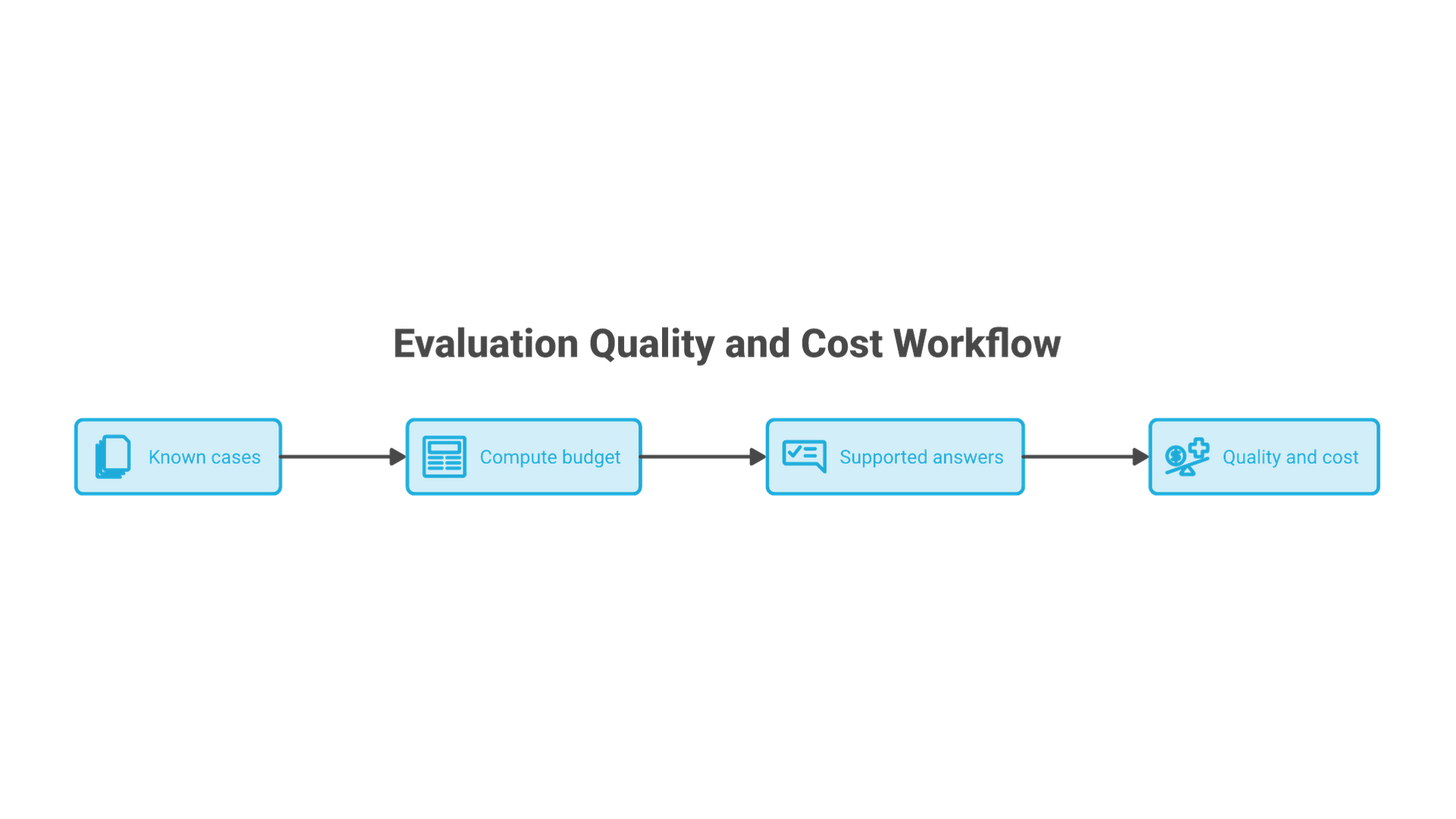
- Prepare cases with known dates, missing dates, contradictory amendments and irrelevant passages.
- Require source references and explicit unknowns; do not reward an answer for sounding decisive.
- Hold the input and permitted evidence constant while changing the compute budget.
- Record accepted answers, critical errors, elapsed time and failed attempts separately.
- Review whether any improvement persists across cases rather than depending on one favorable example.
A useful result might be that extra computation improves difficult cases but makes simple cases too slow. Another might be no measurable improvement. Neither result can be inferred from the presence of recurrence alone. Keep accuracy, latency, cost and observability as distinct dimensions.
Distinguish Monitoring from Enforcing a Boundary
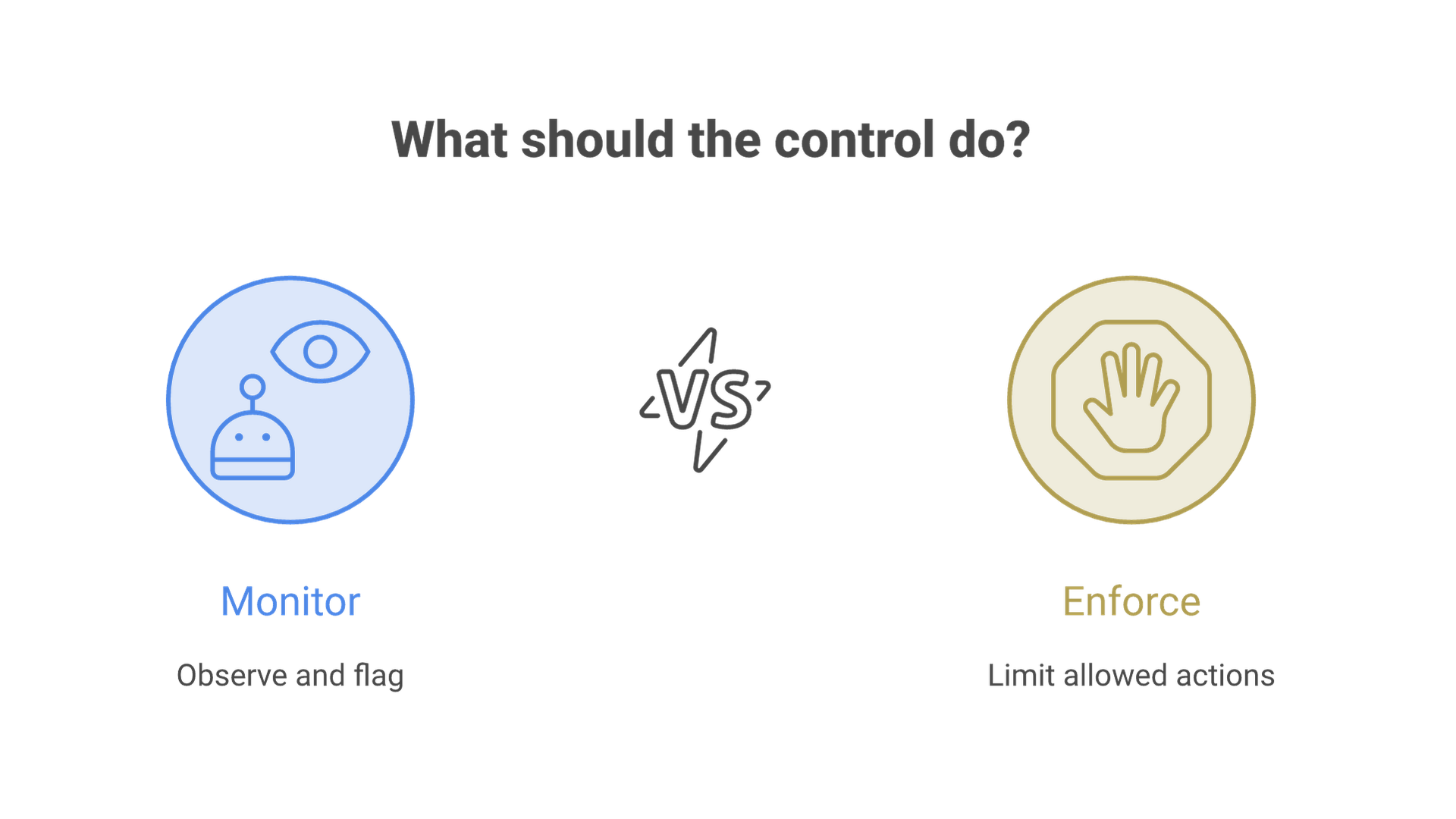
A monitor may inspect outputs, tool requests or other available signals and flag concerns. An enforcement boundary controls what the system can actually do. Those functions are complementary, not substitutes.
| Business requirement | External control | Acceptance check |
|---|---|---|
| Read only approved documents | Document authorization before retrieval. | Unauthorized content is unavailable to the request. |
| Do not send a message without approval | Separate draft creation from the send capability. | A draft cannot trigger delivery by itself. |
| Preserve evidence | Store input versions, tool events and accepted output. | A reviewer can reconstruct the observable work. |
| Stop excessive work | Time, resource and action limits. | The run terminates at the configured boundary. |
These controls do not prove a model is internally transparent or eliminate all failure. They make a narrower operational claim testable. A system that cannot access a write credential has a different risk profile from one merely instructed not to write.
How to Read Claims About Proprietary Deployment
Ask what the evidence establishes: a published research mechanism, a vendor disclosure, an external report or an inference from behavior. Keep those categories separate. Repeated coverage of the same unnamed-source report is not independent confirmation.
For adoption decisions, request the capabilities and controls the product actually exposes, its evaluation conditions and known limitations. Do not turn an architectural rumor into a deployment recommendation. The defensible conclusion is that recurrent computation is a real research direction, while claims about any particular undisclosed implementation require their own evidence.