

Tech Stacks: Components, Examples, and Selection Strategy
A tech stack is the combination of technologies used to build, deploy and maintain an application. It includes languages, frameworks, runtimes, databases and operational tools.
A tech stack is the combination of technologies used to build, deploy and maintain an application. It includes languages, frameworks, runtimes, databases and operational tools. The useful question is not which acronym is most modern, but which combination lets your team deliver the required behavior and operate it responsibly.
Start by separating frontend, backend, data and operating responsibilities. Then compare combinations such as MEAN, MERN, LAMP, Django and .NET against those requirements. A representative prototype can test the assumptions that matter more reliably than generic performance ratings.
What Happens When a Customer Changes an Order?
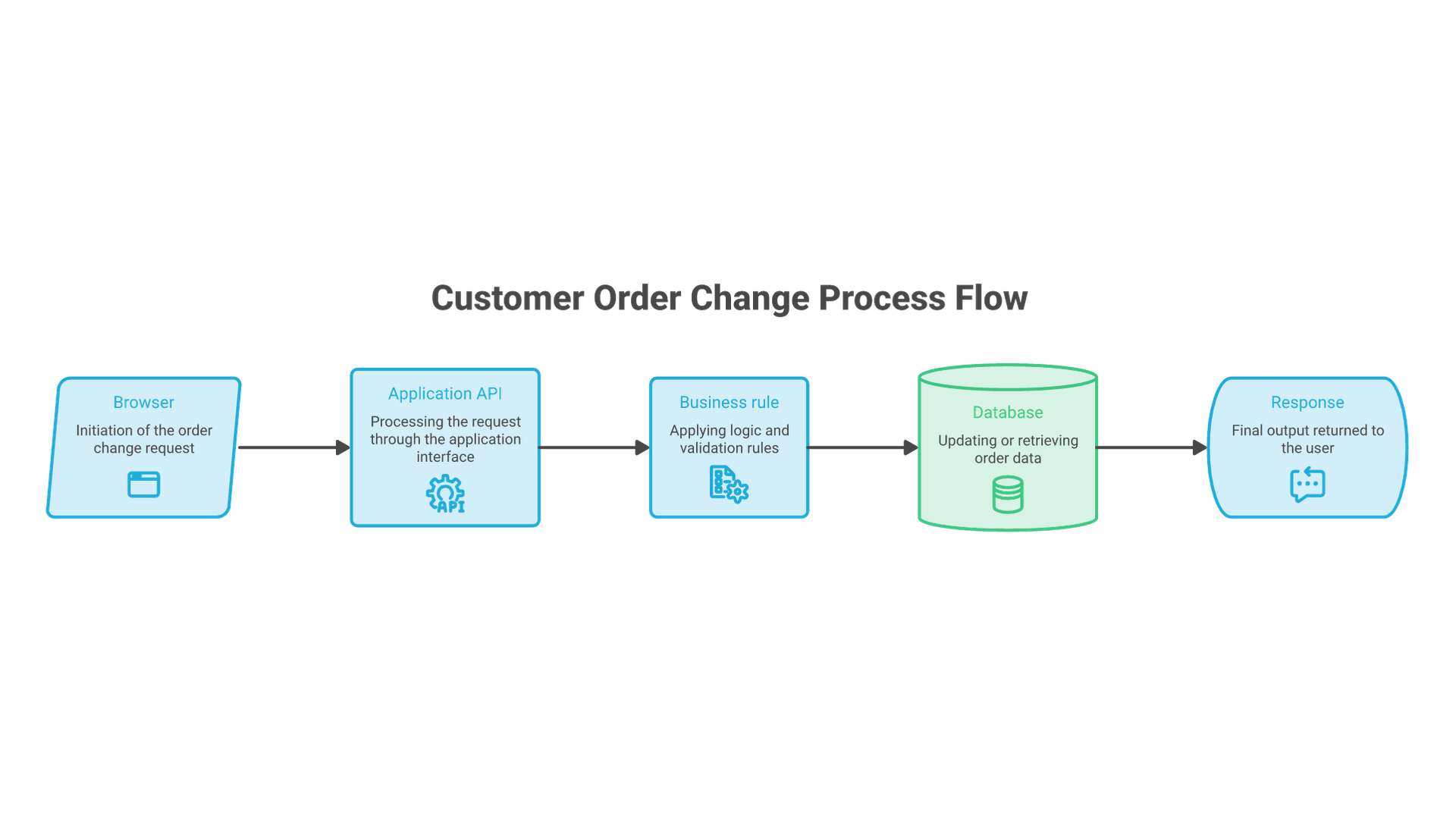
A customer changes the delivery date in a portal. The frontend collects the request and shows progress. The backend checks that the customer owns the order and that the change is allowed. The database records the accepted state; an integration may still need a response from the warehouse. The interface should show that distinction instead of treating every successful HTTP response as a completed business action.
With a Django-based stack, Python and Django can implement the application rules and PostgreSQL can store the transaction. With an ASP.NET Core stack, C# and ASP.NET Core can implement the same behavior. Neither name specifies the interface, deployment target or warehouse contract. Those choices still need owners and tests.
Key Takeaways
- A stack is a connected system, not a list of independently attractive products.
- Separate technology capabilities from claims about the performance or cost of your implementation.
- Choose with constraints, team capability and representative evidence; do not default to microservices or new infrastructure merely to appear modern.
Tech Stacks: Introduction
Developers, technical leaders, product managers and founders need a shared basis for selecting a new system's foundation or evaluating a significant change. A marketing website, an internal operations tool and a transaction-heavy product may share components without needing the same architecture.
A decision has several time horizons. The stack must support the first useful release, but the organization must also maintain dependencies, hire or train people, investigate incidents and migrate data later. Fast initial development is not the same as low lifetime cost.
For an existing application, first identify the constraint you are trying to remove. Replacing the frontend framework will not necessarily solve slow database queries or inconsistent customer records. An architecture review should separate a measured bottleneck from understandable frustration with unfamiliar code.
Understanding Tech Stack Fundamentals
Frontend vs. Backend vs. Full Stack
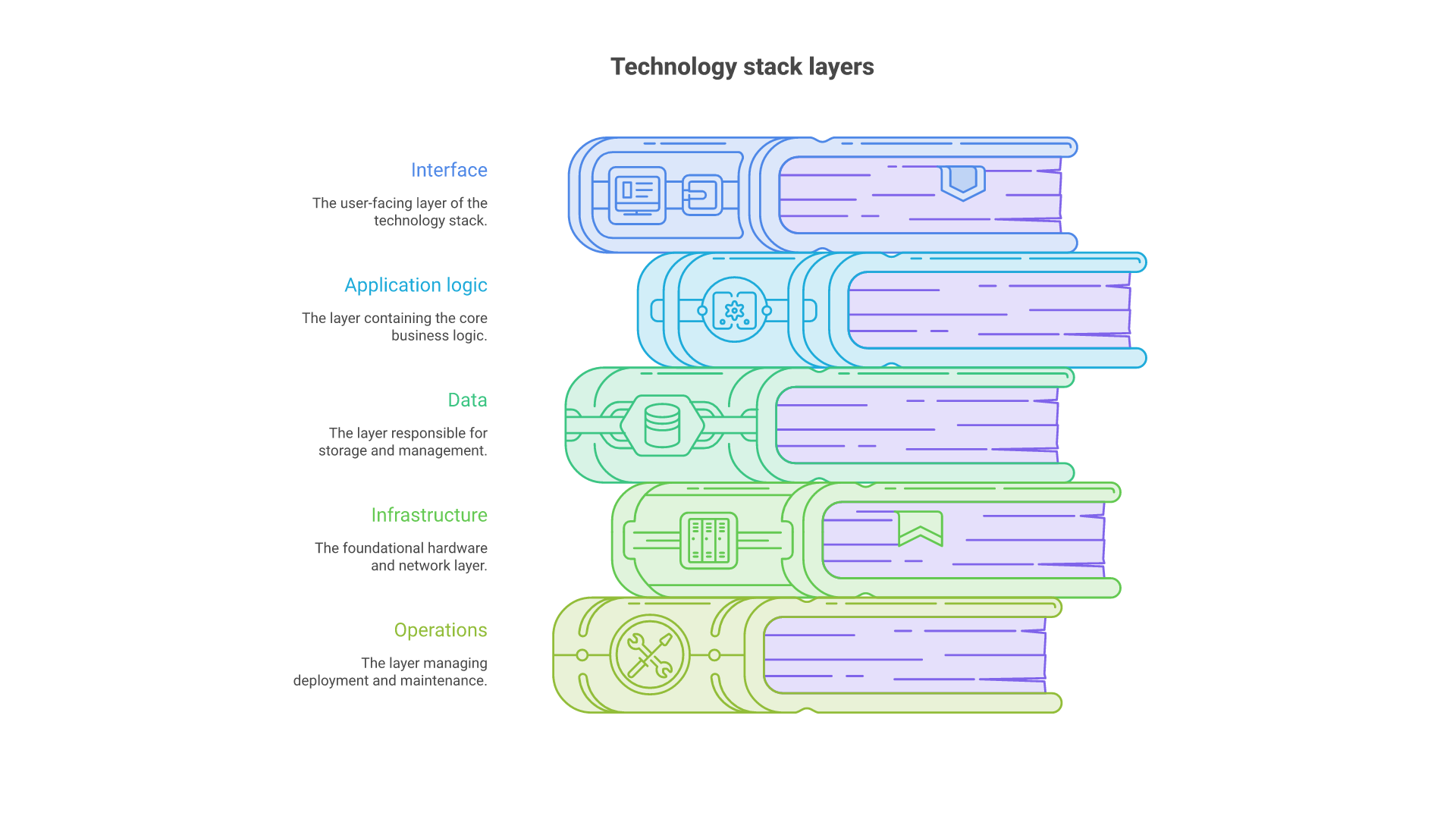
The frontend presents information and accepts user interaction. Web interfaces use HTML, CSS and JavaScript, often with a library or framework. The backend enforces business rules, authorizes access, processes requests and integrates with data and external systems.
Keep the categories accurate. Python, Java, JavaScript and PHP are programming languages; Node.js is a JavaScript runtime. A database is not a backend application, and a frontend validation rule is not a substitute for server-side authorization. “Full stack” describes work across these boundaries, not a guarantee that one person can safely own every specialist responsibility.
For a customer portal, the interface may show an order, while the backend decides whether that customer is permitted to access it. The data layer stores the order and the relationships needed to enforce that decision. Each layer has a role in a secure, usable result.
Modern vs. Traditional Tech Stacks
LAMP and newer JavaScript-oriented combinations are not opposing categories of obsolete and capable technology. Supported versions, sound design and operational discipline matter more than the age of an acronym.
Managed services can reduce some infrastructure responsibilities while adding provider, pricing and portability considerations. Containers can help package an application consistently but do not remove the need for patching or access controls. A modular monolith can be a deliberate architecture, not an unfinished microservices system.
Tech Stack Components and Architecture
Presentation Layer: Frontend
Choose the interface approach from the user's work. A mostly informational site may benefit from straightforward server-rendered pages. An application with substantial interactive state may justify a richer client. Identify accessibility, navigation, loading and error-recovery requirements before comparing frameworks.
React, Angular and Vue represent different ways to build web interfaces, not complete replacements for an application's backend and operations. Decide where rendering happens, how forms are validated, how user state is maintained and what remains usable when a request fails.
For mobile, compare native platform needs with the value of shared code. Device capabilities, offline behavior, distribution and team expertise may matter more than reuse percentage. A shared codebase still requires testing the actual supported devices and interactions.
Application Layer: Backend
The backend implements business behavior through an application framework and runtime. Examples include Python with Django, JavaScript with Node.js and Express, Java with Spring, PHP with Laravel, or C# with ASP.NET Core. Web servers and reverse proxies such as Nginx or Apache can route and serve HTTP traffic; they are not interchangeable with the language runtime executing business logic.
Make integration boundaries explicit. Define request formats, authentication, authorization, timeouts and failure responses. If an external service is unavailable, decide whether the operation fails, remains pending or can be retried. These choices often affect customer experience more than the framework label does.
Separate long-running or CPU-intensive work when the workload requires it. First measure where time and resources are spent. Adding a queue or service introduces another component to secure, monitor and recover, so its benefit should be specific.
Data Layer
Choose data storage from the relationships, access patterns and consistency requirements of the application. Relational databases are useful where constraints, transactions and queries over related records matter. Document-oriented storage can suit an aggregate-shaped data model, but that does not mean every flexible or high-volume workload requires NoSQL.
PostgreSQL supports JSON and JSONB, including JSONB indexing. Conversely, MongoDB supports transactions. These capabilities make blanket rules such as “relational cannot handle flexible data” or “document databases have no transactions” unreliable selection criteria.
Distinguish the authoritative store from a cache, search index, object store or analytics warehouse. A cache can accelerate reads, but the system still needs a defined answer when cached data is stale. An analytics pipeline may use a different freshness and consistency model from the transaction that accepts a customer's order.
The Operational Layer
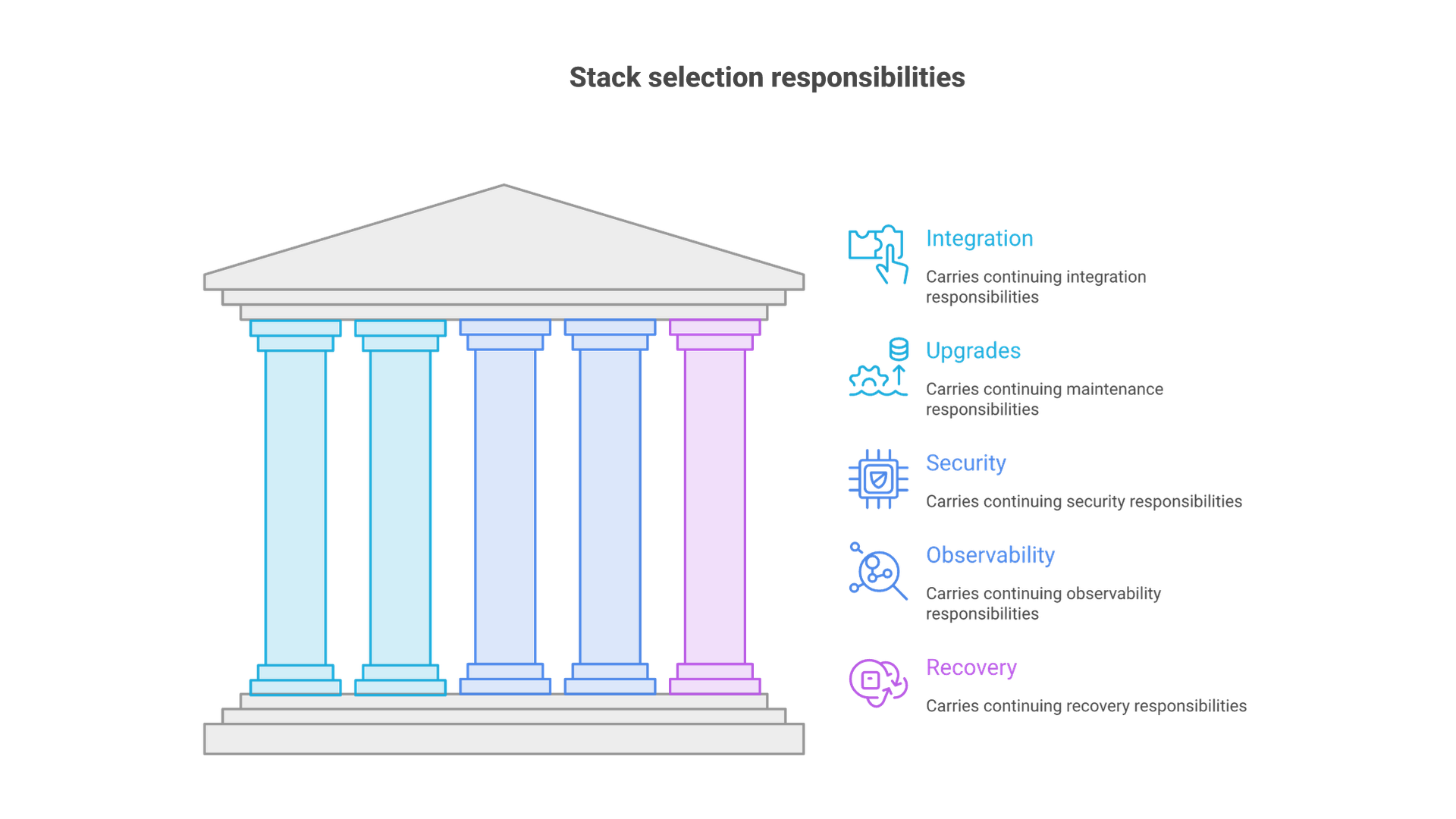
Include deployment, identity, secret management, logging, monitoring, backups and dependency maintenance in the stack decision. Name the team that owns each. A technology without an operating owner is a liability even when the library itself is well maintained.
Define what evidence will diagnose a slow request or a failed integration. Correlate application activity across relevant components without recording credentials or unnecessary personal data. Test restoration using representative nonproduction data so recovery is more than a checklist item.
Popular Tech Stacks and the Selection Process
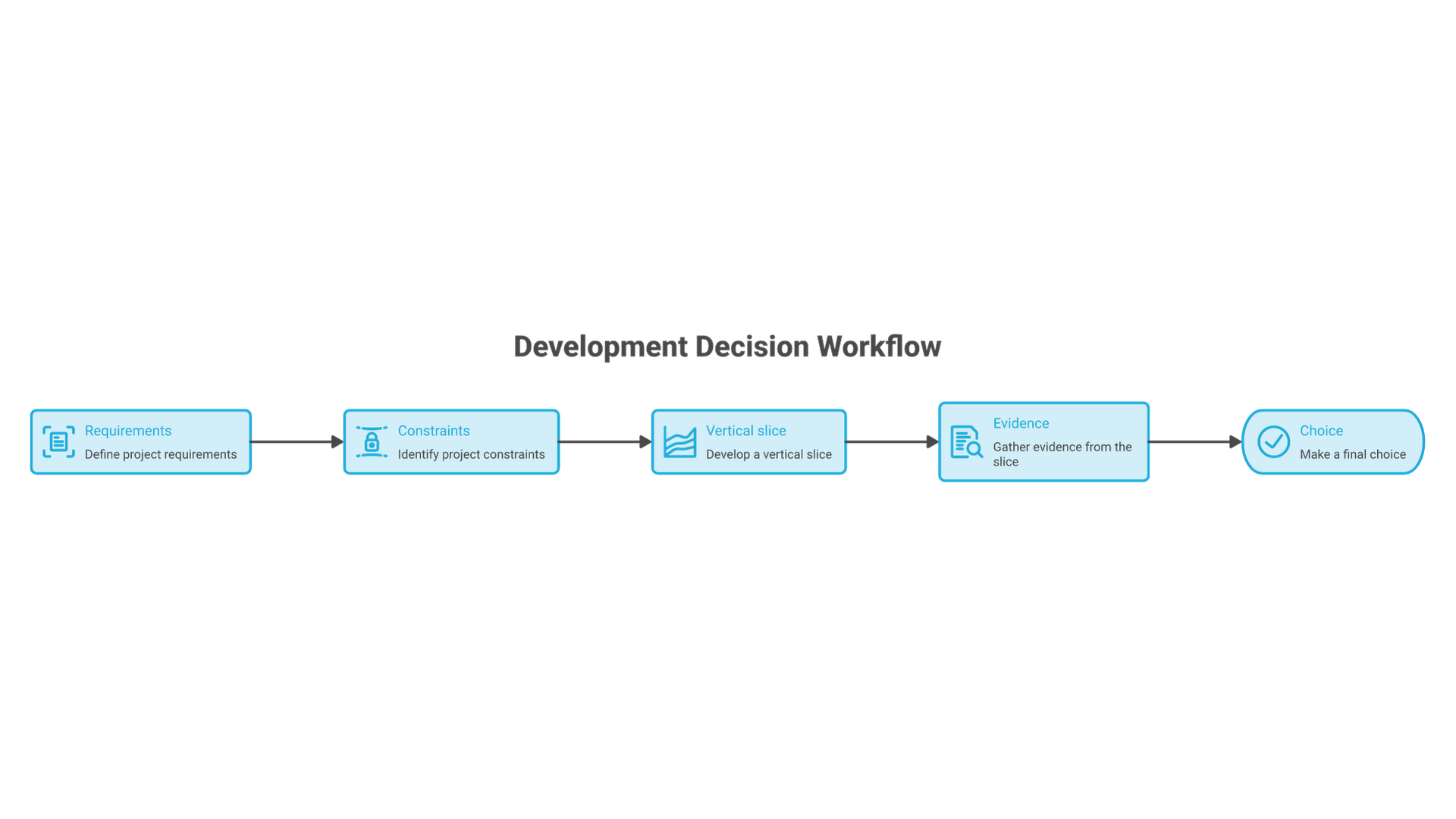
Step-by-Step: Tech Stack Selection
- Define requirements. Record workflows, data relationships, expected load, latency needs, integrations, access constraints and the delivery timeline. Distinguish a measured requirement from a guess.
- Assess team expertise. Identify what the team can build and support today, what it can learn within the schedule and where it depends on a single specialist.
- Check maturity and support. Review maintained releases, dependency health, licensing and upgrade expectations. Community size is useful context, not proof of fit.
- Test integration compatibility. Confirm the authentication, data formats and supported client libraries for critical systems. A connector's existence does not settle error handling.
- Prototype the uncertain part. Use the same realistic workflow and data shape across the viable options. Include operational tasks, not just a homepage and a successful API request.
- Record the decision. Explain the alternatives, evidence, accepted risks and conditions that would justify revisiting the choice.
Comparison: Popular Tech Stack Options
| Stack and composition | A reason to shortlist it | A reason to pause |
|---|---|---|
| MEAN: MongoDB, Express, Angular, Node.js | The team knows Angular and the document model fits the application's aggregates. | Angular or MongoDB is being selected only to complete the acronym, without testing the interface and data constraints. |
| MERN: MongoDB, Express, React, Node.js | React is an established team capability and the backend and data choices fit independently. | Routing, rendering, authorization and operation are assumed to come automatically with a React interface. |
| LAMP: Linux, Apache, MySQL, PHP | A supported PHP application and known hosting model satisfy the required workflows. | A critical dependency is unsupported or the team cannot maintain the actual framework or CMS. |
| Django-based: Python and Django, plus chosen storage and hosting | The application benefits from Django's data and administration conventions and the team can support Python. | The prototype has not tested a critical interaction, integration or workload outside those conventions. |
| .NET-based: C# and ASP.NET Core, plus chosen storage and hosting | Existing C# expertise and integration needs make the implementation and support model practical. | The full operating cost or a required deployment dependency is unresolved; the platform name alone is not a cost estimate. |
Django's overview demonstrates its model, view, URL and administration concepts. That is a capability description, not evidence that every data-heavy application will be fastest to build with Django.
.NET has no platform licensing cost, including for commercial use. Paid tools, support, databases or hosting can still affect a particular solution's cost. Compare those actual costs rather than assigning a blanket “higher licensing” rating to the platform.
Similarly, none of these names establishes an application's scalability or performance. Query design, data volume, caching, network behavior, concurrency and operational tuning can dominate the result. Compare defined implementations under a relevant workload, not “high” and “excellent” labels in a generic table.
A Representative Prototype, Not a Beauty Contest
Consider a hypothetical internal order-review application. It needs authenticated access, a filtered order list, a controlled status change, an audit record and an export. One option uses Django and PostgreSQL; another uses the team's existing ASP.NET Core stack. Neither should win because of its name.
Implement the same vertical slice in both only if the uncertainty justifies that cost. Use equivalent data, record assumptions and test the slowest expected query. Include an unauthorized request, an invalid transition, a duplicate submission and an export large enough to reveal the intended workload behavior.
Record development effort, unresolved defects, response-time measurements under the stated load, resource use and operating tasks. Keep a distinction between a measured result and a predicted production outcome. Do not turn a small prototype into a universal performance claim about a language.
Apply nonnegotiable constraints before scoring preferences. If an option cannot meet a required deployment or data-handling condition, a high weighted score should not conceal that failure. For the remaining options, record the criteria weights and evidence so another reviewer can understand the tradeoff.
Common Challenges and Solutions
Technology Lock-in and Vendor Dependence
Open source does not automatically eliminate lock-in, and a managed service is not automatically a poor choice. Lock-in can come from a proprietary API, difficult data migration, specialized team knowledge or the way business logic is embedded in a platform.
Prioritize the exits that matter. Test exporting core records and attachments, document important contracts and isolate a high-risk provider integration where that reduces real migration cost. Avoid building generic abstraction layers around every library merely to promise theoretical portability.
Scaling Performance Bottlenecks
Measure before restructuring. A slow page may reflect an inefficient query, excessive data transfer or a synchronous dependency. Address the observed limit and repeat the same measurement so the improvement can be evaluated.
Microsoft's microservices architecture guidance describes both independently deployable services and the additional design and operating complexity. Microservices are not a default answer to growth. Use them when boundaries, team ownership and independent operation justify the cost.
Likewise, caching, sharding and load balancing solve different problems. A cache needs an invalidation policy; sharding affects queries and operations; a load balancer does not remove a shared database bottleneck. Make those consequences part of the decision.
Team Skill Gaps and Hiring
Evaluate the actual team and hiring context rather than assuming a popular language guarantees available expertise. Check who can review changes, respond to incidents and upgrade the system. One enthusiastic developer is not a long-term support plan.
Adopt unfamiliar technology where its benefit is meaningful and the learning plan is realistic. Pair work, clear examples and a bounded first use can reduce uncertainty. Avoid migrating an entire stable application just to practice a new framework.
Conclusion and Next Steps
Begin with an inventory of requirements, existing systems and operating responsibilities. Shortlist only plausible options, test the most consequential uncertainty and record why the selected combination fits. Revisit the decision when the underlying evidence changes, not whenever a new stack becomes fashionable.
When the problem involves an existing product, Cognativ's software engineering services are a relevant place to discuss architecture and implementation needs. Bring the constraints and observed failure points so the conversation can evaluate an incremental change as seriously as a replacement.
Additional Resources
Use the linked primary documentation to verify technology capabilities and supported versions. For a selected stack, extend that review to its deployment target, identity provider, data recovery process and dependency support policies. The result should be a maintainable system with understood tradeoffs, not a longer technology inventory.