

What Is a Local LLM? Deployment, Privacy and Cost Explained
A local large language model (LLM) generates responses on hardware you operate rather than sending inference requests to a hosted model provider. That hardware can be your laptop, a workstation or a server on your organization's network.
A local large language model (LLM) generates responses on hardware you operate rather than sending inference requests to a hosted model provider. That hardware can be your laptop, a workstation or a server on your organization's network. The defining feature is where inference happens, not whether the interface looks like a chat application.
Local deployment gives you choices about data handling and model versions, but it also makes you responsible for capacity, updates and access. It does not make generated answers accurate, remove license obligations or automatically establish compliance. The useful question is whether a specific local configuration meets your task and operating requirements.
The Model, Runtime and Application Have Different Jobs
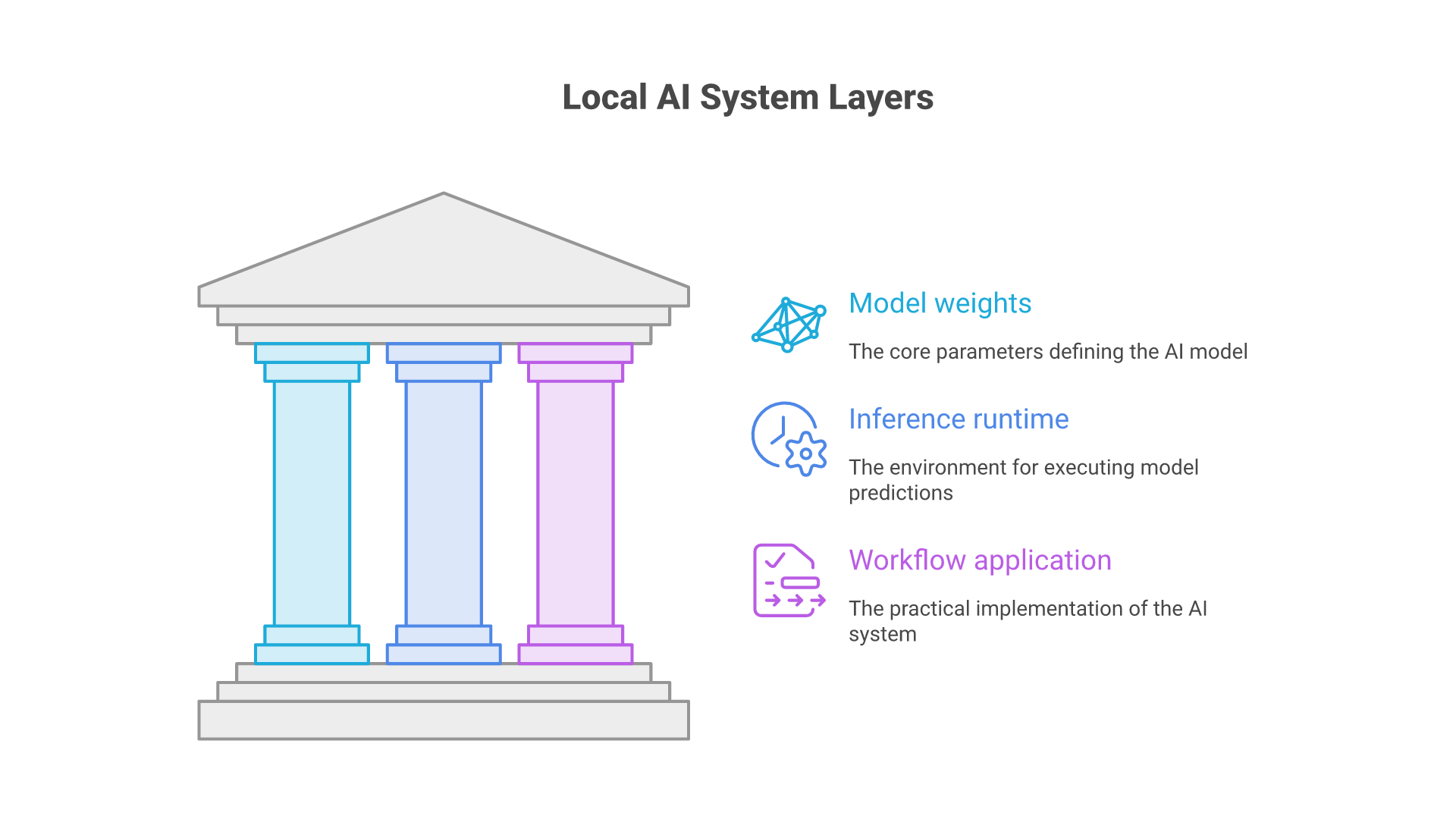
The model is a set of learned parameters, or weights, used to generate output from an input sequence. A runtime loads those weights, handles the supported model format and carries out inference. A client application supplies the prompt and displays the result. A retrieval component may add document passages, while optional tools can perform actions outside the model.
For example, Ollama provides model execution and an API, while LM Studio provides a desktop interface and local serving capabilities. An application framework can connect retrieval or tools to either local or hosted inference. These are different layers, not interchangeable model names. Diagnose each separately: an irrelevant answer may come from missing context, not a faulty installation.
Also distinguish local, on-premises and air-gapped. A laptop model is local to its user. A company-operated server can be on-premises while serving several network clients. An air-gapped system has a deliberately isolated operating environment and controlled transfer process; installing a local model on an internet-connected computer does not create one.
Local Versus Hosted LLMs: Compare the Whole Workflow
| Decision | Local inference | Hosted inference |
|---|---|---|
| Inference data path | Requests go to your operated runtime; other components still need inspection. | Requests reach the provider under its service and data terms. |
| Capacity | You size hardware, context and simultaneous requests. | You work within service limits, availability and pricing. |
| Updates | You can retain an exact local artifact, but must maintain its dependencies. | Version selection and retirement depend on the provider's offering. |
| Offline work | Possible when required files and all task dependencies are available locally. | A remote inference request needs connectivity. |
| Cost | Hardware allocation, power, maintenance, review and failures. | Usage charges, integration, review and service management. |
| Quality | Evaluate the exact model, representation and application on the task. | Evaluate the exact service configuration on the same task. |
A hybrid application can route selected tasks to each environment, but that is an explicit design decision. A timeout must not silently send confidential content to a hosted fallback. Define which data may cross the boundary, who approves that route and what happens when the approved service is unavailable.
Example: Summarizing an Internal Procedure
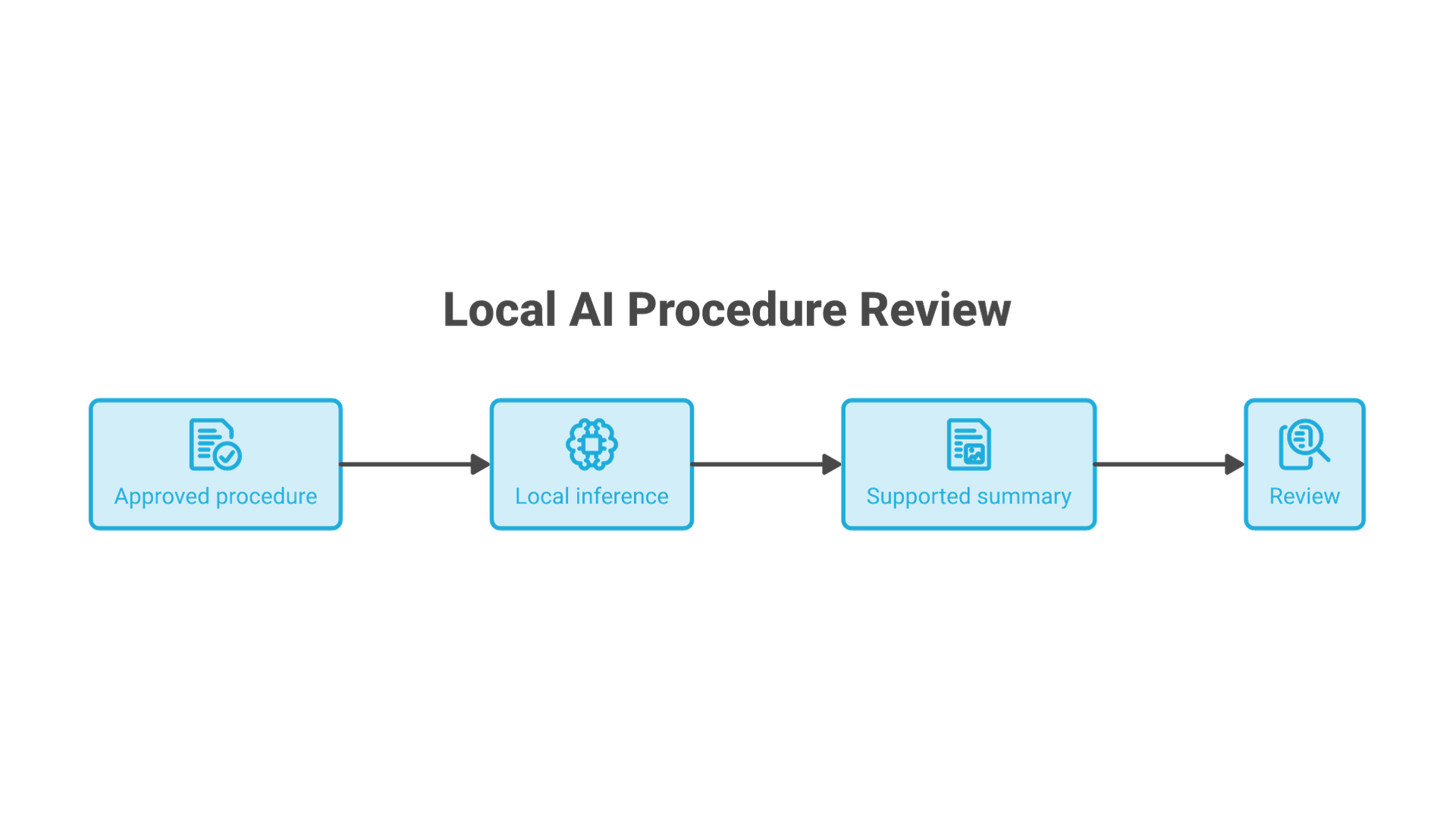
Consider a hypothetical team that wants short summaries of maintenance procedures. Its first evaluation uses a synthetic document describing three inspection steps and an unresolved equipment identifier. The expected answer includes the steps and reports the identifier as unknown. It must not invent an equipment number or turn an ambiguous note into an authorized maintenance action.
The application first extracts the relevant passages. Those passages and the task instructions reach the local runtime, which returns a proposed summary. A reviewer checks the result against the document. The team records unsupported statements, omitted steps, time to a usable answer and corrections. No customer or employee records are needed for this initial test.
For a larger document collection, retrieval can select passages at request time. That is different from fine-tuning: retrieval supplies information for the current answer, while fine-tuning changes model parameters. Keep document permissions in the retrieval layer, retain source references and test what happens when the answer is not in the available documents. A citation-shaped string is not proof that the cited passage supports the answer.
The same distinction applies to code explanation, drafting and text classification. Define the allowed inputs and a checkable result first. Medical, financial or legal decisions need domain-specific assessment and qualified oversight; the deployment location does not establish suitability for those uses.
Choose Hardware and Models Together
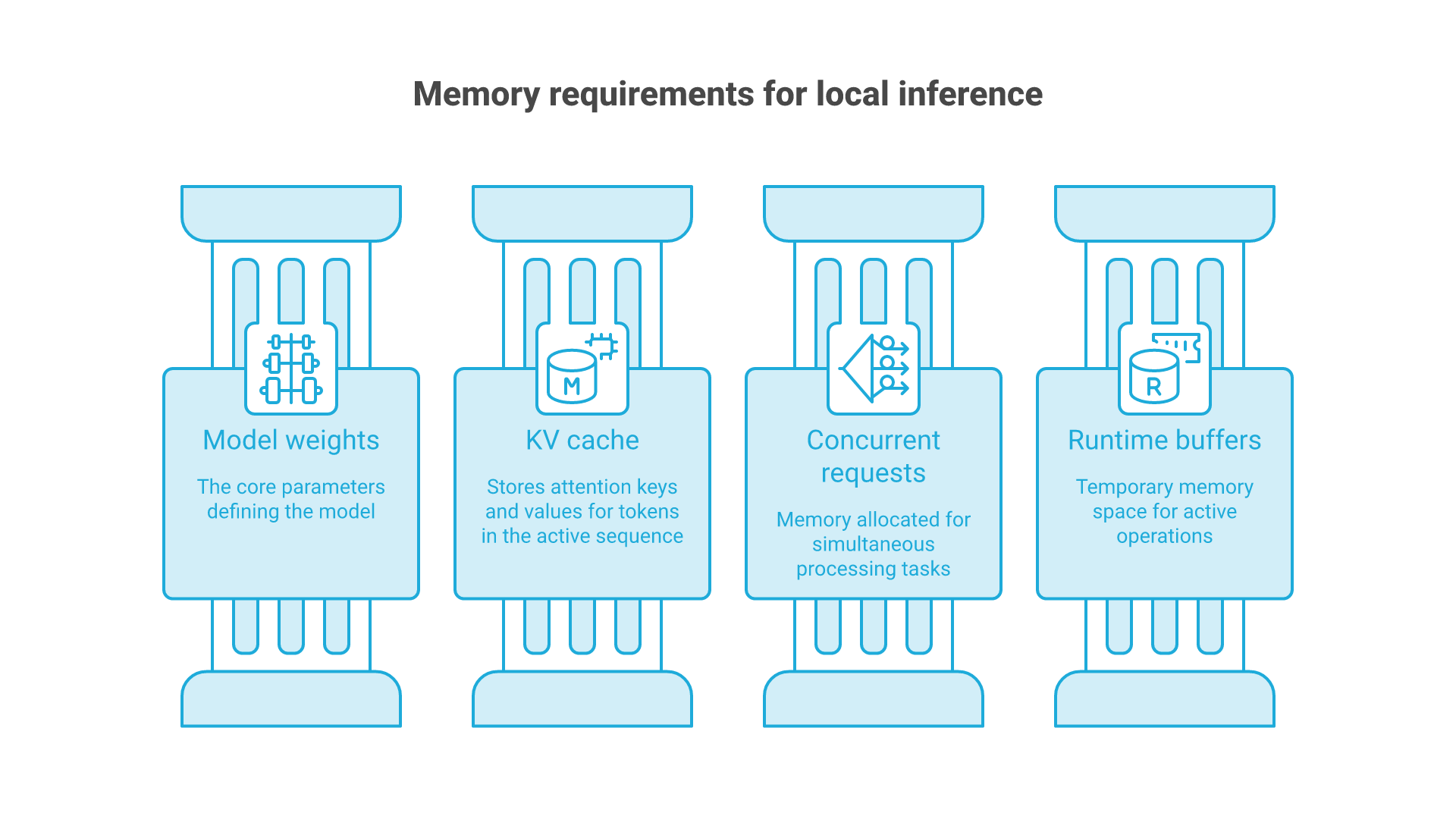
There is no universal RAM or GPU minimum for a local LLM. Required memory depends on the model's total weights, their representation, the runtime, input and output length, and concurrent requests. A model that loads for a short conversation may fail when several users submit long documents. System RAM, dedicated GPU VRAM and unified memory describe different resource arrangements.
Quantization reduces the precision used for some model data and can lower memory requirements, with implementation and quality tradeoffs. GGUF is a file format, not a precision level. The llama.cpp project documents supported inference backends and model handling. Verify the selected architecture and representation in the runtime you intend to use.
Shortlist exact checkpoints instead of relying on family names such as Qwen, Llama or Mistral. Record the publisher, revision, license, intended task, runtime support and actual file size. A downloadable checkpoint is not automatically unrestricted software, nor does access to weights provide ownership of its training data. Confirm terms for the intended use and redistribution.
Begin with a bounded workload on hardware already available. Measure memory pressure, response time and task failures before buying a larger system. Fine-tuning has a separate resource budget for training state and activations; inference capacity alone does not demonstrate that a machine can train the same model.
What Local Execution Does and Does Not Protect
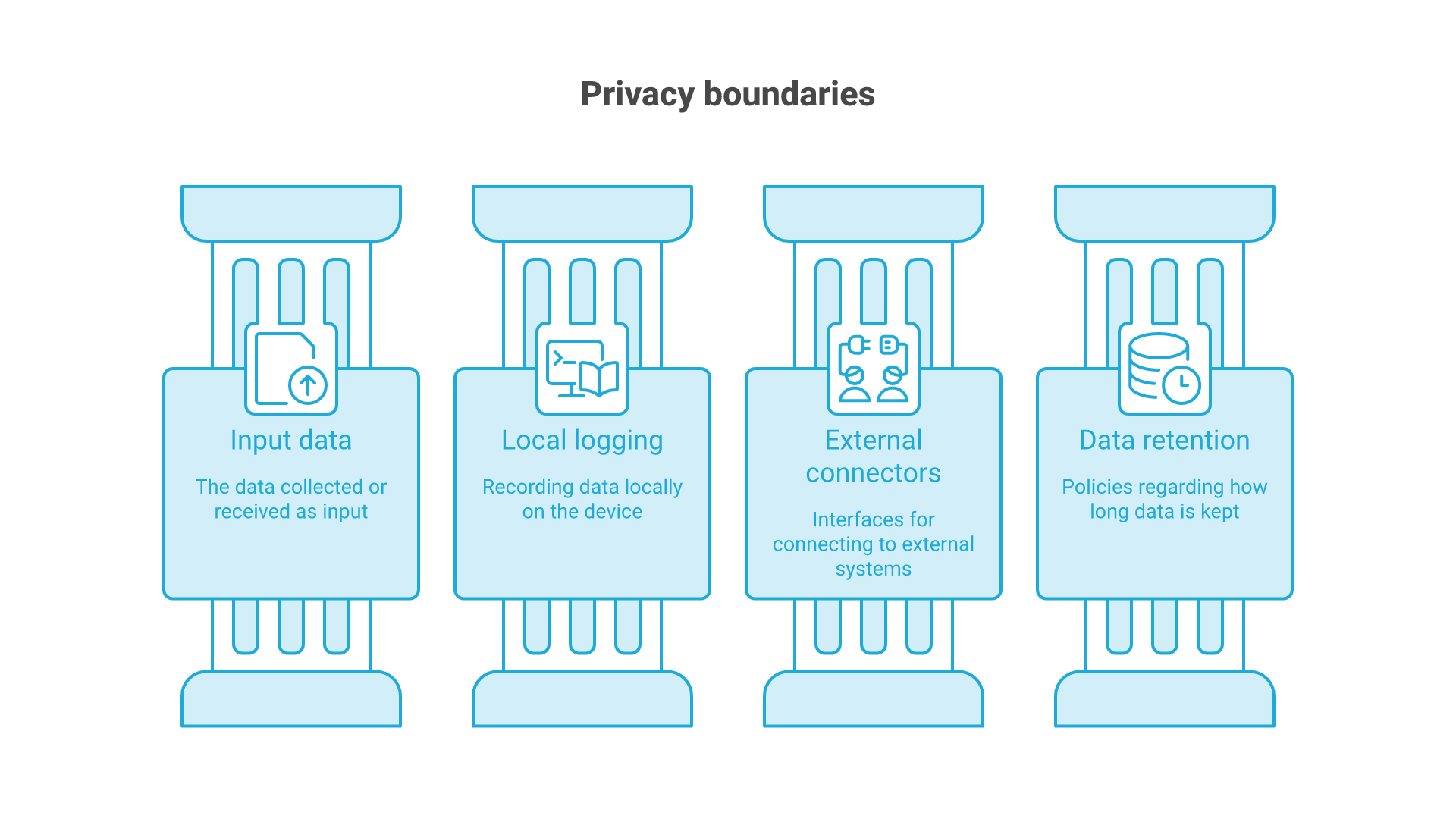
Review the complete route from input to retained output. An editor extension may call a remote service, a tool may search the web, and a backup client may synchronize local conversations. Logs can retain sensitive excerpts even when generation remains on your computer. Restrict file access, protect stored data and choose retention intentionally.
LM Studio's offline documentation separates downloaded-model use from online model search and download. Ollama's configuration documentation distinguishes local operation and cloud features. Check the installed application's configuration and dependencies rather than extrapolating one component's behavior to the entire workflow.
Test offline behavior only after approved files and software are present. Verify that the task still completes, and that optional remote features fail explicitly rather than altering the data route. For a shared server, authentication, network restrictions and request limits remain necessary. Model output is untrusted content; it must not grant itself permission to execute commands or access new files.
Calculate Cost per Accepted Task, Not Cost per Download
A useful comparison includes the same workload and quality requirement on both sides. Count hardware allocation, electricity, maintenance, integration and reviewer effort for local operation. Count usage charges and the corresponding integration and review effort for hosted operation. Include failed attempts: a cheap response that must be discarded is not completed work.
As a hypothetical calculation, suppose local hardware allocation and operation cost $300 for a month and the workload produces 600 accepted summaries. Infrastructure cost is $0.50 per accepted summary. If review takes 30 hours at an assumed $40 per hour, the combined amount is $1,500, or $2.50 per accepted summary. These invented inputs explain the calculation; they are not Cognativ results, market prices or a forecast.
Changing utilization changes the result. Ten users do not necessarily create ten simultaneous requests, while a scheduled batch may create a burst with no interactive users. Evaluate latency and capacity against actual arrival patterns. Scaling across machines also needs supported scheduling, networking and model execution; adding servers is not automatically a working distributed deployment.
A Practical Adoption Decision
- Choose one task, permitted dataset and acceptance criteria.
- Map every component that receives or stores inputs.
- Select an exact supported checkpoint and record its configuration.
- Test normal, missing-information and failure cases.
- Measure quality, latency, memory and full operating effort.
- Assign responsibility for updates, incidents and re-evaluation.
Keep the configuration if it meets the requirement with an operating burden the team can sustain. If the answer quality is poor, investigate task definition, context and model fit before assuming that more hardware will fix it. If the data policy cannot be enforced, do not expand the pilot to sensitive information.
For the wider application and integration decisions, see Cognativ's artificial intelligence services. Local deployment is a component of that system, not a substitute for its design.