AI Readiness Assessment: A Strategic Framework for Mid-Market Teams
Most AI initiatives don't fail because the technology is wrong. They fail because organizations start building before confirming whether their business case, data, architecture, governance, and ownership conditions can support what they're trying to do. An AI readiness assessment is the structured process of evaluating those conditions before committing significant resources.
This guide covers how mid-market technology, operations, data, and business leaders can assess their organization's preparedness for AI across six practical dimensions. It is designed for teams evaluating whether a specific AI initiative is ready to move forward-or whether foundational work needs to happen first. The scope is diagnostic, not strategic: we focus on what you need to evaluate, not on which AI technologies to choose.
An AI readiness assessment evaluates an organization's ability to connect a valuable business problem with usable data, appropriate architecture, controls, accountable owners, and measurable evidence. It answers the question: "Can we actually do this well right now?"
By reading this article, you will gain:
-
A clear definition of AI readiness and how it differs from AI strategy and AI maturity
-
A structured approach to evaluating six critical readiness dimensions
-
A practical AI readiness checklist your team can use internally
-
The ability to identify gaps and interpret results to determine your next steps
-
Awareness of common readiness mistakes that undermine AI projects before they begin
Understanding AI Readiness Assessment
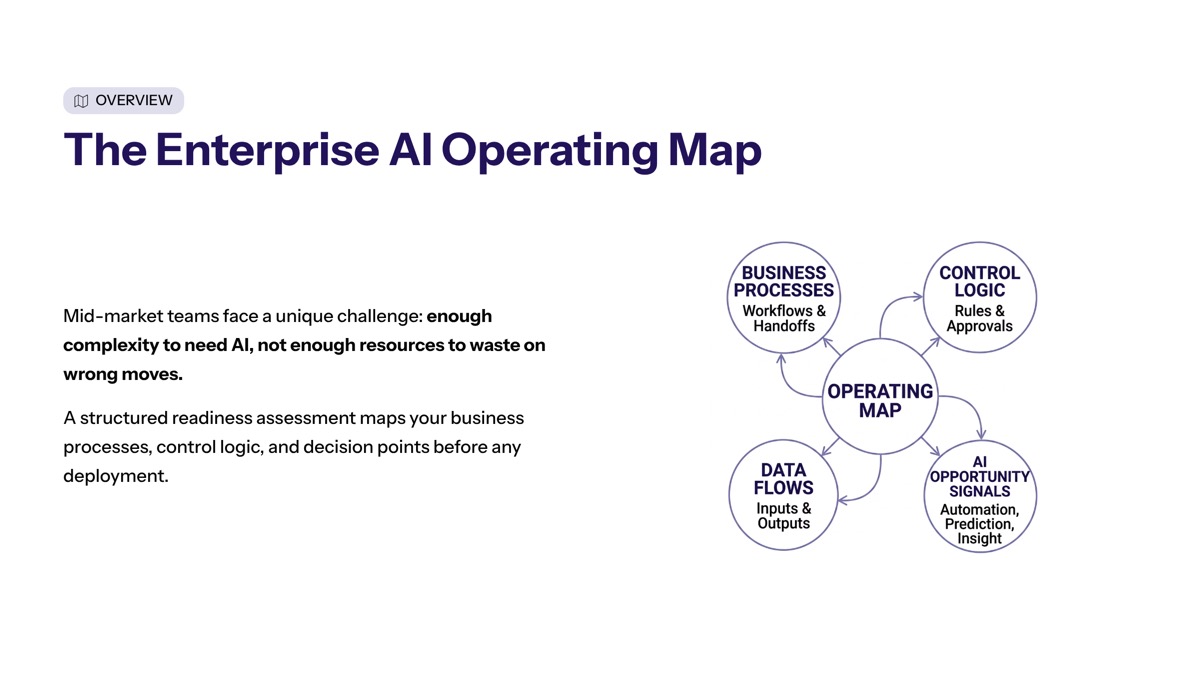
AI readiness assessment is more than checking whether your technology infrastructure can handle AI workloads or whether your team has access to data. It is a comprehensive assessment of the organizational capacity to successfully implement and scale AI solutions-spanning business alignment, data fitness, architectural integration capabilities, governance controls, ownership clarity, and measurement discipline.
Why does this matter before tool selection or pilot projects? Because without it, organizations routinely invest in AI tools that solve symptoms rather than problems, launch pilots that never scale, or discover governance and data quality issues only after significant spend. According to Make.com's research across 540 mid-market companies , 94% already use generative AI, yet only 2% have operationalized it at scale. That gap is a readiness problem, not a technology problem.
AI readiness assessments evaluate data, infrastructure, and talent-but they also measure preparedness across seven key pillars that include governance, cultural fit, and strategic alignment. The assessment examines culture, data, strategy, governance, and technology as interconnected elements, not isolated checklists.
Beyond Technical Prerequisites
Technology infrastructure alone doesn't determine readiness. An organization can have modern cloud architecture, access to leading AI models, and a team of data scientists-and still be unable to deliver AI value if business priorities aren't clear, data governance is absent, or no one owns the outcome.
Readiness connects technical capability to business value delivery. It asks whether the organization can move from "we built a model" to "this model is reliably improving a measurable business outcome with appropriate controls." AI readiness encompasses staff skills and strategic alignment alongside infrastructure and data. It also includes whether your culture supports adoption-culture assessment measures organizational openness to innovation and adaptation to AI workflows.
Readiness vs. Maturity vs. Strategy
These three concepts are related but serve different purposes:
-
AI strategy is about direction: where to invest, which use cases to pursue, how AI fits into business goals. 95% of organizations have developed or are developing an AI strategy-but having a strategy doesn't mean you're ready to execute it.
-
AI maturity models describe your current state along spectrums-data maturity, process maturity, governance maturity. They tell you where you are.
-
AI readiness assessment is diagnostic and gap-focused. It tells you whether you can successfully execute a specific initiative right now, and what must change if you can't.
Organizations should assess whether AI initiatives align with broader business goals for effective implementation. Readiness is the foundation that makes strategy executable. Without it, even well-crafted strategies stall at implementation. AI readiness frameworks help identify gaps and prioritize investments before those gaps become expensive failures.
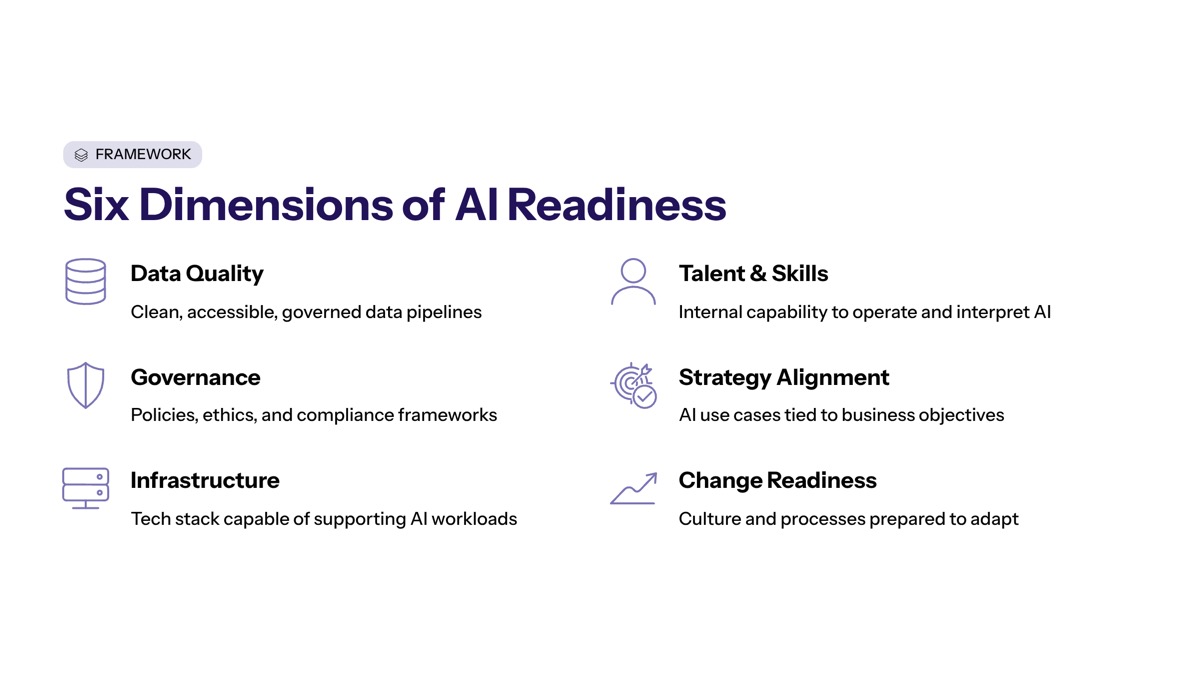
Six Dimensions of AI Readiness
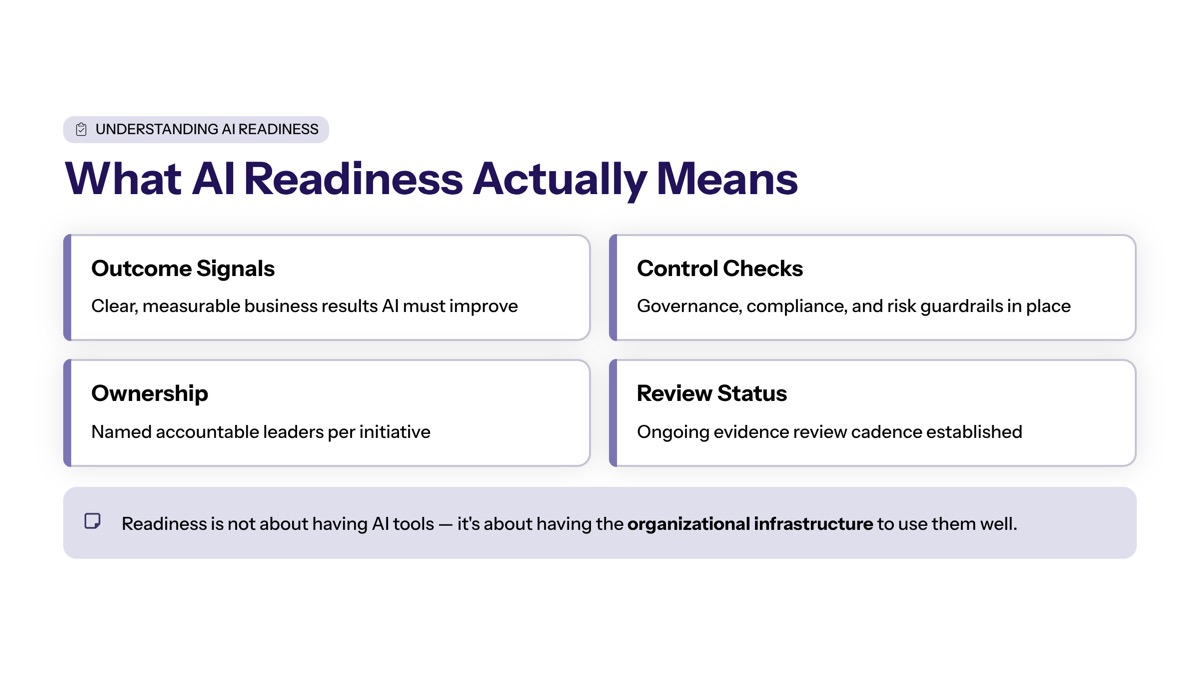
Six key areas determine whether an AI initiative can succeed. These dimensions interconnect-weakness in one often undermines strength in others. For example, strong data availability without governance creates risk; clear business value without ownership creates drift. A thorough readiness assessment evaluates all six.
AI readiness frameworks evaluate organizational preparedness for AI adoption across these core pillars, and seven key pillars define an organization's AI readiness when you include cultural readiness as a cross-cutting factor. AI readiness includes data readiness and infrastructure assessment, but extends well beyond them.
Business Value and Decision Clarity
Why it matters: Without a clear connection between AI capabilities and measurable business outcomes, AI projects become science experiments. Business value is the anchor that justifies investment, guides prioritization, and defines what success looks like.
Key questions leaders should ask:
-
What specific business problem are we solving, and how do we quantify its impact (cost reduction, revenue growth, risk reduction, cycle time improvement)?
-
Do we have documented success metrics linked to financial or operational outcomes?
-
Is executive sponsorship active-driving resource decisions-or nominal?
-
Are business units participating in setting AI priorities?
Warning signs:
-
Vague goals such as "use AI to improve efficiency" without defined metrics or owners
-
Pilot projects driven by technical curiosity rather than economics
-
No cross-functional steering committee; AI treated as purely an IT initiative
-
Business cases that cannot articulate ROI in terms the CFO would recognize
Evidence of readiness:
-
Documented use-case portfolio with estimated business value
-
Cross-functional team setting priorities, with leadership reviewing AI-linked KPIs
-
Clear decision criteria for which initiatives to fund, pause, or stop
Organizations that align AI initiatives with strategic goals build a clear path forward for sustained AI value. AI readiness frameworks align projects with strategic goals, ensuring that every initiative ties back to business priorities.
Data Availability and Fitness
Why it matters: AI systems depend on data quality, scope, accessibility, and governance. Poor data doesn't just reduce model performance-it introduces bias, compliance risk, and unreliable outputs. Data readiness is the foundational requirement that every other dimension depends on.
Assessment questions:
-
What data sources exist (structured tables, documents, logs, images, unstructured content) and how accessible are they?
-
How do we measure data quality-completeness, consistency, accuracy, timeliness?
-
What data governance controls exist: lineage tracking, metadata management, ownership, regulatory compliance?
-
Are unstructured and contextual data sources included for advanced AI work?
Warning signs:
-
Data silos with manual integration; low refresh rates
-
Missing metadata, inconsistent definitions, no documented ownership
-
High volumes of missing or incorrect data with no lineage tracking
-
Assumption that having data equals having usable data- Accenture reports that 72% of organizations do not have trusted data of the right quality and governance for advanced AI
Evidence of readiness:
-
Data catalogs with formal metadata and documented lineage
-
Automated quality controls with measurable benchmarks (e.g., completeness rates, duplicate detection)
-
Data pipelines that include unstructured sources and are accessible to AI models
Data governance evaluates data quality, cleanliness, structure, and compliance with regulations. The ODI's framework for AI-ready enterprise data defines 21 actionable criteria across dataset design, metadata, infrastructure, and governance-a useful benchmark for evaluating your data foundation. AI readiness fosters a culture of data literacy across the organization when data fitness becomes a shared priority.
Empirical work supports automated approaches: one study on automated data quality governance showed improvement from 97.46% to 99.11% data quality across multiple dimensions, with validation time reduced by 95% in a multi-source e-commerce dataset ( Singh, 2026 ).
Architecture and Integration
Why it matters: Your technology infrastructure must support AI workloads-model training, inference, real-time data pipelines-and integrate with existing business processes. Legacy systems or disjointed architecture create friction, cost, and risk that no amount of model quality can overcome.
Key questions:
-
Do we have cloud or hybrid infrastructure capable of AI compute, storage, and network demands?
-
Are systems and data sources integrated or interoperable? Can we support real-time or near-real-time pipelines?
-
How modular and flexible is our architecture for adopting new AI capabilities?
-
Do we have versioning, model monitoring, and deployment/rollback support?
Warning signs:
-
Monolithic legacy systems with high latency and no API layer
-
No standard deployment pipeline or CI/CD for machine learning; no monitoring of drift or performance in production
-
Infrastructure costs unknown or unbudgeted; no scalable compute resources
-
AI integration treated as an afterthought rather than an architectural requirement
Evidence of readiness:
-
Cloud adoption with defined MLOps or AI ops pipelines and orchestration platforms
-
Documented integration patterns with decoupled services and API gateways
-
Monitoring, logging, and fallback mechanisms in place with deploy/test/revert processes
Infrastructure assessment reviews existing IT systems' capacity for AI workloads. Without architectural readiness, even well-built AI models cannot reach the business processes they need to improve.
Governance, Security, and Risk
Why it matters: AI deployment creates risks around data privacy, bias, regulatory compliance, and misuse. Governance must be designed before deployment, not retrofitted after something fails. AI readiness reduces risks related to compliance and ethics when governance is embedded from the start.
Assessment questions:
-
Are policies in place for responsible AI-bias mitigation, transparency, privacy, cybersecurity?
-
Who owns oversight? What decision rights, escalation paths, and audit trails exist?
-
How do you monitor for model drift, security vulnerabilities, and misuse?
-
Are compliance requirements (local laws, industry regulation) documented and accounted for?
Warning signs:
-
No governance framework, or only high-level documents without enforceable controls
-
Gaps in accountability: unclear who can pause systems, review outputs, or manage third-party AI model dependencies
-
Ethics, security, and risk evaluated only at deployment, not continuously
-
Governance frameworks lagging behind AI adoption -common across mid-market firms
Evidence of readiness:
-
Documented, implemented governance framework aligned with standards such as NIST AI RMF, ISO/IEC 42001, or the EC-Council's ADG framework (Adopt·Defend·Govern with 12 minimum controls)
-
Tested incident response processes; defined risk tolerances and thresholds
-
Continuous monitoring of performance, fairness, and human oversight mechanisms
Ethics assessment reviews frameworks for bias mitigation, transparency, and cybersecurity risks. AI readiness frameworks include components like governance and infrastructure as non-negotiable requirements, and governance readiness is increasingly critical as regulatory pressure from the EU AI Act, ISO standards, and NIST frameworks continues to expand.
Ownership and Operating Capacity
Why it matters: AI initiatives require accountable business owners, cross-functional talent, and operational capacity to sustain results over time. Without clear ownership, projects stall, scope creeps, and models degrade post-implementation.
Key questions:
-
Do we have leaders and teams assigned to own specific AI use cases, data pipelines, and production models?
-
Is there dedicated budget for AI work-tools, infrastructure, hiring, and training?
-
What skills do we currently have vs. what's required (data science, ML engineering, AI ops, governance, domain expertise)?
-
What is our change management and adoption plan? Are downstream users ready?
Warning signs:
-
No clear owner; responsibility diffused across multiple people without anyone "on point"
-
Critical skill gaps with dependency on external consultants and no internal knowledge transfer
-
Budget unclear or not allocated to sustain post-pilot operations
-
No plan for user adoption or training; resistance among business units
Evidence of readiness:
-
Named business and technology owners with published resourcing plans
-
Internal capability map documenting existing skills vs. requirements
-
Established cross-functional teams spanning data, engineering, operations, legal, and compliance
-
Dedicated teams with clear roles and decision authority
Talent assessment identifies existing expertise and necessary training or hiring gaps. AI readiness encompasses staff skills and strategic alignment, and without operating capacity, even a well-governed, data-rich organization cannot sustain AI success.
Measurement and Evidence
Why it matters: If you can't measure AI's business impact, you can't justify continued investment, learn from outcomes, or steer initiatives toward value. Measurement connects technical performance to the business outcomes that matter.
Assessment questions:
-
What key performance indicators link AI activity to business outcomes (cost saved, revenue uplift, error reduction, cycle time improvement)?
-
Do we have performance metrics for AI systems (accuracy, precision, recall, drift, fairness)?
-
Is there monitoring in production with feedback loops for model performance and real-world impact?
-
How are decisions about model management evaluated and documented?
Warning signs:
-
Metrics focus only on technical parameters (model accuracy, latency) without connection to business outcomes
-
No monitoring post-deployment; no tracking of model drift or fairness degradation
-
No feedback from users; no mechanism for continuous improvement
-
Success defined as "we launched" rather than "we delivered measurable value"
Evidence of readiness:
-
Dashboards tracking business metrics and technical performance side by side
-
Baselines established with ongoing monitoring of both value delivered and system performance
-
Structured reviews, retrospectives, and incident reports with ability to pause or rollback underperforming AI models
An effective assessment provides a clear roadmap for AI implementation and ROI measurements. Without measurement readiness, organizations cannot distinguish between AI projects that deliver value and those that consume resources without results.
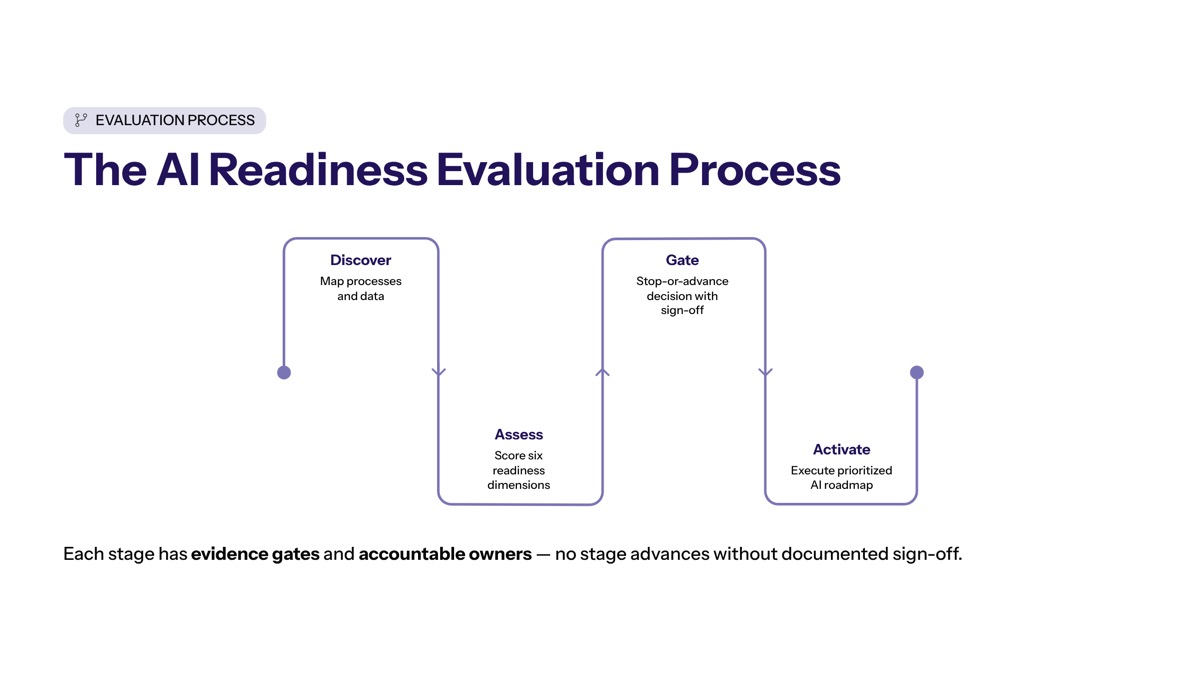
AI Readiness Evaluation Process
With the six dimensions defined, the next step is conducting a structured approach to evaluation. The goal is to assess your current state honestly, identify gaps, and make an informed decision about what to do next.
Readiness Assessment Framework
A practical evaluation process follows this sequence:
-
Assemble a cross-functional assessment team. Include representatives from data, engineering, operations, legal/compliance, and business units. Ensure leadership is involved to provide decision clarity and resource alignment.
-
Evaluate business value first. Start by confirming that the proposed AI initiative connects to a quantifiable business problem. If this dimension is weak, the remaining five are premature.
-
Assess each remaining dimension systematically. Use the questions, warning signs, and evidence criteria from each section above. Gather internal artifacts: data catalogs, existing dashboards, documented strategies, model inventories, incident logs, governance policies.
-
Document findings per dimension. For each area, note current state, evidence supporting readiness, identified gaps, and dependencies between dimensions.
-
Involve key stakeholders in review. Present findings to business and technology leaders together. Readiness is an organizational determination, not a technical one.
-
Determine readiness state and plan next steps. Use the interpretation framework below to decide whether to proceed, prepare, or pause.
Assessments can range from a focused self-evaluation completed in days to a deeper review spanning several weeks depending on organizational complexity. Some estimates suggest mid-market companies can close identified gaps in 3–6 months with focused effort.
Readiness Review Checklist
The following AI readiness checklist provides a practical internal tool for teams to evaluate their current state across all six dimensions. Rate each indicator based on available evidence.
|
Dimension |
Assessment Criteria |
Readiness Indicators |
Current State (Strong / Partial / Weak) |
Gap Priority |
|---|---|---|---|---|
|
Business Value & Decision Clarity |
Documented business problem with quantified impact |
ROI estimates, executive sponsor, cross-functional steering |
|
|
|
|
Success metrics defined and linked to outcomes |
KPIs in leadership dashboards; funded use-case portfolio |
|
|
|
Data Availability & Fitness |
Data sources identified and accessible |
Data catalog, metadata documentation, lineage tracking |
|
|
|
|
Data quality measured and managed |
Automated quality controls, completeness/consistency metrics |
|
|
|
|
Data governance in place |
Ownership assigned, compliance documented, privacy controls |
|
|
|
Architecture & Integration |
Infrastructure supports AI workloads |
Cloud/hybrid capacity, scalable compute, network adequacy |
|
|
|
|
Systems integrated and interoperable |
API layer, real-time pipelines, documented integration patterns |
|
|
|
|
Deployment and monitoring capabilities |
MLOps pipeline, versioning, drift monitoring, rollback process |
|
|
|
Governance, Security & Risk |
Responsible AI policies documented |
Ethics framework, bias mitigation, transparency policies |
|
|
|
|
Accountability and oversight defined |
Decision rights, escalation paths, audit trails |
|
|
|
|
Compliance requirements mapped |
Regulatory requirements documented, risk tolerances set |
|
|
|
Ownership & Operating Capacity |
Business and technology owners named |
Published resourcing plan, cross-functional team established |
|
|
|
|
Skills assessed and gaps identified |
Capability map, training/hiring plan, budget allocated |
|
|
|
|
Change management planned |
User adoption strategy, training programs, stakeholder buy-in |
|
|
|
Measurement & Evidence |
Business-linked KPIs defined |
Dashboards connecting AI metrics to business outcomes |
|
|
|
|
Production monitoring active |
Model performance tracking, drift detection, feedback loops |
|
|
|
|
Review and learning processes |
Retrospectives, incident reports, pause/rollback capabilities |
|
|
This is not a proprietary readiness index-it's a diagnostic tool your team can adapt and apply internally. The value comes from honest evaluation and cross-functional discussion, not from achieving a particular score.
Interpreting Assessment Results
Assessment outcomes generally fall into three states:
Ready to investigate a bounded use case. Most dimensions show strong or partial readiness. The business case is clear. Data is accessible and governed. Architecture can support the workload. Governance controls exist. Owners are named. Measurement is planned. The organization can proceed with a focused initiative, monitoring closely and building evidence.
Needs targeted preparation. One or more dimensions show significant gaps-but they are identifiable and addressable. Common examples: data fitness needs improvement, governance policies need to be formalized, or ownership is unclear. The recommended approach is to address specific gaps before committing major investment. Use findings to build a comprehensive roadmap for remediation, sequencing work based on dependencies (e.g., you cannot build reliable measurement without ownership; you cannot implement governance without strategic alignment).
Not ready to fund implementation. Multiple dimensions are weak. Business case is unclear, data foundation is inadequate, governance is absent, no owners are assigned. Proceeding would likely result in failed pilots, wasted investment, or unanticipated risk. The first step is foundational work: clarify business value, assess data quality, assign accountability, and establish governance before evaluating specific AI applications.
79% of organizations feel urgency to adopt AI technologies, but urgency without readiness creates risk rather than value. AI readiness assessments measure preparedness across seven key pillars precisely to prevent this pattern. The AI Readiness Index measures preparedness across key areas to help organizations assess their current position honestly.
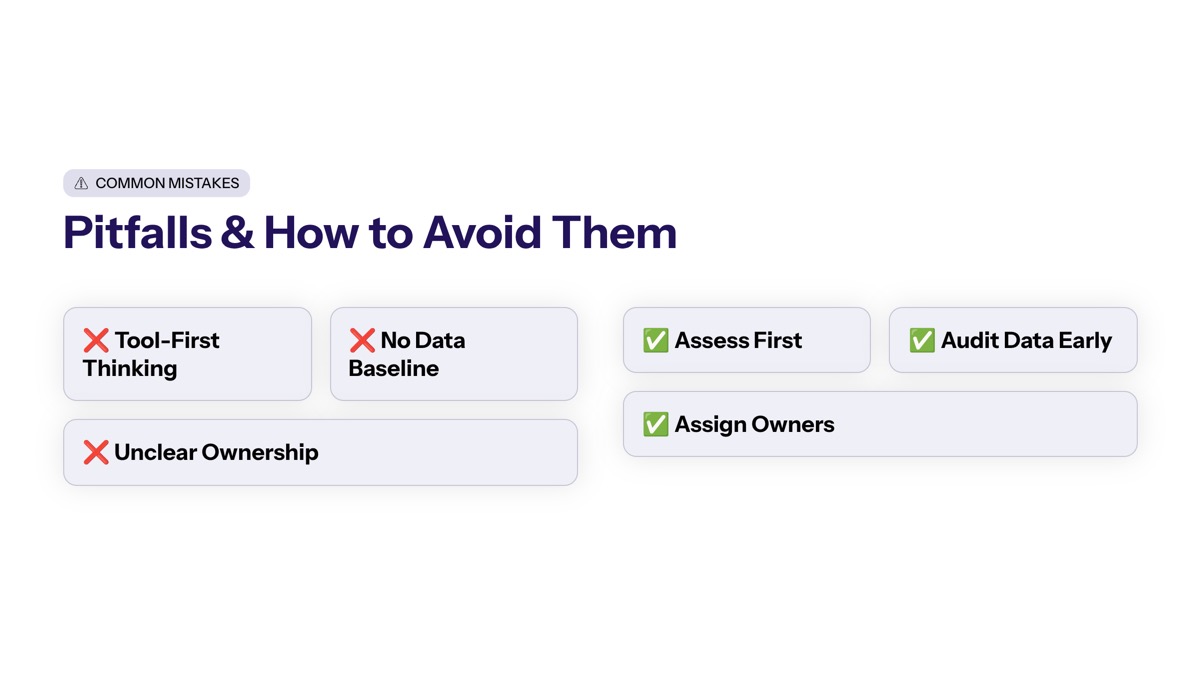
Common AI Readiness Mistakes and Solutions
Several recurring missteps undermine AI initiatives before they begin. Recognizing them during a readiness assessment-rather than after investment-saves time, budget, and organizational trust. Understanding common implementation challenges helps teams avoid repeating patterns that lead to stalled or failed AI projects.
Starting with Tool Selection
The mistake: Choosing AI tools or platforms before confirming whether the business problem, data, and operating conditions support them. This leads to solutions looking for problems.
The solution: Begin with business value and readiness assessment. Confirm the problem is worth solving, the data exists to support it, and the organization can operate the solution. Tool selection follows readiness, not the reverse. AI readiness enhances innovation and competitive advantage only when the foundation supports adoption.
Treating All Available Data as Usable Data
The mistake: Assuming that because data exists, it's ready for AI. Accenture's 2026 research found that while 64% of organizations have moved beyond pilots, only 7% have the data readiness foundation needed for advanced AI-a stark gap between data availability and data fitness.
The solution: Conduct rigorous data assessment covering quality, completeness, consistency, governance, accessibility, and lineage. Invest in data preparation and automated validation before feeding data into AI models. A strong data foundation is prerequisite, not optional.
Ignoring Integration and Identity Requirements
The mistake: Building AI solutions that can't connect to the systems, workflows, or identity controls they need to operate in production. This creates isolated capabilities that don't reach the business processes they were designed to improve.
The solution: Conduct early integration planning and architectural review. Map how AI outputs need to flow into existing systems. Confirm identity, access controls, and API capabilities before development begins.
Leaving Governance Until Deployment
The mistake: Treating governance, risk management, and ethical considerations as a final checkpoint rather than a continuous requirement. By deployment, technical debt, compliance gaps, and accountability voids are already embedded.
The solution: Establish your governance framework before pilot projects. Define decision rights, monitoring requirements, escalation paths, and risk tolerances early. Governance readiness is moving upstream across leading organizations-designed before deployment, not bolted on afterward.
Assigning No Accountable Business Owner
The mistake: AI initiatives owned by "everyone" are owned by no one. Responsibility split across committees or shared informally leads to drift, confusion, and stalled decisions.
The solution: Designate a specific business owner with decision authority, budget responsibility, and accountability for outcomes. Pair with a technology lead. Publish ownership clearly so the organization knows who drives decisions and who escalates issues.
Measuring Activity Instead of Business Evidence
The mistake: Tracking technical metrics (model accuracy, number of models deployed, latency) without connecting them to business outcomes. Teams report progress without evidence of value.
The solution: Define business-focused key performance indicators before development begins. Track business metrics and technical metrics side by side. Build feedback loops so measurement drives improvement, not just reporting. An effective assessment provides a clear roadmap for AI implementation and ROI measurements that tie directly to business goals.
Conclusion and Next Steps
AI readiness assessment is not a bureaucratic exercise-it's risk mitigation. It determines whether your organization can deliver successful AI implementation or whether foundational preparation needs to happen first. Evaluating business value, data fitness, architecture, governance, ownership, and measurement before committing major resources reduces the likelihood of failed pilots, wasted investment, and organizational distrust of AI.
79% of organizations recognize urgency to incorporate AI into operations, and 95% have developed an AI strategy. But the persistent gap between adoption ambition and operational readiness shows that strategy alone isn't enough. A structured readiness assessment closes that gap by giving leaders an honest view of what's working and what isn't.
Immediate next steps:
-
Use the readiness review checklist above to conduct an internal assessment across all six dimensions with your cross-functional team
-
Identify your weakest dimensions and determine dependencies between gaps
-
Classify your readiness state (ready to investigate, needs preparation, or not ready to fund) and act accordingly
-
Reassess periodically-quarterly or semi-annually-as data, technology, regulatory, and organizational conditions shift
To go further: Review Cognativ's AI Services to understand how structured AI implementation connects readiness findings to execution. For a detailed methodology on sequencing modernization and AI work, download the RAPID chapter to see how readiness assessment informs a clear path forward from evaluation to disciplined implementation.