Claude Fable 5.1: Anthropic's Most Advanced AI Model for Coding and Knowledge Work
Claude Fable 5.1 is an advanced AI model released by Anthropic on September 1, 2026, for demanding reasoning, long-horizon agentic work, and complex coding problems. It improves on Claude Fable 5 in reported benchmark performance, cache-read economics, and safeguard precision while introducing enterprise privacy options designed to address customer concerns about data custody.
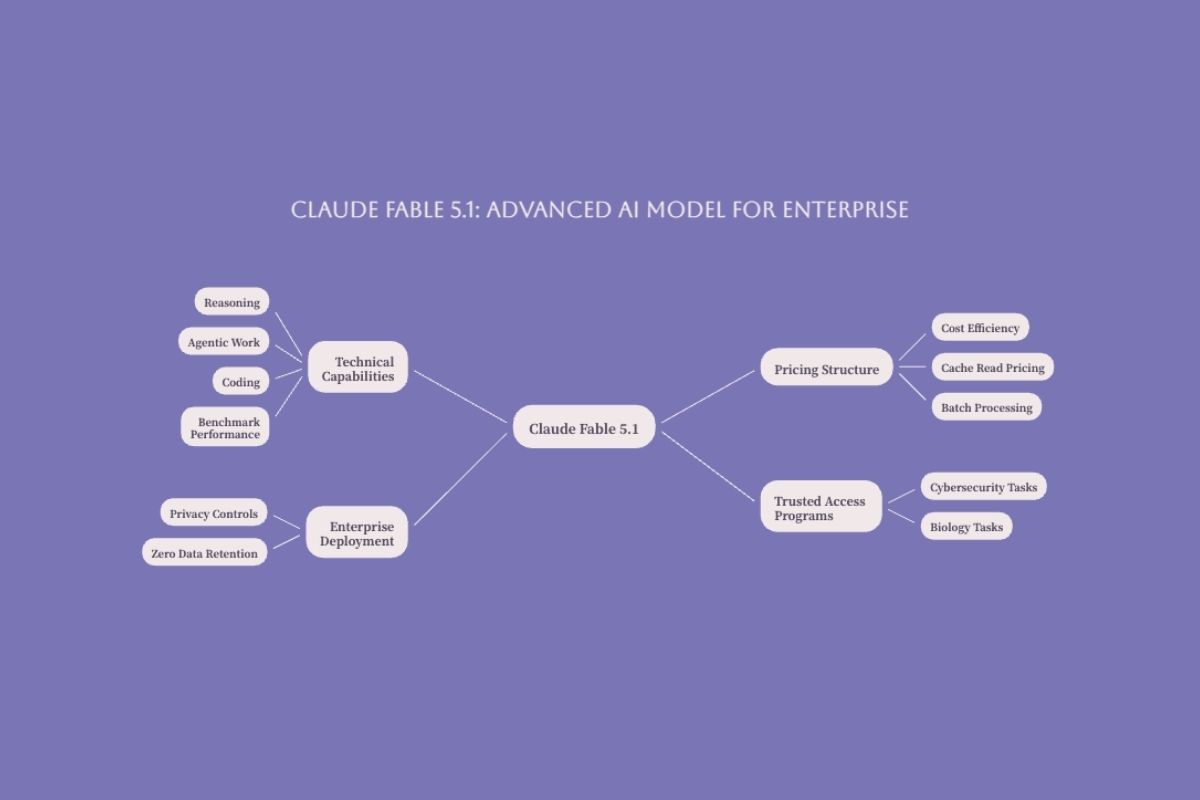
This guide covers Fable 5.1's technical capabilities, pricing structure, enterprise deployment options, and relationship to trusted access programs. It is written for enterprise developers, AI researchers, and technical decision-makers evaluating advanced models for production workflows. Claude Mythos 5.1 uses the same underlying model with more permissive safeguards, but access is limited to vetted participants. This article therefore discusses Mythos primarily where Anthropic attributes specialized cybersecurity and life sciences capabilities to it.
For teams evaluating the release, Anthropic estimates that Fable 5.1 reduces costs by around 25% for typical workloads and by up to approximately 45% for highly agentic workloads. Anthropic also reports a 52.6% score on Terminal-Bench-Science 0.1 and around 60% fewer cybersecurity safeguard interventions per Claude Code session than the safeguards used with Fable 5.
After reading this guide, you will understand:
-
How Fable 5.1's architecture and benchmarks compare to Fable 5, Claude Opus 5, and GPT-5.6 Sol
-
The pricing model, including the 75% reduction in cache read pricing and batch processing options
-
Enterprise Frontier Safeguards and zero data retention configurations
-
Scientific research applications from molecular design to computational biology
-
Implementation strategies for migration, cost optimization, and compliance
Understanding Claude Fable 5.1 Fundamentals
Claude Fable 5.1 is Anthropic's frontier Claude model for ambitious coding projects, long-running knowledge work, and multi-step research that requires sustained reasoning over extended sessions. Anthropic recommends starting most workloads with Claude Opus 5 and using Fable 5.1 when demanding reasoning, long-horizon agentic work, or workload-specific evaluations justify the higher-cost model.
Within Anthropic's model hierarchy, Fable 5.1 is its most capable generally available model and is available to Pro, Max, Team, and Enterprise users. Claude Mythos 5.1 offers the same underlying capabilities with more permissive safeguards for vetted cybersecurity and life sciences work. Fable 5.1 is available through the Claude Platform, Amazon Web Services, Google Cloud, and Microsoft Foundry; Mythos access remains restricted.
Core Architecture and Performance
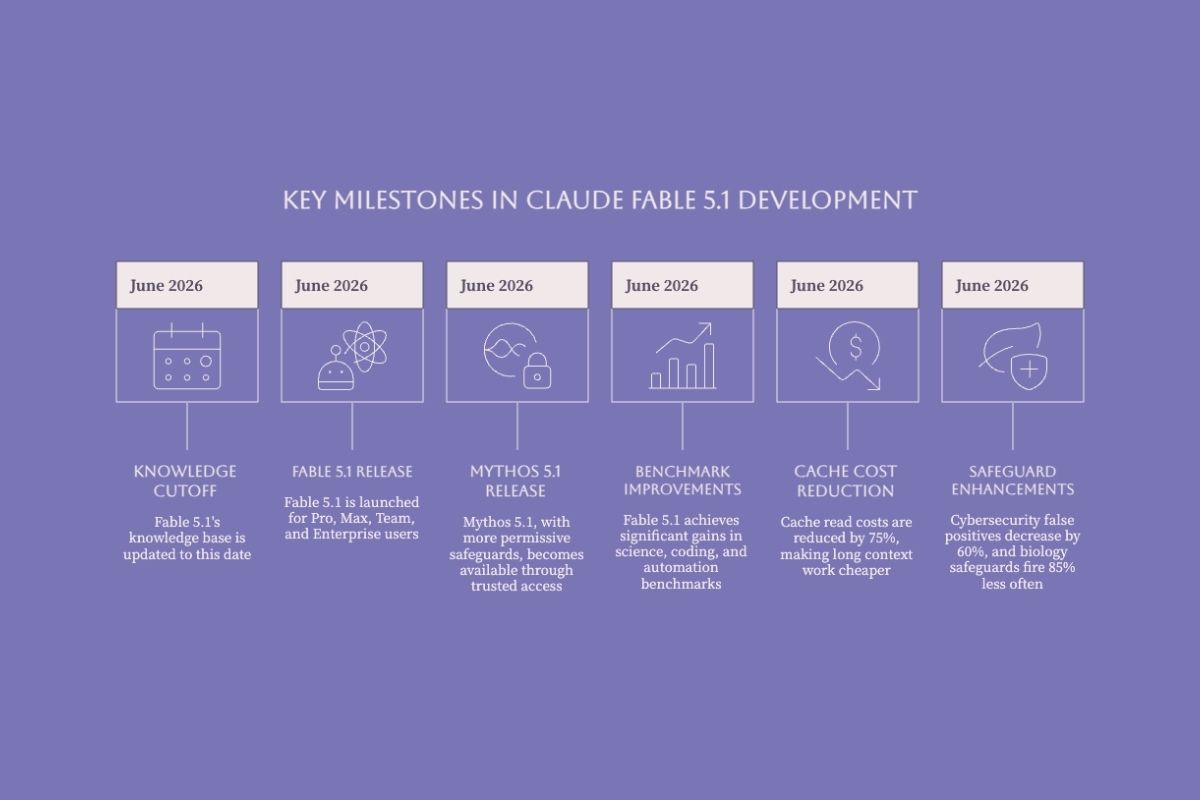
Claude Fable 5.1 processes information across a one-million-token context window with a maximum output length of 128,000 tokens and a knowledge cutoff of June 2026. Its adaptive thinking allows dynamic adjustment of reasoning effort levels based on task complexity-meaning the model allocates more computation to harder problems while handling simpler queries efficiently at low or medium effort settings.
The benchmark results demonstrate substantial improvements over its predecessor. The model scores 52.6% on Terminal-Bench-Science 0.1, more than double the previous version's 24.7% and well ahead of Opus 5's 29.0% and GPT-5.6 Sol's 22.4%. On Terminal-Bench 4.0 for agentic coding, Fable 5.1 reaches 55.8% (with Mythos 5.1 scoring 60.9%), compared to Fable 5's 42.0% and Opus 5's 52.3%. AutomationBench results for business workflows show 31.4%, nearly doubling Fable 5's 17.1%. On CursorBench 3.2.0, it achieves 73.4% versus 70.5% for Fable 5 and 70.0% for Opus 5.
These are Anthropic-reported benchmark results rather than guarantees for production workloads. Performance and cost vary by task, tooling, context, and effort setting, so organizations should validate the model against representative internal evaluations before selecting it for production use.
Key Differentiators from Previous Models
Enhanced reasoning depth. Claude Fable 5.1 is designed for long-running agent tasks, coding, complex reasoning, and research. It can plan multi-step work and recover when a step fails, but production workflows still require human-defined permissions, approval points, and review. An early-access partner at Millennium reported that Fable 5.1 found the cause of a rare crash that had remained unexplained for several years by disassembling an external vendor library and matching it against a core dump.
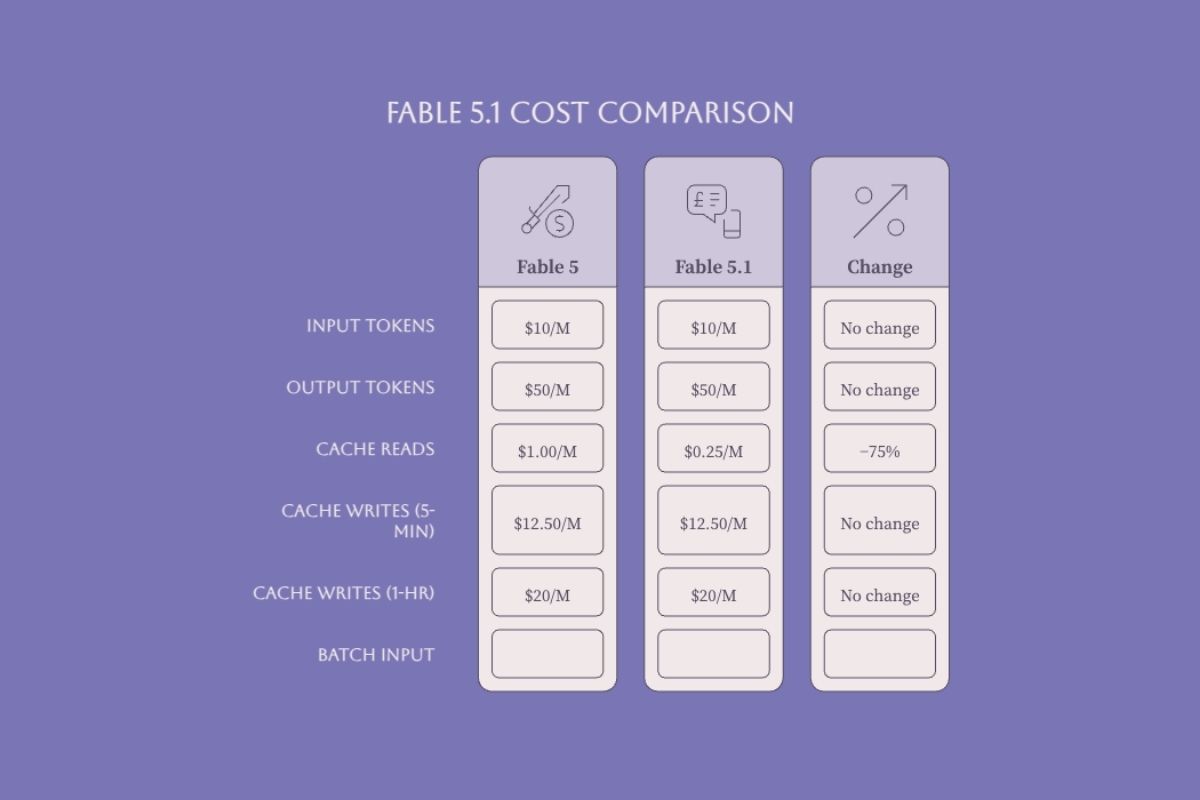
Cost efficiency through cache optimization. Fable 5.1 reduces cache-read pricing by 75% compared with Fable 5, from $1.00 to $0.25 per million tokens. This can lower the cost of long-context and multi-turn agentic sessions when workflows reuse stable cached content. For teams running custom AI agents for workflow automation, the practical savings depend on cache-hit rates and workload design.
More precise safeguards. Anthropic reports around 60% fewer cybersecurity safeguard interventions per Claude Code session than with the earlier Fable 5 safeguards. Its updated biology safeguards also fire 85% less often for benign elementary biology and medical requests. Fable 5.1 can identify software vulnerabilities for defensive purposes, while dual-use tasks such as penetration testing, exploit generation, and binary-based vulnerability scanning may still be redirected to Opus models.
Advanced Capabilities and Enterprise Applications
Building on these improvements, Fable 5.1 can support production use cases across enterprise development and complex business workflows. Anthropic attributes some specialized scientific research results to Mythos 5.1, so those examples should be evaluated separately from Fable 5.1's generally available capabilities.
Scientific Research and Discovery
Anthropic's research with Claude Mythos 5.1 offers an early glimpse of how AI models will contribute to scientific progress across multiple disciplines.
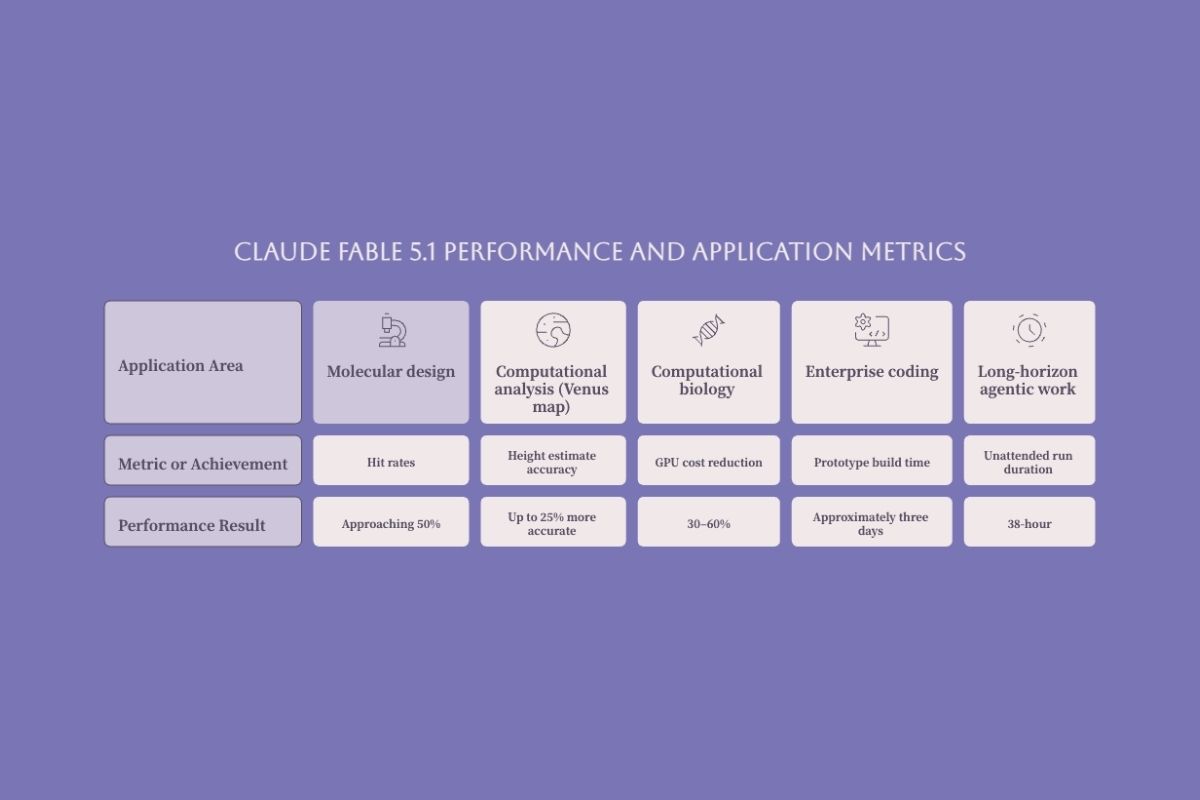
In molecular design, Mythos 5.1 was given access to open-source protein design and folding tools and tasked with designing high-affinity protein binders. Designs were sent to two external organizations for experimental validation. Anthropic reports hit rates approaching 50% across 12 targets, compared with the 10–15% rate it describes as typical in protein design, and binding affinities 10 times higher than the best designs submitted for three referenced competition targets. For organizations in pharma and biotech, these results illustrate the potential of carefully validated AI-assisted research.
In computational analysis, Claude Fable 5.1 trained a neural network to create a high-resolution elevation map of a third of Venus, building on radar images from NASA's Magellan mission. The resulting map resolves details at two to three kilometers rather than the previous 10 to 20 kilometers, with height estimates up to 25% more accurate.
In computational biology, Mythos 5.1 wrote custom GPU kernels and cached intermediate results to speed up seven open-source deep learning models by 1.4× to 2.5×, cutting estimated GPU costs by 30–60% on genome-wide analyses. This kind of optimization would normally take a team of performance engineers weeks-Mythos 5.1 completed it in days using publicly available source code alone.
Enterprise Coding and Development
Anthropic reports that Claude Fable 5.1 improves coding performance over Fable 5 across several evaluations. Early-access partners also reported gains on selected code review, debugging, and multi-service development tasks, although organizations should validate those results against their own codebases and controls.
The model handles autonomous coding project management spanning entire codebases. MongoDB's engineering team reported that Fable 5.1 built a complex prototype in approximately three days, conducting initial research across all services code and documentation, then running for hours unattended with strong verification loops. Claude Code users can expect the model to default to high effort, where its advantages over Fable 5 are most pronounced.
For code review and debugging, Red Hat reported that Fable 5.1 identified the root cause of every broken build in its test set across the evaluated effort levels. Plaid's engineering team reported that the model mapped a change touching more than eight services across three codebases, tracing the workflow from incoming service calls to individual functions and database records.
Cognition announced plans to move their Opus 5 traffic in Devin to Claude Fable 5.1 on launch day, noting that with the new cache read pricing, a Fable-class model is finally economical for workloads they had previously kept on Opus-starting with code review.
Knowledge Work and Business Workflows
Fable 5.1's capabilities extend beyond coding into long-context work across business domains. Hebbia reported that it produced the strongest decks in the company's PowerPoint evaluation and achieved its best fact-recall result over financial documents in a separate citations evaluation.
For long-horizon agentic work, Ramp's ML engineering team reported a 38-hour unattended run on a machine learning problem where the model diagnosed a prior result as a label artifact, corrected it, launched six parallel experiments overnight, and returned with results and next steps. Shopify's engineering team noted that Fable 5.1 maintains coherence over long, unattended work sessions-keeping its own records, reprioritizing as conditions change, and picking up where it left off.
These reported capabilities make Fable 5.1 a candidate for complex, multi-step workflow automation, provided teams apply appropriate permissions, observability, approval gates, and workload-specific evaluations.
Implementation and Access Management
Deploying Fable 5.1 effectively requires understanding its pricing model, platform options, and access tiers. Cost savings depend heavily on how well an organization's workflows align with the model's caching behavior.
Pricing and Cost Optimization
Fable 5.1 costs $10 per million input tokens and $50 per million output tokens-identical to Fable 5's rates. The significant change is in cache read pricing: a 75% reduction to $0.25 per million tokens. Cache writes remain unchanged at $12.50 per million tokens for 5-minute TTL and $20 per million tokens for 1-hour TTL.
Anthropic estimates that Fable 5.1 reduces costs by around 25% for typical workloads, based on usage measured at default effort over four weeks in August 2026. For context-heavy, tool-heavy agentic work where cache reads account for more of the cost, Anthropic estimates savings of up to approximately 45% compared with Fable 5.
Batch processing costs $5 per million input tokens and $25 per million output tokens for non-urgent workloads, offering an additional 50% discount on base rates. Combining batch processing with cache optimization and appropriate effort level selection yields the best ROI for high-volume deployments.
Important caveat: system-message edits, tool-definition changes, or pauses beyond a cache entry's time to live can invalidate relevant cache prefixes and reduce expected savings. Organizations should design conversations and subagents to maximize safe cache reuse, choosing the cache duration according to actual interaction patterns. For guidance on structuring prompts effectively, see our prompt engineering best practices.
Platform Availability and Integration
Anthropic launched Claude Fable 5.1 across the Claude API, Amazon Web Services, Google Cloud, Microsoft Foundry, and Claude Platform on AWS. The Claude API model identifier is claude-fable-5-1. Anthropic lists high as the model's default effort setting and notes that product surfaces may apply different defaults.
Enterprise Frontier Safeguards (EFS) is not a literal zero-retention configuration. It stores retained activity data in cloud infrastructure controlled by the customer, under the customer's encryption keys, access policies, and audit logging, while Anthropic operates automated misuse detection. Human review is performed by the customer by default. EFS was developed with input from more than 100 enterprise customers and is rolling out in phases. Until it is available, eligible customers can use Fable 5.1 with zero data retention.
For organizations navigating enterprise AI implementation challenges, understanding data custody and retention is critical. Anthropic states that Fable 5.1 requires 30-day retention for safety monitoring by default, subject to eligible zero-data-retention access or EFS arrangements.
Trusted Access Programs
Claude Mythos 5.1 is limited to approved customers only, accessible through two structured programs. Access to Claude Mythos 5.1 requires contacting Anthropic or cloud partners directly.
Cyber Verification Program (CVP). The CVP currently provides access to certain Opus- and Sonnet-class models with reduced cyber safeguards for defensive security work. In the near future, this program will also include access to Claude Mythos-class models with the strongest cyber capabilities of any model Anthropic has released. Claude Security, Anthropic's product for scanning codebases for software vulnerabilities and suggesting patches for human review, is now powered by Claude Mythos 5.1.
Life Sciences Verification Program (LSVP). Developed in partnership with the US government, the LSVP is designed so that life sciences professionals can use Claude Mythos 5.1 with safeguards tailored for professional research and development activities while all other safeguards remain in place. Anthropic has enrolled its first participants and plans to expand to open enrollment for scientists soon, including coordination to expand access beyond US organizations to international partners.
Current Mythos 5.1 access is limited to a set of US organizations, although Anthropic says it is working to broaden access. Organizations whose legitimate work in cybersecurity or AI-assisted vulnerability research triggers safeguard interventions should evaluate program eligibility directly with Anthropic or an authorized cloud provider.
Common Challenges and Solutions
Organizations deploying Claude Fable 5.1 face several implementation considerations related to privacy, safeguard management, and regulatory compliance. Addressing these proactively avoids friction during rollout.
Data Retention and Privacy Compliance
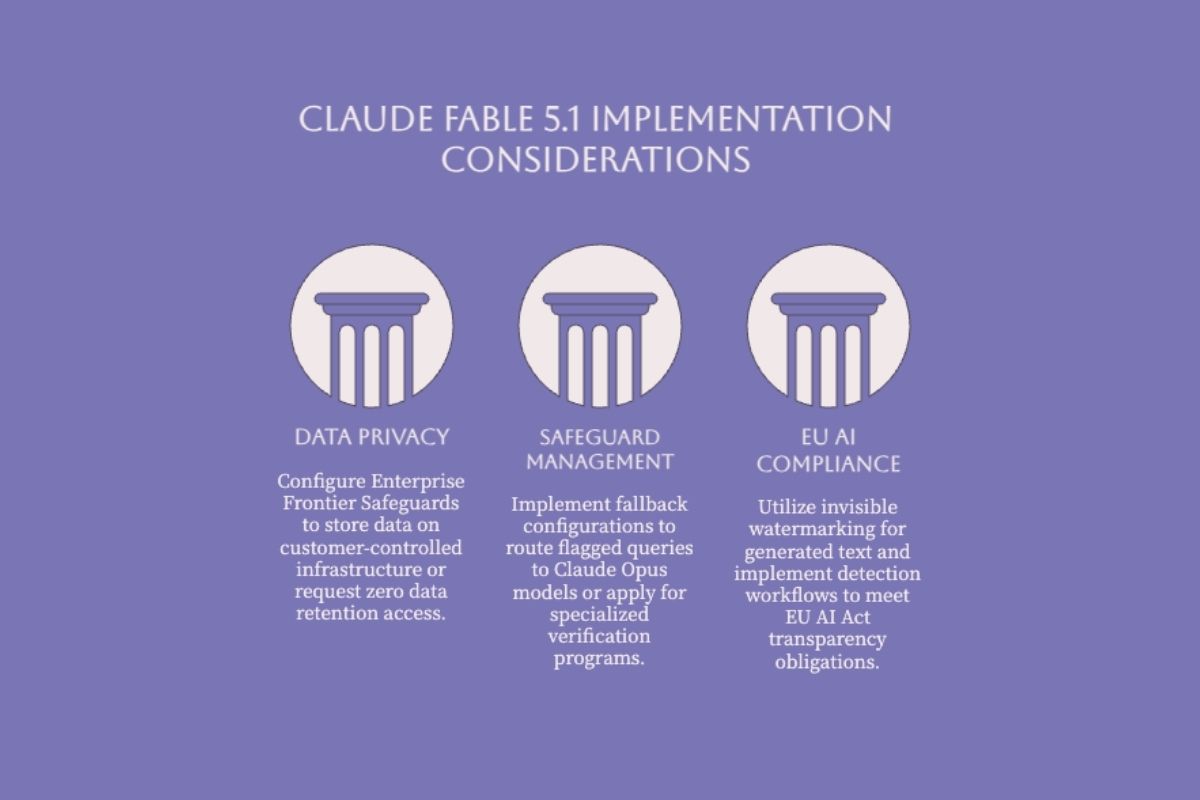
Enterprises that require customer-controlled data custody can evaluate Enterprise Frontier Safeguards, which stores activity data in the customer's cloud environment and keeps customer teams responsible for human review by default. During the EFS rollout, eligible customers can request zero-data-retention access. Organizations in regulated sectors such as healthcare, finance, and government should confirm eligibility, retention behavior, monitoring responsibilities, and cloud-provider terms before deployment. For broader guidance on building AI governance frameworks, consider how EFS fits within your organization's existing compliance architecture.
Safeguard Management and False Positives
Although Fable 5.1 uses more precise safeguards, legitimate queries in cybersecurity and advanced biology may still trigger interventions. Anthropic states that flagged cybersecurity requests may fall back to Claude Opus 4.8, while biology requests may fall back to Claude Opus 5. API customers should review and test Anthropic's fallback configuration rather than assume routing behavior.
If legitimate work consistently triggers safeguard interventions, evaluate the Cyber Verification Program or Life Sciences Verification Program for access to Claude Mythos 5.1 with specialized safeguards. Fable 5.1 also introduces anti-distillation restrictions that can affect integrations that edit earlier conversation turns. Review the migration documentation and test those changes before production deployment.
EU AI Act Compliance and Watermarking
Fable 5.1 includes invisible watermarking for generated text-a numerical method for determining the likelihood that Claude was involved in writing a piece of text. This watermark has no practical impact on the quality or content of outputs and contains no information about the user, their organization, or their conversations. It was implemented to comply with the EU AI Act's Code of Practice on Transparency, which Anthropic signed in July 2026 alongside 190 other signatories.
The detection API is currently in private preview for eligible organizations, including enterprises that must verify watermarking for their own compliance obligations. Organizations should first determine whether those obligations apply, confirm eligibility, and request access before designing a detection workflow. For teams managing AI compliance at scale, these requirements should be incorporated into existing AI governance frameworks.
Conclusion and Next Steps
Claude Fable 5.1 expands Anthropic's options for complex coding, extended knowledge work, and long-horizon agentic workflows. Its reported benchmark improvements, 75% reduction in cache-read pricing, and more precise safeguards make it worth evaluating for demanding use cases. The appropriate choice still depends on workload-specific performance, cost, governance, and risk requirements, while specialized scientific examples attributed to Mythos 5.1 should not be treated as generally available Fable capabilities.
To move forward with Fable 5.1:
-
Audit current AI workflows to identify where long context work, tool calls, and multi-turn agentic sessions dominate-these see the largest cost savings.
-
Benchmark against your own workloads by running the same text and tasks at different effort levels (low, medium, high) to find the optimal cost-performance balance for your use cases. At medium effort, Fable 5.1 often matches Fable 5's high-effort output at lower cost.
-
Evaluate data retention requirements and determine whether EFS or zero data retention is needed for your compliance posture, then contact Anthropic or your cloud provider to request access.
-
Apply for trusted access programs if your work in cybersecurity or life sciences requires Claude Mythos 5.1's more permissive safeguards.
Related topics worth exploring include Claude Code's evolution toward controlled autonomy for development teams, Enterprise Frontier Safeguards implementation planning for regulated industries, and Anthropic's AI for Science program for researchers seeking credits for high-impact scientific projects.
Additional Resources
-
Anthropic's official Fable 5.1 documentation: Technical specifications, pricing, platform identifiers, and migration resources.
-
Enterprise Frontier Safeguards overview: Customer-controlled storage, monitoring responsibilities, rollout information, and access details.
-
Prompt caching documentation: Cache duration, invalidation behavior, tracking, and implementation guidance.
-
Claude model system cards: Safety evaluation methods, alignment assessments, and deployment decisions.
-
Fable 5.1 and Mythos 5.1 announcement: Benchmark context, trusted access programs, safeguards, EU AI Act watermarking, and availability.