

Software Development Life Cycle (SDLC): The 7 Phases Explained
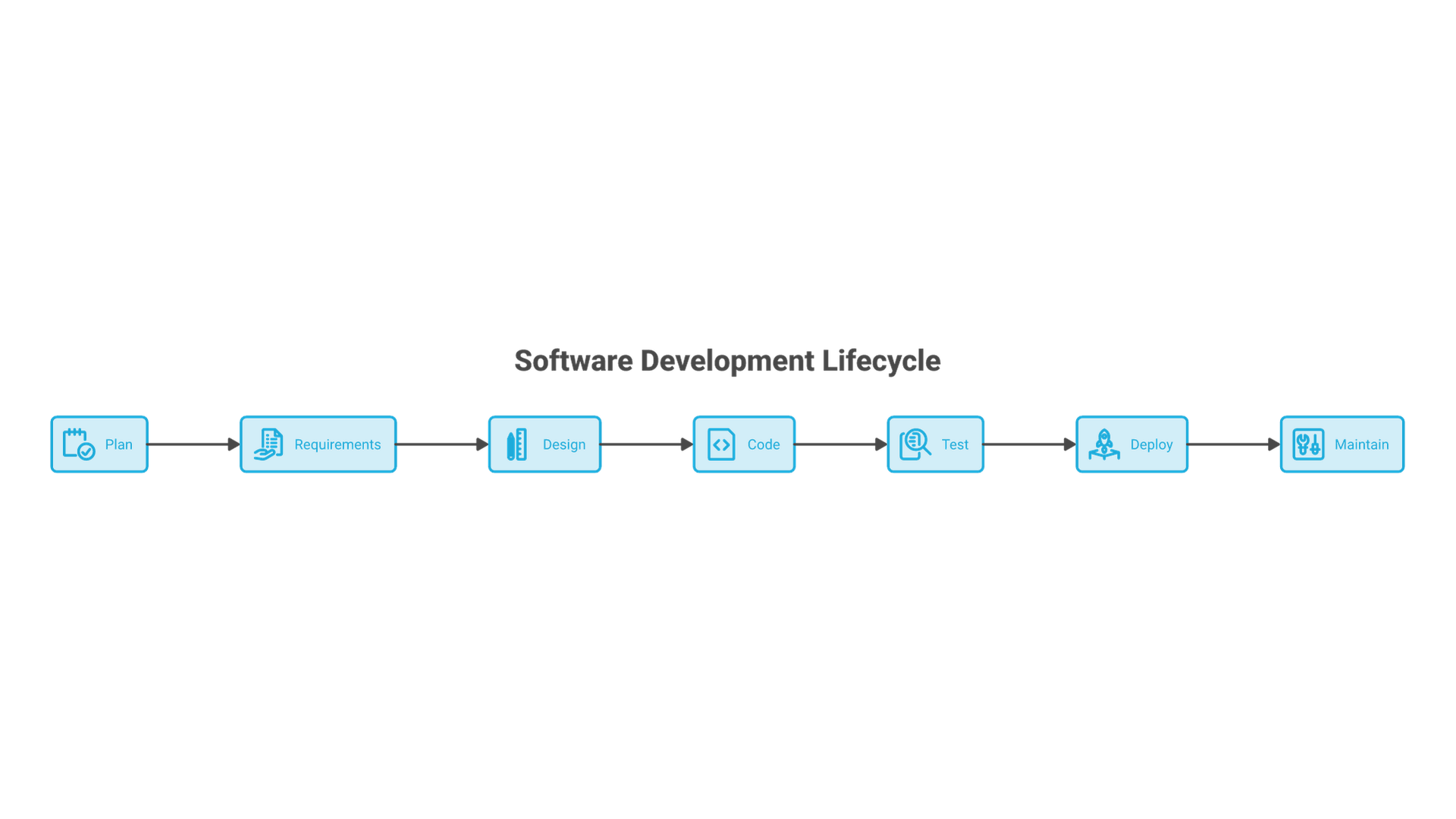
Its seven commonly used phases are planning, requirements analysis, design, coding, testing, deployment and maintenance. Each produces something the next activity needs: an agreed problem, defined behavior, a design, working code, test evidence, a controlled release or operational feedback.
The software development life cycle (SDLC) organizes the work of planning, building and operating software. Its seven commonly used phases are planning, requirements analysis, design, coding, testing, deployment and maintenance. Each produces something the next activity needs: an agreed problem, defined behavior, a design, working code, test evidence, a controlled release or operational feedback.
These phases are not seven isolated departments or a requirement to finish all planning before testing an idea. The guide follows one hypothetical customer portal through the lifecycle, showing the deliverables and decisions behind each phase before comparing development models.
In this guide
The 7 Phases of the Software Development Life Cycle
Consider a customer portal that lets an authorized business contact request a delivery-date change. A request may arrive after warehouse picking has started, be submitted twice or time out before the warehouse responds. Those exceptions connect the phases below. The example is illustrative, not a Cognativ client case study.
| Phase | Concrete output | Decision in the portal example |
|---|---|---|
| 1. Planning | Scope, feasibility assumptions and success measures | Is self-service addressing missed changes, support workload or visibility? |
| 2. Requirements | Allowed states and observable acceptance criteria | Who may request a change, and what happens after picking starts? |
| 3. Design | Interfaces, data ownership and failure handling | How does a pending request reach the warehouse and get reconciled? |
| 4. Coding | Reviewed implementation, tests and build instructions | Does the server enforce authorization and recognize repeated submissions? |
| 5. Testing | Results tied to requirements and unresolved defects | Can a timeout cause a false acceptance email or lose a valid request? |
| 6. Deployment | Released version, monitoring and recovery plan | Can rollout stop without discarding accepted customer requests? |
| 7. Maintenance | Operational records and a prioritized improvement backlog | Who resolves aging requests even when the endpoint is technically available? |
Phase 1: Planning
Purpose: define scope, objectives and feasibility. Identify the problem the software should solve, the intended users and the constraints on time, resources and operation.
Activities: assess the current process, record assumptions, identify dependencies and compare viable options. The answer may be a process change or a supported product configuration rather than a new application. Establish a sponsor and a delivery owner before committing to a date.
For the portal, planning should establish why delivery changes need self-service. Is the problem support workload, missed changes or customer visibility? Those problems require different success measures. Confirm access to warehouse and carrier systems before promising an integrated solution.
Output: a project brief or charter, initial scope, constraints, risk register and success measures. Include exclusions so stakeholders know whether changing delivery dates also changes shipping charges or contractual commitments.
Review question: is there a specific problem, an accountable owner and a feasible next investigation? If a required integration is unavailable, record that blocker rather than treating a schedule as proof that it can be solved.
Phase 2: Requirements Analysis
Purpose: capture the functional behavior and quality requirements the solution must satisfy. Interviews, workflow observation and examples help expose exceptions that a feature list misses.
Activities: document who can perform each action, the states in which it is allowed and the result the user should see. Include accessibility, security, performance, retention and recovery requirements. Define how each important requirement will be accepted.
For the portal, “a customer can change delivery” is incomplete. A better requirement specifies that an authorized contact may request a change before warehouse release; an already-picked order follows a different process. The customer must see whether the request is pending, accepted or rejected. Repeated submission must not create conflicting instructions.
Output: validated requirements in an SRS, a backlog with acceptance criteria or an equivalent maintained record. Connect unresolved questions to owners instead of hiding them in vague wording.
Review question: can the business and testing team distinguish a correct result from an incorrect one? If “fast,” “secure” or “easy” has no observable meaning, it is not yet an adequate acceptance criterion.
Phase 3: Design
Purpose: decide how to implement the requirements. Design includes the user experience, application boundaries, data model, integration contracts and operational behavior.
Activities: compare architectures and technology choices against constraints, prototype uncertain interactions and record meaningful tradeoffs. Use diagrams where they clarify ownership or data flow, not simply to make a design look complete.
For the portal, identify the authoritative shipment state and how a request travels to the warehouse. Define identifiers, timeouts, retries and reconciliation. Show the customer a pending state while the external system is uncertain. Decide how operators can resolve the exception without editing the database manually.
Output: an appropriately detailed design, interface prototypes, data and API contracts, and architecture decision records. Include a threat assessment and a migration or recovery approach where the change requires them.
Review question: does the design explain what happens when a dependency fails, or only how the successful path works? A diagram that leaves out authorization and failure states has not settled those responsibilities.
Phase 4: Coding
Purpose: translate the design into working software and integrate it with the surrounding system.
Activities: implement small reviewable changes, use version control, write focused tests and maintain the relevant documentation. Review dependency choices and protect credentials. Generated code should pass the same review and testing expectations as other code.
For the portal, implement authorization independently of the interface's disabled button. The server must enforce whether a customer can request the change. Store a stable request identity so a repeated submission can be recognized and investigated.
Output: a reviewable codebase with tests, dependency information and enough setup guidance for another developer to reproduce the build. Record deviations from the design and resolve their impact rather than allowing the documentation to become fictional.
Review question: can a reviewer understand the behavior and the reason for the change? Passing a formatter or compiling successfully does not establish that the business rule is correct.
Phase 5: Testing
Purpose: evaluate correctness, reliability and suitability against the requirements. Testing is represented as a phase here, but test design and execution should begin much earlier.
Activities: combine unit, integration, system and user acceptance tests according to risk. Include relevant performance, accessibility and security checks. Track the exact build, data and environment so the evidence can be reproduced.
For the portal, test an unauthorized user, an already-picked order, a duplicate request and a warehouse response arriving after a timeout. Confirm that a failure does not generate a false acceptance email. Have the operating team demonstrate how it identifies and resolves a pending request.
Output: results tied to acceptance criteria, a defect list, resolved and unresolved risks, and a reasoned release recommendation. Avoid describing the output as “defect-free”: a test suite samples behavior and cannot establish the absence of every possible defect.
Review question: have the relevant acceptance conditions passed, and are remaining risks understood by the responsible decision-maker? Test count and code coverage do not substitute for this decision.
Phase 6: Deployment
Purpose: make the approved change available in its intended environment with a controlled transition and an operational owner.
Activities: confirm configuration and access, rehearse migrations, prepare monitoring and recovery, and coordinate release communication. Choose a deployment strategy that fits the system. Blue-green or canary approaches can help some applications, but neither removes database and integration compatibility questions.
For the portal, a restricted rollout can expose the feature to a controlled group while the team checks actual request and warehouse behavior. Define what will stop the rollout and how accepted requests remain recoverable if the interface is disabled. Rolling back code must not silently erase a customer's valid request.
Output: a deployed version, release record, verification evidence, owner handoff and recovery instructions. Separate “deployment completed” from “the business workflow was verified.”
Review question: can the team detect a failed release and recover without creating a second problem? A pipeline's green status is one input to that judgment, not the complete answer.
Phase 7: Maintenance
Purpose: keep the software useful, supported and safe as usage, dependencies and business needs change.
Activities: monitor service and workflow behavior, investigate incidents, patch dependencies, test restoration and incorporate justified improvements. Maintenance includes planned upgrades and eventual retirement, not only fixing reported bugs.
For the portal, monitor unresolved requests and reconciliation age as well as HTTP errors. A technically available endpoint can still leave customers waiting because the warehouse stopped processing messages. Review recurring exceptions with the operating team and feed the causes back into requirements.
Output: maintained software, incident and change records, updated operating guidance and a prioritized improvement backlog. Retire unsupported components deliberately, preserving the records the business must retain.
Review question: is there an owner who can explain the service's current health, known risks and next necessary change? A system without that owner is not maintained merely because it is online.
What Is the SDLC?
The SDLC describes the work needed to take software from an identified need through development and operation. Planning, requirements, design, implementation, testing, deployment and maintenance provide a vocabulary for that work. Teams may combine or rename phases while still needing to address the underlying responsibilities.
SDLC as a Framework for Decisions
Each phase has inputs and outputs, but a document is not automatically evidence that the work is complete. A requirements file can exist while stakeholders disagree about the required behavior. A test report can pass while omitting the failure that matters most to the business. Evaluate whether each output enables a defensible next decision.
Keep traceability practical. A significant requirement should connect to its design decision, implementation, test evidence and release status. This does not require a large administrative system for every small change. It requires enough continuity to explain why the change exists, what was checked and what remains uncertain.
Why the SDLC Matters
Scope, coordination and risk are reasons to use a lifecycle deliberately. A shared process makes hidden assumptions visible: who owns a dependency, what counts as acceptable performance, whether a migration is reversible and who supports the system after launch.
For example, consider a hypothetical customer portal that lets a business customer request a delivery-date change. The feature sounds simple until the team asks whether the warehouse has already picked the order, who can approve the change and what happens if the carrier cannot accept it. The lifecycle gives those questions a place before an unsupported promise reaches the customer.
Key SDLC Models
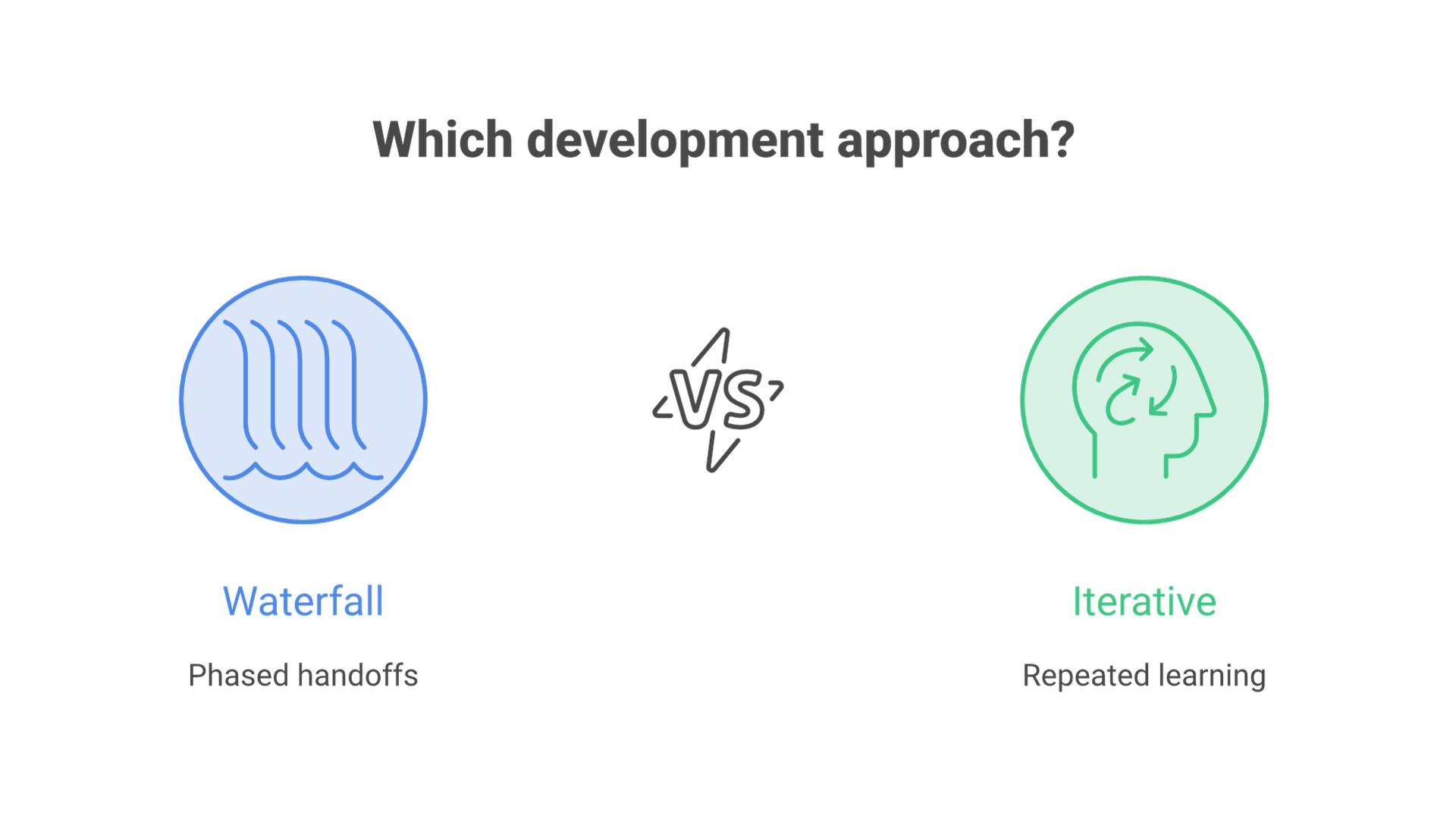
A lifecycle describes necessary work; a development approach organizes how that work happens. Avoid treating “Agile,” “Waterfall” and a seven-phase diagram as directly interchangeable process specifications.
- Waterfall: emphasizes sequential phases and explicit handoffs. It can suit work with stable requirements and strong external approval dependencies, but late discoveries can create expensive rework.
- Iterative development: revisits and improves a solution through cycles. Incremental delivery adds usable portions; a team can use both without treating them as the same idea.
- Agile approaches: emphasize feedback, collaboration and adapting to change. The Agile Manifesto's principles focus on delivering useful software and maintaining technical quality, not abandoning planning or documentation.
- Spiral: organizes repeated development around explicit risk evaluation. The useful question is which uncertainty each cycle is intended to resolve.
- V-model: relates specification and design activities to corresponding verification and validation. It encourages teams to consider how a requirement will be checked rather than waiting until coding ends to invent tests.
Selecting the Right SDLC Model for Your Project
Assess requirements stability, technical uncertainty, release constraints, team capability and access to users. Do not select an approach solely because the project is large or small. A small safety-sensitive integration may require more explicit verification than a larger internal prototype.
For the delivery-date portal, the team could use short iterations to test the interface while treating the warehouse integration and customer-notification rules as explicit release gates. That is a reasoned combination of feedback and controls, not permission to skip difficult decisions under a hybrid label.
When Scrum is used, follow its actual definitions. The Scrum Guide specifies Sprints of one month or less and a Definition of Done for the Increment. A Sprint is not inherently a miniature Waterfall project, and a Sprint Review is not automatically a production release approval. Your release responsibilities still need to be clear.
Choosing the Correct Order of SDLC Phases
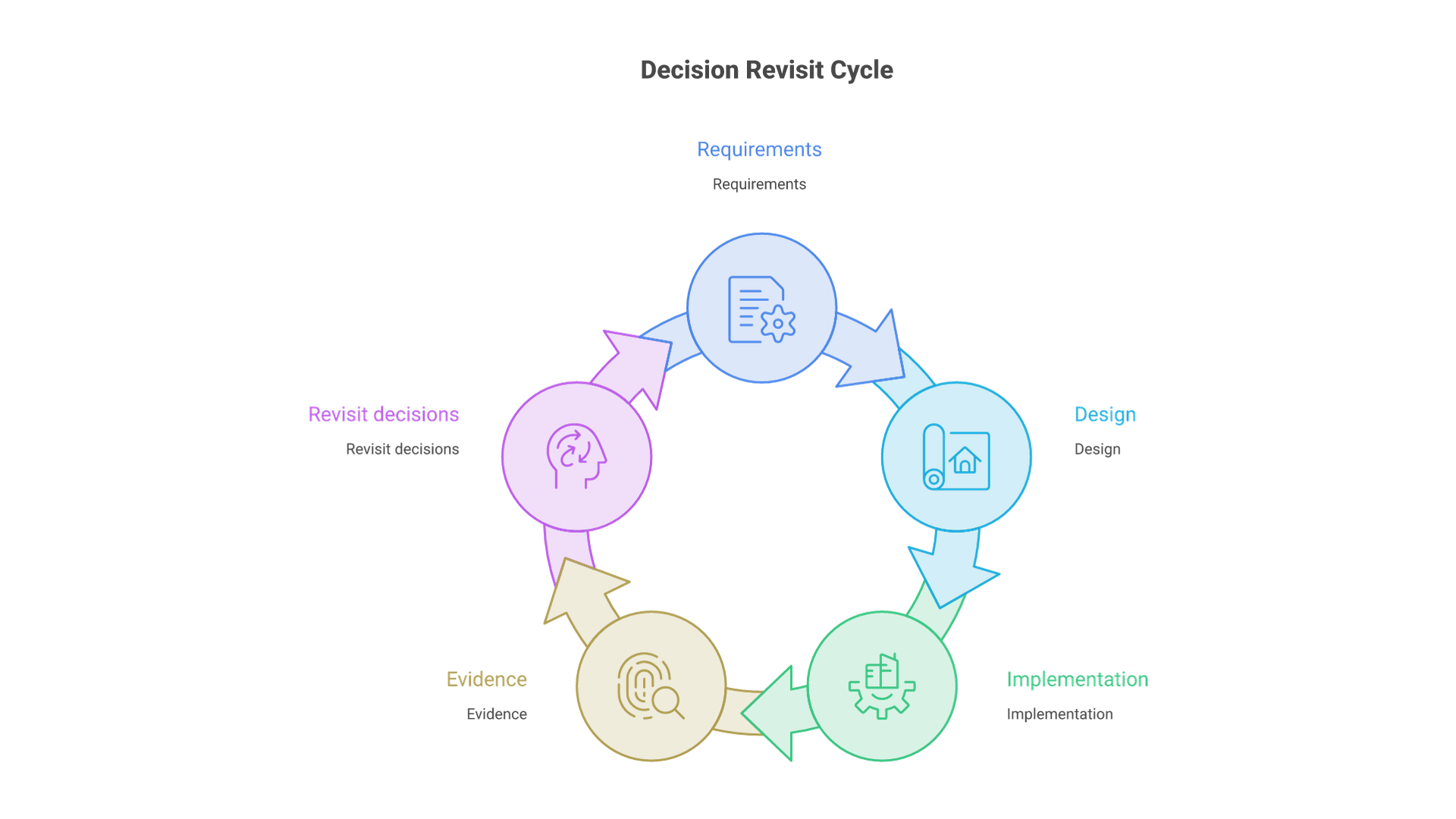
The sequence provides logical dependencies: a design needs requirements, code needs a design direction and release needs acceptance evidence. It does not require delaying all testing until coding ends or forbidding new learning once a document is signed.
Adapting the Sequence in Agile or Hybrid Models
Teams can repeat the lifecycle for a small increment. Planning and requirements may be refined as an experiment reveals new information. Design and implementation can progress in parallel where interfaces and risks are understood. Testing follows those increments rather than accumulating at the end.
For the portal, usability testing may change the wording of a pending state without changing the integration contract. Discovering that the carrier cannot accept a change is different: it may require revisiting scope, requirements and customer promises. Match the review to the impact rather than forcing every change through an identical ceremony.
Keep a visible path for changes to previously accepted decisions. Record what changed, why, which tests or approvals become stale and who must revisit them. A historic approval should not silently apply to a materially different feature.
Security Across the Lifecycle
NIST's Secure Software Development Framework, version 1.1, describes practices that can be integrated into different SDLC implementations. Security is not an eighth phase added after deployment and this seven-phase explanation is not itself a security certification.
Apply that principle concretely: identify sensitive data during requirements, review trust boundaries during design, protect the build and dependencies during implementation, test authorization before release and maintain a vulnerability response process after launch. The exact controls depend on the system's risks and obligations.
Automating SDLC Phases
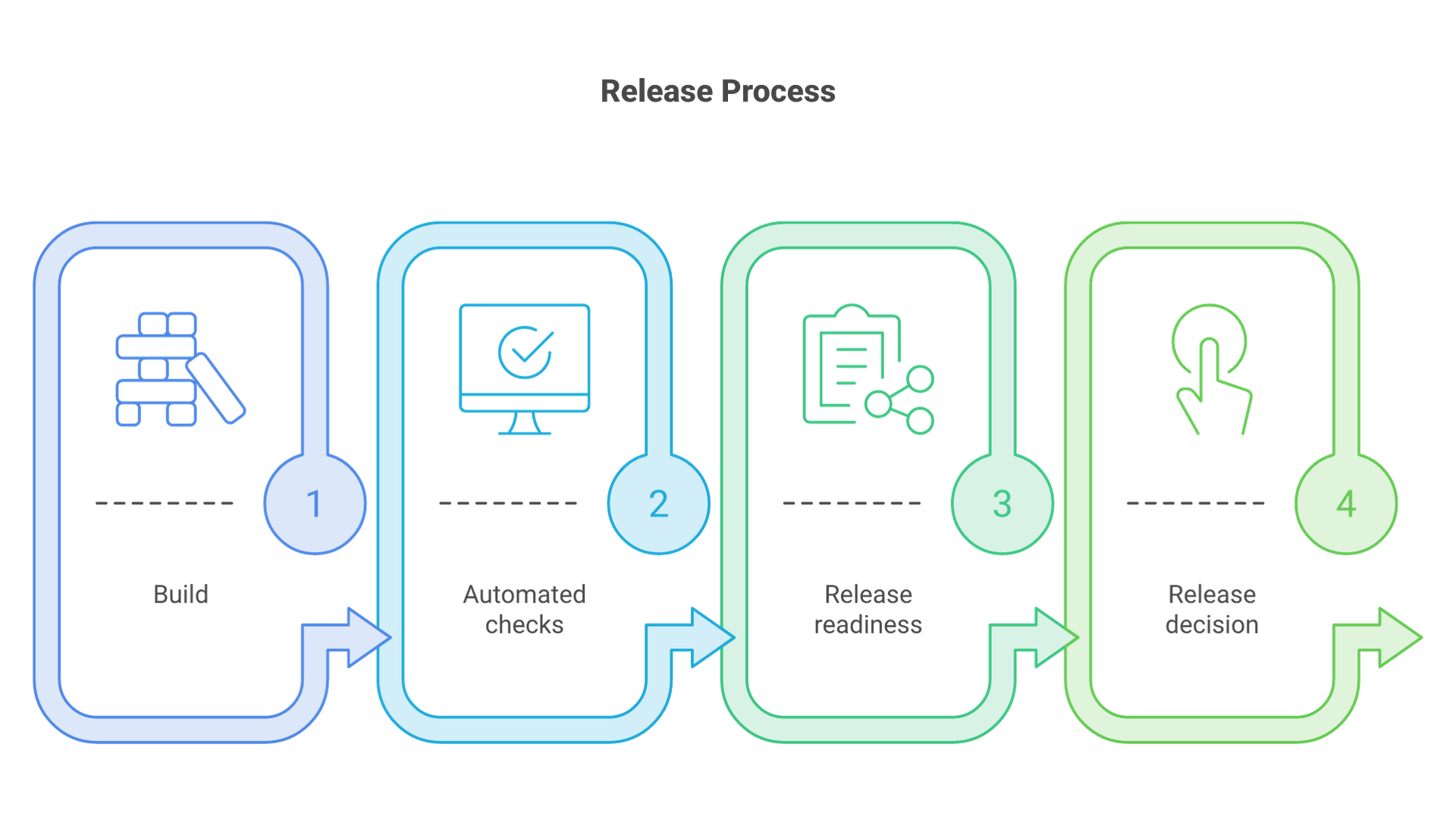
Automation is valuable where the check or action is defined and repeatable. Builds, test execution, static checks, dependency checks and environment preparation are common candidates. Automation should make evidence easier to reproduce, not make the decision harder to inspect.
Keep continuous integration, delivery readiness and production deployment distinct. A project can automate the first two while requiring an explicit production release decision. Whether that gate is manual or automated should follow the risk and operating policy, not the capabilities of the chosen tool.
Adopting Best Practices for SDLC Automation
- Start with a repeated source of errors or slow feedback and define the expected result.
- Run checks against the exact revision under review; do not inherit a pass from different content.
- Make failed and skipped checks visible. A test that did not run is not a successful test.
- Keep secrets and production credentials out of ordinary test data and logs.
- Provide actionable failure output and a responsible owner instead of sending alerts no one investigates.
- Review flaky checks and excessive exceptions; repeated reruns until green can conceal real defects.
AI-assisted development belongs inside these controls. A generated explanation can help a reviewer, but it is not independent verification of its own code. Preserve the distinction between suggested work, executed changes, test evidence and human acceptance.
Frequently Asked Questions
What Are the Seven SDLC Phases?
Planning, requirements analysis, design, coding, testing, deployment and maintenance. These labels organize the guide; organizations may use other groupings without eliminating the underlying work.
Which Activities Are Part of the SDLC?
The lifecycle includes identifying the need, defining and building the solution, checking it, releasing it and operating or retiring it. It is broader than programming.
Why Do Some Models Have Five Phases?
They combine or name activities differently. Compare responsibilities and deliverables, not just the number of boxes. A shorter model should still explain requirements, validation and ongoing operation.
Why Is the SDLC Important?
It makes scope, ownership and acceptance visible across the product's life. Its usefulness depends on whether it helps the team make and revisit real decisions, not whether every template is filled in.
How Many Phases Are in a Secure SDLC?
There is no universal phase count that makes software secure. Integrate security practices into the lifecycle and validate the controls appropriate to the application.
Conclusion
Preserve the seven phases as a shared operating language, then make each one accountable. Define the intended result, produce evidence, review the exceptions and feed learning back into the work. That is more useful than either a rigid sequence that ignores discovery or an informal process that cannot explain its release decisions.
Discuss Your Development Process
When delivery repeatedly stalls between teams, bring one recent change and trace its requirements, design, tests and handover. Cognativ's software engineering services provide a starting point for discussing those implementation and delivery needs.