Business Process Automation in Financial Services: Priorities, Controls, and Evidence
Business process automation in financial services means deploying technology-enabled workflows that handle routine, structured tasks while preserving regulatory controls, audit trails, and human oversight for consequential decisions. It is not simply installing simple software to perform repetitive tasks quickly. In regulated environments, every automated workflow must account for data sensitivity, decision consequences, compliance obligations, and the ability to produce evidence on demand.
This guide covers workflow selection, control design, and evidence requirements specific to regulated financial environments. It does not offer generic automation advice, unsupported ROI projections, or legal, regulatory, or compliance guidance. What falls outside its scope: vendor comparison, technology-specific implementation tutorials, and blanket recommendations to automate particular financial decisions.
The target audience is financial services operations, technology, product, security, and risk leaders evaluating which business processes are appropriate candidates for automation. Whether you lead finance teams at a regional bank, manage compliance at an insurance firm, or direct technology strategy at a fintech company, this framework applies.
Successful financial automation requires evaluating workflow stability, data sensitivity, control requirements, and human review needs before implementation - not after. The most repetitive process is not necessarily the safest or most valuable to automate.
By the end of this guide, you will have:
-
A structured framework for identifying and selecting automation candidates in financial services
-
Control design principles that satisfy regulatory expectations for audit readiness and human oversight
-
Evidence requirements and metrics for demonstrating automation reliability to auditors and regulators
-
A prioritization matrix adaptable to your organization's specific workflows and risk tolerances
-
Clear criteria for deciding when to proceed, pilot, or pause an automation initiative
Understanding Business Process Automation in Financial Services
Business process automation in financial services refers to using software-enabled workflows - including robotic process automation, intelligent automation, and AI-assisted tools - to execute routine tasks with built-in governance, internal controls, and audit trails. Unlike generic automation focused purely on speed, financial automation must embed compliance checks, decision logging, and escalation paths into every workflow.
The distinction matters because financial institutions operate under regulatory scrutiny that demands reproducibility, explainability, and accountability for every material decision. Automation replaces manual work like data entry and invoice tracking with digital workflows, but in financial services, those digital workflows must also generate the evidence regulators and auditors require.
Rule-Based Automation vs. AI-Assisted Workflows
Rule-based automation - including traditional robotic process automation (RPA) and expert systems - handles processes with fixed, well-defined rules and structured data. Invoice matching, payment processing, and accounts payable reconciliation are classic examples. These workflows are straightforward to audit and explain because every decision follows a deterministic path. RPA can automate repetitive tasks in financial operations and improves accuracy by minimizing human errors in finance. However, rule-based systems break when data structures change or when processes require judgment beyond their programmed logic.
AI-assisted workflows incorporate machine learning , natural language processing, or other forms of artificial intelligence to handle unstructured or semi-structured inputs - scanned documents, customer communications, or anomalous transaction patterns. AI-enabled automation can analyze data and improve decision-making processes, but it introduces new risk vectors: explainability gaps, model drift, data bias, and difficulty reproducing specific outputs. AI agents can "sense, evaluate, and act on data and defined rules," but governance, auditability, and human oversight are critical before deploying them in high-impact financial scenarios.
Financial services companies must clearly separate these categories when designing automation. A workflow that uses rule-based RPA for data extraction and AI for document classification requires different controls for each component.
Governance Requirements in Regulated Environments
Compliance obligations shape every automation design decision in financial services. Regulations such as New York's DFS Cybersecurity Regulation (Sec. 500.6) require covered entities to maintain systems that reconstruct material transactions and preserve audit trails sufficient to support operations - with records maintained for five years for transaction reconstruction and three years for cybersecurity event logs.
Basel/BIS guidelines for digitalisation and financial technology risks require banks using electronic systems to ensure clear audit trails, systems highly resistant to tampering, proper change controls triggered by system modifications, and detection of any unauthorized changes.
For trade reporting, FINRA Rule 7160 mandates that member firms maintain all required data elements precisely and completely for transaction audit trails.
These requirements are not optional add-ons - they are foundational constraints that determine how financial automation software must be designed, tested, and operated. Audit trails, data lineage, and explainability requirements apply to every automated decision that touches regulated financial processes.
Understanding these governance foundations is essential before evaluating which workflows are suitable candidates for automation.

Why Repetitive Tasks Are Not Automatically Safe to Automate
The instinct to automate the most repetitive process first is understandable but incomplete. Frequency alone does not determine automation suitability in financial services. A task may execute thousands of times daily yet carry significant risk because of the data it touches, the decisions it enables, or the regulatory consequences of errors.
Consider transaction approval workflows that process customer data or trigger regulatory disclosures. These are high-volume and structurally repetitive, but each instance may involve sensitive personal financial information, anti-money laundering thresholds, or equal credit opportunity obligations. Automating without controls for these dimensions creates compliance risk - not operational efficiency.
Risk factors that must be evaluated alongside frequency include:
-
Decision consequence severity : What is the financial, legal, or reputational impact of an incorrect output? Loan denials, fraud holds, and claim rejections carry very different consequence profiles than formatting a report.
-
Data sensitivity : Does the workflow process customer PII, banking information, financial histories, or identity verification data? Higher sensitivity demands stronger access controls and audit requirements.
-
Regulatory visibility : Is the process subject to examination by regulators? Does it produce outputs that must be explainable - for example, under fair lending laws or anti-money laundering statutes?
Common examples of financial automation include loan processing and fraud detection - both high-frequency activities where the consequences of errors are severe. Automation speeds up turnaround times for services like account openings and loan approvals, but only when the control environment matches the risk profile.
The connection between workflow characteristics and automation approach selection is direct: higher-consequence, higher-sensitivity workflows demand more human intervention, more granular audit evidence, and more conservative deployment strategies.
Start with Workflow, Decision, Owner, and Consequence
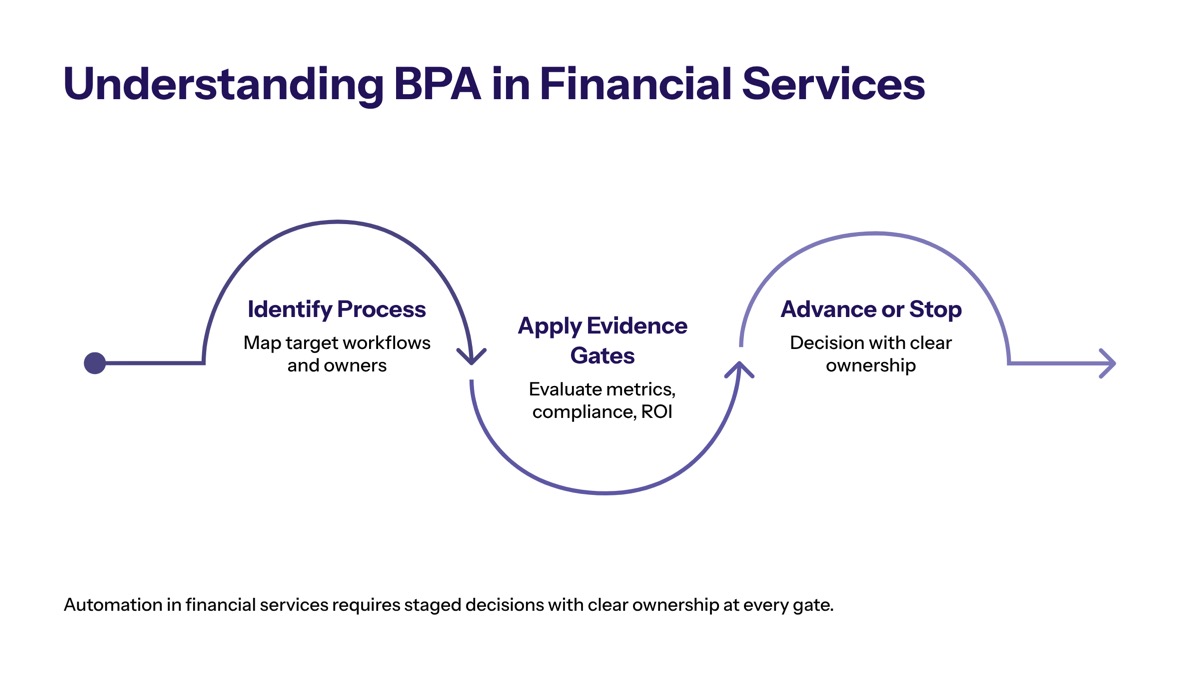
Before evaluating any automation technology, map the workflow itself. Define where the process starts and ends, identify every discrete decision point, and classify which decisions are high-impact - "reject loan application," "escalate fraud alert," "deny insurance claim."
This mapping serves two purposes. First, it reveals the actual complexity of what appears to be a simple process. Second, it establishes accountability for every decision the workflow produces.
Each workflow must have a clearly identified owner responsible for process design, business rules, escalation procedures, and outcomes. If the automated workflow produces an error - a false fraud hold that blocks a legitimate customer, a misclassified document that delays a regulatory filing - who is accountable? Model risk frameworks used by financial institutions typically require clearly mapped roles: process owner, data owner, audit liaison, compliance reviewer.
Assessing the potential impact of automation errors or failures requires quantifying:
-
Financial loss exposure per incident
-
Regulatory penalty exposure
-
Customer harm potential
-
Reputational damage risk
These assessments directly determine whether a workflow is a candidate for full automation, hybrid automation with human review at thresholds, or should remain a manual process with technology assistance only.
Evaluate Process Stability and Exception Frequency
Process stability measures whether the rules governing a workflow are mature and unlikely to change significantly in the near term. An effective test is tracking change history: how often have rules, thresholds, or process steps been modified over the past 12–24 months? If change frequency is high, automation will require frequent maintenance, increasing both cost and risk.
Stable financial processes - month-end reconciliation routines, standard payment processing flows, routine compliance checks - are generally stronger automation candidates than processes undergoing regulatory reform or business model shifts.
Exception frequency is equally important. Track the rate of cases where standard rule-based processing fails or requires human handling. High exception frequency reduces automation yield and increases human review burden. Pattern analysis of exceptions helps identify root causes: input quality variability, data anomalies, or gaps in rule coverage.
An illustrative example: a case study at a U.S. bank documented approximately 2,500 exception transactions processed monthly , with 80% check-related. After implementing document intelligence (OCR), AI semantic comparison, and RPA, they achieved approximately 90% automation of those exceptions. This demonstrates both the opportunity and the prerequisite - understanding exception patterns before designing automation.
The connection between process maturity and automation readiness is direct: unstable processes with high exception rates generate more maintenance work, more human escalations, and more risk of undetected errors.
Map Data Sources, Permissions, and Systems of Record
Every automation workflow depends on data, and in financial services, data access is never unconstrained. Build a complete inventory of data sources the workflow requires: customer files, scanned documents, core systems, accounting systems, enterprise resource planning platforms, and third-party feeds.
Classify each data source by sensitivity level:
-
Public : Market data, published rates
-
Internal : Operational metrics, internal reports
-
Confidential : Customer data, financial information, account details
-
Regulated PII : Identity documents, financial histories, banking information subject to GDPR, CCPA, or GLBA
Identify the authoritative system of record for each data field. When existing data flows from multiple sources, determine which source is the master and how the automation will handle inconsistencies. Integration complexity across financial systems - particularly legacy platforms that lack APIs or produce unstructured outputs - is a significant risk factor that directly affects automation feasibility.
Permissions and access controls must carry forward into automated workflows. If a human analyst requires specific authorization to access customer financial records, the automated process must enforce the same restrictions. Automation that bypasses access controls creates security and compliance exposures regardless of how efficient it is.

Control Design and Human Oversight Requirements
Regulatory expectations for automated financial processes center on a single principle: the organization must demonstrate that its automated workflows produce accurate, explainable, auditable outcomes with appropriate human oversight for consequential decisions. AI agents log every action for compliance and audit purposes, but logging alone is insufficient without the right control architecture surrounding it.
A 2025 GAO report (GAO-25-107197) surveying federal financial regulators found that institutions using AI for credit underwriting, risk management, and illicit finance detection still depend on human oversight and multiple inputs. Regulators remain cautious about fully autonomous decision making due to explainability, data quality, bias, and regulatory uncertainty concerns.
Identify Control Points and Mandatory Human Review
Not every step in an automated workflow requires human intervention, but certain decision points must preserve it. The framework for determining where human intervention must be maintained includes:
-
Regulatory mandates : Adverse action notices in lending, final determinations in fraud investigations, and customer discrimination risk assessments all require human review under existing law.
-
Risk thresholds : Transactions exceeding defined dollar amounts, risk assessment scores above certain levels, or patterns flagged for potential money laundering require human evaluation before final action.
-
Consequence severity : Any automated decision that could result in financial loss, customer harm, or regulatory penalty above defined thresholds should route to a human reviewer.
Automated workflows enforce compliance policies and reduce manual errors, but the control design must specify exactly which decisions can proceed automatically, which require human approval, and which must be fully manual. Governed AI ensures audit-ready documentation for KYC and AML compliance - but only when the governance framework specifies what "audit-ready" means for each specific workflow.
Design Audit Evidence, Logging, and Reconciliation
Audit logs for automated financial workflows must record:
-
Input data and its source
-
Rule version or model version applied
-
Decision outcome
-
Who approved, reviewed, or overrode the output
-
Timestamps for each processing step
Data lineage - tracing from source data through transformation to final output - is not optional in regulated operations. It is the mechanism by which auditors and examiners verify that an automated decision was produced correctly. Automated workflows can enhance audit readiness in financial services, but only when logging is comprehensive and tamper-resistant.
A survey of 500 senior leaders in U.S. and Canadian financial services firms (revenue >$100M) found that 96% had formal AI governance policies, but only 53% reported those policies translated into technical controls . Only 21% were very confident they could produce centralized, complete, auditable evidence for regulators. This gap between policy and technical implementation is where compliance risk concentrates.
Reconciliation - periodically comparing outcomes of automated versus manual decisions - detects drift, error patterns, and degradation. It is the control that confirms automation is performing as intended over time, not just at launch.
Plan Exception Handling and Operational Escalation
Every automated workflow will encounter inputs it cannot process correctly. Structured exception handling requires:
-
Defined exception criteria : Specific conditions under which automation routes a case to human review - low confidence scores, rule mismatches, data quality failures, or exception frequency exceeding thresholds.
-
Escalation paths : Clear routing logic for exceptions, with assigned human teams, response time expectations, and documentation requirements.
-
Operational continuity plans : Procedures for when automation fails entirely or must be paused. If an automated compliance monitoring workflow goes offline, what manual process activates, and who is responsible for it?
Governed AI automation can reduce exception aging by 75% - an illustrative benchmark showing the potential for structured exception management. But the control architecture must be designed before the automation is deployed, not retrofitted after the first failure.
Implementation and Testing Approach
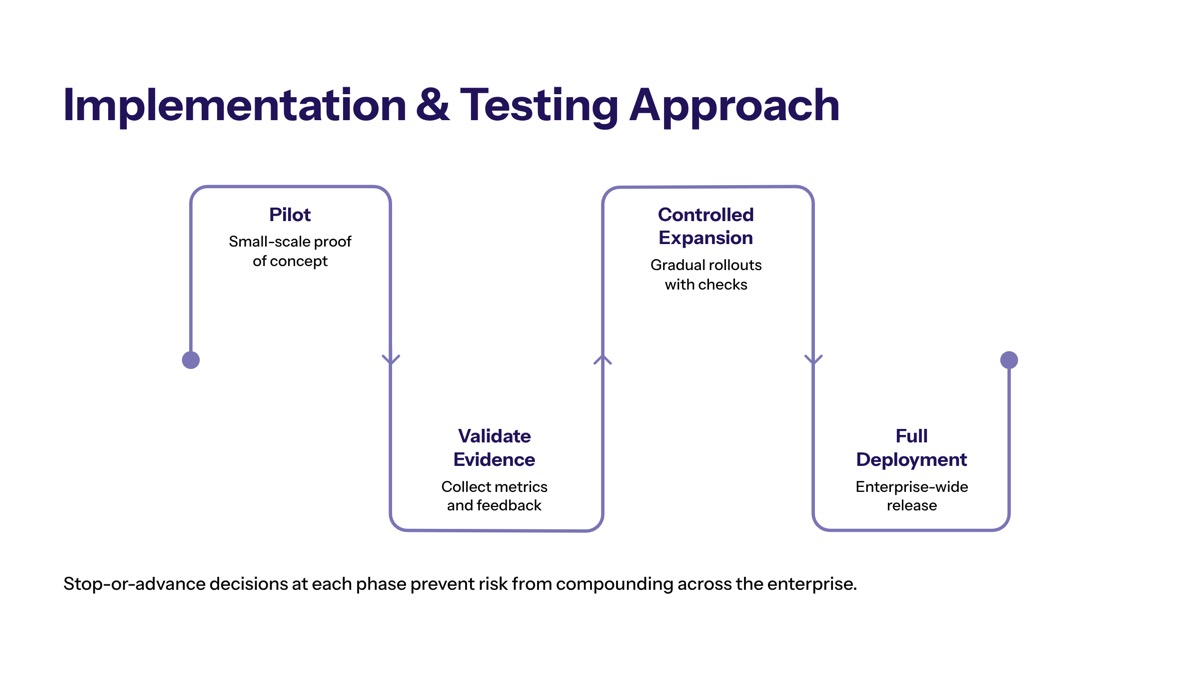
Financial services firms benefit most from phased automation implementation that validates controls and evidence requirements before expanding scope. The automation journey in regulated environments differs fundamentally from general enterprise automation because every phase must satisfy compliance and audit expectations.
Test a Bounded Workflow Before Expanding Scope
Select an initial pilot workflow with characteristics favorable for controlled testing:
-
Relatively stable rules with low change frequency
-
Low to moderate decision consequence severity
-
Limited core systems dependencies
-
Manageable exception volume
-
Clear ownership and accountability
Testing criteria before scaling must include:
-
Accuracy thresholds : Percentage of automated decisions matching human review above a defined acceptance level
-
Control effectiveness : Evidence that all control points function correctly, including escalation triggers and human review routing
-
Audit trail completeness : Verification that every decision is logged with input data, rule/model version, outcome, and timestamps
-
Exception handling validation : Confirmation that exceptions route correctly and are resolved within defined timeframes
Validate results with compliance, risk, legal, and operational stakeholders before proceeding. Automated systems improve operational efficiency in financial services, but efficiency gains must not come at the expense of control effectiveness.
Measure Reliability and Operating Value with Real Evidence
Collect baseline metrics before automation begins:
-
Processing time per unit (transaction, document, case)
-
Human hours consumed
-
Error rate (false positives, false negatives, misclassifications)
-
Cost per transaction
-
Exception volume and resolution time
After deployment, track the same metrics continuously. Automated workflows can reduce manual effort by up to 80% - but this must be verified with actual measurement, not assumed. Key ongoing metrics include:
-
Decision accuracy rate against human review benchmarks
-
Exception rate trends (increasing exceptions may signal process or data drift)
-
Cycle time improvements
-
Audit findings related to the automated workflow
-
Number of manual overrides and their causes
-
Maintenance effort and cost
AI automation reduces compliance risk while improving execution speed, but risk metrics must be tracked alongside efficiency metrics. Dashboard or reporting infrastructure for continuous monitoring is essential - not optional.
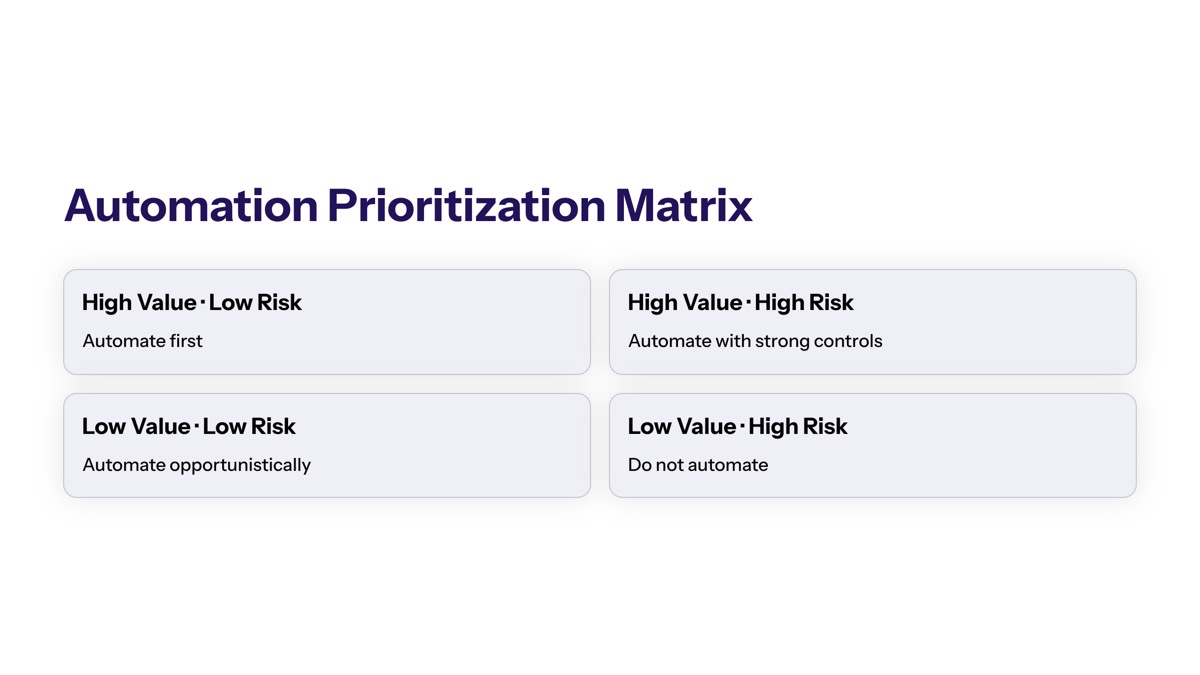
Illustrative Financial Services Workflow Categories
The following categories represent areas where financial institutions commonly evaluate automation opportunities. Each requires individual risk assessment, control design, and stakeholder validation. All examples are illustrative and do not constitute recommendations to automate any specific financial, lending, fraud, compliance, or customer decision.
Document intake and classification : Automating OCR-based extraction and categorization of invoices, KYC documents, and regulatory filings. May involve structured data and unstructured formats, often requiring human verification for edge cases. RPA can reduce invoice processing time by 70%, based on published benchmarks - though actual results depend on document variability and quality.
Routing and prioritization : Directing customer service tickets, fraud alerts, or compliance cases to appropriate teams based on defined criteria. Automated workflows consistently apply compliance standards, reducing errors in routing logic.
Reconciliation support and exception flagging : Supporting bank account reconciliations, identifying discrepancies, and flagging exceptions for human review. AI-driven automation can cut month-end close cycle times significantly when reconciliation rules are stable.
Internal knowledge retrieval and case preparation : Assembling documents, precedent data, and relevant financial information for regulatory reporting, audit preparation, or fraud investigations. This supports finance professionals in focusing on higher value work rather than document assembly.
Customer service preparation and information assembly : Preparing summary briefings, account histories, or financial statements for customer interactions. Automated chatbots provide 24/7 customer support in finance for routine inquiries, while more complex tasks require human engagement.
Reporting preparation and data aggregation : Aggregating data from multiple sources for regulatory or management reports. Automation supports regulatory compliance by generating necessary reports from existing data, but report interpretation and submission typically require human review.
Onboarding workflow coordination : Coordinating new client KYC, account opening, and setup workflows across multiple systems. AI agents can reduce account opening time by 70% - an illustrative figure demonstrating the potential for streamlined onboarding when controls and verification steps are properly designed.
All workflow categories require evaluation against the prioritization dimensions described below.
Financial Services Automation Prioritization Matrix
The following matrix provides a framework for evaluating automation candidates across the dimensions that matter most in regulated financial operations. Actual scoring should reflect your organization's specific risk tolerances, regulatory obligations, and operational context.
|
Dimension |
Document Intake & Classification |
Routing & Prioritization |
Reconciliation Support |
Internal Knowledge Retrieval |
Onboarding Coordination |
Reporting & Data Aggregation |
|---|---|---|---|---|---|---|
|
Business Value |
High |
Medium |
Medium-High |
Medium |
High |
Medium-High |
|
Process Stability |
Moderate |
High |
High |
Moderate |
Moderate |
High |
|
Data Sensitivity |
High (PII, identity docs) |
Medium |
Medium |
Medium-Low |
High (customer data) |
Medium-High |
|
Decision Consequence |
Medium |
Low-Medium |
Medium |
Low |
Medium-High |
Medium |
|
Exception Frequency |
Medium-High (format variability) |
Low |
Medium |
Low |
Medium |
Low-Medium |
|
Human Review Requirement |
Threshold-based |
Minimal (oversight) |
Low-Medium |
Minimal |
Threshold-based |
Review before submission |
|
Evidence Requirement |
High |
Medium |
High |
Low-Medium |
High |
High |
|
Integration Complexity |
Medium-High (legacy OCR) |
Low-Medium |
Medium |
Medium |
High (multi-system) |
Medium |
|
Recommended Next Step |
Pilot with verification |
Pilot or automate |
Phased automation |
Pilot |
Hybrid with controls |
Phased automation |
How to use this matrix : Score each workflow candidate on these dimensions using your organization's definitions. Workflows scoring favorably across stability, evidence readiness, and integration complexity - with manageable exception frequency and appropriate human review - are stronger pilot candidates. Workflows with high decision consequences, high data sensitivity, or regulatory mandates for human review should be approached as hybrid implementations with robust controls.
Adapt the matrix to your organizational context. Financial services firms with mature data governance may tolerate higher integration complexity. Organizations in heavily regulated segments may require higher evidence standards even for low-consequence workflows. The matrix is a starting framework, not a final answer.
Common Implementation Challenges
Financial services automation projects encounter predictable obstacles. Anticipating them improves planning and reduces implementation risk.
Integration Complexity Across Legacy Systems
Many financial institutions operate core systems built decades ago - platforms that lack modern APIs, produce unstructured outputs, or store data in proprietary formats. Connecting automation tools to these systems often requires custom wrappers, middleware, or manual preprocessing steps that reduce the efficiency gains automation was supposed to deliver.
Mitigation strategies include conducting thorough integration assessments before pilot selection, choosing workflows with simpler system dependencies for initial deployment, and investing in secure, well-architected integration layers rather than fragile point-to-point connections. RPA saved Primanti Brothers 2,000 hours annually - but such outcomes depend on the specific integration landscape.
Regulatory Uncertainty and Compliance Risk
Regulatory guidance on AI-driven automation in financial services is evolving. The OECD's policy analysis notes that existing financial regulatory frameworks are largely technology-agnostic and outcomes-based, but identifies gaps in specific requirements for traceability, data governance, and model-risk oversight. Agentic AI adoption is outpacing governance in many regulated industries.
Approaches for managing this uncertainty include designing automation with conservative control assumptions (more human review, more logging than currently required), maintaining flexibility to adjust workflows as guidance clarifies, and engaging compliance and legal functions as ongoing participants in automation governance - not just at project approval.
Change Management and Staff Adoption
Embracing automation requires addressing concerns about job impact, trust in automated decisions, and workflow changes. Finance professionals and operations staff may resist automation they perceive as threatening their roles or producing decisions they cannot explain to customers or examiners.
Effective change management strategies include:
-
Framing automation as shifting work from manual tasks to more complex tasks requiring judgment and expertise
-
Providing training on how automated workflows function, where human review applies, and how to escalate concerns
-
Involving frontline staff in workflow design and testing to build trust and identify practical issues early
-
Communicating clearly that humans remain accountable for consequential decision making
Questions to Answer Before Implementation
Before committing resources to a financial automation initiative, validate these critical questions:
Workflow readiness :
-
Is the workflow clearly defined with documented boundaries, decision points, and ownership?
-
Are the governing rules stable, or are they subject to near-term regulatory or business changes?
-
What is the current exception rate, and are exception patterns well understood?
Control requirements :
-
Which decisions within the workflow require mandatory human review?
-
What audit evidence must each automated step produce?
-
Are reconciliation procedures defined for comparing automated and manual outcomes?
Data access and quality :
-
Are all required data sources identified with clear systems of record?
-
Does existing data meet quality standards for automated processing?
-
Are access controls and permissions mapped and enforceable within the automated workflow?
Organizational capability :
-
Does the organization have the technical skills to build, test, and maintain the automation?
-
Are compliance, risk, and legal stakeholders aligned on the approach?
-
Is there a plan for ongoing monitoring, maintenance, and governance?
Decision criteria for proceeding : If any critical question cannot be answered affirmatively - particularly around control requirements, data access, or regulatory clarity - the workflow should be redesigned or deferred until gaps are resolved. 1300% ROI was achieved within the first year of automation in published case studies, but those outcomes reflect specific contexts where prerequisites were met. Projected returns without validated readiness are unreliable.
Resource and timeline planning should account for control design and testing phases that may equal or exceed the technical build effort. Integration with broader digital transformation initiatives - including enterprise resource planning modernization, data governance programs, and security architecture upgrades - improves long-term sustainability.
Conclusion and Next Steps
Business process automation in financial services delivers measurable value when workflows are selected carefully, controls are designed to regulatory standards, evidence requirements are met, and human oversight is preserved for consequential decisions. The competitive advantage comes not from automating the most processes, but from automating the right processes with the right controls.
Immediate actionable steps:
-
Conduct a workflow assessment using the framework above - map decisions, ownership, consequences, stability, and exception patterns for your highest-priority candidates.
-
Map control requirements for each candidate, including mandatory human review points, audit evidence standards, and exception handling procedures.
-
Design a bounded pilot targeting a workflow with favorable stability, manageable integration complexity, and clear success criteria.
-
Establish baseline metrics before deployment, and plan continuous monitoring infrastructure alongside the automation itself.
Organizations evaluating financial automation benefit from engaging specialists who understand both the technology options and the regulatory environment - including control design, secure integration, and governed AI agents for regulated operations.
To discuss a bounded automation workflow for your financial services organization, contact Cognativ . We help finance leaders connect workflow design, automation engineering, governance, and operating evidence so that automation works within - not around - your compliance and risk requirements.