Enterprise AI Adoption After the Pilot: Workflow, Ownership, and Evidence
Enterprise AI adoption is not achieved when a model performs well in a demonstration. It occurs when people use AI-enabled workflows repeatedly, understand their boundaries, handle exceptions, produce evidence of results, and know who owns the outcome. The gap between a successful pilot and reliable operational practice is where most AI initiatives stall-and it is an operating-system problem, not a technology problem.
This content covers the post-pilot adoption challenge for mid-market and enterprise organizations operating in complex environments. It is written for transformation, technology, operations, and business leaders who have moved past initial proof-of-concept success and now need to make AI work inside real business processes. If you are evaluating whether to start an AI pilot, this is not the right starting point; if you are trying to figure out why a technically successful pilot has not changed how your teams actually work, read on.
Enterprise AI adoption occurs when AI becomes part of repeatable business workflows with clear ownership, boundaries, and evidence collection-not when a pilot demonstrates technical feasibility. A recent S&P 500 study found that by 2025, only about 11% of those enterprises had AI deeply integrated into their business processes, despite nearly universal experimentation. The distance between experimentation and integration is where adoption lives or dies.
By the end of this article, you will understand:
-
Why technically successful pilots routinely fail to become reliable operating practices
-
How to design workflows, decision rights, and exception handling for post-pilot AI
-
What operational ownership and accountability look like in practice
-
How to measure adoption through behavior and decision quality rather than usage statistics
-
How to assess your organization's readiness for scaling AI beyond the pilot
Understanding Enterprise AI Adoption
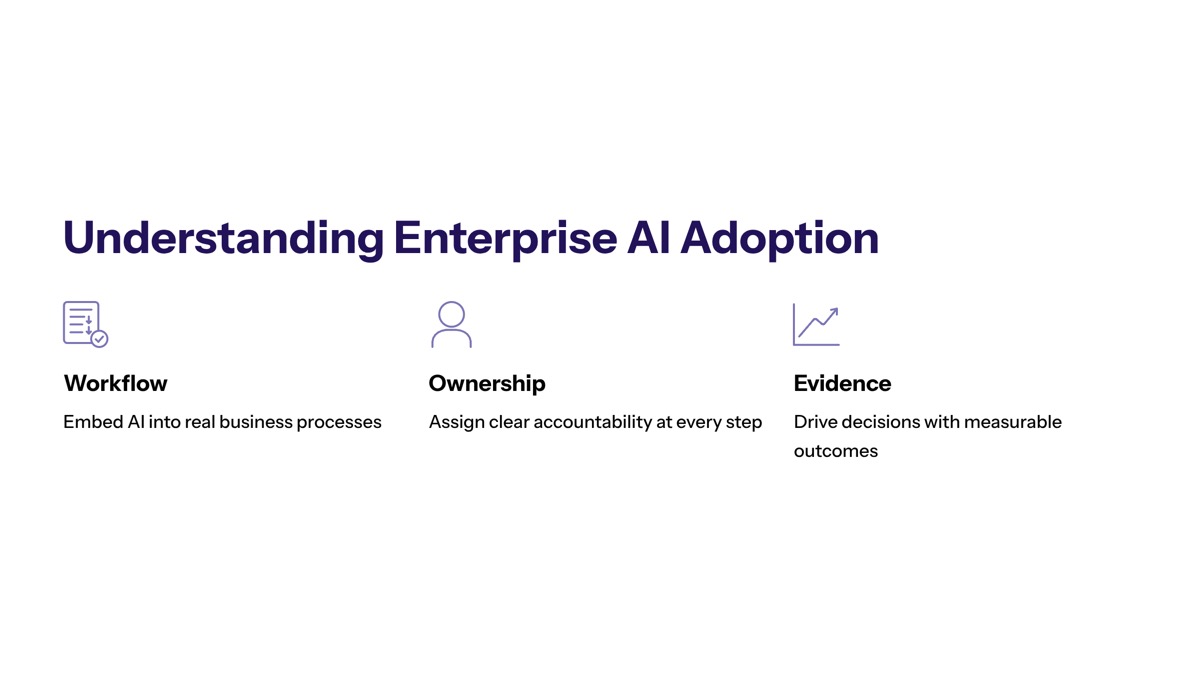
Enterprise AI adoption means operational integration: AI systems improve specific business decisions and workflows, produce measurable outcomes, and run with stable operations, defined ownership, and governance. It is distinct from AI experimentation, AI availability, or even AI usage. Many enterprises have made AI tools available; far fewer have embedded artificial intelligence into the operating fabric of their business functions.
What Adoption Actually Means
Adoption requires users who can operate AI-enabled workflows repeatedly without needing technical support for every action. There are defined templates, decision points, and processes-AI is not an optional side tool but part of how work gets done. According to Prosci research from 2026, user proficiency remains the largest challenge in AI adoption, cited by approximately 38% of respondents-more than technical integration or organizational challenges.
Clear ownership of decisions, processes, and outcomes is foundational. Business ownership means someone is accountable for the quality of results. Technical ownership means someone maintains model performance, data pipelines, and infrastructure. Governance ownership means someone ensures compliance, manages risk, and enforces ethical guidelines. Without these three layers, "adoption" is just availability.
Evidence collection is the third requirement. Organizations must demonstrate improved decision quality, reduced cycle times, lower error rates, cost savings, or revenue impact through data. Baseline metrics-what performance looked like before AI-must exist for any comparison to be meaningful. 66% of organizations report productivity gains from AI adoption, and 34% report operational efficiency gains, but these numbers are meaningful only when tied to specific workflows and measurable outcomes .
Why Successful Pilots Often Fail to Scale
Pilots operate in controlled environments with dedicated technical resources, clean data, and simplified workflows. In production, data is messier-missing values, external dependencies, scale stresses, and variable inputs become the norm. Research confirms that poor data quality has become enterprise AI's weakest link , and 73% of organizations cite data quality as their biggest challenge in AI implementation.
Production environments demand integration with legacy systems, permissions, security, and compliance controls that pilots routinely bypass. Integration of AI can be challenging with legacy infrastructures, and integrating AI models can involve complex re-engineering of existing systems. Many companies fail to invest in necessary AI infrastructure, creating a structural gap between demonstration value and operational reliability.
The organizational dimension is equally critical. Mixed-methods research on pilot-to-scale transitions identifies three distinct failure modes : the "Black Box" failure, where leadership wants AI but no one defines specific workflows or decisions to improve; the "Broken Pipe" failure, where strategic signals never reach frontline teams because middle management doesn't enact changes; and the "Invisible Brake" failure, where eagerness exists but roles are unclear, training is insufficient, and technical infrastructure is missing. An MIT study found that roughly 95% of generative AI pilots fail, with the key factor being that pilots never properly integrate into real business processes .
The modern enterprise faces a pivotal shift: moving from proving that AI technologies work to proving that organizations can work with AI. That transition requires systematic post-pilot implementation.
Post-Pilot Implementation Requirements
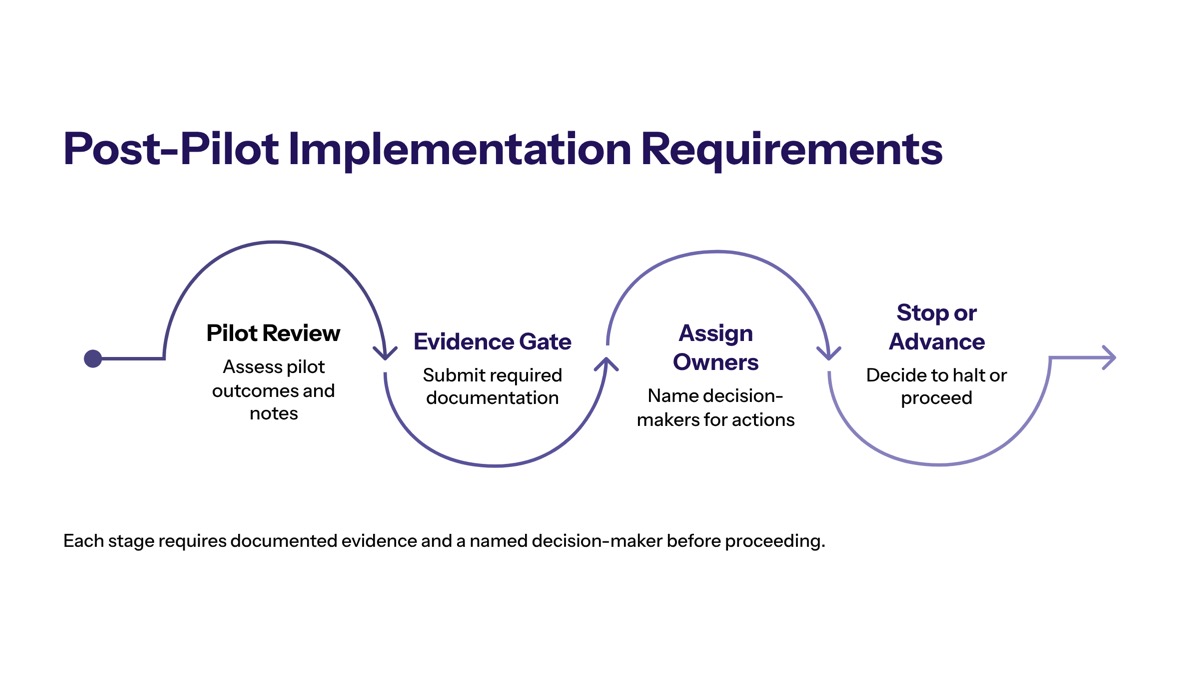
Moving from pilot success to operational adoption requires systematic workflow design and ownership assignment. This is where the operating-system problem begins-not with the model, but with how decisions get made, who makes them, and what happens when something goes wrong.
Define the Target Decision or Workflow
Every post-pilot effort must specify the exact business decision or process that AI will improve. Vague objectives like "improve customer experience" or "optimize supply chain operations" are insufficient. Instead, define the decision point: what inputs arrive, what possible outcomes exist, what approvals are needed, what thresholds apply. For example, AI supporting demand forecasting should specify which product categories, which time horizons, which confidence levels trigger automated reordering versus human review.
Document the current workflow completely-every step, data input, handoff, and decision maker-before determining where AI fits. Only by mapping the existing process can you identify whether AI serves as a pre-decision recommendation, a post-decision validator, an advisory layer, or a fully automated execution step. AI initiatives require top-down alignment with core business outcomes, and that alignment starts with a clearly specified workflow target.
Success criteria must be defined in both technical and business terms. Technical criteria include error rates, latency, output confidence levels, and model accuracy. Business criteria include reduced time per case, cost per decision, revenue conversion improvements, or customer satisfaction changes. 34% of organizations are using AI to transform core processes, but transformation without defined success criteria produces activity, not adoption. Leadership needs clear metrics to demonstrate AI's return on investment visibility.
Identify Users, Owners, and Affected Teams
Assign a named business owner-the person accountable for the workflow outcome, the performance metric, and the decision about whether to expand or stop. This person holds P&L or operational responsibility and defines what "good" looks like. Without this assignment, responsibility for outcomes or failures remains diffuse, and no one feels accountable.
Designate a named technical owner responsible for system maintenance, model updates, data infrastructure, bug fixes, and performance monitoring. AI systems require consistent data governance to function effectively, and someone must own that responsibility day to day. Effective AI platforms require suitable cloud infrastructure and integration capabilities, and the technical owner ensures these remain operational.
Map all user groups with specific needs: primary users who interact with the system daily, reviewers who provide human oversight, approvers who authorize outputs above certain thresholds, and support teams who handle technical and operational issues. Each group requires different training and different levels of data access . Document all teams affected by workflow changes-upstream teams whose data feeds the system, downstream teams who act on its outputs, and adjacent teams whose processes may shift. Scarcity of specialized talent is a major bottleneck in AI adoption, making it essential to identify exactly what ai skills each role requires and where gaps exist.
Establish Boundaries and Exception Handling
Define scenarios where AI recommendations require human review or approval. Not every output needs oversight, but high-stakes decisions, edge cases, and outputs below confidence thresholds must route to qualified reviewers. Clear governance is necessary to prevent algorithmic bias and ensure accountability, and these boundaries are where governance becomes operational rather than theoretical.
Create explicit escalation paths. If an AI system produces an implausible output, what happens? Who reviews it? How quickly? What constitutes "implausible" in the specific business context? These definitions must be codified, not improvised. Enterprises must manage security, privacy, and compliance issues with AI, and exception handling is where compliance meets daily operations.
Set confidence thresholds and quality gates for automated decision making. For instance, an agentic AI system handling supply chain management decisions might operate autonomously above 95% confidence but require human approval below that threshold. Every exception should be captured, categorized, and used to refine the model or the workflow. Companies investing in responsible AI frameworks mitigate bias risks, but only when those frameworks include operational exception handling-not just policy documents. Organizations must balance experimentation with clear governance in AI projects.
Workflow Integration and Operational Design
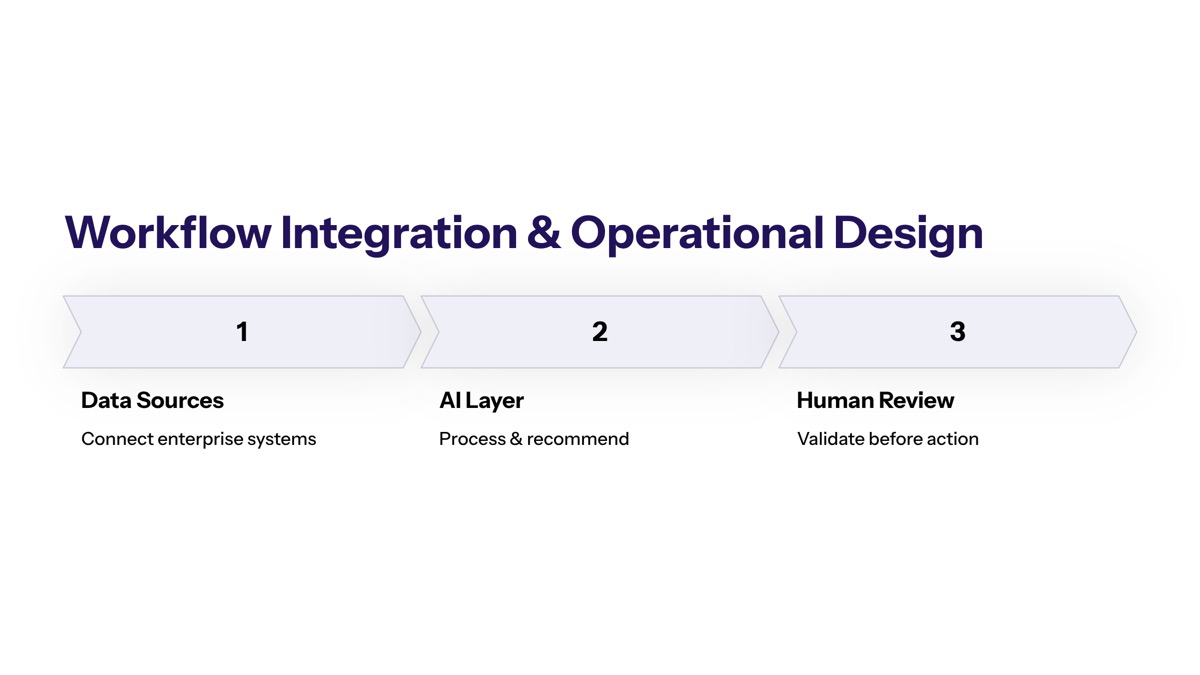
Moving from isolated AI capabilities to integrated business operations requires embedding AI into the places where decisions actually happen-not creating parallel experiments that business leaders and their teams must choose to visit.
Fitting AI into Real Workflows
The most common integration failure is building AI-powered tools that exist alongside existing workflows rather than within them. If a sales team uses a CRM, AI-assisted predictions should appear in the CRM at the relevant decision point-not in a separate dashboard that requires a context switch. If a support team manages cases through a ticketing system, AI-driven chatbots and routing recommendations should operate within that system. AI can automate routine tasks, improving operational efficiency, but only when automation lives inside the process rather than beside it.
Data flow design must specify clear input sources, model scoring mechanisms, output integration into the system of record, and feedback capture back into the system. This is where many enterprises encounter the real cost of adopting AI in complex environments : connecting AI models to production data sources, existing systems, and downstream actions requires engineering work that pilots never surface.
Change management for modified roles is essential but must be specific, not generic. Document exactly what has changed in job tasks, expectations, and KPIs for every affected role. Who now has the authority to override AI? Who reviews flagged cases? What decisions shift from fully manual to AI-assisted? Organizational change management is critical for successful AI implementation, and it must address decision making authority-not just communication plans. 34% of organizations report insufficient worker skills as a barrier, reinforcing that role-specific preparation matters more than general awareness campaigns.
User Training and Judgment Development
Training programs must teach users when to accept, modify, or reject AI recommendations-not just how to use the interface. This is judgment development, and it differs fundamentally from software training. Users need to understand what the AI system can and cannot do, where its ai capabilities are strong, and where its limitations create risk. For conversational ai or generative ai tools that support customer service workflows, users must recognize when AI-generated responses require human editing before delivery.
Reference materials should cover capabilities, limitations, appropriate use cases, and edge-case examples. Include examples of good outputs, bad outputs, and the reasoning for each classification. Make these materials role-specific: a frontline user interpreting AI recommendations needs different guidance than a supervisor reviewing escalated cases or a compliance officer auditing outputs.
Ongoing education is non-negotiable. When models change, when data distributions shift, when workflows are updated, users must be informed and retrained. AI tools evolve, and user judgment must evolve with them. The goal is building institutional competence in working with AI, not just initial familiarity.
Support and Feedback Systems
Support responsibility must be explicitly assigned. Technical support covers uptime, model drift monitoring, integration failures, and data pipeline issues. Operational support covers user questions, workflow problems, and role confusion. Many organizations assume that existing IT help desks can absorb AI support; in practice, AI systems require specialized knowledge that general support teams often lack.
Feedback collection mechanisms should capture user-reported errors, override decisions, trust assessments, and improvement suggestions. Track override rates-how often users reject AI suggestions-as a leading indicator of both model quality and user trust. If override rates are very high, either the model or the training (or both) needs attention. If override rates are very low, users may be accepting outputs uncritically.
Build iteration processes into the operating model. Periodic retrospectives should review model performance, workflow effectiveness, training gaps, and guardrail adequacy. Continuous monitoring of AI systems is essential for managing risk and ensuring compliance. This is not a one-time setup; it is an ongoing operating discipline. Effective AI governance integrates with existing risk and oversight structures, and feedback systems are the mechanism that makes governance operational.
Measurement and Evidence-Based Expansion
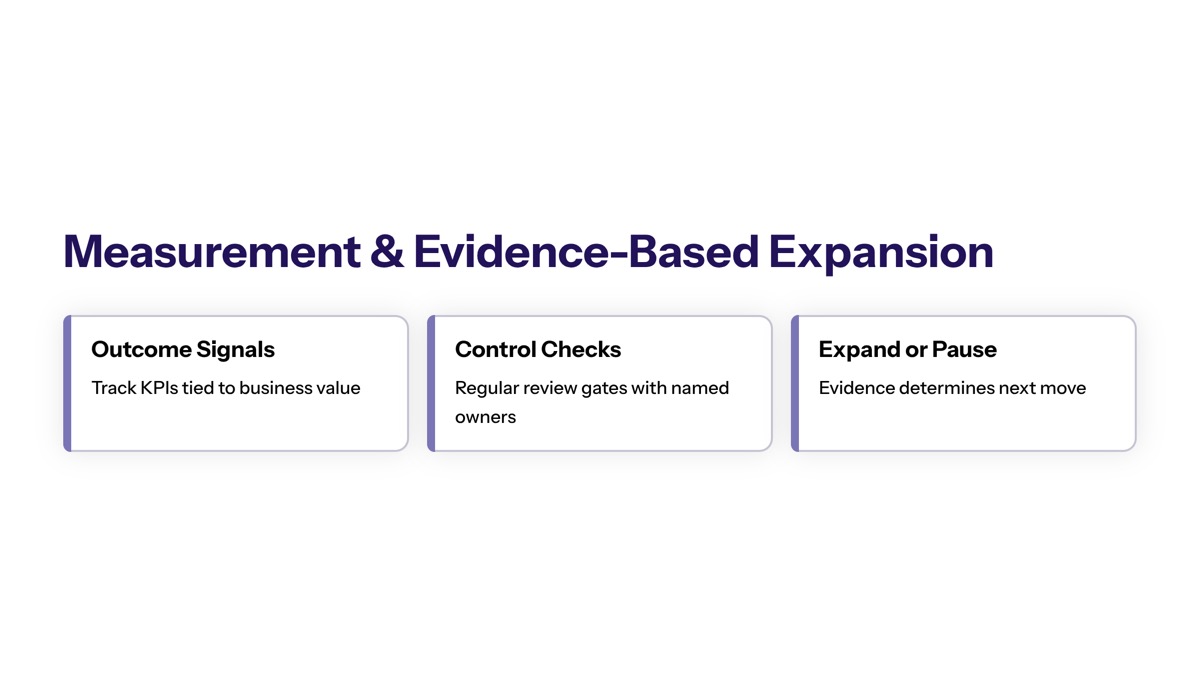
Many organizations measure AI adoption through vanity metrics-number of users, logins, or prompts. These metrics measure availability and activity, not adoption. Adoption measurement must focus on behavior change, decision quality, and business outcomes. As KPMG notes, "adoption quality" is realized through everyday behavior and decision making, not through building lots of pilots.
Meaningful Adoption Metrics
Decision quality indicators are the most important category: accuracy of AI-enhanced decisions, false positive and negative rates, compliance deviations, and rework rates. These directly measure whether AI is improving the workflow it was designed to improve. 77% of AI investors see positive returns in operational efficiencies, but that return is only visible when measured through workflow-specific metrics rather than aggregate statistics.
User behavior metrics track how people actually work with AI: frequency of appropriate use, override rates, escalation patterns, and time-to-decision. A healthy adoption pattern shows users engaging with AI regularly, overriding when appropriate (neither too much nor too little), and escalating edge cases through defined channels. AI supports predictive analytics for demand planning and inventory management, but the value only materializes when users incorporate those predictions into actual planning decisions.
Business outcome measurement connects AI adoption to operational improvements. Track cost per decision, cycle time reduction, throughput changes, customer satisfaction, and revenue impact. 34% of organizations report operational efficiency gains within 18 months of AI implementation, and organizations report ROI from AI typically within 12-24 months-but these timelines assume that measurement systems are in place from the start. Enterprises often struggle with demonstrating the measured business value of AI precisely because they begin measuring too late or measure the wrong things. 88% of leaders now spend 5% or more of their budget on AI, and AI investments are projected to double, exceeding $10 million next year-making rigorous measurement not optional but essential.
Evidence-Based Expansion Decisions
Before expanding AI adoption to additional workflows, teams, or business units, define the evidence required. What accuracy threshold must be met? What user satisfaction level? What business impact? Use controlled comparisons where possible-comparing similar cases with and without AI support-to attribute impact rather than assume it.
Documentation requirements should include performance logs, dashboards showing change over time, and records of negative or unexpected outcomes. Leading organizations maintain audit trails that trace AI-influenced decisions back to model versions, data inputs, and human reviewers. This documentation serves both governance and learning purposes.
Define conditions for modifying, limiting, or discontinuing AI applications. When error rates breach tolerances, when user trust drops, when cost outweighs impact, or when regulatory requirements shift, the organization needs predetermined responses-not ad hoc crisis management. Expansion without evidence is speculation; evidence-based expansion is how leading enterprises build a lasting competitive edge through AI rather than accumulating unmonitored deployments.
Common Challenges and Solutions
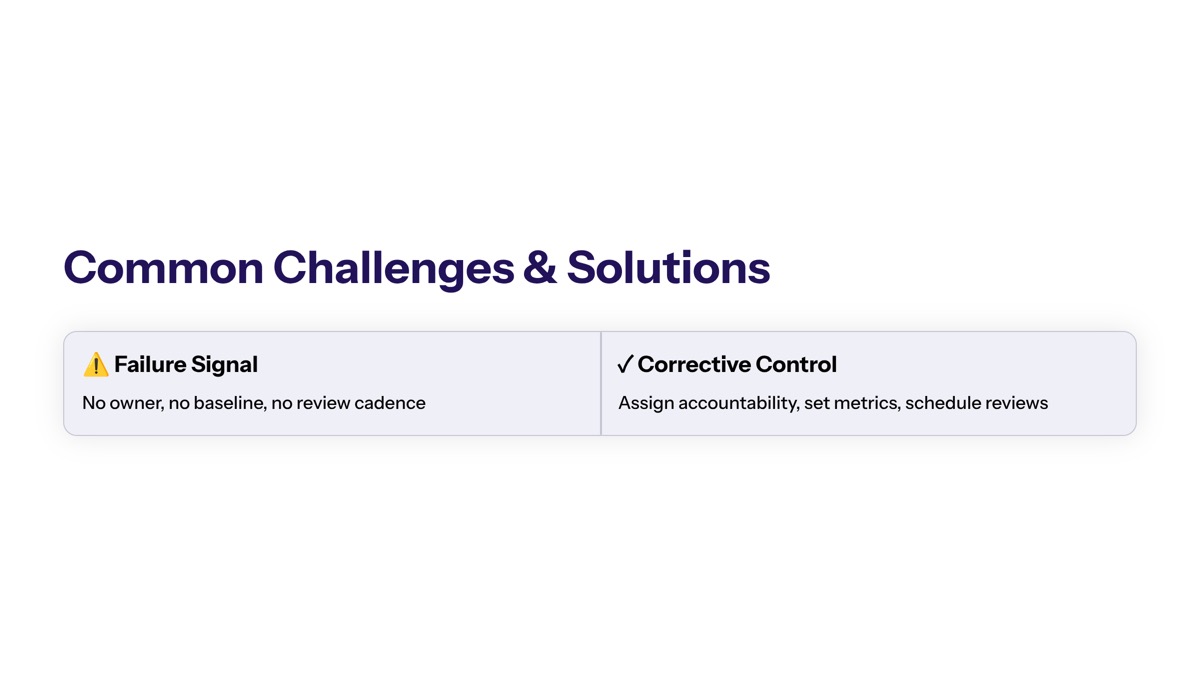
Post-pilot adoption encounters predictable obstacles. Recognizing them early and addressing them systematically prevents the pattern where organizations cycle through pilots without achieving operational integration. These challenges span several domains-organizational, technical, and governance-related.
Resistance to Workflow Changes
People are comfortable with existing processes; AI introduces uncertainty, perceived risk, and sometimes fear of automation. The solution is not more communications but more involvement. Engage affected teams early in workflow design to address concerns and incorporate their operational knowledge. Demonstrate clear value through small-scale implementations in low-risk areas before broader rollout. Use role-specific examples that show how AI changes the job without replacing the person-for example, how AI-powered support in customer service reduces repetitive work while leaving complex cases to human judgment. One case study showed that a company providing broad AI access (ChatGPT) saw uneven adoption until it rolled out role-specific training programs covering beginner, advanced, and role-based use cases-producing far more consistent results.
Unclear Ownership and Accountability
Without named business and technical owners, responsibility for outcomes diffuses. No one feels accountable for whether the AI system is improving the workflow, and failures get attributed to "the AI" rather than to specific operational gaps. Establish explicit ownership assignments for business outcomes and technical maintenance. Create decision-making authority matrices clarifying who can modify, approve, or override AI outputs. Include operational performance KPIs in owners' evaluations so that adoption quality is part of their accountability, not a side project.
Insufficient User Training and Support
Users who don't understand when to trust or override AI may either misuse outputs or avoid the system entirely. 34% of organizations report insufficient worker skills as a barrier, making training a structural requirement rather than a nice-to-have. Develop role-specific training covering AI capabilities, limitations, and appropriate usage scenarios. Implement ongoing support systems-including champions or super-users within teams-with clear escalation paths for both technical and operational issues. High-quality data is foundational for effective ai initiatives, and users must understand how data quality affects the outputs they receive. Organizations across many industries and several domains-from financial services and health care to public sector and life sciences-face this challenge, and the solution is always context-specific training, not generic AI literacy programs.

Conclusion and Next Steps
Enterprise AI adoption is an operating-system challenge. It requires workflow design, decision rights, training, support, measurement, and iteration-not simply a software rollout or a communications campaign. The distance between a working pilot and a reliable business practice is bridged by operational design, not by enthusiasm. A strategic approach to post-pilot adoption treats AI as a business transformation capability that must be governed, measured, and continuously refined.
To move forward:
-
Assess current workflow readiness using the checklist below-identify where your organization has gaps in ownership, training, boundaries, or measurement.
-
Assign clear ownership for every AI-enabled workflow: a named business owner, a named technical owner, and a governance owner.
-
Establish measurement frameworks that track decision quality and business outcomes, not just usage statistics. Senior leaders need evidence that connects AI to measurable business outcomes, and that evidence must be collected from day one of production deployment.
For organizations seeking practical implementation support, Cognativ's Artificial Intelligence Services help teams connect AI strategy, architecture, implementation, operating ownership, and evidence collection. For alignment between AI initiatives and broader business objectives, Cognativ's Business Strategy services provide the strategic framework for post-pilot planning.
Related topics worth exploring include AI maturity assessment, proof-of-concept exit criteria, and enterprise AI governance framework development -each of which addresses adjacent requirements for moving from experimentation to reliable operation.
Enterprise AI Adoption Readiness Checklist
Use this checklist to evaluate your organization's readiness for post-pilot AI adoption. Each item represents an operational requirement-not an aspiration. Items left unaddressed represent specific risks to adoption success.
Workflow and Outcome Definition
-
[ ] Target business decision or workflow is explicitly defined with measurable success criteria
-
[ ] Current workflow is documented including all steps, data inputs, handoffs, and decision points
-
[ ] AI's role within the workflow is specified (advisory, automated, hybrid) with clear boundaries
Ownership and Accountability
-
[ ] Named business owner is accountable for workflow outcomes and expansion/stop decisions
-
[ ] Named technical owner is responsible for model maintenance, data infrastructure, and system performance
-
[ ] Governance owner is assigned for compliance, risk management, and ai policy enforcement
User Groups and Role Changes
-
[ ] All user groups are identified: primary users, reviewers, approvers, support teams
-
[ ] Changes to roles, responsibilities, and decision making authority are documented
-
[ ] Downstream and upstream teams affected by workflow changes are mapped and informed
Training and Reference Materials
-
[ ] Role-specific training materials cover capabilities, limitations, and appropriate use cases
-
[ ] Reference guides include examples of good outputs, poor outputs, and edge cases
-
[ ] Update process exists for when models, workflows, or data distributions change
Human Review and Exception Handling
-
[ ] Confidence thresholds are defined for automated versus human-reviewed decisions
-
[ ] Escalation paths are documented for system errors, unexpected outputs, and edge cases
-
[ ] Guardrails cover data privacy, fairness, model explainability, and regulatory compliance
Feedback and Support
-
[ ] Feedback collection mechanisms capture user experience, override decisions, and error reports
-
[ ] Technical support responsibility is assigned (monitoring, drift detection, pipeline maintenance)
-
[ ] Operational support responsibility is assigned (user help, role of champions/super-users)
Quality and Risk Indicators
-
[ ] Accuracy, error rate, and compliance metrics are tracked against pre-AI baselines
-
[ ] Model drift monitoring is in place with defined intervention thresholds
-
[ ] Audit trails connect AI-influenced decisions to model versions, data inputs, and reviewers
Evidence for Expansion
-
[ ] Performance thresholds required before scaling to additional workflows or teams are defined
-
[ ] Controlled comparisons or cohort studies demonstrate attributed business impact
-
[ ] Resource readiness (infrastructure, talent, budget) for scaled deployment is assessed
Conditions for Limiting or Stopping
-
[ ] Error-rate thresholds that trigger workflow restriction or suspension are defined
-
[ ] User trust indicators that signal adoption problems are monitored
-
[ ] Cost-benefit thresholds and regulatory-change triggers are established for discontinuation decisions
This checklist is a starting point. Adoption requirements vary by workflow, architecture, risk profile, data types, and organizational context. Use it as a diagnostic tool to identify where your organization is operationally prepared-and where gaps remain before you deploy ai beyond the pilot.