How to Choose an AI Consulting Partner: A Practical Evaluation Framework
The right AI consulting company is not the largest, cheapest, or most recognizable name on a list. It is the partner that understands your business decision, provides relevant evidence of comparable work, designs a technical and operating model that fits your environment, defines responsibilities clearly, and supports the system beyond a demonstration. Asking "which AI consulting company should I choose?" leads to a better answer when you treat it as a buying-group decision across business, technology, security, and commercial criteria rather than a technology comparison alone.
This guide provides a practical evaluation framework for mid-market organizations comparing AI consulting partners, AI implementation partners, or AI development companies. The target audience includes business leadership, technology, operations, security, procurement, finance, and legal stakeholders involved in an AI vendor selection process. The framework applies whether you are evaluating consulting firms for a readiness assessment, an enterprise AI strategy, custom AI development, AI integration into existing systems, or ongoing support after deployment.
The numbers explain why careful selection matters. A 2026 McKinsey report found that only about 26% of companies have built the capabilities required to produce meaningful value from AI initiatives beyond pilots. Global corporate AI investment reached $252.3 billion in 2024, yet only 6% of firms reported seeing a measurable earnings impact from that spending. The global AI consulting market will exceed $30 billion in 2026, projected to grow to over $90 billion by 2035, and the AI services market is projected to grow at 21.4% CAGR over five years. 88% of organizations used AI in at least one business function by 2025, up from 78% the prior year. Yet most AI projects that fail do so because of misaligned expectations, poor data foundations, weak governance, or unclear ownership, not because of the underlying technology.
By working through this framework, you will gain:
-
A structured process for defining what you actually need before comparing providers
-
Specific questions to ask across business, technical, security, and commercial dimensions
-
A practical evaluation matrix organized by buyer-group ownership
-
Criteria for distinguishing proof of concept from production readiness
-
A defensible record of how and why a partner was selected
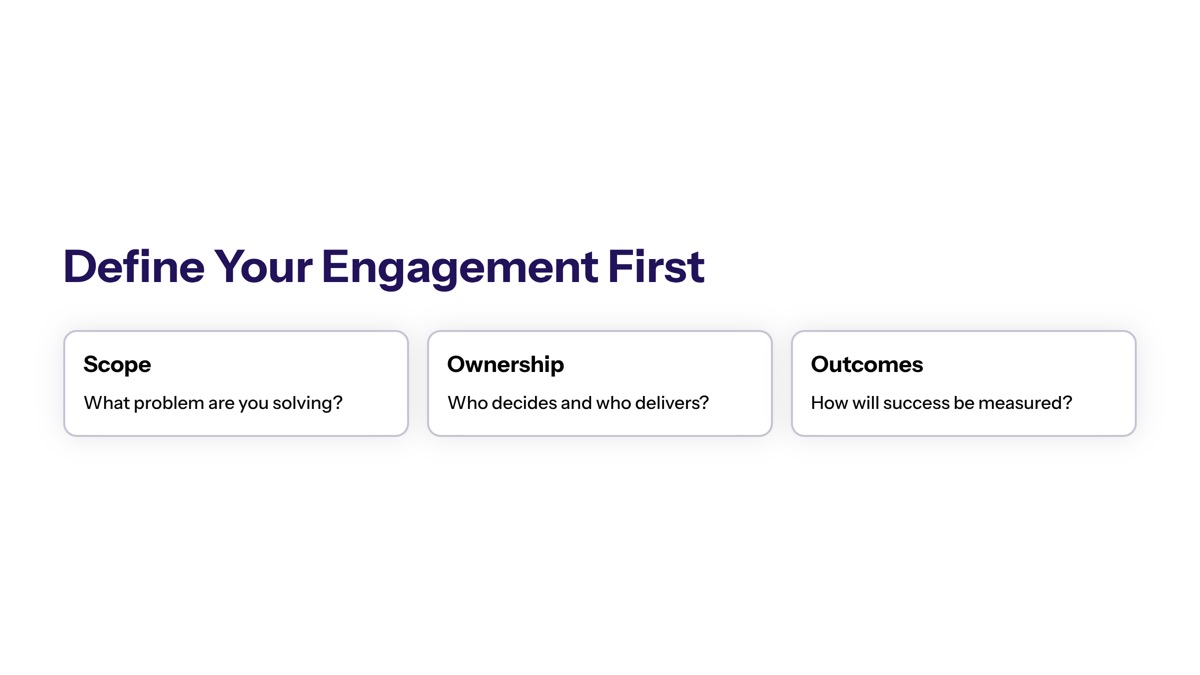
Define Your Engagement Before Comparing Providers
Most AI consulting companies offer overlapping but distinct services. Comparing a strategy advisory firm against an AI development company against a full-stack consulting firm produces confusion unless you first define the engagement type. AI consulting includes strategy formulation, implementation, and training, but few firms excel at all three equally.
Common engagement types include:
-
Readiness or opportunity assessment: Evaluating whether your data, infrastructure, and organization can support AI initiatives. Small assessments typically take 40 to 120 hours.
-
AI strategy and roadmap: Defining where AI fits your business strategies, which use cases to prioritize, and what sequence to follow. Large organizations often need comprehensive AI strategies that encompass business transformation.
-
Architecture and design: Mapping how AI systems connect to existing systems, data flows, identity, and cloud environments.
-
Data preparation: Cleaning, classifying, and organizing data sources before machine learning models or generative AI capabilities can be applied.
-
Proof of concept: Testing feasibility on a defined use case within a contained scope. Implementation timelines for AI projects can range from weeks to months depending on complexity.
-
AI application development: Building custom AI solutions, including natural language processing, conversational AI, machine learning, or AI agents.
-
Integration: Connecting AI tools into legacy systems and existing workflows. Integration into existing legacy systems is a key consideration for AI deployments.
-
Security and governance: Establishing a trustworthy AI framework , access controls, monitoring, and compliance practices.
-
Production deployment: Moving from a working model to a reliable, monitored, supported system.
-
Monitoring and ongoing support: Drift detection, incident response, performance tracking, and model updates.
-
Internal capability building: AI training and upskilling so internal teams can operate and extend what was built. Training is essential for clients to effectively use AI technologies.
A strong AI strategy consulting advisor may not be the right AI implementation partner. A capable AI engineering team may not be equipped to provide governance advisory. Clarifying the engagement type narrows the field to providers whose capabilities match what you need, rather than comparing proposals that cover different scopes.
Once you have defined the engagement type, structured evaluation begins.
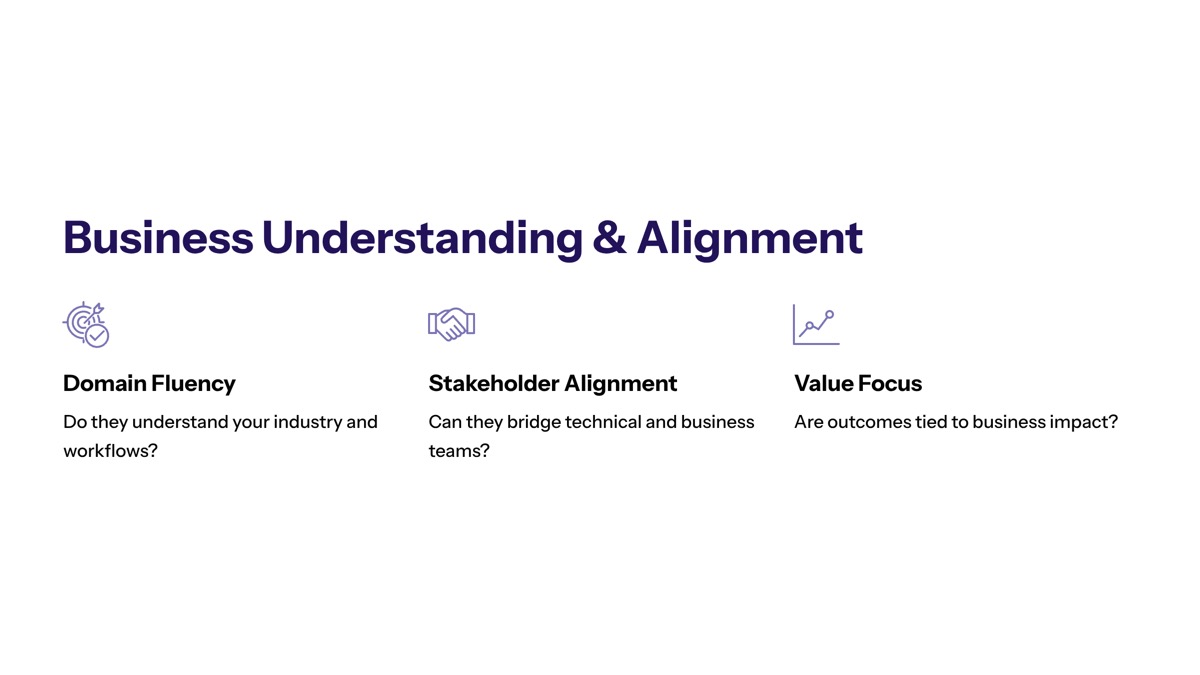
Business Understanding and Alignment
AI consulting firms must demonstrate technical abilities beyond strategy and planning. But technical capability without business understanding produces solutions that solve the wrong problem or cannot be adopted. Effective AI consultants connect technology initiatives to measurable business outcomes.
Evaluate whether a prospective AI partner can articulate which business decision, workflow, or process the AI work is intended to improve. Questions to ask:
-
What business process or decision will change as a result of this work?
-
How will the provider validate that the problem is worth solving, including quantifying return on investment for stakeholders?
-
Can the provider challenge an unsuitable use case, or will they proceed regardless?
-
Which business owners must participate, own decisions, and accept or reject outcomes?
-
What metrics define success? What defines failure or signals stopping?
-
What would cause the provider to recommend against proceeding?
AI projects often fail due to lack of employee adoption and change management. A provider that avoids discussing who will own adoption, how business processes will change, and how results will be measured introduces project risk.
Warning signs:
-
Starting with a preferred tool or platform before understanding your problem
-
Treating every problem as an AI problem regardless of evidence
-
Promising business transformation before completing discovery
-
Vague answers about ownership, adoption, or how business outcomes will be tracked
AI consulting engagements must focus on real metrics such as cost savings and revenue growth, not abstract "AI readiness" scores without connection to business value. The NIST AI Risk Management Framework emphasizes defining business value as a foundational step in AI applications.
Relevant Proof and Evidence
General company experience is different from evidence that a provider can deliver on your specific problem. When evaluating an AI consulting firm's proven track record, distinguish between:
-
General experience: Years in operation, team size, number of engagements
-
Industry familiarity: Work in your sector (22% of the AI consulting market comes from finance and banking, making financial services teams particularly common among top AI consulting firms)
-
Technical capability: Skills in data engineering, cloud architecture, machine learning models, generative AI, data science, or specific AI technologies
-
Comparable delivery evidence: Case studies showing similar problem types, data challenges, regulatory environments, and deployment contexts
-
Public thought leadership: Published analysis on AI scaling, governance, or data readiness that demonstrates depth
-
Verifiable client outcomes: References who can describe what was delivered, what changed, and what results were measured
Request case studies relevant to the type of problem you are solving. Ask to see architecture or delivery examples, named responsibilities within the engagement, acceptance criteria, and references. Gathering and assessing case studies contributes to selecting an effective AI consulting partner.
Evidence requests matter because AI consulting projects range from $5,000 to over $500,000. Senior AI consultants charge between $300 and $500 per hour. Most AI projects fall between $40,000 and $400,000+, and full AI implementations can take 1,200 to 5,000+ hours. The financial exposure warrants proportional diligence.
Delivery Model and Team Structure
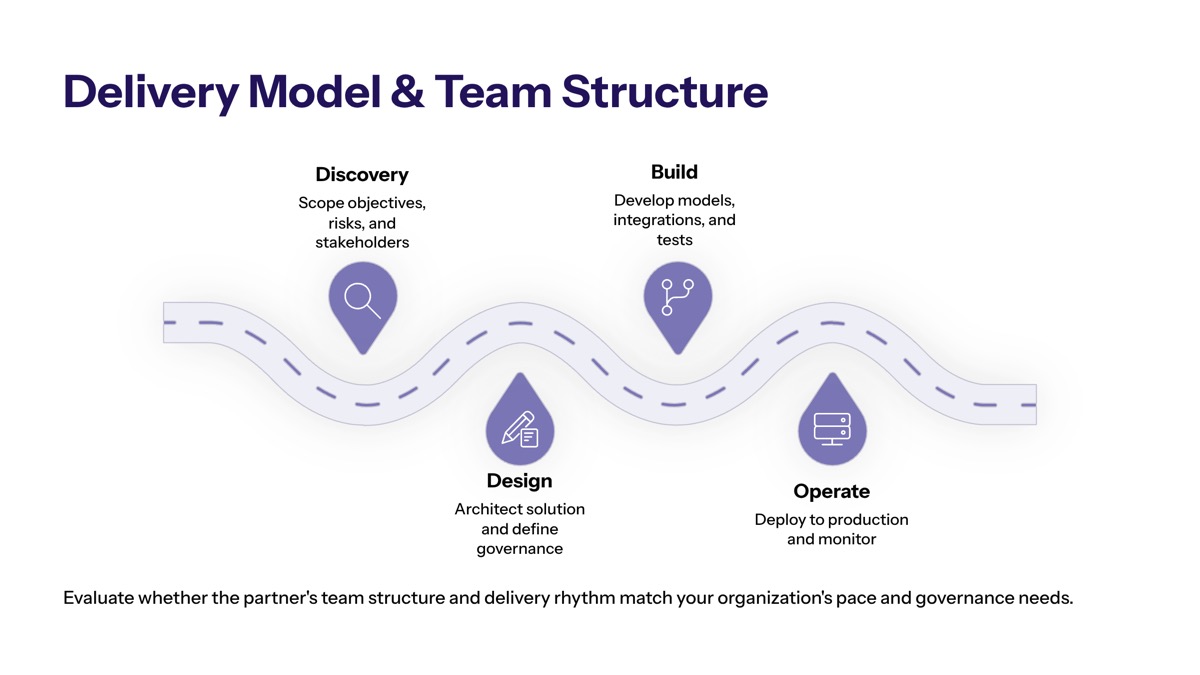
How work gets done matters as much as what gets proposed. Two AI consulting companies can describe the same deliverable but staff, manage, and transfer it in ways that produce opposite results.
Evaluate the discovery process first. Ask what workshops or assessments the provider conducts, how long discovery takes, who participates, and what documentation is produced. Discovery should include assessment of existing systems, data quality, skills, and organizational readiness. Data readiness assessments evaluate the current quality and infrastructure of data before AI implementation.
Then evaluate the team:
-
Who will perform the work? Ask for named roles rather than generic titles. Distinguish between senior principals or partners who set direction and junior associates who execute.
-
Will any work be subcontracted? If so, to whom, and under what oversight?
-
Who makes architecture decisions? Who owns project decisions?
-
What are the client's responsibilities for data access, internal process ownership, and decision rights?
-
What is the communication cadence: regular status updates, steering committees, escalation paths?
-
How are scope changes and changed assumptions handled? What triggers renegotiation?
AI consulting firms help integrate AI into existing workflows, but the integration succeeds or fails based on clear responsibility boundaries between provider and client teams.
Architecture and Technical Fit
A credible AI partner designs around the client's operating environment rather than forcing every engagement into one platform. Evaluate:
-
Existing environment: What data warehouses, data lakes, unstructured systems, API ecosystems, identity systems, and cloud or on-premises infrastructure do you operate? Can the provider adapt?
-
Model and vendor selection: What AI models or platforms are proposed: open source, commercial LLM APIs, custom models? How is vendor lock-in addressed? Choosing an AI consulting company should consider their independence from particular technology vendors, but vendor neutrality is not always required. A provider specializing in a specific platform may deliver faster results if that platform fits your needs. The tradeoff is between specialization and portability.
-
Observability: How will performance, bias, drift, and error rates be tracked over time?
-
Maintainability: Code quality, modular design, documentation standards
-
Performance: Latency, throughput, and scaling behavior as user load increases
Companies should choose AI partners with proven methods for workflow optimization and automation that fit the client's technical context, not providers that require replacing your entire stack to implement AI solutions .
Data Readiness and Governance
Data readiness is the largest bottleneck for organizations trying to scale AI. An Accenture study found that only 7% of organizations have reached sufficient data readiness to scale advanced AI, and 72% of companies lack trusted, high-quality data with standardized governance practices. A Cloudera and Harvard Business Review survey confirmed that only 7% of enterprises consider their data completely ready for AI, while 73% say data preparation remains a challenge.
Evaluate how the AI consulting firm approaches:
-
Data sources: Where data lives, what formats exist, what is structured versus unstructured, who owns each data source
-
Data quality: Completeness, consistency, correctness, bias, timeliness
-
Access and permissions: Legal, contractual, and privacy constraints on data use
-
Classification: How sensitive personal data, IP, and proprietary content are identified and handled
-
Preparation: Cleaning, normalization, feature engineering, and the scope of effort required
-
Testing data: Hold-out sets, validation approaches, synthetic data when needed
-
Ongoing ownership: Who owns cleaned data, metadata, embeddings, and derived artifacts; how retention and deletion are managed
Strong data governance practices are essential when choosing an AI consulting company. McKinsey identifies four metrics for data readiness when scaling generative AI: reuse, reliability, governance, and scalability.
Warning signs: Assuming available data is usable without assessment. Ignoring permissions or privacy constraints. Treating data engineering work as a minor implementation detail. Failing to name a data owner for each source. Any of these create project risk that compounds after deployment.
Security, Governance, and Risk Management
According to BigID's 2025 enterprise survey , 69.5% of organizations cite AI-powered data leaks as their top security concern. Cybersecurity and data privacy knowledge is critical for AI consulting practices. AI governance includes oversight and compliance concerning privacy, bias, and explainability.
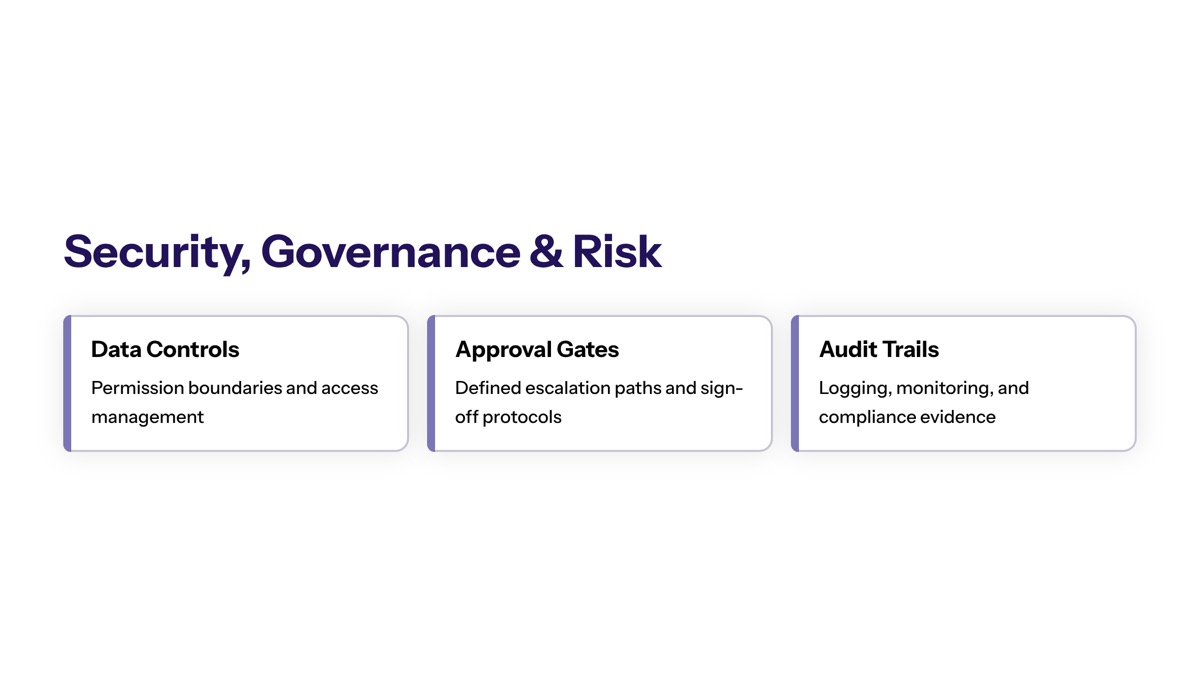
A provider should discuss security and risk management without making unsupported compliance guarantees. Evaluate their approach across:
-
Identity and access: Role-based access control, least privilege, separation of duties. Who reviews and approves access to sensitive data?
-
Data boundaries: What data can the AI system see? What systems can it reach? Are there isolation measures, encryption at rest and in transit, and secure credential handling?
-
Model and vendor risk: If using third-party models or APIs, what licensing terms, update policies, and vulnerability disclosure practices apply?
-
Human oversight: Who reviews outputs? How is human-in-the-loop ensured for high-risk functions? What happens when the model fails?
-
Logging and monitoring: Audit logs, data lineage, ability to reproduce outputs, explainability
-
Incident response: Escalation paths, remediation procedures, rollback capabilities
-
Change management: How are changes to models, data pipelines, or configuration reviewed, tested, and validated?
Research on governance readiness shows that many deployments report formal internal review approval but lack substantive safeguards. Governance theater, where approvals exist on paper without deep controls, is a recognized risk pattern. Assessing data privacy and ethical AI approaches is vital in any AI consultancy engagement.
Questions to ask:
-
What can the system access, and what actions can it take?
-
How are sensitive data and credentials protected?
-
How are model and configuration changes evaluated before deployment?
-
Who can stop the system? What evidence is retained for audit?
-
How does the provider handle responsible AI requirements specific to your industry?
Proof of Concept Versus Production
Enterprise AI implementations often require a phased roadmap from proof-of-concept to full-scale production. These are different stages with different requirements, and conflating them is one of the most common causes of AI project failure.
A proof of concept tests feasibility: can this approach work on this data for this use case? Production must address reliability, scalability, security, monitoring, support, and operational cost. AI adoption initiatives can deliver value within weeks for some projects, but sustained value requires production-grade controls.
Evaluate whether the provider addresses production requirements:
-
Authentication and authorization
-
Integration with existing systems and business processes
-
Data controls and access policies
-
Testing: unit tests, integration tests, performance testing
-
Monitoring: drift detection, error rates, latency tracking
-
Ongoing support and incident response
-
Documentation and runbooks
-
Ownership and operating cost
-
Change management for models and pipelines
Warning sign: A proposal that treats a successful demonstration as sufficient evidence for production deployment. Data from WWT indicates that many AI pilots are abandoned due to poor data quality , unclear business value, or lacking risk controls.
Commercial Clarity and Ownership
Organizations should seek clear pricing models aligned with business goals from AI consultancies. A transparent proposal should define:
-
Scope and deliverables: What will be delivered, in what form, by when
-
Assumptions and exclusions: What is assumed about data, infrastructure, team availability; what is explicitly excluded
-
Client responsibilities and dependencies: What the buyer must provide, including data access, personnel, decision-making authority, and infrastructure
-
Milestones and acceptance criteria: How each deliverable is evaluated and approved
-
Change control: How scope changes, assumption failures, and new requirements are handled
-
IP and ownership: Who owns source code, configuration, credentials, architecture, embeddings, models, and derived artifacts
-
Third-party costs: Hosting, inference API costs, licensing fees, and who bears them
-
Support expectations: What post-delivery support is included, and what requires separate agreement
-
Exit and handoff conditions: What happens when the engagement ends
AI consulting projects can range from $5,000 to over $500,000. Understanding the total cost of ownership, including ongoing inference costs, hosting, and support, prevents surprises after deployment. Vendor lock-in risk should be assessed: does the proposed architecture allow you to change model providers or infrastructure without rebuilding?
The buyer should understand what they can operate without the consulting partner after the engagement ends. This is where knowledge transfer becomes a make-or-break factor.
Knowledge transfer should include:
-
Architecture diagrams, API specifications, model cards
-
Source code access and configuration ownership
-
Credentials and infrastructure access
-
Runbooks for deployment, monitoring, and incident response
-
Workshops and AI training for internal teams
-
Definition of what personnel, skills, and tools the client needs to sustain the system
-
Vendor exit plan: what handover looks like if the engagement ends or the provider leaves
Post-Launch Support and Production Ownership
Post-project support is important for successful AI implementation and operational continuity. Even when ongoing managed support is not purchased, production ownership must be defined.
Questions to ask:
-
Who monitors the system after launch? What tools are used for drift detection, performance, and security incidents?
-
Who handles incidents? What are the SLAs, priority levels, and response times?
-
How are model changes tested, approved, and deployed? Who authorizes them?
-
How are new risks, including risks introduced by changes in upstream data or model provider updates, evaluated?
-
What support levels exist? What is included, and what costs extra?
-
How are improvements prioritized? Is there a backlog or roadmap?
-
What happens when the engagement ends? What transition support, maintenance transfer, and documentation handover occur?
Deloitte's clients report satisfactory ROI within two to four years for large-scale AI implementations. That timeline underscores why post-launch support and clear operational ownership matter: value accrues over years, not weeks.
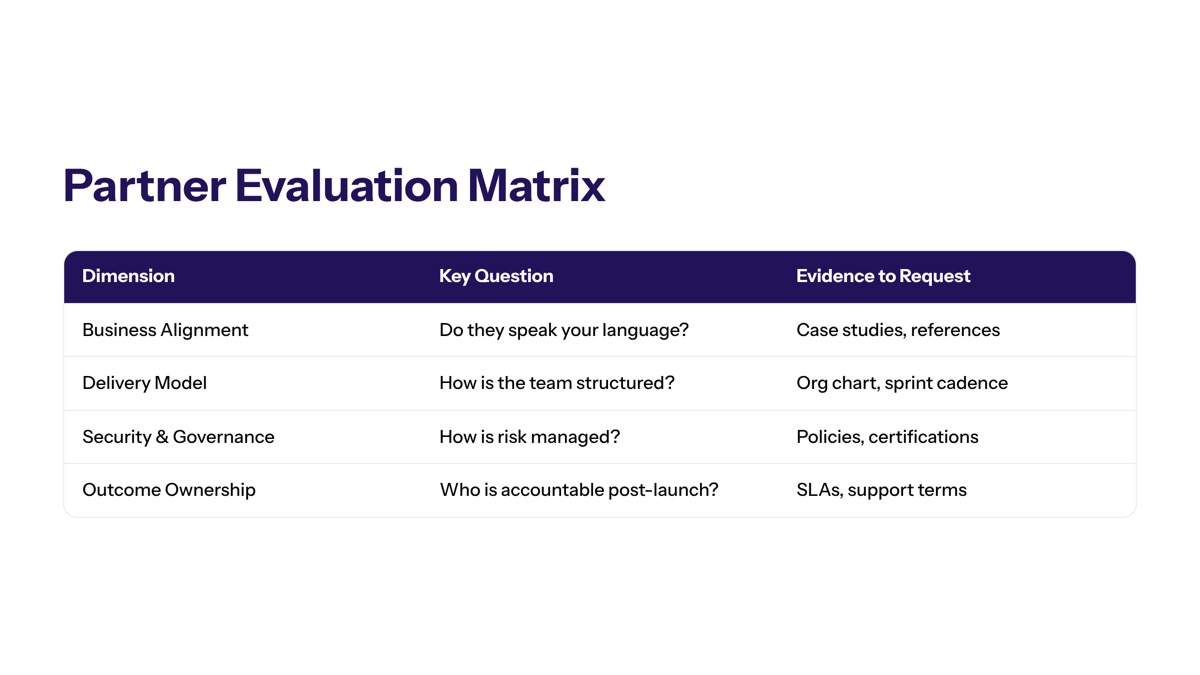
AI Consulting Partner Evaluation Matrix
The matrix below provides a structured format for comparing AI consulting companies across dimensions that matter. Each buying group should set priorities based on its specific use case and risk profile rather than applying universal weights.
|
Evaluation Area |
Questions to Ask |
Evidence to Request |
Positive Signal |
Warning Sign |
Buyer-Group Owner |
|---|---|---|---|---|---|
|
Business fit |
What business outcome will change? How is value quantified? |
Discovery framework, outcome metrics from prior work |
Provider challenges assumptions, names specific KPIs |
Promises transformation before discovery |
Business leadership |
|
Relevant proof |
Have you solved a comparable problem in a similar context? |
Case studies, architecture examples, references |
Named roles, acceptance criteria, measurable results |
Only general credentials, no comparable examples |
Business + Technology |
|
Delivery model |
Who performs work? How are decisions made? |
Team bios, project plan, RACI matrix |
Senior staff involved in delivery, not just sales |
Vague team structure, heavy subcontracting |
Technology + Procurement |
|
Architecture |
How does the solution fit our existing environment? |
Architecture diagrams, integration plans |
Designs around client environment, discusses portability |
Forces single platform regardless of fit |
Technology |
|
Data readiness |
How will data quality, access, and ownership be handled? |
Data assessment methodology, data governance plan |
Names data owners, assesses before assuming |
Treats data work as minor detail |
Technology + Security |
|
Integration |
How does this connect to existing systems and workflows? |
Integration architecture, API documentation |
Demonstrates understanding of legacy systems |
Ignores existing infrastructure |
Technology + Operations |
|
Security |
What can the system access? How are boundaries enforced? |
Security architecture, access control plan, logging approach |
Discusses controls without making compliance guarantees |
Makes blanket compliance claims |
Security + Legal |
|
Governance |
How are model changes, bias, and oversight managed? |
Governance framework, human oversight procedures |
Defines responsible AI practices specific to context |
Governance exists only on paper |
Security + Legal + Business |
|
Commercial clarity |
What is included, excluded, and who owns what? |
Detailed proposal, IP terms, change control process |
Transparent assumptions, clear exit terms |
Vague scope, hidden dependencies |
Procurement + Finance + Legal |
|
Knowledge transfer |
What documentation and training will be provided? |
Sample runbooks, training plan, handover checklist |
Client can operate system independently after engagement |
No handover plan, dependency by design |
Technology + Operations |
|
Production support |
Who monitors, maintains, and updates the system? |
SLA terms, monitoring tools, incident response procedures |
Defined support levels, clear escalation |
No plan beyond initial deployment |
Technology + Operations |
|
Cultural + communication fit |
How does the provider communicate, escalate, and collaborate? |
Communication plan, escalation paths, references |
Regular cadence, transparent about problems |
Avoids difficult conversations, delays bad news |
All stakeholders |
Do not treat this matrix as a checklist to complete once. Revisit it as proposals arrive and as discovery conversations reveal new information.
Questions for References
When speaking with a provider's references, focus on delivery reality rather than general satisfaction. Do not encourage disclosure of confidential client information.
Useful reference questions:
-
What did the provider actually deliver compared to what was proposed?
-
Which assumptions changed during the project, and how were those changes handled?
-
How were problems and risks surfaced? Was the provider transparent about setbacks?
-
Did senior-level individuals remain consistently involved throughout the engagement?
-
Was the documentation handed over usable and sufficient for ongoing operations?
-
How was scope drift managed? Were changes transparent and fair?
-
After the work was completed, could your team maintain, update, and operate what was built?
-
What would you want done differently if you were starting the project again?
These questions test whether the AI consulting firm delivers what it proposes, handles difficulty honestly, and leaves the client in a stronger position.
Common Selection Mistakes
Patterns that lead to poor AI consulting partner selection recur across industries:
Choosing from a generic ranking. Most AI consulting companies appear on directory lists based on fees, self-reported information, or partnerships rather than verified delivery quality. Brand recognition does not indicate fit for your specific problem, domain, or regulatory environment.
Buying a preferred tool instead of solving a problem. AI adoption fails when the engagement starts with a technology choice rather than a business decision. The provider should validate the problem before selecting AI tools.
Comparing proposals with different scopes. If one proposal covers a 6-week assessment and another covers a 12-month implementation, comparing prices produces misleading conclusions.
Ignoring client responsibilities. Every AI project requires internal resources: data access, subject matter expertise, decision-making authority, change management. Proposals that do not define client responsibilities hide risk.
Treating a proof of concept as production work. A working demo is not a deployed system. Enterprise AI implementations require security, monitoring, support, documentation, and operational ownership that PoCs do not address.
Evaluating only the initial build. Selecting on build capability while ignoring ongoing support , monitoring, and ownership creates dependency risk and operational gaps.
Failing to review security and data boundaries. AI systems that access sensitive data without defined boundaries, logging, or oversight create compliance and reputational exposure.
Leaving ownership unresolved. If the contract does not specify who owns code, models, data artifacts, and credentials after the engagement ends, the client may lose control of what they paid for.
Selecting solely on price. AI consulting projects range from $5,000 to over $500,000. The lowest bid often omits scope, transfers risk to the client, or produces work that cannot scale to production.
Accepting unsupported outcome claims. Providers promising large ROI or transformation before discovery or pilot work cannot substantiate those claims. Implementation and change management are crucial in ensuring the successful adoption of AI initiatives.
Final Decision Framework
Before selecting an AI partner, document the following:
-
Business outcome sought: The specific decision, workflow, or process that must improve, stated in terms that can be measured
-
Required capabilities: What the provider must be able to do, mapped to the engagement type defined earlier (e.g., data engineering, AI governance, custom AI development, integration with legacy systems)
-
Material risks: Security, data bias, vendor lock-in, regulatory exposure, internal adoption risk
-
Evidence reviewed: Case studies, references, architecture examples, proposal details
-
Assumptions: What both parties are assuming about data, infrastructure, team, and timeline
-
Preferred provider and reasons: Why this AI consulting firm fits better than alternatives for this specific engagement
-
Conditions to resolve: What must be clarified, tested, or agreed before work begins
The goal is not to identify a universally "best" AI consulting company. Successful AI projects often take 1,200 to 5,000+ hours to implement, and AI consulting projects range from $5,000 to over $500,000. The goal is to choose the best-fit strategic partner for a defined engagement, with clear ownership, realistic expectations, and a defensible record of how the decision was made.
Conclusion and Next Steps
A strong AI consulting partner improves the quality of your organization's decisions before, during, and after implementation. The partner does not just build AI solutions; it helps you understand what to build, why, and how to sustain it. Top AI consulting firms focus on execution, not just strategy. Successful AI adoption requires industry-specific experience and technical expertise matched to the client's actual needs.
To apply this framework:
-
Define your engagement type and scope before soliciting proposals
-
Establish evaluation criteria using the matrix, weighted to your organization's risk profile and use case
-
Request relevant evidence: case studies, architecture examples, references, named team members
-
Conduct structured evaluation across business, technical, security, and commercial dimensions
-
Document your decision rationale, including assumptions and conditions to resolve
Talk with Cognativ about defining your AI modernization roadmap, evaluating your data readiness, or scoping an AI implementation engagement.
For related topics, explore AI strategy and implementation for enterprises , AI governance frameworks , and overcoming AI implementation challenges .