AI Opportunity Assessment: Score Use Cases Before You Fund Them
An AI opportunity assessment is a structured review of a specific business use case before an organization funds a pilot or implementation. It tests whether the problem is worth solving, whether artificial intelligence is an appropriate mechanism, whether the required data and systems exist, whether risks can be controlled, whether someone owns the result, and whether success or failure can be observed.
This article evaluates individual AI use cases-not organizational AI readiness. An AI readiness assessment examines whether an organization has the conditions to pursue AI responsibly across strategy, infrastructure, governance, and culture. An AI opportunity assessment asks a narrower question: does this one specific idea deserve attention and funding?
The target audience is mid-market business, technology, operations, product, and data leaders who have multiple AI ideas competing for limited budget and attention. Most companies generate more AI ideas than they can responsibly pursue. The purpose of this assessment is not to produce the largest possible list of AI initiatives. The purpose is to make a better investment decision.
AI opportunity assessments prioritize projects based on feasibility and value. A $15K assessment can prevent a $200K investment in the wrong use case. Companies that succeed with AI spend 2 weeks choosing the right problem before committing resources. Yet only 21% of organizations have redesigned workflows for AI impact, per McKinsey. The difference between ai high performers and everyone else often starts here-before a single model is built.
By the end of this article, you will have:
-
A practical framework for scoring AI opportunities across eleven dimensions
-
Decision criteria for funding, narrowing, preparing, redirecting, or stopping AI projects
-
A working scorecard for evidence-based evaluation of any use case
-
Clear warning signs that an AI idea is not ready for investment
-
Leadership questions to answer before approving any AI budget
Understanding AI Opportunity Assessment
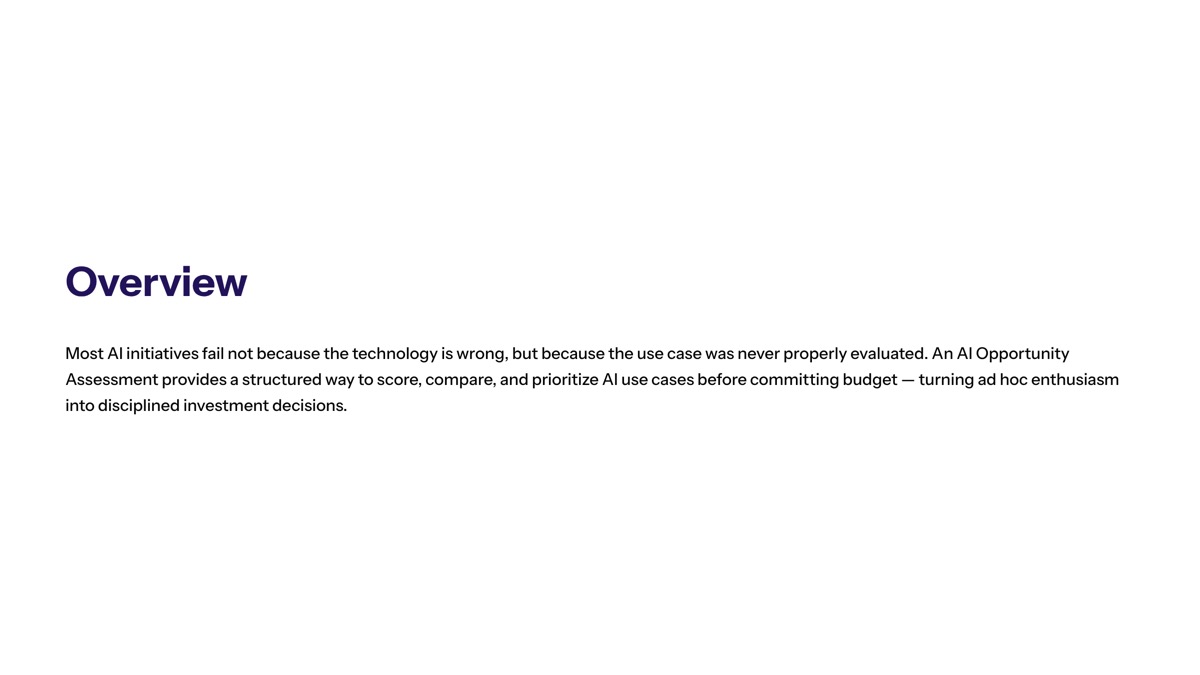
An AI opportunity assessment is a structured process for evaluating whether a specific business use case merits pilot funding, further preparation, or rejection. It examines business value, problem clarity, feasibility, data readiness, architecture requirements, security and risk, ownership, user adoption, and the strength of evidence behind every assumption.
This is distinct from AI use case discovery, which is the ideation stage-generating many ideas without evaluating them in depth. The opportunity assessment comes after discovery, during the evaluation and prioritization stage. It is also distinct from an AI readiness assessment, which evaluates organizational capabilities across governance, data infrastructure, culture, and strategic alignment. Frameworks like the Seampoint AI readiness model measure readiness across five dimensions: data infrastructure, governance maturity, strategic alignment, people capacity, and technical architecture. Those are organizational questions. The opportunity assessment asks: is this one idea worth investment?
The connection to leadership decision making is direct. A focused assessment takes 2 to 4 weeks for mid-market companies. External assessments typically cost between $10K and $30K. That investment creates clarity about which AI projects deserve organizational attention-and which should be stopped before they consume far more.
Business Problem First
Every AI assessment begins with a workflow, decision, or operational bottleneck-not with AI tools, models, or vendor demonstrations.
Questions to ask about the current state:
-
What currently happens in this process? Who performs the work?
-
What decision is being made, and where does delay, inconsistency, cost, or risk occur?
-
Who experiences the problem? What evidence shows the problem is material?
-
What would improve if the problem were addressed? What happens if nothing changes?
Pain point identification pinpoints operational inefficiencies across departments. Identifying use cases involves engaging process owners to brainstorm automation opportunities-but brainstorming is not assessment. The assessment demands evidence that the problem matters.
Warning signs that the business problem is poorly defined:
-
The idea begins with "we should use AI" rather than a documented workflow gap
-
No business owner can describe the current process or its costs
-
The problem exists only in a demo or speculative scenario
-
Expected value depends on unsupported assumptions about time spent or revenue gained
-
Baseline metrics for current performance do not exist
When the business case cannot survive scrutiny before AI enters the conversation, it will not survive implementation.
AI Appropriateness
AI is one possible mechanism, not the default solution. Before evaluating whether AI fits, consider the full range of approaches that might address the identified problem:
-
Process clarification or redesign : removing redundant steps, clarifying handoffs
-
Policy or ownership changes : assigning accountability, updating rules
-
Conventional automation : rules-based software, RPA for repetitive tasks
-
Analytics and reporting : dashboards, advanced analytics, business intelligence
-
Search and retrieval : knowledge bases, improved documentation
-
Machine learning : classification, predictive analytics, pattern recognition
-
Generative AI : content generation, summarization, code assistance
-
Human-led improvement : training, hiring, restructuring
Questions to determine whether AI is appropriate:
-
Does the task require interpretation, prediction, generation, or classification?
-
Would a deterministic system be safer or easier to maintain?
-
Is uncertainty in outputs acceptable? Can a human review and correct the output?
-
Does the use case require an AI agent to take autonomous actions, or only suggestions?
-
Is the added complexity of ML models or generative AI justified by the potential impact?
The Microsoft BXT framework includes experience desirability as a lens-checking whether AI is not just technically possible but acceptable and useful to the people who would interact with it. This is a practical test that many organizations skip.
When AI is not the most appropriate mechanism, stopping here saves significant time and budget. When it is appropriate, the next step is evaluating whether the value justifies the investment.
Business Value and Feasibility Assessment
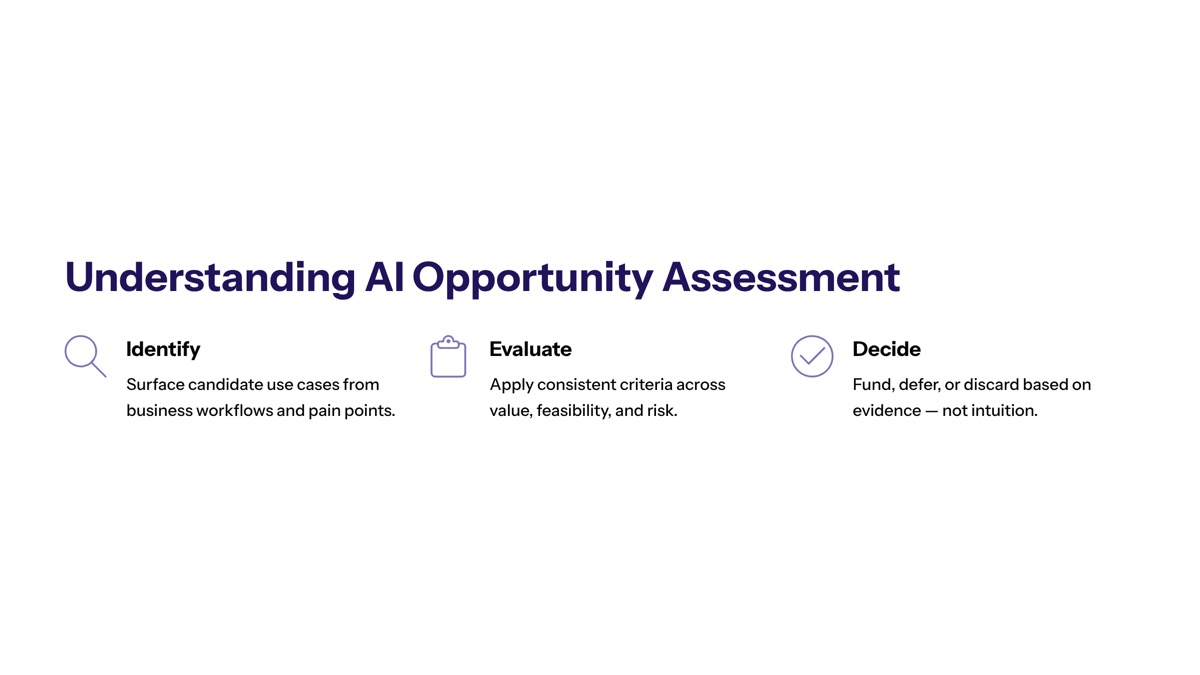
Once a real business problem is confirmed and AI appears to be an appropriate mechanism, the assessment moves to two linked questions: Is the potential value sufficient? And can the organization actually deliver?
Business Value Evaluation
Business value evaluation examines the potential roi of addressing the identified problem with AI. The core value levers to evaluate:
-
Revenue opportunity : new sales channels, improved customer engagement, retention, upsell
-
Cost reduction : labor, error rates, waste, rework
-
Cycle time : faster processing, reduced time spent on manual steps
-
Decision quality : better accuracy, fewer misses, reduced exposure
-
Customer or employee experience : satisfaction improvement, reduced churn
-
Risk reduction : regulatory exposure, compliance breaches, reputational harm
-
Strategic learning : building reusable AI capabilities that scale across workflows
-
Reusability : components that create value across multiple business processes
A consistent scoring model evaluates opportunities based on business value and risk. But the value hypothesis must be grounded in observable evidence, not invented. Feasibility scoring evaluates use cases based on complexity and expected ROI-but that ROI must reference actual baseline metrics.
Every value claim requires:
-
A value hypothesis : what is the expected benefit and how it will be delivered
-
A current baseline : what is the measurable performance today
-
Observable evidence : usage logs, cost records, interviews, existing reports
-
An accountable owner : a named person responsible for validating whether value is realized
Warning: inflating expected returns using vague or generic ROI percentages is one of the most common assessment failures. If the team cannot identify the current cost of a problem, they cannot credibly project the value of solving it. Define strategic objectives tied to measurable business outcomes-not aspirational numbers.
Technical and Operational Feasibility
Feasibility evaluates whether the organization can build, deploy, and operate the proposed solution. Core factors:
-
Task clarity : Is the decision or task well-defined and stable, or highly variable with many edge cases?
-
Data availability : Do representative examples exist in sufficient volume? Are they labeled?
-
Model capability : Can an off-the-shelf or fine-tuned model handle this domain, or is research required?
-
Integration complexity : What systems need to connect? APIs, real-time vs. batch processing, authentication?
-
Workflow variability : How many exceptions exist? Edge cases can dramatically increase cost.
-
Human review capacity : How will humans touch, correct, or override outputs? Who monitors?
-
Internal skills : Does the team include data science, ML engineering, and DevOps capabilities-or will you need to hire or partner?
-
Deployment environment : Cloud vs. on-premise, latency requirements, compliance constraints
-
Time to test : How quickly can the riskiest assumption be validated before committing to full build?
There is a critical distinction between four levels of readiness:
|
Level |
Definition |
|---|---|
|
Technically possible |
A model could produce the desired output in a controlled setting |
|
Operationally usable |
The output integrates into real workflows at acceptable speed and accuracy |
|
Economically justified |
The benefit exceeds all costs including governance, monitoring, and error correction |
|
Production ready |
The system can be maintained, monitored, and scaled over time |
A system might generate accurate predictions but fail because it cannot integrate with existing tools, runs too slowly for real-time use, or creates a review burden that exceeds the time it saves. Assessments help identify technology and integration risks before project initiation-not after budget is committed.
Data and Architecture Requirements
Data readiness is where many AI initiatives fail. According to TechRadar Pro , data issues-quality, accessibility, governance-are among the leading causes of AI project failure. Available data is not automatically usable data.
Data evaluation requires answers to:
-
Does the required data exist? What types-structured, unstructured, text, images, time series?
-
Who owns the data? Is there clarity about privacy, contracts, and legal permissions?
-
Is the data accessible? Pooled in data platforms, behind firewalls, or fragmented across systems?
-
What is the quality? Missing values, duplications, bias, staleness, representativeness?
-
Is it complete? Does historical data cover needed scenarios, including edge cases?
-
What privacy classification applies? PII, sensitive attributes, anonymization requirements?
-
Who corrects or maintains the data over time? What are the update paths and feedback loops?
A thorough assessment includes mapping processes and auditing data readiness. Current state analysis reviews technology infrastructure and data maturity. Map current capabilities and data assets to identify constraints before committing to a pilot.
Architecture and integration evaluation covers:
-
System interfaces: APIs, ETL, data pipelines, reliability
-
Identity and permissions: who accesses what, least privilege
-
Model hosting: cloud service, vendor-hosted, or local deployment
-
Retrieval systems: embedding stores, vector databases, search indices
-
User interface: how outputs reach users and how users act on them
-
Logging and monitoring: observability for errors, model drift, usage patterns
-
Failure handling: fallback strategies, human-in-the-loop controls , rollback
-
Support ownership: who maintains models, data flows, and fixes issues
A use case dependent on extensive integration across legacy systems requires a fundamentally different investment decision than an isolated demonstration. The architecture evaluation surfaces this difference before money is spent.
Risk, Ownership, and Adoption Framework
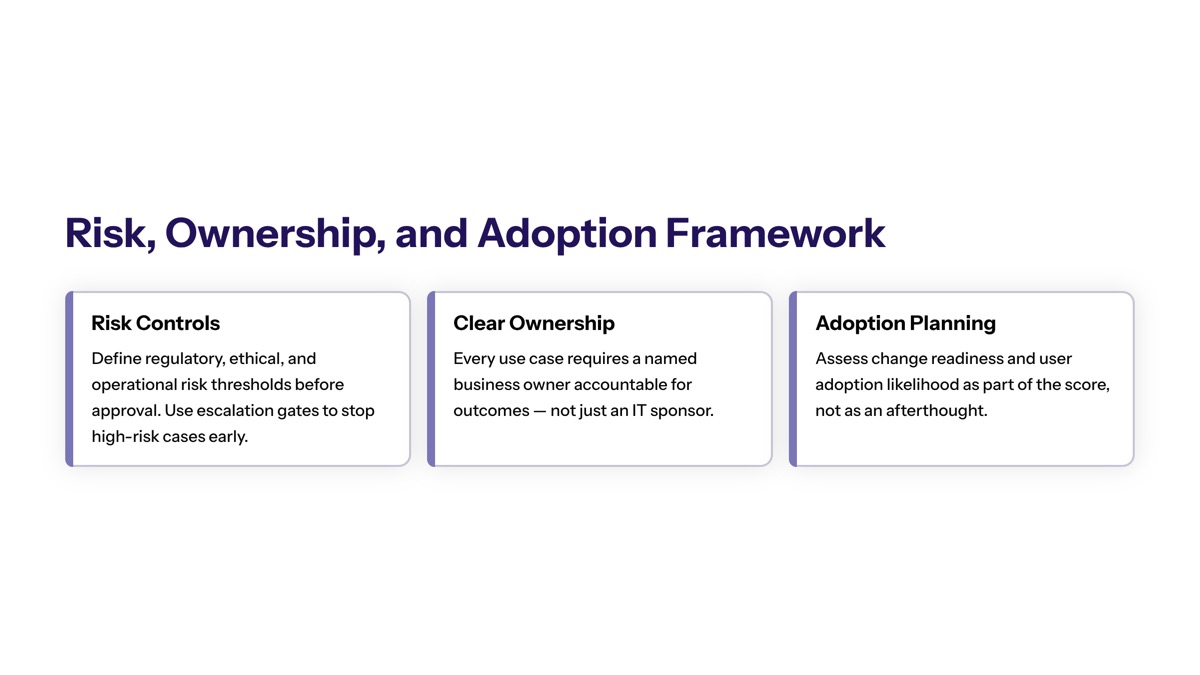
Technical feasibility answers whether something can be built. This section addresses whether it can be governed, owned, adopted, and measured-the organizational readiness factors that determine whether a technically successful system creates actual business impact.
Security and Governance
Every AI use case introduces risk. The assessment must identify, evaluate, and plan for these risks explicitly. Effective AI governance is not optional-Gartner forecasts that by 2027, 60% of organizations will fail to realize expected value from AI use cases because their governance is incohesive.
Risks to evaluate:
-
Sensitive information exposure : model inadvertently revealing or inferring private data
-
Incorrect or misleading outputs : hallucinations, bias, factual errors
-
Unauthorized access : to models, training data, or outputs
-
Excessive permissions : systems able to take actions beyond their intended scope
-
Vendor dependencies : third-party risk, data leaving organizational boundaries
-
Prompt injection or adversarial inputs : especially with generative AI systems
-
Regulatory obligations : EU AI Act, GDPR, DORA, industry-specific requirements
-
Reputational consequences : wrongful decisions, discriminatory behavior, public failure
Questions leadership must answer:
-
What is the plausible failure mode? Who is affected?
-
Can the action be reversed if the output is wrong?
-
Can the system be limited in scope or permissions?
-
What requires human approval before action is taken?
-
Who accepts the residual risk?
Governance requirements include human oversight, audit trails, model explainability, incident response plans, and policy frameworks for managing model, data, and prompt risks. These requirements must be identified during the assessment-not discovered during deployment.
This article does not provide compliance assurance. Regulatory and legal requirements vary by jurisdiction, industry, and use case.
Ownership and Accountability
AI projects without clear ownership fail. "The innovation team" or "IT" is not sufficient ownership unless a named person has decision authority and accountability for the outcome.
Required owners for every assessed use case:
|
Role |
Responsibility |
|---|---|
|
Business outcome owner |
Accountable for whether the use case delivers measurable business value |
|
Workflow or domain owner |
Understands end-users, current process, and operational context |
|
Data owner/steward |
Responsible for data quality, access, and ongoing maintenance |
|
Technology/ML owner |
Builds, deploys, and maintains the technical solution |
|
Security and compliance owner |
Reviews risk, controls, and regulatory alignment |
|
Adoption owner |
Manages training, change management, and user feedback |
|
Measurement owner |
Defines metrics, collects evidence, reports results |
Each role requires a named individual with clear authority. If ownership cannot be assigned during assessment, the use case is not ready for funding. This is a finding, not a failure-it identifies what must be resolved before proceeding.
A decision rights framework clarifies who makes what decisions and prevents the diffusion of accountability that kills AI initiatives.
User Adoption and Evidence Planning
A technically successful system has no operational value if the intended users cannot or will not use it correctly. Adoption evaluation covers:
-
Workflow changes : What changes in the user's daily work? What new steps appear? What disappears?
-
Incentives : What rewards or consequences exist for adoption? What happens if users ignore the system?
-
Trust : How will users react to errors? How is human oversight visible?
-
Training and onboarding : What preparation do users need? How long does it take?
-
Feedback loops : How do users report problems? How does input improve the system?
-
Escalation : What happens when output is unacceptable? Who intervenes?
-
Support burden : Who handles questions and complaints?
-
Accessibility and usability : Can all intended users access and operate the system?
Evidence plan requirements : Every assessed opportunity must define how success or failure will be observed. This is not optional-it is the mechanism that converts an AI initiative from an assumption into a testable investment.
Each opportunity must specify:
-
Hypothesis : What outcome is expected and by when
-
Baseline : Quantitative measure of current performance
-
Test plan : What inputs, what process, what sample group
-
Evidence source : Data logs, user feedback, accuracy measurements
-
Acceptance criteria : Thresholds for success (improvement vs. cost, error rate)
-
Failure criteria : What counts as failure to proceed
-
Decision owner : Who makes the decision after the test
-
Review date : Fixed time to evaluate results
-
Possible next decisions : Scale, redesign, narrow, or abandon
A useful test may show that the organization should change direction or stop. That is a valid outcome. The evidence plan exists to support decision making, not to justify a predetermined conclusion.
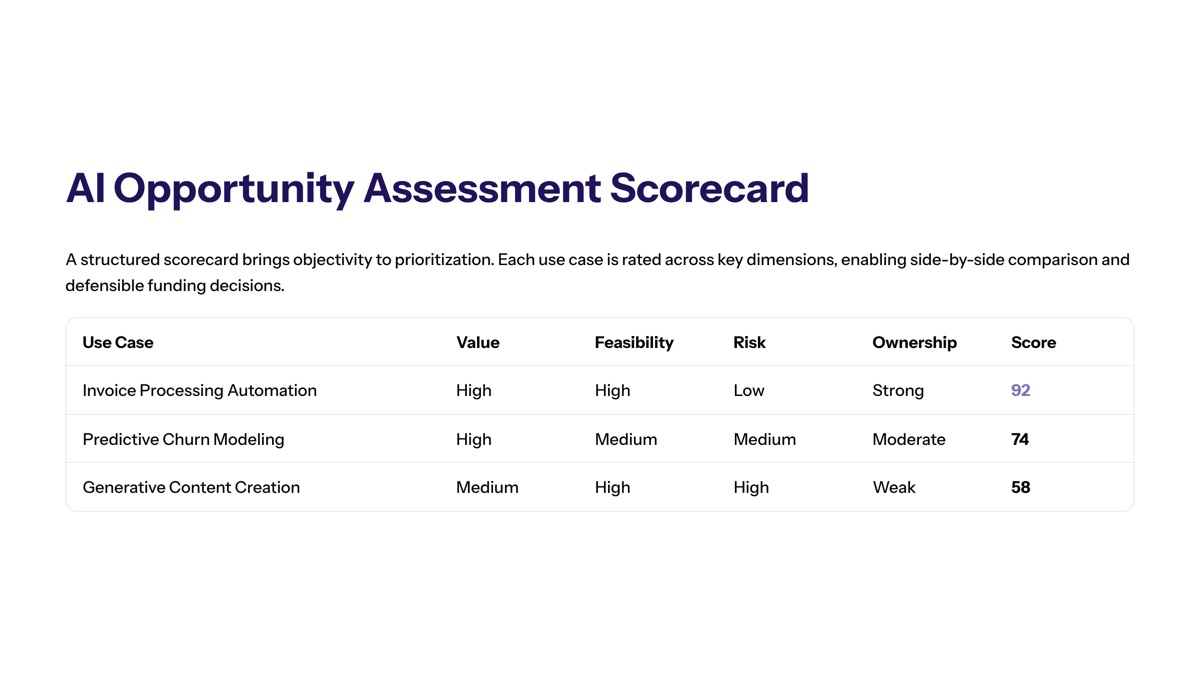
AI Opportunity Assessment Scorecard
The dimensions above organize into a practical scorecard that teams can use to evaluate any AI use case. The assessment should deliver a prioritized list of 3 to 5 opportunities, scored consistently and supported by written evidence.
Scoring Framework
Use the following evidence scale for each dimension:
|
Score |
Evidence Level |
|---|---|
|
1 |
Unsupported assumption-no evidence at all |
|
2 |
Limited anecdotal or partial evidence; significant data gaps |
|
3 |
Partially validated-some quantitative data or small-scale evidence |
|
4 |
Strong evidence from similar contexts, prototypes, or tested assumptions |
|
5 |
Directly validated through pilot or past deployment in this organization |
Apply this scale across eleven dimensions:
|
Dimension |
Key Question |
Evidence Available |
Score (1–5) |
Critical Gap |
Next Action |
|---|---|---|---|---|---|
|
Business problem |
Is the problem documented with baseline metrics? |
|
|
|
|
|
Business value |
Is the value hypothesis supported by observable data? |
|
|
|
|
|
AI fit |
Is AI the most appropriate mechanism vs. alternatives? |
|
|
|
|
|
Feasibility |
Can this be built, deployed, and operated with current capabilities? |
|
|
|
|
|
Data readiness |
Does usable, legal, representative data exist? |
|
|
|
|
|
Architecture & integration |
Are system interfaces, hosting, and monitoring addressed? |
|
|
|
|
|
Security & risk |
Are material risks identified with controls planned? |
|
|
|
|
|
Ownership |
Are named owners assigned for all accountability areas? |
|
|
|
|
|
User adoption |
Is the workflow change understood with adoption planned? |
|
|
|
|
|
Evidence plan |
Are hypothesis, baseline, test, and criteria defined? |
|
|
|
|
|
Production capability |
Can this be maintained, monitored, and scaled after deployment? |
|
|
|
|
Identify and score AI opportunities using practical criteria. Require written evidence beside every score. A score without supporting documentation is an opinion, not an assessment.
Important boundaries:
-
The score organizes discussion-it does not predict project success
-
Do not create universal weights across dimensions
-
A particular total does not guarantee approval
-
A severe security, data, ownership, or legal gap may block the opportunity regardless of the total score
-
The assessment framework aligns technical capabilities with high-impact business areas, but alignment is a starting point, not a guarantee
Decision Categories
Based on the scorecard results, each use case receives one of five decisions:
Fund a Bounded Test The problem matters. AI appears appropriate. Material dependencies are visible. The riskiest assumptions can be tested safely within a defined scope, timeline, and budget. Companies should select one AI project to start, not multiple.
Prepare Before Testing The opportunity may have value, but data readiness, ownership, architecture, security, or measurement requires targeted preparation before a test would produce reliable results. Resource allocation is optimized towards initiatives with a path to profitability-preparation ensures that path exists.
Narrow the Use Case The original idea is too broad or risky. A smaller workflow, user group, dataset, or permission set could be tested at lower risk and cost. High-impact AI projects should be prioritized based on feasibility and ROI-narrowing makes feasibility achievable.
Use a Different Approach The problem is valid, but conventional software, process redesign, analytics, or human-led work is more appropriate. Not every business process improvement requires AI. Sometimes the quick wins come from streamline operations through simpler means.
Stop The value is weak, evidence is absent, risk is disproportionate, or no accountable owner exists. An AI Opportunity Assessment prevents wasted time and budget-stopping is a legitimate and valuable outcome.
Portfolio comparison : When leadership evaluates several opportunities, compare across strategic fit, strength of evidence, time to learn, reusability, risk, required dependencies, internal capacity, and opportunity cost. The top-right quadrant of the priority matrix indicates high impact and feasibility-use cases that score well on both business value and feasibility deserve first attention. Encourage funding a small number of well-defined tests instead of launching many disconnected pilots. Assessments accelerate time to value by establishing execution paths for AI projects.
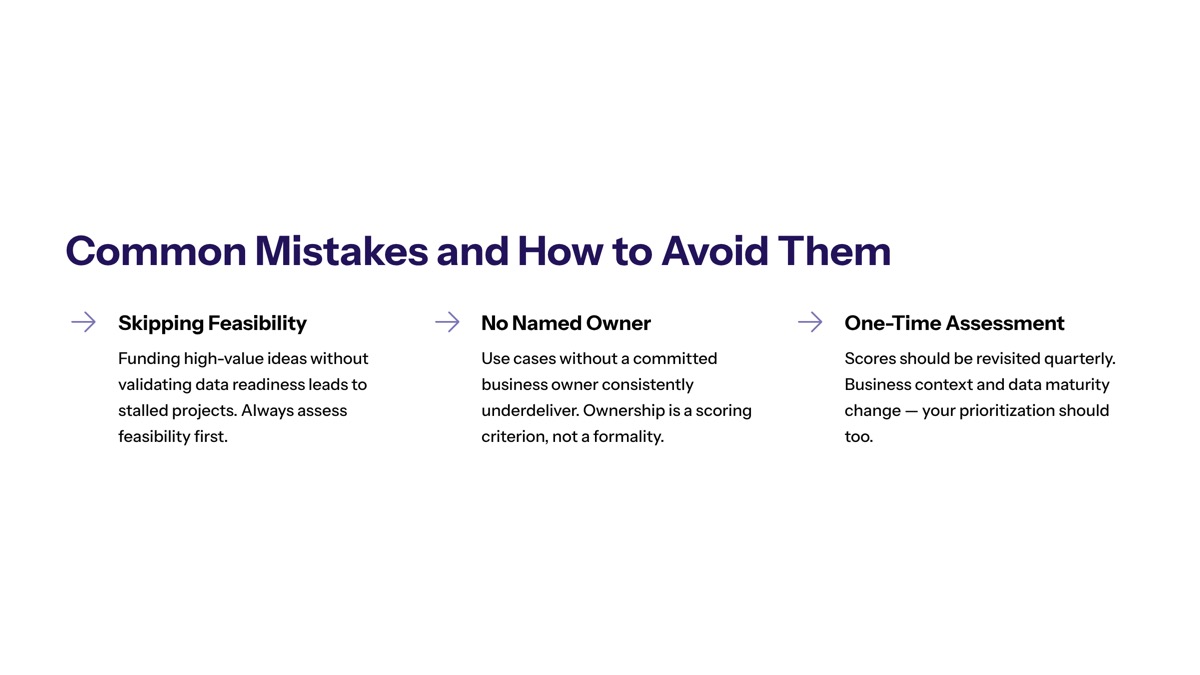
Common Assessment Mistakes and Implementation
Even with a structured process, common errors reduce the effectiveness of AI opportunity assessments. Recognizing these patterns helps leadership avoid missed opportunities and wasted investment.
Assessment Pitfalls
Starting with tools instead of problems. When an assessment begins with "we bought this AI platform" or "we should use generative AI," the evaluation is already biased toward a solution. Start with the business problem. Always.
Scoring without evidence. Giving a use case a 4 out of 5 on data readiness because "we probably have the data" is not assessment-it is assumption. Every score requires written evidence. If evidence does not exist, the score is 1 or 2.
Inflating expected value. Projecting 40% efficiency gains without baseline measurements, cost data, or comparable evidence produces a business case that cannot survive contact with reality. AI implementation challenges frequently trace back to unrealistic expectations set during planning.
Ignoring integration complexity and security until late. Data movement, API reliability, identity management, and security controls are not implementation details-they are feasibility factors. Discovering them after funding is approved creates budget overruns and delays.
Treating a demo as production evidence. A successful demonstration in a controlled environment does not validate production readiness. Production requires maintenance, monitoring, drift detection, error handling, and scale-none of which exist in a demo.
Assigning no owner. If no named person is accountable for the business outcome, the project has no one responsible for determining whether it succeeded. This is the single most common organizational failure in AI projects.
Measuring activity instead of outcomes. Counting the number of pilots launched, models built, or AI tools deployed tells leadership nothing about business impact. Measure cost saved, revenue gained, risk reduced, or decisions improved.
Funding too many pilots. Fewer than 30% of organizations have their AI agenda directly sponsored by the CEO, according to TechRadar Pro . Without executive focus, organizations spread attention across too many initiatives and achieve immediate value in none of them.
Refusing to stop weak ideas. Sunk cost bias keeps failing AI projects alive. The evidence plan exists specifically to create stopping criteria. Use them.
Fictional Example
The following example is entirely fictional. It does not represent a Cognativ client or actual project.
Company : A mid-market logistics firm with 200 delivery vehicles and a legacy fleet maintenance system.
Original AI idea : Use generative AI to automatically generate maintenance schedules, alerts, parts orders, and technician work orders across the entire fleet.
Underlying business problem : Unplanned vehicle downtime causes delivery delays and penalty costs. Reactive maintenance costs exceed proactive alternatives. Parts ordering lags because technicians report issues manually. Monthly unplanned downtime averages 340 hours across the fleet. Maintenance costs run $180K per month.
Narrowed use case after initial assessment : Predictive maintenance alerts for 10 critical long-haul vehicles based on sensor data. Parts ordering automation deferred as a secondary phase.
Assessment scorecard results :
|
Dimension |
Score |
Key Finding |
|---|---|---|
|
Business problem |
5 |
Downtime hours and costs documented monthly |
|
Business value |
4 |
Clear cost reduction; 10% downtime reduction would save ~$18K/month |
|
AI fit |
4 |
Predictive analytics appropriate; rules-based approach insufficient for sensor pattern recognition |
|
Feasibility |
3 |
ML model capability exists; integration with legacy scheduling system is complex |
|
Data readiness |
2 |
Historical sensor data exists but is fragmented; missing negative examples; inconsistent timestamps |
|
Architecture |
2 |
Legacy system has limited API; real-time sensor feeds unreliable; monitoring undefined |
|
Security & risk |
4 |
Low privacy risk; vendor risk from sensor provider needs review; false positives could cause unnecessary downtime |
|
Ownership |
2 |
Fleet operations manager identified; data owner unclear; technology owner not assigned |
|
User adoption |
3 |
Technicians receptive but concerned about alert fatigue; training plan needed |
|
Evidence plan |
3 |
Hypothesis defined; baseline exists; test duration and success criteria need formalization |
|
Production capability |
2 |
No monitoring, drift detection, or maintenance plan for the model |
Recommended decision : Prepare before testing. Clean and consolidate sensor data for the 10-vehicle subset. Assign data and technology owners. Define integration approach with legacy system. Formalize evidence plan with 90-day test period. Success criterion: 10% reduction in unplanned downtime for test fleet at cost below $15K. If data preparation reveals fundamental gaps, reassess before proceeding.
This example demonstrates how the scorecard surfaces specific gaps-data quality, ownership, architecture-that would otherwise be discovered after funding, when the cost of correction is far higher.
Leadership Decision Questions
Before approving funding for any AI project, leadership should be able to answer these questions with evidence-not assumptions:
-
What problem are we solving? Can we describe the current workflow, its costs, and who is affected?
-
Why is AI appropriate? Have we evaluated whether process redesign, conventional automation, or analytics would solve this more simply?
-
What evidence supports the value? Do we have baseline metrics and a testable value hypothesis?
-
Which assumption is most likely to be wrong? What is the riskiest bet we are making?
-
What data is required, and is it usable? Do we have legal, accessible, representative data assets-or are we assuming they exist?
-
What systems and permissions are involved? Have we mapped the integration requirements and their complexity?
-
What could fail, and what are the consequences? Have we identified plausible failures and planned controls?
-
Who owns the result? Is a named person accountable for business outcome, data, technology, and adoption?
-
How will users participate? Have we evaluated workflow changes, training needs, and adoption incentives?
-
What evidence determines the next decision? Do we have acceptance and failure criteria, a review date, and a decision owner?
-
What would make us stop? Can we identify conditions under which we would redirect or end the project?
If leadership cannot answer these questions for a proposed AI initiative, the use case is not ready for funding. That does not mean it should be abandoned-it may need preparation, narrowing, or better evidence. But it is not ready for investment.
Conclusion and Next Steps
Good AI investment begins with disciplined selection, not a longer list of ideas. The real story behind organizations that leverage AI successfully is not that they found more opportunities-it is that they evaluated each opportunity rigorously before committing resources. AI opportunity assessments align initiatives with measurable business outcomes and prevent the pattern of funding many pilots while delivering value from none.
Roadmap development creates a prioritized implementation plan for AI initiatives. Outline a phased roadmap to transform insights into action. Validate shortlisted opportunities with technical experts for feasibility.
Immediate next steps:
-
Apply the scorecard to your current AI ideas. Require evidence for every score.
-
Define clear ownership for each use case under consideration-named individuals, not team labels.
-
Establish stopping criteria before you approve funding, not after.
-
Select one AI project to start , not multiple. Focus creates learning; diffusion creates waste.
-
Review results at a fixed date and make the next decision based on evidence.
To move from opportunity assessment to controlled implementation, explore Cognativ's decision-oriented RAPID approach -a framework for connecting AI strategy to measurable execution.
For related guidance on navigating AI implementation challenges , operationalizing governance frameworks , and building an AI strategy aligned to enterprise needs , explore Cognativ's resource library.