
AI Architecture Built Around Business Work
An AI architecture connects a specific business outcome to the applications, information, model services and people needed to support it. Cognativ helps teams make those choices together before isolated experiments become hard-to-maintain systems.
A US business may be assessing a single workflow, introducing an AI-enabled product or connecting an existing application to model services. The architecture scope depends on the decisions to be made, the systems that must remain in place and the responsibilities the team will retain.
The engagement can focus on architecture and a delivery roadmap, or extend into implementation when the scope calls for software engineering and integration. Private or local deployment is one option to evaluate against requirements, not a prerequisite for every AI system.
Turn an AI Use Case into an Architecture Decision
AI-first architecture is the decision layer between an AI idea and a production system. It establishes which business problem matters, which data can be used, where models should run, how systems will integrate, and who owns performance after launch.
That foundation helps leadership replace fragmented experimentation with a governed portfolio of AI capabilities that can be evaluated, operated, and improved over time.
Define which data sources models may use, how sensitive information is isolated, where inference occurs, and which users, agents, and systems receive access. The result is a practical control model rather than a blanket promise of privacy.
Move beyond demonstrations by defining evaluation criteria, release gates, monitoring, fallback behavior, audit evidence, and incident ownership before a model or agent enters a business-critical workflow.
Connect AI to the systems and decisions where work already happens. Architecture clarifies API boundaries, human review points, exception handling, training needs, and the operating changes required for adoption.
Tie each capability to a baseline, target outcome, operating owner, and review cadence. That makes it possible to compare cost, quality, cycle time, risk, and adoption instead of treating model output as the only measure of success.
Four Decisions That Shape an AI System
Architecture makes the dependencies between the business task, information, technology and operating model explicit. Each decision affects what the solution can do, who can use it and how the team will evaluate it.
The appropriate design can use managed services, private infrastructure or a combination. Evaluate those options against data sensitivity, latency, integration, vendor constraints, cost and the capacity to operate the resulting system.
A focused architecture does not need to settle every future use case. It should explain the assumptions for the first scope, the boundaries that must be maintained and the decisions that need validation before implementation.
Begin with a current-state view of the workflow: which application receives a request, which records contain the authoritative information and where people already make decisions. Map the proposed AI capability against that flow so the team can identify interfaces, dependencies and an appropriate place for review before choosing a model.
A target design should explain what each component is responsible for and what happens when it is unavailable. For example, if a model service cannot return a usable response, the workflow may route the task to a person or continue without the AI suggestion. The fallback depends on the consequences of delay and the process owner’s requirements.
-
Business Workflow
Define the task, intended users, desired outcome and accountable owner.
-
Data and Integration
Identify information sources, permissions and application boundaries.
-
Models and Deployment
Compare model and hosting options against the actual workload and constraints.
-
Evaluation and Operations
Agree on testing, human review, monitoring, ownership and escalation.
Connect Architecture to Delivery with RAPID
Architecture establishes the target, constraints and decision model. RAPID connects research, analysis, planning, implementation and decisions so the team can revisit assumptions as delivery evidence becomes available.
An engagement can establish a decision cadence, named owners, escalation paths and evidence for each agreed milestone. The cadence and deliverables depend on the scope. RAPID does not replace engineering or governance; it helps teams connect those disciplines to the business outcome being pursued.
What an AI Architecture Engagement Can Define
The work starts with the business process, its users and the outcome the organization wants to improve. From there, the architecture identifies the application boundaries, information sources, model capabilities and operating responsibilities relevant to the chosen scope.
A first phase can produce a use-case and dependency map, a target architecture with alternatives, a data and integration assessment, and a sequence of decisions for delivery. Agree the precise deliverables and level of validation before the engagement begins.
The architecture can describe how information moves between applications, where retrieval or model access is needed, how permissions are enforced and which outputs require human review. It should identify failure handling and the systems of record that remain authoritative.
Evaluation criteria connect technical behavior to the task. Depending on the workflow, the team may examine output quality, review effort, response time, operating cost and exception handling. Establish the baseline and acceptance method for the engagement instead of assuming that one benchmark represents business value.
Delivery planning identifies owners, dependencies, release decisions and the people who will operate the system. A prototype may answer a narrow technical question; a production service needs an agreed support model, monitoring, change control and a way to handle incidents.
Architecture is distinct from implementing every capability it describes. Software development, AI integration, automation and governance can be scoped as related services when they are needed, with responsibilities and handoffs documented across the engagement.
For data and knowledge access, assess the source of each input, its owner, access rights, update frequency and retention requirements. Decide whether a response needs a source reference and how the application will handle missing, stale or conflicting information. These decisions apply to the entire information path, including logs and connected tools, not only to the model provider.
For evaluation, define representative tasks and expected behavior with the people who use and operate the workflow. Include ordinary requests, ambiguous inputs and cases where the system should decline or escalate. Compare the proposed behavior with the current process, review errors with subject owners and record which issues must be resolved before release.
For deployment, compare how each option affects data handling, integration, reliability, change control and ongoing spend. A managed service may reduce some infrastructure work while introducing provider dependencies; a private or hybrid arrangement can introduce different operating and support obligations. The architecture records the tradeoffs and the decisions that still need validation.
The first delivery handoff can include a prioritized use-case definition, a diagram of the selected boundaries, a decision log, a list of data and integration dependencies, and an evaluation and operating plan. Each item should identify its owner and next action. The precise package is agreed for the engagement rather than assumed to be a fixed implementation contract.
Accountability for AI-Assisted Work
AI agents are most useful when their authority is explicit. A production agent should have a defined responsibility, approved tools, scoped information, observable actions, clear failure behavior, and a known person or team accountable for the workflow.
Cognativ designs human review around consequence. Low-risk summarization or classification may move automatically after evaluation, while financial, security, clinical, customer, or policy-sensitive actions can require approval. This keeps automation useful without confusing speed with uncontrolled autonomy.
The same boundaries support continuous improvement. Teams can inspect decisions, compare outcomes, identify failure patterns, and adjust prompts, tools, data, policies, or escalation rules without rebuilding the entire workflow.
When an agent can call a tool or change a record, separate recommendations from actions. Define which actions require approval, which tools and data are available, and how the application confirms a permitted action before it occurs. For repeated or interrupted work, agree how the workflow will detect a duplicate request and recover without leaving an unclear system state.
Monitoring should support an actual operating decision. Record the events needed to investigate an exception, assign an owner for reviewing them and limit sensitive information in logs according to the organization’s requirements. Review changes to prompts, models, data sources and connected tools through an agreed process because each can affect behavior after release.
A team can start with a bounded workflow, test the architecture against real operational constraints and use the findings to decide what to build next. That may lead to a software delivery engagement, a separate integration project or a governance review. The architecture phase makes those choices visible; it does not presume that every organization needs the same platform or deployment pattern.
Related Work Across Data and Software
The following Cognativ cases concern data integration and business applications. They illustrate the system and workflow decisions that can inform architecture work; the case records do not establish that these projects were AI deployments. Two further cases, a data management repositioning and a logistics transformation, show related work in other settings.
Connecting Health Insurance Data and Reporting
Data Integration
Claims Analytics
Business Reporting
Data Aggregation
Connecting Health Insurance Data and Reporting
Cognativ mapped reporting and data sources for a health insurance organization, then described a governed analytics foundation spanning claims, billing, eligibility and finance.
The project record focuses on data architecture, business definitions and access for reporting teams.
Explore the Health Insurance Case
Modernizing a B2B Marketplace Workflow
B2B Ecommerce
Marketplace Development
Product Data
Bulk Ordering
Modernizing a B2B Marketplace Workflow
Cognativ rebuilt a business marketplace around product discovery, account-specific buying and repeat ordering.
The project record describes the relationship between product data, search, ordering and the systems that support purchasing.
Explore the Marketplace Case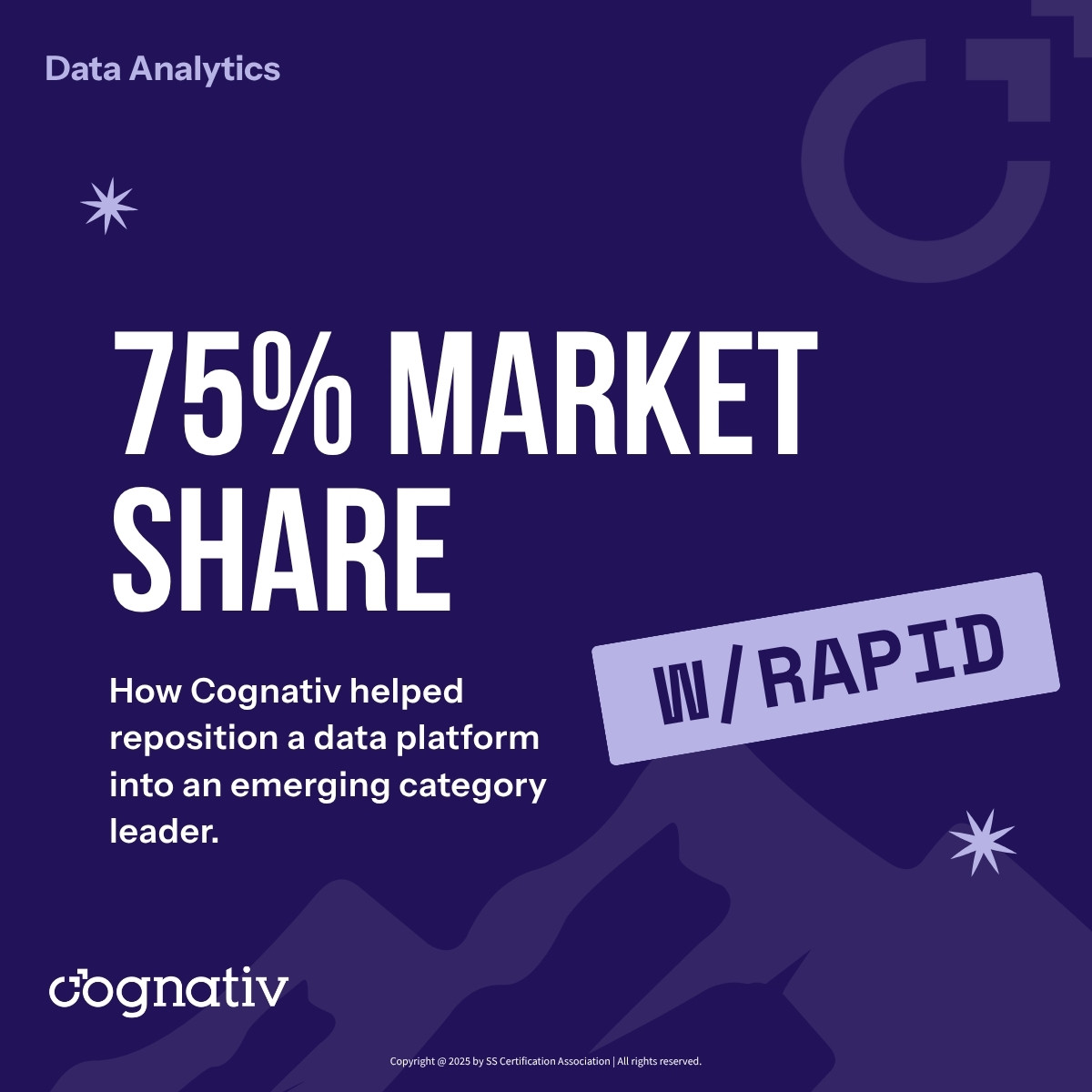
Data Platform Reaches 75% Category Market Share
Data Platforms
Data Aggregation
Data Management
Technology Strategy
Data Platform Reaches 75% Category Market Share
Cognativ helped reposition a data management offering around a clearer market category, stronger operational narrative, and more defensible growth strategy.
The repositioning helped the business establish 75% market share in an emerging category while clarifying its value for enterprise buyers.
Explore the Data Category Win
Logistics: Give Customers and Operations a Shared View
Logistics Software
Customer Portals
Workflow Automation
Systems Integration
Logistics: Give Customers and Operations a Shared View
A logistics business needed to move beyond manual processes and a stalled modernization initiative. Cognativ delivered shipment tracking, mobile-friendly appointment scheduling and digital overage, shortage and damage reporting, alongside a B2B portal.
The project connected customer self-service with the information operations teams needed to manage delivery. Similar initiatives start by identifying the events customers need to see, who supplies those updates and how exceptions move back into operational work.
Read the logistics platform modernization case study.
Discuss Your AI-First Architecture Initiative
Tell us about your operating priorities, existing systems and the workflow you want to improve.
Share your requirements and constraints so we can define the scope and next steps.
AI-First Architecture Services: Frequently Asked Questions
Clarify the scope, the relationship between architecture and implementation, deployment choices and the decisions needed to begin.
What is the difference between AI-first architecture and AI software development?
AI-first architecture defines the business, data, infrastructure, integration, security, governance, and operating decisions that shape the system. AI software development implements those decisions in applications, platforms, services, agents, and production workflows. An engagement can cover architecture only or continue into delivery.
Does an AI architecture have to use private or local models?
No. Managed APIs, private cloud, on-premises models and hybrid combinations can all be evaluated. Choose the deployment approach based on the information involved, latency, integration, cost, legal requirements and the team’s ability to operate the system.
Can Cognativ work with our existing systems and AI vendors?
Yes. Architecture work can evaluate existing applications, data platforms, cloud environments, APIs, model providers, identity controls, vendors, and internal teams. The goal is to identify which components remain useful, where integration is required, and which constraints must be resolved before production delivery.
How long does an AI-first architecture engagement take?
Timing depends on the number of use cases, systems, data sources, stakeholders, and governance requirements involved. A focused engagement can concentrate on one decision-ready architecture, while a broader enterprise program is usually sequenced into discovery, architecture, validation, and controlled delivery stages.
How do governance and security fit into AI architecture?
Governance and security define permitted use, data access, model evaluation, release approval, monitoring, evidence, incident response, and accountability. These controls should be proportional to the use case and built into architecture and delivery rather than added after the system reaches production.
What should the first phase produce?
A focused first phase should clarify the business outcome, priority use cases, data and integration reality, risk profile, target architecture, operating owners, decision gates, and recommended delivery sequence. The scope can remain narrow when the initiative is already well defined.
How do we know whether an AI use case is ready to build?
A use case is ready when the user, workflow, business outcome, data access, acceptable risk, owner, evaluation criteria, and integration path are clear enough to test. If those decisions remain unresolved, targeted discovery or architecture work should come before full implementation.
What affects the cost of AI-first architecture services?
Cost is shaped by architecture scope, data readiness, integration complexity, model and hosting decisions, security or compliance requirements, and the level of validation needed before delivery. Cognativ scopes the first phase around the decisions and evidence required, then defines subsequent implementation stages separately.