

AI Operating Model: How Leadership Owns AI Decisions, Governance and Scale
Scaling AI takes more than tools. See how leadership teams assign decision rights, owners, governance forums and review rhythms, and how to build the model.
An AI operating model is the set of decision rights, roles, governance routines and funding rules that determine how an organization chooses, builds, approves and runs AI. Most companies already have AI tools. Far fewer have a clear answer to simpler questions: who can approve a new use case, who accepts the risk when a model touches customers, who owns the result once it is in production, and how often leadership reviews whether any of it is working.
That gap is why AI leadership has become an operating-model issue. When rollout speed rises faster than ownership, governance or measurement discipline, momentum turns into stalled pilots, duplicated tools and risk nobody has formally accepted. This guide explains what an AI operating model includes, the common structures, how to assign decision rights and roles, what a workable governance cadence looks like, and where the model stands as of November 2026.
What Is an AI Operating Model?
An operating model describes how work gets done: who decides, who executes and how performance is measured. An AI operating model applies that lens to AI. It sits between AI strategy, which says where AI should create value, and AI delivery, which builds and runs the systems.
A complete AI operating model answers five questions:
- Decision rights: who approves use cases, funding, platforms, vendors and risk acceptance.
- Ownership: who is accountable for each AI system's outcomes after launch, not just for building it.
- Structure: where AI expertise sits, centrally, inside business units or both.
- Governance cadence: which forums meet, how often, and what they are allowed to decide.
- Measurement: which business and risk metrics prove a use case should scale, change or stop.
Governance is one layer of the model, not the whole model. The NIST AI Risk Management Framework treats its GOVERN function as cross-cutting: it expects documented roles, responsibilities and lines of communication, and it states that executive leadership takes responsibility for decisions about risks from AI systems (NIST AI RMF Core). An AI governance operating model is the part that turns those expectations into named people, forums and approval paths.
Why AI Leadership Is Now an Operating-Model Issue
AI changes the economics of work, the risk profile of decisions and the speed at which teams ship, all at once. Treating those as separate tracks, with finance reviewing spend, legal reviewing risk and IT reviewing platforms, produces slow approvals on safe ideas and weak scrutiny on risky ones.
The evidence points the same way. McKinsey's March 2025 State of AI survey reported that redesigning workflows had the largest effect of the attributes it tested on whether organizations saw bottom-line impact from generative AI, and that CEO oversight of AI governance was among the factors most correlated with that impact, especially at larger companies (McKinsey). In the same survey, only about a quarter of respondents said their CEO was responsible for overseeing AI governance. The organizations getting value treat AI as a leadership and workflow question; most have not yet assigned it that way.
The useful question is no longer "should we use AI?" but "which decisions now need a named owner, a boundary and a measurement line?"
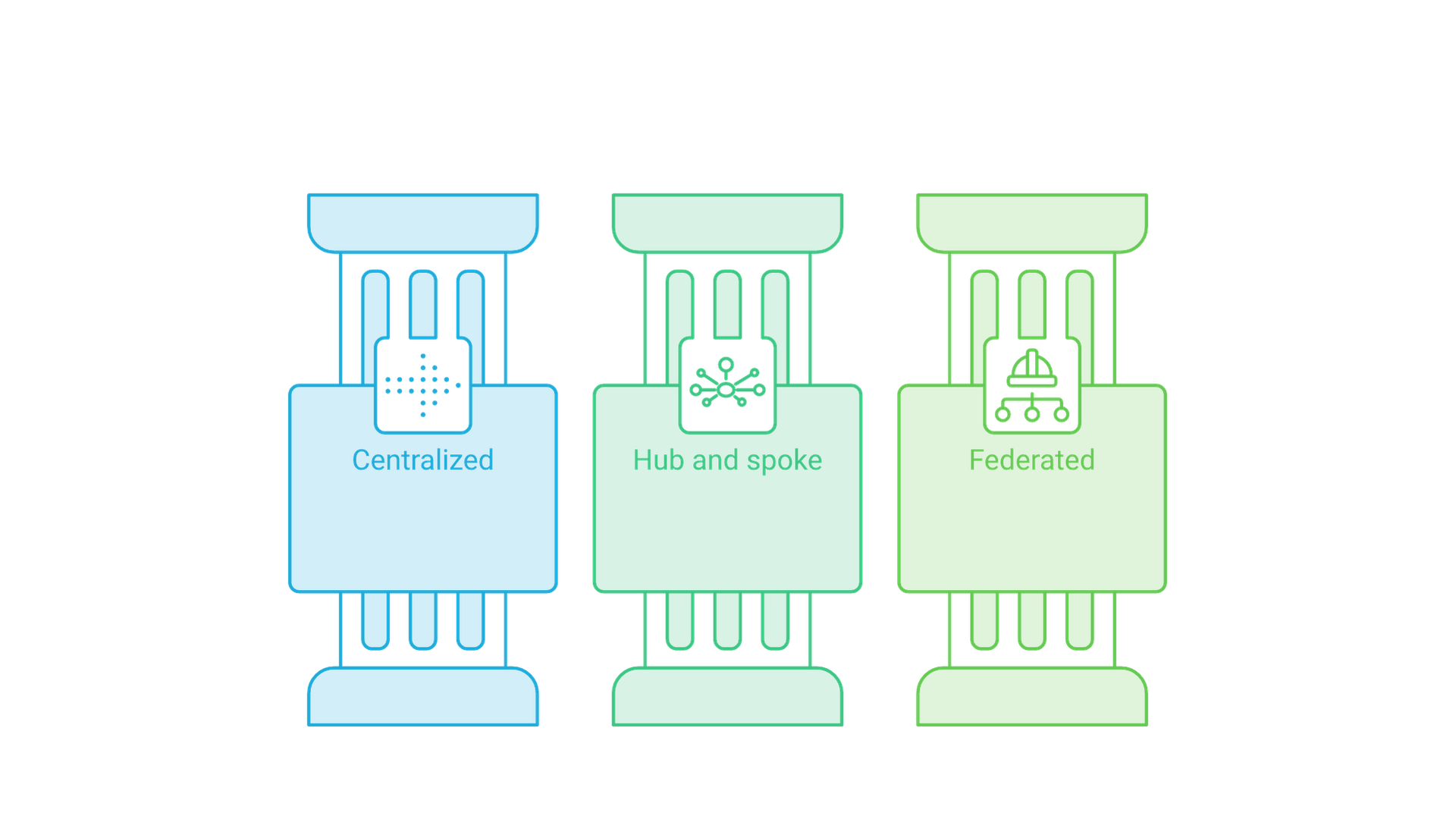
Centralized, Hub-and-Spoke and Federated AI Operating Models
Most AI operating models fall into one of three structures, distinguished by who sets the rules, who builds and who monitors what runs in production. Microsoft's guidance for AI centers of excellence, updated in July 2026, describes the same three and notes that most organizations blend them rather than pick one (Microsoft Learn).
| Structure | Who builds | Who governs | Main strength | Main risk | Fits when |
|---|---|---|---|---|---|
| Centralized | One central AI team | The central team | Consistency and control | Delivery bottlenecks | Maturity is early or risk is high |
| Hub-and-spoke (hybrid) | Central and business unit teams | Central standards, shared oversight | Balance of scale and speed | Coordination complexity | Teams are starting to build for themselves |
| Federated | Business unit teams | Central standards, govern by exception | Many teams deliver in parallel | Standards drift and shadow AI | Teams can own the full lifecycle locally |
Hub-and-spoke is the most common arrangement at scale. The hub owns the platform, security baseline, standards and AI inventory; spokes embedded in business functions own use-case delivery within those guardrails. Many organizations start centralized, then push delivery outward as automated controls mature.
A growing approval queue is a signal to federate; duplicated vendors or unregistered tools are a signal to pull standards back to the center.
AI Decision Rights: Who Decides What
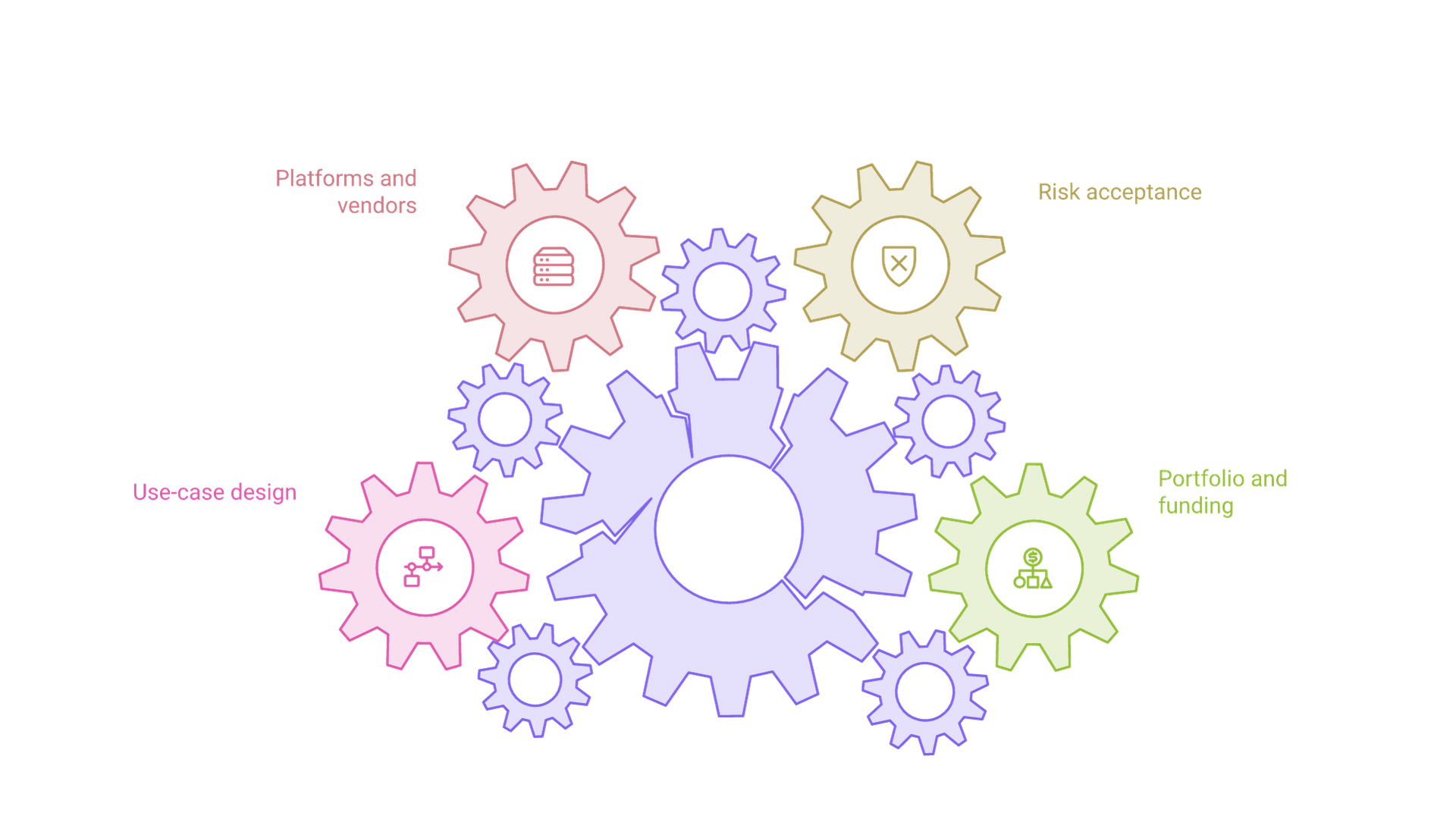
Decision rights are the core of any AI leadership operating model. Without them, every use case becomes a negotiation. A practical map separates four decision types and gives each a single accountable owner.
Portfolio and funding decisions
Which use cases get funded, scaled or stopped. This belongs to an executive forum that can trade off budgets across functions, with business owners committing to measurable outcomes before funding is released.
Risk acceptance decisions
Who can accept the residual risk of a specific system. Risk should be tiered: internal productivity tools can be approved by the business owner with standard controls, while customer-facing, regulated or consequential uses require formal sign-off and independent review. The U.S. federal approach is a useful reference: OMB memorandum M-25-21 requires agencies to document which uses are high-impact, complete pre-deployment testing and an AI impact assessment, and run an independent review before accepting risk on those uses (OMB M-25-21).
Platform and vendor decisions
Which models, cloud services, data platforms and vendors are approved. These usually stay central, because fragmented choices create cost, security and integration problems no single unit sees.
Use-case design decisions
How a specific workflow changes, where human review stays visible and when an exception escalates. These belong close to the work, with the business owner who will live with the result.
A short written charter makes these rights stick. If you are redesigning how decisions, roles and governance forums fit together across the business, Cognativ's operating model consulting work focuses on exactly that alignment.
Roles and Ownership for Scaling AI
Titles vary, but the roles in a working AI operating model are consistent. The ISO/IEC 42001:2023 management system standard requires top management to assign and communicate responsibilities and authorities for AI, without prescribing an org chart, which leaves each organization to define these roles explicitly.
- Executive sponsor or Chief AI Officer: owns the AI agenda at the leadership table, chairs or vice-chairs the governance forum and reports progress and risk to the CEO and board.
- AI governance board or council: a cross-functional forum covering technology, data, security, legal, privacy, finance and the business, with authority to approve high-risk uses and set policy.
- Use-case or product owner: accountable for each system's business outcome, adoption and ongoing performance after launch.
- Platform and data owners: run the shared infrastructure, data access and monitoring every team uses.
- Risk, compliance and legal partners: define risk tiers, review high-impact uses and track obligations as regulation changes.
- Change and enablement leads: handle training and workforce redesign so new workflows are actually used.
The federal model in M-25-21 shows the seniority this requires. Agencies had 60 days to name a Chief AI Officer positioned to engage regularly with the Deputy Secretary, and larger agencies had 90 days to convene an AI governance board chaired at the Deputy Secretary level with the Chief AI Officer as vice-chair. The principle transfers to private companies: AI ownership has to sit high enough to resolve trade-offs between functions.
The AI Governance Operating Model and Its Cadence
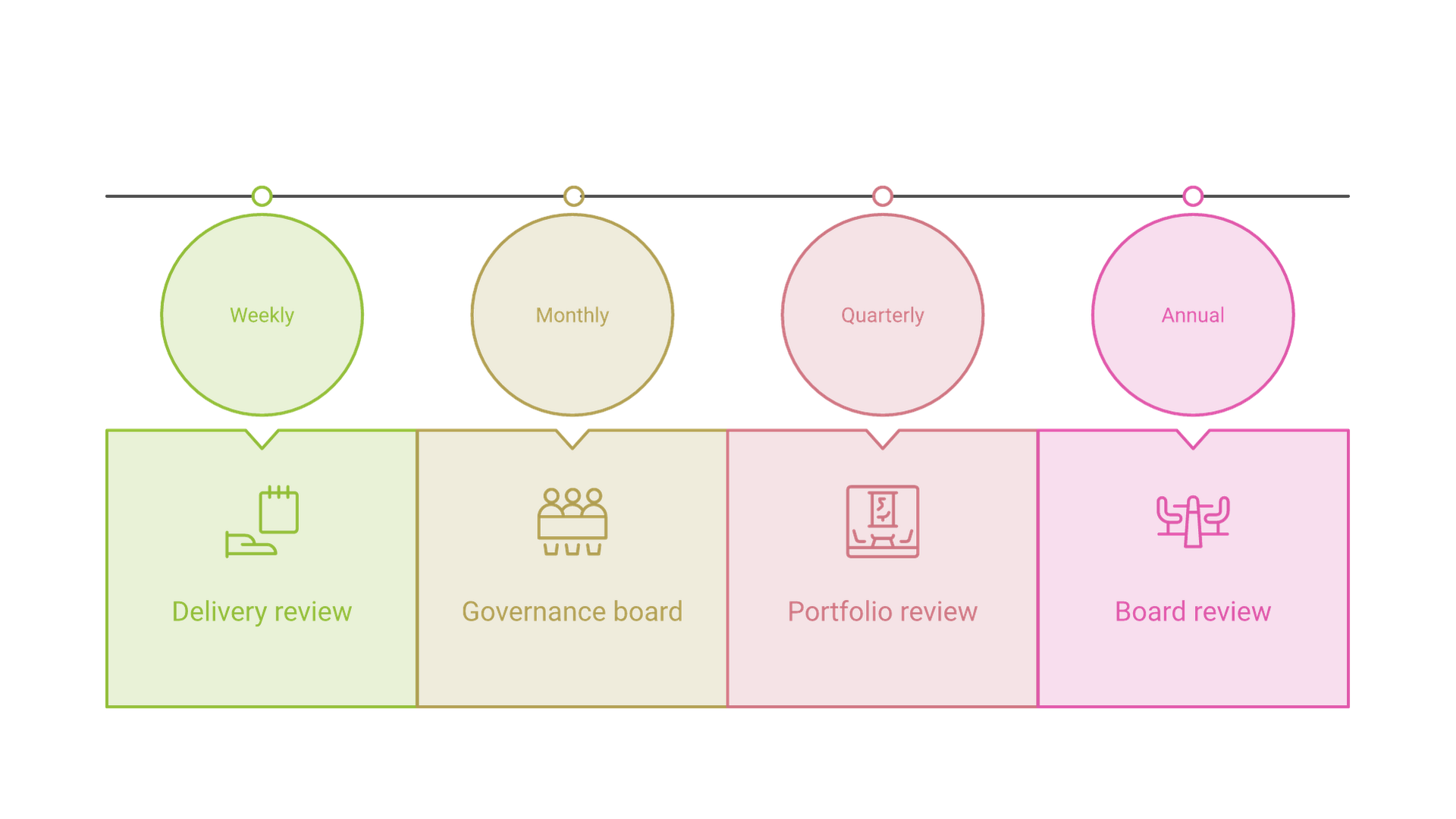
Roles only work with a predictable rhythm. A governance cadence defines which forum meets, how often and what it decides.
- Weekly, at the delivery level: use-case owners and platform teams review incidents, model performance and blocked work.
- Monthly, at the governance board: approve or reject high-risk use cases, review the AI inventory, resolve escalations and update policy.
- Quarterly, at the executive level: rebalance the portfolio, fund what is working, stop what is not and review risk posture against appetite.
- Annually, with the board of directors: confirm strategy, risk appetite and the operating model itself.
Two rules keep the cadence honest. Every forum needs a written decision scope, so the monthly board does not relitigate weekly decisions. And every system in the inventory needs a reassessment date: M-25-21 requires impact assessments to be updated across a system's lifecycle, not filed once at launch.
How to Build an AI Operating Model in Five Steps
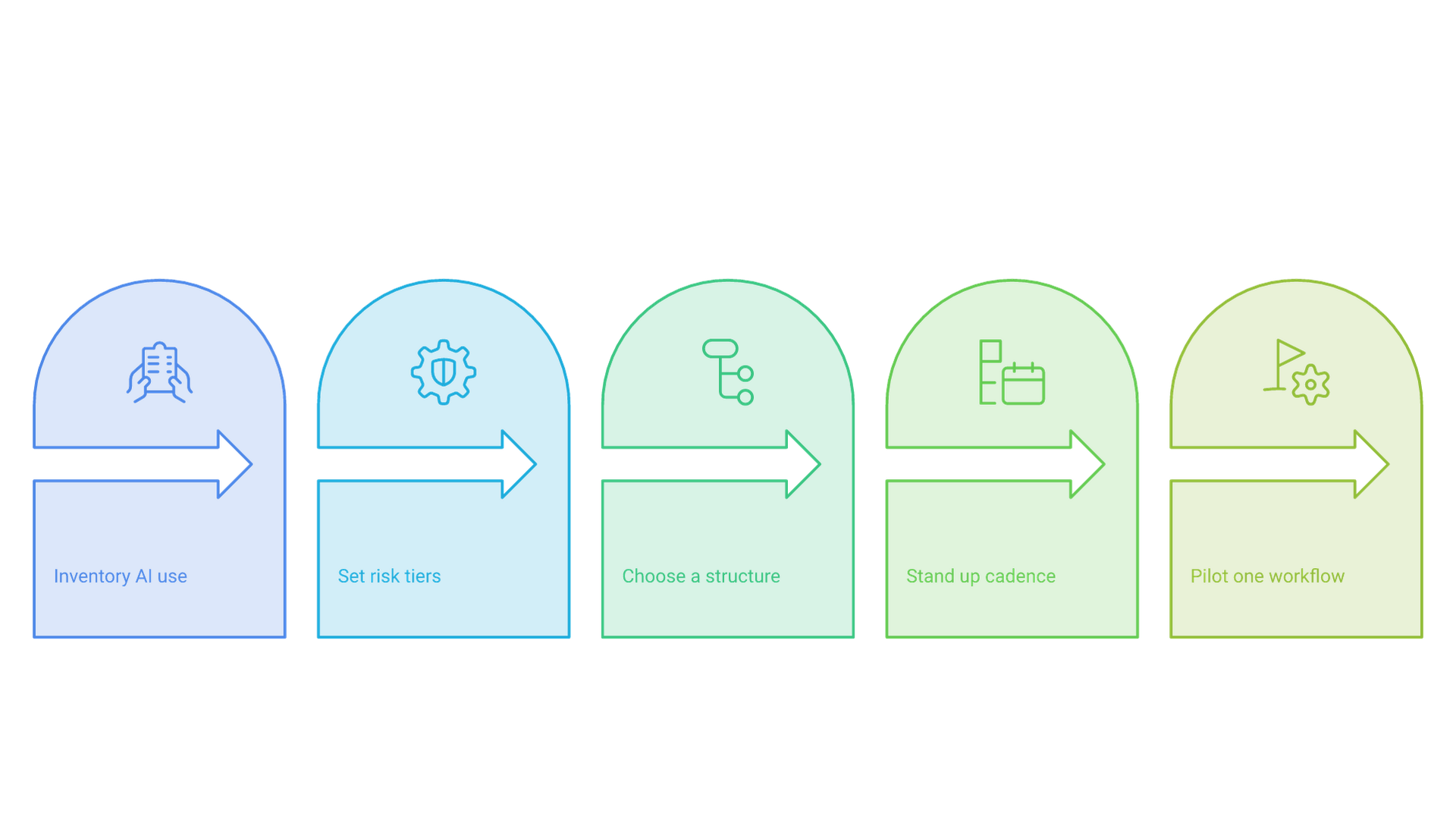
Building an AI operating model does not require a reorganization on day one. It works best as a sequence.
1. Inventory current AI use
List every AI system and tool in use, including unapproved ones, with an owner, a purpose and a risk tier for each.
2. Define risk tiers and decision rights
Set two or three risk tiers with clear criteria, then map who approves each tier, who funds it and who accepts the residual risk.
3. Choose a starting structure
Pick a structure based on maturity and risk, and decide what always stays central: platforms, security baseline, standards and the inventory.
4. Stand up the cadence and metrics
Launch the forums with written scopes and agree on the metrics that decide whether a use case scales: cycle time, quality, adoption, cost and incidents.
5. Pilot one workflow end to end
Run one workflow, with one owner and one escalation path, through the full model. Fix what breaks before scaling it.
This step is where most programs stall, because people change more slowly than tools. Cognativ's AI adoption consulting helps leadership teams move from pilots to owned, measured workflows that people actually use.
Common AI Operating Model Mistakes
- Treating governance as a gate. One committee reviewing everything becomes a bottleneck and pushes teams toward unregistered tools.
- Owning the build but not the outcome. Systems degrade when nobody is accountable after go-live.
- Measuring activity instead of results. Counting pilots or licenses proves nothing about workflows.
- Ignoring workforce change. New workflows fail if roles and incentives stay the same.
The AI Operating Model in 2026: What Has Changed
As of November 2026, three reference points shape AI governance operating model design.
Regulatory timelines moved. The European Union's Digital Omnibus on AI, Regulation (EU) 2026/1744, became applicable in late July 2026 and postponed the main high-risk obligations of the AI Act. Obligations for high-risk use cases such as employment, education and critical infrastructure now apply from December 2, 2027, and those for AI used as safety components in regulated products from August 2, 2028 (Mayer Brown). The extra time is best used to build inventories, risk tiers and ownership now.
Frameworks are being updated. NIST notes that AI RMF 1.0, released in January 2023, is being revised, and in April 2026 it published a concept note for a profile on trustworthy AI in critical infrastructure (NIST). The GOVERN function remains the most direct template for roles and accountability.
Agents raise the stakes on ownership. As AI systems act inside business systems rather than only drafting text, more use cases move into higher risk tiers, which makes outcome ownership, monitoring and escalation paths more important.
Frequently Asked Questions
What is an AI operating model?
It is the combination of decision rights, roles, governance forums, funding rules and metrics that determines how an organization selects, builds, approves and runs AI systems. It connects AI strategy to day-to-day delivery.
What is the difference between AI governance and an AI operating model?
AI governance covers policies, risk controls and oversight. The operating model is broader: it also defines structure, ownership, funding, delivery processes and how performance is measured. Governance is one layer inside it.
Who should own AI in an organization?
Accountability usually sits with a senior executive sponsor or Chief AI Officer, supported by a cross-functional governance board. Each AI system also needs a business owner accountable for its outcomes after launch.
What is a hub-and-spoke AI operating model?
A central hub owns platforms, standards, security and the AI inventory, while teams embedded in business functions choose and deliver use cases within those guardrails. It balances consistency with delivery speed.
What are decision rights in AI governance?
Decision rights specify who can approve use cases, funding, platforms, vendors and risk acceptance. Clear rights prevent bottlenecks on low-risk work and weak scrutiny on high-risk systems.
How often should an AI governance board meet?
Many organizations use a monthly governance board for approvals and escalations, a quarterly executive portfolio review and weekly operational reviews at the delivery level. The right rhythm depends on volume and risk.
Conclusion
An AI operating model turns AI leadership from a statement of intent into a set of working rules: who decides, who owns the outcome, how often leadership reviews the portfolio and what evidence justifies scaling. The organizations that get value from AI are not the loudest adopters; they are the ones that contain change inside owned workflows, visible controls and repeatable review cycles.
The fastest test of readiness is to name one workflow, one governance rule and one owner that need to change this quarter. If that exercise exposes gaps in decision rights or ownership, talk with Cognativ about scoping the next step.