

AI Shopping Agents vs. Amazon: What the Muse Fight Means for Retailers
Amazon blocked Meta's Muse and says outside agents barely touch its ads. Here is how agentic commerce works and a readiness checklist for ecommerce teams.
AI shopping agents are assistants that search, compare and increasingly buy products for a shopper. In late October 2026 The Wall Street Journal ran a report headlined "The Shopping Bots Are Coming for Amazon," focused on Meta's Muse agent and the risk it poses to Amazon.
The useful question for business leaders is narrower than the headline. If product research starts inside an AI assistant instead of a search bar or the Amazon app, who controls the customer, the data and the ad dollars? Below: what happened, how agentic commerce works, what the numbers say and what to do now.
What happened: Amazon, Meta Muse and the shopping bot standoff
Meta launched Muse, its first standalone personal AI agent, in early September 2026. According to TechCrunch, Muse connects to retailers including Walmart, Best Buy, Sephora, Gap and Wayfair, can work across the Shopify catalog and pays through Link by Stripe, Shop Pay and PayPal.
Amazon moved the other way. Multiple outlets reported that it began blocking Muse on September 20, after Meta declined to remove Amazon from the experience. Amazon said the agent did not identify itself and raised concerns about customer login credentials. Meta has said Muse has no access to passwords or payment details.
The day after the block, Shopify and Meta said Muse would use Shop Pay for agentic checkout on Shopify stores. Then came Amazon's third-quarter earnings on October 29, which gave the WSJ story its numbers. Amazon reported net sales of $201.9 billion and advertising revenue of $19.6 billion, up 11% year over year.
CEO Andy Jassy raised the question himself: are outside agents hurting Amazon Ads? "The answer is no," he said; few customers shop that way yet. He expects Amazon's own Alexa for Shopping to be the primary agent on Amazon, and says over 400 million customers used it in the past year.
Meta's side is earlier but moving fast. Fortune reported Mark Zuckerberg's figures: more than 10 million people in the U.S. and Canada set up Muse, more than a quarter shop with it, and average purchases top $200. Those are company numbers, not independent measurements.
How AI shopping agents work
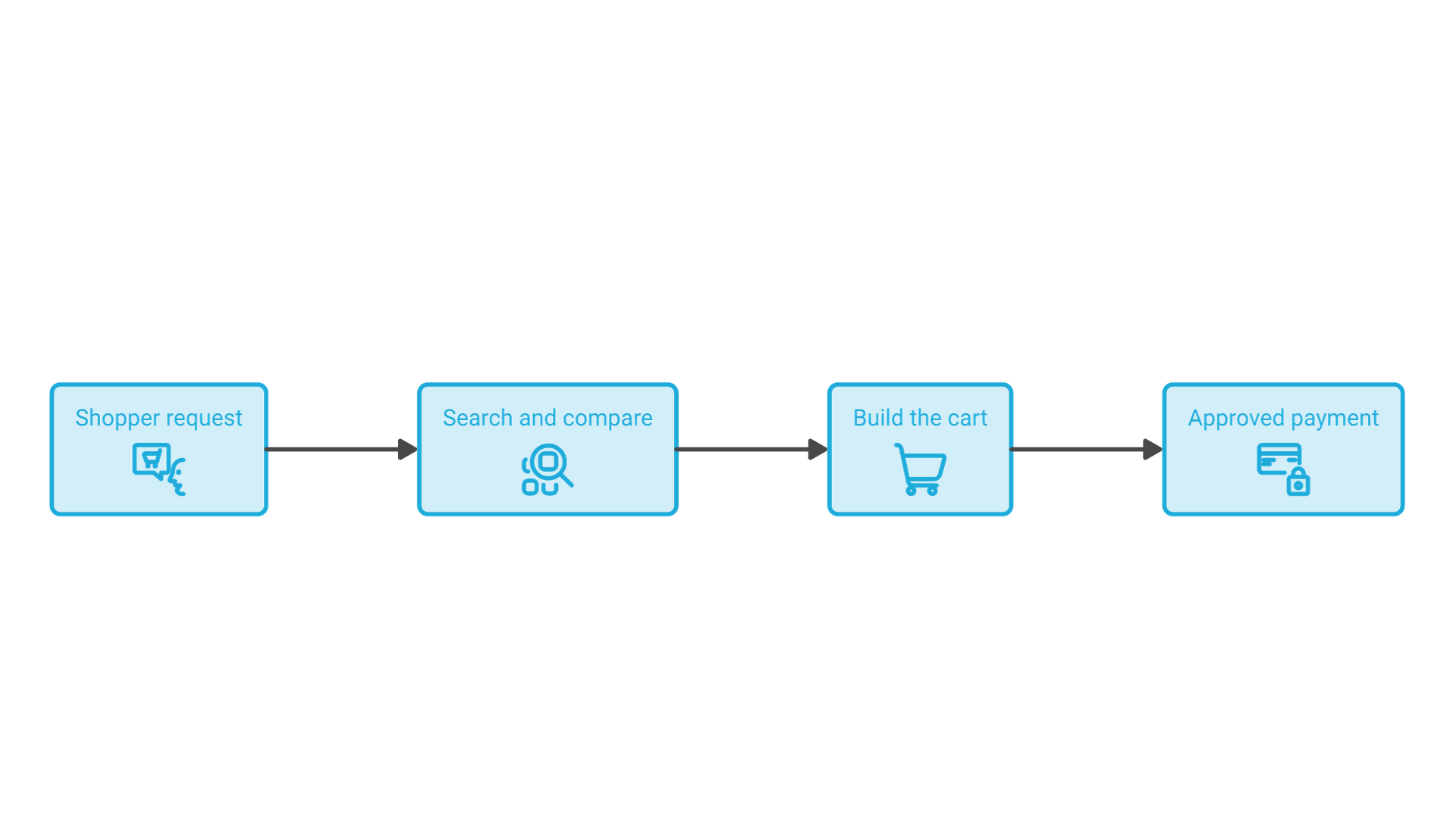
An agent turns a request such as "waterproof hiking boots under my budget" into tasks: interpret the need, search catalogs, compare, build a cart and, with approval, pay. The conversation is the easy part. The hard parts are reliable product data, a checkout the agent can complete and a payment credential merchants and banks trust.
Agents reach stores in two ways. Some drive a browser and click through a site like a person, which is why Amazon objects to agents that do not identify themselves. Others use protocols that let merchants publish catalogs and checkout on purpose, keeping control of pricing, orders and the customer record.
The protocols behind agentic commerce
Since 2025 the platforms have published overlapping standards. OpenAI and Stripe released the Agentic Commerce Protocol in September 2025. Google followed with the Agent Payments Protocol (AP2), which uses signed "mandates" to prove what a user authorized, then in January 2026 the Universal Commerce Protocol, built with Shopify and major retailers.
The card networks supply the trust layer. Mastercard announced Agent Pay for registered agents, and Visa introduced the Trusted Agent Protocol so merchants can tell approved agents from malicious bots. For the network side, see our guide to how AI agents shop and pay with Mastercard Agent Connect.
| Date | Milestone | Why it matters |
|---|---|---|
| Apr 2025 | Mastercard Agent Pay announced | Tokenized cards for registered agents |
| Sep 2025 | Google AP2; OpenAI and Stripe ACP with Instant Checkout | First open standards for agent payments and checkout |
| Oct 2025 | Visa Trusted Agent Protocol | Merchants can verify which agent is visiting |
| Nov 2025 | Amazon sues Perplexity over Comet | First major legal test of agent access |
| Jan 2026 | Google and Shopify Universal Commerce Protocol | Checkout inside Google AI Mode and Gemini |
| Mar 2026 | OpenAI scales back Instant Checkout | Discovery proves easier than in-chat buying |
| Sep 2026 | Meta Muse launches; Amazon blocks it | Open and closed retail strategies split |
| Oct 2026 | Amazon Q3 results and WSJ report | Amazon says outside agents are not yet hurting ads |
Why Amazon blocks outside shopping agents
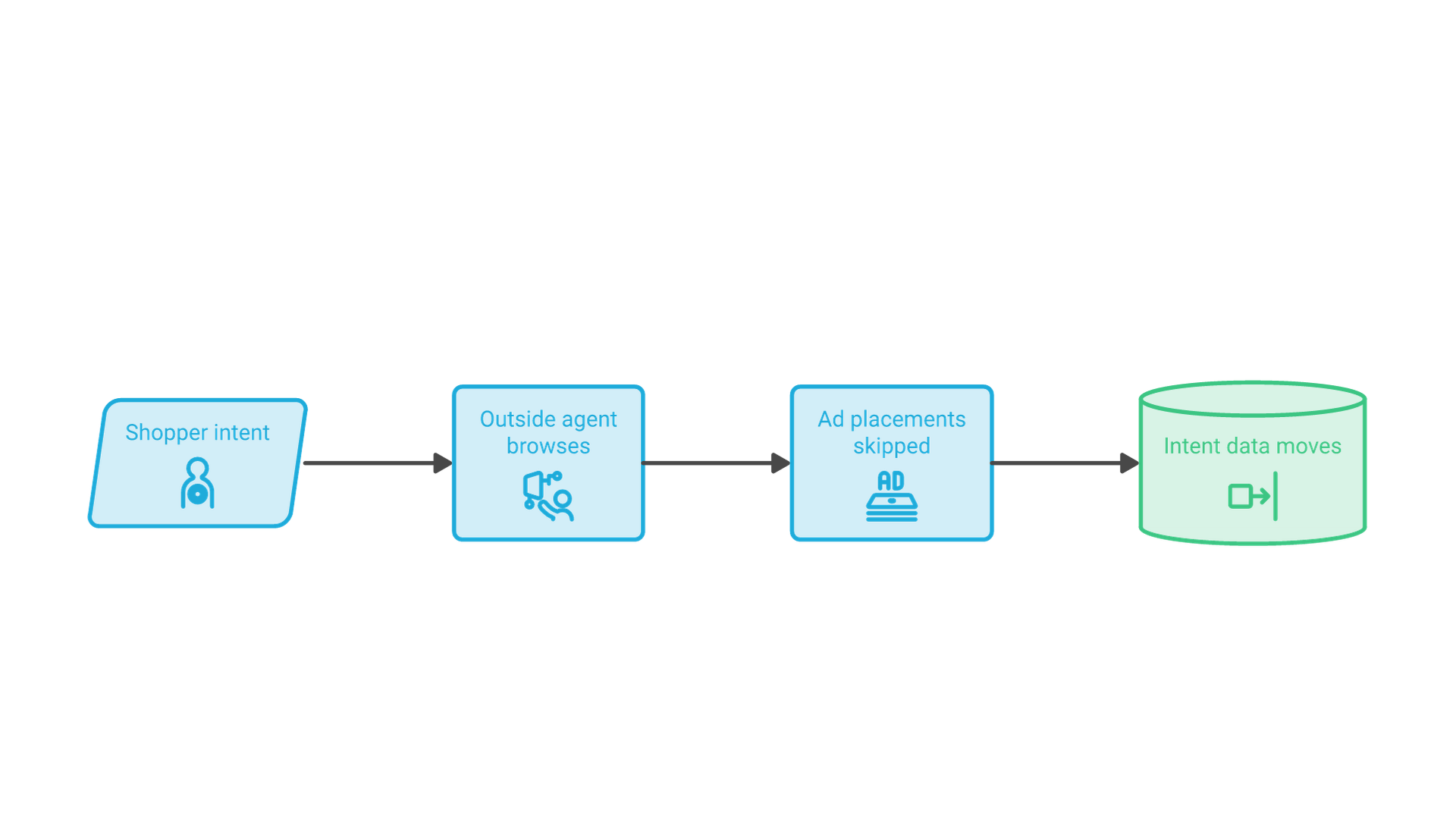
Amazon's public reasons are security and customer experience: unidentified agents, credential handling and purchases that may miss the best price or delivery option. The business logic matters as much. Amazon's ad business depends on shoppers seeing sponsored placements while they browse, and an outside agent can skip that moment entirely.
Data is the second asset. When a shopper starts on Amazon, Amazon learns what they searched, compared and rejected. When an outside agent browses, that intent signal sits with the agent's owner. Its own agent lets Amazon keep the placements and the data while still offering conversational shopping.
The Perplexity case is still open
Amazon sued Perplexity in November 2025, alleging that the Comet browser's agent accessed accounts without authorization. A judge granted an injunction in March 2026; in August, according to Engadget, the Ninth Circuit lifted it, reasoning that the user was the one accessing Amazon. The case continues, so the rules for agent access remain unsettled.
What the numbers say about agentic commerce today
The evidence points two ways. Research is moving into AI assistants quickly, while purchases mostly still close on familiar retail sites. That gap explains how Jassy can dismiss outside agents while Meta reports strong adoption.
OpenAI offers the clearest data point. Instant Checkout let U.S. users buy Etsy items in ChatGPT from September 2025. In March 2026, as first reported by The Information and covered by TechRound, OpenAI scaled it back and shifted purchases to connected retailer apps, finding that people research in ChatGPT but rarely buy there.
Survey data supports the same split. In an October report, PYMNTS Intelligence found that 59.7% of the most recent AI-assisted purchases still closed on Amazon. Our earlier analysis of AI co-pilots in holiday shopping showed the same pattern: assistants shape the shortlist before they handle the payment.
The takeaway is timing. Agents are not yet a major checkout channel, but they increasingly decide which products make the shortlist. A brand that is invisible or poorly described to an agent can lose the sale before the shopper reaches any store.
Open, partner or block: how retailers are choosing
Retailers are splitting. According to The Wall Street Journal, as summarized by PYMNTS, QVC and HSN let agents complete purchases, Kohl's does not let agents buy, and Tapestry sells through Google's AI tools while keeping agents off its own checkout. Walmart partnered with Muse; Amazon blocks outside agents.
Many have not decided at all. CNBC reported a Billions Network audit of 51 large U.S. retailers: only 11 had taken a deliberate position, and 37 blocked shopping agents largely by accident through older anti-bot rules. An accidental block is still a decision, just not a deliberate one.
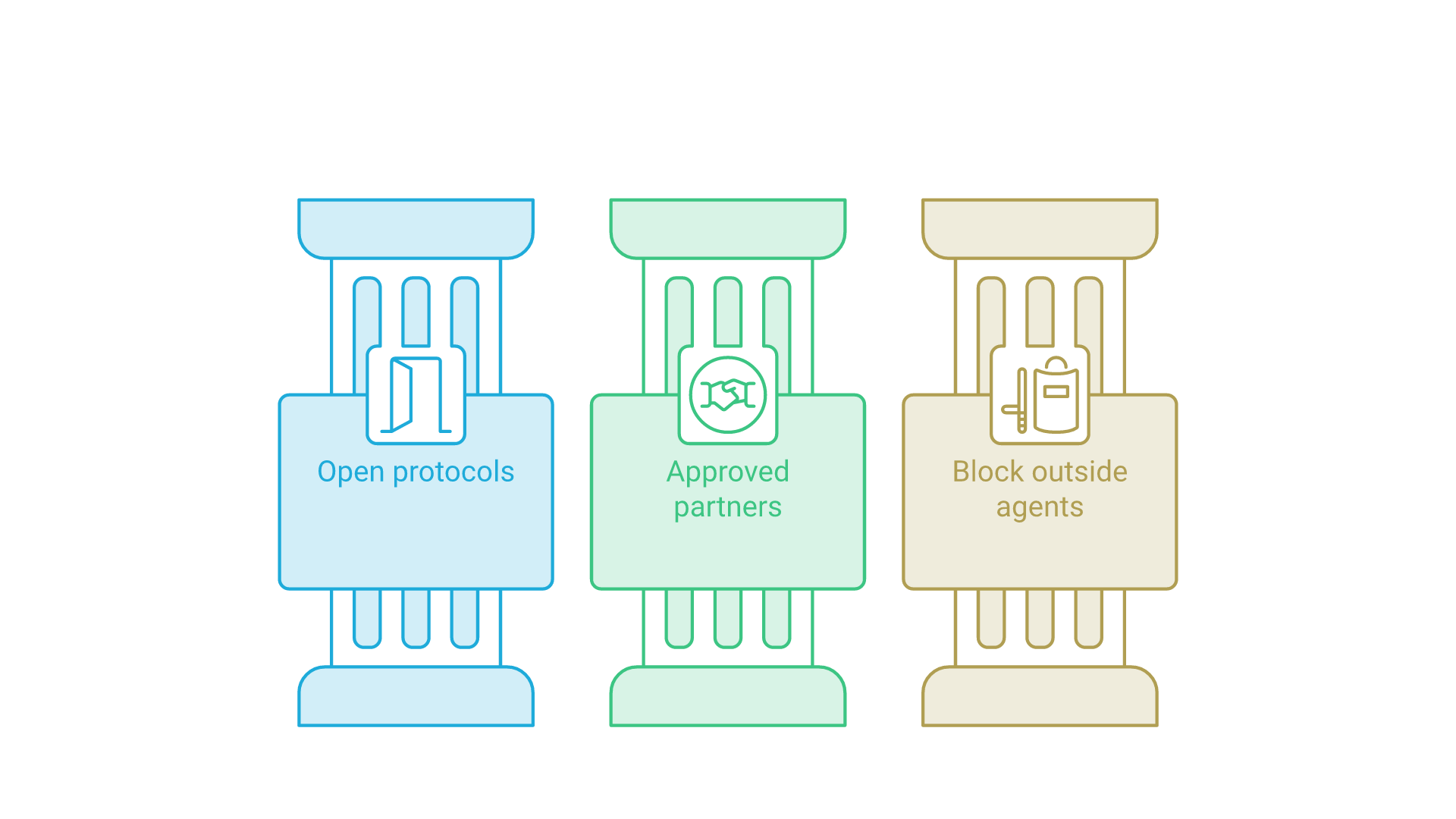
There are three workable stances. Open access through protocols suits retailers that win on assortment and price. Partner-only access suits brands that want reach with control. Blocking suits companies with a strong owned channel and ad business to protect, at the risk of vanishing from agent shortlists.
What ecommerce leaders should do now
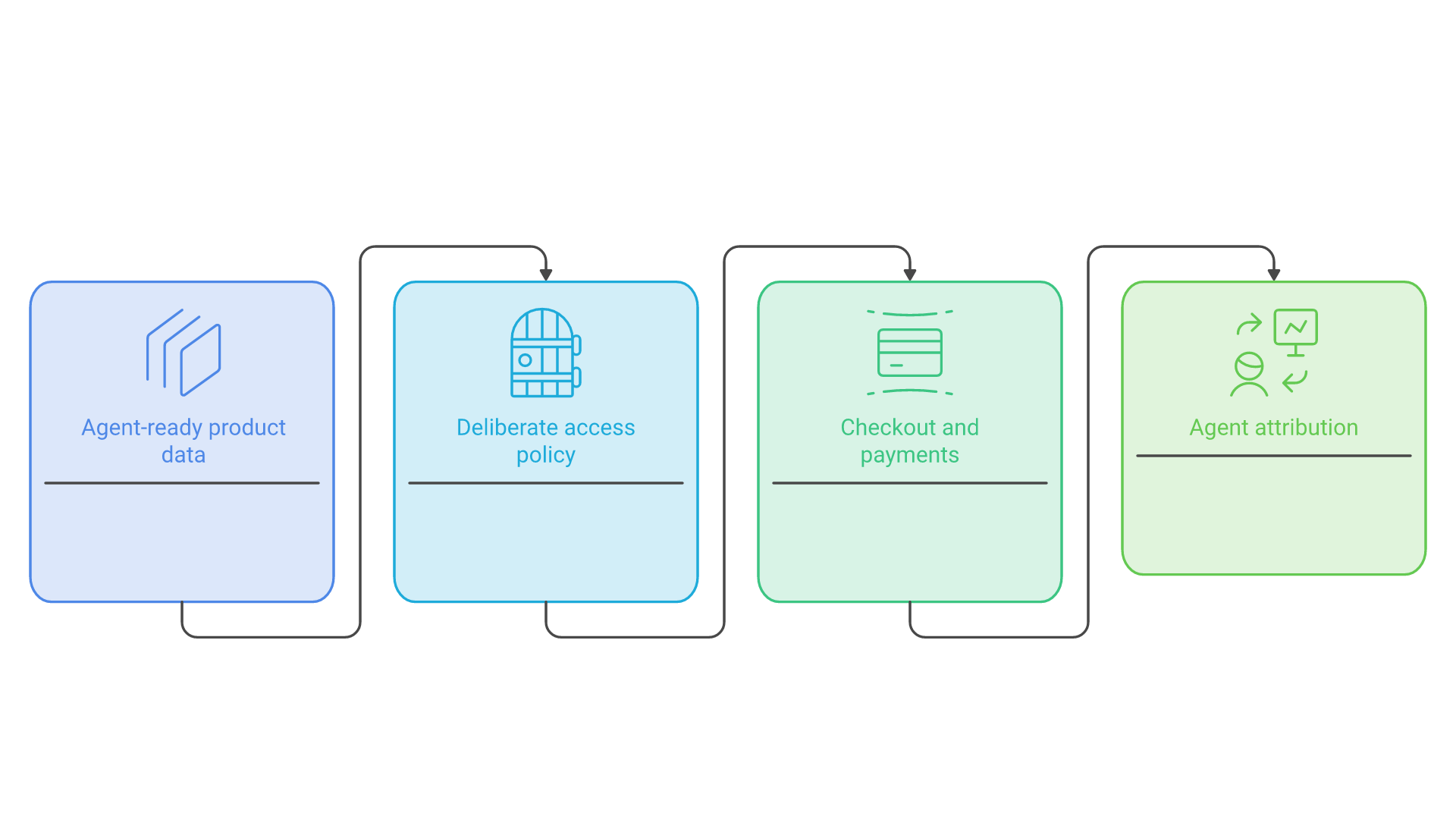
SMB and mid-market retailers do not need an Amazon-scale agent. They need the agents customers already use to find, understand and trust their products. The work falls into four areas.
Make product data agent-ready
Agents compare structured facts: titles, attributes, sizes, compatibility, price, stock, shipping and return terms. Gaps that a human shopper can work around cause an agent to skip the product. Clean, complete catalog data is now a distribution asset, which is why disciplined ecommerce product data entry matters more than it did a year ago.
Decide your agent access policy on purpose
Review what your bot management and terms of use actually do to AI agents. If you want agent traffic, consider verified-agent standards such as Visa's protocol and Web Bot Auth rather than blanket blocks. If you restrict agents, document why, and check that legitimate shoppers using assistants are not being turned away.
Prepare checkout and payments
Ask your commerce platform and payment provider which protocols they support. Shopify merchants can reach Google and Meta agents through platform integrations, while Stripe users can adopt shared payment tokens. Our ecommerce technology team sees the most risk in custom checkouts that agents cannot complete without breaking fraud rules or promotions.
Fix attribution before it breaks
Agent-referred orders can look like direct traffic in standard analytics. Tag agent channels where platforms allow it and track conversion separately. Otherwise you cannot tell whether agents add demand or just move it.
A short readiness checklist:
- Audit catalog completeness for your top-selling products.
- Test how two or three major assistants describe and rank your products.
- Review bot rules for accidental blocks of legitimate agents.
- Confirm which agent protocols your platform and payment provider support.
- Set approval limits, refund rules and fraud controls for agent orders.
- Add agent channels to your attribution reporting.
Some retailers will want more than readiness, such as their own shopping assistant built on their catalog and policies. That is a larger project, and it starts with clear scope, data access and guardrails; our AI agent development practice follows that order.
Frequently Asked Questions
What is agentic commerce?
Agentic commerce is shopping in which an AI agent acts for the buyer: it searches, compares, builds a cart and, with the buyer's approval, completes payment. Standards such as ACP, AP2 and UCP define how agents talk to merchants and payment providers.
Can AI agents shop on Amazon?
Amazon blocks outside shopping agents such as Meta's Muse under its Conditions of Use and offers its own agent, Alexa for Shopping. Its lawsuit against Perplexity over the Comet browser is still in court.
Why did Amazon block Meta's Muse?
Amazon said Muse did not identify itself while browsing and raised concerns about customer credentials, and asked Meta to remove Amazon from the experience. Analysts also point to Amazon's interest in protecting its advertising business and shopper data.
What is the difference between ACP, AP2 and UCP?
ACP, from OpenAI and Stripe, covers agent checkout. AP2, from Google, focuses on proving what a user authorized an agent to pay for. UCP, from Google and Shopify, covers discovery, checkout and orders, and is compatible with AP2.
Are AI shopping agents safe to pay with?
The networks are adding safeguards such as tokenized credentials, registered agents and signed user approvals. Risks remain, including fraud, wrong items and disputed orders, so most agents ask for explicit approval before a purchase.
Will AI shopping agents replace Amazon?
Not soon. Most AI-assisted purchases still close on Amazon or other retail sites, and Amazon reports heavy use of its own agent. The bigger near-term shift is where product research starts.
Conclusion: AI shopping agents are changing where the sale starts
The WSJ framing captures a real tension, but the evidence shows a slower shift than the headline suggests. Amazon's in-house agent is growing fast, outside agents are still small at checkout, and the rules for agent access are being written in court and in protocol specifications.
For retailers and brands, the decision is not whether to fight Amazon's battle. It is whether your products, policies and checkout are ready for shoppers who delegate the first steps of a purchase to software. Clean data, a deliberate access policy, agent-ready payments and honest measurement are achievable now.
If you want to assess how ready your catalog, checkout and analytics are for AI shopping agents, talk to Cognativ about your agentic commerce plan.