


Mastercard Agent Connect: How AI Agents Shop and Pay in Agentic Commerce
Agentic Tokens, agent registration and Verifiable Intent explained: how AI agents pay, and where Mastercard Agent Connect fits beside Visa, Google and OpenAI.
Mastercard Agent Connect is a single integration that lets merchants, AI agents, digital platforms and payment providers connect and transact with each other. Mastercard announced it on September 9, 2026, alongside an expansion of Agent Suite for Merchants and a plan to offer Anthropic's commerce agent blueprint to merchants who want to build shopping agents with Claude models.
The launch is the latest step in a program Mastercard started in April 2025 with Agent Pay. Below we cover the announcement, then explain how agentic payments work, with a dated timeline through October 31, 2026.
Key takeaways
- Agent Connect gives merchants one connection point to participating AI agents, commerce services and payment providers, starting in the United States.
- Agents move through three stages: catalog discovery, cart and price confirmation, and checkout with credentials from any network.
- Agent Pay, Agentic Tokens and Verifiable Intent supply the payment security and proof of consumer authorization behind those purchases.
What Mastercard Agent Connect Is
According to Mastercard's September 2026 press release, Agent Connect is a new solution that helps merchants, AI agents, digital platforms and payment providers connect and transact through a single integration. Instead of building a separate connection for every AI assistant or shopping platform, a merchant connects once and chooses which AI experiences can reach its catalog.
Mastercard stresses merchant control. Businesses keep authority over pricing, fulfillment, customer relationships, brand experience and business rules. That addresses a core retailer worry: losing the customer relationship to whoever owns the chat window.
The three stages of an agent-led purchase
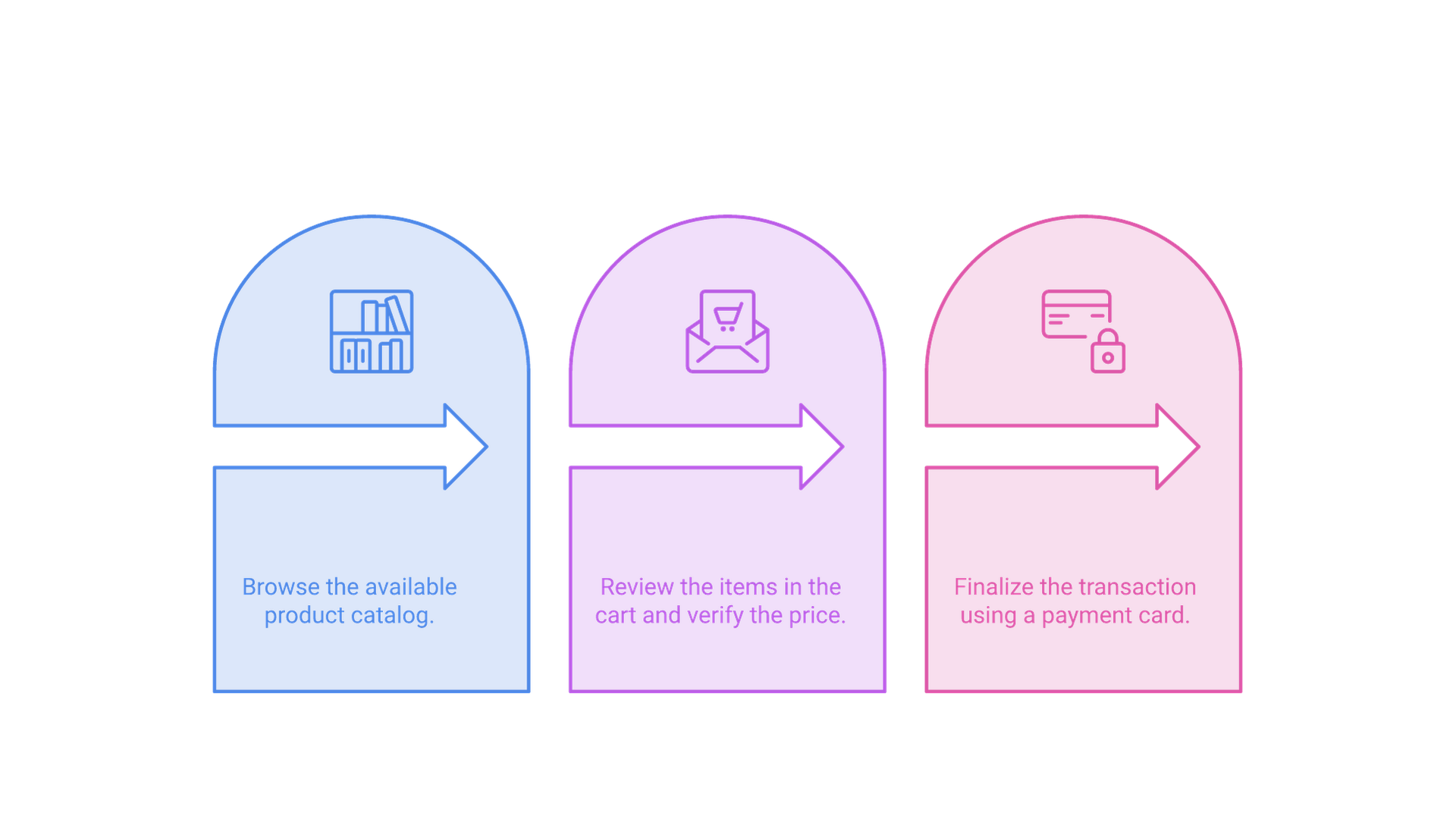
Mastercard describes Agent Connect as supporting three stages of the shopping journey. First, participating agents discover merchant-provided catalog information. Second, they recommend products and confirm final pricing, taxes, shipping and fulfillment, so the shopper sees the real total before buying. Third, they complete the transaction with secure payment credentials from any network, not only Mastercard.
Who plans to use it, and where
Mastercard says Agent Connect launches first in the United States and will evolve with additional capabilities, subject to market needs and product availability. Companies named in coverage by The Paypers as expecting to use it include Bemobi, Getnet, Glance, Global Payments, Network International, Nexi, Planet, Samsung, Trip.com, Vodafone Egypt, Wizard and Wompi. As of October 31, 2026, we found no later Mastercard announcement naming additional markets or a general availability date outside the US.
Agent Suite for Merchants and the Anthropic Blueprint
Agent Connect arrived together with new capabilities in Agent Suite for Merchants. Mastercard first introduced Agent Suite on January 27, 2026 as a set of customizable AI agents and advisory services, with availability planned for the second quarter of 2026. The merchant version lets retailers run shopping conversations governed by their own rules for inventory, margins, promotions and brand voice.
The September expansion helps merchants bring agent-powered shopping into their existing e-commerce sites, prepare product information for AI discovery and connect with third-party agents. Product details, pricing, availability and fulfillment options become accessible across AI models and platforms, while the merchant decides how that data is used. Companies Mastercard named as planning to use the suite include Castlery, Fabrick, Fiserv, FreedomPay, Getnet, Global Payments, Moneris, Nexi, Network International, Trip.com and Worldline.
The most notable detail for builders is the Anthropic tie-in. Mastercard will offer Anthropic's commerce agent blueprint through Agent Suite for Merchants, so merchants can build shopping agents with Claude models on their own sites or apps, connected to Mastercard's commerce intelligence, controls, personalization and payment capabilities. For context on how assistants already shaped retail behavior, see our analysis of AI copilots in holiday shopping.
How AI Agents Pay: Agent Pay, Agentic Tokens and Verifiable Intent
Agent Connect handles the conversation between agents and merchants. The payment itself relies on Mastercard Agent Pay, which Mastercard unveiled on April 29, 2025 as its agentic payments program. Its goal is to let AI platforms complete purchases inside a conversation with security and transparency at each step.
Agentic Tokens
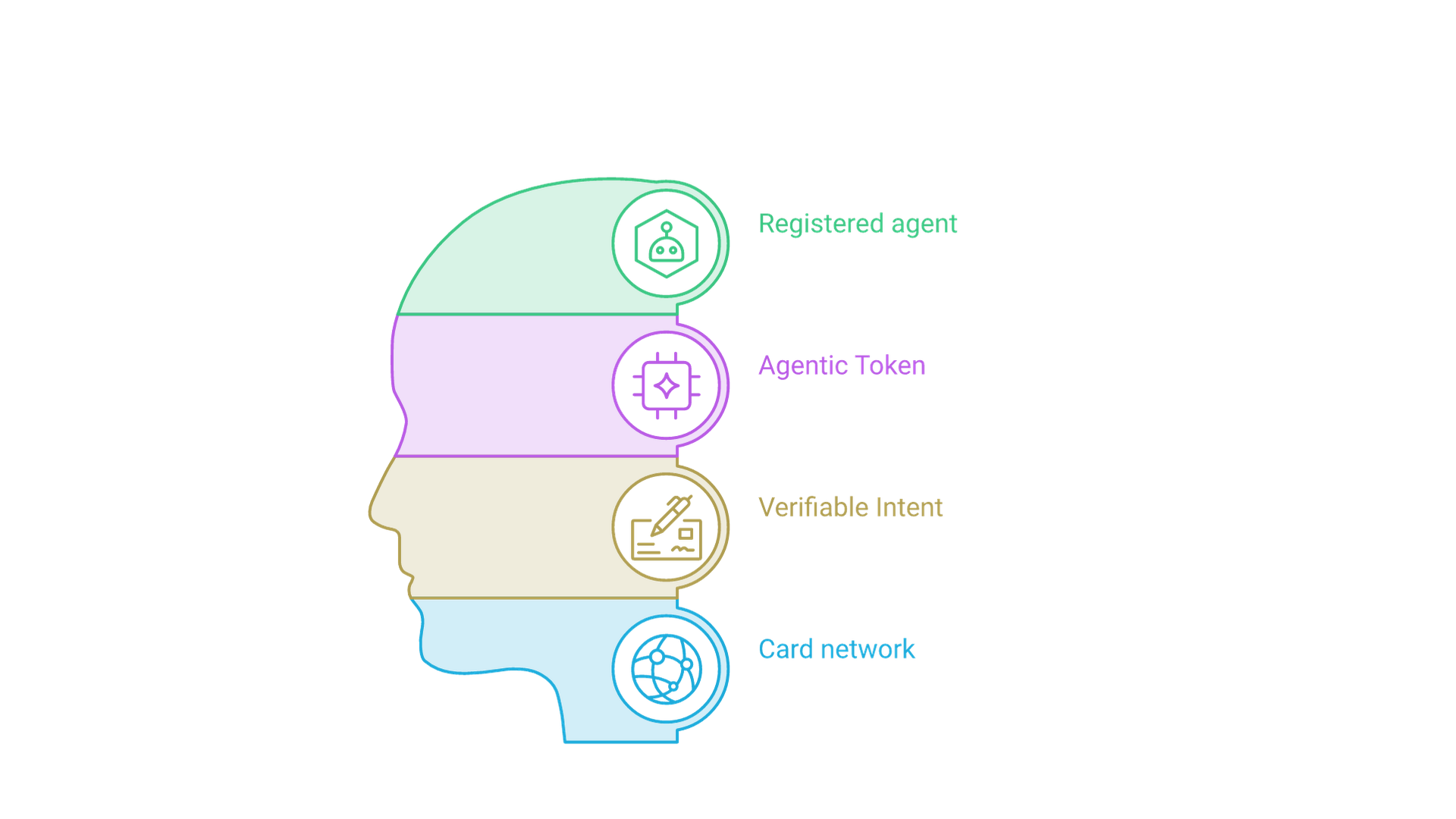
The core building block is the Mastercard Agentic Token. It extends the same tokenization Mastercard already uses for mobile contactless payments, card-on-file, Payment Passkeys and recurring payments. A token stands in for the real card number, so an agent can pay a merchant without ever holding the consumer's actual credentials.
Agent registration
Agent Pay requires trusted AI agents to be registered and verified before they can make payments on a user's behalf. That lets issuers and merchants tell a known shopping agent from an anonymous script.
Verifiable Intent
The hardest question in agentic payments is proof: did the person actually ask for this purchase? Mastercard's answer is Verifiable Intent, an open trust framework announced in March 2026 and co-developed with Google. It creates a tamper-resistant record of what the user authorized, and Mastercard says it is designed to work across agentic protocols rather than replace them. In the Agent Connect release, Mastercard said Agent Pay uses Verifiable Intent to help ensure Mastercard purchases are completed with the consumer's authorization.
Mastercard Agentic Commerce Timeline
Agent Connect makes more sense as one step in an 18-month build-out. The table below lists the Mastercard milestones confirmed in the company's own releases.
| Date | Announcement | What it added |
|---|---|---|
| April 29, 2025 | Agent Pay | Agentic Tokens, agent registration, work with Microsoft, IBM, Braintree and Checkout.com |
| September 10, 2025 | New tools and collaborations | Agent Toolkit via an MCP server, Insight Tokens, early access for Citi and U.S. Bank cardholders |
| January 27, 2026 | Agent Suite | Customizable agents for banks and merchants, planned for Q2 2026 |
| March 2026 | Verifiable Intent | Open framework, with Google, for proving what a user authorized |
| June 10, 2026 | Agent Pay for Machines | Permissioned, low-value payments between agents and machines |
| September 9, 2026 | Agent Connect | Single integration for merchants, agents and payment providers, US first |
In its September 2025 release, Mastercard said all U.S. Mastercard cardholders would be enabled for Agent Pay by the 2025 holiday season, with a global rollout to follow. The Agent Pay for Machines launch in June 2026 extended the program to automated payments that can be as small as a fraction of a cent, settled across cards, accounts and stablecoins.
Agentic Commerce Protocols: Where Mastercard Fits
Several open protocols now define how agents, merchants and payment providers talk to each other, and Mastercard positions its products to work with them.
Google AP2
Google announced the Agent Payments Protocol (AP2) on September 16, 2025, with more than 60 organizations, Mastercard among them. AP2 uses cryptographically signed mandates: an Intent Mandate records what the user asked for, and a Cart Mandate locks the exact items and price the user approved. It is payment-agnostic and can extend Google's Agent2Agent protocol and the Model Context Protocol.
OpenAI and Stripe ACP
On September 29, 2025, Stripe and OpenAI released the Agentic Commerce Protocol (ACP) and launched Instant Checkout in ChatGPT. Its Shared Payment Token lets ChatGPT start a payment without exposing the buyer's credentials, scoped to one merchant and the cart total.
Visa Trusted Agent Protocol
Visa introduced the Trusted Agent Protocol on October 14, 2025, developed with Cloudflare. Agents send signed data about their intent, consumer recognition and optional payment details, so merchants can tell a trusted shopping agent from a malicious bot.
The common thread is a tool layer, a payment credential and a proof of intent. Mastercard's own Agent Toolkit already exposes its API documentation to AI assistants through MCP, which is why teams building agents should understand how the Model Context Protocol works before choosing a commerce stack.
Trust, Authentication and Disputes in Agentic Payments
Card networks are betting that trust, not interface, will decide who wins agentic commerce. In a human checkout the cardholder enters credentials, the issuer authenticates and chargeback rules settle disputes. When an agent buys, each step needs a new answer.
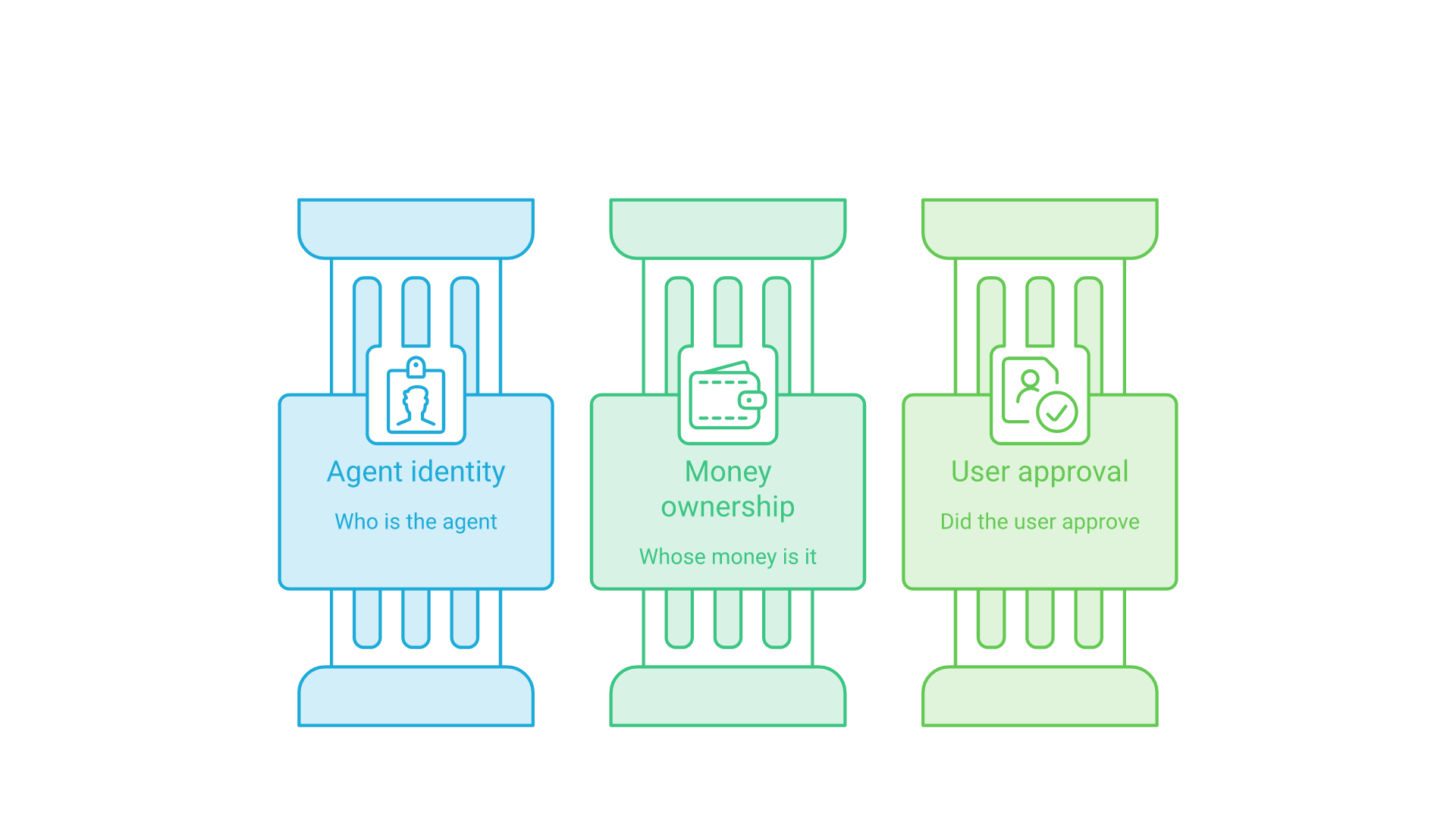
Mastercard's chief product officer, Jorn Lambert, framed the shift as moving commerce from search and discovery toward checkout and disputes, according to The Paypers. In practice, that means three questions every agentic payment has to answer:
- Who is the agent? Answered by agent registration in Agent Pay and signed agent identity in Visa's protocol.
- Whose money is it? Answered by tokens bound to a consumer, a merchant and spending limits.
- Did the user approve this? Answered by Verifiable Intent or AP2 mandates that a bank can check later.
Mastercard also said it is working with the FIDO Alliance's Payments Working Group on a verifiable credential standard confirming the amount, merchant and product of a transaction. Until those records are widely accepted in dispute handling, merchants should expect liability rules for agent-initiated purchases to keep evolving.
What Agentic Commerce Means for Merchants and Enterprise Builders
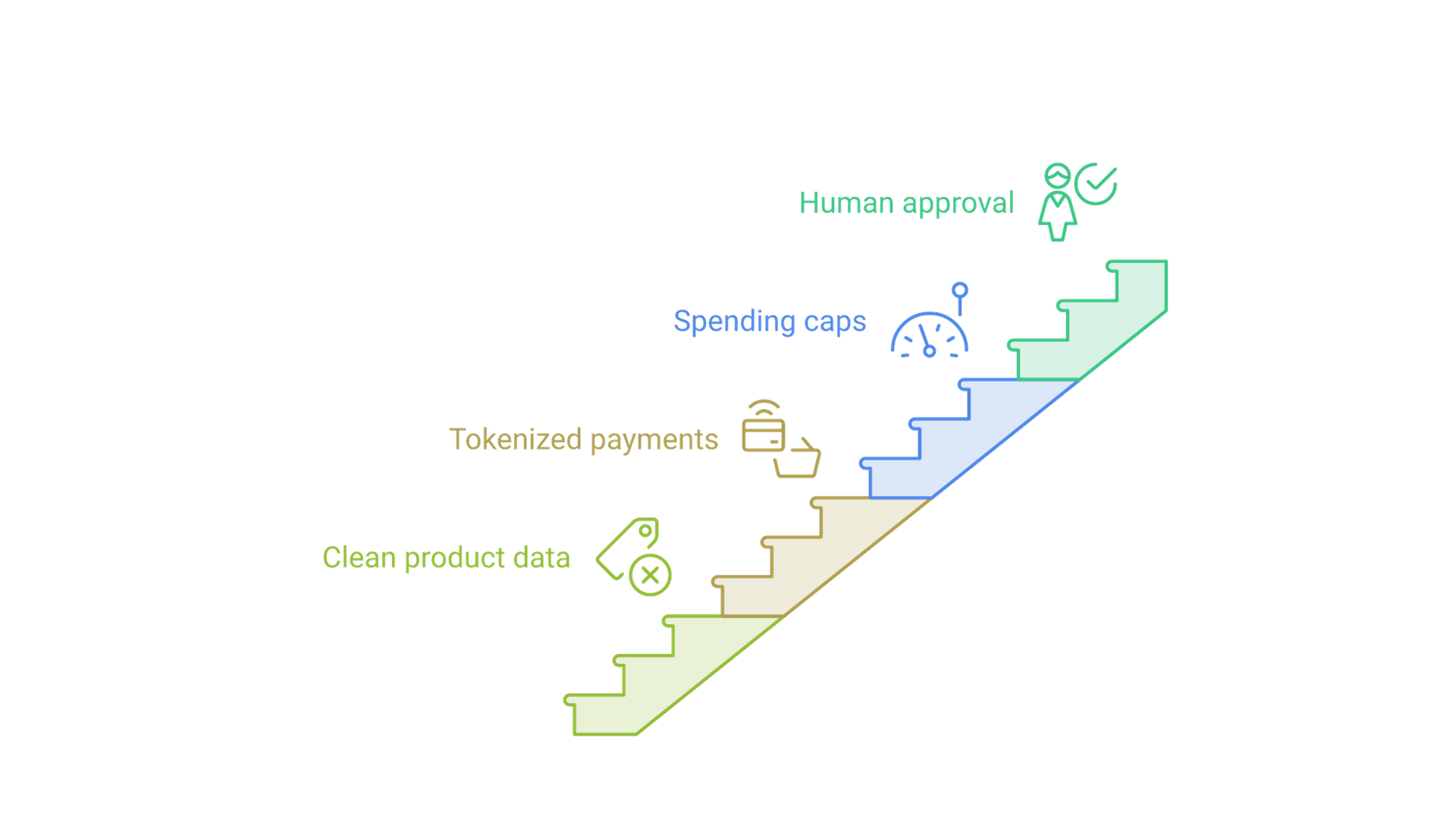
For merchants, the first job is not choosing an agent. It is making product data machine-readable: accurate catalog attributes, live pricing and inventory, clear shipping and tax rules, and return policies an agent can parse. Agent Connect and Agent Suite both assume that data exists and is governed.
For enterprise teams building their own agents, the work splits into tools, payments and oversight. An agent needs reliable APIs into catalog and order systems, a tokenized payment path that never stores raw card data, and logging that records what the user approved. Those logs are also the evidence your risk and compliance teams will ask for, which is why an enterprise AI governance framework should cover spending limits, approvals and audit trails before any agent can buy.
Teams that want shopping or procurement agents can start with a bounded pilot: one product category, one payment provider, hard spending caps and human approval above a threshold. Cognativ's AI agent development work follows that pattern, and the integration side, connecting agents to ERP, commerce and payment APIs, is covered by our AI integration services.
Frequently Asked Questions
What is Mastercard Agent Connect?
Mastercard Agent Connect is a single integration, announced September 9, 2026, that connects participating merchants, AI agents, digital platforms and payment providers so agents can discover products, confirm final prices and complete purchases. It launches first in the United States.
What is Mastercard Agent Pay?
Agent Pay is Mastercard's agentic payments program, introduced in April 2025. It uses Agentic Tokens and requires AI agents to be registered and verified before they can pay on a user's behalf.
How do AI agents pay for things?
An agent receives a tokenized payment credential instead of a real card number, limited to specific merchants, amounts or time windows. The merchant charges the token, and a signed record shows what the user approved.
What is agentic commerce?
Agentic commerce is shopping in which an AI agent searches, compares and buys on a person's or business's behalf, within limits that person sets, rather than the person completing each checkout step.
Is agentic payment safe?
The networks are building safeguards: tokenization so agents never hold card numbers, agent registration, spending limits and verifiable records of consumer intent. Dispute and liability rules for agent purchases are still maturing.
Does Agent Connect only work with Mastercard cards?
No. Mastercard says Agent Connect supports payment credentials from any network. Mastercard transactions can add Agent Pay and Verifiable Intent for authorization proof.
Conclusion
Mastercard Agent Connect turns a scattered set of agent integrations into one connection point, and it sits on top of a payment layer Mastercard has been assembling since April 2025: Agentic Tokens, agent registration and Verifiable Intent. The direction across Mastercard, Visa, Google and OpenAI is the same. Agents will shop, but only through credentials and records that merchants and banks can trust.
The businesses that benefit first will be the ones with clean product data, tokenized payments and clear approval rules already in place. If you are planning an agent that buys, sells or reconciles on your behalf, talk to Cognativ about scoping a safe first pilot.