


AI Governance for Enterprises: Building Scalable Frameworks in 2026
Inventory, risk tiers, named owners and evidence-producing controls: a practical guide to scaling enterprise AI governance across NIST, ISO 42001 and EU law.
AI governance implementation is the systematic process of translating abstract governance principles into concrete policies, controls and workflows that shape how AI systems are developed, deployed and monitored throughout their lifecycle. Theoretical frameworks describe what an organization should do. Implementation is the practical work of building operating structures that make responsible AI development routine while meeting regulatory requirements such as those in the EU AI Act.
The challenge for most enterprises in 2026 is not writing principles. It is scale. A governance process that works for five pilot projects often collapses when hundreds of employees use generative AI tools, business units buy AI features inside SaaS products, and engineering teams start deploying agents that take actions instead of only making predictions. A scalable framework applies light controls to low-risk uses and deep review to high-impact ones, and it produces evidence as a by-product of normal work rather than as a separate audit exercise.
What This Guide Covers
This guide explains how enterprises build an AI governance framework that scales: the policies, roles and decision rights, risk tiers, AI inventory, evaluation, monitoring, incident response and vendor management that make it work, and how those pieces line up with the NIST AI Risk Management Framework, ISO/IEC 42001 and the EU AI Act as they stand on October 30, 2026. It also covers a phased implementation approach and practical answers to common roadblocks. It does not cover abstract AI ethics debates or vendor-specific tool comparisons, and it is general information rather than legal advice.
Who This Is For
This guide is designed for Chief Data Officers, chief risk and compliance officers, CISOs, IT and engineering leaders, and executives who are accountable for AI in their organizations. Whether you are building AI governance from scratch in a fast-growing company or updating an existing program to reflect new AI regulations, the same building blocks apply; what changes is how much depth each one needs.
Understanding the AI Governance Process in AI Development
AI governance covers the end-to-end process by which an organization turns principles such as fairness, accountability, transparency, privacy and safety into operating models, controls, workflows and tooling that reliably shape model development and AI operations. It answers four practical questions for every AI system: who may approve it, what it must be tested against, how it is watched once it runs, and what happens when it goes wrong.
Implementation differs from writing a governance framework or policy. A framework defines what should be done. Implementation determines how governance is embedded into daily development workflows, procurement, change management and executive decision-making.
Core Principles and Key Components of AI Governance Implementation
Responsible AI governance rests on a small set of principles, including ethical development, data privacy, data integrity, security and adherence to legal boundaries. Those principles become operational through three connected components:
- Organizational structure and role definitions. Clear accountability through an AI governance committee or council, named system owners, data stewards, risk and compliance reviewers, and security partners who each hold specific responsibilities across the AI lifecycle.
- Policy development and documentation requirements. Policies that specify how AI systems must be designed, validated, deployed, monitored and retired, with standard templates for use-case intake, risk assessments, model or system cards and audit trails.
- Process integration and control points. Governance checkpoints embedded in existing workflows, such as architecture review, procurement, release management and access reviews, so that practices are enforced consistently rather than remembered occasionally.
These components work together because each addresses a different dimension of the problem: accountability, guidance and enforcement. A policy without an owner is ignored, an owner without a control point has no leverage, and a control point without a policy has no criteria.
Why AI Governance Is Important in 2026
Regulation is the most visible driver, and the timeline has shifted over the last year. According to the European Commission's AI Act policy page (last updated October 19, 2026), prohibited AI practices and AI literacy obligations have applied since February 2, 2025, and governance rules and obligations for general-purpose AI models since August 2, 2025. The Act became generally applicable on August 2, 2026, including its transparency rules. The "AI Omnibus" simplification package, which entered into force on July 27, 2026, moved the high-risk rules for Annex III use cases, such as employment, education, biometrics and critical infrastructure, to December 2, 2027, and the rules for high-risk AI embedded in regulated products to August 2, 2028.
The penalties remain significant. Under Article 99 of the AI Act, violations of the prohibited-practice rules can lead to fines of up to EUR 35 million or 7% of total worldwide annual turnover, whichever is higher; most other operator obligations carry fines of up to EUR 15 million or 3%; and supplying incorrect or misleading information to authorities can cost up to EUR 7.5 million or 1%. For SMEs, the lower of the two amounts applies.
The delay for high-risk systems is a deferral, not a cancellation. Organizations that deploy AI in hiring, credit decisions or other Annex III areas still have to build the inventory, documentation, human oversight and logging capabilities those rules require, and these take time to put in place across a large portfolio. Beyond compliance, effective governance reduces the risk of biased outcomes, system failures, data leakage and reputational damage, and it gives leadership a defensible basis for approving AI investments instead of blocking them.
The Reference Frameworks Enterprises Use
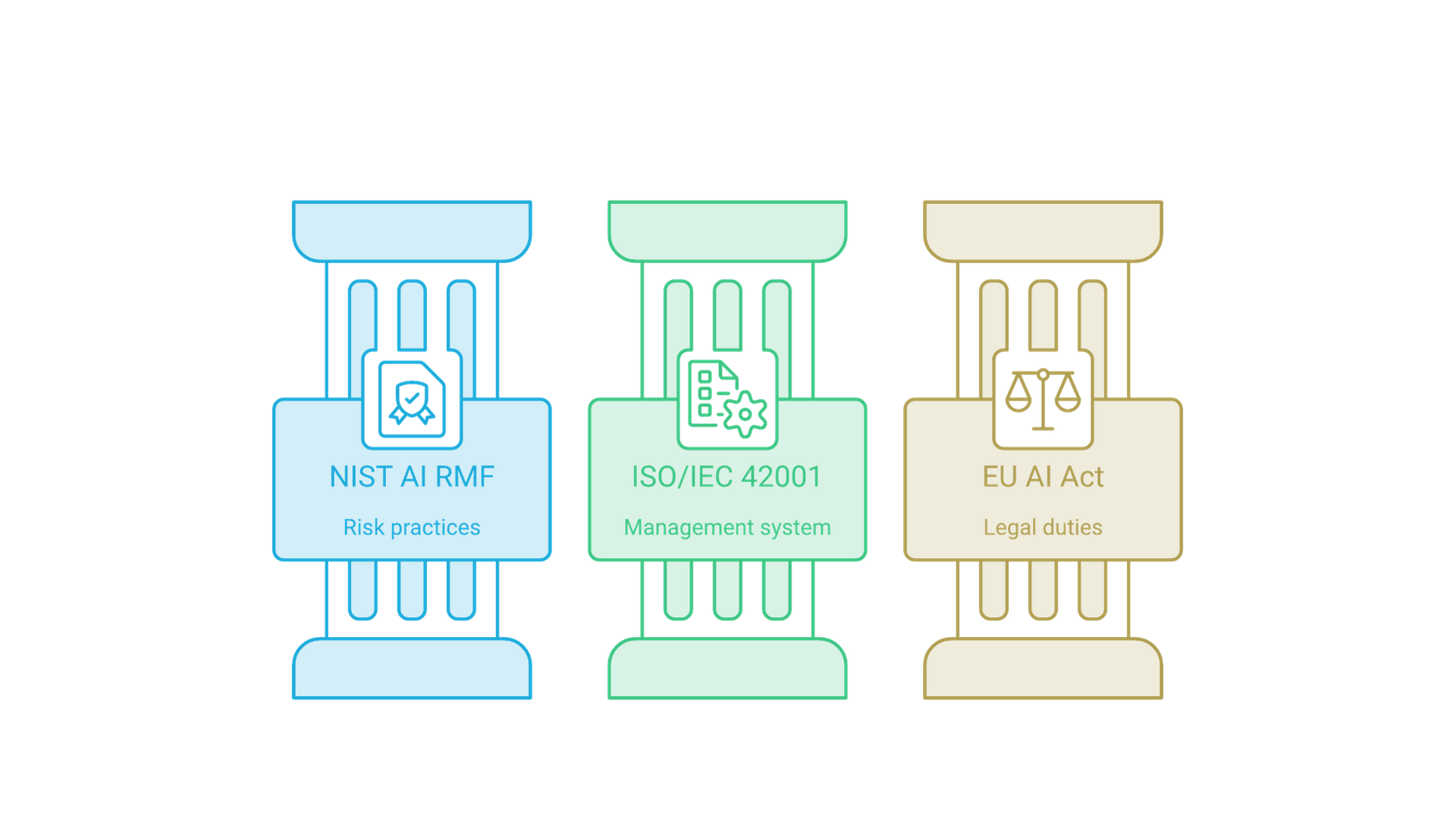
Three references dominate enterprise programs. The NIST AI Risk Management Framework (AI RMF 1.0, released January 26, 2023) is a voluntary framework that NIST says is being revised as part of the White House AI Action Plan; its Generative AI Profile, NIST AI 600-1, followed on July 26, 2024. ISO/IEC 42001:2023 specifies requirements for an AI management system (AIMS) and is the standard organizations seek certification against. The EU AI Act is binding law for organizations that place AI on the EU market or use it there. Most enterprises use NIST for risk practice, ISO/IEC 42001 for the management system, and the AI Act as a set of legal requirements mapped onto both.
Developing a Governance Framework: Policies, Roles and Risk Tiers
Framework development turns AI governance concepts into structures an organization can actually operate. Unlike academic frameworks, an implementation-focused framework has to integrate with existing corporate governance, enterprise risk management and compliance processes. Three foundations come first because everything else depends on them: the policy layer, decision rights and a risk-tiering scheme.
Policies That People Can Follow
A scalable policy set is layered. At the top sits a short AI policy, approved by executive leadership, that states principles, scope, prohibited uses and who is accountable. Beneath it are standards that set minimum requirements per risk tier, such as required testing, documentation and approvals, and procedures that tell teams exactly what to do: how to register a use case, which intake form to complete, how to request an exception. A generative AI acceptable-use policy covers everyday users.
Roles and Decision Rights
The most common failure in enterprise AI governance is a committee that tries to review everything. A scalable model separates who sets the rules from who applies them. A cross-functional AI governance council, typically with members from legal, compliance, security, privacy, risk, data and engineering, HR and the business units that deploy AI, owns the policy, risk appetite and decisions on high-risk cases. Each AI system has a named business owner who is accountable for its outcomes and a technical owner who is responsible for its operation. Reviewers in privacy, security and legal sign off within their domains. A RACI matrix (Responsible, Accountable, Consulted, Informed) for each lifecycle stage makes this explicit.
The NIST AI RMF places this under its Govern function, which it describes as cross-cutting: it informs the Map, Measure and Manage functions. Its Core calls for accountability structures with clear roles and executive responsibility for risk decisions. For high-risk systems, the AI Act adds a concrete requirement: under Article 26, deployers must assign human oversight to people with the necessary competence, training, authority and support.
Defining Scope and Managing AI-Specific Risks
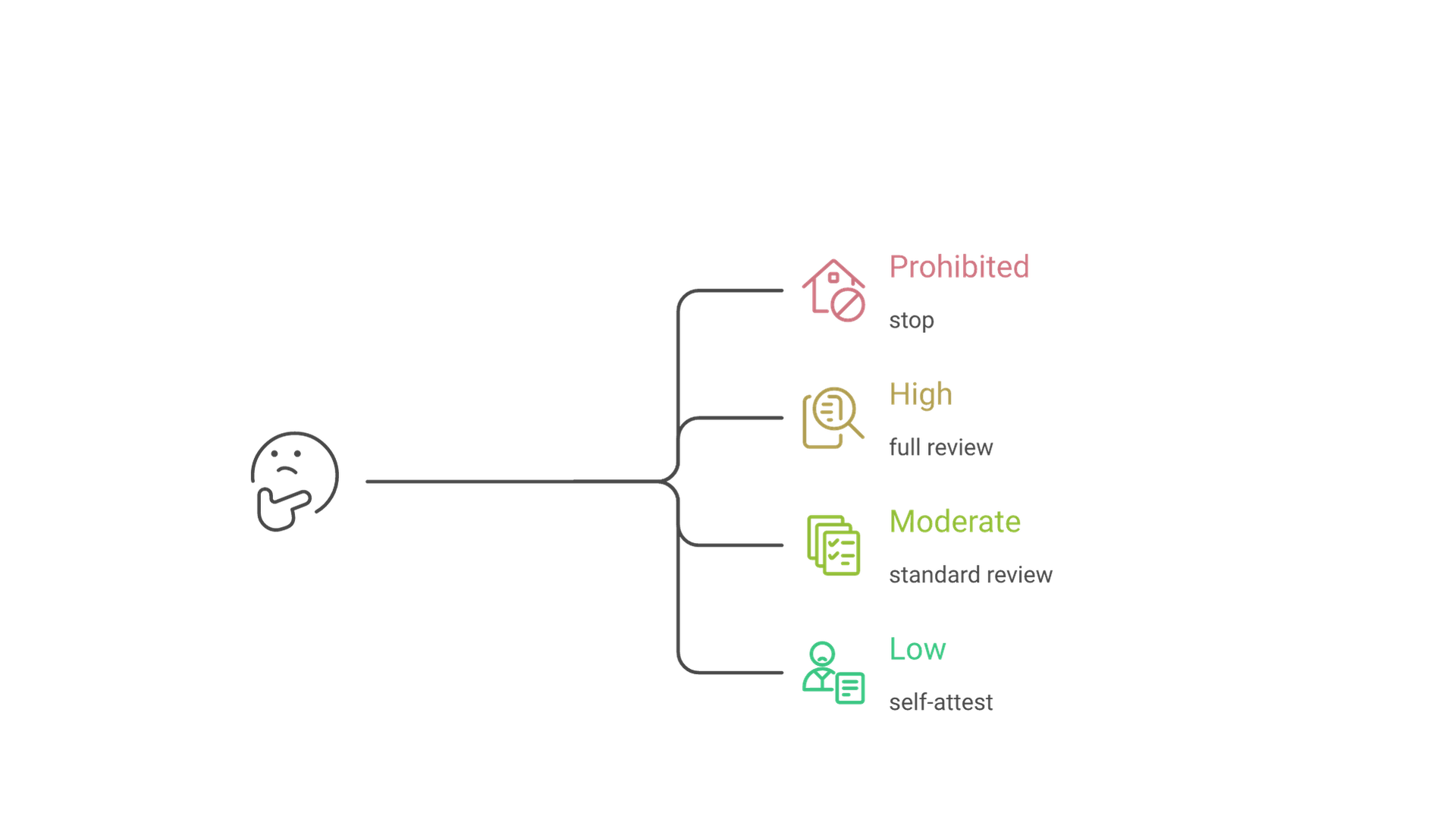
Risk tiers are what make governance proportional. Following the logic of the EU AI Act and the NIST AI RMF, organizations classify each AI use case by its potential impact and apply controls accordingly, from lightweight self-assessment for low-risk internal productivity uses to comprehensive review for systems that affect people's access to jobs, credit, education or essential services.
A practical scheme usually has four outcomes. Prohibited uses, which include the practices the AI Act bans, are stopped at intake. High-risk uses receive full review, documented testing, human oversight design and council approval. Moderate-risk uses, such as customer-facing chatbots that must disclose they are AI, receive a standard review by domain reviewers. Low-risk uses are registered and self-attested against the acceptable-use policy. Tiering criteria should be simple enough that a product team can apply them without a meeting, and the tier must be revisited when a system's scope, data access or autonomy changes.
Lifecycle Controls: Inventory, Evaluation, Monitoring, Incidents and Vendors
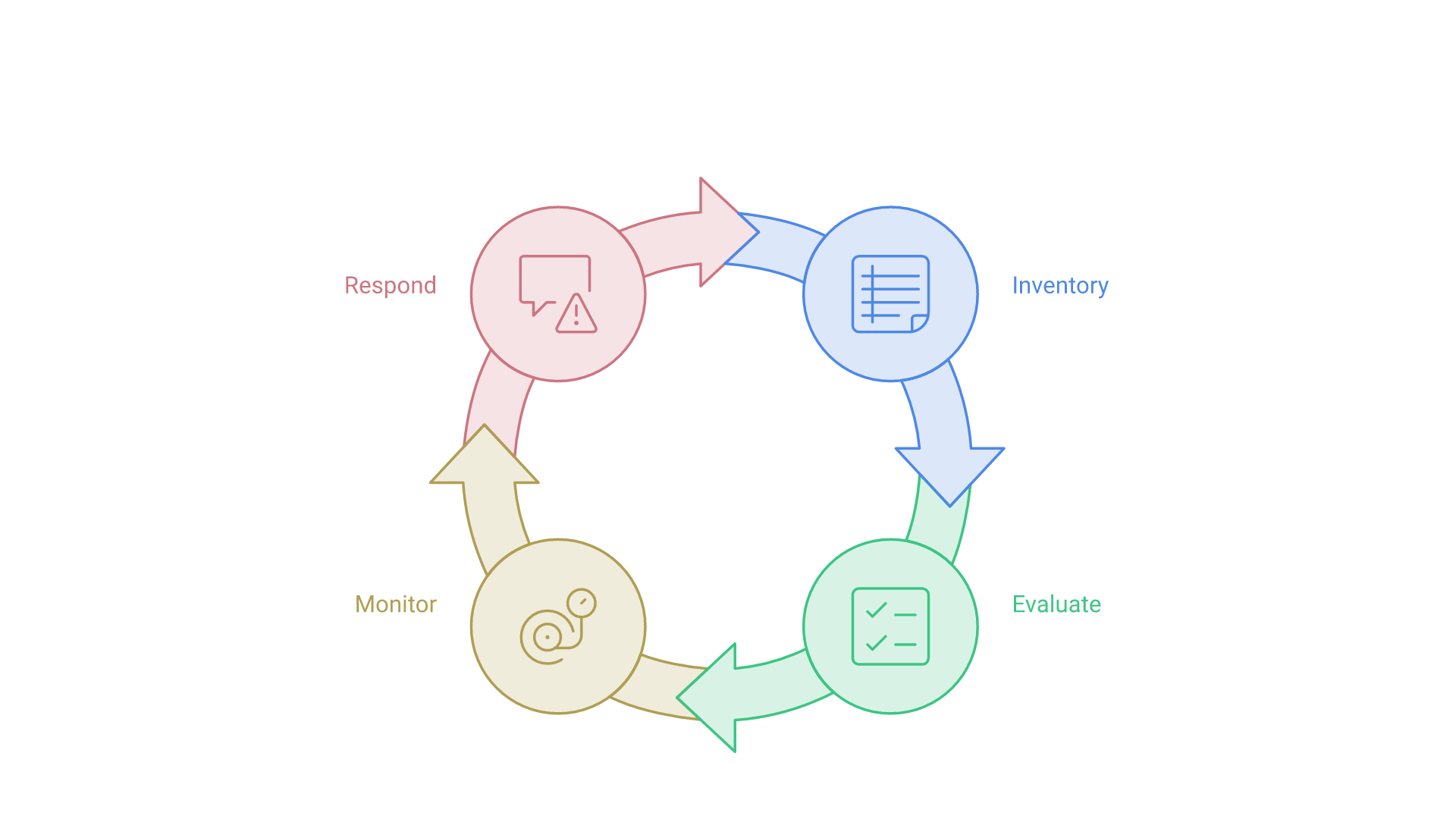
With the foundations in place, governance has to follow each AI system through its life. Five control areas carry most of the weight, and each produces evidence that regulators, auditors and customers increasingly ask to see.
AI System Inventory and Discovery
Implementation begins with a comprehensive inventory of AI in use, including shadow AI: tools that business units have adopted without IT oversight, and AI features that arrive inside existing SaaS products. The NIST AI RMF Core lists inventorying AI systems as a governance practice (GOVERN 1.6). A useful inventory entry records the system's purpose, business and technical owners, risk tier, models and vendors involved, data sources and data categories, users and affected people, deployment status and next review date.
Evaluation Before Deployment
Every tier needs defined evaluation criteria before go-live. For predictive models this means accuracy, robustness and fairness testing on data that reflects the deployment population. For generative AI, the NIST Generative AI Profile describes risks that are new or amplified, such as confabulation, data privacy, information security, harmful bias and the integrity of the AI value chain, and it highlights governance, content provenance, pre-deployment testing and incident disclosure as primary considerations. Evaluations should include adversarial and misuse testing proportionate to risk and should deliberately probe rare and unusual inputs, because, as our analysis of why AI models struggle with edge cases explains, the long tail is where real deployments fail first.
Monitoring in Production
Approval is a snapshot; monitoring is continuous. Production monitoring tracks performance against the thresholds set during evaluation, data and concept drift, output quality, policy violations, user complaints and cost. It also watches for vendor model updates. The NIST AI RMF covers post-deployment monitoring under MANAGE 4.1, and under Article 26 of the AI Act deployers of high-risk systems must monitor operation according to the provider's instructions and keep automatically generated logs for at least six months unless other law requires otherwise.
Incident Response
AI incidents need a defined path: how users and staff report them, how severity is assessed, who can pause or roll back a system, how affected people and partners are informed, and how lessons feed back into standards. NIST's MANAGE function includes mechanisms to supersede, disengage or deactivate systems that perform inconsistently with their intended use (MANAGE 2.4) and to communicate and track incidents and errors (MANAGE 4.3). For high-risk systems in the EU, deployers that identify a serious incident must inform the provider and then the relevant parties and authorities. Integrate AI incidents with existing security incident response rather than building a separate process; misuse patterns described in reports such as Anthropic's September 2026 threat intelligence report show how often AI risks travel through ordinary identity, data and access controls.
Vendor and Third-Party Management
Most enterprise AI is bought, not built, so vendor management is a governance control in its own right. NIST addresses third-party software, data and supply chain risks under GOVERN 6, including contingency plans for failures in third-party systems. Due diligence should cover the vendor's model documentation, data use and retention terms, whether customer data trains shared models, security certifications, incident notification commitments, change notification for model updates and, where relevant, the vendor's own AI Act role and ISO/IEC 42001 status. Data flows deserve particular attention; our guide to using LLMs with private data shows why mapping the full data path matters more than choosing a model labeled "private".
Aligning with Regulatory Compliance and the AI Act
A single control set should satisfy several frameworks at once. The goal is to map each internal control to the requirements it covers, so one piece of evidence serves NIST alignment, ISO/IEC 42001 certification audits and AI Act obligations.
EU AI Act Implementation Requirements
Organizations operating in or serving EU markets need governance capable of classifying AI systems by risk category, screening for prohibited practices, meeting transparency duties for systems that interact with people or generate synthetic content, and, for high-risk systems, supporting risk management, data quality, logging, technical documentation, human oversight and robustness. The obligations differ by role. Providers carry the heaviest load; deployers must use systems according to instructions, assign competent oversight, monitor, keep logs and inform workers before using high-risk AI at the workplace. AI literacy remains a baseline: Article 4, as amended by the AI Omnibus, requires providers and deployers to take measures to support the AI literacy of their staff, without guaranteeing a specific level for each individual.
NIST AI Risk Management Framework Integration
Many US-based organizations anchor implementation on NIST's four core functions: Govern (culture, policies and accountability), Map (context, intended purpose and risk identification), Measure (analysis, testing and tracking of trustworthiness characteristics) and Manage (prioritizing, treating, monitoring and responding to risks across the lifecycle). The framework is voluntary and outcome-based, which makes it a good vocabulary for internal standards. NIST has also published sector-oriented work, including an April 2026 concept note for an AI RMF profile on trustworthy AI in critical infrastructure.
ISO/IEC 42001 and Related Standards
ISO/IEC 42001 treats AI governance as a management system: policies, objectives, roles, risk and impact assessment, operational controls, performance evaluation and continual improvement, implemented with a Plan-Do-Check-Act approach. Because it is certifiable, it is increasingly used as evidence in vendor due diligence. It sits in a family of standards: ISO/IEC 23894 for AI risk management, ISO/IEC 38507 for the governance implications of AI for boards, and ISO/IEC 42005:2025, published in May 2025, which gives guidance for AI system impact assessments on individuals, groups and society.
Documentation and Audit Readiness
All three references reward the same habit: generate evidence as work happens. Intake records, risk assessments, data lineage, evaluation reports, bias and red-team results, approval decisions, monitoring dashboards and incident logs should be produced by the workflow itself and stored where auditors can find them.
Policy Integration Methodology for Responsible AI Governance
Rather than creating standalone AI policies, effective implementation folds AI-specific requirements into existing structures: enterprise risk management, IT governance, procurement, privacy and data governance. Because AI systems depend on data quality and often process personal information, AI governance must align with data protection impact assessments and data classification rules so the same data is not reviewed twice under different criteria. Integrated approaches make AI governance a natural extension of familiar processes, which raises adoption and consistency.
Stakeholder Engagement Framework and Organizational Values
Implementation depends on visible executive sponsorship and regular board reporting on the AI portfolio, risk exposure, incidents and compliance status. It also needs change management: explaining why governance exists, addressing concerns that it will slow innovation, and giving teams a clear, fast path for approved uses.
Step-by-Step AI Governance Implementation Process
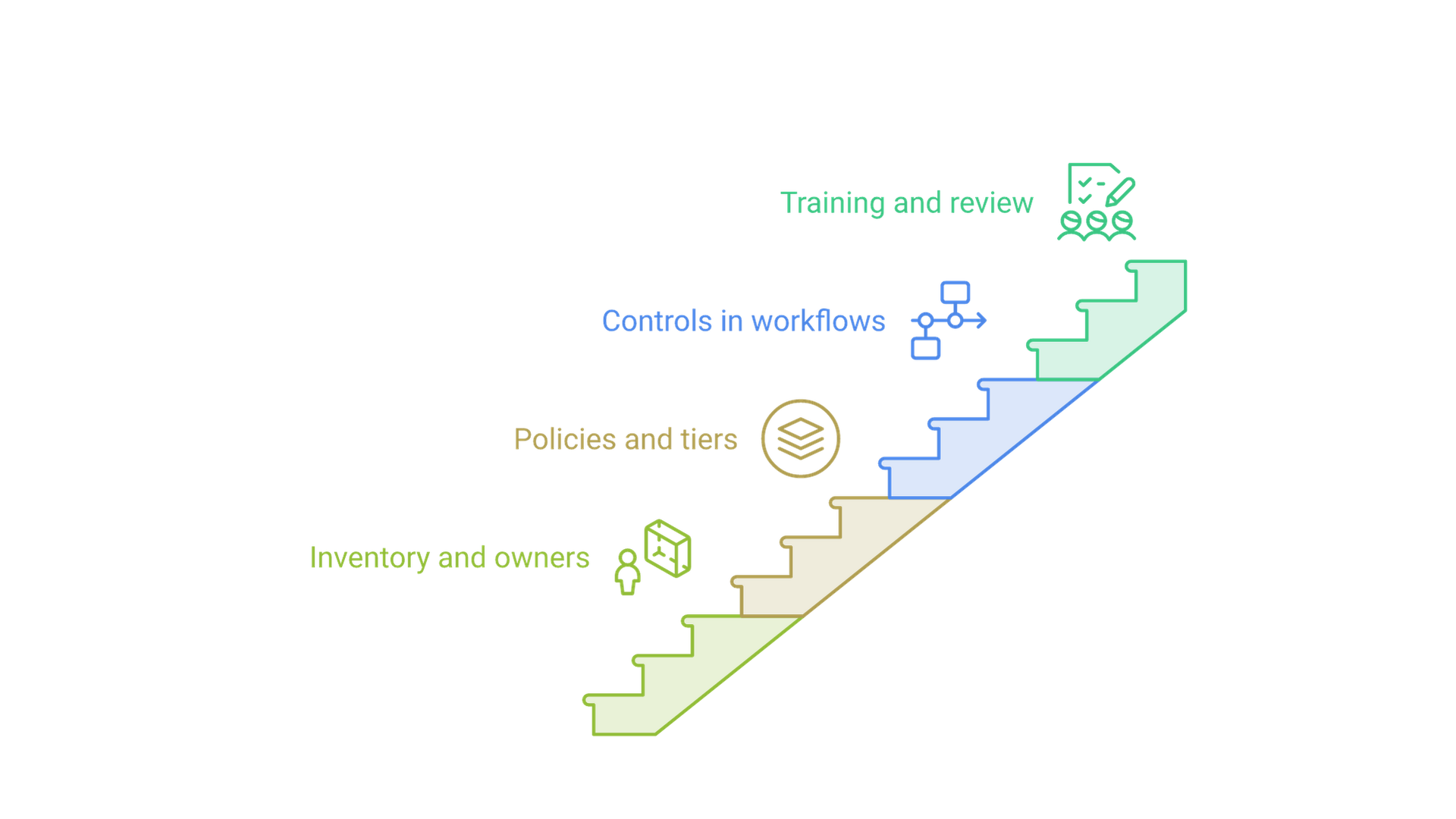
A phased program lets an organization learn and adjust as it goes. Timelines depend on portfolio size, regulatory exposure and existing risk maturity, so treat the phases below as a sequence rather than a fixed schedule; phases often overlap.
Step-by-Step: Complete AI Governance Implementation
When to use this: organizations implementing AI governance for the first time, or significantly upgrading an existing program to meet requirements such as the EU AI Act or an ISO/IEC 42001 certification goal.
- Phase 1: Foundation and planning. Build the AI inventory, including generative AI tools and shadow AI. Establish the governance council with an executive sponsor and assign roles with a RACI matrix. Define scope and risk appetite, and secure budget.
- Phase 2: Policy and tiering. Publish the AI policy, acceptable-use rules and risk-tiering criteria. Write standards per tier and procedures for each lifecycle stage, from intake through retirement. Define evidence requirements.
- Phase 3: Controls in workflows. Embed intake, review and approval checkpoints in existing development, procurement and release processes. Stand up monitoring, logging and incident response. Pilot the process on a few high-priority systems and refine it.
- Phase 4: Training and continuous improvement. Deliver role-specific training for builders, reviewers and everyday users to support AI literacy. Report metrics to leadership, run periodic policy reviews and use internal audits to drive improvement.
If you want outside support to set up the operating model, inventory and decision paths, Cognativ's AI governance and human oversight services cover that work; this guide focuses on how the pieces fit together.
Comparing Implementation Approaches for Trustworthy AI
| Feature | Big Bang Implementation | Phased Implementation |
|---|---|---|
| Rollout | All policies and controls launched at once | Foundations first, then controls by risk tier |
| Disruption | Higher, as every team changes at the same time | Lower, with time to adapt |
| Resources | Intensive upfront investment | Distributed over the program |
| Learning | Limited room to correct course | Pilots inform later phases |
| Typical fit | Smaller organizations with few AI systems | Enterprises with large or complex AI portfolios |
The phased approach suits most enterprises because it allows iterative learning, stakeholder adaptation and course correction based on early results, which tends to make adoption more durable.
How to Scale AI Governance Without Slowing Delivery
A framework that scales has a few distinctive traits. It makes the approved path faster than the workaround, it automates evidence collection, and it adjusts as AI systems gain autonomy.
Make the Approved Path the Easy Path
Shadow AI grows when the sanctioned route is slow. Offer pre-approved tools with enterprise data protections, a short intake form that routes low-risk cases to self-attestation, and published turnaround targets for reviews. Reuse approvals: once a model, vendor or pattern passes review, new use cases built on it should only need to assess what is different.
Automate Controls and Evidence
At scale, manual spreadsheets break. Connect the inventory to procurement and identity systems, enforce checkpoints in CI/CD and release tooling, collect evaluation results and monitoring metrics automatically, and generate audit reports from those records. Policy-as-code techniques, such as blocking deployment of a model without a registered owner and tier, turn standards into guardrails.
Govern AI Agents by Their Actions
Agents change the risk profile because they act: they call tools, move data and trigger transactions. Governance for agentic systems should define which actions an agent may take without approval, which require human confirmation, what credentials and data scopes it receives, how its actions are logged, and how it can be stopped. Teams designing these systems through AI agent development should treat permissions, audit trails and kill switches as design requirements rather than afterthoughts.
Common Challenges in Implementing AI Governance and Solutions
Organizations implementing AI governance face recurring obstacles. The following approaches address the most frequent roadblocks.
Challenge 1: Lack of Executive Buy-In and Resource Allocation
Build a business case that covers both the benefits of governance and the cost of failure. Use the AI Act's penalty ceilings, contractual requirements from customers and the operational cost of incidents as concrete scenarios, and show how governance speeds approvals for valuable use cases.
Challenge 2: Cross-Functional Coordination Difficulties
Establish RACI matrices for each governance activity and lifecycle stage. Run council meetings with standard agendas, documented decisions and tracked actions. Give all functions shared visibility into the inventory, policy status and open reviews, so that legal, security and engineering work from the same record.
Challenge 3: Technical Integration with Existing Systems
Assess the technical landscape before selecting governance tooling, and prioritize options that integrate with existing MLOps platforms, data catalogs, ticketing and identity systems. Reuse data governance investments, such as lineage and classification, instead of building parallel systems that add complexity and maintenance overhead.
Challenge 4: Keeping Pace with Rapidly Evolving AI Regulations
Design the framework so that regulatory change updates standards, not structure. Assign someone to track official sources such as the AI Act Service Desk, NIST and ISO, as well as reference work such as the OECD AI Principles. Run quarterly policy reviews, and map each control to the requirements it satisfies so a regulatory change shows exactly which controls to adjust.
Frequently Asked Questions
What is an AI governance framework?
It is the set of policies, roles, decision rights, risk criteria, controls and evidence an organization uses to make sure its AI systems are safe, lawful and aligned with its values across their lifecycle, from intake to retirement.
What are the main components of enterprise AI governance?
Most programs include policies and standards, roles and decision rights, risk tiering, an AI inventory, pre-deployment evaluation, production monitoring, incident response, vendor management, training and documentation for audits.
Who should own AI governance in an enterprise?
Accountability usually sits with an executive sponsor and a cross-functional council that sets policy. Day-to-day accountability for each system belongs to named business and technical owners, supported by privacy, security, legal and risk reviewers.
When do the EU AI Act high-risk rules apply?
After the AI Omnibus amendments, which entered into force on July 27, 2026, high-risk rules for Annex III use cases apply from December 2, 2027, and rules for high-risk AI in regulated products from August 2, 2028.
Is ISO/IEC 42001 mandatory?
No. ISO/IEC 42001 is a voluntary international standard for AI management systems. Organizations can be certified against it, and many use it to demonstrate structured governance to customers, partners and regulators.
How is AI governance different from data governance?
Data governance controls the quality, lineage and permitted use of data. AI governance builds on it but also covers model behavior, generated outputs, autonomous actions, human oversight and legal duties tied to specific AI use cases.
Conclusion and Next Steps for Responsible AI Governance
Successful AI governance for enterprises balances regulatory compliance with delivery speed. The frameworks that scale share a pattern: a stable policy backed by flexible standards, clear decision rights instead of a committee bottleneck, risk tiers that make oversight proportional, a living inventory, and evaluation, monitoring, incident response and vendor controls that produce evidence as part of normal work. NIST AI RMF, ISO/IEC 42001 and the EU AI Act all point in the same direction, and one well-mapped control set can serve all three.
The most effective programs treat governance as an enabler of trustworthy AI rather than a brake on it. To get started, inventory the AI already in use and the gaps around it, form a cross-functional council with real decision authority, and pilot the full lifecycle on your highest-risk systems before scaling to the rest of the portfolio.
If you are setting up or scaling an AI governance program and want to compare approaches for your portfolio, contact Cognativ to discuss your priorities.