

Artificial Intelligence for Networking: A Practical Guide
How network teams use machine learning to baseline telemetry, explain incidents and automate safe fixes, plus what GPU clusters need from the network fabric.
Artificial intelligence for networking is changing how enterprises run and optimize their network infrastructure. It is not a passing trend: the number of devices, clouds, remote users and applications on a typical network now exceeds what engineers can watch by hand, and the data those networks emit is too large and too fast for static thresholds and manual triage.
As organizations deal with growing network complexity, security threats and user expectations, AI-driven operations offer a practical path to automation, better performance and earlier risk detection. Vendors now build machine learning into monitoring, troubleshooting, wireless tuning and security, with generative AI assistants on top.
Short answer: AI for networking means using machine learning, and increasingly generative AI, to collect network telemetry, learn what normal looks like, detect and explain problems, predict demand and, within guardrails, act on the network. A second, related topic is networking for AI: the high-bandwidth, low-latency fabrics that GPU clusters need. This guide covers both, explains intent-based networking as defined by the research community, and shows how to adopt AI in network operations without handing control to a black box.
Key Takeaways
- Networks generate massive amounts of telemetry, and AI for networking is how teams turn that data into baselines, alerts that matter and root causes.
- AI automates routine network management tasks, such as validation, troubleshooting steps and radio tuning, freeing network engineers for design and strategy work.
- Machine learning and predictive analytics support anomaly detection, traffic prediction, capacity planning and threat detection.
- Intent-based networking describes what the network should achieve and uses closed loops to keep it there; the IRTF's RFC 9315 is the reference definition.
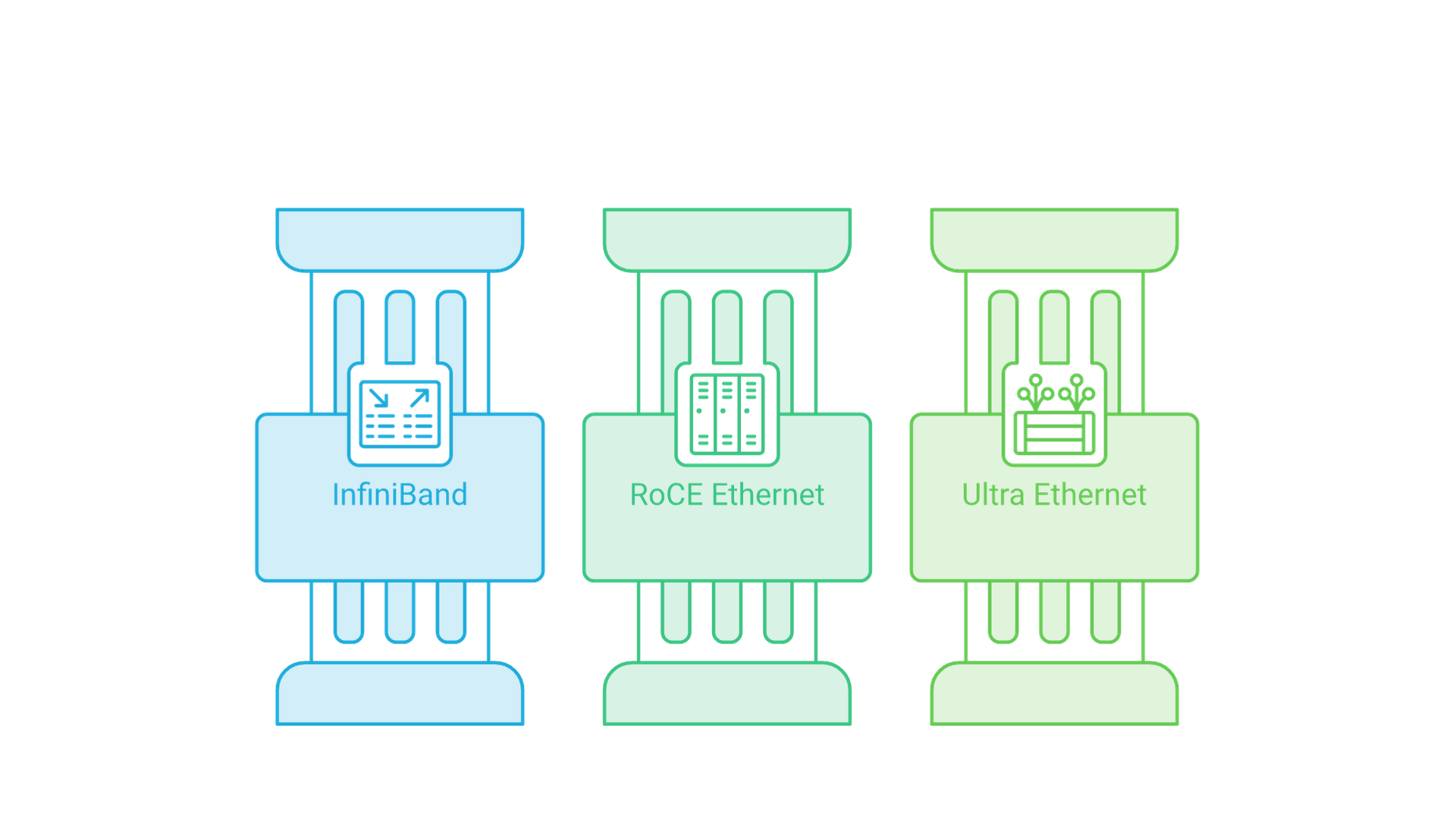
- AI workloads also change the network itself: GPU clusters rely on InfiniBand, RoCE-based Ethernet and the new Ultra Ethernet specification.
- Success depends on telemetry quality, clear goals, human approval for risky changes and security controls for AI assistants and agents.
Artificial Intelligence for Networking
Artificial intelligence for networking is no longer a futuristic concept; it is a practical necessity for modern businesses. Cloud adoption, IoT growth, hybrid work and SaaS dependence have multiplied network traffic and the number of places where something can break. Traditional, manual management approaches struggle to keep pace, especially when the problem is network congestion or an intermittent fault that disappears before anyone looks at it.
Enterprises generate large volumes of network data every day: interface counters, flow records, device logs, routing events, wireless client sessions and application performance metrics. AI and machine learning are good at the part humans find hardest, which is correlating many weak signals across thousands of devices and spotting the pattern that matters. Major vendors, including Cisco, HPE (which now owns Juniper Networks) and NVIDIA, build these techniques into their management platforms and data center fabrics.
AI for Networking and Networking for AI
The phrase covers two different problems, and it helps to keep them apart. AI for networking applies machine learning and generative AI to operate networks: monitoring, assurance, troubleshooting, security and automation. Networking for AI is the infrastructure that AI workloads run on: the back-end fabrics that connect GPUs for training and the front-end networks that deliver inference to users. The first is an operations discipline; the second is an architecture discipline.
How AI for Networking Relates to AIOps
AIOps (artificial intelligence for IT operations) is the broader practice of applying analytics and machine learning to operational data across infrastructure and applications. AI for networking is the network-specific slice of AIOps. It shares goals such as noise reduction and faster root cause analysis, but depends on network-specific data and protocol knowledge such as DHCP, DNS, BGP and 802.1X.
How AI for Networking Works
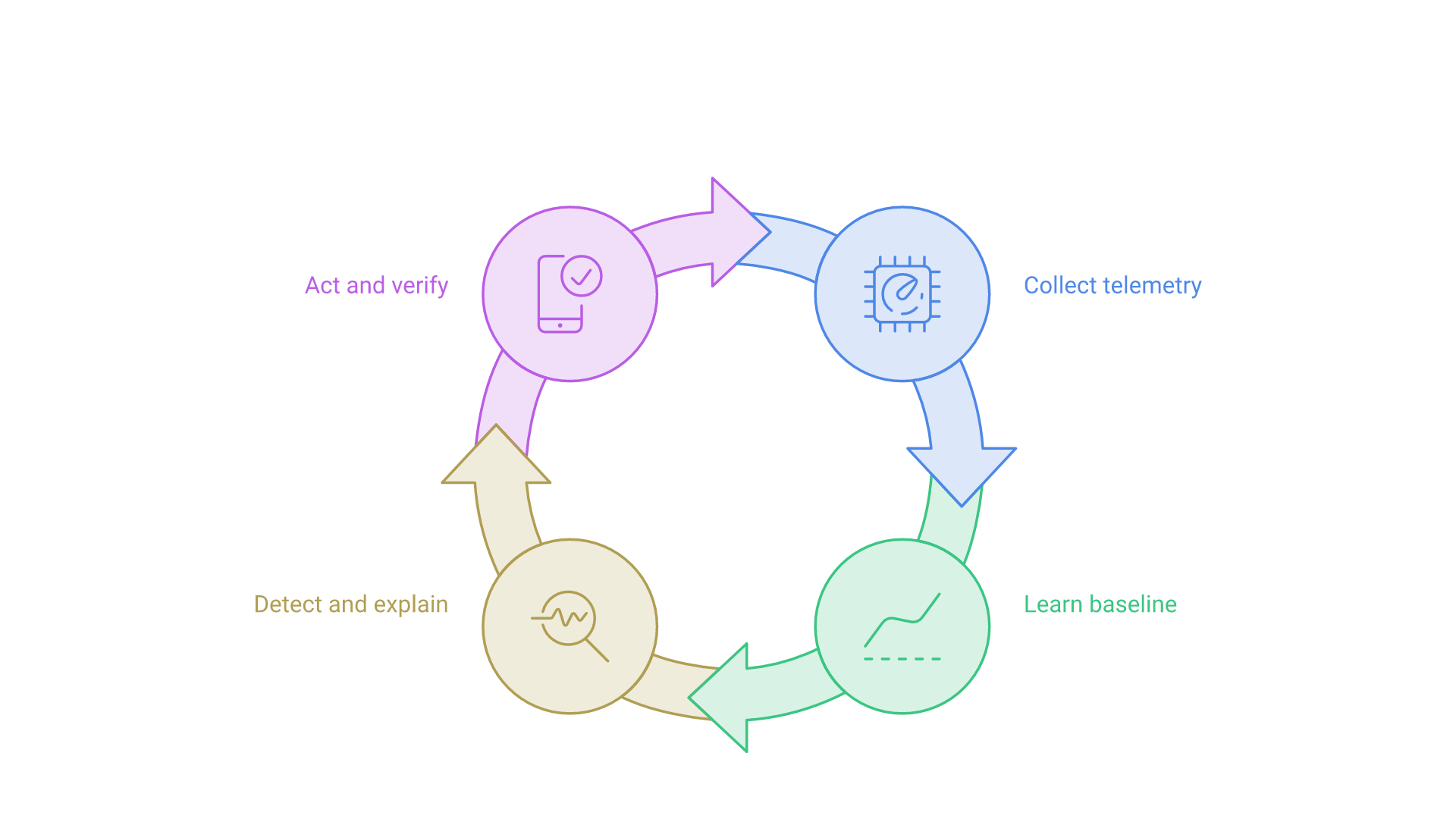
Most AI networking systems follow the same pipeline, whatever the vendor calls it. Telemetry is collected from the network, models learn a baseline of normal behavior, deviations are detected and correlated into incidents, a likely cause is identified, and an action is recommended or taken. After any action, the system checks whether the problem actually went away.
Telemetry Is the Foundation
Models are only as good as their data. The IETF's Network Telemetry Framework (RFC 9232) organizes network data into four modules: the management plane, the control plane, the forwarding plane, and external data and events. It maps existing protocols, including gNMI, NETCONF, BMP, IPFIX and IOAM, onto that framework. Coarse polling hides short-lived events; streaming telemetry and flow records give models enough resolution.
Models That Do the Work
Several families of models appear in network operations. Time-series models learn daily and weekly baselines for traffic, latency and error rates. Unsupervised methods such as clustering and isolation-based outlier detection flag behavior that does not fit any learned pattern. Supervised classifiers recognize device types and known failure signatures, and graph-based reasoning follows topology so one failed link explains many downstream alarms. Large language models add a conversational layer that summarizes incidents and drafts changes.
Closed-Loop Automation
The final step is closing the loop: detect, decide, act and verify. Closed-loop automation can be fully automatic for low-risk, reversible actions, such as adjusting a wireless channel, and human-approved for anything that could cause an outage. Verification matters as much as the action, because it shows whether the diagnosis was right.
Benefits of AI in Networking
Implementing artificial intelligence for networking delivers several advantages that address the challenges of modern network environments. AI systems continuously monitor network data, which allows teams to identify and resolve issues before they reach users rather than after the help desk fills up.
Enhanced Network Performance and Efficiency
AI-enabled networks analyze traffic flows and resource allocation continuously. By learning when and where demand peaks, they help balance load, reduce congestion and tune parameters such as wireless channels and transmit power. This reduces downtime and improves user experience, especially in environments with fluctuating traffic patterns.
Improved Security and Threat Detection
Network security is a critical concern for every enterprise. Machine learning can detect anomalies that signature-based tools miss, such as a device that suddenly talks to unfamiliar destinations, an unusual volume of DNS queries or a login pattern that does not match a user's history. Combined with automated response playbooks, these signals can shorten the time between detection and containment.
Automation of Routine Network Management Tasks
AI automates routine network operations such as configuration validation, connectivity testing and the first steps of troubleshooting. This reduces the burden on network engineers, who can spend more time on architecture and projects. Automation also reduces human error, which remains a common cause of outages after changes.
Data-Driven Decision Making
By integrating AI tools and technologies, enterprises gain deeper insight into network behavior and health. Predictive analytics supports forecasting of network demand and early identification of potential bottlenecks. This data-driven approach improves capacity planning and lets teams justify upgrades with evidence rather than intuition.
Core AI Networking Use Cases
The benefits above come from a handful of concrete use cases. Most mature AI networking programs start with one or two of them and expand once the data and trust are in place.
Anomaly Detection and Event Correlation
Anomaly detection learns a baseline per device, site, application or time of day, then flags meaningful deviations instead of crossing a fixed threshold. Event correlation groups related alarms into a single incident so engineers see one problem, not three hundred alerts. The IETF also recognizes this as an operational priority: the Network Management Operations (NMOP) working group lists anomaly detection and incident management among its current topics of focus.
Vendor platforms implement the same idea in different ways. Cisco's Catalyst Center 3.3.1 data sheet describes AI-driven personalized baselining, predictive analytics and AI-driven anomaly detection that filters harmless anomalies to reduce noise, along with a machine-reasoning engine for multi-step root cause analysis.
Traffic Prediction and Capacity Planning
Traffic prediction uses historical data and seasonal patterns to forecast utilization on links, WAN circuits, wireless cells and data center uplinks. Good forecasts support short-term actions, such as shifting traffic before congestion appears, and long-term capacity planning. Treat forecasts as ranges and check them against actual utilization.
Wireless and User Experience Assurance
Wireless was an early AI success because radio conditions change constantly. Some platforms now run synthetic tests continuously. HPE's Marvis Minis documentation describes a network digital twin that emulates wireless clients on access points, and wired clients on supported switches, to verify services such as DHCP, DNS, ARP and RADIUS, with validations running every hour even when no users are connected.
Root Cause Analysis and Network Assistants
Root cause analysis connects symptoms to causes across layers: a slow application, a congested uplink and a misconfigured quality-of-service policy may be one problem. Generative AI assistants add a natural-language interface on top. Cisco describes its AI Assistant as built into the Meraki dashboard and Catalyst Center to help with troubleshooting, network insights and routine configuration tasks. They are most useful when they cite the telemetry behind each answer.
Network Security and Threat Response
AI-driven endpoint profiling, traffic classification and behavioral analytics help security teams see what is on the network and when it starts behaving differently. Cisco's data sheet, for example, describes endpoint analytics that identifies and classifies campus endpoints with AI and machine learning so policies can be assigned automatically. High-impact responses such as quarantining a device should stay under human review until the model proves accurate in your environment.
Intent-Based Networking and Closed Loops
Intent-based networking is often described in marketing terms, but it has a precise reference definition. The IRTF's RFC 9315, "Intent-Based Networking - Concepts and Definitions", published in October 2022 as an Informational research document rather than an IETF standard, defines intent as a set of operational goals and outcomes, expressed declaratively, that the network should meet without specifying how to achieve them.
RFC 9315 also distinguishes intent from policy. A policy is typically a set of event-condition-action rules that say what to do in given circumstances. Intent sits at a higher level of abstraction and describes the desired outcome; an intent-based system works out the rules needed to reach it, and may generate policies for a policy-based system to deploy.
Intent Fulfillment and Intent Assurance
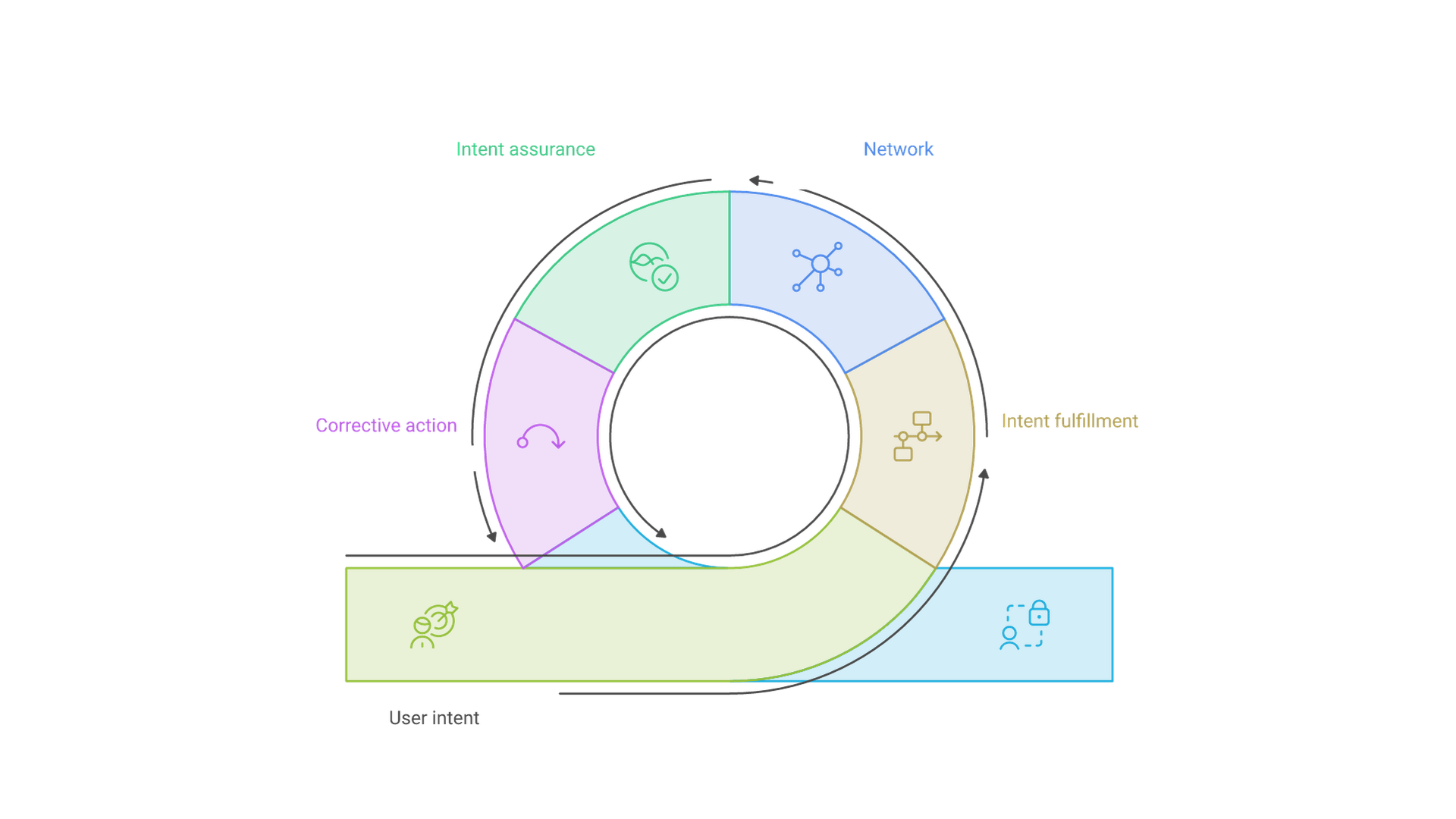
The RFC splits the work into two functional areas. Intent fulfillment covers ingesting intent from the user, translating it into actions and device-level parameters, and orchestrating configuration across the network. Intent assurance checks that the network keeps complying: monitoring, assessing compliance, detecting "intent drift" over time, and taking corrective action or reporting to operators when correction is not possible. It describes two loops: an inner, autonomic loop that corrects the network without human involvement, and an outer loop in which the user refines, modifies or retracts intent based on feedback.
Levels of Network Autonomy
Telecom operators use a similar ladder to describe progress. TM Forum's Autonomous Network Levels model gives operators a common scale for measuring automation maturity, commonly summarized as running from L0, manual operation, to L5, a fully autonomous network. Most enterprises are well short of full autonomy, and that is appropriate: the goal is to automate the decisions you understand and can reverse, not to remove engineers from the loop.
AI Networking Strategy
Developing a comprehensive AI networking strategy is essential for successful adoption. The strategy must align with organizational goals and account for a fast-changing technology landscape.
When formulating an AI strategy, address the network requirements behind it: what data must be collected and at what resolution, how much it will scale, where it will be stored and whether the infrastructure can support the AI and machine learning workloads involved.
Aligning Strategy with Business Goals
An effective AI networking strategy begins with clear objectives tied to business outcomes, such as fewer user-impacting incidents, faster mean time to resolution, lower operating cost or better compliance evidence. Define key performance indicators before the pilot starts, measure the current baseline, and compare like with like after deployment.
Data Management Techniques
High-quality data collection and management are foundational. Enterprises need reliable systems for gathering, storing and analyzing network data, including traffic patterns, configuration history and user behavior. Accurate inventory and labeled incident history make models more accurate and easier to trust.
Selecting the Right AI Tools and Technologies
Different AI tools suit different network environments and industries. A campus-heavy enterprise may get the most value from wireless assurance, while a cloud-first company may prioritize WAN and SaaS visibility. Evaluate AI solutions on data coverage, integration with existing tools, explainability, security controls, data residency and the vendor's approach to automated actions.
Continuous Monitoring and Optimization
AI networking is not a one-time implementation but an ongoing process. Continuous monitoring of network health and user experience lets AI systems adapt to changing conditions, and closed-loop automation supports real-time adjustments. Models also drift as the network and the business change, so plan for regular reviews of their accuracy.
AI Solution for Networking
A robust AI networking solution integrates multiple components to deliver comprehensive network management:
- Machine learning algorithms that analyze historical and real-time data to detect anomalies and predict network issues.
- Automation tools that streamline configuration, testing and remediation.
- Security features such as threat detection, anomaly detection and automated response.
- Integration capabilities that connect with existing network infrastructure, ticketing systems and cloud platforms.
- Scalability to support growing network demands and evolving AI workloads.
Vendor Platforms in 2026
The vendor landscape has consolidated. Cisco's campus management platform is now Cisco Catalyst Center, formerly Cisco DNA Center. HPE closed its acquisition of Juniper Networks in July 2025, which put Juniper's Mist AI and Marvis alongside HPE Aruba Networking Central in one portfolio.
Product names change quickly, so check current documentation for your release. Teams designing the infrastructure underneath these platforms, from data pipelines to compute and network boundaries, can review Cognativ's AI infrastructure consulting for an assessment-led approach.
Generative AI Assistants and Agents
The newest layer is agentic: assistants that do not only answer questions but call tools, query telemetry and propose or execute changes. Open protocols are emerging to connect these agents to operational systems. The Model Context Protocol specification describes a standard way for AI applications to reach external data and tools, and it states that hosts must obtain explicit user consent before invoking any tool. That principle fits network operations well; our explainer on how the Model Context Protocol works covers the architecture in more depth.
AI Tools and Technologies
The AI tools powering networking advances combine machine learning algorithms, generative AI and closed-loop automation. Together, these technologies enable:
- Real-time network data analysis and visualization.
- Predictive maintenance to prevent outages.
- Intelligent routing and path selection to optimize traffic flows.
- Synthetic testing and digital twins that validate services before users notice problems.
- Enhanced security through continuous threat detection.
- Natural-language querying and incident summaries for engineers.
Enterprises must evaluate these tools carefully, balancing innovation with operational requirements and compliance mandates. A useful test is to replay a recent, well-understood incident and check whether the tool would have caught and explained it.
AI Workloads for Networking
AI workloads place unique demands on network infrastructure. Distributed training splits a model across many GPUs that exchange gradients and activations constantly, so the slowest link or a single congested path can leave expensive accelerators idle. Inference adds strict latency targets. Both push networks toward high bandwidth, low latency, lossless transport and predictable tail latency. Inference that runs close to users adds many small sites to connect and secure; our guide to edge computing for AI workloads covers when that trade-off pays off.
InfiniBand and In-Network Computing
InfiniBand has long been the default fabric for large training clusters. NVIDIA's current InfiniBand family includes the Quantum-X800 platform for 800 Gb/s networking. A distinctive feature is in-network computing: NVIDIA's SHARP technology moves collective operations such as all-reduce from servers into the switches, and the NCCL communication library used by distributed training frameworks can offload collectives to the network through it.
RoCE and AI-Optimized Ethernet
RDMA over Converged Ethernet (RoCE) brings remote direct memory access to Ethernet, which many operators prefer for its familiarity and multi-vendor ecosystem. Standard Ethernet needs help to behave well under AI traffic, so vendors add adaptive routing and telemetry-based congestion control. NVIDIA describes its Spectrum-X Ethernet platform as Spectrum-X switches paired with SuperNICs that provide RoCE connectivity between GPU servers, with adaptive routing and congestion control for multi-tenant isolation. If you are sizing the serving side of these clusters, our guide to AI inference infrastructure considerations covers engines, batching and cost.
Ultra Ethernet
The industry is also standardizing a new Ethernet-based stack for AI and HPC. The Ultra Ethernet Consortium published its Ultra Ethernet Specification 1.0 on June 11, 2025, followed by point releases and version 1.1 on October 12, 2026. The specification includes a new transport protocol aimed at the congestion and scale problems that AI clusters create. Check which version a vendor's NICs and switches actually implement.
Network Intelligence
Network intelligence is at the heart of effective AI networking. By analyzing network data continuously, including historical data and real-time traffic patterns, AI systems give network engineers deep visibility into how the network performs and where improvements can be made. This continuous analysis supports proactive network management, so teams can address potential issues before they escalate into major disruptions.
Using machine learning algorithms and AI models, network intelligence tools can detect subtle shifts in user behavior, anticipate congestion and optimize resource allocation across the network. This reduces exposure to security threats and keeps performance consistently high as demand fluctuates. The goal is an adaptive network that repairs common faults quickly, with people supervising risky decisions.
Implementing AI for Networking
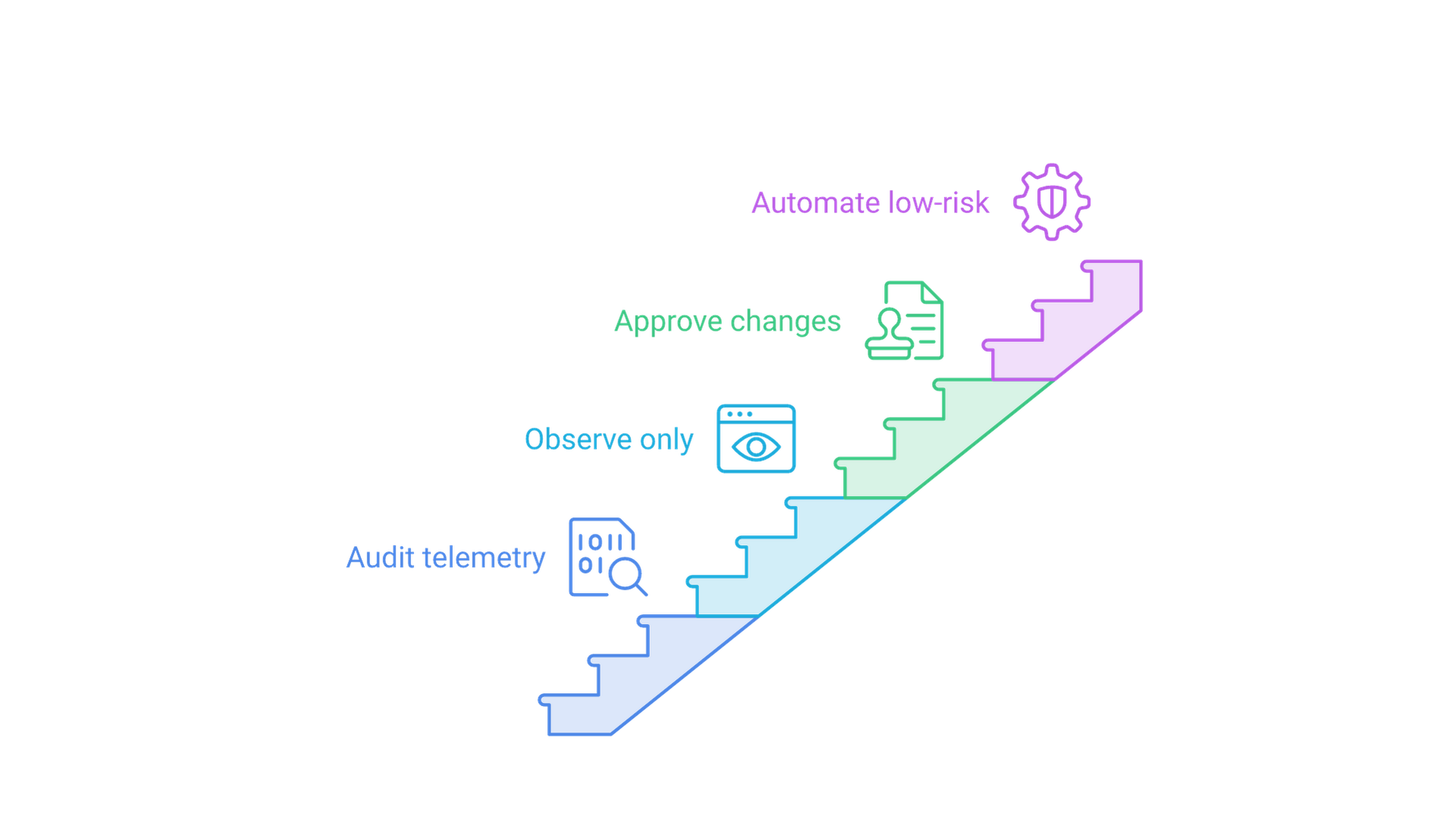
Successful implementation depends on careful planning and staged execution. A practical sequence looks like this:
- Develop a clear AI networking strategy aligned with business goals and measurable KPIs.
- Audit telemetry coverage and fix gaps in data collection, inventory and naming.
- Start in observe-only mode: let models baseline, alert and recommend without acting.
- Select AI tools tailored to your network domains and integration needs.
- Enable automated actions for low-risk, reversible changes, with approval gates for everything else.
- Train staff to interpret, challenge and tune AI findings.
- Establish continuous monitoring of model accuracy and business outcomes.
The staged approach builds trust: engineers who have seen a model diagnose problems correctly are more willing to let it act, and poor recommendations surface before any change reaches production.
Challenges in AI Networking
The advantages of AI networking are significant, but organizations often meet several challenges when integrating AI into existing network infrastructure. One of the main obstacles is merging AI technologies with legacy systems and established network operations. Older devices may lack streaming telemetry, and inventories are often incomplete.
AI workloads also place substantial demands on infrastructure. Teams that host their own models need suitable compute, storage and network capacity, along with specialized expertise in data engineering and machine learning operations.
Security is a further concern. As networks become more interconnected and reliant on AI, the attack surface grows. AI assistants and agents introduce new risks of their own: the OWASP Top 10 for LLM Applications 2025 lists prompt injection and excessive agency among the main risks for LLM-based systems, and both apply directly to an assistant that reads device logs and can push configuration. Treat log and ticket content as untrusted input, give agents least-privilege credentials, and require approval for changes.
Governance rounds out the list. The NIST AI Risk Management Framework, a voluntary framework released in January 2023 and organized around the functions Govern, Map, Measure and Manage, offers a vendor-neutral structure for documenting who owns each model, what it may do and how its performance is checked.
Best Practices for AI Networking
To get lasting value from AI networking, organizations should adopt practices that prioritize network security, data management and user experience. The foundation is a comprehensive AI strategy that aligns network requirements with business objectives, supported by AI tools that integrate cleanly with existing network infrastructure.
Effective data collection and analysis come next. With predictive analytics, teams can identify trends, anticipate bottlenecks and optimize performance before issues arise. Security should be embedded in every layer of the solution, using anomaly detection and closed-loop automation to identify and respond to threats quickly, while keeping humans in control of disruptive actions.
Continuous monitoring is another key practice. Track network behavior in real time, and track the AI too: false positives, time to resolution and how often engineers override it. Review and retrain models as the network changes so they stay accurate and resilient.
Finally, keep every automated action explainable and reversible: log what the system saw, decided and changed, and make rollback a standard step.
Future of AI in Networking
The future promises deeper integration of AI with networking, driven by fast-moving technology and expanding AI applications:
- More autonomous, self-healing networks for well-understood faults.
- Agentic assistants that investigate incidents across tools, under explicit approval controls.
- Integration with IoT and edge devices that extends AI's reach to more sites.
- Generative AI that improves network analytics, documentation and troubleshooting.
- AI-optimized fabrics and standards such as Ultra Ethernet for larger AI clusters.
- Stronger security capabilities to address emerging cyber threats, including attacks on AI systems themselves.
Enterprises that invest now in telemetry, process and skills, not only products, will be best placed to adopt these capabilities as they mature.
Frequently Asked Questions
What is AI for networking?
AI for networking is the use of machine learning and generative AI to monitor, troubleshoot, secure and automate networks. It learns normal behavior from telemetry, detects and explains problems, predicts demand and recommends or performs fixes.
How is AI used in network operations?
Common uses include anomaly detection, alarm correlation, root cause analysis, wireless radio tuning, traffic prediction, capacity planning, endpoint classification, synthetic service testing and natural-language assistants for engineers.
What is intent-based networking?
Intent-based networking manages a network by stating the outcomes it should achieve rather than device-level commands. The system translates intent into configuration and continuously checks and corrects the network so it keeps meeting that intent.
Will AI replace network engineers?
No. AI takes over repetitive monitoring and triage, but engineers still design networks, set intent, approve risky changes and handle novel failures. The role shifts toward architecture, automation and supervising AI systems.
What network does an AI cluster need?
AI training clusters need high-bandwidth, low-latency, lossless fabrics. Common choices are InfiniBand and RDMA over Converged Ethernet with adaptive routing and congestion control, and the Ultra Ethernet specification is emerging as an open Ethernet-based option.
How do I start using AI in my network?
Start by auditing telemetry and defining KPIs, then run AI tools in observe-only mode on one domain. Add automated actions only for low-risk, reversible changes once the recommendations have proven accurate.
Conclusion
Artificial intelligence for networking is reshaping enterprise IT infrastructure. By automating routine tasks, improving security and optimizing performance, AI networking solutions help organizations meet the demands of a complex digital environment. The approach that works is grounded in good telemetry, clear business goals and closed loops that keep humans in charge of risky decisions.
At the same time, AI workloads are changing what networks must deliver, from lossless GPU fabrics to inference at the edge. Enterprises that treat AI for networking and networking for AI as connected disciplines, and adopt both in measured stages, will build networks that are more resilient and easier to run. For help with the cloud and network foundations behind that work, see Cognativ's cloud infrastructure consulting.
If you are planning AI-driven network operations or the infrastructure for an AI cluster, talk to Cognativ about your project.