

Ecommerce Product Data Entry Services: What They Include, How They Compare and Where AI Fits
A practical guide to product data entry for online stores: in-house, outsourced and AI-assisted options, quality controls and the channel rules that matter.
Ecommerce product data entry is the work of turning supplier spreadsheets, manufacturer PDFs, photos and internal records into complete, accurate product listings on a storefront and every channel it feeds. It sounds clerical, but the quality of that work decides whether shoppers can find a product, whether a marketplace accepts the listing and whether the order that follows ships the right variant.
Most online retailers handle this in one of three ways: an in-house team, an outsourced ecommerce data entry service, or an AI-assisted workflow where software drafts and validates records and people approve them. This guide explains what ecommerce product data entry services typically include, how the approaches compare on speed and accuracy, which quality controls matter, what drives cost and where automation changes the economics. It does not recommend a specific vendor, and it does not quote prices, because pricing depends on scope in ways a published rate card rarely captures.
What Is Ecommerce Product Data Entry?
Ecommerce product data entry covers the input, enrichment and ongoing maintenance of the information that describes each item you sell. That includes identifiers such as SKUs and GTINs, titles, descriptions, attributes like size, color and material, prices, inventory status, categories, images and the relationships between a parent product and its variants.
The work never finishes at launch. Prices change, suppliers revise specifications, seasonal products come and go, and every new sales channel asks for the same information in a slightly different shape. A catalog that was accurate in January can drift into contradictions by spring if updates arrive through email attachments and manual copy and paste.
How it differs from general data entry
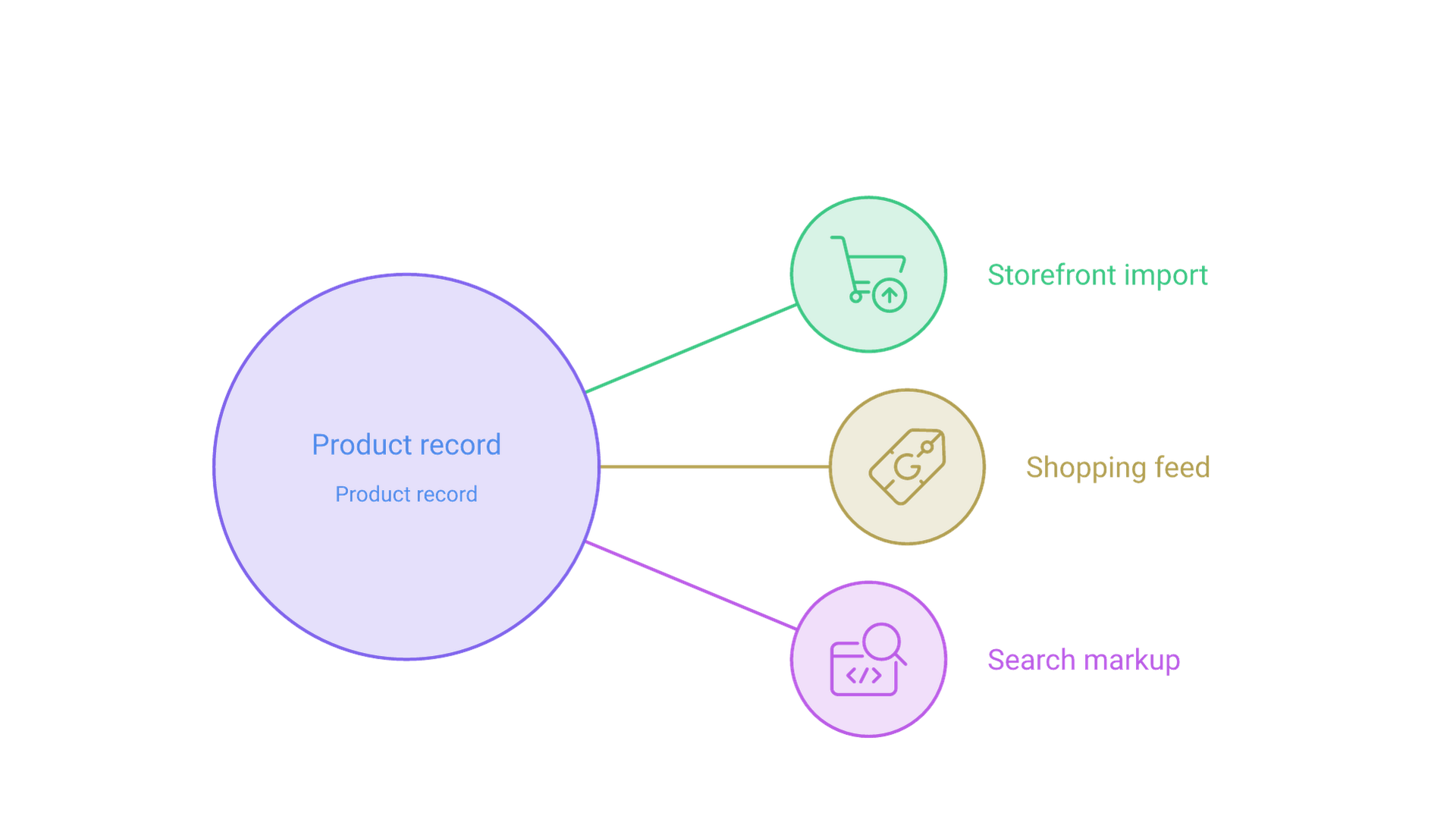
General data entry moves information from one place to another. Product data entry also has to satisfy the rules of the destination. A storefront import template, a marketplace category schema and a shopping feed each define which fields are required, how long they can be, which values are allowed and how variants are grouped. Getting a record into the system is only half of the job; getting it accepted and findable is the other half.
What Ecommerce Data Entry Services Typically Include
Providers of ecommerce product data entry services tend to describe their offerings as a menu of components rather than fixed bundles, and many state that packages are customized by volume and scope. The components below appear consistently across service descriptions, and they are a useful checklist whether you outsource, hire or automate.
| Component | What it covers | Typical inputs |
|---|---|---|
| Product listing and upload | Creating new products individually or in bulk through import files or platform APIs | Supplier spreadsheets, price lists |
| Data extraction | Pulling specifications from manufacturer sites, catalogs, PDFs and scanned documents, often with OCR | PDF catalogs, spec sheets, images |
| Attribute enrichment | Filling and standardizing size, color, material, dimensions and compliance fields | Spec sheets, category schemas |
| Copywriting and SEO | Writing titles, bullet points and descriptions that match search intent and channel limits | Brand guidelines, keyword research |
| Categorization and variants | Mapping products to taxonomies and grouping parent and child variants correctly | Store and marketplace taxonomies |
| Image processing | Renaming, resizing, background cleanup and linking images to the right variant | Photography, supplier images |
| Catalog maintenance | Ongoing price, stock and specification updates, plus cleansing of duplicates and errors | ERP, inventory and supplier updates |
Typical offerings in data entry service packages
When you compare packages, the label matters less than the scope behind it. Ask whether a quote covers supplier data extraction or only keying from a clean sheet, whether copywriting is original or lightly edited supplier text, whether images are edited or simply attached, how many channels are included and how many quality-control passes each record receives. Two offers that both say "product upload" can differ widely on those points.
The Product Data Workflow, From Supplier File to Storefront
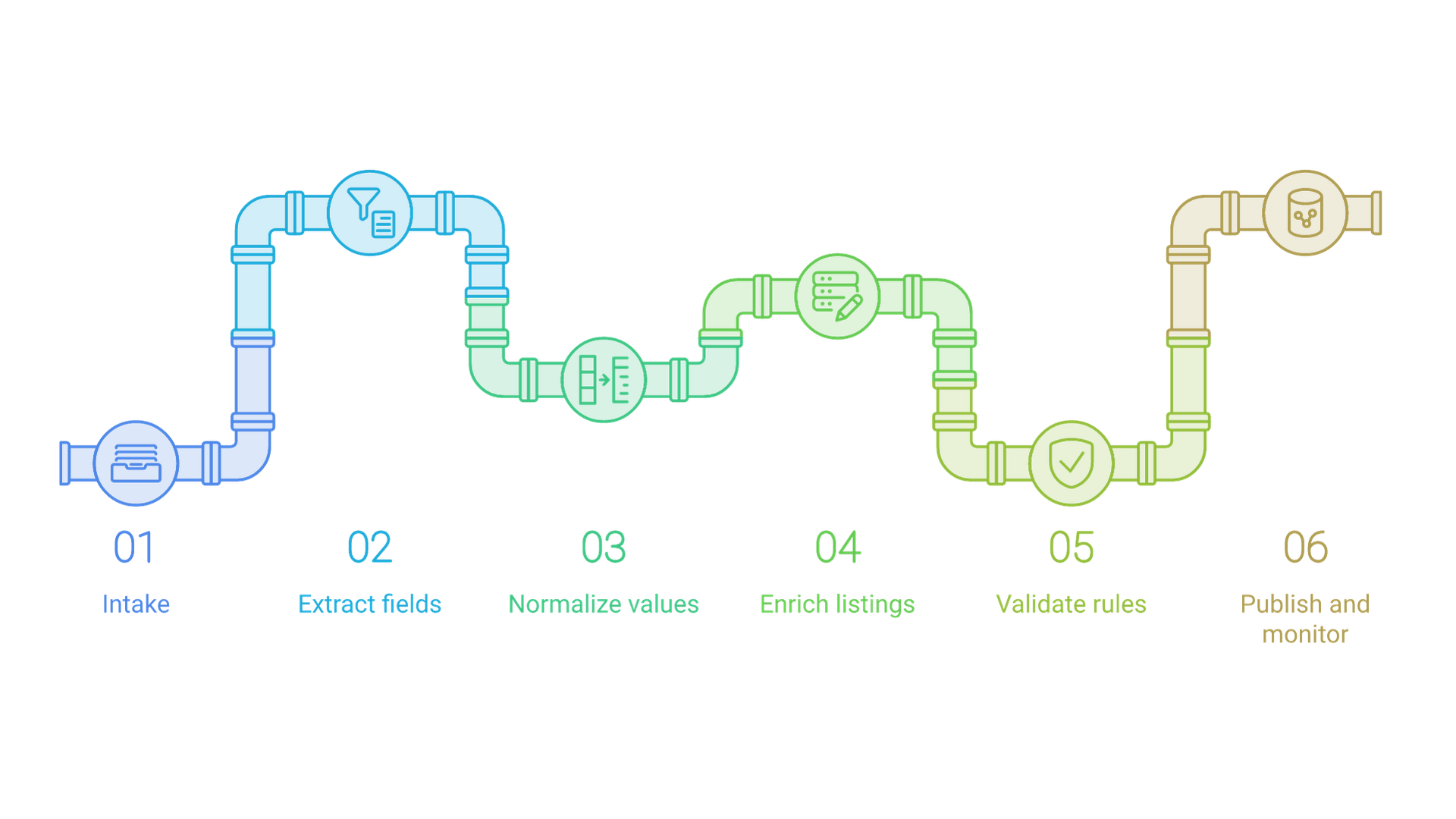
Whoever does the work, the underlying workflow is similar. It starts with intake, where supplier files, catalogs and images are collected and logged against the products they describe. Extraction follows, turning unstructured sources into fields. Normalization then converts units, spellings and value lists into the format your catalog expects, which is the same discipline described in our guide to data transformation.
Enrichment adds what the supplier did not provide: search-friendly titles, descriptions, missing attributes and category mapping. Validation checks every record against the rules of each destination before anything is published. Publishing pushes approved records to the storefront and feeds, and monitoring catches rejections, disapprovals and drift so they can be corrected at the source.
Treating these steps as a repeatable pipeline rather than a series of one-off tasks is what separates a catalog that scales from one that needs a cleanup project every quarter. The same staged thinking applies to any business data flow, as explained in what a data pipeline is and how it works.
Platform and Channel Requirements That Shape the Work
Much of the effort in ecommerce product data entry comes from meeting each channel's specification, and those specifications change. A few current examples show why accuracy has to be checked against the destination rather than assumed.
Google Merchant Center
Google's product data specification requires an ID, a title, a description, a landing page link, an image link, a price and availability for each product, with brand, GTIN or MPN and variant grouping required in many cases. It caps IDs at 50 characters, titles at 150 and descriptions at 5,000. It also asks merchants to use the structured title and structured description attributes for text created with generative AI, and it has announced a minimum image size of 500 by 500 pixels, with enforcement scheduled to begin on January 31, 2027.
Shopify and other storefront imports
Shopify's CSV import documentation limits a product file to 15 MB, treats headers as case sensitive and warns that changing option values in an import deletes existing variant IDs and creates new ones, which can break systems that rely on them. It also notes that a blank non-required column overwrites the existing value. Bulk imports are fast, but a single badly prepared file can remove data at scale.
Search results and product identifiers
For organic results, Google's merchant listing structured data guidance requires a product name, image and an offer with price and currency, and says Google may attempt to verify product data before showing it. GS1, which issues GTINs, maintains a GTIN Management Standard that sets out when a product change, such as a new brand or formula, requires a new identifier. Identifiers that point to the wrong item undermine every channel at once.
In-House, Outsourced or AI-Assisted: How the Approaches Compare on Speed and Accuracy
A common search question is how ecommerce data entry services compare on speed and accuracy. There is no neutral benchmark that ranks providers, and published accuracy claims are usually self-reported. What you can compare is how each model produces speed and how it protects accuracy.
| Factor | In-house team | Outsourced service | AI-assisted workflow |
|---|---|---|---|
| Speed driver | Team size and competing priorities | Provider staffing and agreed turnaround | Automated drafting and validation, limited by review capacity |
| Accuracy driver | Product knowledge and internal checks | Provider QC passes and the quality of your brief | Validation rules, source grounding and human approval |
| Best fit | Smaller catalogs, technical products | Large one-time loads, seasonal peaks | Recurring high-volume updates and multi-channel feeds |
| Main risk | Bottlenecks and inconsistent conventions | Context loss and slow feedback loops | Unreviewed generated claims and weak rules |
In-house teams know the products best but rarely scale cleanly through launches and peaks. Outsourcing ecommerce data entry services adds capacity quickly, and it works best when you supply a precise style guide, attribute dictionary and acceptance criteria. AI-assisted workflows change the shape of the work: software extracts, drafts and checks, while people review exceptions and approve. Many retailers combine all three.
Quality Controls That Determine Product Data Accuracy
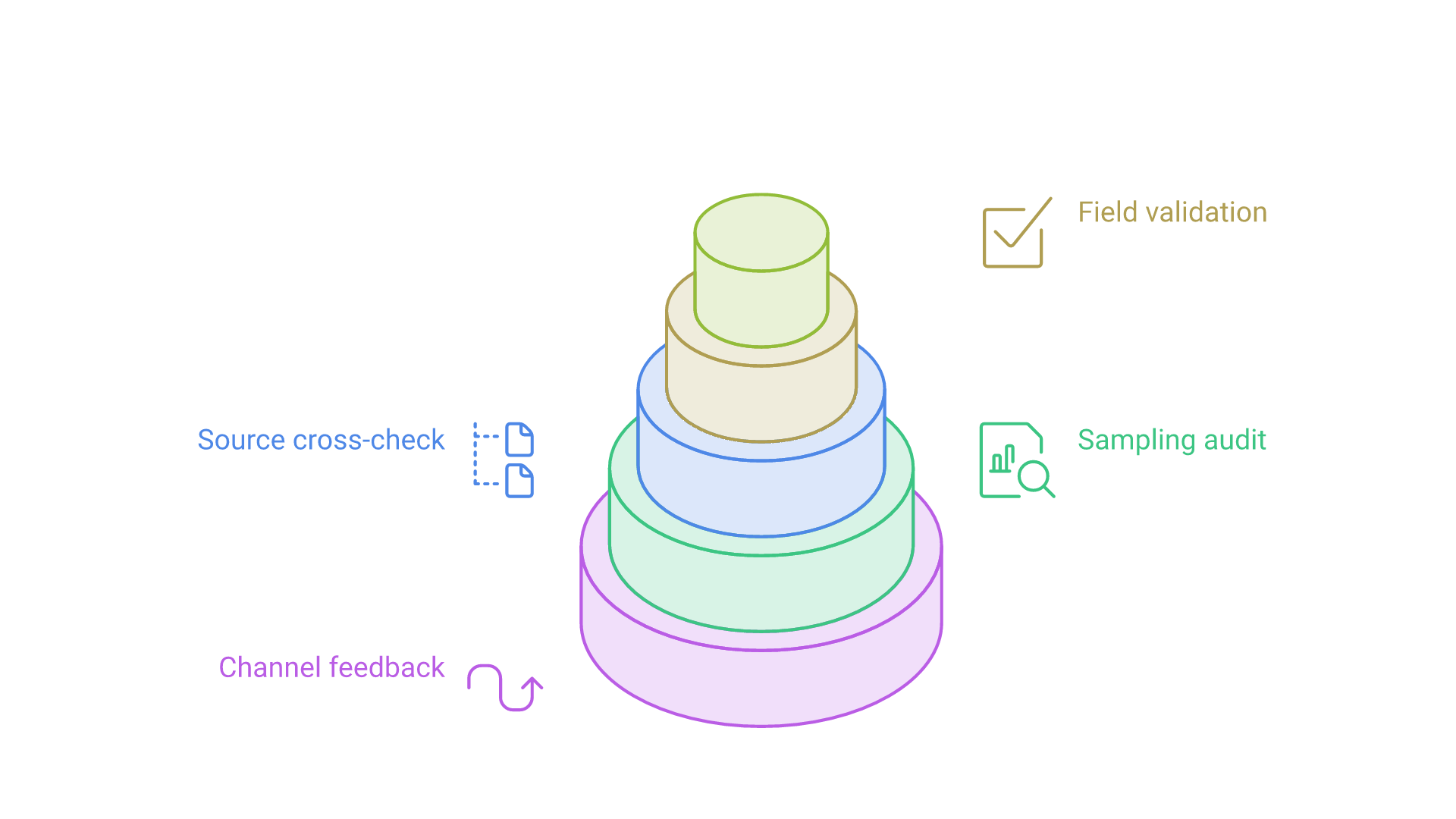
Accuracy is the result of controls, not effort. The most reliable catalogs layer several checks so that an error missed by one is caught by the next.
Field validation confirms required fields, formats, lengths and allowed values for each destination before publishing. Cross-checks compare entered data with the source document, a second entry or a reference system, which is the principle behind double-key verification. Sampling and audits review a share of finished records against an agreed error definition, so that accuracy is measured rather than asserted. Channel feedback feeds marketplace rejections and feed disapprovals back to the person or rule that created the error.
Whatever approach you choose, define accuracy in writing before work starts: which fields count, what counts as an error and how results will be reported. Without that definition, two providers can quote the same accuracy figure and mean very different things.
What Drives the Cost of Ecommerce Product Data Entry
Pricing models vary, including per product, per hour and per project, and quoted rates are only comparable when the scope behind them matches. The main cost drivers are consistent:
- Catalog size and the number of variants per product
- The condition of source data, from clean spreadsheets to scanned PDFs
- Attribute depth and category-specific compliance fields
- Original copywriting versus light editing of supplier text
- Image editing requirements
- The number of channels, languages and storefronts to maintain
- Required turnaround and update frequency
- The number of quality-control passes and the reporting expected
The largest hidden cost is usually rework: records that are rejected by a channel, corrected by hand and then overwritten by the next supplier update. That is why the conversation often shifts from who types the data to how the workflow is designed.
Automating Product Data Workflows With AI
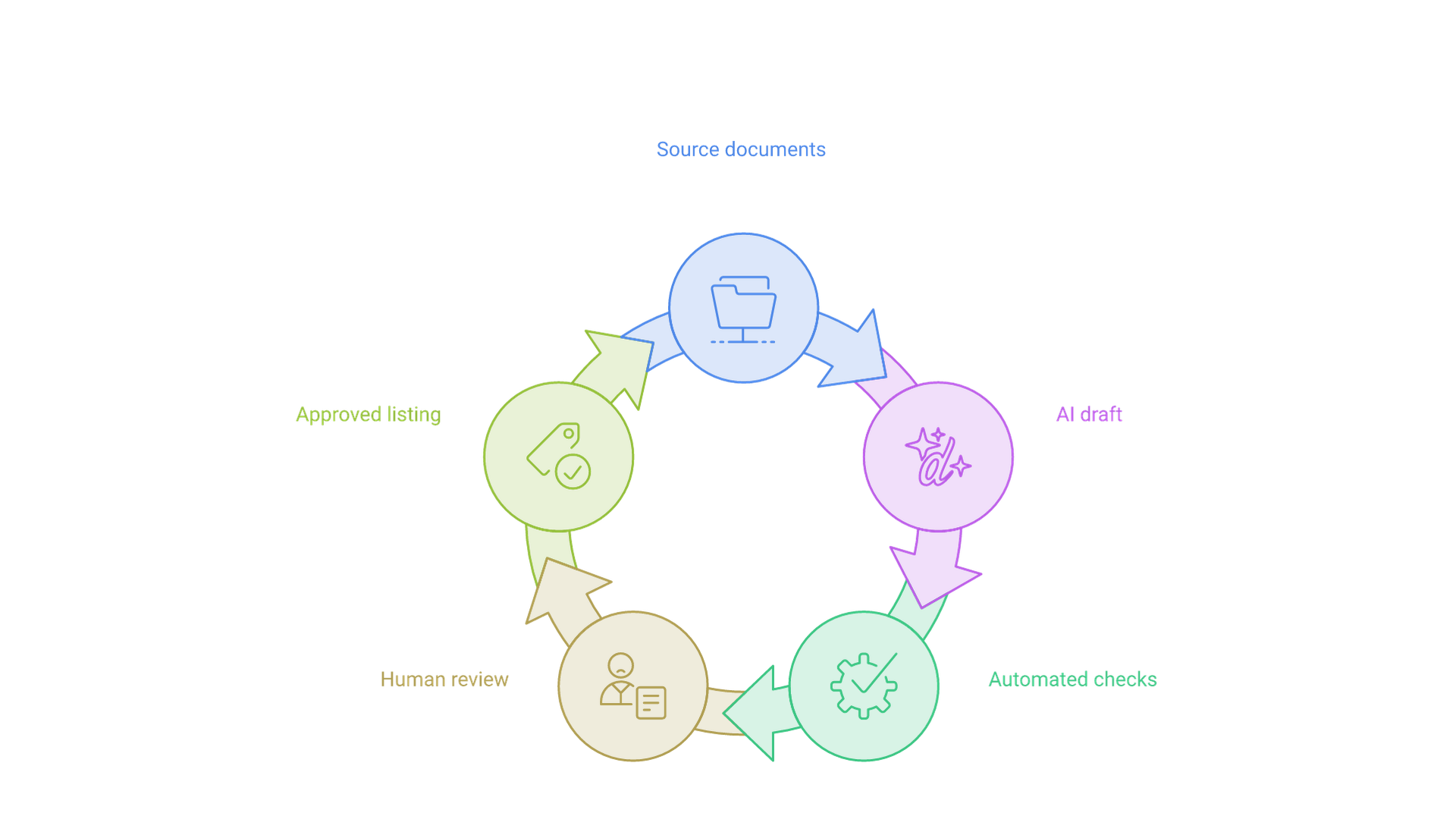
Retailers increasingly use AI to handle the repetitive parts of product data work. Language models can extract attributes from spec sheets, map products to categories, draft titles and descriptions within channel limits and flag records that conflict with their sources. Marketplaces have moved the same way: Amazon introduced a generative AI listing tool for sellers in 2023 that drafts titles, bullet points and descriptions for the seller to review and edit before submission.
That review step is the point. Generated product copy can state features a product does not have, and an incorrect specification can cause returns or compliance problems. A sound design grounds generation in your own source documents, applies the same validation rules described above, routes uncertain records to people and logs every change. Because supplier contracts and unreleased products are often sensitive, it also matters where models run and what they can see, a topic covered in our guide to using LLMs with private data.
Cognativ does not provide data entry services. We help teams design and build the automation around product data: intake, extraction, validation, approval and publishing integrated with the systems they already use. Our AI process automation work focuses on workflows like these, and our AI automation consulting helps teams decide which steps to automate first and where people should stay in the loop.
How to Choose a Provider or Approach
Start with the catalog, not the vendor. Measure how many products and variants you maintain, how often they change, how many channels you feed and where errors currently come from. Then evaluate options against the same criteria:
- Documented quality-control steps and a written error definition
- Experience with your platforms and the channels you sell on
- Clear turnaround commitments for new products and updates
- Access controls and data handling that fit your contracts
- A pilot on a representative sample before full rollout
- Reporting that shows rejections, corrections and trends
If the same corrections keep recurring, treat that as a workflow problem. More hands will process the backlog faster, but rules, integrations and automation stop it from coming back.
Frequently Asked Questions
What is included in ecommerce product data entry services?
Typically product uploads, data extraction from supplier sources, attribute enrichment, titles and descriptions, categorization and variant setup, image processing and ongoing catalog maintenance. Scope varies by provider, so confirm each component in writing.
How do ecommerce data entry services compare on speed and accuracy?
Speed depends on staffing, turnaround agreements and how much is automated. Accuracy depends on validation rules, verification passes and the clarity of your brief. Ask for a pilot measured against your own error definition rather than relying on published claims.
Should I outsource ecommerce data entry?
Outsourcing suits large one-time loads and seasonal peaks. Recurring high-volume updates often benefit more from automating the workflow, with people reviewing exceptions. Many retailers combine both.
How much does ecommerce data entry cost?
It depends on catalog size, variants, source data quality, copywriting depth, image work, channels and turnaround. Compare quotes only when the scope behind them is the same.
Can AI do product data entry?
AI can extract attributes, categorize products and draft listing copy, but it needs grounding in source documents, validation rules and human approval to avoid inaccurate product claims.
What are the most common product data entry mistakes?
Duplicate records, wrong variant grouping, mismatched identifiers, missing required attributes, outdated prices or stock and descriptions that contradict the specification.
Conclusion: Building a Product Data Workflow That Scales
Ecommerce product data entry is the foundation of discoverability, channel acceptance and accurate fulfillment. Data entry services, in-house teams and AI-assisted workflows can all produce good catalogs, but only when scope, quality controls and channel rules are defined clearly and errors are fixed at the source.
For growing catalogs, the lasting gains usually come from designing the workflow itself: structured intake, automated extraction and validation, human review where judgment matters and clean integration with your storefront and feeds.
If you want to automate the product data workflows behind your catalog rather than add more manual capacity, talk to Cognativ about your automation project.