

The Best Applications of AI for Supply Chain Efficiency and Resilience
Where AI pays off in supply chains today, from short-term demand sensing to supplier alerts and planning agents, and how to start with low-risk decisions first.
The global supply chain has become one of the most complex and dynamic networks in modern business. Rising demand volatility, geopolitical uncertainty, tariff changes and capacity constraints have pushed companies to adopt artificial intelligence to build resilience, efficiency and real-time adaptability. Disruption is no longer an exception: in McKinsey's annual supply chain risk survey, nine in ten respondents said they had encountered supply chain challenges in 2024.
AI in supply chain management processes structured and unstructured data in real time to improve decisions, risk management and efficiency end to end. Machine learning, natural language processing and, increasingly, AI agents help organizations sense demand shifts, predict disruptions and respond faster than traditional planning.
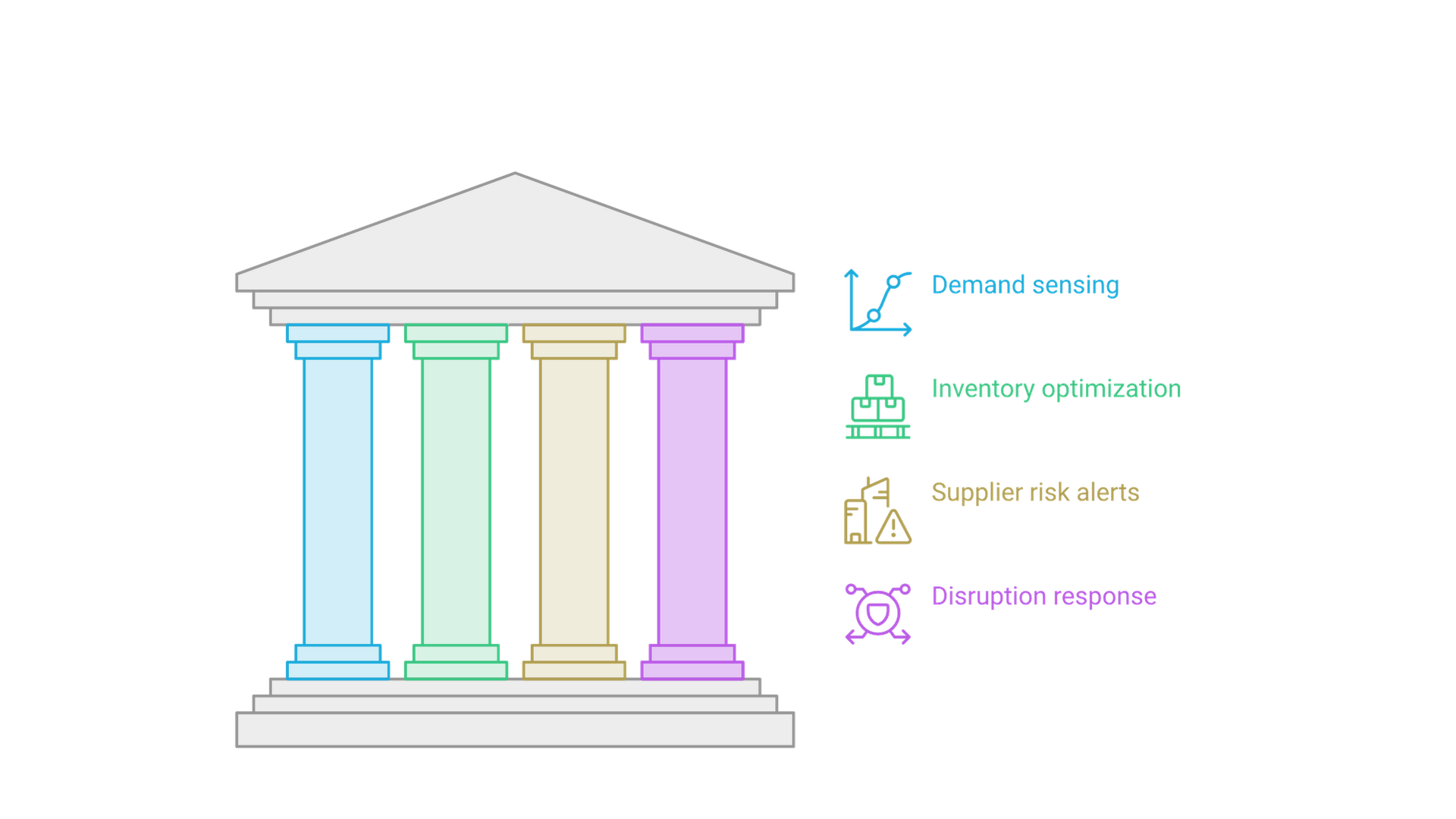
Short answer: the AI applications with the clearest payoff in 2026 are demand forecasting and demand sensing, inventory optimization, supplier risk monitoring, disruption response and scenario planning, and planning agents that take over routine, low-risk decisions. Each works best with clean data, measurable goals and human oversight.
Strategic Benefits of AI Adoption in Supply Chain
AI delivers two kinds of value that leaders often treat as a trade-off: efficiency, meaning lower cost and less waste in normal conditions, and resilience, meaning the ability to absorb and recover from shocks. Well-designed AI improves both, because the signals that tune a plan on an ordinary week also reveal when it is about to break.
Enhanced Operational Efficiency
AI automates repetitive work such as inventory tracking, order processing, exception triage and shipment monitoring. That reduces manual effort and human error, cuts operational costs and shortens lead times.
Improved Risk Management
AI models detect early warning signals of disruption, from late supplier confirmations to port congestion and severe weather. They enable proactive responses such as switching to alternative suppliers, rerouting shipments or rebalancing inventory, which strengthens resilience and business continuity.
Smarter Decision Making
AI combines demand history, open orders, promotions and weather data and gives supply chain planners actionable, data-driven recommendations and, in newer tools, plain-language explanations of why a forecast or plan changed.
Greater Visibility and Responsiveness
Connected data enables end-to-end visibility from suppliers to customers, helping companies stay ahead of disruptions and demand shifts instead of reacting after service levels slip.
Core AI Capabilities in Supply Chain
Most supply chain AI products, whatever their branding, combine a few underlying capabilities. Knowing them makes vendor claims easier to judge.
Predictive Intelligence
Machine learning models identify patterns in historical data, market trends and external signals. They improve forecasting accuracy and strategic planning and reduce uncertainty. Gartner predicted in September 2025 that 70% of large organizations will adopt AI-based supply chain forecasting to predict future demand by 2030, with touchless forecasting, which reduces manual inputs in demand planning, as the main opportunity.
Process Automation
AI tools streamline order management, replenishment and procurement communications. Automation ranges from simple rules to AI agents that read a supplier email, match it to a purchase order and propose a response.
Optimization and Pattern Recognition
Optimization algorithms search for the best plan under constraints such as capacity, lead times, service targets and cost. Pattern recognition detects anomalies, such as a supplier whose lead times are quietly drifting, so plans can adjust before bottlenecks form.
Responsible AI (RAI)
Responsible AI embeds governance and human oversight into automation, keeps decision logic transparent and builds trust for mission-critical use. The NIST AI Risk Management Framework, released in January 2023 and extended with a Generative AI Profile in July 2024, organizes this work into four functions: Govern, Map, Measure and Manage. For a practical structure, see our guide to building an enterprise AI governance framework.
Key Applications of AI in Supply Chain
The applications below focus on supply chain planning and resilience. For transportation, warehousing and the logistics vendor landscape, our separate guide to AI logistics solutions covers execution tools in more detail.
1. Demand Forecasting and Demand Sensing
Demand forecasting is one of the most mature and impactful AI applications in supply chain management. AI analyzes historical data alongside external factors such as seasonality, promotions, weather and macroeconomic signals. Better forecasts reduce stockouts and overstocks and improve service levels.
Demand sensing uses the latest orders, shipments and point-of-sale signals to adjust the next few days or weeks. SAP, for example, describes its IBP demand sensing feature as predicting near-future demand from short-term data to produce optimized daily forecasts. Cloud tools also target cases where history is thin: AWS Supply Chain says its forecasting can work from limited history, sparse patterns and new product launches, and Microsoft Dynamics 365 Supply Chain Management lets planners combine AI, their own machine learning models and external signals.
2. Inventory Optimization
Inventory optimization decides how much stock to hold, where and when. AI models weigh forecast uncertainty, supplier reliability, lead-time variability and service targets to set safety stock and reorder points per item and location rather than by blanket rules. The result is less capital tied up in slow movers and fewer shortages of critical items. Multi-echelon approaches extend this across distribution centers and stores.
3. Supplier Risk Monitoring
Supplier risk tools watch for early signs of trouble: missing confirmations, drifting lead times, quality issues, financial stress, plant incidents or sanctions. Natural language processing lets them read news, supplier messages and documents at scale. Microsoft, for instance, lists a Procurement Agent, in preview, that automates supplier communications to help teams act on delivery risks. The goal is to see risk beyond tier-one suppliers and to act while there is still time to qualify an alternative.
4. Disruption Response and Scenario Planning
When a disruption hits, AI helps quantify its impact and compare responses. Digital twins and simulation models replay the network under different assumptions: a closed port, a lost supplier, a demand spike. Planners can then compare expediting, reallocating inventory or shifting production before committing. AWS describes its AI teammates as triaging large volumes of exceptions, surfacing only what matters and performing automated root-cause analysis.
5. Route Optimization
AI analyzes traffic, weather and delivery constraints to optimize routing, reduce fuel use, emissions and delays, and improve last-mile delivery. This is where planning hands off to logistics execution.
6. Autonomous Supply Chains and Planning Agents
Autonomous supply chains execute some decisions without waiting for a person. In 2026 this mostly means planning agents that handle bounded, well-defined decisions, such as adjusting replenishment parameters or prioritizing orders, inside guardrails set by planners. Gartner forecast in April 2026 that spending on supply chain management software with agentic AI will grow from less than $2 billion in 2025 to $53 billion by 2030, and that 60% of enterprises using SCM software will have adopted agentic AI features by 2030, up from 5% in 2025. It also warns that deployment will lag vendor availability because of data and workforce gaps.
7. Predictive Maintenance and Sustainability
Predictive maintenance uses sensor data and pattern recognition to identify asset failures before they occur, reducing downtime and protecting production plans. Digital twins also help simulate network performance and resource use, supporting greener logistics and environmental commitments.
How AI Strengthens Risk Management?
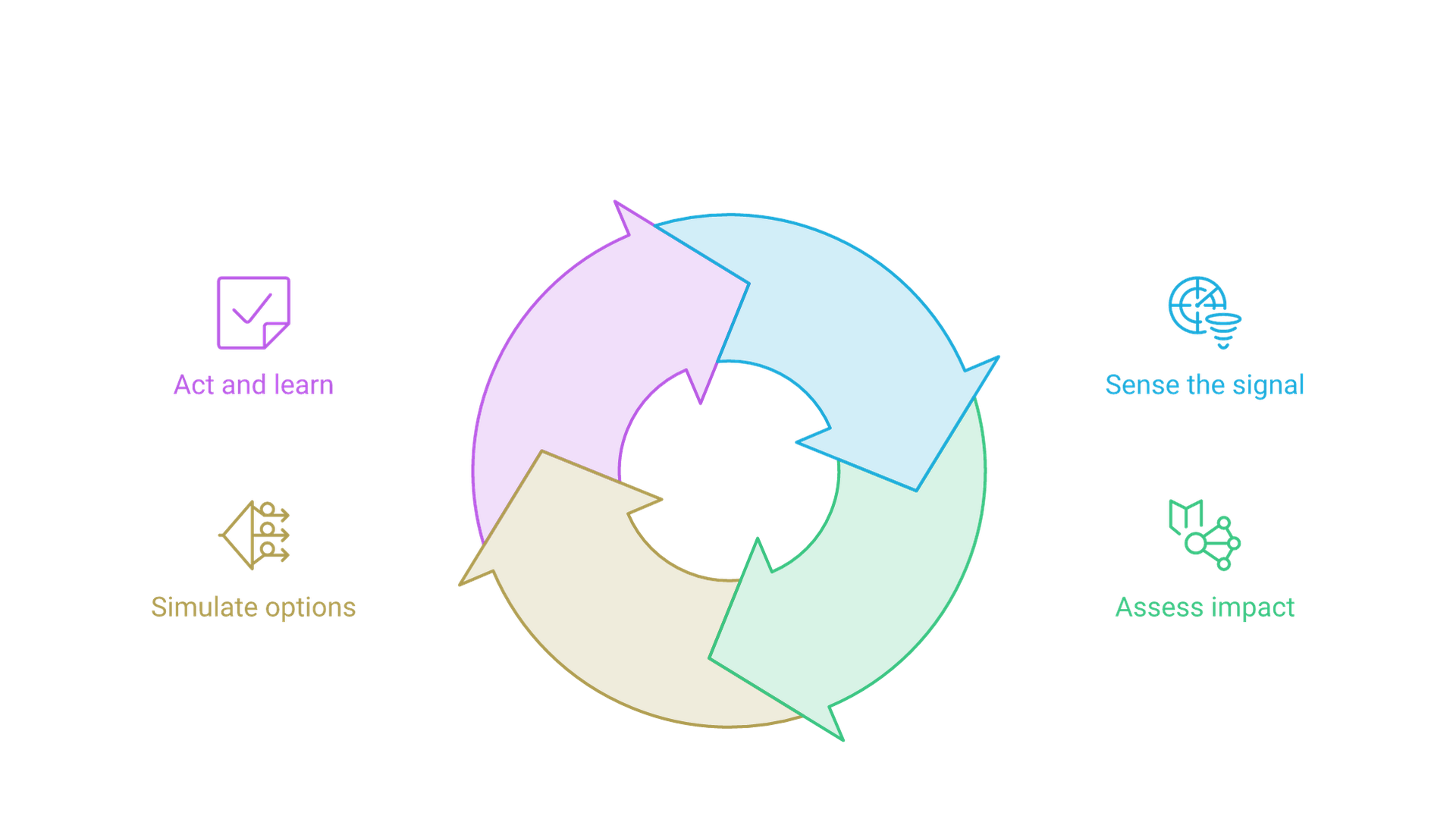
AI strengthens supply chain risk management by connecting real-time alerts to scenario planning in a loop: sense a signal such as a weather event or supplier delay, assess which orders and customers depend on the affected node, simulate options such as alternative suppliers, rerouting or inventory rebalancing, then act, through a person or an approved agent, and feed the outcome back into the models.
The loop matters because speed alone is not resilience. Gartner predicted in March 2026 that by 2031, 60% of supply chain disruptions will be resolved without human intervention, but its recommendations pair that ambition with investment in data quality and governance and with contingency plans, including protocols for rapid human intervention, for when autonomous decisions fail. This proactive, governed risk posture creates a more resilient supply chain network.
Leveraging Generative AI and Advanced Technologies
Generative AI adds a new layer to supply chain planning. Large language models can explain why a forecast changed, summarize the impact of a late shipment, draft supplier messages and generate "what-if" scenarios. Copilots support planners; agents go further by executing approved actions.
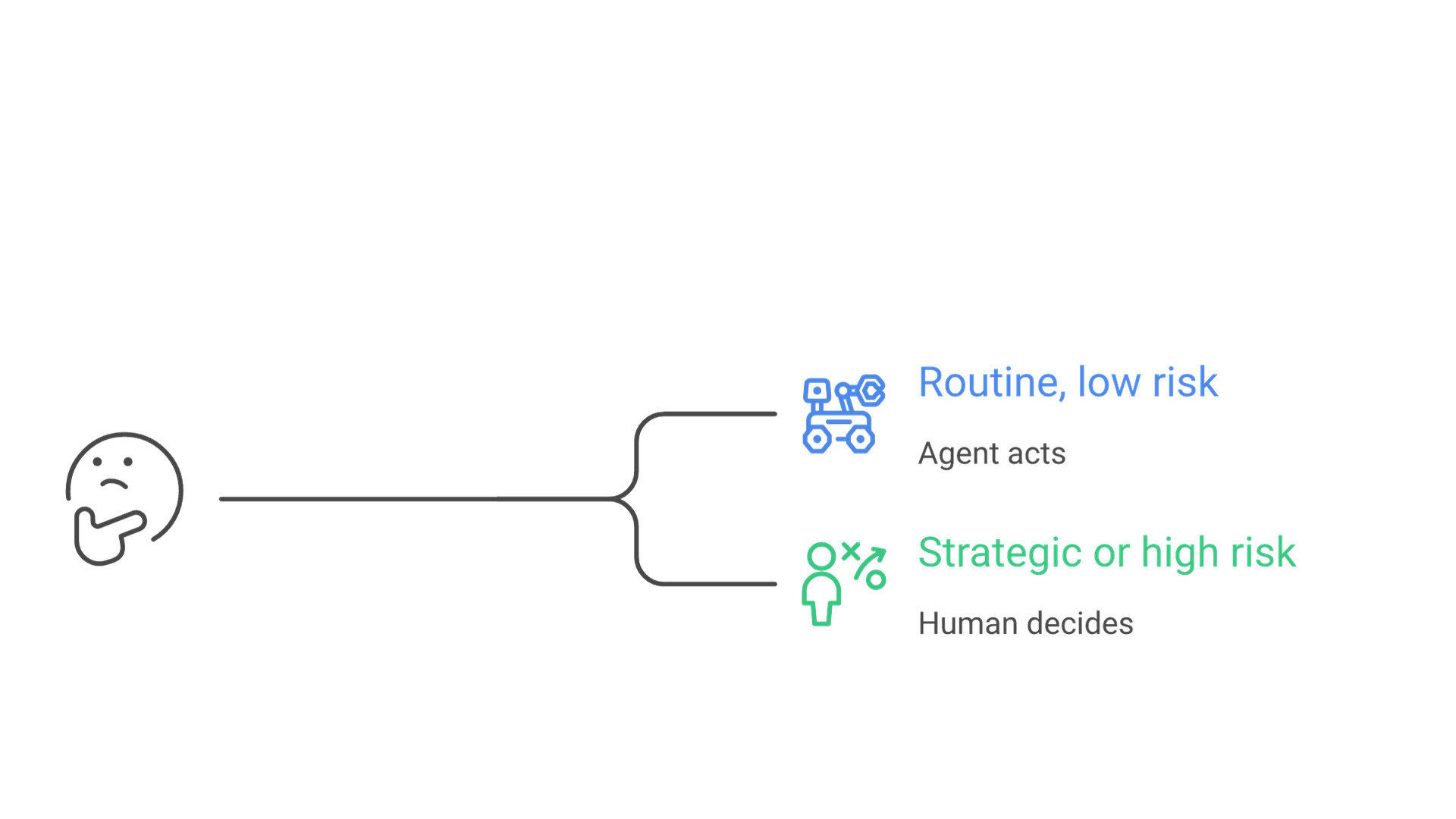
Separate genuine capability from marketing. In May 2026 Gartner warned of "agent washing," where vendors relabel conventional automation as agentic, and said vendors claiming end-to-end autonomous supply chain planning before 2027 are overstating what is possible. Gartner recommends starting with well-defined, high-volume activities where impact is measurable and the cost of error is low, such as touchless forecasting for stable SKUs or automated replenishment parameter changes. A simple rule follows: let agents act on routine, low-risk decisions and keep strategic or high-risk decisions with people.
Agents are only as good as the systems they connect to. If you are designing one, our AI agent development team builds agents with scoped permissions, approval steps and audit trails for operational workflows.
From Manual Processes to AI-Powered Execution
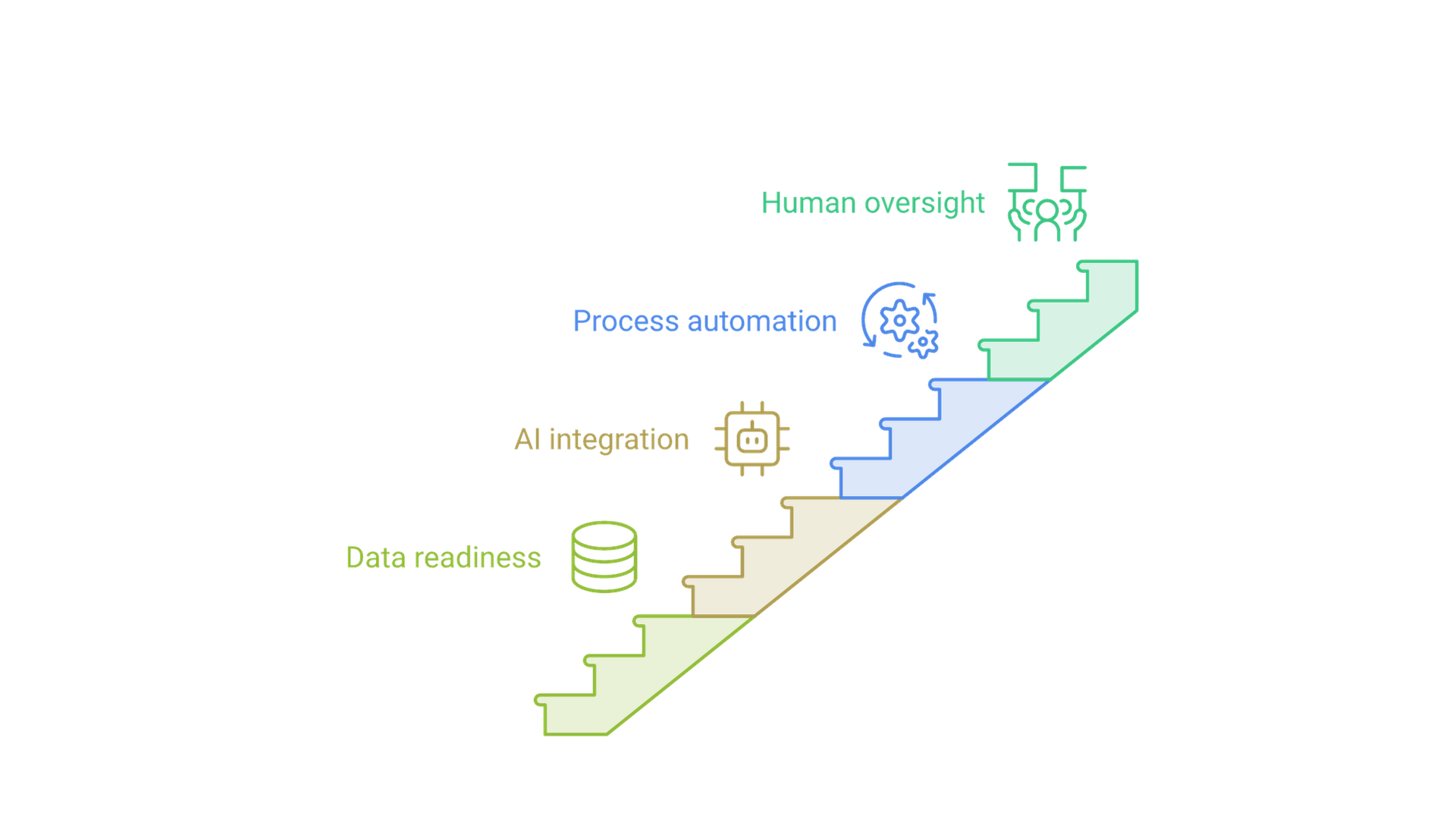
The shift from traditional supply chain planning to intelligent automation rarely happens in one leap. It works best as a staircase in which each step makes the next one safer:
Data readiness. Integrate fragmented ERP, warehouse, supplier and point-of-sale data into a governed source with consistent master data. A reliable data pipeline is the foundation for every application above.
AI integration. Deploy AI tools in forecasting, inventory, supplier risk and procurement workflows, running them alongside existing processes first so planners can compare results before trusting them.
Process automation. Automate the decisions that prove stable: routine replenishment, order prioritization and exception triage, each with clear thresholds and rollback.
Human oversight. Keep people accountable for policy, exceptions and strategy, with audit trails. Gartner expects routine decisions such as replenishment to be automated first, while network design and inventory policy still need human judgment.
If your data is the bottleneck, our data analytics consulting team can help you assess readiness and prioritize use cases before you commit to a platform.
How to Measure the Impact of AI in Supply Chain
Before a pilot starts, agree on a baseline and a few metrics tied to the decision being improved: forecast accuracy and bias for forecasting, service level together with inventory value for inventory, and detection lead time and recovery time for supplier risk and disruption response.
Gartner's September 2026 prediction that only 5% of organizations using planning automation will make at least 10% of their planning decisions autonomously by 2030 is a reminder that autonomy is not the goal in itself. Gartner advises classifying decisions, building data, talent and governance foundations, and measuring decision quality rather than tools deployed.
The Future: AI-Native Supply Chains
Tomorrow's supply chain will change gradually. Autonomous loops will take over more routine decisions, planning will become continuous as signals arrive, and supply chains will shift from responding to disruptions toward anticipating them. The winners will pair AI-powered decisions with clean data, clear decision rights and sustainable operations.
Key Takeaways for Leaders
- AI for supply chain is no longer experimental; forecasting and inventory optimization are mature, and planning agents are emerging.
- The greatest gains come from integrating AI into demand forecasting and sensing, inventory optimization, supplier risk monitoring and disruption response.
- Start with high-volume, low-risk decisions where impact is measurable, and treat claims of full autonomy with skepticism.
- Risk management is strongest when AI capabilities are paired with human judgment and ethical governance.
- Companies that adopt AI early and responsibly can stay ahead of disruption, improve margins and scale sustainably.
Frequently Asked Questions
How is AI used in supply chain management?
AI is used to forecast and sense demand, optimize inventory levels, monitor supplier risk, simulate and respond to disruptions, optimize routes and predict equipment failures. Newer tools add copilots that explain plans and agents that execute routine planning decisions within set limits.
What is the difference between demand forecasting and demand sensing?
Demand forecasting predicts demand over a medium to long horizon, mostly from historical patterns and planned events. Demand sensing focuses on the next days or weeks and uses the latest orders, shipments and sales signals to correct the short-term forecast.
How does AI improve supply chain resilience?
AI detects early warning signals, traces which orders and customers a disruption affects, simulates responses such as alternative sourcing or inventory rebalancing, and speeds up the decision. Resilience improves most when this loop is backed by good data and clear escalation to people.
What are AI agents in supply chain planning?
AI agents are software systems that can plan, act and adapt toward a goal, for example adjusting replenishment parameters or triaging supplier messages. Today they work best on high-volume, medium-complexity tasks where the cost of error is low and humans review exceptions.
Will AI replace supply chain planners?
AI is more likely to change planners' work than to remove it. Routine decisions such as replenishment are being automated first, while strategic choices like network design and inventory policy still require human judgment, oversight and accountability.
Conclusion: Applying AI for Supply Chain Efficiency and Resilience
The best applications of AI for supply chain efficiency and resilience are already practical: demand forecasting and sensing, inventory optimization, supplier risk monitoring and disruption response deliver value today, and planning agents are taking on routine decisions. Success depends on connected data, measurable goals, staged automation and human oversight.
Begin with one decision that matters, prove the improvement against a baseline, then expand. If you want help choosing the right first use case or designing the data and governance behind it, talk to Cognativ about your supply chain AI project.