

Top 10 AI Logistics Solutions Transforming Supply Chain Efficiency
Where AI pays off in logistics today: planning, routing, visibility, warehouse and freight agents, with 2026 vendor examples and a practical way to start small.
The logistics industry is at the center of one of the most significant operational transformations in decades. Artificial intelligence is no longer an experimental technology. It has become a strategic engine for improving supply chain management, optimizing logistics operations and driving operational efficiency at scale.
As logistics companies face increasing pressure to reduce costs, meet customer expectations and build more resilient supply chains, AI models and machine learning algorithms are emerging as essential tools. They enable predictive demand forecasting, route optimization, intelligent warehouse management and real-time decision-making. In 2026 a new layer sits on top: AI agents that carry out routine logistics work, such as chasing carriers or scheduling dock appointments.
Adoption is moving quickly. In the 2026 MHI Annual Industry Report, produced with Deloitte, 41% of surveyed supply chain leaders said their company currently uses AI, up from 30% a year earlier, according to DC Velocity's coverage of the MODEX 2026 keynote. For logistics managers, the question is no longer whether to adopt AI, but where to start and at what scale.
This guide covers ten AI logistics solutions with current vendor examples. The list is grouped by problem, not ranked: the right choice depends on where your operation loses time and money.
Strategic Benefits of AI in Logistics
AI-powered logistics solutions offer measurable, bottom-line impact when they are tied to a clear operational problem. By embedding AI systems directly into supply chain operations, logistics firms can unlock gains across planning, execution and service delivery.
1. Cost Reduction and Efficiency Gains
AI tools analyze real-time traffic data and transportation routes to find the most efficient delivery routes, reducing fuel consumption and transportation costs. AI also reduces manual data entry and human error by automating routine planning and reporting tasks.
2. Smarter Inventory Management
AI algorithms help optimize inventory levels, reduce excess inventory and align stock availability with customer demand. Predictive analytics based on historical sales data and market trends enables better forecasting and replenishment.
3. Improved Customer Experience
By automating basic customer inquiries, AI-powered systems provide faster, more consistent responses. End-to-end visibility helps logistics companies meet customer demand with fewer disruptions and warn customers earlier when a delivery will slip. The result is a supply chain that is leaner, faster and more responsive to change.
Top 10 AI Logistics Solutions in 2026
The ten solutions below cover the flow of goods from planning to the customer's door. Vendor names are examples from their own 2026 announcements and documentation, not endorsements or rankings, so confirm current details with each vendor.
1. Demand Forecasting and Supply Chain Planning
Planning platforms combine historical data, open orders and external signals to forecast demand and balance supply, inventory and capacity. Kinaxis describes Maestro as an "AI-infused supply chain orchestration platform" and, in its September 2026 Kinexions EMEA announcement, framed agentic AI as moving from decision support to operational partner.
2. Delivery Route Optimization
Route optimization assigns stops to vehicles and sequences them within time windows, capacity and driver rules. NVIDIA's cuOpt documentation (release 26.10) covers GPU-accelerated vehicle routing and pickup-and-delivery problems, which makes re-optimizing routes during the day more practical.
3. Real-Time Visibility and ETA Prediction
Visibility platforms track shipments across carriers and modes and predict arrival times, so teams can act before a late load becomes a missed delivery. project44 describes its Decision Intelligence Platform as joining agents with a data graph that unifies ERP, transportation, visibility, yard and ecommerce systems.
4. AI-Powered Warehouse Management
Warehouse management systems use AI to plan waves, slot inventory and balance labor. In January 2026 Manhattan Associates announced commercial availability of AI agents across Manhattan Active; early-access customer Eaton uses Wave Coordinator and Labor agents to place associates in the right fulfillment zones.
5. Warehouse Robotics and Computer Vision
Mobile robots, robotic picking and camera-based inspection use machine learning to perceive items, navigate aisles and detect damage. Respondents to the 2026 MHI report ranked robotics and automation as the second most disruptive technology after AI, according to MHI Solutions magazine.
6. Predictive Fleet Maintenance
Fault codes, engine hours and sensor readings feed models that flag when a vehicle needs service before it strands a load. Samsara's fiscal 2026 results release describes carrier Estes expanding from telematics into equipment monitoring and connected asset maintenance.
7. Freight Execution Agents
Freight teams spend hours on check calls, proof-of-delivery requests, appointment confirmations and claims. In April 2026 project44 acquired LunaPath.ai, whose agents handle exactly those tasks, and coordinates agents from several vendors through one orchestration layer.
8. Document Processing and Shipment Creation
Bills of lading, invoices and supplier confirmations still arrive as PDFs and emails. Document AI extracts and validates the data, then creates shipments. FourKites lists Sam, an agent that processes supplier documents and links shipments to purchase orders, in its February 2026 Loft launch.
9. Customer Service Automation
Most customer inquiries are some version of "where is my order?" AI assistants answer from live shipment data and hand complex cases to a person. FourKites describes Cassie for order-status questions, and Manhattan's release names a Contact Center Agent and a Shipment Tracking Agent.
10. Scenario Planning and Specialized Supply Chain Models
Simulation and generative models let planners test a port closure, supplier failure or demand spike before committing to a response. At ICON 2026, Blue Yonder introduced a Model Training Factory built on NVIDIA Nemotron to produce and grade supply chain models for its next generation of agents.
Leveraging AI in Logistics Operations
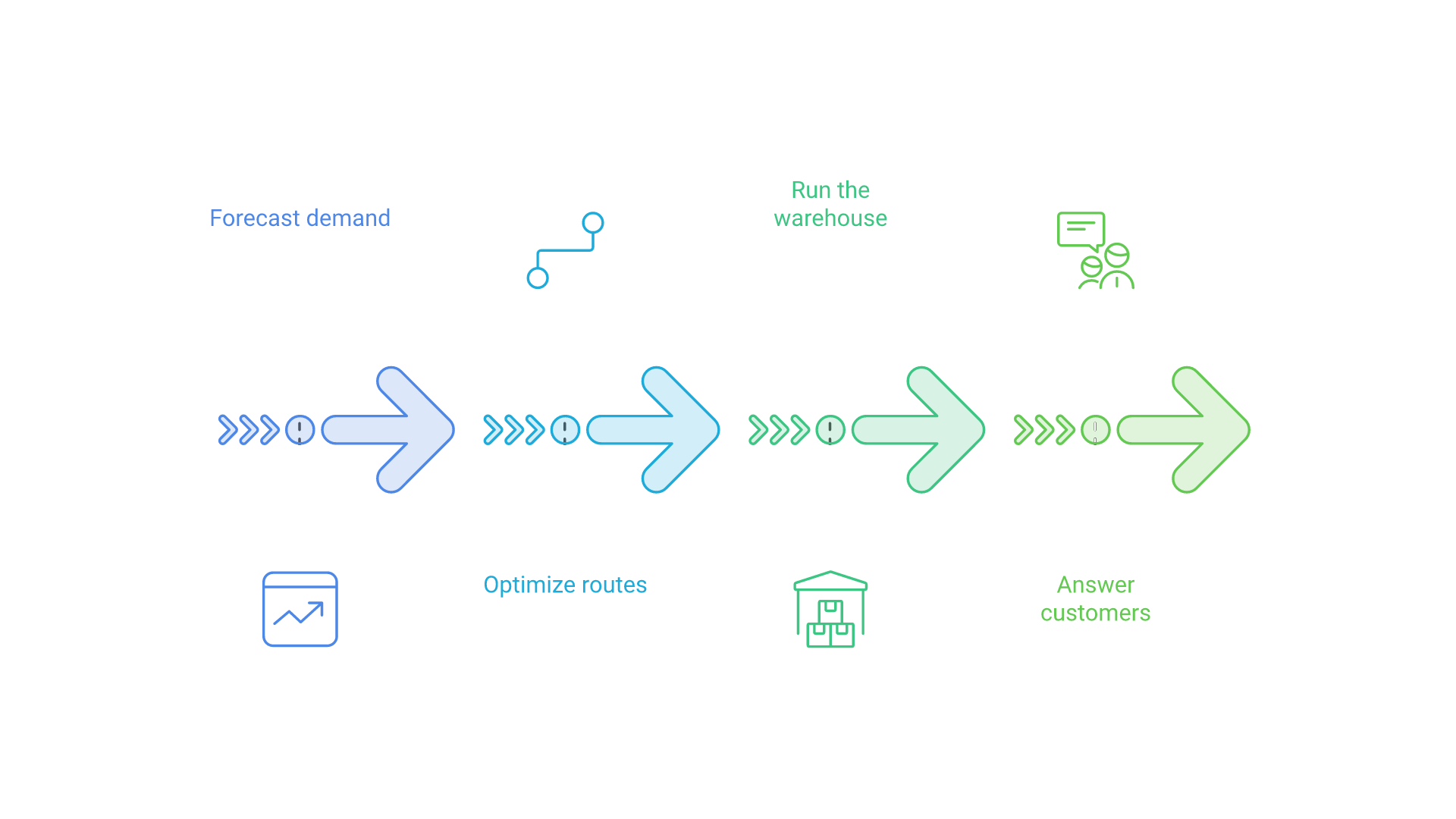
Leveraging AI strategically requires integrating intelligence at each operational layer, from planning and routing to fulfillment and after-sales support.
- Demand forecasting: AI models combine historical data and real-time signals to predict future demand more accurately.
- Delivery route optimization: AI-powered logistics systems identify the most efficient route in real time, factoring in traffic, capacity and cost.
- Data management: Automated data processing improves planning accuracy and reduces operational delays.
- Customer service automation: AI chatbots and agents handle routine queries, so teams can focus on complex issues.
This layered approach increases operational efficiency while keeping a strong focus on customer satisfaction. Connecting the layers is usually the hardest part, because forecasts, transport plans and warehouse tasks often live in different systems. A practical AI integration plan decides which system owns each decision and how agents read and write to it.
AI-Powered Solutions in Modern Logistics
The logistics sector is increasingly defined by AI-powered solutions that provide predictive insight for proactive decision-making, not just automation.
Warehouse Management
AI-powered warehouse management systems enhance inventory control, enable adaptive slotting and optimize picking and packing, while agents coordinate labor and dock activity as conditions change.
Transportation and Route Optimization
AI uses real-time traffic and delivery data to minimize transit delays and transportation costs. Predictive maintenance helps avoid unexpected fleet downtime.
Supply Chain Planning
By analyzing market trends, AI enables dynamic supply chain planning, supporting just-in-time delivery and more accurate capacity forecasting, so logistics firms can stay ahead of disruptions in volatile environments.
Generative AI in Logistics: A New Frontier
Beyond classical machine learning, generative AI is unlocking new opportunities for logistics companies.
- Scenario modeling: Generative models help simulate bottlenecks, disruptions or surges in demand.
- Dynamic pricing: Pricing can follow transportation costs, demand signals and capacity constraints.
- Automated response planning: Generative AI can draft alternative delivery route strategies quickly when markets shift.
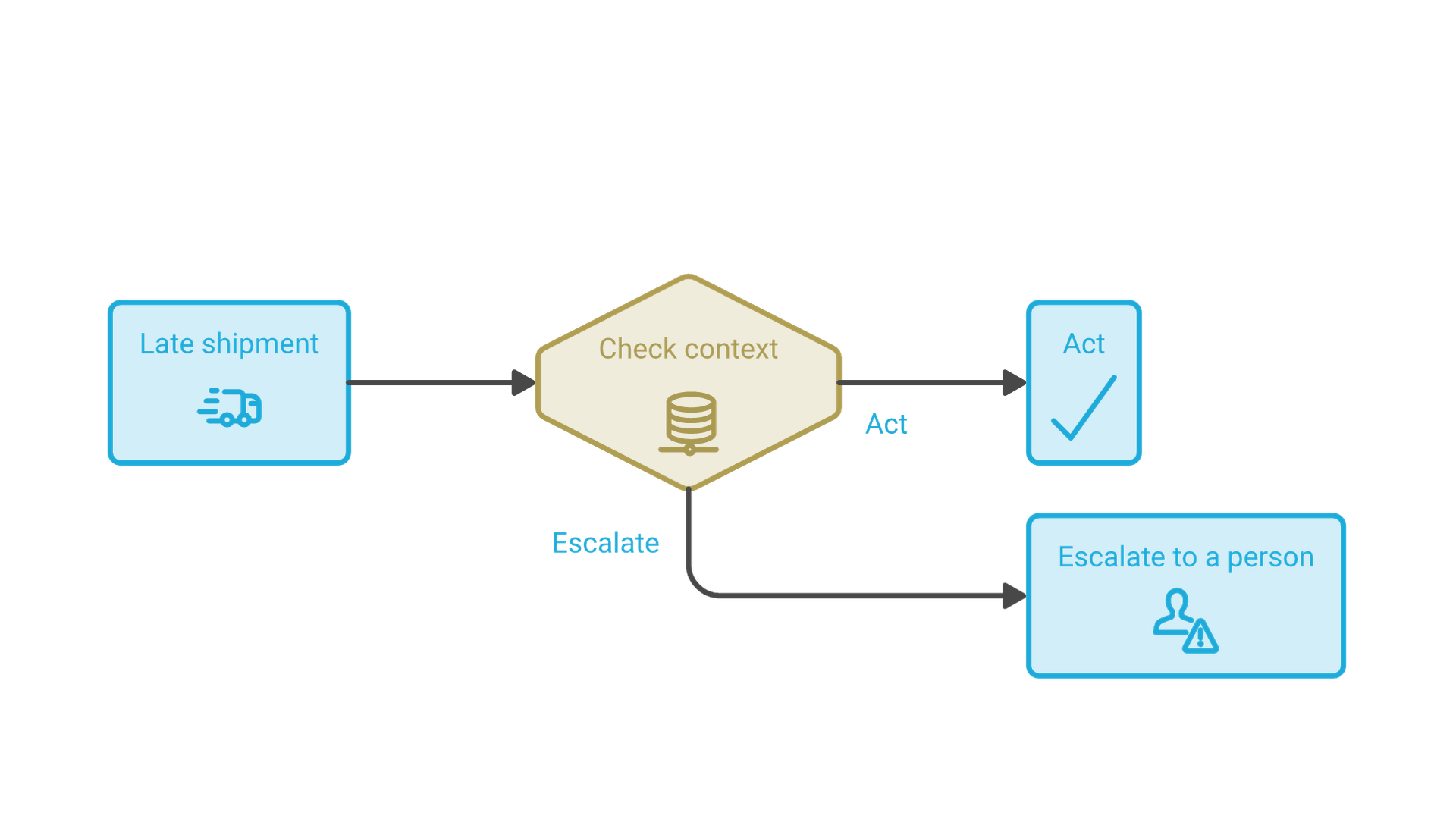
The bigger 2026 change is agentic AI. An agent watches for a trigger, such as a late shipment, checks context in connected systems, then acts or escalates to a person. Interoperability is improving too: Manhattan says agents built in its Agent Foundry support the A2A and MCP standards, so they can work with a customer's own agents. For how the underlying tool-calling loop works, see our guide to building local AI agents.
For logistics firms, this means moving from reactive problem-solving to proactive supply chain strategy, with people supervising agents instead of repeating the same follow-up all day.
How to Choose an AI Logistics Solution
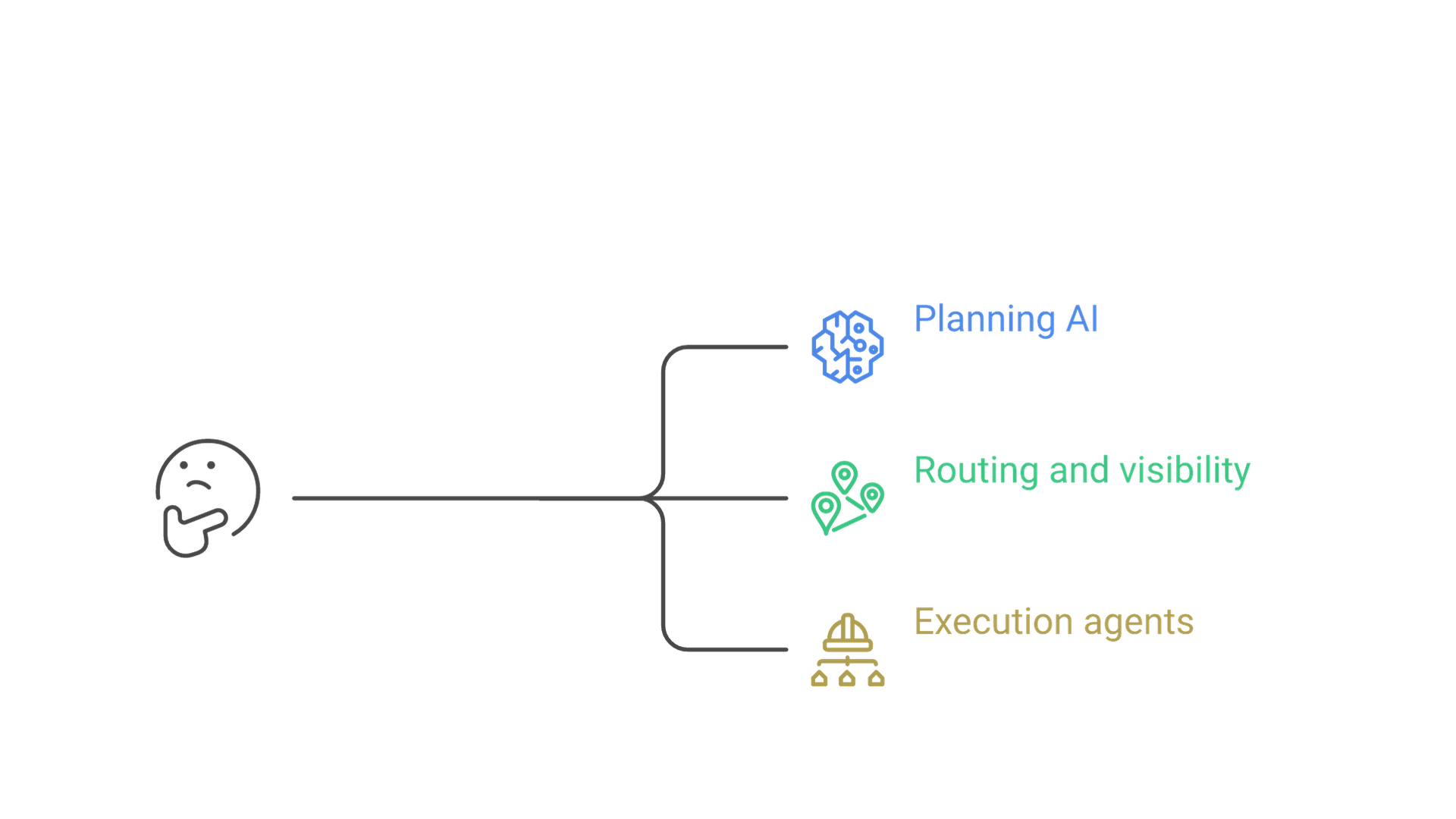
Start with your most expensive bottleneck, not the most advanced product. If forecast misses cause stockouts and overstock, start with planning. If late or costly deliveries hurt margins, start with routing and visibility. If skilled staff spend their days on paperwork and follow-up calls, start with execution agents and document AI.
When comparing vendors, check:
- Data fit: whether it can use your orders, shipments and carrier data without a long cleanup.
- Integration: native connectors to your ERP, TMS and WMS, plus open APIs.
- Control: approval steps, audit logs and clear limits on what agents may change.
- Evidence: references at comparable volumes and a pilot against your own baseline.
Vendor-reported results are a signal, not proof for your network. Run a time-boxed pilot on one lane, site or process and agree on the metric before it starts.
Data Security in AI-Powered Logistics
As logistics companies adopt AI systems at scale, data security becomes critical. These systems process sensitive customer data, transaction information and operational metrics, and agents add risk because they can take actions, not just read data.
Key considerations include:
- Encryption and secure infrastructure to protect data integrity.
- Regulatory compliance for cross-border operations.
- Least-privilege access for agents, with human approval for financial or contractual actions.
- Clear protocols to prevent data extraction or misuse of operational insights.
Operations that handle personal data of people in the EU must meet the General Data Protection Regulation (GDPR), and the NIST AI Risk Management Framework offers a voluntary structure for governing AI risk, including a generative AI profile added in 2024. If you plan to use language models on contracts, rates or customer records, our guide to using LLMs with private data covers the main architecture options.
Implementing AI Strategically in the Logistics Sector
Successful AI adoption requires more than buying software. It demands a strategic implementation plan aligned with operational goals.
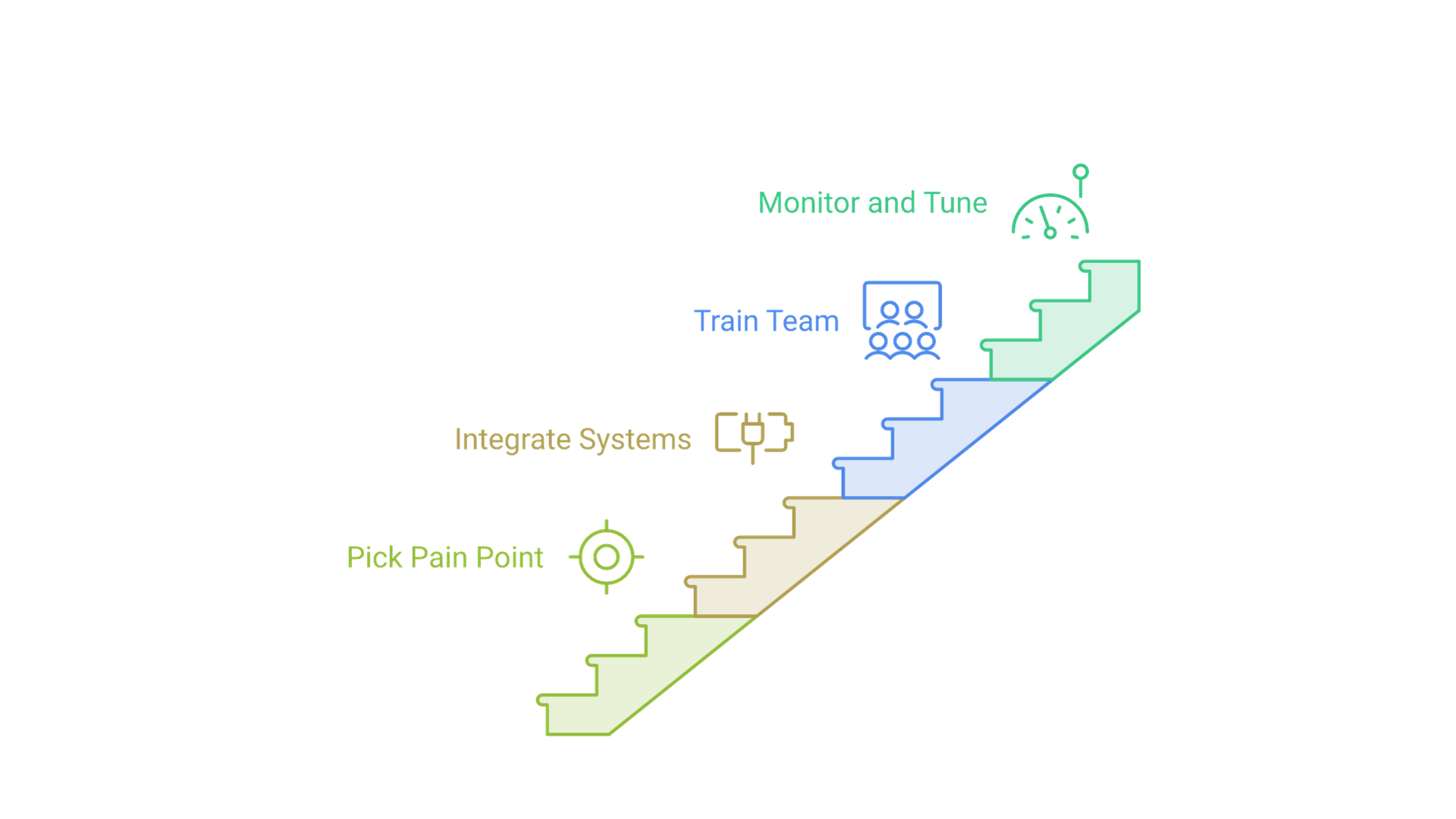
Steps to implement AI in logistics effectively:
- Identify pain points in supply chain operations and define clear ROI metrics.
- Integrate AI with existing systems and workflows for seamless execution.
- Invest in staff training and change management to enable adoption at scale.
- Monitor model performance and fine-tune AI algorithms as conditions evolve.
- Ensure compliance and security frameworks are established early.
Monitoring deserves special attention. Logistics is full of rare events, such as port strikes or a new customer's ordering pattern, and models trained on normal weeks can fail on them. Our article on why AI models struggle with edge cases explains why routing exceptions to people belongs in the design from day one.
Also decide who will maintain each model and supervise each agent after launch. Starting with well-scoped AI process automation lets logistics companies minimize risk while proving the value of intelligent automation.
AI for Logistics: Building Resilience and Competitive Advantage
AI is giving logistics firms the ability to build resilient supply chains that adapt quickly to disruptions, from sudden demand spikes to geopolitical instability.
- Predictive analytics enables agile response to supply chain challenges.
- Generative AI creates flexible routing and planning strategies.
- Automation and agents improve cost control and operational speed.
- Advanced forecasting allows firms to meet customer expectations reliably.
This shift is strategic, not just technological. Survey respondents expect AI to be the most disruptive force in supply chains over the next decade, and companies that pair it with clean data, sound integration and trained people will be best placed to benefit.
Frequently Asked Questions
How is AI used in logistics?
To forecast demand, plan inventory, optimize routes, predict arrival times, run warehouses, predict maintenance, process documents and answer customers. In 2026 agents also handle routine follow-up such as carrier check calls.
What is the best AI solution for logistics?
There is no single best one. Match it to your largest bottleneck: planning AI for forecast problems, routing and visibility for delivery costs, and execution agents for manual follow-up.
What is agentic AI in logistics?
Systems that watch for a trigger, gather context from connected systems and then act or escalate to a person, such as requesting a missing proof of delivery.
Can AI replace logistics planners?
No. AI automates repetitive tasks and suggests decisions, but people set priorities, handle unusual exceptions and own customer and carrier relationships.
How long does it take to implement AI in logistics?
It depends on data quality and integration scope. A focused pilot on one process or site is far faster than a network-wide rollout, so many teams start small.
Is AI in logistics secure?
It can be, with encryption, least-privilege access, audit logs, human approval for sensitive actions and compliance with rules such as GDPR where they apply.
Conclusion: The Future of Logistics is Intelligent
AI for logistics is redefining what is possible in supply chain operations. From warehouse optimization to demand forecasting, route efficiency, execution agents and data security, AI technologies are driving operational efficiency, cost savings and better customer satisfaction across the logistics sector.
As adoption accelerates, the industry will move from linear, manual processes to digital systems that anticipate and adapt to change, with people supervising the work rather than repeating it.
For logistics leaders, the path forward is clear: pick the bottleneck that costs the most, prove value with a measured pilot, then scale. To choose and integrate the right AI logistics solution for your operation, talk to Cognativ about your logistics AI project.