

The Best Digital Transformation Frameworks for Successful Implementation
Strategy, architecture, delivery and change models each solve one layer of transformation. See what each framework covers and how to build a stack that fits.
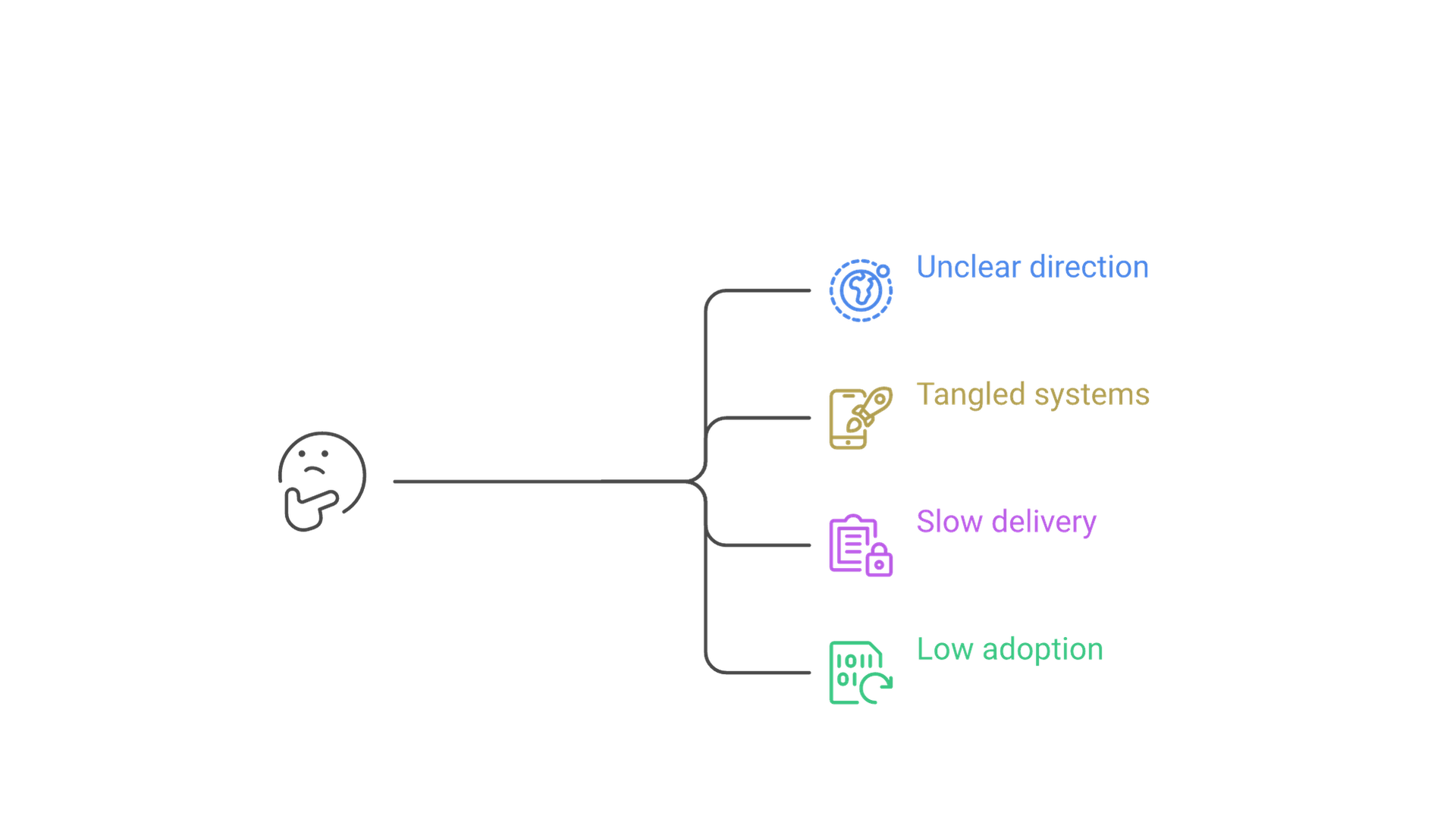
Looking to navigate digital transformation effectively? Digital transformation frameworks offer structured approaches to guide your business through technological change. They help align digital efforts with strategic goals, surface risks early and focus scarce resources on the work that creates value. Without one, transformation tends to become a collection of disconnected technology projects that each look reasonable on their own but rarely add up to a different business.
The difficulty is that "framework" covers very different things. Some frameworks describe where a company should end up, some describe how to design the enterprise architecture that gets it there, some describe how teams should deliver, and some describe how people actually change their behavior. MIT CISR's Future Ready model, McKinsey's Rewired, BCG's success factors, Kotter's 8 Steps, Prosci's ADKAR Model, the TOGAF Standard, Lean and the Scaled Agile Framework all answer a different question. Comparing them as if they were interchangeable is the most common mistake in framework selection.
This guide explains what each of the best-known digital transformation frameworks actually covers, based on its originator's own published material, how they compare, and how to choose and combine them into a working approach for 2026.
Key takeaways
- Digital transformation frameworks provide structured guidance that aligns digital initiatives with business strategy, rather than with technology for its own sake.
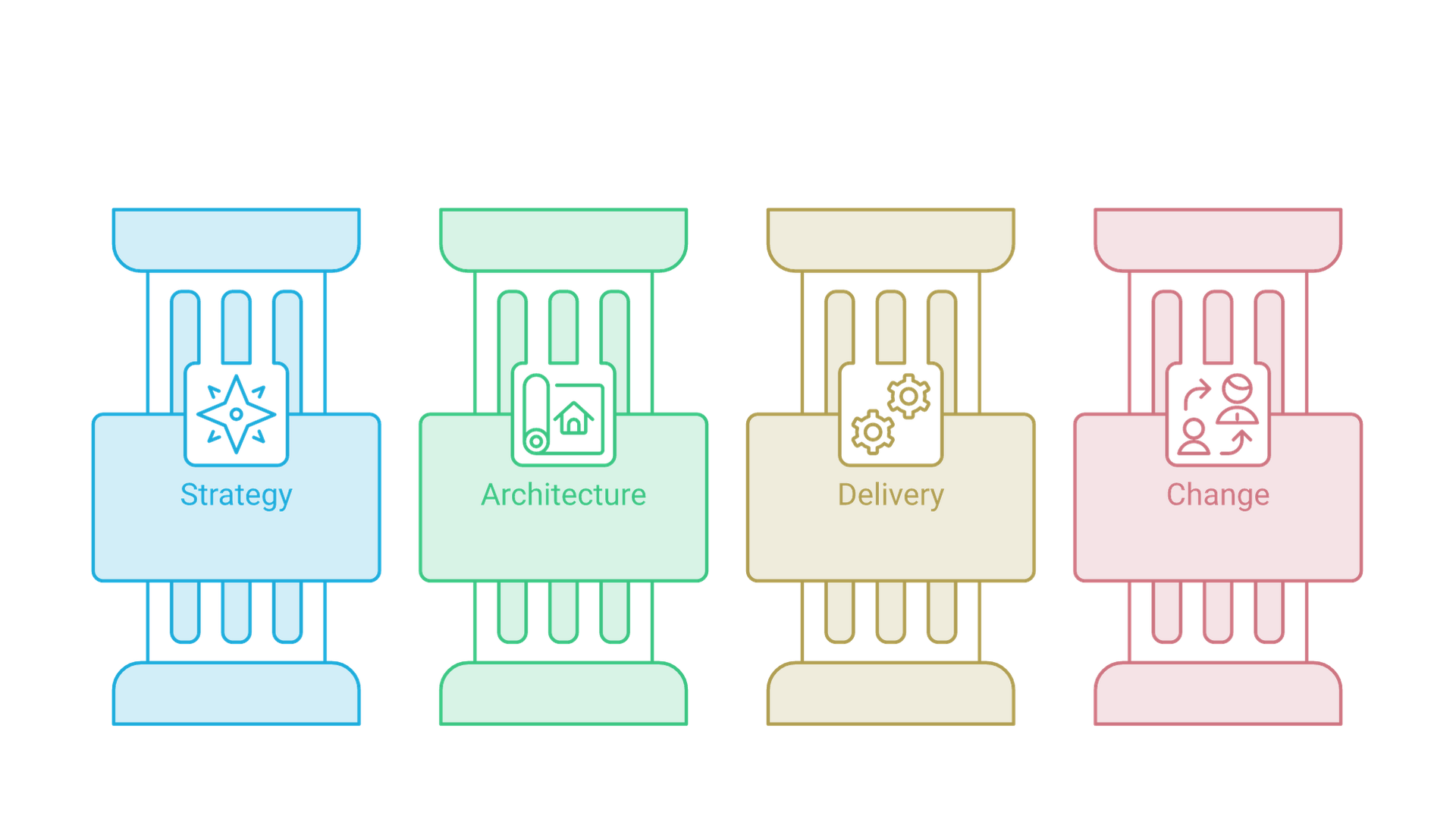
- Most well-known frameworks cover one layer of the problem: strategic direction, enterprise architecture, delivery and process improvement, or people and change.
- Effective programs combine one framework per layer, connected by shared outcomes, governance and measurement.
- Choosing the right framework depends on your biggest gap, your organizational goals, budget, regulatory constraints and current digital maturity.
Understanding Digital Transformation Frameworks
Digital transformation frameworks serve as structured guides that enable organizations to plan and execute their digital initiatives effectively. They help leaders adapt strategies and investments to their digital transformation goals, and they give everyone involved a shared vocabulary for what is changing, why, and in what order.
At their core, digital transformation frameworks help businesses navigate the complex process of digital change by providing a clear roadmap. They help identify and mitigate the risks associated with digital initiatives and keep efforts aligned with the overall business strategy. That alignment is what makes resource allocation efficient: a framework makes it easier to say no to projects that do not move the agreed outcomes.
A useful way to think about a digital transformation framework is as a model with three parts. First, a description of the target state, such as better customer experience, more efficient operations or a new business model. Second, a method for moving from the current state to that target, including sequencing, decision rights and checkpoints. Third, a set of practices for the people and teams doing the work. Very few published frameworks cover all three in depth, which is why most organizations end up combining several.
MIT CISR makes a point worth repeating at the start of any program: the goal is not digital transformation itself but business transformation using digital capabilities. A framework that keeps attention on business outcomes, rather than on technology adoption, is already doing half its job.
Importance of Digital Transformation Frameworks
Digital transformation frameworks provide strategic direction, helping organizations set goals and identify areas for improvement. By offering a clear roadmap to innovate and adapt, they keep digital transformation efforts aligned with business strategy and make the change easier to govern.
The case for structure is backed by research on how often transformations miss. In its 2020 study "Flipping the Odds of Digital Transformation Success", BCG reported that about 70% of digital transformations fall short of their objectives. The same study found that companies that got six specific factors right raised their odds of success from 30% to 80%. Those factors, covered below, are essentially the components a good framework forces you to address.
The key benefits of adopting a digital transformation framework include:
- The ability to identify potential risks early in the transformation process, enabling proactive risk management.
- Better decision-making through data-driven and evidence-based choices about which initiatives to fund, pause or stop.
- Stronger collaboration among stakeholders and departments, unifying efforts toward common goals.
- A consistent way to track performance and report progress to leadership and the board.
Having a digital transformation framework streamlines processes and tracks performance, which helps optimize organizational resources. It provides a roadmap for navigating disruption and ensures that every step taken is in line with the overall digital transformation strategy. That combination is what allows organizations to transform successfully and stay competitive as technology, including generative AI, keeps shifting what customers and employees expect.
Key Components of an Effective Digital Transformation Framework
An effective digital transformation framework includes several components that are critical for success. Across the published models, the same elements recur: customer relationships and experience, processes and systems, products and services, and the organization itself, including its structure, talent and culture.
BCG's six success factors are a practical checklist of those components. The firm lists an integrated strategy with clear transformation goals; leadership commitment from the CEO through middle management; deploying high-caliber talent; an agile governance mindset that drives broader adoption; effective monitoring of progress toward defined outcomes; and a business-led modular technology and data platform.
Strategy and Outcomes
Every framework starts with a clear statement of what the transformation should achieve and how it will be measured. Data-driven decision-making, customer experience and operational efficiency are the outcomes most frameworks put at the center. Outcomes should be tied to operational metrics that the business already recognizes, such as churn, cost to serve, cycle time or margin.
Technology, Data and Integration
Technologies incorporated into a digital transformation framework should be scalable and flexible enough to adapt to future change. Collecting data about customer behavior, operational performance and market trends is essential for driving technology decisions. Seamless integration of new technologies with existing systems is crucial to avoid disruption, which is why modular platforms and well-defined interfaces appear in nearly every modern model.
Governance and Measurement
Governance frameworks, including policies, standards and procedures, are necessary to guide efforts and maintain control during digital transformation. In 2026 that governance increasingly has to cover AI as well: model inventories, risk tiers, evaluation and monitoring. Our guide to building an enterprise AI governance framework covers how to add those controls without slowing delivery.
People and Culture
Successful digital transformation also requires people to work differently. Frameworks that ignore sponsorship, communication, training and reinforcement tend to produce systems that are delivered but not adopted. Omnichannel interaction and services matter for customer engagement, but they only work when employees are equipped to support them.
Types of Digital Transformation Frameworks
Digital transformation frameworks guide organizations through digital initiatives and keep them aligned with business objectives, but they cater to different aspects of business transformation. Sorting them by the question they answer is more useful than ranking them, because a strategy model and a change model are not competitors.
The main types are:
- Strategic frameworks, which define the target state and the path to it, such as MIT CISR's Four Pathways to Future Ready and McKinsey's Rewired.
- Enterprise architecture frameworks, which design how business, data, applications and technology fit together, such as the TOGAF Standard.
- Process improvement and delivery frameworks, which govern how work flows and improves, such as Lean, Lean Six Sigma, Agile and SAFe.
- Change management frameworks, which focus on how organizations and individuals adopt change, such as Kotter's 8 Steps and Prosci's ADKAR Model.
- Capability and maturity frameworks, which assess where an organization stands today and which capabilities it must build.
Each type of framework serves a unique purpose, and selecting the right combination depends on the specific needs and goals of the organization. The subsections below describe the categories the original framework debate tends to focus on.
Enterprise Architecture Frameworks
Enterprise architecture frameworks guide large organizations through systematic digital transformation by connecting strategy to the structure of systems, data and processes. They help ensure that every digital initiative supports the broader corporate strategy instead of adding another isolated application.
The most prominent example is The TOGAF Standard, maintained by The Open Group. Its current version, the 10th Edition published in 2022, is positioned by The Open Group as supporting agile enterprises and digital transformation. Its core is the Architecture Development Method (ADM), a cycle that runs from a Preliminary phase through Architecture Vision, Business Architecture, Information Systems Architectures, Technology Architecture, Opportunities and Solutions, Migration Planning, Implementation Governance and Architecture Change Management, with Requirements Management at the center.
Enterprise architecture works best when it is treated as a decision aid rather than a documentation exercise. Teams that already use a structured approach to delivery, such as the ones described in our overview of system development methodologies, can use the ADM to decide what to build and in what order, then let delivery methods handle how.
Process Improvement Frameworks
Process improvement frameworks enhance operational efficiency and keep transformation adaptable. An iterative approach structures the transformation journey in smaller phases that can be adjusted and optimized as results come in.
The Lean Enterprise Institute describes lean as a way of creating needed value with fewer resources and less waste, starting from what the customer values. Its roots are in the Toyota Production System, and Womack and Jones summarized it in 1996 as five principles: specify value, identify the value stream, create flow, establish pull and pursue perfection. Lean Six Sigma pairs that waste-removal mindset with Six Sigma's data-driven DMAIC cycle (Define, Measure, Analyze, Improve, Control) to reduce variation in critical processes.
Change Management Frameworks
Change management frameworks address the reason many technically sound programs stall: people do not adopt the new way of working. Kotter's 8 Steps work at the organizational level, building urgency, coalitions and momentum. Prosci's ADKAR Model works at the individual level, diagnosing where each person is in their change journey. Both are covered in detail in the next section.
Customer-Centric Frameworks
A core objective of customer-centric digital transformation is improving customer experience. Industries such as financial services, insurance and retail in particular focus on enhancing customer value propositions through digital services. Key technologies that support this include cloud computing, artificial intelligence, machine learning and the Internet of Things.
By understanding customer segments, needs, preferences and pain points, businesses can use these technologies to digitize customer experiences, improve satisfaction and redesign the business processes behind them. MIT CISR's customer experience axis, described below, is one way to make that goal measurable.
Examples of Leading Digital Transformation Frameworks
The frameworks published by research centers, consulting firms and standards bodies serve as reference points for best practice. The descriptions below are drawn from each originator's own published material rather than from secondary summaries, which often attach labels or components the originators do not use.
MIT CISR: Four Pathways to Future Ready
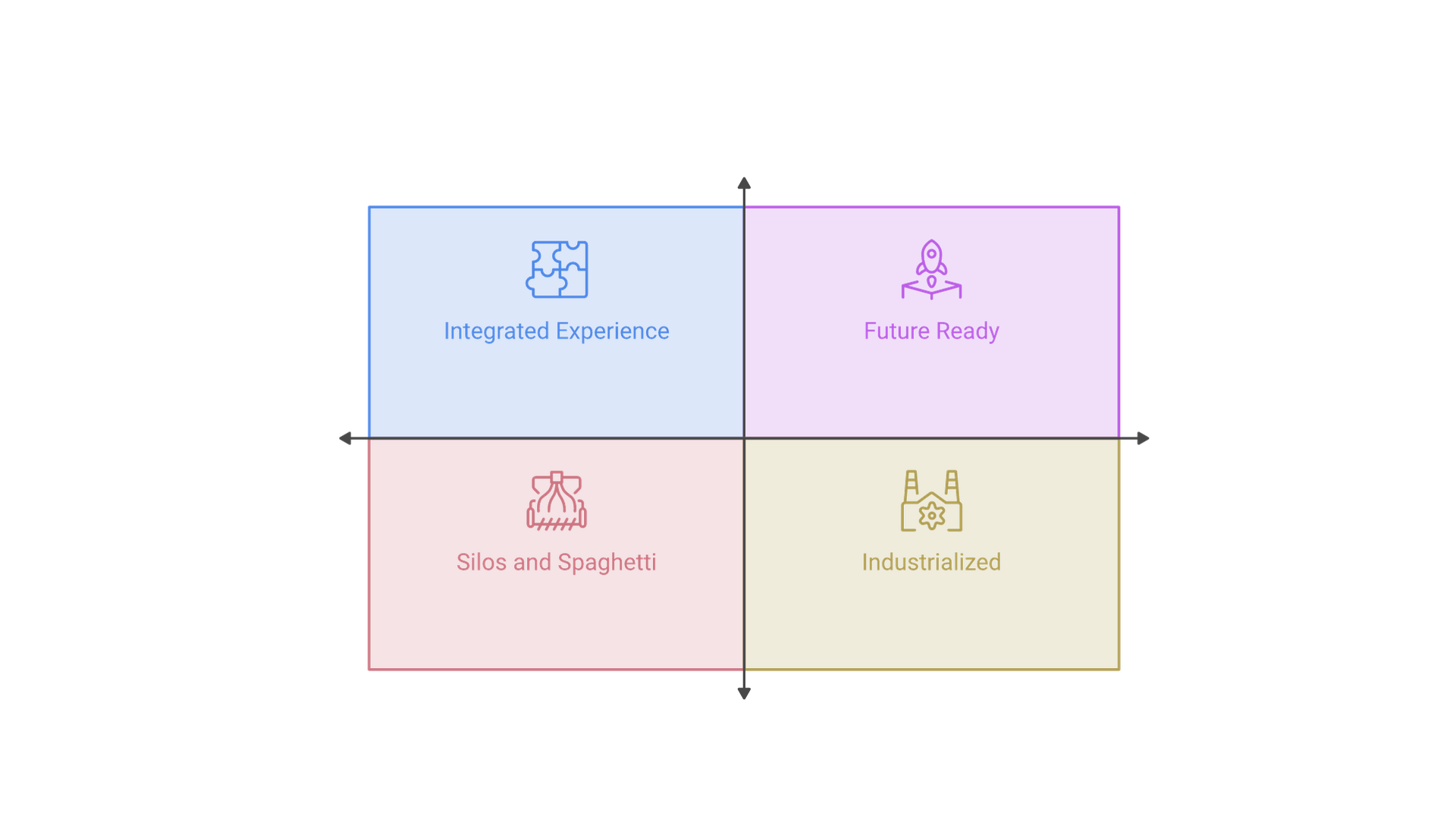
Researchers at the MIT Center for Information Systems Research (CISR), Peter Weill and Stephanie Woerner, describe transformation along two dimensions: customer experience and operational efficiency. Their 2017 research briefing divides firms into four quadrants. Silos and Spaghetti describes traditional experience and complex operations; Industrialized describes standardized, automated, modular operations; Integrated Experience describes a unified customer experience over still-complex operations; and Future Ready combines strong customer experience with efficient, agile operations. In that research, 23% of firms were in the Future Ready quadrant, and they averaged margins 16 percentage points above their industry average.
The framework then describes four pathways from Silos and Spaghetti to Future Ready. Pathway 1 industrializes operations first, largely by building API-enabled business services. Pathway 2 improves customer experience first and then fixes operations. Pathway 3 alternates small steps between the two. Pathway 4 builds a new Future Ready business rather than transforming the existing one. MIT CISR expanded the work into the 2022 book Future Ready: The Four Pathways to Capturing Digital Value by Woerner, Weill and Ina Sebastian, published by Harvard Business Review Press.
The model's strength is that it forces an explicit choice of path, which shapes funding, sequencing and organizational design. Its limit is that it says relatively little about day-to-day delivery or individual adoption, which is why it pairs well with delivery and change frameworks.
McKinsey's Digital Transformation Framework: Rewired
Older articles, including earlier versions of this one, attribute a "4Ds" model to McKinsey. We could not find that model in McKinsey's current published material, so we do not describe it here. McKinsey's own current guidance is Rewired, introduced in a McKinsey Quarterly article and the 2023 book Rewired: The McKinsey Guide to Outcompeting in the Age of Digital and AI by Eric Lamarre, Kate Smaje and Rodney Zemmel, with a revised second edition published by Wiley in 2026.
Rewired argues that companies need a baseline of competence across six enterprise capabilities: a business-led digital roadmap, a strong bench of digital talent, an operating model that lets business and technology teams work together, a distributed technology environment that teams can build on, data embedded throughout the business, and adoption and scaling of solutions across the enterprise. The roadmap is meant to tie each business domain's transformation to operational KPIs, so value is visible in the short term while capabilities are built for the medium term. The framework is grounded in McKinsey's work with more than 200 companies.
BCG's Digital Transformation Framework: Six Success Factors
Some summaries describe BCG's approach as a "three-phase" model of quick wins, medium-term plans and long-term sustainability. BCG's most cited published research frames it differently, as the six success factors listed earlier, derived from its work with 70 leading companies and a survey of 825 senior executives. The practical lesson from that research is that the factors work together: addressing only some of them is not enough to change the odds meaningfully.
The phasing idea is still sound practice, even if it is not BCG's formal model: deliver visible quick wins to build credibility, plan the medium-term capability build, and design for long-term sustainability so the organization keeps improving once the program office disbands.
Gartner and Other Analyst Frameworks
Gartner, KPMG, Deloitte and other analyst and advisory firms also publish digital business frameworks, often emphasizing leadership, creativity, technology and data-driven decision-making. Many of these are available only to clients or behind registration, and their component lists change between editions. If one of them is already in use in your organization, it is worth checking the current official version rather than relying on a summary.
Kotter's 8-Step Process for Leading Change
John Kotter introduced his model in the Harvard Business Review article "Leading Change: Why Transformation Efforts Fail" (March–April 1995) and expanded it in the book Leading Change. The current version on Kotter's official site lists eight steps: create a sense of urgency, build a guiding coalition, form a strategic vision, enlist a volunteer army, enable action by removing barriers, generate short-term wins, sustain acceleration and institute change.
Kotter's firm notes that the model has evolved from the linear sequence in the original book into the more concurrent "8 Accelerators" described in Accelerate (2014). For digital programs, the concurrent reading matters: urgency, coalition-building and short-term wins need to keep running throughout a multi-year transformation, not happen once at the start.
Prosci's ADKAR Model
The Prosci ADKAR Model describes the five outcomes an individual needs for a change to succeed: Awareness of the need for change, Desire to participate and support it, Knowledge of how to change, Ability to implement the required skills and behaviors, and Reinforcement to sustain the change. Prosci is explicit that ADKAR is a model for individual change, not a complete change management methodology.
At the organizational level, Prosci pairs ADKAR with its 3-Phase Process: Prepare Approach, Manage Change and Sustain Outcomes. ADKAR is especially useful in digital programs for diagnosing why a rollout is stuck, for example when people understand a new system (Knowledge) but have not had the practice or support to use it confidently (Ability).
Lean and Agile at Scale: SAFe
Agile delivery traces back to the principles behind the Agile Manifesto, which put early and continuous delivery of valuable software first. Scaling those practices beyond individual teams is where frameworks such as the Scaled Agile Framework come in. Scaled Agile, Inc. describes SAFe as an operating model for scaling Lean and Agile practices across an organization, organized into disciplines such as Lean Portfolio Management, Team and Technical Agility, Product Development Flow, Large Solution Integration and Delivery, and Leadership and Culture. In 2026 it also promotes an AI-Native extension aimed at getting a return on AI.
Agile at scale is not right for every part of a transformation. Regulated programs, fixed-scope contracts and hardware dependencies often call for a hybrid approach; our comparison of Agile vs Waterfall explains when each fits and how hybrids work in practice.
Digital Transformation Frameworks Compared
The table below summarizes the frameworks covered above by the primary question each answers and the level at which it operates. It is a guide to fit, not a ranking.
| Framework | Originator | Primary question | Operates at | Best for |
|---|---|---|---|---|
| Four Pathways to Future Ready | MIT CISR | Which path to a transformed business? | Enterprise strategy | Choosing and sequencing the overall direction |
| Rewired | McKinsey | Which capabilities must we build? | Enterprise capabilities | Roadmaps, talent, operating model and data |
| Six success factors | BCG | What makes a program succeed? | Program health | Program design reviews and risk checks |
| TOGAF Standard (ADM) | The Open Group | How should the enterprise be architected? | Architecture | Complex system landscapes and migrations |
| Lean and Lean Six Sigma | Lean Enterprise Institute and others | Where is the waste and variation? | Processes | Operational efficiency and process redesign |
| SAFe | Scaled Agile, Inc. | How do many teams deliver together? | Delivery | Large software portfolios and product flow |
| 8-Step Process | Kotter | How do we lead the organization through change? | Organization | Urgency, coalition and momentum |
| ADKAR Model | Prosci | Why is this person not changing yet? | Individual | Adoption, training and reinforcement |
Two patterns stand out. First, no single row covers strategy, architecture, delivery and people. Second, the frameworks share a bias toward outcomes and iteration: even the architecture and change models have moved toward cycles and accelerators rather than one-way sequences.
The RAPID Framework
RAPID is Cognativ's own five-phase decision and communication framework: Research, Analyze, Plan, Implement and Decide. It is designed to keep each step tied to clear, measurable outcomes and to connect business decisions with the people responsible for carrying out the change. It is the method behind Cognativ's business transformation consulting, where it is applied to strategy, process improvement, operating models and adoption.
Unlike the strategy and architecture frameworks above, RAPID is a working rhythm rather than a target-state model. It can sit alongside them: a company might choose a Future Ready pathway, design the architecture with the ADM, and use RAPID to run the decisions and course corrections along the way.
Two Flywheels for Continuous Improvement
Flywheel 1 (Research to Analyze). Research is an unemotional, methodical diagnostic. It gathers hard data such as financials, organization charts and customer profiles, alongside softer insights into company myths and culture. Analyze filters that data into relevant and irrelevant buckets, looks closely at people, finance, product and technology, and often loops back to Research to fill gaps.
Flywheel 2 (Plan to Implement to Decide). Plan turns analysis into a tactical roadmap focused on people, process and product. Implement puts the plan into action, where real-world feedback drives iterative adjustments. Decide is the ongoing verdict on whether actions are delivering the intended results, prompting new plans or deeper implementation as needed.
Core Principles
- Outcome orientation: every phase is aligned to specific business goals, not vanity metrics.
- Fluidity and adaptation: decision-making is continuous, and wrong turns are expected and corrected quickly.
- Empowerment: leaders deliberately push decisions to front-line teams so they can make real-time choices.
- Simplicity in technology: technology exists to serve strategy, so architectures stay simple and avoid over-engineering.
Embedded into an operating rhythm, this approach turns digital initiatives from one-off projects into a self-reinforcing cycle of improvement.
How to Choose and Combine Digital Transformation Frameworks
Because each framework answers a different question, the practical decision is less "which framework?" and more "which framework for which layer, and how do they connect?" A simple approach is to start from your biggest gap and work outward.
Start From Your Biggest Gap
If leadership cannot agree on where the business should end up, start with a strategic framework such as MIT CISR's pathways or Rewired's roadmap. If the strategy is clear but systems and data are tangled, an enterprise architecture method such as the TOGAF ADM is the bottleneck to address. If plans are sound but delivery is slow, Lean, Agile or SAFe practices matter most. If systems are delivered but not used, Kotter and ADKAR are where to focus.
Build a Layered Stack
Most mature programs end up with one framework per layer: a strategic model to set direction, an architecture method to design the target landscape, a delivery framework to run the work, and a change model for adoption. Governance and measurement tie the layers together, so a pathway decision at the top translates into architecture priorities, team backlogs and adoption targets. MIT CISR's 2021 update supports the case for coordination: among firms pursuing multiple pathways, those that were well coordinated reported far more progress than those that were not.
Keep the stack as small as possible. Every additional framework adds vocabulary, ceremonies and roles. Adopting a whole methodology when you need only one part of it is a common source of overhead. If you want an independent view of which layers your organization actually needs, our technology strategy consulting team works through that question with leadership teams.
Common Combinations
- Future Ready pathway plus ADKAR: a clear strategic direction with individual adoption tracking for each major rollout.
- Rewired plus SAFe: capability building and domain roadmaps executed through coordinated agile delivery.
- TOGAF ADM plus Lean: architecture decisions for complex legacy estates, combined with process redesign that removes waste before it is automated.
- Kotter plus BCG's success factors: organization-wide momentum checked against a program-health checklist.
Steps to Creating Your Own Digital Transformation Framework
Creating your own digital transformation framework produces an approach tailored to your specific business needs. Companies often choose this route when existing methodologies do not fit their challenges, or when they want to combine parts of several frameworks under one model. Aligning the framework with your organizational requirements is crucial, but the effort can feel overwhelming because it touches strategy, resources and culture at the same time.
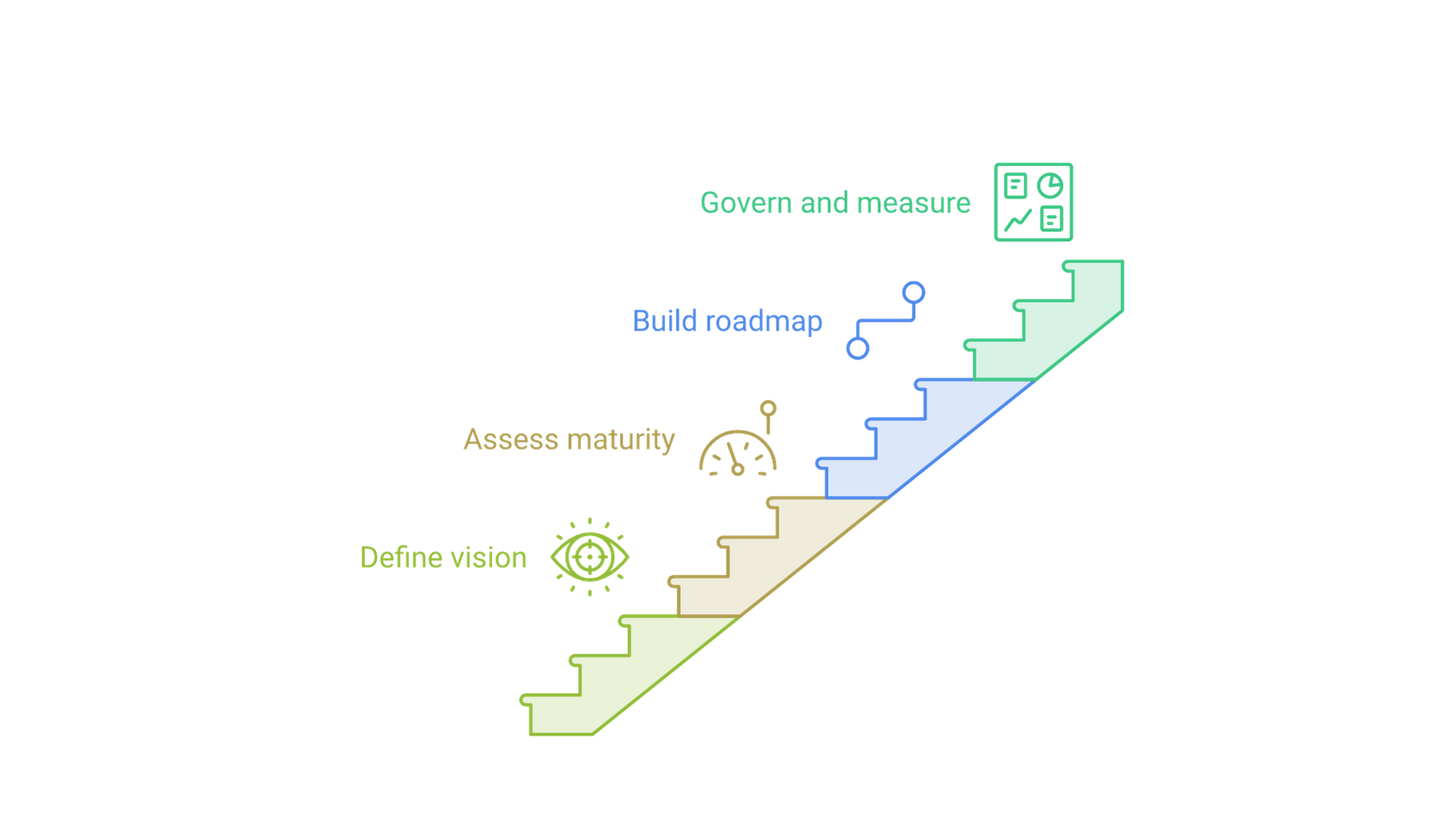
A sensible principle is to start small, think big and scale fast. A successful digital transformation strategy requires the right technology, employee buy-in and a culture that rewards innovation. The steps below walk through defining your vision and objectives, assessing current digital maturity, developing a detailed roadmap and setting up governance.
Define Your Vision and Objectives
An effective digital transformation framework outlines clear objectives to guide the transformation process. Establishing clear, aligned goals makes it possible to prioritize digital transformation initiatives and to explain those priorities to the rest of the organization.
A practical vision balances internal needs with customer expectations. Express it in terms of outcomes, such as a target customer experience score or a cost-to-serve reduction, rather than technologies. That keeps the framework focused and purposeful when new tools appear mid-program.
Assess Current Digital Maturity
A thorough examination of current digital capabilities is crucial for identifying transformation gaps. During the assessment, businesses need to:
- Understand their current technology landscape, including integrations and technical debt.
- Evaluate their skill sets and cultural readiness for change.
- Identify gaps between current and desired states to prioritize efforts and resources.
- Identify areas that need urgent focus to establish a foundation.
This baseline is essential for tracking progress. MIT CISR's two axes are a useful structure for the assessment: rate customer experience and operational efficiency separately, then decide which to move first. Regular re-assessment keeps the program aligned with business goals and shows whether investments are producing the intended movement.
Develop a Detailed Roadmap
A digital transformation roadmap:
- Outlines the purpose and key objectives of the transformation efforts.
- Decides which technologies and capabilities are needed to meet those objectives.
- Sequences initiatives to deliver early value and reduce risk during implementation.
- Sets timelines and allocates responsibilities for execution.
A clear roadmap ensures a structured and coordinated approach to digital transformation. Tie each item to an outcome metric, and revisit the sequence at fixed intervals rather than treating the plan as fixed.
Set Up Governance and Measurement
Decide who owns each outcome, how funding decisions are made and how progress is reported. BCG's emphasis on effective monitoring toward defined outcomes is a reminder that measurement is a success factor in its own right, not an administrative afterthought. Keep the metric set small enough that leaders actually review it.
Common Challenges and How to Overcome Them
Fostering a culture of adaptability is essential for successful digital transformation. Key elements include:
- Continuous innovation, so the business stays flexible and responsive to market changes.
- A culture that sustains transformation and maintains agility after the initial program ends.
- Breaking down siloed departments that hinder the collaboration transformation depends on.
A second common challenge is communication: teams need a shared language that matches the framework, or each function will interpret goals differently. Strategies to address this include:
- Establishing continuous monitoring so the organization can adjust its digital strategy based on evidence.
- Providing employees with adequate training and resources so they can take part in the transformation.
- Creating a dedicated change leadership team to facilitate a smoother transition.
A third challenge is fragmentation. When business units or country leaders launch their own initiatives, a company can end up on several uncoordinated paths at once. MIT CISR's 2021 pathways update found that companies on multiple, well-coordinated pathways reported their transformations as 59% complete on average, compared with 30% for companies on multiple pathways without coordination. Running more than one pathway should be a deliberate decision with shared data, processes and components.
Effective governance and strong leadership are essential to maintain momentum and accountability. Continuous monitoring, employee training and leadership commitment from the CEO through middle management are what keep a framework from becoming shelfware.
Success Stories: Companies Excelling in Digital Transformation
Digital transformation is crucial for businesses that want to remain competitive and meet evolving customer demands. Microsoft, Nike and Domino's are often cited as companies that have used digital technology to reshape their operations and customer experience. The examples below describe publicly known strategic shifts; they are illustrations, not evidence that any particular framework was used.
Microsoft's Cloud Computing Shift
Microsoft moved from a business centered on packaged software licenses to one centered on cloud services, giving customers scalable, on-demand access to computing resources. The scale of that shift shows in its current results: in its fiscal 2026 fourth-quarter results, reported on July 29, 2026, Microsoft said Microsoft Cloud revenue was $59.3 billion for the quarter, up 27% year over year.
The lesson for framework design is that the transformation changed the business model, pricing, sales motion and engineering practices together, not only the technology. That is the kind of whole-business change that MIT CISR's Pathway 4 and McKinsey's capability model describe.
Nike's Data-Driven Personalization
Nike built a digital ecosystem that includes e-commerce, member apps and personalized shopping experiences. Its apps sell directly to consumers and use data to tailor recommendations and content to individual preferences and behaviors, strengthening the direct relationship with customers.
In framework terms, this is a customer-experience-first move: the business invested in an integrated experience and the data behind it, which then created pressure to modernize the operations that fulfill it.
Domino's Digital Ordering Innovations
Domino's is widely cited for investing early in online and app ordering, and for extending ordering to a broad range of channels, including voice assistants, smart devices and messaging platforms. The company has also used conversational ordering to answer customer requests quickly.
The common thread is persistent focus on making ordering easier, delivered through repeated small releases rather than one large launch. That pattern resembles MIT CISR's Pathway 3, alternating improvements to customer experience and to the operations behind it.
Factors to Consider When Choosing a Digital Transformation Framework
When selecting a digital transformation framework, organizations should make sure that:
- The chosen framework addresses their biggest gap and provides clarity on intended outcomes.
- The model supports organizational goals and objectives and fits the overall business strategy.
- Budget considerations are addressed, with the framework matching the resources available for transformation.
- The framework's vocabulary and ceremonies fit the organization's size and culture.
Legal constraints and industry regulations can significantly affect technology adoption choices during transformation. Regulated industries usually need stronger architecture governance, documented decisions and audit trails, which favors pairing agile delivery with formal architecture and risk processes. The technology selected should help the company analyze data effectively, personalize customer interactions and safeguard user information.
The technology implemented should also support effective job performance and employee productivity. Finally, consider the cost of adoption itself: training, certification, tooling and the time leaders spend in new governance forums. A lighter framework that is actually used will outperform a comprehensive one that is only partly adopted.
Frequently Asked Questions
What is a digital transformation framework?
A digital transformation framework is a structured guide that helps an organization plan and execute digital initiatives in line with its business goals. It typically defines the target state, the path to get there, and the practices teams and leaders use along the way.
Why are digital transformation frameworks important?
They provide strategic direction, improve decision-making and align stakeholders around shared outcomes. BCG's 2020 research found that about 70% of digital transformations fall short, and that getting six key factors right raised the odds of success from 30% to 80%.
What are some examples of leading digital transformation frameworks?
Widely used examples include MIT CISR's Four Pathways to Future Ready, McKinsey's Rewired, BCG's six success factors, the TOGAF Standard, Lean and SAFe for delivery, and Kotter's 8 Steps and Prosci's ADKAR Model for change management.
What are the key components of an effective digital transformation framework?
Clear strategy and outcomes, leadership commitment, capable talent, a modular technology and data platform, agile governance, progress monitoring, and attention to customer experience and to how people adopt change.
Can you combine more than one framework?
Yes, and most large programs do. A common pattern is one framework per layer: a strategic model for direction, an architecture method for design, a delivery framework for execution and a change model for adoption, connected by shared governance.
How can I create my own digital transformation framework?
Define your vision and objectives, assess your current digital maturity, develop a detailed roadmap tied to outcome metrics, and set up governance and measurement. Borrow proven parts of existing frameworks rather than starting from a blank page.
Summary: Choosing the Right Digital Transformation Framework
Digital transformation frameworks are essential tools for guiding organizations through the complex process of digital change. By providing strategic direction, surfacing risks and aligning efforts with business objectives, they make transformation initiatives more likely to succeed and to last. The most effective programs recognize that the best-known frameworks each cover one layer, from MIT CISR's pathways and McKinsey's Rewired for strategy to TOGAF for architecture, Lean and SAFe for delivery, and Kotter and ADKAR for change.
In 2026, the right approach is usually a small, deliberate combination rather than a single framework: choose a direction, design the architecture to support it, deliver iteratively and invest in adoption, with clear outcomes and continuous assessment holding it together. Whether you adopt an established model or build your own, focus on the gap that is holding the business back today.
If you are deciding which frameworks fit your organization and how to turn them into a working roadmap, talk to Cognativ about your transformation.