

Understanding Digital Transformation: Key Insights, Essentials and Strategies for Your Business
A plain-language explainer for business leaders on digital transformation: how it differs from digitization, where it changes a company and how to measure it.
Digital transformation means using digital technology to fundamentally change how a business operates and how it delivers value to customers. It is essential for staying competitive and for meeting customer expectations that keep rising as everyday digital services improve. Yet the term is used so loosely that many leadership teams struggle to say what it includes, where it starts and how they will know it worked.
This guide explains what digital transformation is and is not, why organizations pursue it, which parts of the business it changes, which technologies enable it, and how to plan, govern and measure it. It is written for business leaders rather than engineers, and it favors durable principles and documented examples over trend lists. Where figures appear, they come from named primary sources and are labeled as forecasts or company statements.
Short answer: digital transformation is a business change program, not a technology purchase. Technology makes new ways of working possible, but the transformation itself happens in the business model, the processes, the products, the skills and the culture of the organization.
Key Takeaways
- Digital transformation integrates technology with business processes and requires a rethinking of business models, operating routines and culture, not just new tools.
- The main drivers are customer expectations, competitive pressure and the need for operational efficiency, with data silos and legacy systems as common obstacles.
- It touches five connected areas: the business model, processes, products and services, the employee experience and the customer experience.
- Success depends on strategy, leadership and change management at least as much as on technology, and on measuring outcomes rather than activity.
- In 2026, AI and generative AI are a major focus of transformation investment, which makes data quality and AI governance part of the transformation agenda.
Understanding Digital Transformation
Digital transformation means integrating technology with business processes to fundamentally change how organizations operate and deliver value to customers. It is not merely about adopting new digital tools; it is about reimagining how the business works end to end. A comprehensive transformation encompasses cultural shifts, redesigned processes and the use of digital data to drive decisions. IBM describes it as a business strategy initiative that incorporates digital technology across all areas of an organization, a framing that puts strategy before technology.
Digital transformation became a necessity for most businesses because of rapid technological change and industry disruption. Customers expect to interact with services anytime, anywhere and on any device, and they compare every company with the best digital experience they have had elsewhere. The COVID-19 pandemic accelerated this shift by forcing many organizations to move sales, service and collaboration online almost overnight, and many of those changes became permanent.
Achieving successful digital transformation involves balancing strategy, structure, systems, skills, shared values, style and staff. Those seven elements come from the 7-S model that Tom Peters, Robert Waterman and colleagues developed at McKinsey around 1980. The model is useful here because it shows that changing systems without changing structure, skills or shared values rarely holds. Organizations should tailor their approach to the customer value they want to create, so the transformation stays aligned with their own business goals rather than with a generic template.
A working definition for business leaders
For planning purposes, a practical definition is: digital transformation is the deliberate redesign of how an organization creates, delivers and captures value, using digital technology and data as enablers, and managed as a continuing business program with clear outcomes. Each part of that sentence matters. "Deliberate" separates it from ad hoc tool adoption. "Creates, delivers and captures value" points at customers and revenue, not only at internal efficiency. "Continuing" acknowledges that there is no finish line, because customer expectations and available technology keep moving.
Why strategy, not technology, leads
Research from MIT Sloan Management Review and Deloitte reached the same conclusion years ago. Their 2015 study, based on a survey of more than 4,800 executives, managers and analysts, found that digital maturity is the product of strategy, culture and leadership rather than of any single technology. More mature organizations used digital tools to transform how the business worked, while less mature ones applied them to narrow operational problems. The finding is a useful test for any program: if the plan is a list of systems to buy, it is not yet a transformation strategy.
Digitization, Digitalization and Digital Transformation
Three related terms are often used interchangeably, and the confusion leads to programs that are either too small or too vague. Separating them helps leaders scope work honestly.
Digitization
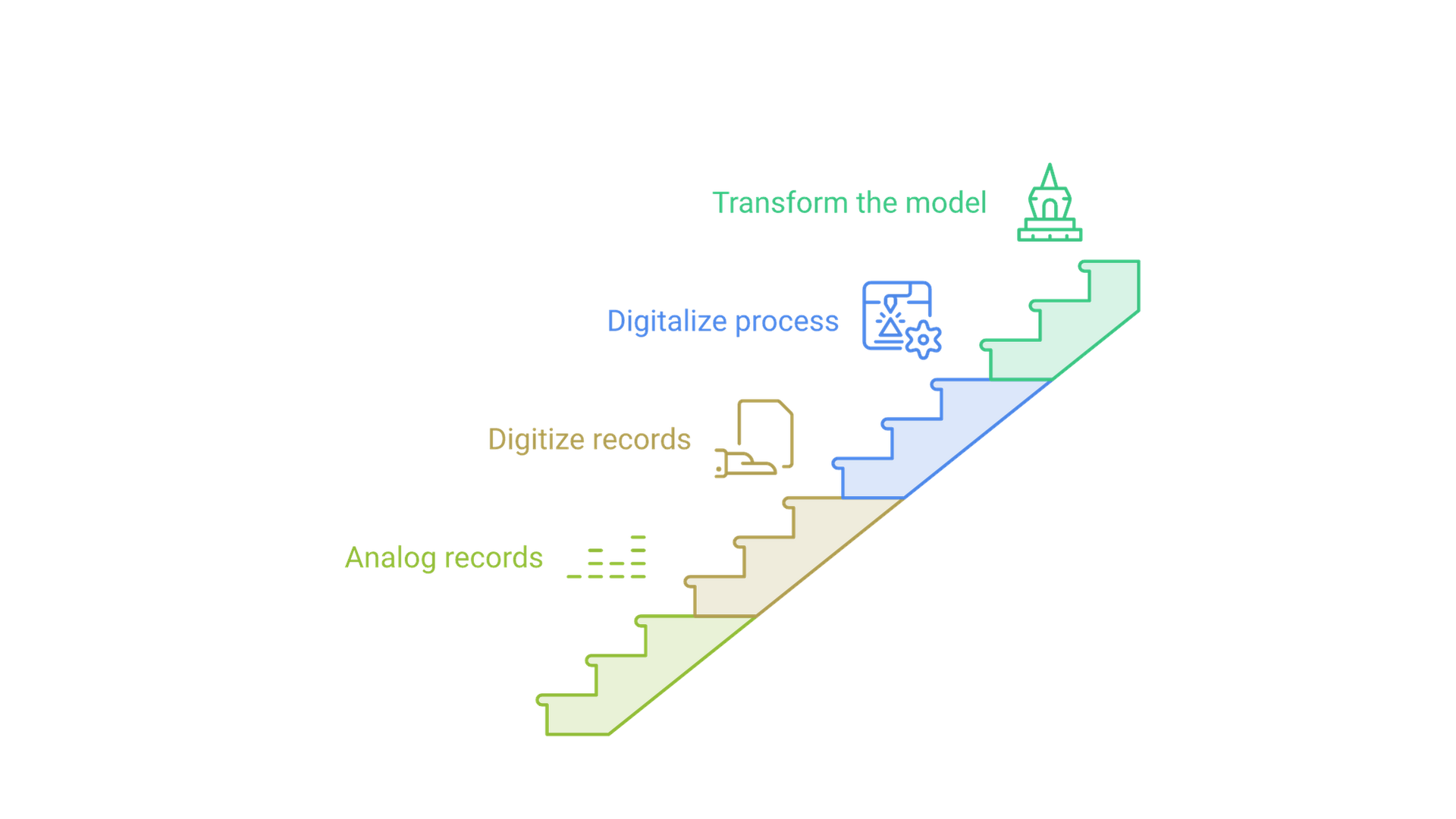
Digitization converts analog information into digital form. Scanning paper invoices, moving customer records from filing cabinets into a database or replacing paper forms with PDFs are all digitization. It is a necessary foundation, but on its own it changes little about how work is done; the same process now runs on digital files.
Digitalization
Digitalization uses digital technology to change a process or workflow. An invoice that is captured automatically, validated against a purchase order and routed for approval without manual rekeying is digitalized. Digitalization usually improves speed, accuracy and cost within an existing business model.
Digital transformation
Digital transformation goes further and changes the business itself: what the company offers, how customers buy, how teams are organized and how decisions are made. A manufacturer that uses connected equipment data to sell uptime as a service, rather than only selling machines, has changed its business model. In practice, transformation programs contain plenty of digitization and digitalization work; the difference is that those projects serve a defined change in how the organization creates value.
Key Drivers of Digital Transformation
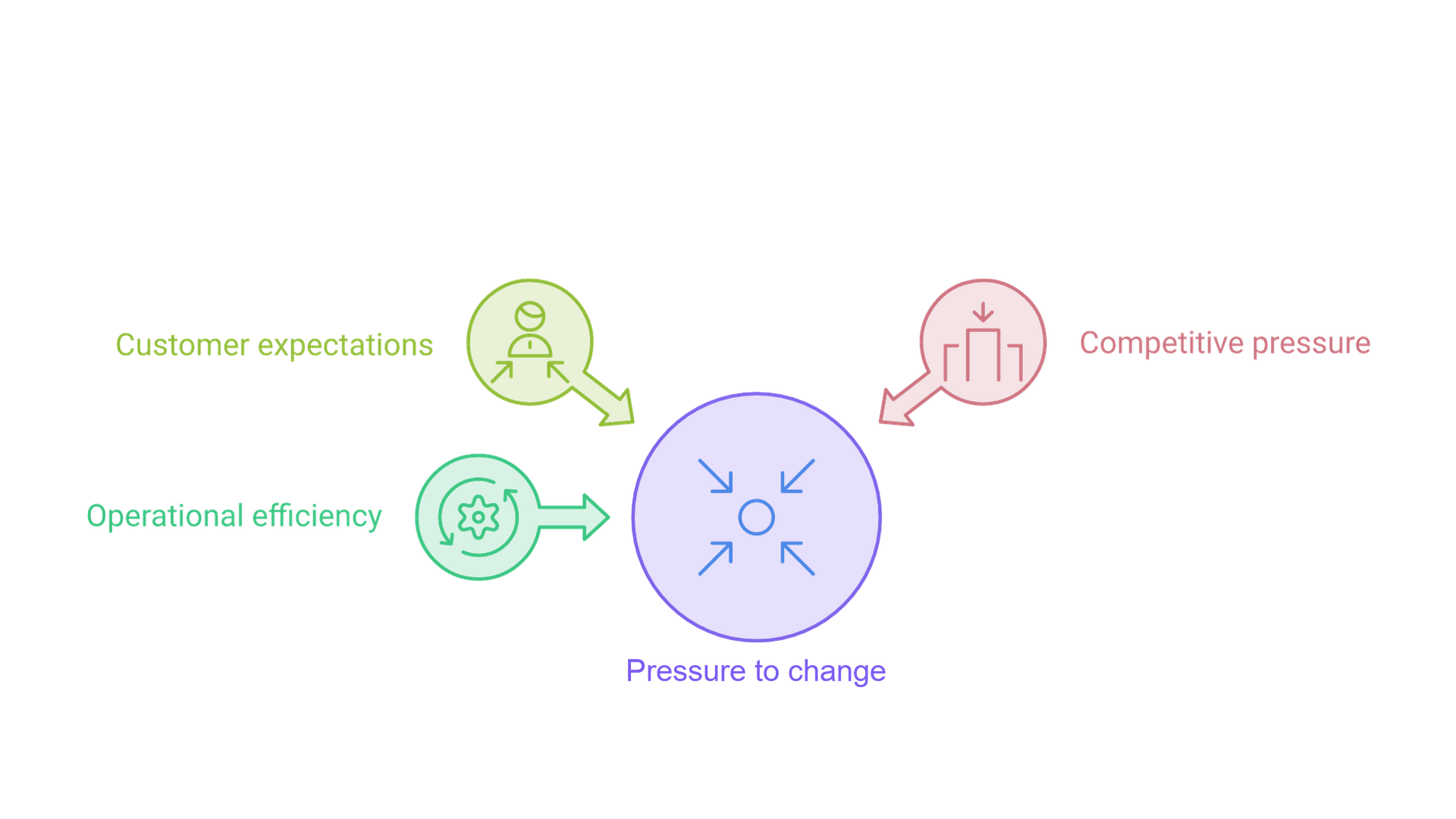
The key drivers of digital transformation are multifaceted, but at the core the work is about meeting and exceeding customer expectations. Enhanced digital experiences have raised what customers expect from every business, compelling companies to keep improving their digital offerings. Consumers want to do business anytime, anywhere and on any device, which makes digital channels a crucial part of purchasing decisions in both consumer and business-to-business markets.
Competition is another crucial driver. As industries such as insurance and retail undergo digital transformation, competitors must follow to stay relevant. Business model innovation often emerges as companies respond to shifts in how customers consume products and to new entrants that start without legacy systems. IBM's case study of Audi, for example, describes how the carmaker needed to expand into electric vehicles and connected services to keep pace with newer electric-car competitors, a strategic change that depended on data and digital capabilities.
Improving work for employees and streamlining operations are equally important drivers. Breaking down data silos and building data literacy let teams make faster, better-informed decisions. Telecom, media and technology companies, for example, use analytics to design new services and personalize customer experiences. Understanding which driver matters most in your market helps you prioritize transformation work, because a program driven by customer experience looks very different from one driven by cost.
Market and regulatory pressure
Regulation increasingly shapes transformation as well. Data protection, accessibility and sector rules affect how digital services must be designed, and AI-specific regulation now affects how AI features can be deployed. In the European Union, the AI Act entered into force on 1 August 2024 and became generally applicable on 2 August 2026, with some high-risk obligations extended to 2027 and 2028. Organizations that operate in or sell into the EU need to treat compliance as a design input, not an afterthought.
The investment signal
Spending forecasts show how central transformation has become to technology budgets. In May 2024, IDC forecast that worldwide digital transformation spending would reach almost $4 trillion in 2027, with AI and generative AI named as the main forces pushing investment. A forecast is not proof of value, and it does not tell any single company what to spend, but it does show that competitors are investing.
Core Areas of Digital Transformation
Digital transformation impacts several core areas within an organization. The three classic areas are business model innovation, process optimization and product and service enhancement. Many current frameworks, including IBM's, add the employee experience and the customer experience as distinct areas, because both determine whether the other changes are adopted. Each area plays a role in reshaping how businesses operate and compete.
Understanding the significance of each core area shows how they contribute together to a successful digital transformation, and why progress in one area often stalls without progress in another.
Business Model Innovation
Business model innovation is at the heart of digital transformation. Organizations rethink traditional business models to align with how digital customers discover, buy and use products. This involves a fundamental change in how an organization delivers products, services and value. Netflix is a familiar example: its service depends on personalization, and the company explains that its recommendation system estimates how likely each member is to enjoy each title using viewing history, similar members' preferences, title details and context such as time of day and device.
A digital-first approach enables businesses to scale their systems as they grow, meet changing customer expectations and differentiate in a competitive market. Small and medium-sized businesses benefit from building scalable capabilities early, so that growth does not require rebuilding core systems later.
Business model innovation is not just about adopting new technologies but about redefining how a business operates and engages with its customers. Subscription offers, platform and marketplace models, usage-based pricing and data-enabled services are common patterns. By embracing digital innovation within a solid business strategy, organizations can create new revenue streams, enhance customer experiences and stay ahead of the competition.
Process Optimization
Process optimization improves operational efficiency by redesigning systems and workflows. Automation can increase productivity and remove repetitive manual work. IBM's case study of energy company Wintershall Dea, for example, describes an AI program that automated data extraction from 2,000 PDF documents, freeing employees for higher-value work.
Integrating process optimization into transformation strategy supports sustainable growth. By using digital tools, businesses can streamline workflows, automate tasks and reduce manual effort, improving efficiency and agility. The important discipline is to redesign the process before automating it; automating a broken process only produces broken results faster. Process work also depends on clean, consistent data moving between systems, which is why data transformation practices such as standardizing, validating and reshaping records often sit underneath visible process improvements.
Product and Service Enhancement
Integrating digital technology into products and services helps businesses meet evolving customer expectations. Manufacturers can use sensor data to detect product flaws and plan machinery maintenance before failures occur. This proactive approach improves product quality and customer satisfaction at the same time.
Digital product management shifts organizations from one-off projects to long-lived products that are improved continuously based on usage and feedback. Web and app-based self-service portals in sectors such as insurance let customers compare options, enroll and file claims without waiting for an agent. Digital product managers play a crucial role in this transition because they own outcomes rather than delivery dates.
By applying new and emerging technologies, businesses can offer digital services and products that meet the demands of today's customers, and they can learn from real usage data what to build next.
Employee Experience
Employees are the people who make new processes work, and their tools shape how quickly they can serve customers. Transformation that adds new systems without retiring old ones, or that forces staff to switch between many screens to complete a single task, creates friction and resistance. Improving the employee experience means simpler internal tools, access to the right data, training that matches real tasks and a clear explanation of why the change matters.
Customer Experience
Customer experience is where most transformation efforts are judged. Customers do not see an organization's architecture; they see whether they can find what they need, complete a purchase, get support and trust the company with their data. Mapping customer journeys, identifying the moments that cause effort or drop-off, and redesigning those moments end to end is often the most direct way to connect transformation work to revenue and loyalty.
Technologies Enabling Digital Transformation
Several families of technology make modern transformation possible. None of them is a strategy by itself, and the right mix depends on the outcomes you are pursuing.
- Artificial intelligence (AI): uses data to automate decisions, predict outcomes and generate content, and is now the main focus of many transformation budgets.
- Machine learning: learns patterns from data to classify, forecast and personalize customer interactions.
- Generative AI and natural language processing: drafts text, summarizes documents, answers questions and supports customer service and knowledge work.
- Retail applications: retailers use AI and machine learning for personalized marketing, recommendations and demand forecasting.
Cloud computing provides scalable infrastructure that supports remote collaboration, faster delivery and business growth. Migrating from on-premises data centers to cloud platforms lets organizations scale capacity up and down and adopt managed services rather than operating every component themselves. Cloud adoption also changes cost structures, shifting spending from capital investment toward operating expense, which needs its own financial governance.
The Internet of Things (IoT) equips devices to collect and transmit real-time data, which supports better decisions. IoT-enabled sensors can give insurers data for risk assessment and claims management, and they help manufacturers and logistics firms track assets and equipment condition.
Mobile devices drove many early digital transformation initiatives and helped create new business models, from mobile banking to on-demand services. Today, mobile, cloud, AI, IoT and data platforms work together: data flows from devices and applications into shared platforms, AI models turn that data into predictions or actions, and mobile and web interfaces put those capabilities in front of employees and customers. Application programming interfaces (APIs) and integration platforms connect these pieces so that new services can be added without rebuilding everything.
Data as the common foundation
Every technology on this list depends on data that is accurate, accessible and governed. Organizations with fragmented data across departments usually find that their first transformation investments go into integration, data quality and shared definitions rather than visible new features. That work is easy to underestimate, yet it determines whether analytics and AI produce trustworthy results.
Benefits of Embracing Digital Transformation
Embracing digital transformation offers benefits for both business operations and customer engagement. A significant advantage is the ability to deliver personalized experiences, which can improve customer satisfaction and loyalty. Enhancing customer experience is a key motivator for transformation initiatives, as businesses work to improve every interaction and build stronger relationships.
Digital transformation can also create a competitive advantage by:
- Attracting talent and increasing business value through modern tools and ways of working.
- Improving operational efficiency through automation and streamlined workflows, so tasks are completed faster and with fewer errors.
- Allowing businesses to respond quickly to market changes and customer demands, fostering innovation and growth.
- Improving decision-making with timely, shared data instead of delayed reports assembled by hand.
- Strengthening resilience, since digital channels and cloud infrastructure can keep operating when physical operations are disrupted.
Digital technology also helps organizations reach new markets, open new revenue streams and refine sales strategies with better insight into customer behavior. These benefits are possibilities rather than guarantees. They appear when the transformation is tied to specific outcomes and when the organization changes its processes and habits along with its tools.
Challenges in Digital Transformation
Despite its benefits, digital transformation presents real challenges. Cultural challenges arise from established mindsets, especially where traditional processes are deeply entrenched and have worked well for years. Shifting to a digital-first culture requires sustained change management and genuine employee buy-in, not a single announcement.
Many organizations also struggle with insufficient digital and IT skills, which limits what they can design, build and operate. Budget limits can slow progress further, particularly when scope creep turns a focused initiative into an open-ended program.
Complex legacy systems and training difficulties contribute to integration problems that undermine transformation efforts. Older systems may hold critical data in formats that are hard to access, and replacing them carries operational risk. Recognizing and addressing these challenges early is crucial for achieving successful transformation.
Why transformation programs stall
Common patterns behind stalled programs include unclear ownership between business and IT, too many parallel initiatives competing for the same people, success measured by systems delivered rather than outcomes achieved, and pilots that never move into production because nobody planned for scale. Each of these is a management problem more than a technical one, which is why the strategy and governance choices in the next section matter.
AI-specific risks
As AI becomes a larger part of transformation, it adds risks of its own: inaccurate or biased outputs, exposure of confidential data, unclear accountability for automated decisions and new regulatory obligations. The U.S. National Institute of Standards and Technology published its voluntary AI Risk Management Framework in January 2023 and a generative AI profile in July 2024, and many organizations use it as a reference. A practical enterprise AI governance framework matches controls to the risk of each use case so that oversight does not freeze useful work.
Strategies for Successful Digital Transformation
Successfully implementing digital transformation requires careful planning and disciplined execution. Strategies should prioritize business outcomes over technology. Technology plans must align with established business strategy, and organizations should define their business goals before starting any transformation work.
Involving a diverse team across departments improves the odds of success, because transformation crosses functional boundaries by design. Feedback from stakeholders, customers and frontline employees is essential to refine the strategy over time. Scaling successful initiatives can then involve applying proven approaches across more locations, business units and technologies.
Ongoing workforce training gives employees the skills to use digital tools well and the confidence to change how they work. Organizations with robust change management are better placed to meet their transformation goals. By focusing on these strategies, businesses can use technology to drive change and achieve their objectives.
Build a digital transformation roadmap
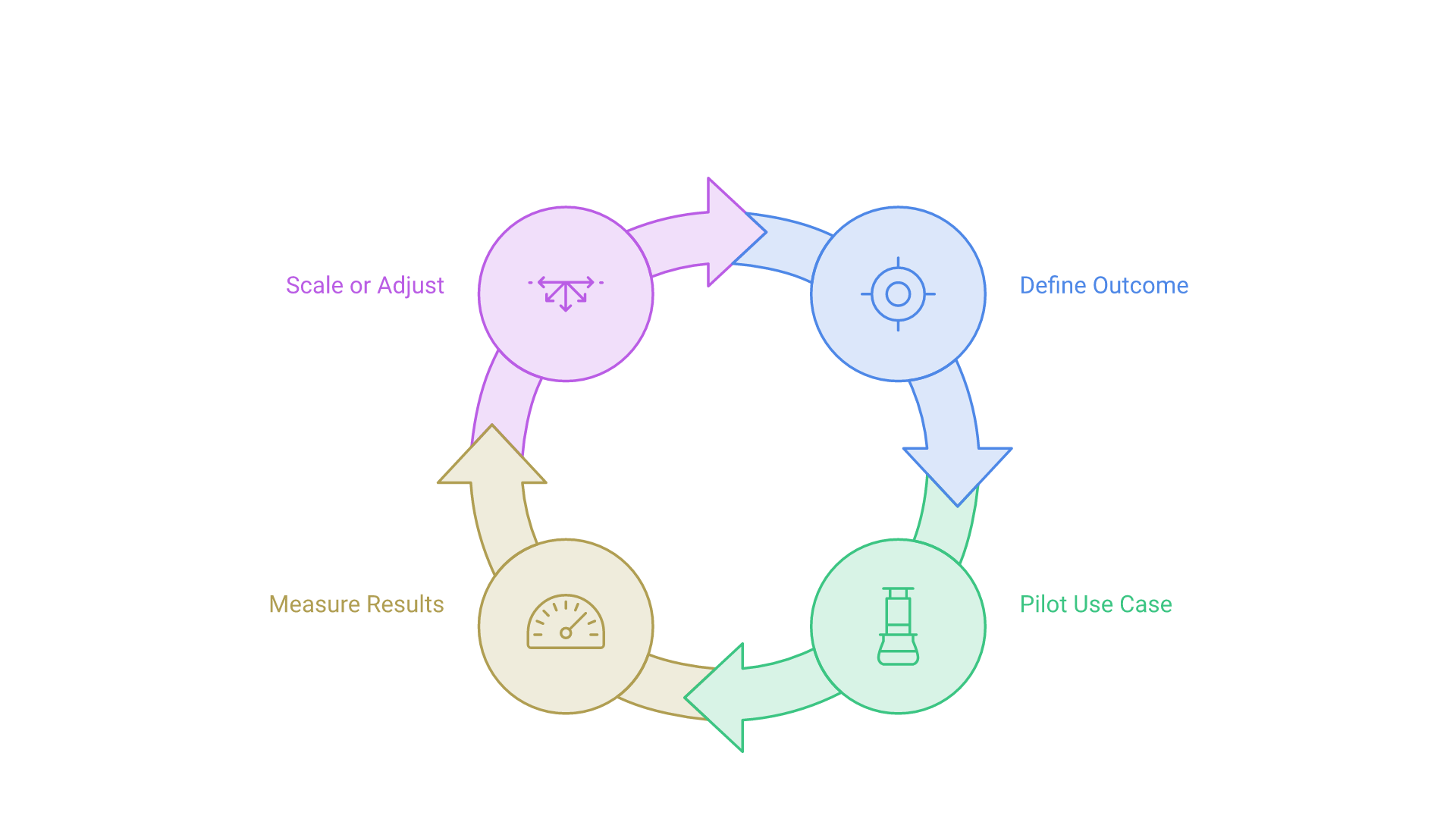
A roadmap turns strategy into a sequence of decisions. A practical approach follows a few steps. First, define the business outcome in measurable terms, such as reducing customer onboarding time or increasing digital sales share. Second, assess the current state of processes, systems, data and skills honestly. Third, prioritize a small number of initiatives by value and feasibility. Fourth, pilot one initiative with clear success measures. Fifth, scale what works and stop what does not. Leadership teams that want outside help with this work, including process redesign, operating model and change delivery, can look at Cognativ's business transformation consulting.
Assign roles and governance
Transformation needs a visible executive sponsor, a business owner for each initiative and technology leadership that is part of the decision rather than a downstream supplier. Many organizations create a small transformation office to coordinate priorities, track outcomes and remove blockers. Product managers, data specialists, architects, designers and change managers each play a role. Governance should be lightweight enough to keep work moving and firm enough to stop initiatives that are not delivering.
Choose technology deliberately
Technology choices should follow the roadmap. Decide which capabilities to buy, which to build and which to retire, and plan how systems will integrate before you commit. A short architecture review that weighs options against business priorities can prevent costly rework; Cognativ's technology strategy and advisory work focuses on that step. When software is built, proven modern software development practices such as small changes, fast feedback and automated quality checks keep delivery predictable.
Make culture part of the plan
Culture is not a soft topic to address after the systems are live. Leaders shape it through what they measure, what they fund and what they celebrate. Encouraging experimentation, sharing results openly, including when pilots fail, and giving teams time to learn new tools all signal that the change is real. Communicating the reason for the change, in terms that matter to each team, reduces resistance more than any training session alone.
Real-World Examples of Digital Transformation
Real-world examples show how different industries use digital technology to innovate and stay competitive. The patterns below are common across sectors; individual results depend heavily on execution and context.
The following sections look at how digital transformation is changing retail, healthcare and financial services.
Retail Industry
Digital transformation has changed the retail experience by:
- Enhancing in-store experiences with digital tools for staff and shoppers
- Improving e-commerce platforms and mobile apps
- Developing data-driven loyalty programs
- Connecting customer touchpoints across store, web and app
- Using automated systems to create a seamless shopping and fulfillment experience
IoT technology in retail can support automated reordering, for example when shelf or warehouse sensors signal low stock, which reduces manual inventory checks.
Retailers respond to shifts in consumer behavior driven by e-commerce by adopting advanced analytics and customer intelligence tools. These tools reveal customer preferences, so retailers can tailor offers, adjust assortments and improve engagement.
By applying digital technology across stores, supply chains and online channels, retailers can run their operations more efficiently and stay competitive.
Healthcare Sector
Digital transformation in healthcare enables remote patient monitoring, telehealth and digital records that follow patients across providers. Integrating digital technology improves clinical and administrative workflows and speeds up service delivery. Remote monitoring platforms, for example, let providers track patients with chronic conditions between visits, which can reduce unnecessary in-person appointments.
Digital transformation matters for healthcare providers because it can improve both patient care and operational efficiency. Healthcare also shows why governance matters: patient data is highly sensitive, clinical tools are regulated and errors carry real consequences, so security, privacy and validation must be designed in from the start.
Financial Services
Capital One transformed its operations by putting software and cloud infrastructure at the core of its banking services. The bank moved to Amazon Web Services and, in the words of its CIO quoted by AWS, exited all of its data centers and went all in on AWS. Banking institutions more broadly adopt digital solutions for account opening, payments, fraud detection and customer service, which streamline processes and let them respond to market demands more quickly.
The continuing adoption of digital solutions is essential for banks to stay competitive as customers move to digital channels and new financial technology providers enter the market. Financial services also illustrate that transformation is long-running: large migrations of core systems unfold over years and require sustained executive commitment.
Measuring the ROI of Digital Transformation
Measuring the return on investment (ROI) of digital transformation is complex because many benefits are intangible or arrive over time. Data-driven decision-making is still essential for spotting opportunities and handling challenges. Real-time data from transformed processes gives leaders the insight to adjust course quickly.
Financial KPIs assess the monetary impact on the bottom line, including revenue growth, cost savings and profitability. Project management KPIs track completion rates, schedule and resource allocation across initiatives. Monitoring both helps organizations evaluate the effectiveness of their efforts and make informed decisions about where to invest next.
Measuring ROI ultimately requires a comprehensive approach that considers tangible and intangible benefits. By using data and analytics, organizations can understand the impact of each initiative and keep improving their strategy.
A balanced set of measures
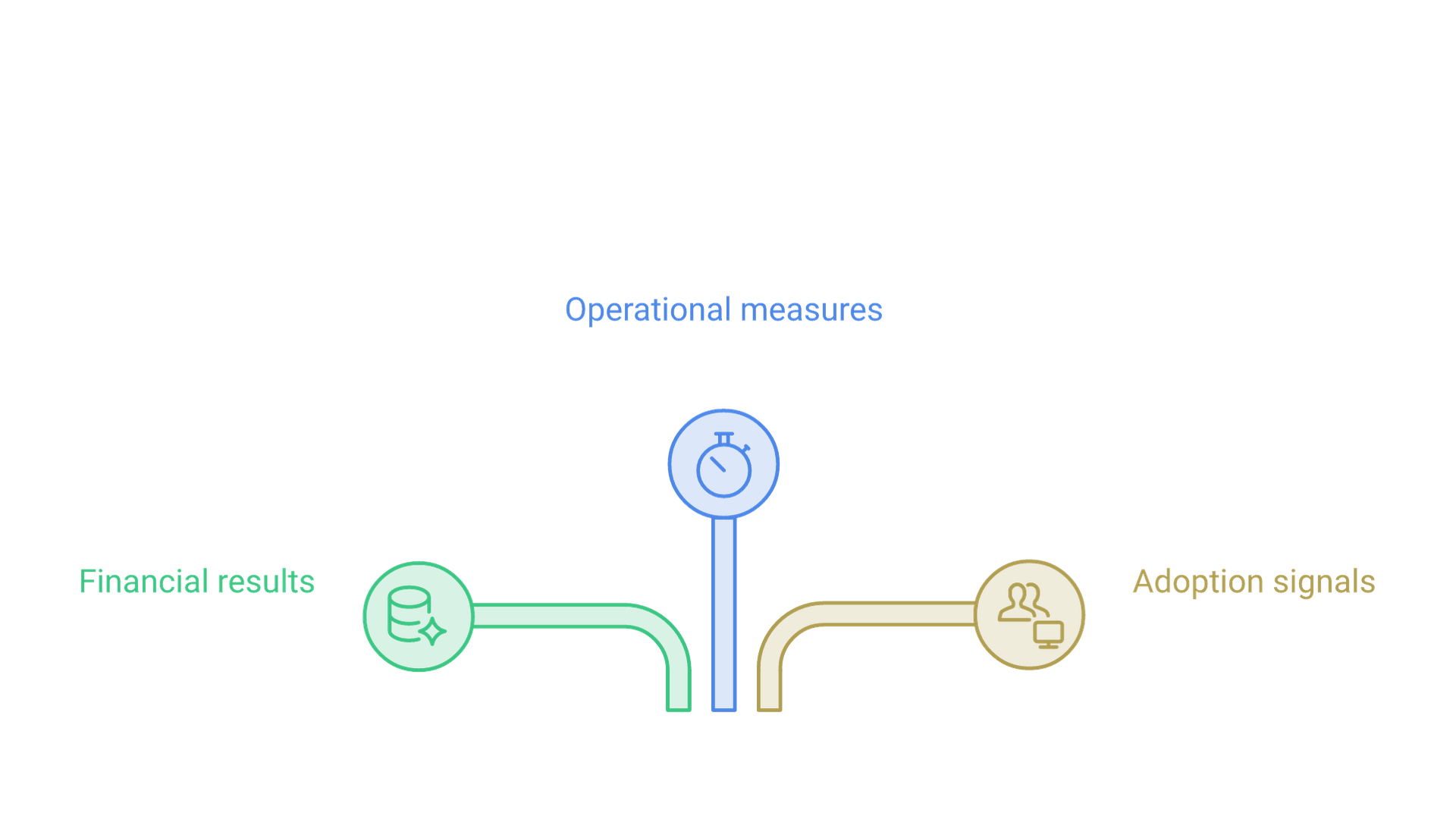
Useful scorecards combine four kinds of measures. Financial results show revenue, margin and cost impact. Operational measures show cycle time, error rates and throughput in the processes that changed. Customer measures show satisfaction, retention and digital adoption. Adoption signals show whether employees actually use the new tools and processes, since an unused system delivers no return. Agree on a baseline before each initiative starts; without one, any later claim of improvement is hard to defend.
Leading and lagging indicators
Revenue and profit are lagging indicators that may take quarters to move. Leading indicators, such as the share of transactions completed digitally or the time to resolve a customer request, show earlier whether an initiative is on track. Reviewing both on a regular cadence lets leaders scale initiatives that work and stop the ones that do not before they consume more budget.
Future Trends in Digital Transformation
The landscape of digital transformation keeps becoming more complex. Recent years have favored pragmatic initiatives, such as launching new digital products and entering new markets, over broad programs without clear results. That emphasis on tangible outcomes continues in 2026.
Barriers such as misaligned incentives and legacy systems remain, and they make it harder to move beyond the status quo. To overcome them, businesses must keep innovating and adapting their strategies to stay competitive.
AI moves from pilots to operations
The most visible trend is the move of AI, and generative AI in particular, from experiments into everyday operations. IDC's forecast names AI and generative AI as the main forces behind transformation spending. In practice this means AI assistants in customer service and knowledge work, AI-supported document processing and, increasingly, AI agents that carry out multi-step tasks across systems under human oversight. The organizations that benefit most tend to be those that already invested in clean data, integration and governance.
Governance and regulation mature
With the EU AI Act now generally applicable and frameworks such as the NIST AI RMF widely referenced, AI governance is becoming a standard part of transformation programs. Expect more attention to documenting how AI systems are used, assessing risk by use case and keeping humans accountable for consequential decisions.
Composable and data-centric architecture
Organizations continue to move away from monolithic systems toward modular, API-connected services and shared data platforms. This makes it easier to change one capability without disrupting others, and it supports the faster, smaller release cycles that continuous transformation requires.
By staying ahead of digital transformation trends, organizations can capitalize on new opportunities and drive sustainable growth, while choosing which trends genuinely serve their strategy and which can wait.
Frequently Asked Questions
What is digital transformation?
Digital transformation fundamentally changes how an organization operates and delivers value by integrating technology with business processes. It requires cultural change and a rethinking of processes, and it emphasizes using digital data to inform decisions.
What are the key drivers of digital transformation?
The main drivers are rising customer expectations, competitive pressure, rapid technological change, regulation and the need for better operational efficiency. Which driver dominates shapes the priorities of each program.
What are the core areas of digital transformation?
The classic core areas are business model innovation, process optimization and product and service enhancement. Many frameworks also treat employee experience and customer experience as core areas.
What technologies enable digital transformation?
Key enabling technologies include artificial intelligence, machine learning, generative AI and natural language processing, cloud computing, the Internet of Things, mobile platforms, data platforms and APIs that connect systems.
How can organizations measure the ROI of digital transformation?
Track financial KPIs such as revenue growth and cost savings alongside operational, customer and adoption measures, and agree on a baseline before each initiative starts. Leading indicators show progress before financial results appear.
What is the difference between digitization and digital transformation?
Digitization converts analog information into digital form. Digitalization uses technology to improve a process. Digital transformation changes the business itself, including its model, operations and culture.
Summary: Making Digital Transformation Work
Digital transformation is not just a technological shift but a comprehensive rethinking of how a business operates and delivers value. By understanding its core areas, business model innovation, process optimization, product and service enhancement, and the employee and customer experience, organizations can navigate their transformation with clearer priorities. Customer expectations, competition, regulation and technological change will keep pushing businesses to evolve.
The benefits range from better customer engagement and operational efficiency to faster innovation and competitive advantage, but they depend on facing the challenges honestly: cultural resistance, skill gaps, legacy systems, budget limits and, increasingly, AI risk. Well-defined outcomes, strong sponsorship, deliberate technology choices and balanced measurement are what turn a collection of projects into a real transformation.
If your leadership team is deciding where transformation should start, how to sequence it or how to measure it, contact Cognativ to discuss your priorities.