


Modern Software Development Best Practices: Essential Insights for 2026
A 2026 guide to modern software development best practices, covering small changes, automated quality gates, secure-by-design delivery and honest measurement.
Modern software development integrates agile methodologies, automation, cloud platforms and, increasingly, AI coding assistants. The tools change quickly, but the practices that separate reliable teams from struggling ones have stayed remarkably stable: small changes, fast feedback, automated quality gates, security built into every phase, and honest measurement of how software actually behaves in production.
This guide updates our earlier overview of software development best practices to reflect what has changed by October 2026. It covers version control and trunk-based development, continuous integration and delivery (CI/CD), the testing pyramid and test-driven development, code review, secure development under the NIST Secure Software Development Framework (SSDF) and OWASP guidance, observability, AI-assisted coding with governance, documentation, and how to measure delivery performance with DORA metrics. Where a claim depends on a standard or a research report, we link to the primary source.
Short answer: the core modern software development best practices in 2026 are to keep work in small batches on a shared trunk, gate every change with automated tests and review, build security in with a recognized framework such as the NIST SSDF, instrument systems so you can see failures, treat AI-generated code as an untrusted contribution that passes the same gates as human code, and measure throughput and stability together rather than chasing speed alone.
The Evolution of Software Development
The landscape of software development has evolved significantly since its early days, moving from simple programming tasks to the disciplined methodologies that define modern software engineering. This evolution reflects technological progress, but it is also a response to the changing needs of businesses and users who expect frequent, reliable updates.
In the early stages, software development was often a linear, rigid process dominated by models like the Waterfall Model. These traditional approaches had their merits, especially where requirements were stable and regulated sign-offs were mandatory, but they made it hard to adapt to new information or changing requirements. Cost, timeline, quality and the value delivered to end users were all shaped by long, sequential phases. Over time, the industry recognized the need for more flexible and responsive approaches, which led to agile methodologies and iterative development processes.
Modern application development focuses on rapid innovation cycles that allow continuous delivery of new features and improvements across web, mobile and backend systems. This shift has increased the agility, reliability, security and scalability of software projects, enabling businesses to respond quickly to market demands. If you want a phase-by-phase view of how planning, design, build, test, deployment and maintenance fit together, our guide to the seven phases of the software development life cycle covers the lifecycle itself; this article focuses on the engineering practices that make each phase work well.
The most recent shift is the arrival of AI assistance in nearly every engineering workflow. Google's 2025 DORA research reports that 90% of surveyed technology professionals use AI at work. That does not replace the fundamentals described below. As the same research argues, AI tends to amplify whatever practices a team already has, which makes the fundamentals more important, not less.
Agile and Iterative Development
At the core of agile methodologies is the concept of iterative development. Teams work in short cycles, often called sprints or iterations, which allow rapid feature delivery and the incorporation of user feedback. This iterative approach increases flexibility and reduces the risks of complex projects by breaking them into manageable increments. Continuous improvement and regular evaluation keep development processes and products evolving in tandem with user needs and market conditions.
Collaboration is another cornerstone of agile development. Open communication and teamwork help software development teams address challenges and innovate solutions. Retrospectives held at the end of each sprint give teams an opportunity to reflect on their performance and identify areas for improvement, reinforcing the commitment to continuous enhancement.
Prototyping and early testing are also integral to agile development. By creating early versions of software and gathering user feedback before finalizing the product, developers can confirm that the application meets user expectations and requirements. Proactive user engagement distinguishes agile development from traditional methodologies.
Small batches are the practice that matters most
Agile ceremonies are easy to adopt and easy to hollow out. The underlying practice that carries most of the benefit is working in small batches: slicing features so each change can be built, tested, reviewed and released in hours or days rather than weeks. DORA lists working in small batches as one of the seven capabilities in its 2025 AI Capabilities Model, alongside strong version control practices and quality internal platforms. Small batches shorten feedback loops, make code review practical and make rollbacks cheap, and they matter even more when AI tools make it easy to generate large amounts of code at once.
Key Principles of Modern Software Development
Modern software development is guided by a handful of core principles that help teams create high-quality, user-centric applications. One of the most important is user-centric design, which focuses on intuitive, responsive software that meets the real needs of users. Prioritizing user experience helps development teams build applications that are both functional and pleasant to use, with deliberate attention to usability, accessibility and a clear user interface.
Automation plays a critical role in modern development, reducing human error and accelerating release cycles. Automated testing, continuous integration and deployment pipelines streamline the development process and keep code quality consistent. This emphasis on automation helps teams deliver working software more efficiently and with fewer defects.
Continuous learning and customer feedback integration are also essential. Regularly gathering and incorporating user feedback keeps software aligned with evolving user expectations and market demands, which improves customer satisfaction. This iterative approach encourages ongoing support and improvements and builds a culture of continuous improvement.
Collaboration among cross-functional teams is another key principle. Bringing together diverse skill sets and perspectives helps teams align technical execution with business objectives. This collaborative approach keeps every part of a software project, from design to deployment, coordinated with the organization's goals.
Principles that have hardened into expectations
By 2026, several principles that used to be aspirational are now baseline expectations from customers, auditors and regulators:
- Secure by default. CISA's Secure by Design initiative asks software makers to treat security as a core business requirement and ship products that are secure out of the box.
- Everything as code. Infrastructure, pipelines, policies and configuration live in version control and go through the same review as application code.
- Observable by design. Services emit traces, metrics and logs from day one rather than after the first outage.
- Accountable AI use. Teams state clearly which AI tools are allowed, on which data, and how AI-generated changes are reviewed.
Version Control and Code Quality
Version control systems such as Git are foundational to modern software development. They let developers track every change to the code, identify where issues were introduced and roll back to earlier versions when necessary. This capability protects the integrity of the codebase, especially when many developers work on the same project.
Version control also makes collaboration possible at scale. Developers can work on different features at the same time and integrate their changes, keeping the whole team aligned. Git records snapshots of the codebase at each commit, which gives teams a complete, auditable project history.
Combining version control with automated checks and code review raises code quality and keeps best practices consistent. Platforms such as GitHub provide GitHub Actions, which automate workflows directly within repositories by reacting to events like pushes and pull requests. Integrating version control with automated tools produces code that is robust, secure and maintainable.
Trunk-based development
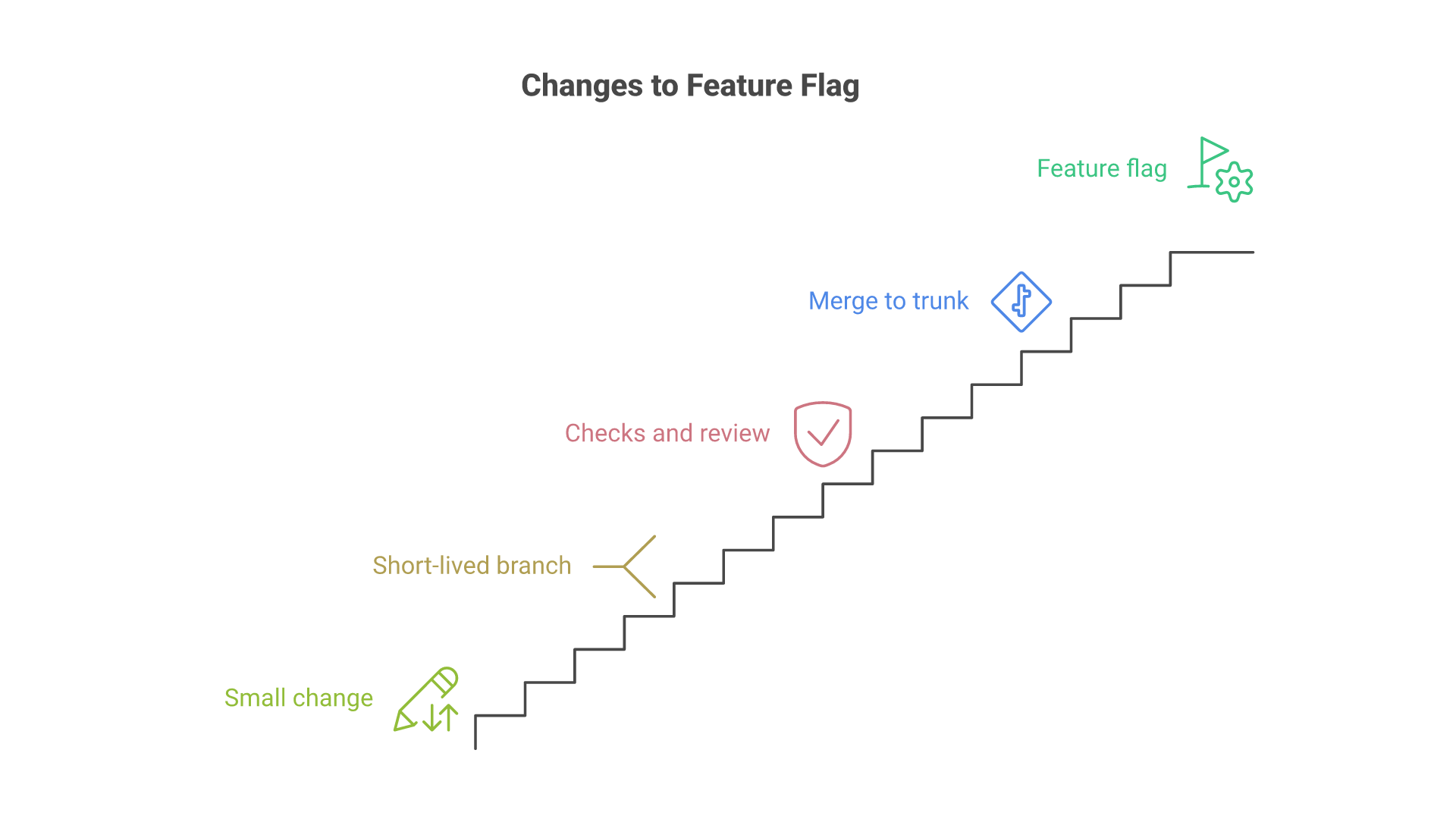
Trunk-based development is the branching model most strongly associated with high delivery performance. In DORA's description of trunk-based development, developers split work into small batches and merge into the main branch (trunk) at least once a day, branches live for no more than a few hours, the repository has three or fewer active branches, and there are no code freezes or long integration phases. DORA treats trunk-based development as a prerequisite for real continuous integration.
Long-lived feature branches feel safer, but they postpone integration until the end, when conflicts are largest and the context is oldest. Trunk-based teams instead hide unfinished work behind feature flags, so code can be merged and deployed before a feature is released to users. The flag becomes a release decision rather than a merge decision, and it can be turned off without a redeploy if something goes wrong.
Protecting the trunk
A shared trunk only works if it is protected. Repository rules should block force pushes to the main branch, require at least one review on every pull request and require passing automated checks before merge. GitHub's repository rulesets, for example, can require pull request reviews and signed commits and restrict who can push to a branch. Commit signing and clear commit messages also strengthen provenance, which matters for supply-chain security later in this guide.
DevOps and Continuous Integration/Continuous Deployment (CI/CD)
DevOps has become a cornerstone of modern software development, emphasizing collaboration and shared responsibility between the people who build software and the people who run it. By breaking down silos and fostering continuous improvement, DevOps strengthens the whole development process. One of its key components is continuous integration and continuous deployment (CI/CD), which enables frequent code integration and reliable deployment.
Continuous integration means every change is merged into the trunk and verified by an automated build and test suite, ideally within minutes. Continuous delivery extends that guarantee so the trunk is always in a releasable state, and continuous deployment goes one step further by releasing every change that passes the pipeline to production automatically. Many teams practice continuous delivery with a manual approval step for regulated or high-risk systems, which is a legitimate choice as long as the pipeline, not a person, does the verifying.
Selecting the right CI/CD tools is essential for optimizing development workflows. Modern CI/CD platforms run builds in containers or virtual machines, which improves scalability and reproducibility. This flexibility is particularly valuable in cloud-native environments, where rapid resource provisioning and deployment are critical.
What a strong pipeline includes in 2026
A modern pipeline does more than compile and run unit tests. Typical stages include dependency installation from pinned versions, static analysis and linting, unit and integration tests, secret scanning, software composition analysis for known-vulnerable dependencies, container image scanning, and generation of a software bill of materials (SBOM). Build provenance is increasingly expected too. The SLSA specification, now at version 1.2, defines levels of build integrity and provenance that help consumers verify that an artifact was built from the source it claims.
Deployment strategies such as blue-green deployments, canary releases and progressive rollouts limit the blast radius of a bad change. Combined with automated rollback and feature flags, they let teams deploy often without betting the whole system on each release. Integrating CI/CD into workflows in this way protects the user experience and maintains code quality, because issues are found by automated feedback loops before customers find them.
Test-Driven Development (TDD) and the Testing Pyramid
Automated testing is what makes frequent delivery safe. Without it, every release depends on manual regression checks that grow slower as the product grows. Two ideas shape how modern teams approach testing: the testing pyramid, which describes how to balance different kinds of tests, and test-driven development, which describes when to write them.
The testing pyramid
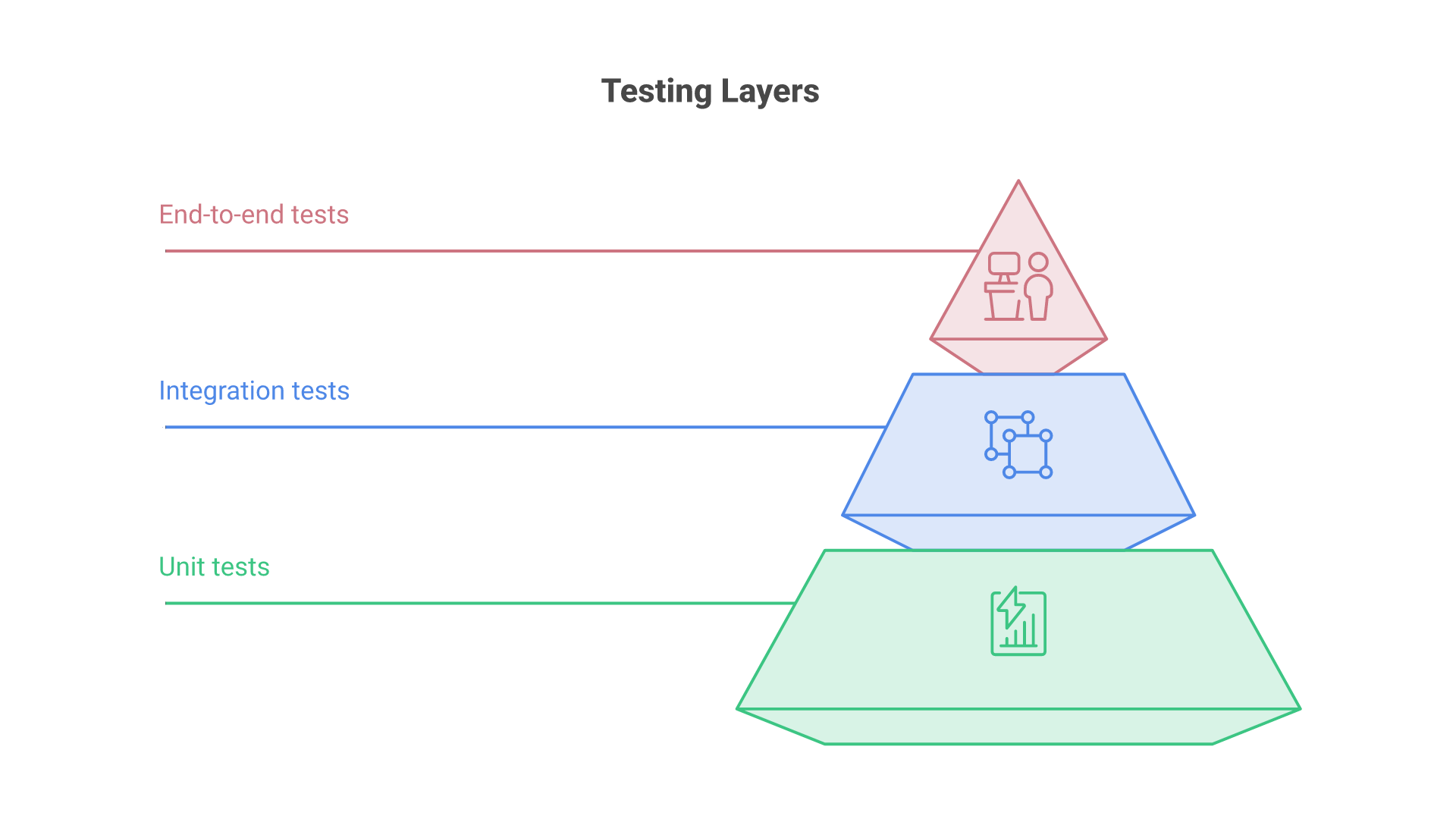
The testing pyramid, introduced by Mike Cohn in Succeeding with Agile and explained in detail in Ham Vocke's Practical Test Pyramid on martinfowler.com, groups automated tests by granularity. The base is a large number of small, fast unit tests. The middle holds fewer integration, service and contract tests that check how components work together. The top holds a small number of end-to-end tests that exercise the system the way a user would. The guiding rule is that the higher the level, the fewer tests you should have, and each behavior should be tested at the lowest level that can catch the failure.
The common anti-pattern is the inverted "ice-cream cone": many slow, brittle end-to-end tests and few unit tests. That shape makes pipelines slow, failures hard to diagnose and refactoring risky. Contract tests deserve special mention in microservice systems, because they verify that a provider still honors the interface its consumers depend on without spinning up the entire system.
Test-driven development
Test-driven development (TDD) is a methodology in which developers write a test before writing the code that satisfies it, so the code meets specified behavior from the outset. This helps catch bugs early, when they are cheapest to fix.
The TDD cycle has three phases, often summarized as red, green, refactor: write a failing test, write the minimal code that makes it pass, then refactor the code while keeping the tests green. This iterative process keeps code continually tested and improved, which leads to higher code quality and more reliable software.
One key advantage of TDD is developer confidence. Validated code lets developers make changes and refactor knowing the tests will flag regressions. A fast feedback loop is essential, because developers need test results in seconds, not minutes, to keep the rhythm. TDD also pairs well with AI coding assistants: a human-written test states the intended behavior precisely, and generated code can then be judged against it rather than against a vague prompt.
Automated tests should run on every pull request, so code quality is verified before changes are merged into the main branch. Code review, discussed next, adds the human judgment that tests cannot provide. Manual and exploratory testing still have a place for usability, accessibility and unexpected behavior, but they should complement automation rather than substitute for it.
Code Review Best Practices
Code review is one of the most effective quality and knowledge-sharing practices in software engineering, and one of the easiest to do badly. A review should check that a change is correct, readable, tested, secure and consistent with the system's design. It is also how teams spread knowledge of the codebase and keep standards from drifting.
Google's published engineering practices for code review offer a useful standard: reviewers should approve a change once it clearly improves the overall health of the code, even if it is not perfect, and should never approve changes that make code health worse. The same guide says one business day is the maximum time it should take to respond to a review request. Slow reviews are one of the main reasons teams drift back to large, risky batches.
Making reviews effective
Several practices consistently make reviews more useful. Keep pull requests small and focused on one purpose, because reviewers catch far more in a short diff than in a sprawling one. Let automated tools handle formatting, linting and style so humans can focus on logic, design and risk. Write a clear description that explains why the change exists, not just what it does. Mark optional suggestions explicitly, for example with a "Nit:" prefix, so authors know what blocks the merge. Resolve disagreements quickly through conversation, and escalate rather than letting a change sit idle.
Reviewing AI-generated code requires the same rigor, plus a few extra questions: does the code use real APIs and existing dependencies, does it handle errors and edge cases, does it introduce a new package that needs vetting, and does the author understand it well enough to maintain it? A reviewer should be able to ask the author to explain any line, regardless of who or what wrote it.
Security Practices in Modern Software Development
Incorporating robust security practices into software development is essential to protect applications from emerging threats. Integrating security into every phase of the software development life cycle (SDLC) means vulnerabilities are identified and addressed early, which reduces remediation costs and improves overall security.
A secure software development policy outlines the practices needed to minimize vulnerabilities during development. It typically includes:
- Employing secure coding practices and coding standards
- Conducting thorough code reviews with security in scope
- Using frameworks like the NIST Secure Software Development Framework (SSDF) to apply consistent security measures
- Maintaining secure code repositories with restricted access to protect software integrity
- Tracking third-party components and their known vulnerabilities
The NIST Secure Software Development Framework
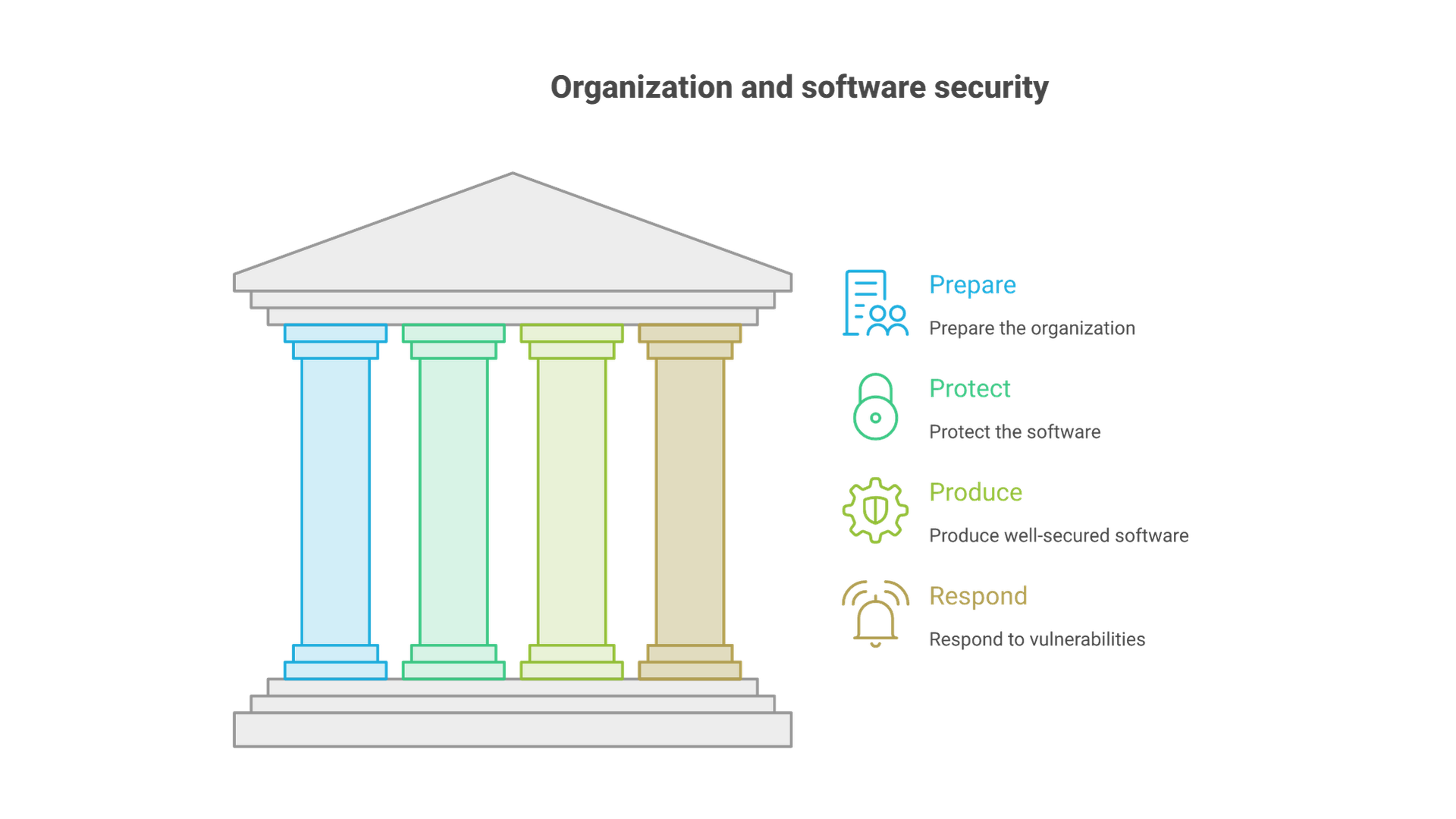
The NIST SSDF is the most widely referenced baseline for secure development. The current final version, SSDF 1.1 (NIST SP 800-218), groups its practices into four areas: Prepare the Organization, Protect the Software, Produce Well-Secured Software, and Respond to Vulnerabilities. The SSDF is deliberately methodology-neutral, so it can be added to agile, DevOps or more traditional lifecycle models.
The framework is being updated. NIST published the initial public draft of SSDF version 1.2 (SP 800-218 Rev. 1) on December 17, 2025, with comments closing January 30, 2026; at the time of writing, version 1.1 remains the final version. For teams building with generative AI, NIST's SP 800-218A, finalized in July 2024, is an SSDF community profile that adds practices for developing generative AI and dual-use foundation models.
OWASP guidance for application security
OWASP supplies the most practical application-level references. The OWASP Top 10:2025 lists the most critical web application security risks, led by Broken Access Control and Security Misconfiguration, and it now includes Software Supply Chain Failures and Mishandling of Exceptional Conditions as their own categories. The OWASP Application Security Verification Standard (ASVS), at version 5.0.0 since May 2025, turns that awareness into testable security requirements that teams can use for design, verification and procurement.
Developers are encouraged to use secure coding practices and conduct thorough reviews to prevent vulnerabilities. AI tools can help with code quality and bug detection, but their suggestions need the same verification as any other change. Static analysis, dependency scanning and secret detection in the pipeline catch many issues automatically, while threat modeling at design time catches problems that no scanner will see.
Supply chain security and vulnerability response
Most applications are assembled largely from open-source components, so supply-chain security is now part of everyday development. Practical steps include pinning dependency versions, generating SBOMs, verifying build provenance, restricting who can publish packages and monitoring for newly disclosed vulnerabilities in what you ship.
Organizations should prepare a rapid response plan for vulnerabilities to minimize the risk of exploitation. This is increasingly a legal requirement as well as a good practice. Under the EU Cyber Resilience Act, reporting obligations for manufacturers of products with digital elements apply from September 11, 2026, and the main obligations apply from December 11, 2027. Ingraining security into organizational culture and development processes helps teams combat emerging threats and protect the integrity and reliability of their applications.
Cloud Native Development
The shift from physical servers to cloud computing has transformed modern software infrastructure. Cloud-native development packages software, typically in containers, so it can be deployed consistently across environments, which enables rapid and repeatable deployment. This shift has improved productivity and given businesses access to powerful IT resources and faster implementations.
One of the main advantages of cloud-native development is flexibility and scalability. Cloud-native applications are designed to use cloud infrastructure so resources can be adjusted quickly to meet demand. Automated scaling lets applications handle varying workloads efficiently without manual intervention.
Cloud-native development also enables faster application updates, reducing the time needed to deploy changes from months to minutes when paired with mature CI/CD. That speed is a significant advantage, allowing businesses to respond quickly to market demands and user feedback.
Platform engineering has become the common way to make cloud-native development manageable. Instead of every team assembling its own pipelines, clusters and monitoring, an internal platform team offers paved paths: templates, golden pipelines and self-service environments with security controls built in. The 2025 DORA report found that 90% of organizations have adopted at least one internal platform and associated high-quality platforms with an organization's ability to get value from AI. Infrastructure as code tools keep these environments reviewable and reproducible.
Microservices Architecture
Microservices architecture has become a popular architectural style in modern software engineering. It divides applications into smaller, independently deployable services that communicate through APIs, which improves scalability and maintainability. Teams can change a single service without redeploying the entire application, enabling faster development cycles and more targeted updates.
Fault isolation is a key advantage of microservices. If one service fails, others can keep working, provided the system is designed with timeouts, retries and graceful degradation. This resilience supports high availability in complex systems. Microservices can also improve team productivity by letting small teams own specific services end to end.
However, managing service communication and coordinating deployments can be challenging. Well-defined, versioned APIs and contract tests are crucial for system cohesion. Debugging is harder because a single request may cross many services, which is why distributed tracing, covered in the next section, is essential for microservice systems.
Microservices are not the right default for every product. A well-structured modular monolith is often simpler to build, test and operate for a small team or an early product, and it can be split later along boundaries that experience has proven. The choice depends on team size, scaling needs and the maturity of your platform and observability. Our overview of types of software development explains how architecture needs differ between web, mobile, embedded, enterprise and other kinds of software.
Observability and Reliability
Testing tells you whether software works before release; observability tells you whether it works in production, and why not when it fails. Observability means instrumenting systems so engineers can ask new questions about their behavior without shipping new code. The three core signals are traces, which follow a request across services; metrics, which aggregate measurements such as latency and error rates; and logs, which record discrete events.
OpenTelemetry, a Cloud Native Computing Foundation project, has become the standard vendor-neutral way to generate and export traces, metrics and logs. Instrumenting with OpenTelemetry lets teams switch or combine observability backends without re-instrumenting their code, which reduces lock-in and makes telemetry part of the codebase rather than an afterthought.
Service level objectives
Reliability targets should be explicit. Google's Site Reliability Engineering book defines a service level indicator (SLI) as a carefully defined quantitative measure of some aspect of service, such as latency or error rate; a service level objective (SLO) as a target value for that indicator; and a service level agreement (SLA) as a contract with consequences for meeting or missing those objectives. SLOs give teams a shared, user-centered definition of "reliable enough," and the error budget they imply helps balance feature work against reliability work.
Good observability also supports security. The OWASP Top 10:2025 includes Security Logging and Alerting Failures as a category, a reminder that systems need to record security-relevant events and alert on them, not just collect data. Alerts should be tied to user-visible symptoms and SLOs rather than to every internal fluctuation, so on-call engineers respond to what matters.
AI-Assisted Coding with Governance
AI-assisted coding is the biggest change in day-to-day software development since the previous version of this article. Coding assistants now autocomplete code, generate tests, explain unfamiliar codebases, draft pull requests and, in agentic setups, carry out multi-step tasks across files and tools. The question for most teams is no longer whether to use AI but how to use it without eroding quality, security or accountability.
What the research says
The 2025 DORA State of AI-assisted Software Development report, based on survey responses from nearly 5,000 technology professionals, found that 90% use AI at work and more than 80% believe it has increased their productivity. It also found that 30% report little or no trust in AI-generated code. AI adoption now shows a positive relationship with software delivery throughput and product performance, but it still shows a negative relationship with delivery stability. The report's interpretation is that AI amplifies existing strengths and weaknesses: teams with strong testing, version control and fast feedback loops benefit, while teams without those controls ship more change and more instability.
Governance practices for AI-generated code
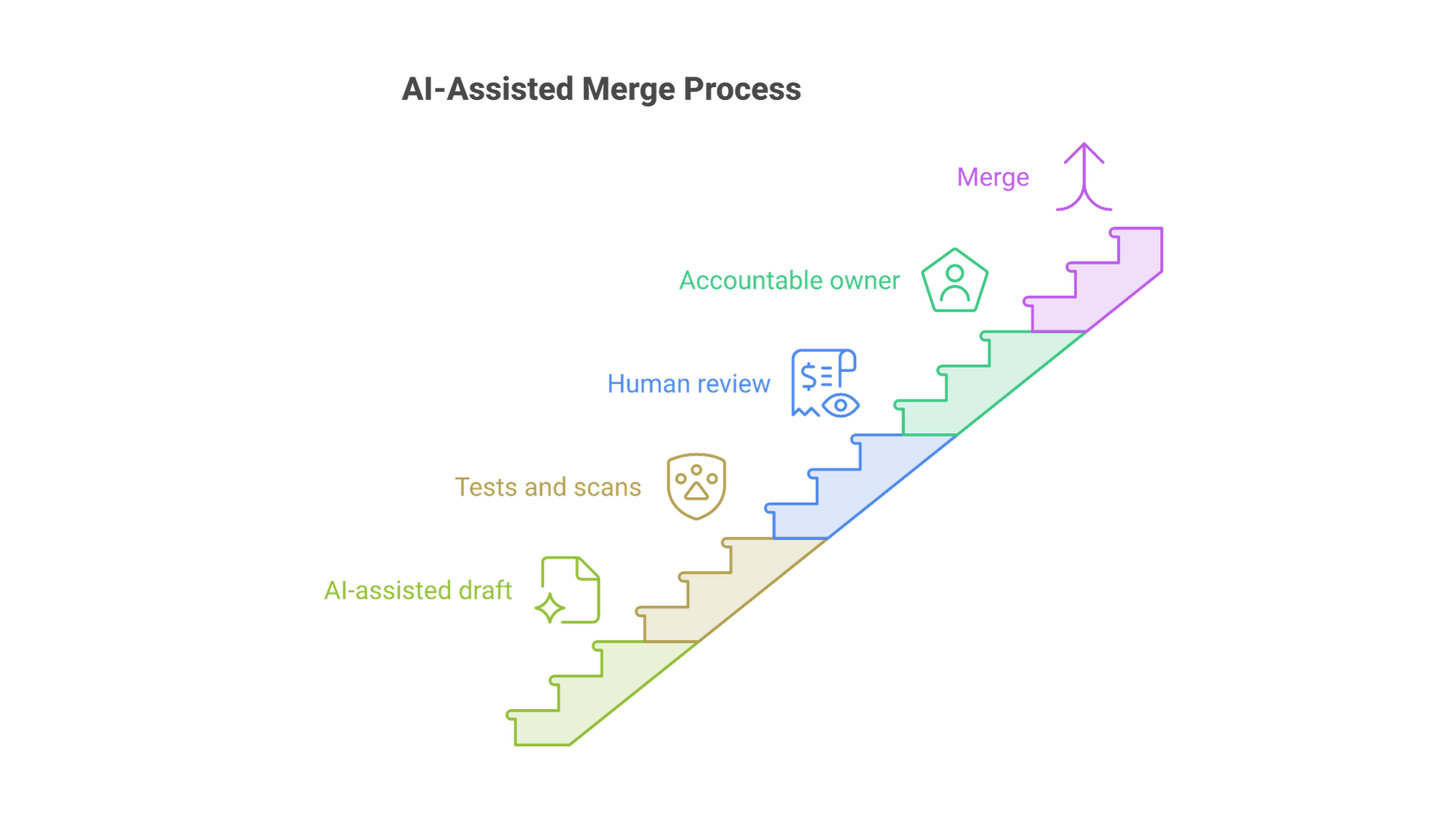
Treat AI output as an untrusted contribution. It should pass the same tests, reviews, security scans and approval rules as code written by a person, and a named human should remain accountable for every merged change. Practical governance includes:
- A clear AI policy. State which tools are approved, which repositories and data they may access, and what must never be pasted into prompts, such as secrets and customer data.
- Same gates, no shortcuts. Required reviews, passing CI and security scans apply to AI-assisted changes without exception.
- Dependency vetting. Check that any package an assistant suggests actually exists, is maintained and is the one you intended.
- Least privilege for agents. Coding agents get scoped credentials, sandboxed environments and human approval for consequential actions.
- Small batches. Ask for focused changes that a reviewer can genuinely understand.
When your product itself includes large language model features, the risk surface grows. The OWASP Top 10 for LLM Applications 2025 lists risks such as prompt injection, sensitive information disclosure, improper output handling and excessive agency. NIST's AI Risk Management Framework and its Generative AI Profile (NIST AI 600-1) give organizations a structured way to identify and manage those risks. Choosing the right assistant is a separate decision; our guide to the best local LLMs for coding covers options for teams that need to keep source code on their own hardware. Teams formalizing policies, approvals and audit trails for AI use can also look at structured AI governance programs.
Documentation Best Practices
Documentation is often the first practice to slip under deadline pressure and one of the most expensive to neglect. Good documentation shortens onboarding, reduces repeated questions, preserves the reasoning behind decisions and gives AI assistants accurate context about your systems. DORA's AI Capabilities Model lists AI-accessible internal data as one of its seven capabilities, which in practice depends on internal documentation being current and findable.
Effective teams treat documentation as code. They keep it in the repository next to the software it describes, review it in the same pull requests, and update it as part of the definition of done. Useful types of documentation include a README that explains how to build, test and run a project; API references generated from code or specifications such as OpenAPI; runbooks that tell on-call engineers how to diagnose and recover from common failures; and architecture decision records (ADRs) that capture what was decided, the alternatives considered and why.
The aim is not volume but accuracy. A short, correct document is more valuable than a long, outdated one. Assign owners to key documents, link them from the places people already work, and delete or archive pages that no longer reflect reality.
Measuring Delivery with DORA Metrics
Best practices are only useful if you can tell whether they are working. DORA's software delivery metrics are the most widely used way to measure delivery performance. DORA originally defined four key metrics; its current DORA metrics guide describes five, grouped into throughput and instability:
- Change lead time: the time from a change being committed to version control to its deployment in production.
- Deployment frequency: how often changes are deployed to production.
- Failed deployment recovery time: how long it takes to recover from a deployment that fails and needs immediate intervention.
- Change fail rate: the share of deployments that need immediate follow-up, such as a rollback or hotfix.
- Deployment rework rate: the share of deployments that are unplanned and made in response to a production incident.
The value of these metrics comes from reading them together. Throughput without stability means a team is shipping problems faster; stability without throughput often means changes are batched and risky when they do go out. Track trends for your own teams over time instead of comparing teams against each other, and avoid turning the metrics into individual targets, which invites gaming. Pair delivery metrics with user-facing SLOs and business outcomes to see whether faster delivery is producing better software.
Key Roles in a Modern Software Development Team
A successful modern software development team brings together several roles that contribute to meeting project requirements. Product Managers oversee the product lifecycle and keep the team aligned with user needs and market success. Business Analysts gather insights on user needs and recommend product enhancements, bridging the gap between business objectives and technical execution.
Software Architects define the software's internal structure so it meets functional requirements and remains scalable and maintainable. Engineering Managers cultivate team dynamics and oversee the implementation of technical solutions, fostering a collaborative and productive environment.
Software developers write code and bring software concepts to life. They collaborate with UX/UI Designers to align user experience and interface design, with attention to accessibility and aesthetics. Quality engineers and testers identify defects, design test strategies and help developers automate tests, which plays a critical role in maintaining code quality.
Scrum Masters or agile coaches facilitate agile processes, helping teams improve performance and remove impediments. Team Leads manage task prioritization and maintain morale while overseeing day-to-day team operations.
Modern teams also commonly include roles that were rarer a few years ago. Platform engineers build the internal platforms and paved paths other teams rely on. Site reliability engineers own SLOs, incident response and the reliability of production systems. Security champions, developers with additional security training, bring secure development practices into everyday review and design discussions. Each of these roles helps keep the development process coordinated with the project's goals. Organizations that want an outside view of how their roles, practices and tooling fit together sometimes start with a software engineering consulting assessment before changing their process.
Project Management in Modern Software Development
Effective project management is essential for the successful execution of software development projects. Project Managers and Scrum Masters keep projects moving and the direction clear. They coordinate tasks, manage timelines and keep the team focused on the project's goals.
Business Analysts and Product Owners bridge the gap between business and technical teams, aligning solutions with business objectives and user needs. They gather insights on user requirements and market trends that guide the development process, so the final product meets both business goals and user expectations.
Project management tools such as Gantt charts, kanban boards and project calendars help teams plan and execute work. They help teams visualize timelines, track progress and manage tasks. A Work Breakdown Structure (WBS) organizes project work into smaller, more manageable components, which improves clarity and planning.
Risk registers and Earned Value Management (EVM) are also useful, particularly for larger or contract-driven projects. Risk registers track potential project risks along with their likelihood and impact. EVM combines project scope, schedule and cost to provide performance insights and forecasts.
A RACI chart clarifies roles and responsibilities by identifying who is responsible, accountable, consulted and informed. In agile environments, these tools work best when they support short planning cycles and visible flow of work rather than fixing a detailed plan months in advance. Limiting work in progress on a kanban board, for example, reinforces the same small-batch discipline that makes CI/CD effective.
Low-Code and No-Code Development
Low-code and no-code platforms let people build applications and workflows through visual designers, configuration and prebuilt components rather than writing most of the code by hand. They can shorten delivery for internal tools, forms, approval workflows and integrations, and they reduce the backlog that would otherwise wait for a development team. Speed-up claims vary widely by vendor and use case, so it is best to judge them against a pilot in your own environment rather than headline figures.
Low-code and no-code solutions also promote automation by letting users create workflows that span multiple information systems. Empowering non-technical users to build applications spreads development capability across an organization and can encourage innovation and collaboration.
The same best practices still apply. Low-code applications need access control, change management, testing, backups and an owner, and they should be visible to IT so they do not become unmanaged "shadow" systems holding sensitive data. Many platforms now include AI features that generate apps or workflows from natural language, which raises the same review and governance questions as AI-assisted coding. As demand for rapid and flexible software grows, low-code and no-code platforms will keep playing an important role, usually alongside conventional development rather than replacing it.
Emerging Technologies in Software Development
Several technologies continue to shape how software is designed and built. Artificial intelligence and machine learning remain at the forefront, both as tools for developers and as features inside applications, such as personalization, search, forecasting and conversational interfaces. These technologies let teams build more adaptive applications, but they also add new requirements for data quality, evaluation and monitoring.
Blockchain technology can provide transparent, tamper-evident transaction records where several parties need a shared ledger and do not fully trust a single operator. It is most relevant in specific domains such as payments, asset tracking and some supply-chain scenarios, and it is not a general substitute for conventional databases or application security.
Quantum computing is still at an early stage for most commercial software, but it already affects one practical area: cryptography. NIST finalized its first post-quantum cryptography standards (FIPS 203, 204 and 205) in August 2024, and software teams should begin inventorying where they rely on public-key cryptography so they can plan a migration. Practical quantum applications in fields such as materials science and optimization remain an area of active research.
Edge computing improves real-time data processing by bringing computation closer to where data is generated. This reduces latency and supports immediate analysis, which suits applications that need rapid responses, such as IoT devices, industrial systems and on-device AI.
Trends shaping software development in 2026
Looking across these technologies, the trends with the most direct impact on development practice in 2026 are agentic AI tools that carry out multi-step coding tasks, platform engineering as the standard way to deliver secure paved paths, growing regulatory expectations for secure development and vulnerability handling, supply-chain integrity through SBOMs and build provenance, and the use of small, local or private models where source code and data must stay in-house. Each of these trends rewards the same fundamentals: small batches, strong version control, automated testing, clear ownership and good observability.
Frequently Asked Questions
What are the most important software development best practices in 2026?
Work in small batches on a shared trunk, run automated tests and security checks on every change, require code review, follow a secure development framework such as the NIST SSDF, instrument production systems, govern AI-generated code like any other contribution, and measure throughput and stability together.
What is the significance of agile development in modern software engineering?
Agile development fosters flexibility and rapid iterations, so teams can adapt to changing requirements and deliver software that matches user needs. Its lasting value comes from short feedback loops and small, frequently released increments rather than from ceremonies alone.
What is trunk-based development?
Trunk-based development is a branching model in which developers merge small changes into the main branch at least once a day, keep branches short-lived and avoid code freezes. Unfinished features are hidden behind feature flags until they are ready to release.
Why is security important in modern software development, and how can it be ensured?
Security protects applications and users against evolving threats and is increasingly a regulatory expectation. It is ensured by integrating it throughout the life cycle: secure coding, security-focused review, automated scanning, supply-chain controls, a vulnerability response plan and frameworks such as the NIST SSDF and OWASP ASVS.
How do AI and ML impact software development?
AI coding assistants speed up tasks such as writing code, tests and documentation, and AI features make applications more adaptive. DORA's 2025 research links AI adoption to higher throughput but also to lower stability, so strong testing, review and governance are essential.
What are DORA metrics?
DORA metrics measure software delivery performance. The current set covers change lead time, deployment frequency, failed deployment recovery time, change fail rate and deployment rework rate, grouped into throughput and instability.
Conclusion: Modern Software Development Best Practices
The landscape of software development keeps changing, from agile methodologies and cloud-native platforms to AI assistants that now touch nearly every workflow. Yet the practices that consistently produce reliable software remain the same: small batches on a protected trunk, automated CI/CD, a balanced testing pyramid, timely code review, security built in through the NIST SSDF and OWASP guidance, observable production systems, clear documentation and honest measurement of both throughput and stability.
AI raises the stakes on those fundamentals. Teams with strong engineering habits can use it to deliver more, while teams without them risk shipping more change and more instability. The safest path is to adopt AI deliberately, keep humans accountable for every change and let the same automated gates judge all code, whoever writes it.
If you are reviewing your engineering practices, planning a secure delivery pipeline or deciding how to introduce AI-assisted coding with the right controls, talk to Cognativ about your software project.