

Agile vs Waterfall: Choosing the Right Project Management Methodology
Should your team plan everything first or deliver in short iterations? Learn where each approach fits, why hybrids dominate, and a six-step way to decide.
In the world of project management, choosing between agile vs waterfall methodologies can significantly influence the success of your project. Both approaches offer distinct advantages depending on the development process, project life cycle and team dynamics involved. Understanding them helps you manage projects effectively, especially when you handle complex projects or coordinate multiple teams across the development lifecycle.
Choosing between agile and waterfall methodologies is not about finding the "best" approach. It is about selecting the right project management approach for your specific project requirements, team capabilities and organizational context. Many teams in 2026 do not pick one side at all: they combine plan-driven governance with iterative delivery.
This guide goes back to the primary sources, including the 2001 Agile Manifesto, the 2020 Scrum Guide and Winston Royce's 1970 paper that is usually credited with describing the waterfall model, and then compares the two approaches, explains hybrid models and walks through a step-by-step decision framework.
Key Takeaways
- Agile methodology uses an iterative approach that relies on consistent feedback and collaboration to adapt to changing project requirements.
- The waterfall method follows sequential phases with a structured design phase, comprehensive documentation and fixed project timelines.
- Royce's 1970 paper, often cited as the origin of waterfall, actually warned that a purely sequential implementation is risky and recommended feedback, prototyping and customer involvement.
- Hybrid approaches, which combine upfront planning with iterative delivery, are now common, and PMI frames the choice as predictive, adaptive or hybrid.
- Selecting the right methodology depends on requirement stability, project complexity, stakeholder involvement, regulatory constraints and the need to manage inter-project dependencies and technical debt.
Understanding Project Management Methodologies
Project management methodologies provide structured frameworks for planning, executing and delivering projects. They define how project teams organize work, manage resources, coordinate activities and measure progress throughout the project lifecycle.
The choice of methodology significantly affects team dynamics, stakeholder involvement and project execution patterns. Different methodologies suit different types of projects, organizational cultures and industry requirements, which makes methodology selection a strategic decision rather than a matter of team preference.
The Project Management Institute (PMI) offers a useful vocabulary for this choice. Its project performance domains summary states that the project deliverables determine the most appropriate development approach, "such as a predictive, adaptive, or hybrid approach." In everyday language, predictive means waterfall-style planning, adaptive means agile, and hybrid means a deliberate mix. The current PMBOK Guide, now in its Eighth Edition, keeps this principles-based foundation and organizes it around six principles and seven performance domains.
Who This Is For
This guide is designed for project managers, team leads, software developers and business stakeholders evaluating methodology options. Whether you are managing complex software development initiatives or considering agile adoption for your organization, you will find practical guidance for making informed methodology decisions.
Why This Matters
Your choice of methodology affects every aspect of project execution, from team dynamics and customer collaboration to risk management and final product quality. A poor fit can lead to project delays, budget overruns and stakeholder dissatisfaction, while the right choice enables predictable delivery and continuous improvement. The methodology also shapes how you run each phase of the software development life cycle, from requirements to maintenance.
What Is Agile Methodology?
Agile methodology is an iterative, flexible approach that emphasizes continuous feedback loops and adaptive responses to change. The term comes from the Manifesto for Agile Software Development, written by 17 practitioners who met at Snowbird, Utah, on February 11 to 13, 2001, according to the manifesto's own history page.
The Agile Manifesto and Its 12 Principles
The manifesto states four values:
- Individuals and interactions over processes and tools
- Working software over comprehensive documentation
- Customer collaboration over contract negotiation
- Responding to change over following a plan
A detail that many comparisons skip: the manifesto adds that while there is value in the items on the right, its authors value the items on the left more. Agile does not reject plans, contracts or documentation; it ranks them below working software and collaboration. The accompanying 12 principles make this concrete. They call for delivering working software frequently, "with a preference to the shorter timescale," welcoming changing requirements even late in development, daily collaboration between business people and developers, sustainable pace, technical excellence, simplicity and regular team reflection.
Scrum in the 2020 Scrum Guide
Agile is a set of values, not a single process. Scrum is the most widely known agile framework, and the 2020 Scrum Guide remains its official definition. It describes Scrum as a lightweight framework for creating value through adaptive solutions to complex problems, grounded in empiricism and its three pillars of transparency, inspection and adaptation.
The guide defines three accountabilities (Product Owner, Scrum Master and Developers), five events (the Sprint, Sprint Planning, Daily Scrum, Sprint Review and Sprint Retrospective) and three artifacts, each with a commitment: the Product Backlog with its Product Goal, the Sprint Backlog with its Sprint Goal, and the Increment with its Definition of Done. Sprints are fixed-length events of one month or less. Two-week Sprints are a common choice, but the guide does not prescribe a specific length below that limit.
Kanban and Other Agile Frameworks
Kanban takes a different route. The Kanban Guide (version 2025.5) defines it as a strategy for optimizing the flow of value through a process. Instead of timeboxed Sprints, teams visualize the workflow, limit work in progress and track flow measures such as work in progress, throughput, work item age and cycle time. Many teams combine Scrum events with Kanban flow practices, and scaling frameworks extend agile ideas across multiple teams.
Key characteristics of agile project management therefore include short iterations, cross-functional teams with shared accountability, frequent customer feedback and usable product increments delivered regularly. Agile teams treat change as natural, using iterative development cycles to incorporate learning and adapt to evolving requirements.
What Is Waterfall Methodology?
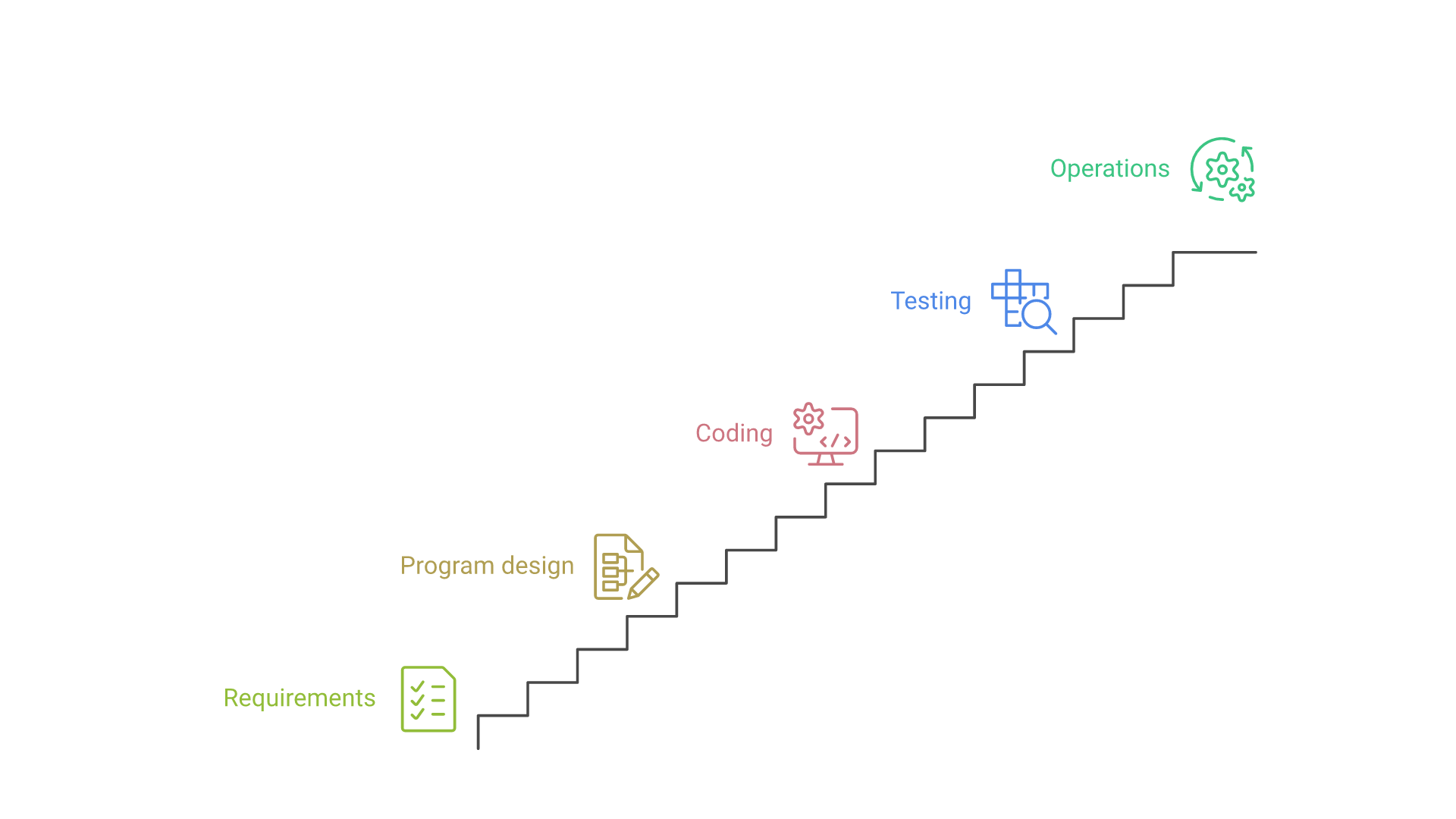
Waterfall methodology follows a linear, sequential approach in which each project phase is completed before the next phase begins. A typical waterfall project moves through requirements gathering, system design, implementation, testing, deployment and maintenance, with formal phase gates and sign-offs between them.
What Royce Actually Wrote in 1970
Waterfall is usually traced to Winston W. Royce's paper "Managing the Development of Large Software Systems", presented at IEEE WESCON in August 1970. Royce did not use the name "waterfall"; that label was applied later. His paper does draw the familiar cascade from system requirements through software requirements, analysis, program design, coding and testing to operations.
What is often forgotten is Royce's verdict on that pure sequence. He wrote that he believed in the concept, but that the implementation he had just described was "risky and invites failure." His reason was that problems with timing, storage and input/output are first experienced during testing, after the design has been fixed, so a late discovery can force major redesign. To reduce that risk, he recommended additional steps: complete a preliminary program design early, document the design thoroughly, do the job twice so that a first version serves as an early simulation of the final product, plan and control testing carefully, and involve the customer formally at several points. Several of these ideas, such as early prototypes and customer feedback, sound closer to modern iterative practice than to the rigid model that later carried his name.
The Phases of a Waterfall Project
Key characteristics of waterfall project management include comprehensive upfront planning, extensive documentation at each phase, formal phase gates requiring approval before progression and a final product delivered at project completion. Waterfall projects rely on detailed project plans, fixed timelines and controlled scope changes once development begins.
Sequential, document-driven delivery is also familiar from engineering disciplines such as construction and manufacturing, where design must be fixed before expensive physical work starts. That analogy explains much of waterfall's appeal: when a change late in the project is genuinely expensive, it pays to decide early and in writing.
Where Waterfall Still Fits
Waterfall remains a reasonable choice when requirements are stable and well understood, when a fixed scope must be signed off before work starts, when external regulators or contracts require formal documentation at each stage, or when software is tightly bound to hardware, infrastructure or other components with long lead times. In these cases predictability and traceability can matter more than the ability to change direction every few weeks.
Agile vs Waterfall: Core Differences and Applications
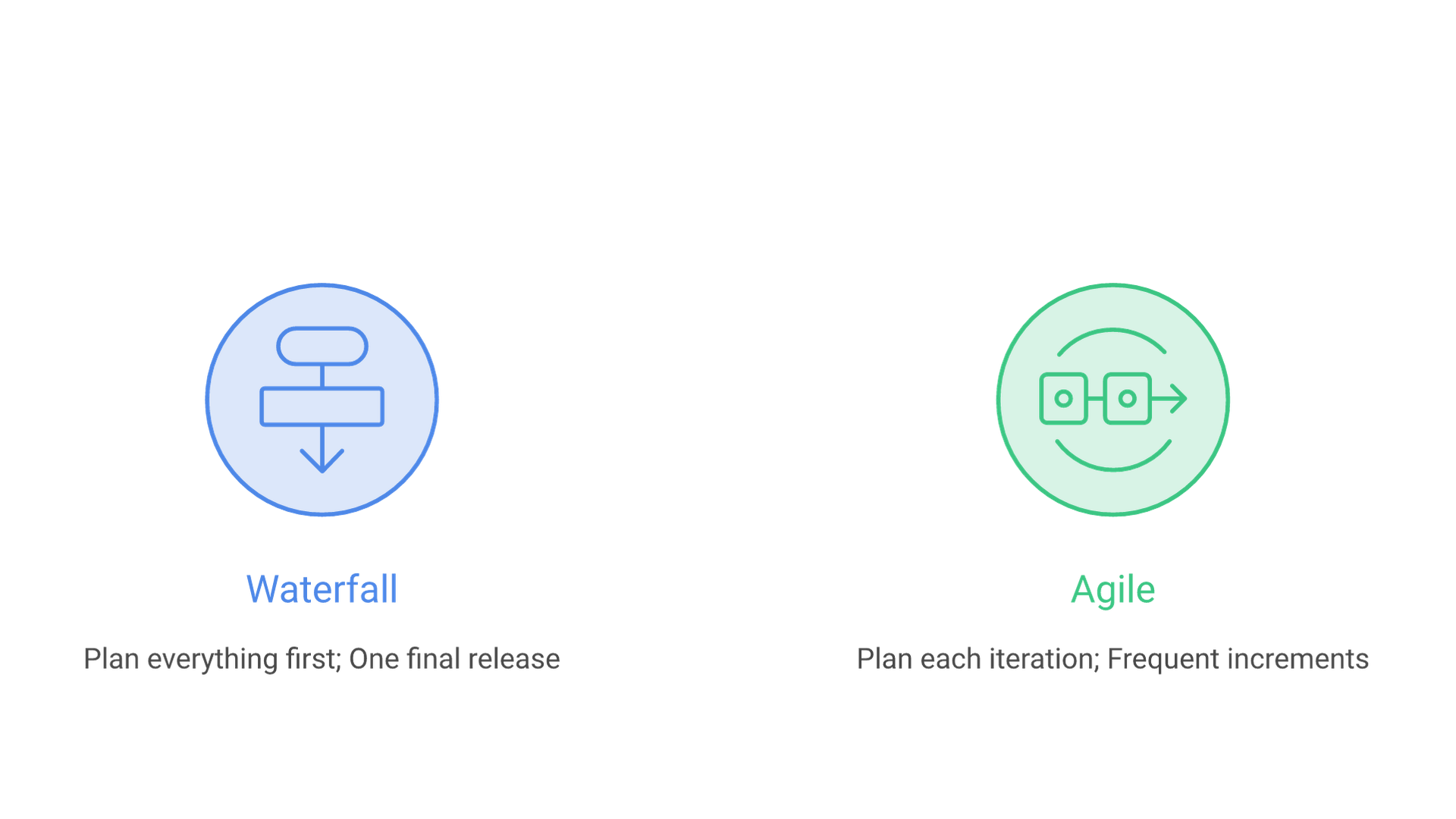
These methodologies represent fundamentally different philosophies about how projects should be planned, executed and delivered. Each addresses a different kind of uncertainty: waterfall assumes uncertainty can be reduced through analysis before building, while agile assumes much of it can only be resolved by building, showing and learning.
Key Differences in Approach
Planning. Waterfall requires comprehensive upfront planning, with detailed requirements, technical specifications and project timelines established before development begins. Agile uses iterative planning: a high-level roadmap and a product goal, refined continuously through backlog refinement and sprint planning.
Flexibility and change management. Waterfall projects treat changes as disruptive and costly, routing them through formal change control and potential timeline adjustments. Agile projects expect change and use it to deliver more valuable solutions based on evolving understanding and customer feedback.
Customer involvement. Waterfall typically concentrates customer involvement in requirements gathering and final acceptance. Agile requires ongoing customer collaboration through regular reviews, demos and iterative refinement of product features.
Risk management. Waterfall projects identify and mitigate risks during upfront planning and may miss risks that only emerge during development or testing, which is exactly the weakness Royce described. Agile projects surface risk continuously through frequent delivery, continuous testing and regular retrospectives.
Team Structure and Collaboration
Waterfall team structures typically follow a hierarchical organization with specialized roles and clearly defined responsibilities. Team members often work within functional groups, such as analysts, developers and testers, with formal handoffs between phases. Project managers coordinate between specialized teams, and documentation carries knowledge from one phase to the next.
Agile team structures emphasize cross-functional teams with shared accountability for outcomes. Self-managing teams include the skills needed to take a feature from analysis and design through testing and deployment. Daily Scrums, Sprint Planning, Sprint Reviews and retrospectives create frequent interaction that improves collaborative problem-solving. Communication follows the same pattern: waterfall relies on formal documentation, status reports and scheduled meetings, while agile prioritizes direct conversation and rapid information sharing, in person or through digital collaboration tools.
Timeline and Planning Differences
Waterfall establishes fixed project timelines with sequential milestones and a single final delivery. Phases have predetermined durations, and the full scope is typically completed before deployment. This approach provides predictable schedules but offers limited flexibility for scope adjustments or early value delivery.
Agile uses iterative releases, with a usable increment produced every Sprint or delivered continuously in a flow-based system. Scope remains adjustable, which enables early value delivery and frequent course corrections but requires stakeholders to be comfortable with a forecast rather than a fixed feature list. In practice, agile teams often fix time and cost and let scope flex, while waterfall teams fix scope and let time and cost absorb the surprises.
Documentation, Quality and Testing
Waterfall produces documentation as a deliverable of each phase: requirements specifications, design documents, test plans and sign-off records. Testing is a distinct phase after implementation. Agile keeps documentation lean and close to the work, and builds quality into each increment through a shared Definition of Done, automated tests and continuous integration. That is why, in iterative teams, writing, reviewing and testing code happen together within a short cycle rather than in separate phases, as described in our guide to the software coding process.
Comparison: Agile vs Waterfall
The table below summarizes the differences discussed above. Treat it as a description of tendencies, not rules: a well-run waterfall project can still hold regular reviews, and a well-run agile team still plans and documents.
| Feature | Agile Methodology | Waterfall Methodology |
|---|---|---|
| Project scope | Flexible requirements with iterative refinement | Fixed requirements with comprehensive upfront definition |
| Team structure | Cross-functional teams with shared accountability | Specialized teams with hierarchical coordination |
| Timeline | Iterative releases with adaptive planning | Sequential phases with fixed milestones |
| Customer involvement | Continuous collaboration and feedback | Concentrated at requirements and acceptance |
| Change management | Embraces change as expected | Formal change control; change treated as costly |
| Documentation | Lightweight, focused on value | Comprehensive, produced for each phase |
| Testing | Continuous, within every iteration | Dedicated phase after implementation |
| Risk management | Continuous identification through frequent delivery | Upfront risk planning with formal mitigation |
| Contracting | Often time and materials or capacity-based | Often fixed price with defined scope |
Projects with stable requirements, regulatory constraints and traditional governance often benefit from waterfall methodology, while projects that require adaptability, innovation and frequent customer feedback typically succeed with agile approaches.
Advantages and Disadvantages of Agile and Waterfall
Each methodology's strengths come with matching weaknesses, because they result from the same design choices.
Advantages and Disadvantages of Agile
Agile delivers usable software early, exposes misunderstandings quickly and lets the product owner reprioritize as the market or the users teach the team something new. Frequent reviews keep stakeholders informed, and continuous testing reduces the chance of a large late surprise. The costs are equally real: agile asks for sustained customer and product owner availability, makes long-range dates harder to promise, can drift without a clear product goal, and can accumulate technical debt if teams chase features without investing in design and refactoring.
Advantages and Disadvantages of Waterfall
Waterfall offers clear milestones, a defined scope for budgeting and contracting, thorough documentation and straightforward reporting for governance bodies. It works well when the problem is understood and the solution is unlikely to change. Its weaknesses are late feedback, since users may not see working software until the end, expensive late changes, and the risk that integration or testing reveals design flaws when there is little time left to fix them.
Hybrid Approaches: Combining Agile and Waterfall
Most organizations do not run a pure version of either method. Digital.ai's 18th State of Agile Report, released on October 28, 2025, found that 74% of respondents now use hybrid, blended or homegrown agile models. The survey covered roughly 350 participants, mostly agile coaches and consultants at large enterprises, so treat the figure as a signal from that population rather than a census of all software teams.
Common Hybrid Patterns
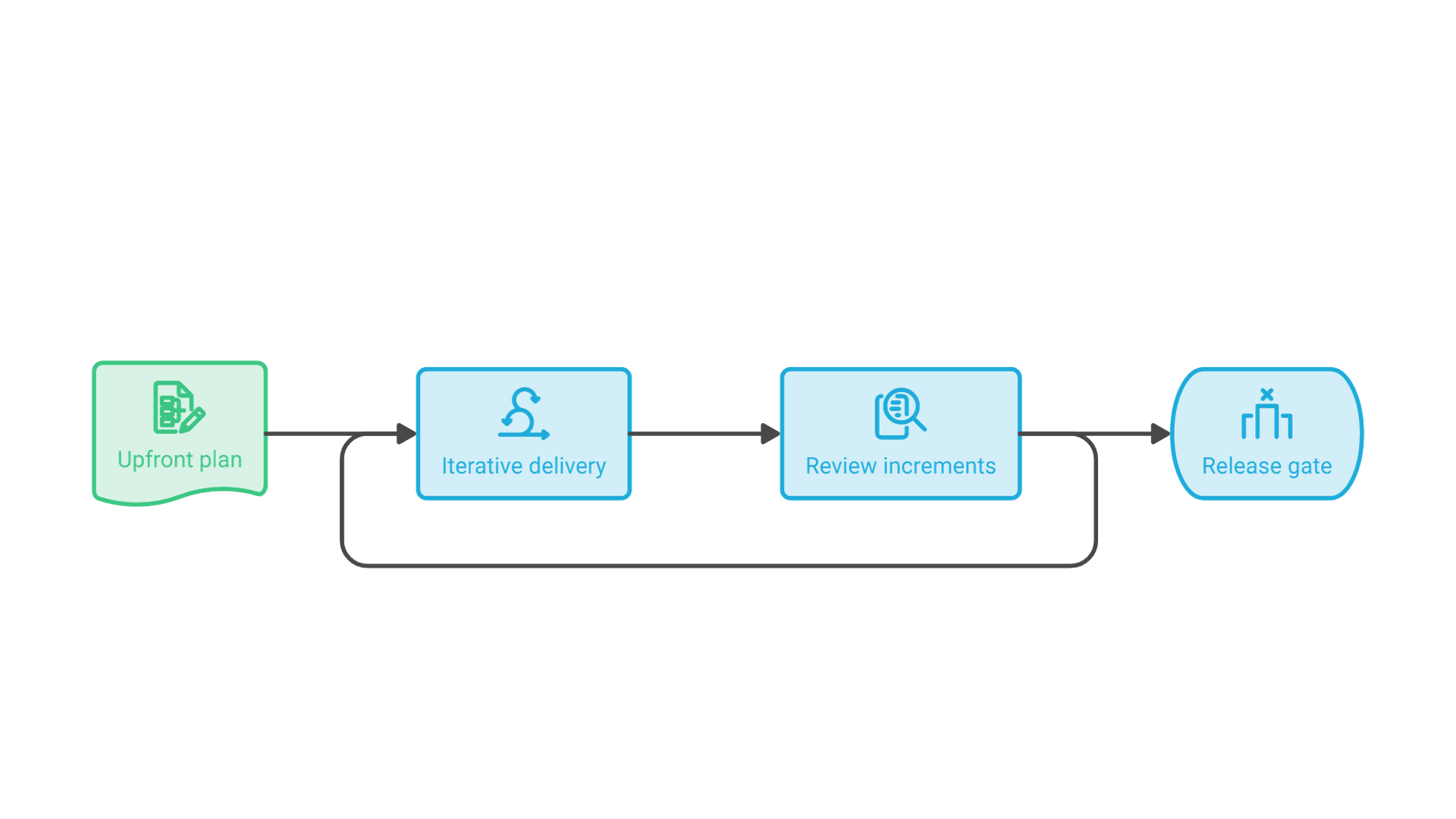
A frequent hybrid keeps waterfall-style stages at the edges of the project and runs agile delivery in the middle. Requirements, architecture, funding and compliance approvals happen upfront; development proceeds in Sprints or a Kanban flow; and release, acceptance or certification follows a formal gate. This pattern is sometimes called "water-scrum-fall." It can work well when the organization needs a fixed budget and audit trail, but it loses much of agile's value if the upfront phase freezes every requirement.
A second pattern splits work by component. Hardware, infrastructure, vendor integrations or regulated modules follow a predictive plan, while user-facing software iterates. A third keeps a phase-gated portfolio and governance process, with stage gates reviewing outcomes and evidence from iterations instead of documents alone.
Hybrid in Government and Regulated Environments
Public-sector guidance shows that agile and formal controls can coexist. The U.S. Government Accountability Office's Agile Assessment Guide (GAO-24-105506, November 2023) sets out best practices for adopting agile in federal programs and explains how agile work can be connected to standard program controls, including cost estimating, scheduling and earned value management. The guide also covers tailoring acquisition planning and contract structure to agile delivery, which is often the hardest part of a hybrid in practice.
Choosing the Right Methodology: Step-by-Step Decision Framework
Selecting the appropriate methodology requires a systematic evaluation of project characteristics, team capabilities and organizational context, so that methodology strengths match project requirements. Use the framework below before project initiation or when evaluating whether the current methodology is still working for an ongoing project.
Step-by-Step: Methodology Selection Process
- Assess requirements clarity and stability. Are requirements well defined and unlikely to change (favoring waterfall), or evolving and in need of ongoing refinement (favoring agile)? Note regulatory requirements, compliance needs and contractual obligations that dictate documentation and process.
- Evaluate stakeholder involvement and availability. Can stakeholders provide ongoing collaboration and feedback (supporting agile), or do they prefer limited involvement after comprehensive upfront planning (supporting waterfall)? Check who holds decision-making authority.
- Analyze team structure, skills and collaboration capabilities. Does the team have experience with cross-functional work and self-management, or does the work depend on specialized groups that integrate at defined points?
- Consider industry standards, regulation and organizational culture. Does your industry require extensive documentation, formal approvals or certification? Is the organization ready for the cultural change that agile adoption involves?
- Determine budget flexibility and timeline constraints. Does the project have a fixed budget and date that demand predictable planning, or can investment be decided incrementally based on delivered value?
- Decide where a hybrid fits. If the answers are mixed, choose which parts need predictive control and which can iterate, and make that split explicit rather than accidental.
Quick Decision Rules
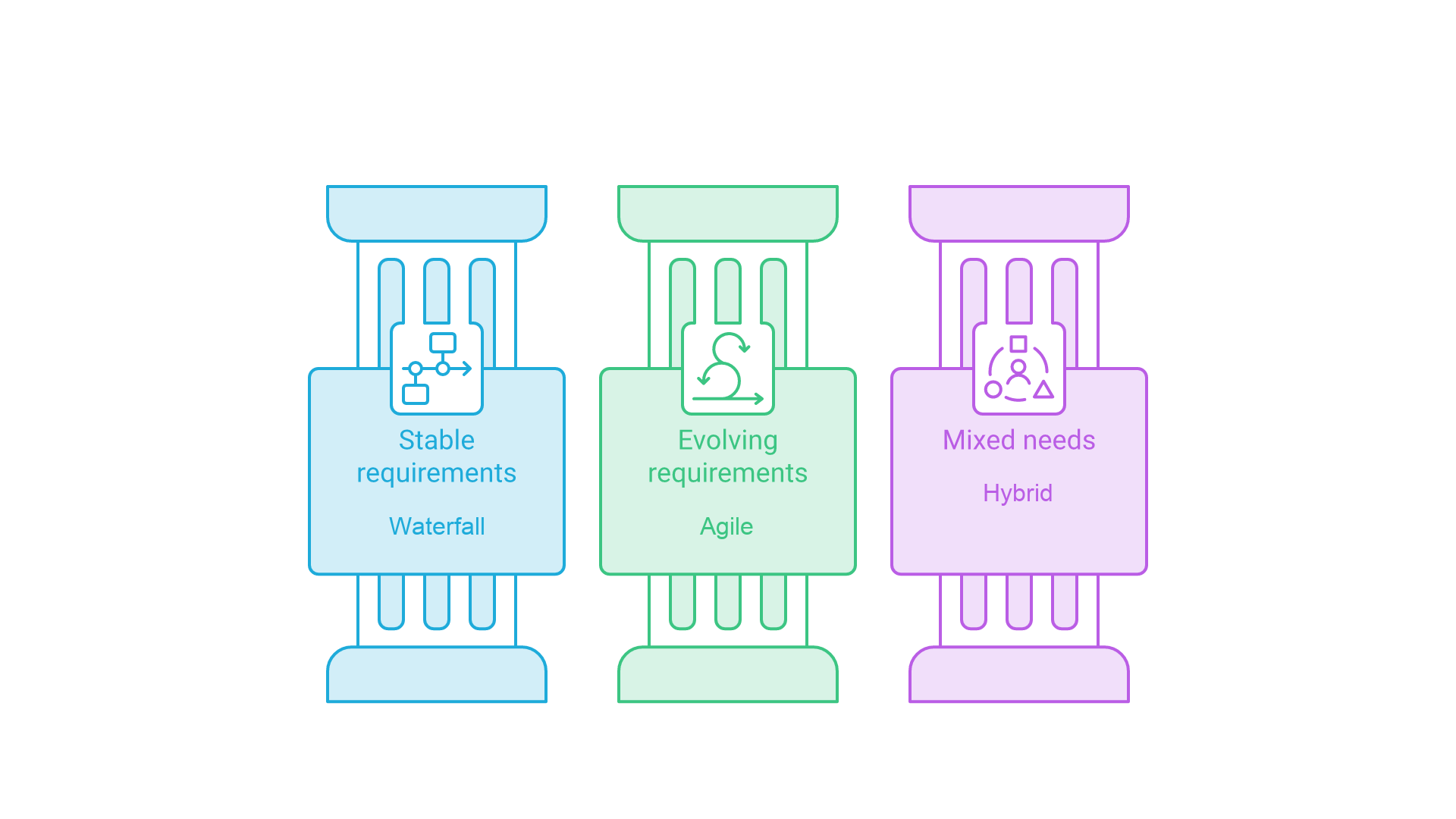
If the requirements are stable, the technology is familiar and change is expensive, a predictive, waterfall-style plan is usually the better fit. If the requirements are uncertain, users can give frequent feedback and early releases have value, agile is usually the better fit. If both conditions apply to different parts of the work, a hybrid is the honest answer.
Budget questions deserve particular care. Waterfall estimates are built from a detailed scope, while agile forecasts rely on team velocity and a prioritized backlog. Either way, early estimates are uncertain, and our guide to software cost estimation explains how to size work and communicate ranges before committing to a fixed price. When you are planning a new product from discovery through launch, the same trade-offs appear in product development, where early releases validate assumptions before the full investment is made.
Common Challenges and Solutions
Understanding implementation challenges helps project managers and development teams prepare for difficulties and plan mitigation, regardless of the chosen methodology.
Challenge 1: Scope Creep and Changing Requirements
Agile handles scope changes through iterative planning and backlog management, treating changes as natural evolution rather than project failure. The product owner orders work by value, and each Sprint Planning provides an opportunity to incorporate changes without disrupting work already in progress.
Waterfall requires formal change control with impact assessment, stakeholder approval and timeline adjustments. Clear communication about the cost and schedule impact of each change helps stakeholders make informed decisions about scope modifications.
Challenge 2: Team Resistance to Methodology Change
Introduce changes gradually, with training and clear communication about why the change is being made. Start with a pilot project to demonstrate results and build confidence before an organization-wide rollout.
Leadership support is essential, particularly when moving from waterfall to agile. Experienced coaches or practitioners can guide teams through adoption and address concerns early, and engineering practices such as automated testing and continuous integration need investment alongside the new ceremonies.
Challenge 3: Misaligned Stakeholder Expectations
Explain the methodology at project initiation so that every stakeholder understands delivery patterns, involvement requirements and decision-making processes. Agile projects require stakeholder comfort with evolving requirements and iterative delivery; waterfall projects require patience with sequential development and limited early visibility.
Challenge 4: Contracts, Estimates and Governance
Fixed-price contracts assume a fixed scope, which conflicts with agile's willingness to change it. Teams can reduce that tension by contracting in phases, fixing time and budget per release while keeping scope flexible, and agreeing on outcome measures up front. Governance should also review working increments and evidence, not only documents. An independent view of engineering practices and delivery approach, such as software engineering consulting, can help when a team is redesigning its process or recovering a struggling project.
Frequently Asked Questions
What is the main difference between Agile and Waterfall?
Waterfall completes each phase, from requirements to testing, in sequence and delivers the product at the end. Agile delivers in short iterations, gathers feedback after each one and adapts the plan as it learns.
Is Scrum the same as Agile?
No. Agile is a set of values and principles from the 2001 Agile Manifesto. Scrum is one framework that applies them, with defined accountabilities, events and artifacts. Kanban is another.
Did Royce invent the waterfall model?
His 1970 paper described the sequential model that later became known as waterfall, but he did not use that name, and he warned that a purely sequential implementation was risky. He recommended prototyping, documentation, careful testing and customer involvement.
Can you combine Agile and Waterfall?
Yes. Hybrid approaches are common: upfront planning, budgeting and compliance gates combined with iterative development. PMI explicitly recognizes predictive, adaptive and hybrid development approaches.
Is Waterfall still used in 2026?
Yes, especially where requirements are stable, regulation demands formal documentation or software is tied to hardware and long-lead components. It is often used within hybrid models rather than in pure form.
Which methodology is better for a fixed budget?
Waterfall suits a fixed budget when scope is truly fixed. When scope is uncertain, agile can work within a fixed budget by fixing time and cost and prioritizing scope by value.
Conclusion and Next Steps
The choice between agile and waterfall depends on project characteristics, team capabilities and organizational context, not on the universal superiority of either approach. Waterfall offers predictability when the problem is understood; agile offers adaptability when it is not; and a deliberate hybrid lets you apply each where it fits. The primary sources support this balance: Royce himself warned against a purely sequential process, and the Agile Manifesto still sees value in plans and documentation.
To get started, assess your current project with the decision framework above, focusing on requirement stability, team structure and stakeholder involvement. Then evaluate team readiness, including training, cultural change and leadership support, and pilot your chosen approach on a smaller project before scaling it.
If you are deciding how to plan and deliver a software project, or how to blend agile delivery with the governance your organization needs, talk to Cognativ about your project.