


What Is a Data Pipeline? Complete Guide to Modern Data Processing
From ingestion to dashboards: how modern data pipelines move, transform and test data, when to pick streaming over batch, and how Airflow, Kafka and dbt fit in.
In today's data-driven world, organizations rely on data pipelines to move data efficiently from many sources to storage and analytics platforms. A data pipeline extracts raw data, transforms it through a sequence of processing steps and loads it into a data warehouse, a data lake or a cloud data platform where people, dashboards and machine learning models can use it.
Not all data pipelines are the same. Some process large data sets in batches at scheduled intervals; others handle streaming data continuously so that a fraud check, an inventory count or a live dashboard reflects what happened seconds ago. Many organizations run both.
Short answer: a data pipeline is an automated, repeatable workflow that ingests data from one or more sources, applies transformations and quality checks, and delivers the result to a destination, with an orchestrator deciding when each step runs and monitoring telling you whether it worked. This guide explains the components, ETL versus ELT, batch versus streaming, orchestration, data quality and observability, and a practical way to build your first production pipeline. Tool references point to the official Apache Airflow, Apache Kafka, dbt and cloud documentation, current as of October 30, 2026.
Key Takeaways
- Data pipelines automate the process of moving data from multiple sources to storage, enabling consistent and reliable data integration instead of manual exports.
- Batch and streaming pipelines serve different business needs, balancing latency, data volume, cost and processing complexity.
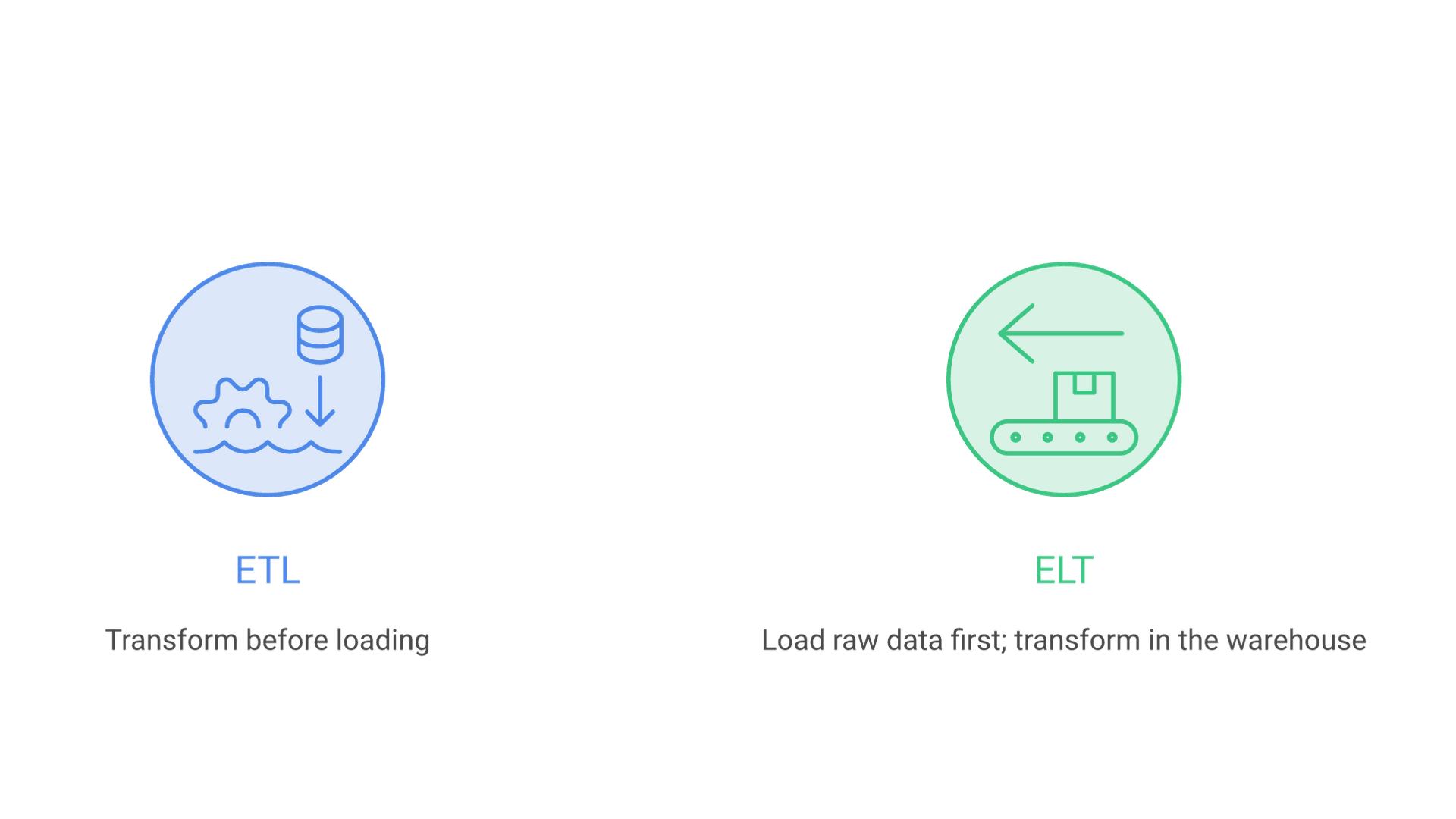
- ETL transforms data before loading it; ELT loads raw data first and transforms it inside the warehouse. Both are types of data pipeline.
- Orchestration, data quality tests and observability are what separate a production pipeline from a script that happens to work today.
- Cloud-native managed services reduce infrastructure work, but you still own data modeling, testing and governance.
Introduction to Data Pipelines in Software Development and Artificial Intelligence
A data pipeline is an automated workflow that orchestrates the movement, transformation and loading of data from multiple sources to target destinations such as data warehouses, data lakes or analytics platforms. It turns raw data from disparate sources into clean, reliable and documented information that analysts, applications and AI systems can trust.
Data pipelines are the backbone of modern data infrastructure. They handle the repetitive work of data extraction, transformation and storage while protecting data quality and data integrity across the entire process. In software development they feed product analytics, billing and operational reporting. In artificial intelligence they assemble the training sets, feature tables and retrieval indexes that models depend on.
What This Guide Covers
This guide covers data pipeline architecture fundamentals, the difference between ETL and ELT, batch processing and stream processing systems, cloud-native solutions, orchestration, data quality and observability, and practical approaches to building scalable data processing workflows.
Who This Is For
It is written for data engineers, data scientists, software engineers, business analysts and IT leaders who need to understand or implement data pipelines. Whether you are planning your first data integration project or modernizing existing enterprise workflows, the same principles apply to small and large volumes of data.
Why This Matters
Organizations generate large amounts of structured and unstructured data from SaaS applications, sensors, transactional databases and event logs. Without well-organized pipelines, that information stays trapped in silos, reports disagree with each other and every new analysis starts with a manual extract. For AI initiatives the stakes are higher: a model is only as good as the data it learns from, a point illustrated by research on how low-quality training data degrades language models.
Understanding Data Pipeline Fundamentals
Data pipelines are automated systems that manage the flow of data from source systems through processing stages to final storage destinations. They replace manual data handling with sequenced, versioned steps that extract, transform and load data at scheduled intervals, when an upstream event occurs, or continuously in real time.
A useful mental model is a series of stages where the output of one step becomes the input of the next. Each stage should be independently testable and safe to rerun, so a failure halfway through can be fixed without corrupting the destination.
Core Components of Data Pipelines
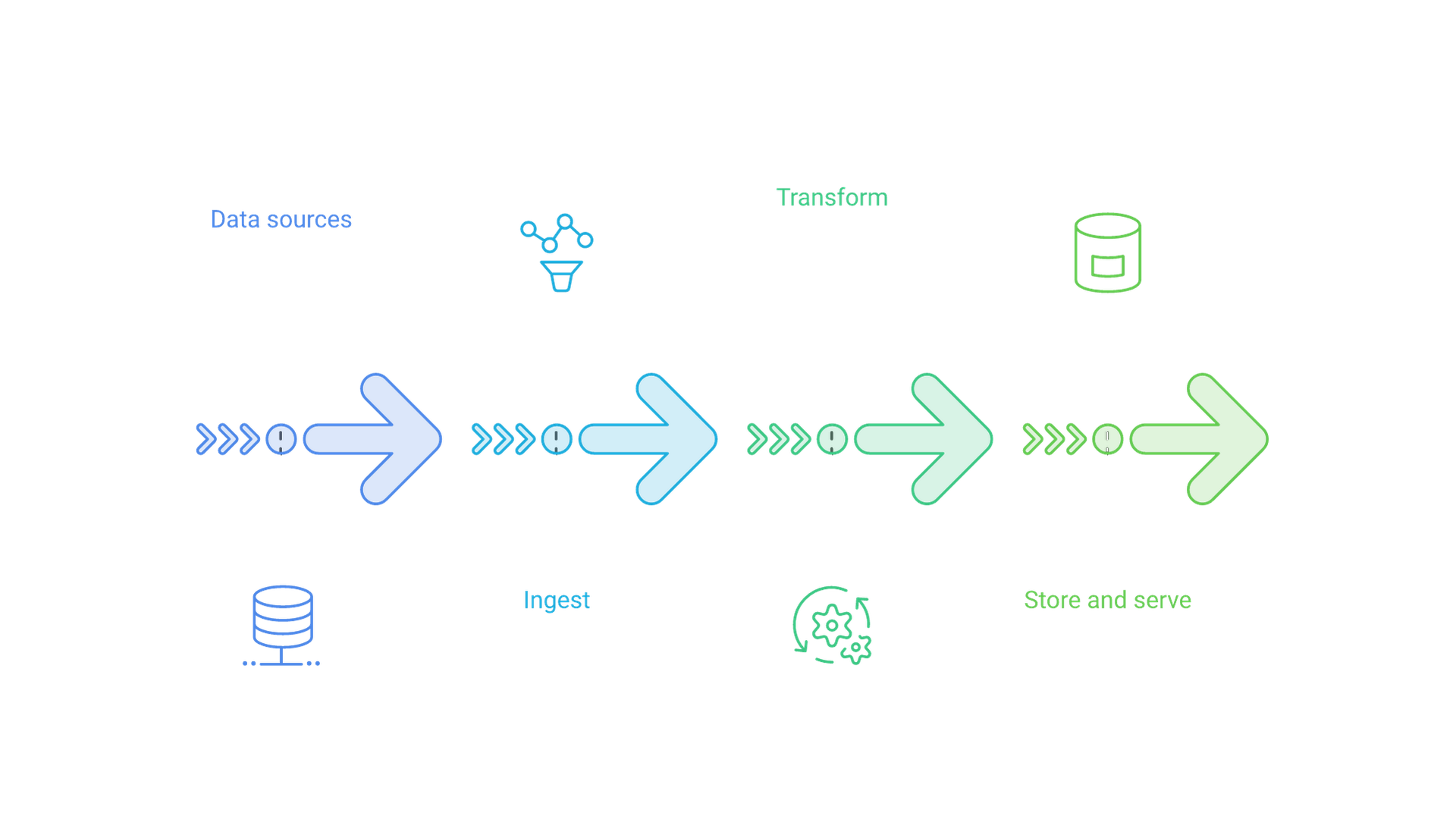
Most data pipelines, regardless of tooling, contain the same building blocks:
- Data sources. Operational databases, SaaS APIs, files and object storage, application logs, IoT devices and event streams.
- Ingestion. Connectors, API calls, file loaders or change data capture (CDC) that collect data and route it into the pipeline.
- Processing and transformation. Cleaning, deduplication, normalization, joins, aggregation and enrichment.
- Storage. A data warehouse, a data lake or a lakehouse that holds raw and modeled data.
- Orchestration. The scheduler that runs tasks in dependency order, retries failures and records each run.
- Monitoring and governance. Data quality tests, alerts, lineage, access control and audit logs.
- Consumers. BI dashboards, reverse ETL into business tools, applications, machine learning features and AI retrieval systems.
Sources shape everything downstream because they determine data volume, format, change frequency and how reliably you can read them. A nightly CSV drop, a REST API with rate limits and a database transaction log call for very different ingestion strategies. Change data capture is common for databases: Debezium, for example, reads a database's change log and, as its architecture documentation explains, is most commonly deployed through Kafka Connect so every insert, update and delete becomes an event.
Data Processing and Transformation
The processing layer is the core of data pipeline architecture. Raw data undergoes cleaning, type casting, normalization, aggregation and enrichment so that disparate formats become standardized structures suitable for analytics and machine learning. Good transformations are deterministic and idempotent: running the same job twice on the same input produces the same output rather than duplicate rows.
Where the transformation happens is the main design choice, and it is the difference between ETL and ELT, covered next. The same preparation discipline applies when the consumer is a model rather than a dashboard; our guide to training an LLM on your own data walks through collection, cleaning, deduplication and formatting for that case.
Data Pipeline vs ETL: ETL and ELT Explained
People often use "data pipeline" and "ETL" interchangeably, but they are not the same. Data pipeline is the umbrella term for any automated movement of data. ETL (extract, transform, load) is one specific pattern within it, and a pipeline can also simply replicate data, stream events or feed an application without a classic transform step.
ETL: Transform Before Loading
In an ETL pipeline, data is extracted from sources, transformed on a separate processing engine and only then loaded into the target data store. ETL suits cases where you must mask or drop sensitive fields before they reach the warehouse, where the destination has limited compute, or where the target schema is strict. Microsoft describes Azure Data Factory as a managed service built for hybrid ETL, ELT and data integration projects, which shows that most modern platforms support both patterns.
ELT: Load First, Transform in the Warehouse
ELT loads raw data first and performs transformations inside a cloud data warehouse or lakehouse using its own compute. Because the raw copy is preserved, you can rebuild models when business logic changes without re-extracting from the source. dbt is the best-known tool for the "T" in this pattern: its documentation describes transforming raw warehouse data with SQL select statements (or Python DataFrames) while dbt handles materialization and schema changes.
| Aspect | ETL | ELT |
|---|---|---|
| Where transformation runs | Separate engine before loading | Inside the warehouse or lakehouse |
| Raw data retained | Often not in the destination | Yes, alongside modeled tables |
| Good fit | Strict schemas, early masking of sensitive data | Cloud warehouses, evolving business logic, analytics engineering |
| Main risk | Rework when logic changes | Uncontrolled warehouse cost and ungoverned raw data |
In practice many teams blend the two: light cleaning and masking during ingestion, then modeling in the warehouse.
Types of Data Pipelines and Applications
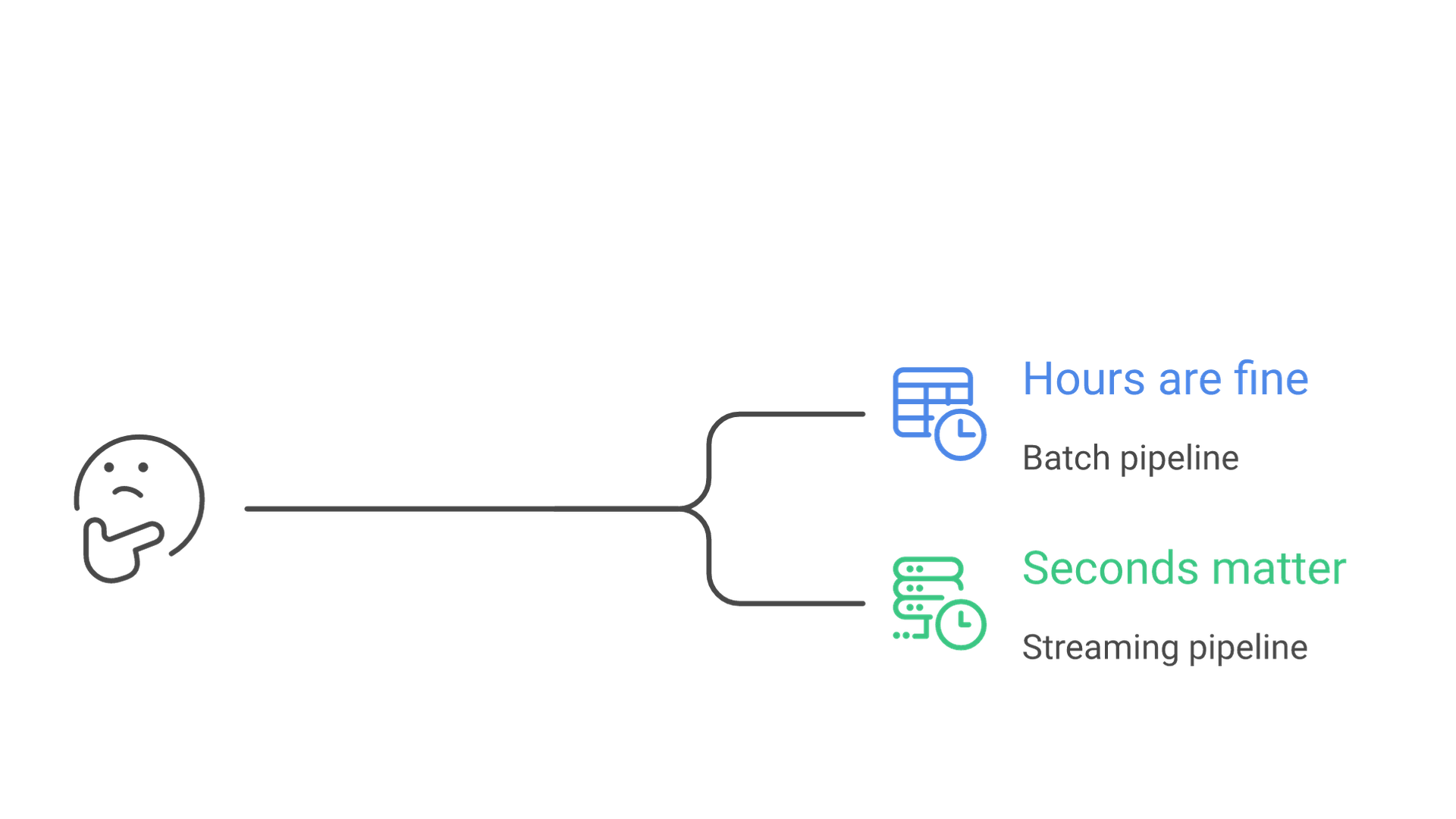
Business requirements and technical constraints drive the choice between pipeline architectures. The most important question is how fresh the data must be when someone or something uses it.
Batch Processing Pipelines
Batch pipelines collect and process data in discrete chunks at scheduled intervals, often handling large volumes of historical data during off-peak hours. They work well for monthly accounting reports, nightly data warehouse updates, model retraining and complex analytical workloads that do not require real-time data.
Common technologies include Apache Spark for distributed processing, warehouse SQL and dbt for modeling, and an orchestrator such as Apache Airflow. Batch remains the default for many enterprise workloads because it is simpler to reason about, easier to rerun and usually cheaper for data that is not time-sensitive.
Real-Time Streaming Pipelines
Streaming data pipelines process information continuously as new data arrives. Instead of waiting for a schedule, they consume an unbounded stream of events and apply transformations incrementally. The Apache Kafka introduction defines event streaming as capturing data in real time from event sources and lists three core capabilities: publishing and subscribing to streams of events, storing them durably, and processing them as they occur or retrospectively.
Kafka 4.0, released in March 2025, was the first major release to operate entirely without Apache ZooKeeper, running in KRaft mode by default, and the project blog lists Kafka 4.4.0 as released on October 22, 2026. On the processing side, Spark Structured Streaming processes streams as a series of small batch jobs by default; its programming guide cites end-to-end latencies as low as 100 milliseconds with exactly-once fault-tolerance guarantees in that mode.
Typical examples include fraud detection that scores transactions as they happen, IoT monitoring of sensor data, clickstream personalization and live operational dashboards. Streaming requires more infrastructure and operational maturity, so use it where seconds genuinely change the outcome.
Cloud-Native Data Pipelines
Cloud providers offer managed pipeline services that scale compute with data volume and remove much of the burden of managing infrastructure:
- AWS Glue is described in the AWS documentation as a serverless data integration service supporting ETL, ELT and streaming workloads, with a central Data Catalog.
- Google Cloud Dataflow provides unified stream and batch processing and is built on the open-source Apache Beam programming model, according to the Dataflow overview.
- Azure Data Factory orchestrates data movement and transformation; Microsoft now positions Data Factory in Microsoft Fabric as its next generation and recommends that new users start there.
One update to older guides: AWS Data Pipeline is no longer available to new customers and is in maintenance mode, according to its developer guide, which points existing users to migration options. New AWS projects typically start with AWS Glue or a managed orchestrator instead.
Cloud-native platforms support both batch and streaming patterns and provide built-in security features, access controls and compliance capabilities. Choosing between them is part of a broader platform decision; teams weighing managed services against self-hosted stacks often review it together with their cloud infrastructure strategy.
Data Pipeline Orchestration
Orchestration decides what runs, in what order and what happens when something fails. Without it, pipelines become a tangle of cron jobs with hidden dependencies and silent failures.
DAGs, Schedules and Dependencies
Most orchestrators model a pipeline as a directed acyclic graph (DAG) of tasks. The Apache Airflow documentation describes Airflow as a platform for orchestrating batch workflows, defined entirely in Python, where a DAG holds the schedule, tasks and dependencies of a workflow. Because the workflow is code, it can be reviewed, versioned and tested like any other software.
Airflow 3.0, released in April 2025, added DAG versioning, scheduler-managed backfills, a rewritten React UI and asset-based scheduling, according to the official release notes, which list 3.3.2 (September 17, 2026) as the latest release at the time of writing. Asset-aware scheduling lets a downstream DAG run when an upstream task updates the data it depends on, not only on a clock, as the asset scheduling guide explains.
Choosing an Orchestrator
Airflow is the most widely adopted open-source option. Prefect and Dagster are popular Python-native alternatives, with Dagster emphasizing data assets and operational visibility. Cloud services such as Azure Data Factory, AWS Glue workflows and managed Airflow offerings reduce hosting work. Whichever you choose, insist on retries with backoff, alerting on failure, clear run history and the ability to backfill a date range safely. Streaming jobs are different: they run continuously and are monitored like services, with lag and error-rate alerts.
Data Quality and Observability
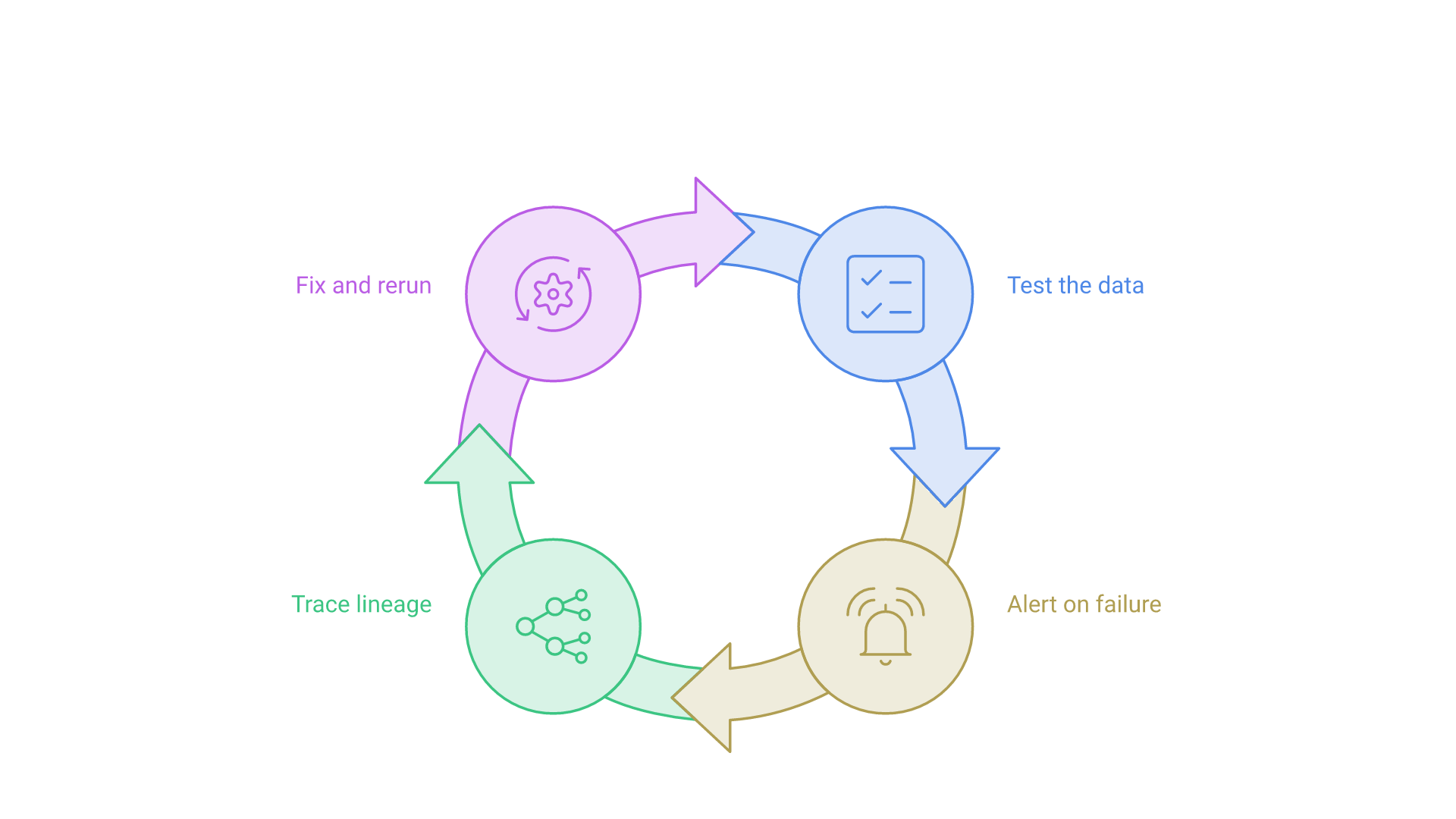
A pipeline that runs on time but delivers wrong data is worse than one that fails loudly. Data quality checks catch bad data; observability tells you where it came from and who is affected.
Testing Data in the Pipeline
Treat data assertions like unit tests. dbt's data tests are SQL queries that return failing rows, and four generic tests ship built in: unique, not_null, accepted_values and relationships. Great Expectations takes a similar approach and defines an Expectation as a verifiable assertion about data. Place checks at three points: when data lands, after key transformations and before publishing to consumers.
Freshness, Volume and Schema
Beyond row-level rules, monitor whether data arrived on time, whether volumes look normal and whether a source schema changed. dbt's source freshness checks report whether source data meets the freshness SLA you define, and a failed check can stop downstream steps from running on stale data.
Lineage and Incident Response
Lineage records which jobs read and wrote which datasets, so you can trace a broken dashboard back to its cause and see what else is affected. OpenLineage is an open framework for collecting and analyzing lineage metadata, and Airflow and other tools can emit it. Combine lineage with clear ownership, alert routing and a habit of fixing root causes and rerunning affected partitions rather than patching numbers by hand.
Building and Implementing Data Pipelines
Successful implementation requires planning that considers data sources, processing requirements, scalability and organizational constraints. The process runs from assessment through production deployment and ongoing monitoring.
Step-by-Step: Pipeline Development Process
Use this sequence when planning a new data integration project or modernizing existing data infrastructure:
- Requirements assessment. Identify data sources, target destinations, consumers and business dependencies. Document expected data volume, freshness requirements, retention and compliance needs.
- Architecture design. Choose batch or streaming, ETL or ELT, storage and orchestrator. Define data models, naming conventions and how environments are separated.
- Development and testing. Build pipeline components as version-controlled code, add data tests and unit tests, and validate transformations against representative test datasets.
- Deployment and CI/CD. Promote changes through development, staging and production with automated checks.
- Monitoring and operations. Configure alerting, freshness checks, lineage and runbooks, and assign an owner for every pipeline.
The same lifecycle thinking that governs application code applies here. Treat each pipeline as a product with an owner, documentation and a change process, and size the stack using the same criteria described in our guide to choosing tech stack components.
Comparison: Build vs Buy Solutions
| Factor | Custom development | Managed or commercial tools |
|---|---|---|
| Implementation time | Longer, depends on scope and team | Faster for standard connectors |
| Technical expertise | Requires skilled data engineers | Analysts can configure basic pipelines |
| Customization | Full flexibility for unusual sources and logic | Limited to platform capabilities |
| Ongoing maintenance | You own updates, scaling and connector fixes | Vendor maintains infrastructure and connectors |
| Cost structure | Engineering time up front, infrastructure ongoing | Lower setup effort, usage or subscription fees |
Custom development with tools such as Apache Airflow, Spark and dbt provides maximum flexibility but requires sustained engineering investment. Commercial ingestion platforms such as Fivetran or Stitch accelerate deployment for common SaaS sources but may require adjusting workflows to platform constraints. Many teams buy ingestion for standard sources and build transformation and orchestration in code.
Common Challenges and Solutions
Implementation means navigating technical complexity, protecting data quality and keeping operations reliable across diverse source systems.
Challenge 1: Data Quality and Validation Issues
Solution: implement data quality checks at multiple stages: source validation, transformation verification and destination monitoring. Alert on anomalies, missing values and schema changes, and quarantine bad records instead of loading them silently. Tools such as Great Expectations or dbt tests catch issues before they reach downstream analytics and AI models.
Challenge 2: Pipeline Performance and Scalability
Solution: design for growth from the start. Use incremental loads rather than full reloads, partition large tables by date or key, push filters close to the source and parallelize independent tasks. Monitor run duration and cost per run so regressions are visible, and use the autoscaling features of managed services where they fit.
Challenge 3: Data Security and Compliance
Solution: encrypt data in transit and at rest, grant least-privilege access, keep secrets in a secrets manager rather than in pipeline code and maintain audit logs for all data operations. Mask or tokenize personally identifiable information early, apply retention policies to historical data and document where regulated data flows so compliance reviews do not depend on tribal knowledge.
Challenge 4: Schema Drift and Late-Arriving Data
Solution: sources change without warning. Use schema validation or data contracts at ingestion, version your models, and design incremental logic that can reprocess a window of recent data when late events arrive.
Data Pipeline Examples and Use Cases
The following illustrative patterns show how the components combine. They are generic architectures, not descriptions of specific client systems.
Analytics and Reporting
Ingestion connectors copy CRM, billing and product data into a cloud warehouse each hour. dbt models clean and join it into revenue and customer tables, tests verify keys and freshness, and BI dashboards read only the tested models.
Real-Time Operations
Change data capture streams order events from an operational database into Kafka. A stream processor enriches each event, updates inventory and flags anomalies within seconds, while a nightly batch job reconciles totals for finance.
Machine Learning and AI
A batch pipeline builds feature tables and curated training sets on a schedule, with lineage linking each model version to the data that produced it. For retrieval-augmented generation, a pipeline extracts documents, splits and embeds them, and refreshes the vector index when sources change. Turning these patterns into a reliable analytics and AI foundation is the focus of Cognativ's data analytics consulting.
Frequently Asked Questions
What is a data pipeline in simple terms?
It is an automated set of steps that moves data from where it is created to where it is used, cleaning and reshaping it along the way, on a schedule or continuously.
Is a data pipeline the same as ETL?
No. ETL is one type of data pipeline that transforms data before loading it. Data pipeline is the broader term and also covers ELT, replication and streaming pipelines.
What are the main stages of a data pipeline?
Typically ingestion from sources, processing and transformation, storage in a warehouse or lake, and delivery to consumers, with orchestration and monitoring around every stage.
When should I use streaming instead of batch?
Use streaming when acting on data within seconds changes the outcome, as in fraud detection or live operations. If hourly or daily freshness is acceptable, batch is usually simpler and cheaper.
Is Apache Airflow a streaming tool?
No. Airflow's documentation describes it as a platform for orchestrating batch workflows. It can schedule the jobs around a streaming system, but engines such as Kafka, Spark Structured Streaming or Dataflow process the streams.
How do I make a data pipeline reliable?
Make tasks idempotent, add retries and alerts, test data at ingestion and before publishing, monitor freshness and volume, and record lineage so failures can be traced and safely rerun.
Conclusion and Next Steps
Data pipelines are the foundation of modern data infrastructure, turning raw data from disparate sources into trustworthy business insights and AI-ready datasets through automated, scalable workflows. Whether you implement batch processing for comprehensive analytics or streaming for immediate decisions, success depends on careful planning, the right ETL or ELT pattern, disciplined orchestration and continuous data quality monitoring.
To get started, inventory your current sources and integration gaps, choose batch or streaming based on real freshness requirements, and begin with a pilot pipeline that has tests, alerts and an owner from day one. Expand from there as you learn what your consumers actually need.
If you are planning a new data platform or need to stabilize the pipelines you already run, talk to Cognativ about your data project.