


Application Architecture: Key Concepts, Types and Patterns
From monoliths and N-tier layers to microservices, events and serverless: how each architecture pattern works, its trade-offs and a framework for choosing.
Application architecture is the high-level structure of a software application: which components it contains, what each one is responsible for, how they communicate and how data moves between them. It is the blueprint that decides whether an application can scale, stay secure, absorb new requirements and be changed by more than one team without breaking.
An architecture is a set of decisions, not a framework. Choosing a monolith, layered N-tier design, microservices, event-driven system or serverless functions shapes cost, release speed and operational burden for years, so it pays to understand the main application architecture patterns before committing to one.
This guide covers the definition, the core layers, the main types of application architecture, how to choose between them, common mistakes and the state of the field as of November 2026.
What Is Application Architecture?
Application architecture describes how a single application, or a closely related set of services, is organized internally. It defines the boundaries between parts of the code, the contracts between them (function calls, APIs, messages or events), where state lives and how the application is deployed and run.
It sits between enterprise architecture, which maps capabilities and systems across the whole organization, and software design, which decides classes and functions inside one component.
Architecture Patterns Versus Design Patterns
The two terms are often confused. An architecture pattern, sometimes called an architecture style, sets the organizing principle for the whole application, for example "the system is a set of independently deployable services" or "every layer only calls the layer beneath it." A design pattern solves a localized coding problem inside that structure, such as a repository, factory or observer. You can use dozens of design patterns inside one architecture pattern.
Architecture Styles as Constraints
A useful way to think about any pattern is as a set of constraints. Microsoft's Azure Architecture Center guide to architecture styles describes a style as a family of architectures that restricts which elements can appear and how they relate. Microservices, for instance, require that each service owns a single responsibility and keeps its data private. Respect the constraints and you get the benefits, such as independent deployment and fault isolation. Adopt the label without the constraints and you inherit the complexity without the payoff.
Core Components of Application Architecture
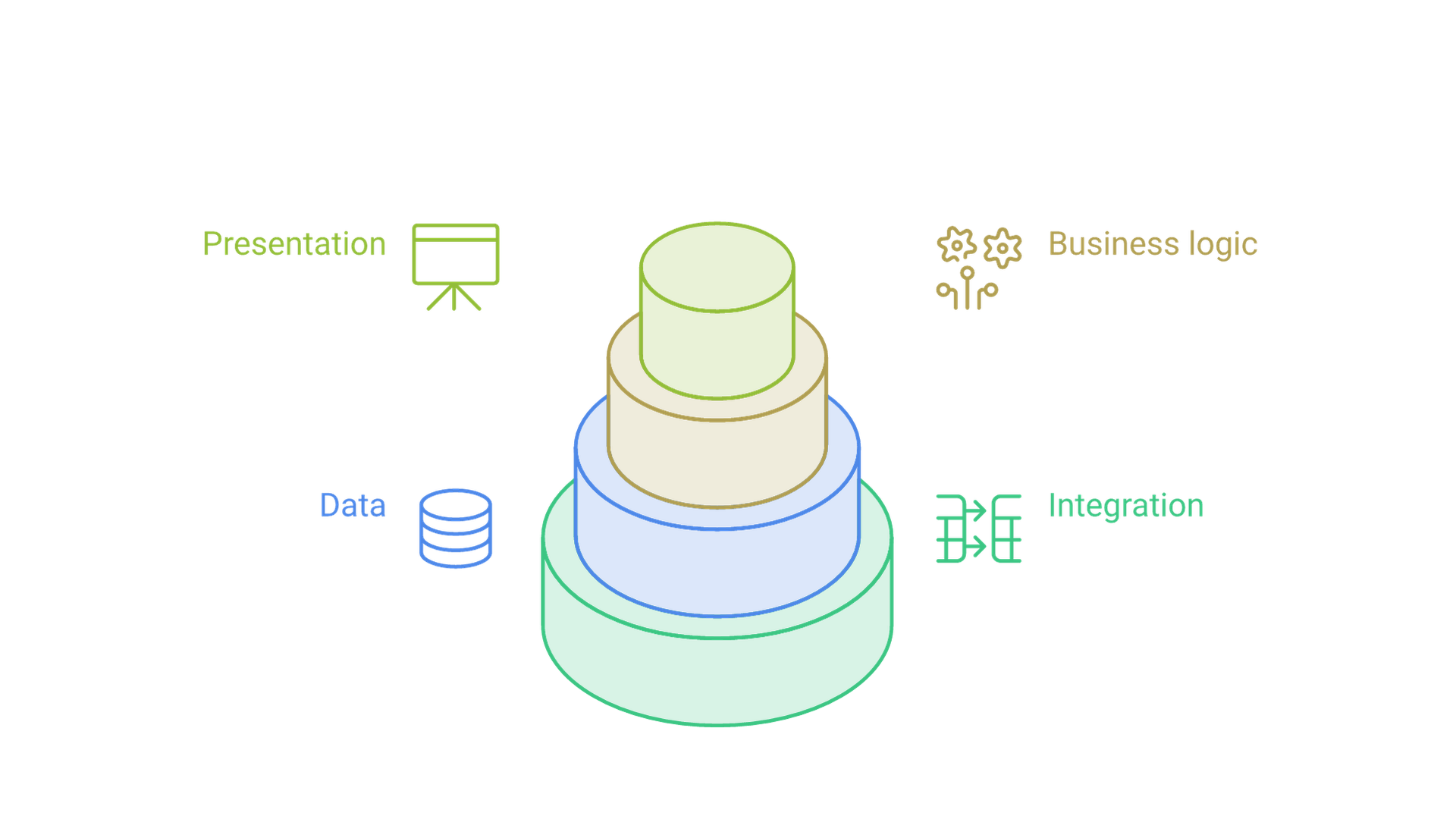
Whatever pattern you choose, most applications separate the same four concerns, whether as modules in one codebase or as separate services.
Presentation Layer
The presentation layer is everything the user touches: web pages, mobile screens, APIs consumed by front ends and the logic that validates input and formats output.
Business Logic Layer
The business logic layer, also called the domain or application layer, holds the rules that make the software valuable: pricing, eligibility, workflows, approvals and calculations. Keeping these rules independent of the user interface and the database is the most important habit for long-lived software.
Data Layer
The data layer manages storage, retrieval and consistency. It includes relational and NoSQL databases, caches, search indexes and file storage,. Decisions here, such as one shared database or one database per service, constrain every other choice.
Integration Layer
The integration layer connects the application to third-party APIs, identity services, message brokers and internal platforms, so a vendor can be replaced without rewriting business logic.
Types of Application Architecture Patterns
There is no single official list of application architecture types, but the same patterns appear in vendor guidance, textbooks and real systems. Most production applications combine two or more of them.
Monolithic Architecture
A monolith packages the entire application as one deployable unit, usually with a single database. It is the simplest pattern to build, test and deploy. As it grows, every change requires redeploying everything and, without discipline, modules become tangled.
Modular Monolith
A modular monolith keeps one deployment unit but enforces strict boundaries between internal modules, each with its own public interface and, ideally, its own data. Shopify described choosing this route in its engineering post on deconstructing its Rails monolith, aiming to increase modularity without increasing the number of deployment units. For many teams it is the best starting point: simple to operate, and ready to split later along boundaries that have already proven themselves.
Layered (N-Tier) Architecture
Layered architecture organizes code into horizontal tiers, typically presentation, business logic and data access, where each layer calls only the one below it. N-tier extends this into physically separate tiers, such as web servers, application servers and database servers. It is well understood and common in enterprise systems. Its weakness is that a single feature often touches every layer, which slows frequent change. It remains a natural fit for a typical business web application, and teams building custom web applications often start with clean layers inside a modular monolith before considering anything more distributed.
Service-Oriented Architecture (SOA)
SOA organizes functionality into reusable, business-aligned services shared across the enterprise, historically connected through an enterprise service bus. Central buses often became bottlenecks, and microservices evolved from SOA with lighter protocols and decentralized ownership.
Microservices Architecture
Microservices decompose an application into small, autonomous services. Each implements one business capability within a bounded context, owns its own data and can be developed, deployed and scaled independently. The benefits are team autonomy, fault isolation and faster releases in complex domains; the costs are distributed data consistency, network latency, versioned APIs and the need for mature DevOps.
Event-Driven Architecture
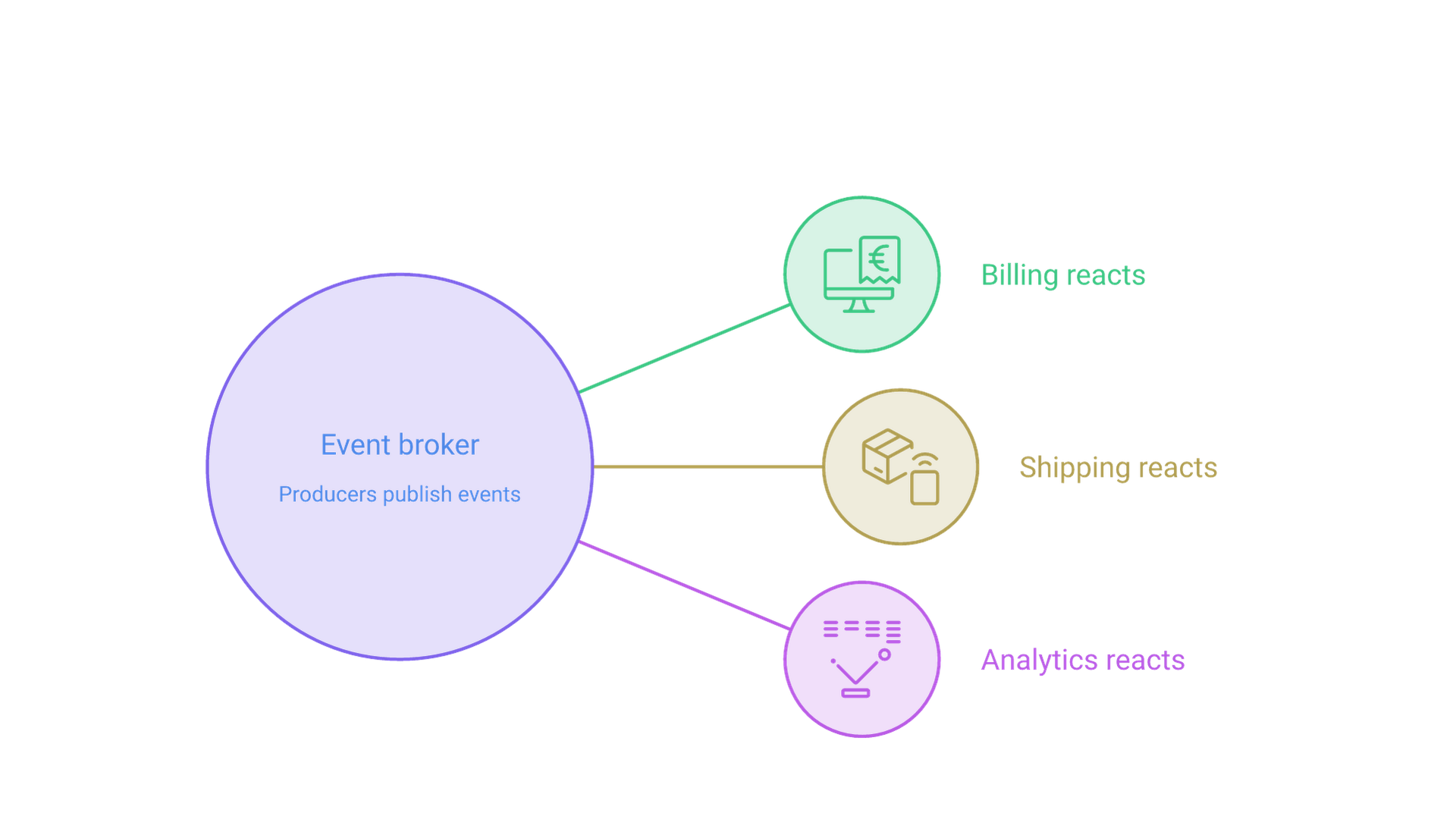
In an event-driven architecture, producers publish events to a broker or stream, and consumers react independently. Producers do not know who is listening, so new consumers can be added without touching existing code. The pattern suits real-time processing, IoT and workflows that fan out to many systems, but it introduces eventual consistency, duplicate messages and ordering questions that must be designed for explicitly.
Serverless Architecture
Serverless applications run code as managed functions or containers triggered by events and requests, with the cloud provider handling servers, scaling and patching. AWS describes Lambda as running code without provisioning or managing servers, billed for what you use. Serverless is excellent for spiky or event-driven workloads and small teams. Trade-offs include cold starts, execution limits and provider lock-in.
Cloud-Native Architecture
Cloud-native is less a single pattern than a way of running the others: containers, orchestration (usually Kubernetes), infrastructure as code, continuous delivery and resilience patterns such as retries and circuit breakers. A containerized modular monolith can be cloud-native too.
Comparing the Main Types of Application Architecture
The table summarizes how the main patterns compare on the factors that usually drive the decision.
| Pattern | Deployment unit | Operational complexity | Scaling | Best fit |
|---|---|---|---|---|
| Monolith | One application | Low | Whole application | Prototypes, MVPs, small teams |
| Modular monolith | One application, enforced modules | Low to medium | Whole application | Growing products with unclear boundaries |
| Layered (N-tier) | One or several tiers | Medium | Per tier | Traditional business applications |
| Microservices | Many independent services | High | Per service | Complex domains, many teams |
| Event-driven | Producers and consumers | High | Per consumer | Real-time and integration-heavy systems |
| Serverless | Functions or managed containers | Low to medium | Automatic | Spiky, event-triggered workloads |
How to Choose an Application Architecture
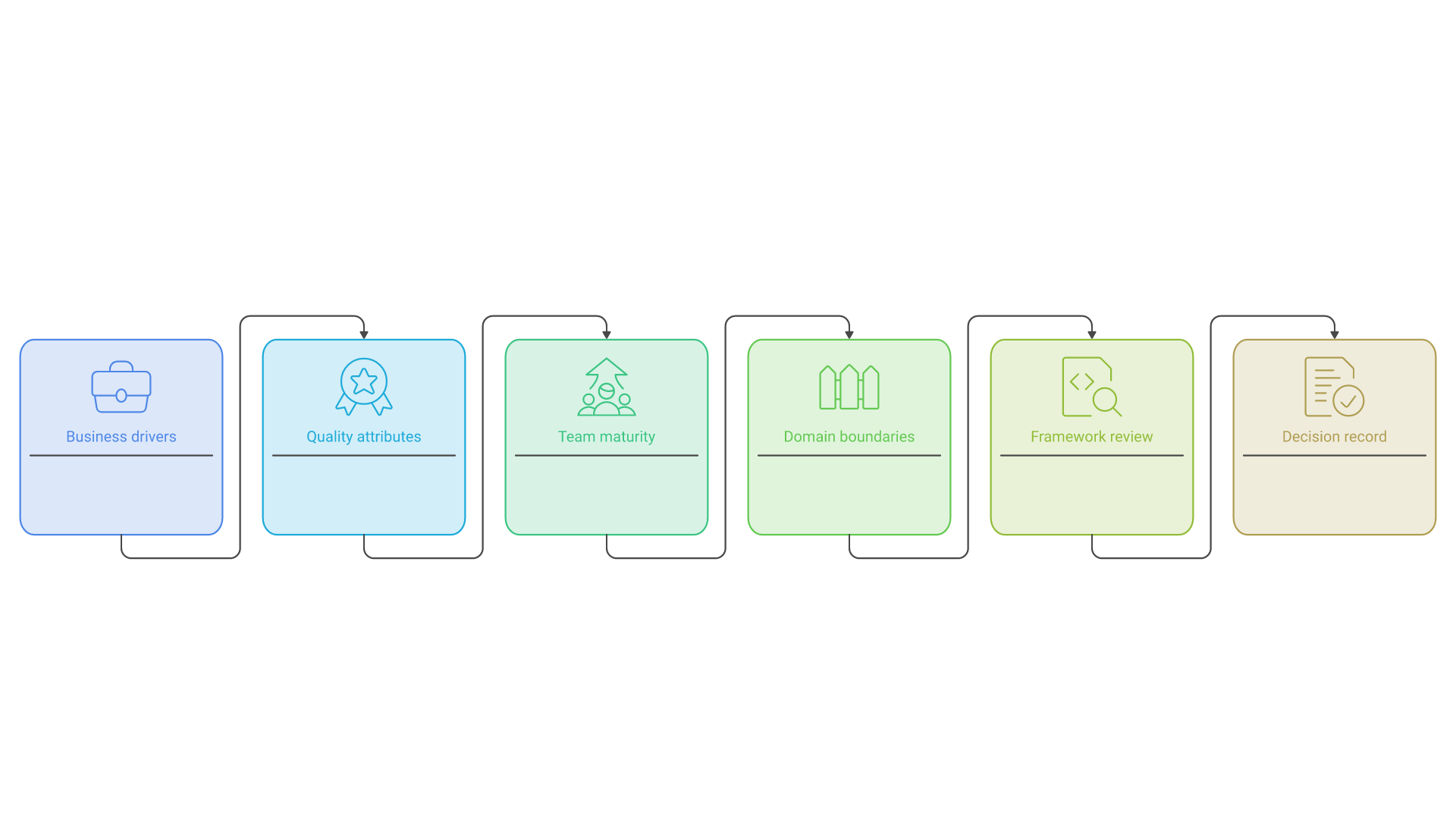
Treat architecture selection as a structured decision, for new builds and modernization alike.
- Clarify the business drivers. Identify what matters most: time to market, regulatory compliance, cost ceilings, expected growth or integration with existing systems.
- Translate drivers into quality attributes. Rank nonfunctional requirements such as availability, latency, security, maintainability and cost. These, more than features, determine the pattern.
- Assess team and operational maturity. Be honest about DevOps automation, monitoring and on-call capacity. A pattern your team cannot operate is the wrong pattern.
- Map the domain. Use domain-driven design to find bounded contexts. Clear, stable boundaries support services; fuzzy ones argue for a modular monolith first.
- Evaluate against a framework. Review the candidate against the six pillars of the AWS Well-Architected Framework: operational excellence, security, reliability, performance efficiency, cost optimization and sustainability.
- Record the decision. Capture the context, decision and consequences in an architecture decision record so future teams understand why.
Architecture decision records follow the lightweight format Michael Nygard proposed in Documenting Architecture Decisions: a title, context, decision, status and consequences, stored with the code and marked as superseded rather than deleted when the decision changes.
When the application is one of many that share data, identity and integrations, the decision should also fit the wider landscape. An enterprise architecture review helps align a single application's pattern with the organization's capability map, standards and roadmap, so that each new system does not invent its own integration style.
Common Application Architecture Mistakes to Avoid
Most failures come from applying a reasonable pattern without its constraints.
Starting With Microservices Too Early
Martin Fowler's MonolithFirst argument still holds: service boundaries are hard to get right before you understand the domain, and they are far more expensive to move across services than within one codebase. Build a modular monolith, learn where the seams are, then extract services where a measurable need appears.
Building a Distributed Monolith
Services that share one database, must be deployed together or call each other synchronously in long chains give you the downsides of both worlds. Fix it by giving each service ownership of its data, favoring asynchronous events for cross-service updates and versioning APIs.
Ignoring Observability
Once requests cross process boundaries, distributed tracing, centralized logging, metrics and clear service ownership need to arrive with the first service, not after the first outage.
Attempting a Big-Bang Rewrite
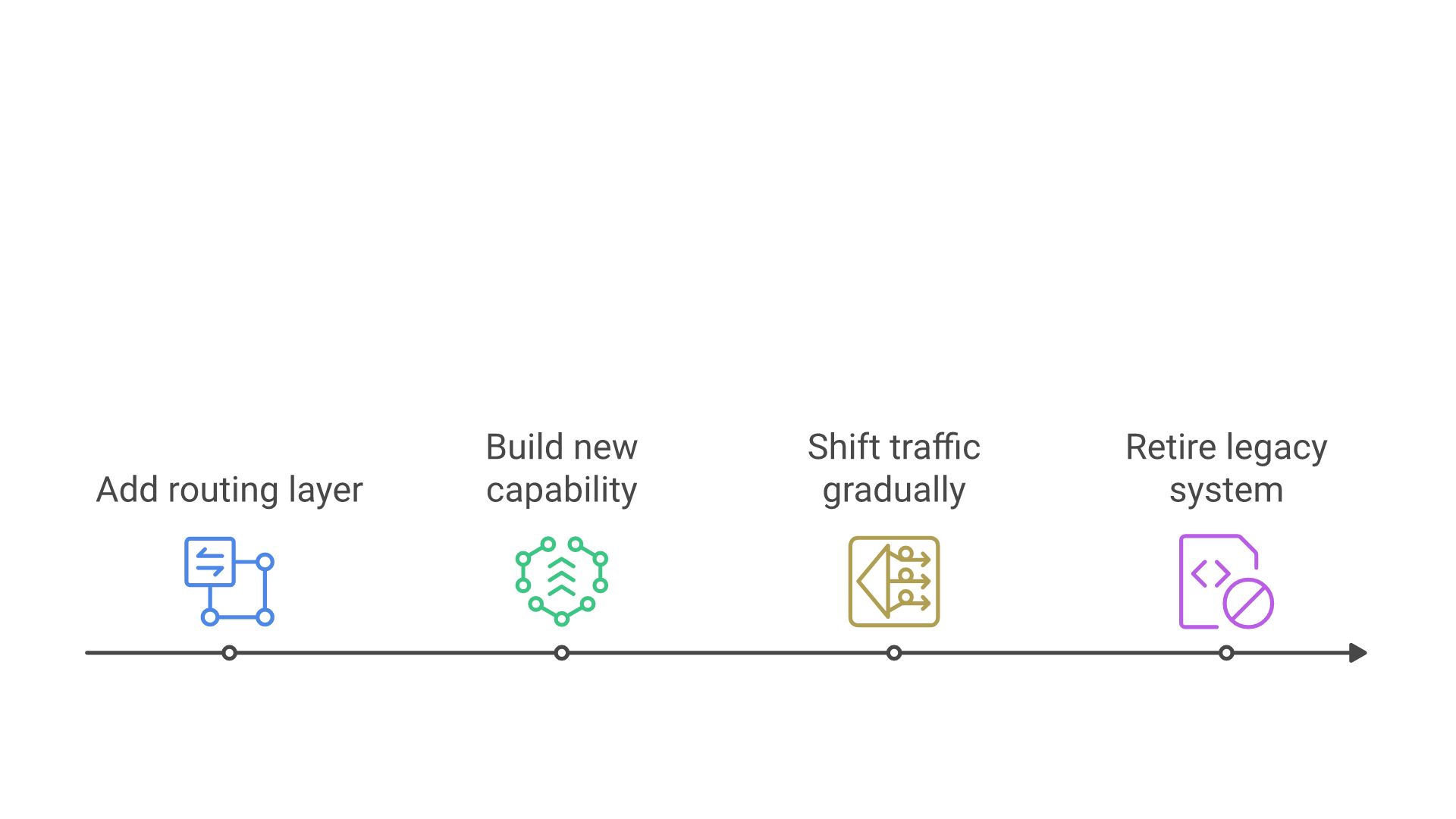
Replacing a legacy system all at once is the riskiest modernization path. The strangler fig pattern offers a safer route: put a routing layer in front of the legacy system, build new capabilities alongside it, move traffic one capability at a time and retire the old code only when nothing depends on it.
Application Architecture in 2026
As of November 2026, several trends shape how teams apply these patterns. Cloud-native operation is now mainstream: the CNCF 2025 Annual Cloud Native Survey, released in January 2026, reported that 82% of container users run Kubernetes in production and that cultural change within development teams is now the most cited challenge, ahead of purely technical barriers.
At the same time, the industry has become more pragmatic about distribution. The modular monolith is increasingly treated as a legitimate long-term architecture rather than only a stepping stone, and service granularity is judged by team and scaling needs rather than by a goal of making services as small as possible. Serverless platforms keep widening what they can host: AWS Lambda documentation now covers event functions, web functions that serve HTTP backends and durable multi-step workflows, which blurs the line between serverless and container-based designs.
AI workloads add new concerns. Model inference, retrieval pipelines and agents are usually added as separate services or event consumers behind clear APIs, with their own scaling, cost and governance controls. Clean boundaries and owned data make that far easier.
Frequently Asked Questions
What is application architecture in simple terms?
It is the blueprint of a software application: the main parts it is made of, what each part does, how the parts talk to each other and where data is stored. It determines how easily the application can grow and change.
What are the main types of application architecture?
The most common types are monolithic, modular monolith, layered (N-tier), service-oriented, microservices, event-driven and serverless. Many real systems combine several, for example a modular monolith that publishes events to serverless consumers.
What is the difference between application architecture and software architecture?
The terms overlap heavily. Software architecture is the broader discipline covering any software system, while application architecture usually refers to the structure of a specific business application and how it fits alongside other applications in an organization.
What are the three layers of application architecture?
The classic three-tier model has a presentation layer for the user interface, a business logic layer for rules and workflows, and a data layer for storage. Many modern designs add a separate integration layer for external systems.
Is microservices architecture always better than a monolith?
No. Microservices help when a complex domain and several teams need independent deployment and scaling, but they add significant operational overhead. For many products, a well-structured modular monolith is simpler, cheaper and faster to evolve.
How do you choose the right application architecture?
Start from business drivers and quality attributes, assess what your team can operate, map domain boundaries, evaluate candidates against a framework such as AWS Well-Architected and document the decision in an architecture decision record.
Conclusion: Choosing Application Architecture Patterns That Last
Application architecture is a set of long-lived decisions about boundaries, communication and data. The patterns covered here, from monoliths and layered designs to microservices, event-driven systems and serverless, are tools with known trade-offs, not ranks on a maturity ladder. The best choice is the simplest structure that meets your quality attributes today while keeping clean seams for tomorrow.
Start with business drivers, respect the constraints of the pattern you pick, record why you picked it and evolve incrementally rather than through big-bang rewrites.
If you are weighing architecture options for a new application or planning to modernize an existing one, talk to Cognativ about your application architecture.