

Application modernization: approaches, costs, risks, and a practical roadmap
A practical guide to modernizing legacy applications: six approaches side by side, typical cost and timeline ranges, key risks, and a six-step roadmap to use.
Application modernization is the process of updating the architecture, infrastructure, code, and operations of existing applications so they run securely, efficiently, and scalably on modern platforms - cloud, containers, microservices, serverless, and beyond. It is not simply moving a server to a new location; it means transforming legacy systems into modern apps capable of supporting today's business needs.
This article covers what application modernization is, the main approaches (rehost, replatform, refactor, rearchitect, rebuild, replace), their typical costs, risks, and timelines, and how to build a legacy modernization roadmap that balances quick wins with long-term architectural improvement. The scope here is mid-market and enterprise business applications - not simple website redesigns or consumer mobile apps.
The "best" modernization approach depends on your business goals, risk tolerance, and the current state of your legacy applications. There is no universal answer, and most enterprise modernization efforts blend multiple strategies across different parts of the existing application portfolio. What matters in 2025–2026 is that cloud-first mandates, AI and machine learning integration demands, security and compliance pressure, and the rising cost of legacy skills make standing still the riskiest option of all.
By reading this article, you will gain:
- A clear definition of application modernization and when it's needed.
- A side-by-side comparison of common application modernization strategies by cost, risk, and timeline.
- A step-by-step legacy modernization roadmap you can adapt to your organization.
- Practical guidance on common risks and how to mitigate them without disrupting existing operations.
- Decision criteria for when to involve a partner and how to start with a thorough assessment.
Understanding application modernization
Application modernization is the structured effort to bring outdated software applications in line with modern technologies and practices - enabling digital transformation, cloud computing adoption, and AI-driven workflows. It is foundational to enterprise modernization and directly supports faster delivery, better security, and reduced maintenance costs.
Modernization is not always a full rewrite. It spans a wide spectrum: from small infrastructure moves (rehosting to virtual machines in the cloud) to deep rearchitecting of a monolithic application into microservices - or even replacing custom systems entirely with managed services. This section establishes the foundational concepts that the later comparison and roadmap sections build upon.
What is application modernization (in practical terms)?
In practical terms, application modernization is the process of updating the architecture, code, and infrastructure of existing applications so they can run securely and efficiently on modern platforms - cloud infrastructure, Kubernetes, serverless, or a modern cloud platform of your choosing. It is business-outcome driven: the goal is not technology change for its own sake, but reduced time-to-market, improved performance, lower operating risk, and clearer data visibility.
It differs from a simple "lift-and-shift" hosting change, which moves an application to new infrastructure without meaningful performance or security gains. It also differs from greenfield product development, which creates entirely new systems unrelated to existing ones.
Core elements of a modernized application
"Modern" means specific architectural and operational traits, not just "running in the cloud." A modernized application typically exhibits the following core characteristics:
- Cloud-ready or cloud-native architecture - microservices, containers, or serverless where appropriate. Cloud-native applications can scale automatically based on user demand, and containerization improves application scalability and deployment efficiency.
- APIs and event streams for integration with other systems and partners, enabling real-time data flows.
- Automated CI/CD pipelines - continuous integration and delivery for frequent, low-risk releases. DevOps practices improve software development cycles and reduce errors.
- Built-in observability - logging, metrics, and tracing for faster diagnosis and proactive issue detection.
- Security by design - identity management, encryption, governance, and auditability baked into the architecture. Application modernization enhances security by fixing vulnerabilities that outdated applications expose.
- Scalability and elasticity - handling demand spikes cost-effectively without over-provisioning on premises infrastructure.
- Support for AI-driven automation and analytics - application modernization supports better integration with AI and analytics tools, including machine learning pipelines.
Cognativ's approach emphasizes these traits while aligning with industry-specific compliance and operational constraints, ensuring that the modernization process delivers significant benefits without introducing unnecessary risk.
Signs your organization needs application modernization
Many leaders underestimate how much legacy systems are silently constraining growth and risk posture. Legacy systems often accumulate technical debt, slowing innovation and increasing costs. Here are the symptoms to watch for:
- Release cycles measured in months or quarters, with frequent change freezes that prevent shipping new features.
- Key systems tied to end-of-life platforms - Windows Server 2012, unsupported Java/.NET versions, obsolete databases.
- Frequent production incidents or outages tied to brittle integrations between existing systems.
- Security findings from audits that are hard to remediate because of legacy stacks. Outdated applications expose businesses to cyberattacks and data breaches.
- Critical workflows still handled via spreadsheets, manual rekeying, or email because systems cannot integrate - preventing automation of core business processes.
- Growing difficulty hiring or retaining engineers familiar with older languages and frameworks (COBOL, PowerBuilder, classic ASP).
- Unit cost to serve customers rising due to operational workarounds and manual QA and operations overhead.
- Legacy systems struggling to handle increased traffic and data growth, creating scaling bottlenecks.
Recognizing these signs is the first step. The next is choosing the right modernization approach - which is what the following section addresses in detail.
Application modernization approaches
There is no "one-size-fits-all" strategy for app modernization. Most enterprises blend multiple approaches across their portfolio, and the 5Rs of modernization - Rehost, Replatform, Rearchitect, Rebuild, and Replace - along with Refactor, form the core toolkit. The AWS "6 Rs" framework is commonly used to manage application portfolios, and key strategies in application modernization include rehosting and refactoring alongside deeper transformation options.
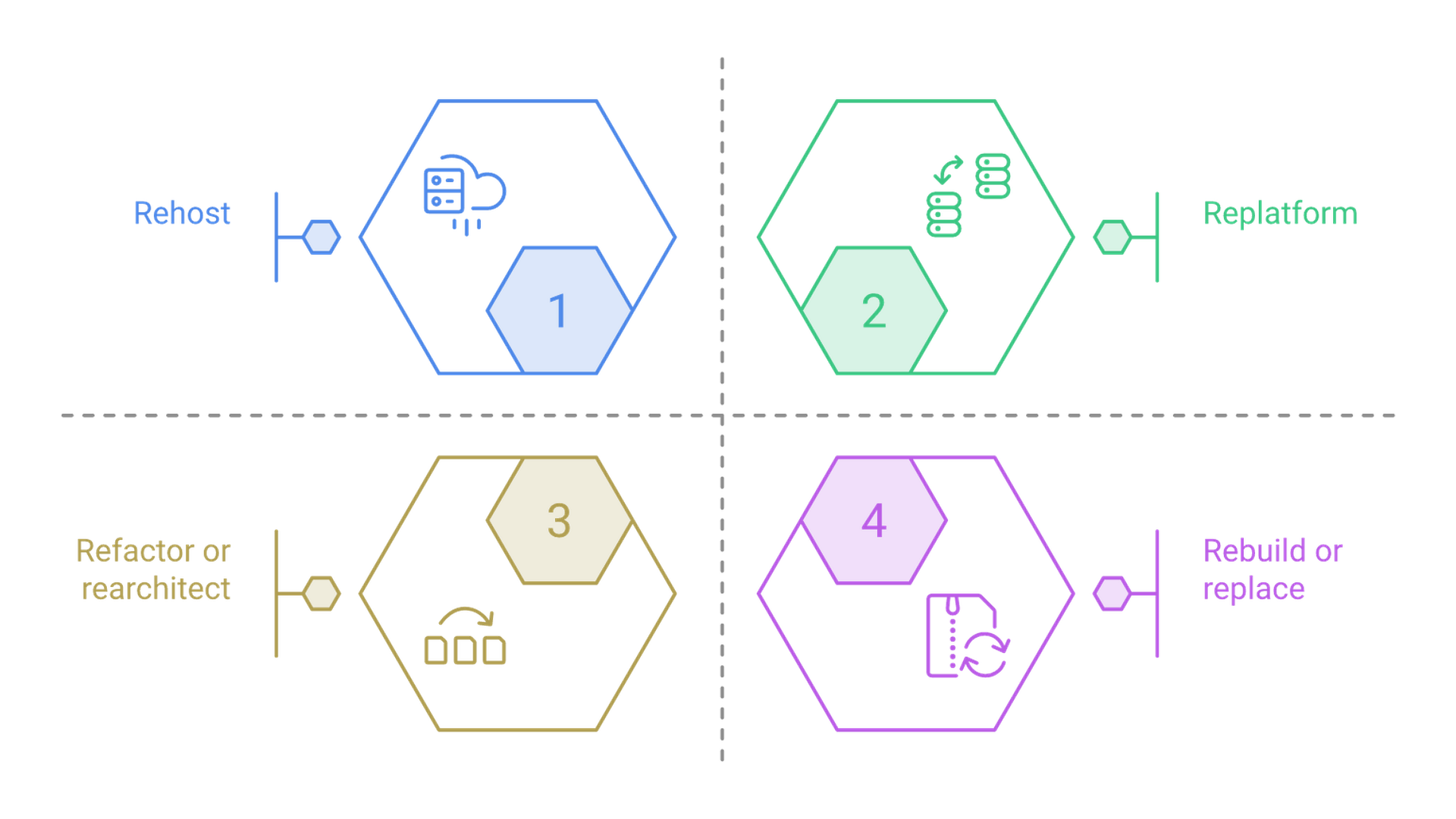
This section covers each approach with a focus on business trade-offs: cost, risk, and timeline. These strategies map to both cloud migration and broader modernization - they are not limited to infrastructure changes alone.
Rehost (lift and shift)
Rehosting involves moving applications to a new infrastructure with minimal changes - typically from on premises servers to cloud virtual machines. The application code, data model, and architecture remain essentially the same.
Typical use cases:
- Time-sensitive data center exits or hardware refresh deadlines.
- Need for quick cost visibility while planning deeper modernization later.
Business impact:
- Fastest path to cloud infrastructure with the lowest disruption. Timelines are typically 2–6 weeks per application.
- Limited long-term agility gains - the application inherits all its architectural constraints.
- Can serve as a deliberate first step in the application modernization journey before refactoring or rearchitecting.
Common pitfalls: Replicating on-prem inefficiencies in the cloud, leading to surprise cloud bills without optimization. Moving to cloud services alone does not modernize business processes or reduce technical debt.
Replatform (lift and shape)
Replatforming adapts applications to a new platform with limited code changes - for example, moving from self-managed VMs to a managed database, application services, or Kubernetes on a cloud provider. It delivers more gains than pure rehost without the effort of a full refactor.
Typical scenarios:
- Moving a .NET app from on-prem IIS to Azure App Service or containers.
- Upgrading database engines while offloading infrastructure management to cloud platforms.
Benefits:
- Better scalability, resilience, and reduced operational overhead compared to rehost.
- Enables initial CI/CD and observability improvements - stepping stones toward modern development practices.
Constraints: Still limited by monolithic architecture and legacy code structure. Scope creep can occur if the boundary between "modest changes" and "refactoring" is not clearly governed.
Refactor (code-level modernization)
Refactoring means restructuring and cleaning up code without changing core business behavior. The goal is typically to extract services, improve modularity, reduce technical debt, and adopt newer frameworks or language versions.
Ideal conditions:
- The application's business logic is still valuable and correct, but the implementation is fragile and hard to change.
- Teams need faster change cycles but cannot afford a full rewrite.
Refactoring usually takes longer than rehost or replatform - typically 3–12 months depending on system complexity - but yields substantially better developer productivity and maintainability. It is a practical path to improved performance and the ability to ship new features faster.
Rearchitect (modularize and redesign)
Rearchitecting means redesigning the application's fundamental structure - often breaking a monolithic application into domain-aligned services or adopting event-driven patterns. Microservices architecture enables modular modernization of applications, allowing different teams to deploy independently.
Drivers:
- Scaling bottlenecks in specific parts of a monolith.
- Need for independent deployment of features by different teams.
- Critical integrations or data domains that must be isolated for enhanced security or compliance.
Risks and complexity:
- Requires strong domain modeling, careful use of patterns like the Strangler Fig, and robust testing. Managing technical complexity requires realistic expectations and appropriate tooling.
- Higher upfront effort - typically 12–24 months for large systems - but unlocks substantial agility and reliability gains, particularly for enterprise software integration scenarios.
Rebuild (rewrite) and Replace (SaaS/COTS)
These represent the most transformative - and most expensive - ends of the spectrum.
Rebuild means rewriting the application from scratch, preserving key business logic and IP but using a modern tech stack, UX, and data models. It is appropriate when the legacy app is beyond salvage or heavily misaligned with current workflows. Costs range from $500K to well over $1M for enterprise-scale systems, with timelines of 6–18+ months. The risk is very high (scope creep, lost requirements), but so is the potential for maximum design flexibility and future-proofing. Modernized applications are designed for rapid change and scalability.
Replace means retiring the custom legacy app and adopting an off-the-shelf SaaS or COTS solution. Typical use cases include HR, CRM, or standard ERP modules where market-leading SaaS exists. The pros include quicker time-to-value and vendor-managed updates and compliance. The trade-offs are vendor lock-in, limited customization, and complex data migration. For organizations evaluating SaaS options, a structured vendor platform selection framework can reduce risk substantially.
Cognativ can help decide which domains warrant custom enterprise software development versus SaaS adoption - and how to integrate both cleanly.
Hybrid and incremental modernization patterns
Most real-world application modernization projects combine approaches. A phased approach to modernization minimizes operational risk and allows organizations to learn as they go.
Key application modernization patterns include:
- Strangler Fig pattern: Incremental modernization uses the Strangler Fig pattern to replace components gradually - surrounding the monolith with new services and cutting over functionality piece by piece.
- API-first wrapping: Placing an API layer or anti-corruption layer in front of legacy systems to reduce coupling while planning deeper modernization. This enables integration with other systems immediately.
- Domain-based segmentation: Treating each bounded context with a different "R" based on its business value and technical complexity.
Hybrid cloud architectures allow gradual modernization of applications, letting organizations move at a pace that matches their risk tolerance and budget. To choose effectively among these options, leaders need a clear comparison of cost, risk, and timelines - which the next section provides.
Comparing modernization approaches: cost, risk, and timeline
Executive decisions and governance boards need an at-a-glance comparison to evaluate common application modernization strategies. The table below synthesizes typical ranges from industry data, followed by guidance on how to interpret the trade-offs for different business priorities.
Approach comparison table
Approach | Typical Cost | Timeline | Business Risk During Change | Operational Disruption Risk | Long-Term Agility Upside | Best When |
|---|---|---|---|---|---|---|
Rehost | $ (~$20K–$150K) | Weeks to 2–3 months | Low - minimal code change | Low to moderate | Low - architectural constraints persist | Data center exit; urgent cost pressure |
Replatform | $$ (~$75K–$250K+) | 1–6 months | Medium - some code/config risk | Moderate | Medium - infrastructure gains | Hosting outdated but core logic still sound |
Refactor | $$–$$$ (~$200K–$600K+) | 3–12 months | Medium-high - hidden code risk | Moderate-high | High - code health, maintainability | Systems that change often but are brittle |
Rearchitect | $$$+ (~$200K–$3M+) | 12–24 months | High - many moving parts | High | Very high - scalability, domain isolation | Growing scale demands; AI/data needs |
Rebuild | $$$+ (~$500K–$1M+) | 6–18+ months | Very high - scope and feature risk | High until cutover | Very high - clean slate potential | System too far from current business needs |
Replace (SaaS) | Subscription + implementation | 1–12 months (incl. integration) | Medium - vendor lock-in, fit-gap risk | Moderate - switching disruption | Medium - dependent on vendor roadmap | Commodity functions with mature SaaS options |
Values are approximate and vary by system size, technical complexity, compliance requirements, data volume, and integration dependencies.
Interpreting the trade-offs:
For tight timelines or regulatory deadlines, rehost or replatform offer the fastest path to compliance and cloud migration. When innovation or AI enablement is the top priority, refactoring or rearchitecting delivers the agility and data pipeline access needed for machine learning and automation. Gartner predicted that 85% of organizations would embrace a cloud-first principle by 2025, and 46% of organizations planned to increase spending on application modernization in 2023 - reflecting the urgency across industries.
Most portfolios use multiple approaches across different systems. According to Red Hat research, 85% of respondents planning to refactor plan two or three steps (e.g., rehost first, then replatform, then refactor), acknowledging that enterprise application modernization is rarely a single-step event.
How to choose the right modernization approach
Choosing the right approach requires answering a few structured questions:
- Is this system differentiated IP? Custom systems that deliver competitive advantage warrant deeper investment - refactor, rearchitect, or rebuild.
- How sensitive is the data and what are compliance requirements? Heavily regulated data domains may require on-prem or private cloud and more conservative migration approaches.
- What is the acceptable change window? Tight deadlines favor rehost or replace; longer horizons allow rearchitecting.
- What skills and capacity are available internally? Skill gaps may push toward replatform or replace rather than rebuild.
A practical segmentation model:
- Differentiate (competitive advantage) → refactor, rearchitect, or rebuild.
- Standardize (commodity functions) → replace with SaaS or replatform.
- Stabilize (critical but low-change) → rehost with targeted improvements.
Cognativ uses its RAPID framework to align these choices with measurable ROI and implementation risk - mapping business outcomes to architecture constraints, risk assessment, and sequencing across modernization waves. Once the right mix is chosen, organizations need a structured modernization plan. Cognativ's US-based team provides application modernization services that carry each chosen approach from assessment through cutover.
Building a legacy modernization roadmap
With approaches selected, the next challenge is sequencing them into a roadmap that respects real-world constraints: budgets, team capacity, regulatory windows, and the need to keep existing operations running. A successful modernization project balances quick wins that build credibility with the long-term architectural improvements that deliver lasting cost savings and agility.
Step 1: Portfolio assessment and baseline
Every application modernization journey starts with an audit and inventory of the existing application portfolio. This means mapping all applications across the enterprise, including:
- Business criticality - revenue impact, customer risk, regulatory exposure.
- Technical health - tech stack age, end-of-life platform status, test coverage, bug backlog.
- Security and compliance risk profile - audit findings, vulnerability counts, security risks.
- Operating and support costs - hosting, licensing, human effort, maintenance costs.
- Integration dependencies - which systems depend on which, and how tightly coupled they are.
Create a scoring model to rank modernization candidates. This thorough assessment typically takes 2–6 weeks and forms the foundation for every subsequent decision. Cognativ's approach starts with a structured assessment focused on measurable outcomes - available through their consulting practice. Cognativ's application modernization consulting covers this portfolio assessment, the scoring model and the wave plan, delivered by a US-based team.
Step 2: Define objectives and constraints
Align leadership on top-level modernization goals tied to business outcomes:
- Reduce incident rate by an agreed percentage.
- Cut lead time for changes by a defined number of days.
- Support entry into new markets or enable AI-driven workflows.
- Modernization can reduce operational overhead and shorten time-to-market.
Identify constraints that bound what is achievable:
- Budget and headcount limits over the next 12–24 months.
- Regulatory events - audits, new standards enforcement dates, end-of-support deadlines.
- Upcoming M&A integrations or divestitures.
Convert these into prioritization rules: which applications must move first, which can wait, and which should be retired. Modernization increases organizational agility and responsiveness, but only when objectives are clear and measurable.
Step 3: Select approaches per application or domain
Map each application or domain to a specific modernization approach based on:
- Business value and differentiation.
- Technical feasibility and risk.
- Dependency clusters - domains that must move together.
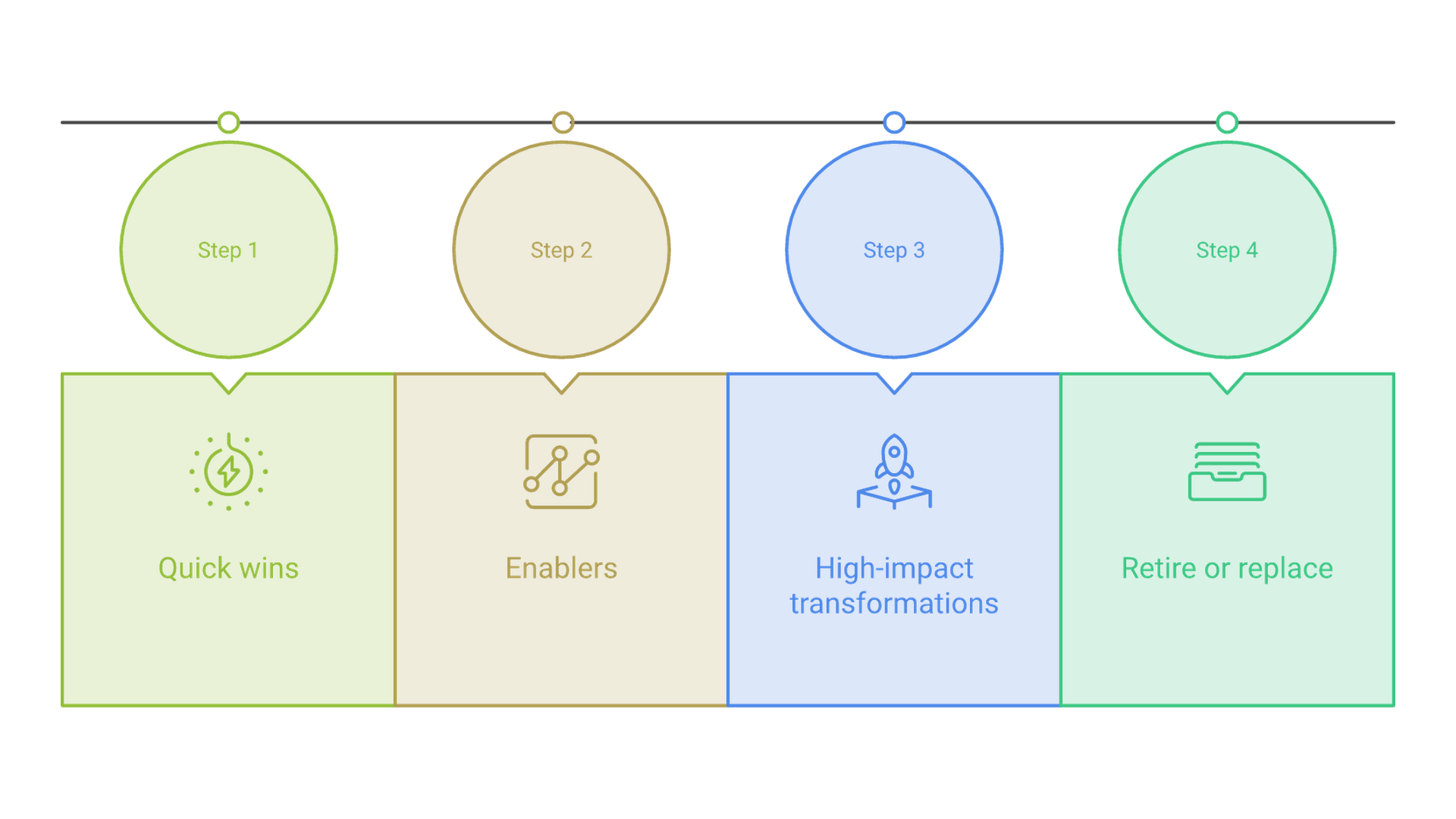
Group applications into 3–4 modernization "waves":
- Quick wins - rehost or replatform low-risk systems to demonstrate cost savings and build momentum.
- Enablers - modernize shared services, APIs, or data platforms that unlock downstream transformations.
- High-impact transformations - rearchitect or rebuild the core differentiating systems.
- Retire or replace - decommission outdated applications or switch to SaaS for commodity functions.
More enterprise apps end up being rehosted or replatformed than receive deeper refactor or rearchitect treatment - focusing the highest effort where it creates the most business value.
Step 4: Design target architecture and operating model
Define a conceptual target enterprise architecture:
- Service boundaries, data domains, integration patterns, and security zones.
- Cloud and infrastructure standards - multi-cloud vs. single cloud provider, CI/CD stacks, observability tools.
- AI-first considerations where relevant: capturing event data for analytics, designing workflows for process automation.
Operating model changes matter as much as technology changes:
- Product-aligned teams instead of project-based handoffs.
- DevOps and modern development practices embedded in every team.
- Governance updated to handle faster release cadences while maintaining compliance.
Step 5: Execute iteratively with governance
Execute each wave iteratively:
- Define a minimal viable modernization scope for a system or domain.
- Build, test, migrate data, and cut over with a rehearsed rollback plan.
- Measure impact versus baseline - improved performance, incident rate reduction, lead time, cost.
- Adjust the roadmap based on what you learn.
Change management and communication with business stakeholders are critical. Organizational resistance is a major hurdle in modernization efforts, and it is overcome through transparency, quick visible wins, and consistent measurement.
Cognativ's RAPID framework keeps decision-making and execution disciplined across waves, connecting each increment to measurable business outcomes.
Step 6: Optimize, scale, and retire legacy
After initial cutovers, the work continues:
- Performance tuning and cost optimization - rightsizing, autoscaling policies, eliminating waste in cloud services.
- Retiring or archiving legacy systems - including data retention, legal considerations, and decommissioning on premises infrastructure.
- Standardizing patterns and platforms across teams to reduce tool sprawl and future rework. Aligning on approved tech stacks prevents fragmentation.
Modernization is an ongoing capability, not a one-time project. Modernized applications reduce operational costs significantly over time, but only when organizations embed continuous improvement into their operating model.
Costs and risks of application modernization
Application modernization projects can be expensive and risky if poorly planned. A Wakefield Research survey found that the average modernization project costs approximately $1.5M with an average duration of 16 months - and nearly 79% of organizations have experienced at least one failed modernization effort. This section makes those costs and risks visible and manageable.
Key cost drivers
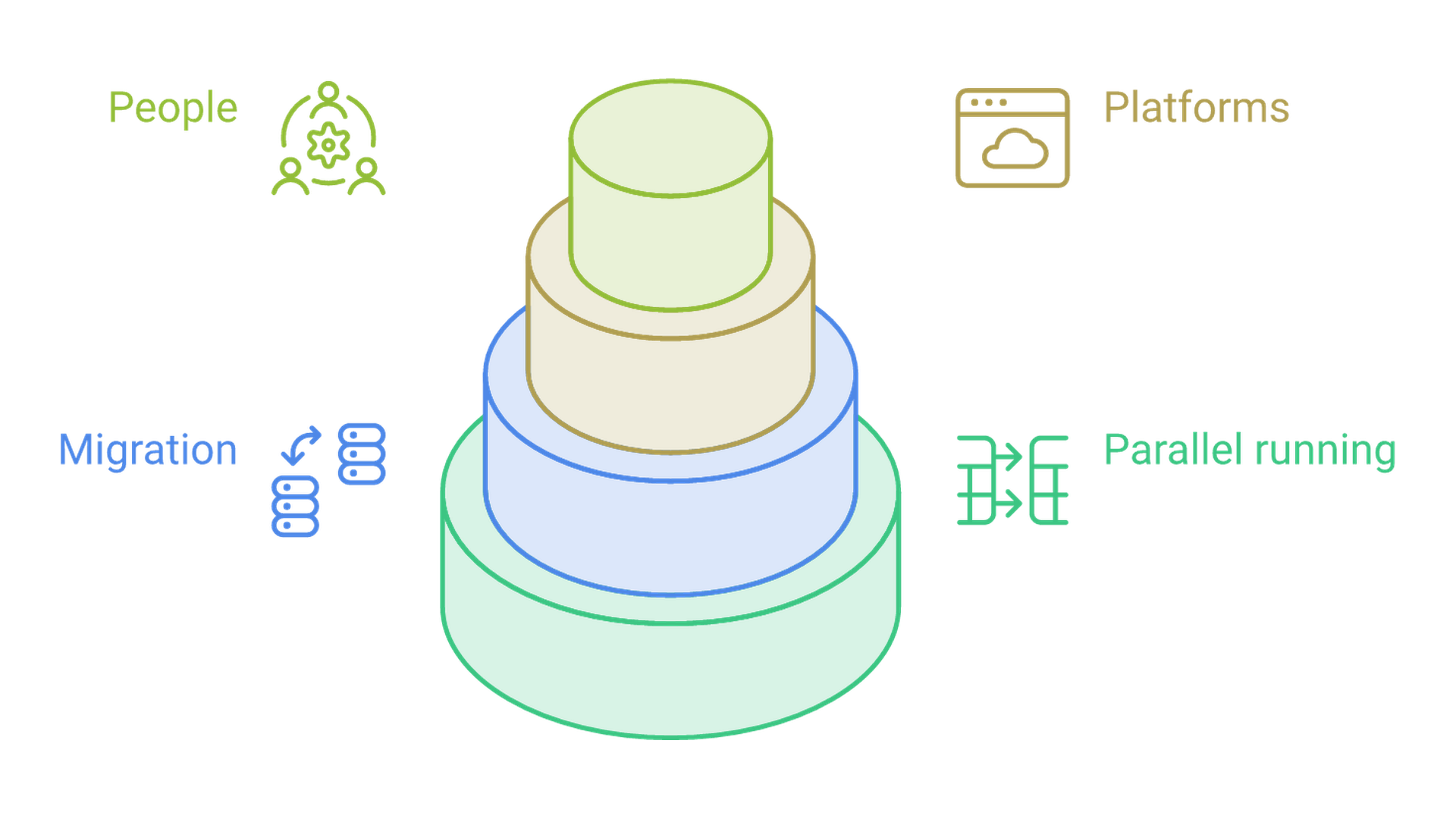
The main cost categories across modernization projects:
- People: Engineering, architecture, QA, DevOps, security, and change management resources. Team sizes of 5–10 people are common for core business system rebuilds.
- Platforms: Cloud services, licenses, observability tools, CI/CD pipelines, data platforms.
- Migration and integration: Data migration tooling, environment duplication for testing, integration rework with other systems.
- Training and enablement: Upskilling teams on new frameworks, tools, and operating models - a critical part of the software development equivalent of modernization.
- Operational overlap: Running old and new systems in parallel during cutover periods adds temporary but significant cost.
Different approaches influence these drivers differently. A rehost costs $20K–$150K and runs weeks; a rebuild can cost $500K–$1M+ over 6–18 months. Model TCO over 3–5 years, not just initial project budgets - maintenance costs for legacy systems often exceed what organizations realize, with enterprises reporting $370 million in losses annually due to outdated technology.
Major risk categories
The most common risks in application modernization efforts:
- Business continuity risk: Downtime or degraded service during cutovers. Mitigate with blue-green deployments and phased rollouts.
- Data risk: Data loss, corruption, inconsistent states, or privacy breaches during data migration. Comprehensive backup and validation processes are essential.
- Security and compliance risk: Misconfigured cloud services, weak IAM, or missing audit trails. Enhanced security requires involving compliance teams early.
- Delivery risk: Scope creep and underestimation of technical complexity. A Wakefield study found expectation mismatch is the root cause in 43% of failed projects. Mitigate with governance forums and realistic scoping.
- Change fatigue and adoption risk: Users resisting new workflows or tools. Address through training, communication, and incremental rollouts. Improved user experience is a key benefit of application modernization that helps drive adoption.
- Vendor and architecture lock-in: Choices today limiting flexibility tomorrow. Multi-cloud strategies and standards-based architectures reduce this risk.
Reducing risk without slowing modernization
Practical risk-mitigation tactics for modernization efforts:
- Start with low-risk, high-visibility wins to build organizational confidence and demonstrate cost savings before tackling high-complexity systems.
- Use feature flags and canary releases to limit the blast radius of changes in production.
- Maintain robust backups and rehearsed rollback procedures for every cutover.
- Involve security and compliance teams early - shift-left security rather than treating it as a final gate.
- Adopt shared metrics dashboards so engineering and business stakeholders see the same data on incident rates, deployment frequency, and cost trends.
- Measure against baselines established before modernization begins - without measurement, ROI claims remain theoretical.
A partner like Cognativ can help quantify and prioritize risks within a modernization roadmap, particularly for regulated industries where compliance and security risks carry outsized consequences.
Common challenges in application modernization and how to solve them
Even with a well-structured roadmap, organizations encounter predictable execution challenges. Technical debt slows innovation and increases costs, but these challenges have proven solutions.
Challenge 1: Complex, poorly documented legacy systems
Pain points: Missing documentation, tribal knowledge locked in a few veteran engineers, hidden dependencies between existing systems.
Solutions:
- Use discovery tools - code analysis, dependency mapping, runtime tracing - to surface what documentation missed.
- Interview veteran engineers and operations staff to capture critical knowledge before it walks out the door.
- Start with read-only integration via APIs to reduce risk before deeper refactoring. This approach allows modernizing apps incrementally without disrupting existing operations.
Challenge 2: Competing priorities and limited capacity
Pain point: Product teams are busy delivering new features while being asked to modernize legacy applications simultaneously.
Solutions:
- Create dedicated modernization capacity rather than relying on "spare time" work.
- Bundle modernization tasks with feature delivery - refactor the areas touched by new features as you build them.
- Use the roadmap to justify trade-offs and scale what works from pilot to program, de-prioritizing low-value features to free capacity.
Challenge 3: Tool sprawl and inconsistent platforms
Pain point: Multiple CI/CD pipelines, monitoring tools, cloud providers, and frameworks creating operational overhead and security exposure.
Solutions:
- Define a set of "golden paths" and approved tech stacks to guide teams toward consistent choices.
- Consolidate tooling where practical. Fewer tools means lower licensing cost, less training burden, and smaller attack surface.
- Align modernization projects with standard platforms to prevent future rework and enable teams to move between systems more easily.
Challenge 4: Aligning modernization with measurable ROI
Pain point: Finance and business leadership are skeptical when the benefits of application modernization are described in vague or purely technical terms.
Solutions:
- Establish pre-modernization baselines: incident count, MTTR, lead time for changes, infrastructure costs, manual effort hours.
- Define specific, trackable targets for each modernization wave - e.g., reduce incident rate by 30%, cut deployment lead time from weeks to days, achieve 20% infrastructure cost savings.
- Report back with before-and-after metrics to validate or adjust the roadmap. Some organizations report significant maintenance cost savings after successful application modernization.
Conclusion and next steps
Application modernization is the deliberate effort to transform outdated software applications - updating architecture, infrastructure, and code so existing applications can deliver business value on modern cloud environments. The main approaches (rehost, replatform, refactor, rearchitect, rebuild, replace) differ significantly in cost, risk, and timeline, and most successful modernization projects use a blend across the existing application portfolio. A structured roadmap with clear objectives, phased waves, and disciplined governance turns what could be an expensive gamble into a manageable, measurable transformation.
Application modernization helps organizations adapt to digital transformation demands, delivering customer satisfaction, competitive advantage, and the agility to adopt new technologies - including AI and machine learning - as the existing environment evolves.
Recommended next steps:
- Conduct a quick internal assessment using the "signs you need modernization" checklist above.
- Identify 3–5 critical applications and tentatively map them to modernization approaches.
- Align leadership on goals and constraints for the next 12–24 months.
- Consider a focused external assessment to validate assumptions and quantify ROI - particularly if your organization faces tight deadlines, complex dependencies, or regulated environments.
Related topics worth exploring next include AI-first architecture design, cloud governance, and secure custom software development - each of which builds on the modernization foundation covered here.
If you're looking to design a practical modernization roadmap rooted in measurable outcomes, Cognativ offers application modernization services that blend strategy, architecture, and delivery. You can also reach out through Cognativ's consulting practice or the contact page to start with a targeted assessment or RAPID workshop.
Frequently asked questions about application modernization
This FAQ addresses common practical questions from executives and engineering leaders navigating the application modernization process.
How long does application modernization usually take?
Timelines depend heavily on approach and system complexity. Simple rehosts typically take a few weeks to a couple of months per application. Replatform and refactor work runs several months for complex systems. Rearchitect and rebuild efforts take 6–18 months or more - often executed in phases. Large, highly complex monolithic systems may require 12–24+ months for rearchitect and rebuild work. Timelines depend on scope, team capacity, and risk tolerances.
Can we modernize without disrupting day-to-day operations?
Yes. Well-planned modernization projects use strategies like parallel runs, blue-green deployments, canary releases, and gradual cutovers to minimize downtime. The Strangler Fig pattern allows incremental replacement without taking the legacy system offline. Some short maintenance windows may still be needed, especially for data migrations, but operational disruption can be managed to near zero with proper planning.
Do we need to move everything to the cloud to modernize?
No. Modernization can include hybrid and on-prem models. Some regulated or latency-sensitive systems may remain on premises or in private clouds. Hybrid cloud architectures allow gradual modernization of applications while respecting data sovereignty, latency, and regulatory constraints. The key is adopting modern architecture and practices - continuous integration, observability, security by design - rather than a specific hosting model.
How do we estimate ROI for modernization?
Key benefit categories to model include: reduced infrastructure and licensing costs, lower incident and outage costs, faster feature delivery translating into revenue or customer satisfaction, and reduced manual work through automation. Model TCO over 3–5 years, comparing the cost of maintaining legacy systems against the investment in modernization. Cognativ's initial assessment can include a short ROI modeling exercise to establish whether the modernization journey justifies the investment.
When should we bring in an external modernization partner?
Common triggers include: limited internal experience with modern architectures or cloud platforms, mission-critical timelines (e.g., data center exit by a fixed date), complex multi-system dependencies, and regulated environments where compliance risk is high. Many organizations plan to use outside help for modernization efforts. An external partner brings assessment rigor, architecture experience, and risk quantification - particularly valuable when transforming legacy systems that underpin core business processes.