

How to Choose a Software Development Company: Evaluation Criteria, Questions, and Checklists
A practical vendor selection guide: define success metrics, shortlist 3-5 firms, score them, ask the right questions, run a paid pilot and lock down IP terms.
Choosing the right software development company determines whether your project ships on time, stays within budget, and delivers measurable business value-or becomes an expensive lesson in vendor mismanagement. This complete guide walks you through every stage of the selection process, from defining your business problem to negotiating contracts and running a pilot engagement.
This article is written for CTOs, CPOs, CIOs, VPs of Operations, and business owners preparing to hire a custom software development company in 2026 for a business-critical project. It focuses on mid-market and enterprise buyers evaluating development partners for custom builds-web platforms, mobile applications, AI-driven systems, and enterprise modernization-not teams shopping for off the shelf software or hiring individual freelancers.
Here is the core formula: define your business problem and success metrics first, then shortlist aligned vendors and evaluate them across portfolio relevance, team seniority, delivery process, security posture, pricing transparency, and contract terms. Before committing fully, run a small paid pilot to validate the partnership in practice.
Selecting the right software development partner impacts budget and timeline directly. According to Standish Group CHAOS research, only about 35% of software projects are fully successful in delivering on time, on budget, and to specification. Around 19% are cancelled outright, and 46% finish late, over budget, or with significant quality gaps. Choosing the wrong partner can lead to project delays, costly technical compromises, and features that are inconsistently implemented. A solid evaluation framework protects budget, timeline, and intellectual property.
By the end of this article, you will have:
- A clear, repeatable process to shortlist and compare software development companies.
- A practical evaluation scorecard for vendor comparison (with an example table).
- A list of 15–20 specific questions to ask each potential partner.
- A contract and IP checklist for secure, low-risk engagements.
- Key red flags to disqualify risky vendors early in your hiring process.
Understanding What You Actually Need From a Software Development Company
Before you evaluate a single vendor, you need to understand your own requirements with precision. Most companies jump straight to comparing portfolios and hourly rates without first clarifying the business problem they are solving, the metrics that define success, or the type of engagement that fits their situation. This section ensures you start the evaluation process from a position of clarity rather than assumption.
The right partner depends on your problem type-whether it is a new product build, legacy modernization, AI-driven workflow automation, or platform consolidation-as well as your industry, risk profile, and the strength of your internal team.
Clarify the Business Problem and Success Metrics
Identify the business problem before proposing solutions. Write a one-page problem statement that describes the current pain in concrete terms: slow claims processing that delays revenue recognition, ecommerce cart abandonment rates above industry benchmarks, manual logistics scheduling that cannot scale, or data silos preventing cross-department visibility.
Define success metrics in concrete numbers or deadlines. These metrics will later drive your vendor questions, contract KPIs, and acceptance criteria. Without them, you have no objective way to measure whether the software project succeeded.
Decide What You're Hiring For (Project Type and Engagement Model)
Clarify project type and budget before evaluating development firms. Typical scenarios include:
- Full-cycle product build: High uncertainty, best suited for MVP-first approaches with iterative progress toward a complete platform.
- Legacy system modernization: Hidden technical debt and integration risks require experienced architects who understand trade offs between refactoring and rebuilding.
- AI-driven automation: Requires specialized expertise in artificial intelligence, data pipelines, and governed workflows alongside traditional software engineering.
- Staff augmentation: When your internal team needs additional software engineers for a defined period without building a permanent headcount.
Engagement models should align with project clarity and flexibility needs. The fixed price model suits projects with clear requirements and well-defined scope. The time and material model allows flexibility during development when requirements may evolve. A dedicated team model provides focused attention on your project for ongoing or complex work. Choosing the right engagement model avoids project friction and misaligned incentives.
Set a Realistic Budget and Timeline for 2026
In 2026, enterprise MVP builds commonly run into six figures over approximately six months when using a competent team that includes senior developers, a technical lead, QA, DevOps, design, and project management. Larger systems, multi-platform modernizations, and compliance-heavy builds regularly exceed $1M. Senior developer hourly rates in the U.S. are substantially higher for enterprise-grade work. Rates significantly below $100/hr often indicate offshore staffing with less experience or hidden limitations in team size and seniority.
Setting a realistic budget means accounting for the total team cost-not just developer hours, but also infrastructure, licensing, third-party dependencies, post launch support, and ongoing maintenance after go-live. Hiding your budget from vendors leads to unhelpful estimates and wastes everyone's time. Conversely, unusually cheap bids are a red flag: low-cost partners often lead to higher long-term expenses through rework, architectural shortcuts, and security gaps.
External constraints matter too. Regulatory deadlines, seasonal peaks, and funding milestones all shape your timeline. With needs, scope, and a realistic budget defined, you can now build a strong shortlist of candidates.
How to Build a Shortlist of Software Development Companies
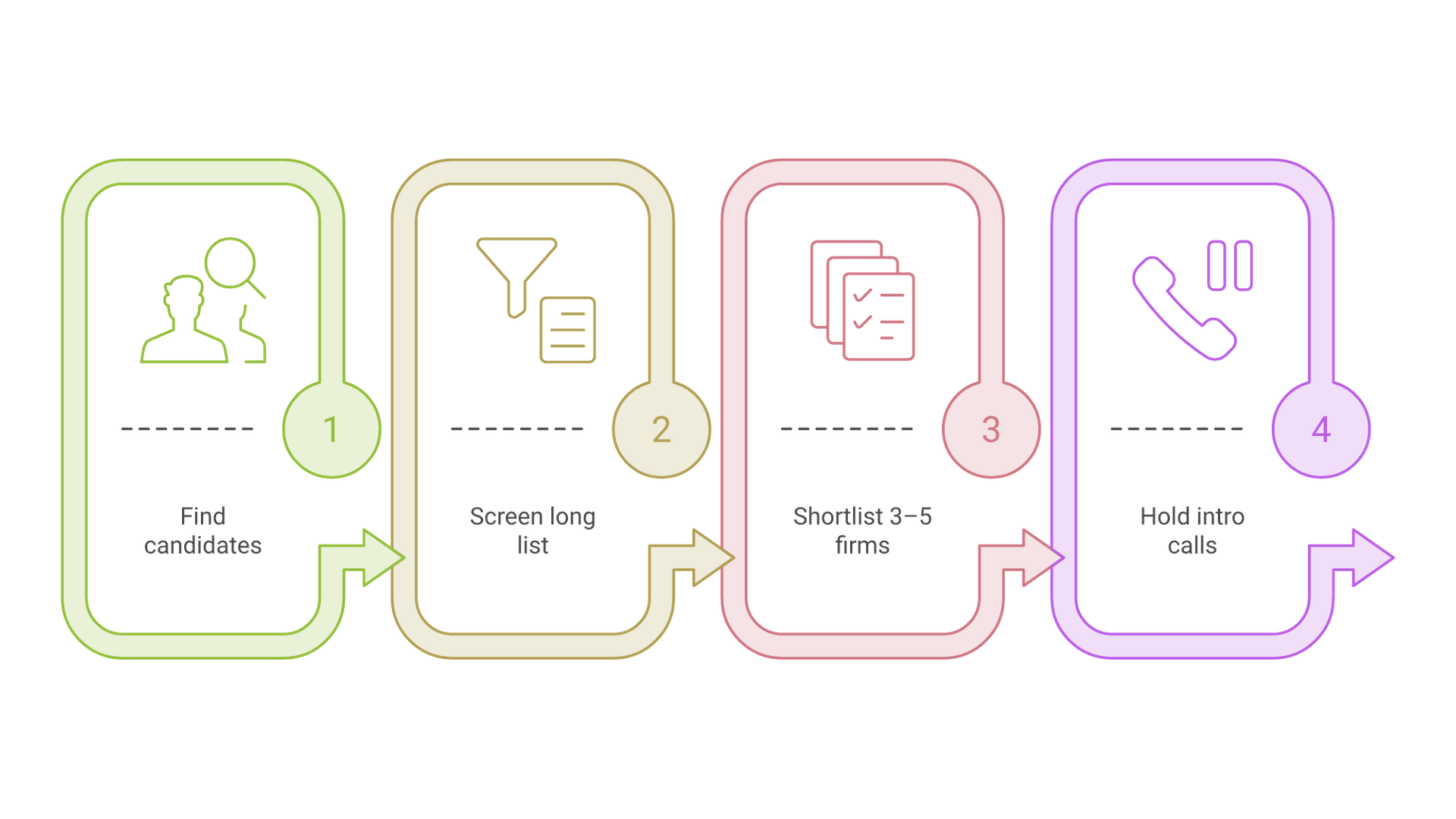
The goal is a shortlist of 3–5 serious contenders, not a massive RFP blast that overwhelms your decision making process with superficial responses. Focus on companies that regularly deliver at your level of complexity, in your industry or adjacent ones, and with operating models that align with your working style.
Where to Find Potential Partners
Start with industry referrals from peers who have completed similar projects. Specialized directories like Clutch and GoodFirms offer filtered searches by industry, technology, and project size. Conference speakers and open-source contributors often signal deep technical knowledge. Scan vendor blogs, published case studies, and resource pages to gauge thought leadership and domain understanding-for example, reviewing a firm's custom enterprise software development page can reveal whether they operate at enterprise scale or primarily serve startups.
Thorough research at this stage saves significant time later. Look for development companies whose published work addresses problems structurally similar to yours.
Initial Screening Criteria for Your Long List
Apply these simple filters quickly from publicly available information to narrow your long list:
- Industries served: Does the company work in your sector (healthcare, fintech, logistics, ecommerce, media)? Relevant experience is crucial for handling project complexity and reduces the learning curve.
- Project sizes: Are the budgets, team sizes, and durations mentioned in their case studies comparable to yours?
- Security and compliance awareness: Do they reference HIPAA, PCI-DSS, SOC 2, GDPR, or other relevant standards? Data security should prioritize encryption, access controls, and secure coding.
- Clarity of services: Do they specialize in custom software development, AI automation, or modernization-or do they describe themselves as generic "app builders"?
Eliminate vendors clearly misaligned with your industry, scale, or complexity. A company that primarily builds consumer mobile apps is unlikely to deliver an enterprise workflow platform with regulated data requirements.
Creating a Shortlist of 3–5 Companies
Narrow further using these clear criteria:
- Portfolio relevance: Does the potential partner's portfolio include projects similar to your use case? A strong portfolio shows decision-making patterns, not just design polish.
- Long-term client relationships: Evidence of multi-year engagements or repeat business signals reliability shows consistent delivery quality.
- Geographic model: Whether local, nearshore, or offshore, confirm that overlapping working hours and communication style fit your needs. Working closely with a team in a radically different time zone creates friction that compounds over months.
- Capacity: Can they staff your project within your timeline without overcommitting?
Schedule intro calls with your shortlisted companies and share a short project brief. Observe how each vendor responds-their questions, assumptions, and process reveal far more than their sales deck. This sets the stage for detailed evaluation using structured selection criteria.
Core Evaluation Criteria for Choosing a Software Development Company
With your shortlist of 3–5 potential partners assembled, shift to structured evaluation. Each sub-section below corresponds to a dimension on the vendor evaluation scorecard presented later in this article. Evaluate firms based on proven capabilities rather than solely on price or marketing.
1. Portfolio Relevance and Complexity Match
Look beyond visual polish. Evaluate past projects for industry relevance and measurable results. A healthcare scheduling platform with HIPAA-compliant data handling, a logistics route optimization system processing thousands of daily shipments, or a multi-store ecommerce rebuild handling peak-season traffic spikes-these demonstrate that the vendor has solved problems with constraints similar to yours.
Evaluate case studies for complexity relevant to your project. Look for documented outcomes and lessons learned in case studies: performance gains, downtime reduction, operational cost savings. A portfolio should include diverse case studies across industries, but the ones most relevant to your domain deserve the closest scrutiny. Case studies that show only screenshots without a problem statement, architecture overview, or measured result are a red flag.
2. Technical Expertise and Team Seniority
Verify technical expertise with relevant programming languages and frameworks, but do not obsess over exact tech stack names. What matters more is architectural thinking: can the team design systems that support future growth through scalability and integration capabilities? Proven architectural expertise is essential for scalable projects. Technical expertise varies significantly between different software types-building a real-time data pipeline requires different skills than a content management platform.
Assess the seniority mix. A team typically staffed entirely with junior developers will produce slower, lower-quality work regardless of the hourly rate. Ask whether senior roles (solution architect, technical lead) are hands-on contributors or just names on a proposal. Experience with similar projects reduces the learning curve and decreases ramp-up time.
In 2026, artificial intelligence tools are widely used in software development. A 2025 Veracode report found that AI-generated code contained OWASP Top-10 security flaws in roughly 45% of samples tested. Ask how your potential partner uses AI-assisted development and what review, automated testing, and security scanning processes they apply to AI-generated code. Disciplined use of AI is a strength; unreviewed AI output is a liability.
3. Delivery Process, Communication, and Governance
Communication is essential for successful software development. Good communication prevents project delays and misunderstandings, while poor communication can escalate minor issues into crises. Structured methodologies like Agile or Scrum allow flexibility and transparency, giving you visibility into iterative progress through regular sprint reviews, backlog grooming, and retrospectives.
Expect a named delivery lead who is your single point of accountability-not a rotating cast of project managers. Effective communication includes timely updates and clarity: weekly status calls, sprint demos of working software, and open communication channels that enhance collaboration and project success. Open access to issue trackers, roadmaps, and documentation is non-negotiable.
Governance practices distinguish serious partners from ad-hoc shops. Look for documented change management processes, decision logs, and risk registers. Proactive communication about risks reduces project crises. A strong partner raises problems early rather than hiding them until deadlines slip.
4. Security, Compliance, and Data Protection
For enterprise and regulated-industry projects, security is not optional. Verify these practices:
- Secure coding and testing: Static analysis, dynamic analysis, dependency vulnerability scanning, and penetration testing before production releases. Software quality assurance practices include functional and automated testing as standard workflow.
- Data handling: How do they manage protected health information, financial data, or personally identifiable information? Data security should prioritize encryption, access controls, and secure coding at every layer.
- Access control and auditability: Who has admin rights to your environments? How are credentials managed and rotated? Can they produce audit trails, design documents, and test reports?
A development partner should support compliance requirements in regulated industries. Avoid vendors who guarantee compliance outright-compliance is a shared responsibility-but expect them to demonstrate governed workflows, auditable processes, and relevant experience.
5. Pricing Model, Transparency, and Total Cost
Compare pricing models against your project type:
Model | Best For | Risk Profile |
|---|---|---|
Fixed Price | Well-defined scope, clear requirements | Low flexibility; vendor may cut corners to protect margin |
Time & Materials | Evolving requirements, iterative discovery | Requires active oversight; costs can drift without discipline |
Dedicated Team | Ongoing development, complex multi-phase work | Higher commitment; provides focused attention and continuity |
Look beyond hourly rates. Understand what roles are included (development, design, QA, DevOps, project management), what environments are provisioned, and what is explicitly out of scope. Flag overly vague estimates or quotes dramatically below market rates.
6. Contracts, IP Ownership, and Exit Terms
Understand ownership of source code and intellectual property in contracts. This is non-negotiable:
- Explicit IP transfer: The contract should assign all deliverables IP to the client upon agreed payment-using language like "hereby assigns," not vague promises. Background IP (vendor's pre-existing tools and libraries) stays with the vendor, but the client receives a license to use and modify embedded components.
- Repository access from day one: Your organization should be owner or co-owner of the code repository throughout the engagement. Never accept a model where source code is withheld until final payment.
- Clear termination and handover: Ability to terminate for cause (breach, SLA failure) or convenience, with pro rata refunds, in-progress work delivery, credentials, and documentation handed over completely.
A healthy development partner is comfortable documenting a clean exit path, even if you never use it. Contracts that create lock-in via proprietary tools or withheld documentation are a serious red flag.
7. References, Reputation, and Cultural Fit
Review client references to assess reliability and post launch support. Use third-party review platforms alongside direct reference calls. When speaking with references, ask specifically about the vendor's behavior when things went wrong: how did they communicate bad news? How did the team handled scope changes or unexpected technical challenges?
Cultural fit matters more than most buyers expect. Watch for these signals during evaluation conversations: honesty about risks, proactive pushback when your assumptions seem flawed, clarity in explanations without excessive jargon, and responsiveness to follow-up questions. Transparency in communication builds trust between partners and is the foundation of a productive software development partnership. Cognativ provides software development outsourcing with a US-based team, which keeps working hours and communication aligned for US companies.
Key Questions to Ask a Software Development Company
Use these questions as a practical script during discovery and evaluation calls. They are grouped by theme. Listen for specific, concrete examples in responses-vague or generic answers signal inexperience or evasiveness. Assess how partners communicate when unexpected problems arise and evaluate how partners handle ambiguity before project starts.
Questions About Business Understanding and Discovery
- "How do you typically run discovery for a new project like ours, and what deliverables do we receive from that phase?" (Good answers mention requirements documents, architecture diagrams, risk assessments, prototypes, or validated assumptions. Poor answers mention only a quote.)
- "Tell me about a time discovery significantly changed the original solution you proposed." (A structured discovery process identifies risks early in projects. Listen for specifics: what assumption was wrong, how they adapted.)
- "How do you translate business goals into technical priorities and trade offs?"
Questions About Team, Expertise, and Ways of Working
- "Who will be on our core team, and can we meet the delivery lead and tech lead before we sign?" Ask who will work on your project before signing a contract.
- "What similar projects have these specific people shipped in the past two years?" Check if the partner has relevant experience at your project's complexity level.
- "How do you use AI-assisted development in practice, and how do you review AI-generated code?"
- "How do you handle vacations, illness, or turnover so our project doesn't stall?"
- "What is the team typically structured like for a project of this size-what's the senior-to-junior ratio?"
Questions About Process, Communication, and Transparency
- "What does a typical two-week sprint look like with your team? What deliverables and demos come out of each cycle?"
- "How often will we see working software, and in what format-staging environment, recorded demos, direct access to a test build?"
- "What tools do you use for issue tracking, version control, and documentation, and will we have full access?"
- "Describe a project where things went wrong-scope creep, a critical bug in production, a resource gap. How did you communicate the issue, and how did you adjust?"
Assess how partners communicate when unexpected problems arise. These questions reveal their real operating style under stress, not just their polished sales presentation.
Questions About Security, Compliance, and Support
- "How do you handle secrets management and access control for our environments?"
- "What types of security testing do you run before production releases-static analysis, penetration testing, dependency scanning? Can you share redacted results?"
- "How do you support compliance requirements in industries like healthcare or financial services?"
- "What does your standard post-launch support model look like, and how are SLAs defined?" Inquire about post-launch support options during evaluation.
Questions About Pricing, IP, and Contracts
- "What exactly is included in your estimate-which roles, how many hours, and which environments? What is explicitly out of scope?"
- "How do you handle change requests if we need to adjust scope mid-project? What's the process and impact on timeline?"
- "Who owns the code, documentation, and infrastructure accounts at each stage of the project?"
- "Can you share a sample contract, including IP transfer, termination, and handover clauses?"
With these questions answered across your shortlisted vendors, you need a structured way to compare responses. A scorecard makes that comparison consistent and defensible.
Using a Scorecard to Compare Software Development Companies
Use a practical evaluation scorecard to compare development partners instead of relying on gut feel or the strength of a sales pitch. A weighted scorecard ensures that every stakeholder evaluates vendors against the same clear criteria, using a consistent scale.
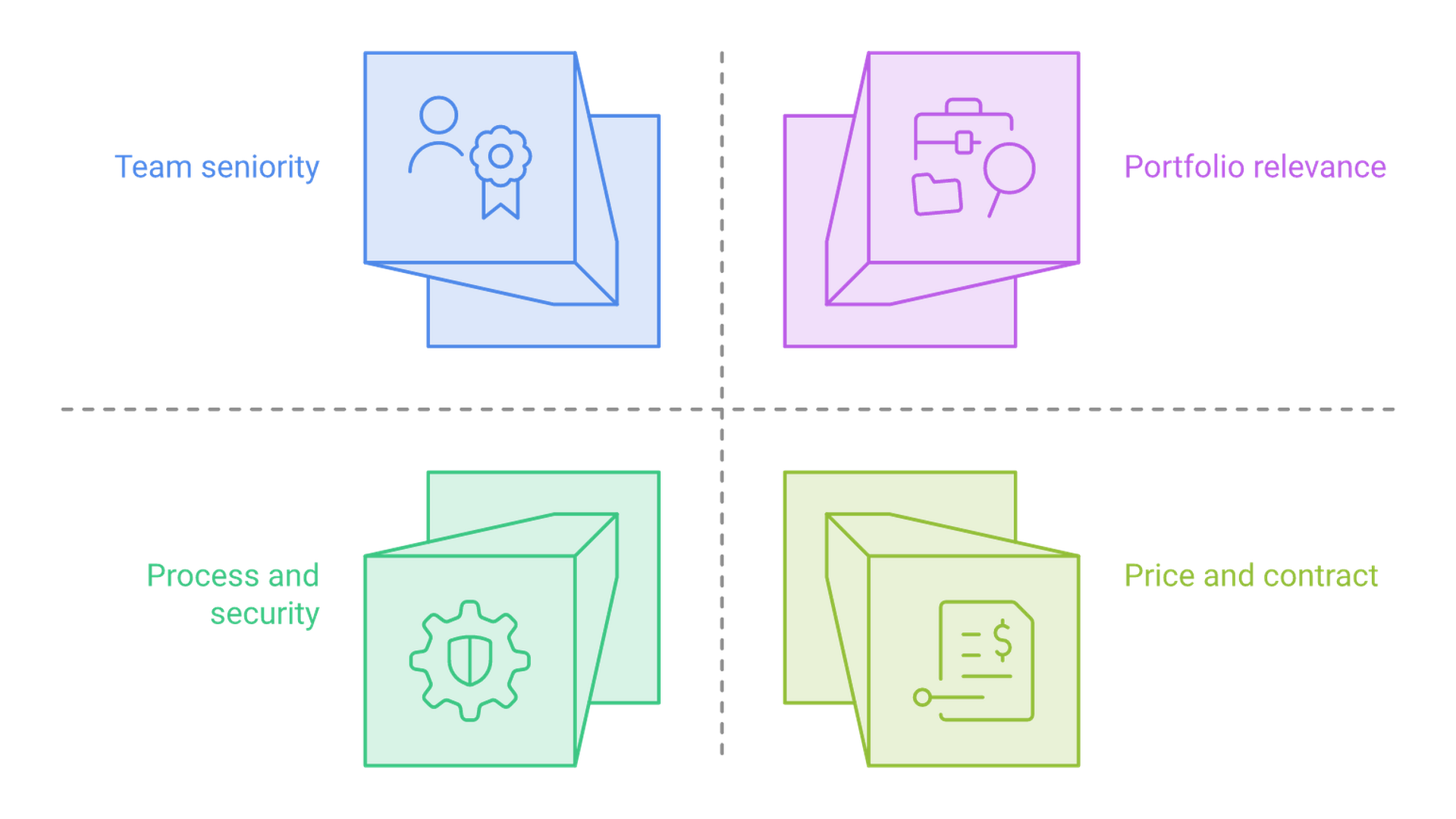
Have each evaluator (CTO, product lead, security lead, legal) score independently on a 1–5 scale before averaging. This prevents groupthink and surfaces disagreements early.
Example Vendor Evaluation Scorecard
Criterion | Description | Weight | Vendor A | Vendor B | Vendor C |
|---|---|---|---|---|---|
Portfolio Relevance | Case studies matching your domain, complexity, and scale | 20% | - | - | - |
Team Seniority | Senior/mid/junior mix, named leads, architectural expertise | 20% | - | - | - |
Process & Communication | Agile methodology, demo cadence, named PM, clear communication | 15% | - | - | - |
Security & Compliance | Testing practices, access control, compliance support | 15% | - | - | - |
Pricing Transparency | Itemized roles, realistic rates, included/excluded scope | 10% | - | - | - |
Contract & IP Terms | Explicit IP transfer, exit rights, handover obligations | 10% | - | - | - |
Cultural Fit & References | Client feedback quality, honesty, responsiveness | 5% | - | - | - |
Post-Launch Support | SLA clarity, ongoing support models, maintenance plans | 5% | - | - | - |
Multiply each score by the weight, sum the weighted scores, and compare totals. Treat these totals as inputs to your decision making process, not as the final answer-a vendor scoring highest overall but with a critical gap in security or IP terms may still be the wrong choice for a regulated project.
How to Run a Short Paid Pilot
Before committing to a full engagement, run a 4–6 week paid pilot delivering a real but non-critical feature, integration, or prototype. This is the most reliable way to validate fit beyond sales conversations.
During the pilot, observe:
- Estimation accuracy: Did they deliver what they committed to within the agreed timeframe?
- Communication pace: How frequently and clearly did they update you? Was client feedback incorporated promptly?
- Code quality: Review the deliverables for documentation practices, version control discipline, automated testing coverage, and architectural soundness.
- Response to feedback: How did the team handled your input-defensively, or as iterative progress toward a better outcome?
A pilot reveals whether senior people remain engaged after the contract is signed or disappear in favor of junior staff. It also tests whether the vendor's delivery framework translates into real execution discipline. Documentation practices should be integrated into the project timeline from the pilot onward-not bolted on at the end.
Common Mistakes and Red Flags When Choosing a Software Development Company
Avoiding common mistakes is as important as identifying positive signals. Identify potential red flags such as unrealistic quotes and lack of verifiable references early to save months of frustration and hundreds of thousands of dollars.
Red Flags in Early Conversations
Watch for these warning signs during your initial interactions:
- Instant fixed-price quotes from a short email or a single call with no discovery phase. Reliable vendors know that estimating without understanding is guesswork.
- Reluctance to let you speak with the delivery team or technical lead. Ask who will work on your project-if the answer is perpetually vague, the team may not exist yet or may be shared across too many clients.
- Vague or generic answers to questions about process, security, or past projects. A proven track record comes with specific examples, not hand-waving.
- Overly aggressive promises about timeline, cost, or guaranteed compliance. Many decision-makers report experiencing delays past promised timelines-overpromising is endemic.
- No verifiable client references or unwillingness to connect you with recent clients.
- Portfolios with polished screenshots but no problem statements, architectural context, or measured outcomes.
- Undisclosed subcontracting of critical roles-you think you are hiring their team, but the work is silently passed to another firm.
Over-Optimizing for Price or Tech Stack
Choosing the cheapest vendor usually leads to longer timelines, more rework, and higher long-term cost. A development company quoting 50% below market rates is likely cutting corners on seniority, security, testing, or documentation. Low-cost partners often lead to higher long-term expenses-technical debt accumulated during the initial build compounds with every feature added afterward.
Similarly, insisting on a niche tech stack that your preferred vendors lack experience with can rule out partners with stronger product judgment and architectural expertise. Optimize for delivery confidence, business understanding, and security posture. The right model prioritizes outcomes over framework preferences.
Skipping References, Contracts, and Exit Planning
Not calling references means no insight into how a vendor behaves when projects get hard-when scope shifts, when a critical developer leaves, when a production incident occurs on a Friday evening. A bad partner may cause features to be inconsistently implemented, but you will only learn this from people who have lived through it.
Common contract gaps-unclear IP ownership, missing SLAs, no handover clauses-create long-term risk that far exceeds the cost of thorough legal review. Poor choices can result in costly technical compromises that are expensive to unwind. A healthy partner is comfortable documenting a clean exit path and transition plan, even if you never use it.
Contract, SLA, and IP Checklist Before You Sign
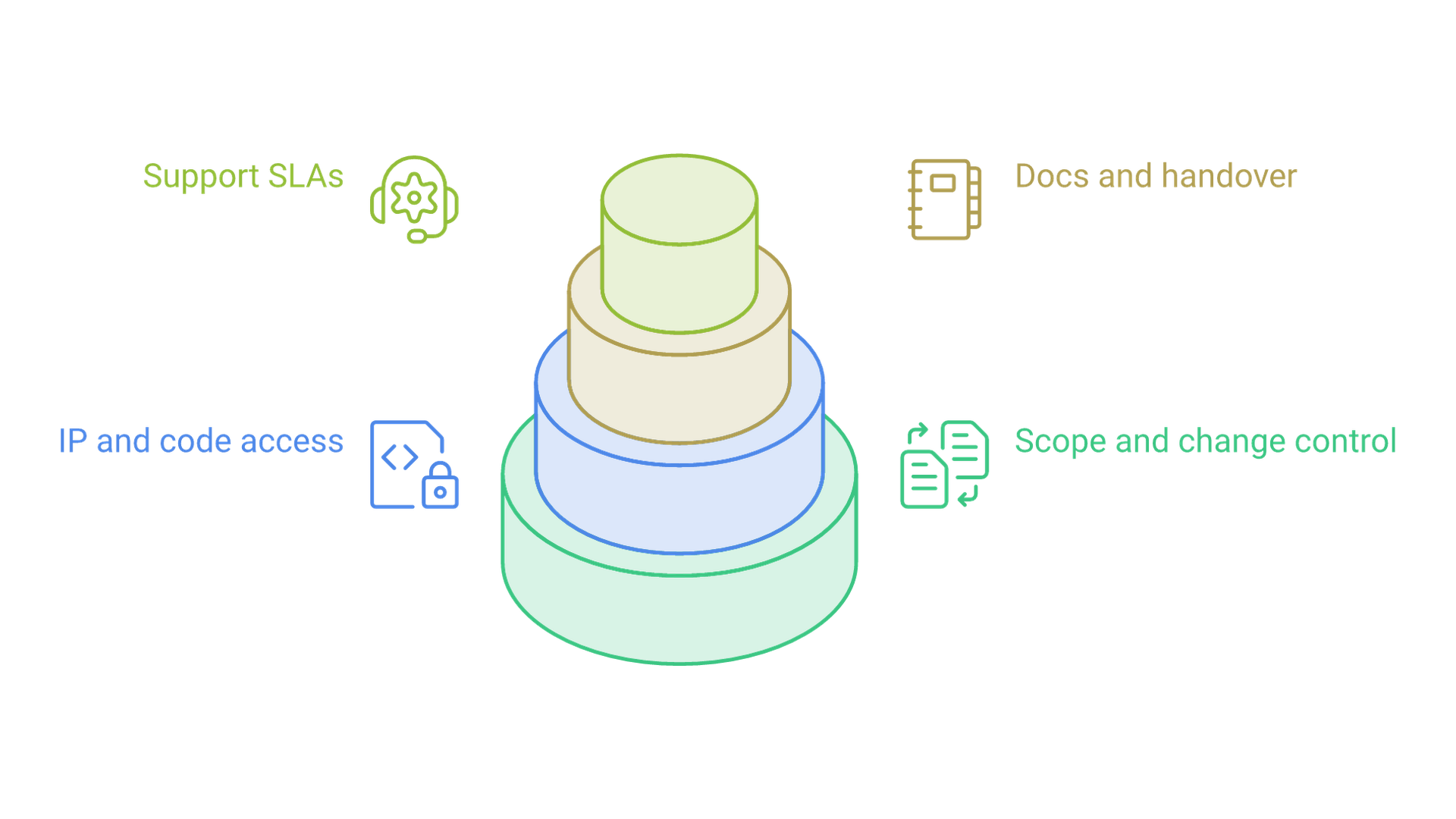
Treat this section as a practical pre-signature review. For regulated industries, involve your legal and security teams. Clear project requirements improve coordination and timelines, and precise contract language prevents the most damaging disputes.
Essential Contract Elements
Your contract should clearly state:
- Scope outline and how change requests will be handled (process, cost impact, timeline impact).
- Roles and responsibilities on both sides-client obligations (timely feedback, access, decisions) and vendor obligations (staffing, delivery, quality).
- Milestones, acceptance criteria, and payment schedule tied to measurable deliverables, not calendar dates alone.
- Confidentiality and data protection obligations, including NDA terms and data processing agreements when personal or regulated data is involved.
- Warranty and indemnification: Warranty that deliverables do not infringe third-party IP rights, and that the vendor has obtained proper licenses for any third-party components.
IP Ownership, Code Access, and Documentation
- IP transfer terms: Ownership of source code, designs, and all documentation transfers to you upon agreed payment. The contract should use explicit assignment language.
- Repository access from day one: Your organization as owner or co-owner, with direct access throughout the engagement-not just at project conclusion.
- Up-to-date documentation: Architecture diagrams, deployment instructions, API documentation, and configuration guides maintained continuously. A transition plan is crucial for knowledge transfer post-launch, ensuring another competent team can take over if needed.
- Background IP carve-outs: Clearly defined and narrow. Overbroad carve-outs that claim large portions of the codebase as vendor background IP are a red flag.
Support SLAs and Incident Response
Post-launch support ensures product usability and performance adjustments over time. Ongoing support models help maintain product health after launch. Your SLA should define:
- Priority levels (P1, P2, P3, P4) based on business impact-not just technical severity.
- Response and resolution time targets for each priority level (e.g., P1: 1-hour response, 4-hour resolution target).
- Channels for raising incidents and clear escalation paths when initial response is insufficient.
- Coverage hours: Business hours vs. 24/7, with on-call arrangements specified for critical systems.
"Response" should mean real diagnostic work starting-not just an automated email acknowledgment. Post-launch support can include retainers or embedded team arrangements depending on the complexity of your system and the criticality of uptime.
Additional Resources
- Vendor evaluation checklist: A downloadable version mirroring the scorecard criteria, questions, and contract terms covered in this article.
- AI-driven automation planning: Guides on building AI agent workflows for enterprise operations and understanding where automation delivers measurable ROI.
- Case studies with measurable outcomes: Published examples showing documented impact from custom enterprise software development and platform modernization projects.
- Engagement model guides: Articles explaining software development outsourcing models and when fixed price, time-and-materials, or dedicated team structures fit best.
Conclusion and Next Steps
Choosing a partner should focus on transparency and understanding business objectives at every stage. Successful selection comes from a clear problem definition, structured evaluation across the criteria outlined above, disciplined questioning that surfaces concrete evidence, and a well-designed contract that protects both parties.
Here are your immediate next steps:
- This week: Write a one-page problem statement and success metrics document.
- Next: Create your vendor scorecard based on the seven evaluation criteria, weighted for your project needs.
- Shortlist 3–5 companies and schedule structured discovery calls using the questions in this guide.
- Plan a 4–6 week paid pilot to validate your preferred partner before full commitment.
- Before signing: Run through the contract, IP, and SLA checklist with your legal team.
If you are evaluating partners for a secure, enterprise-grade custom build or exploring software development outsourcing for a complex modernization project, structured discovery conversations are the right starting point. You can start that conversation here.