

ChatGPT Enterprise Available in AWS Marketplace: A Practical Guide for Enterprise Teams
ChatGPT Enterprise is now sold through AWS Marketplace with private offers that can count toward AWS commitments. What changes and what to check first.
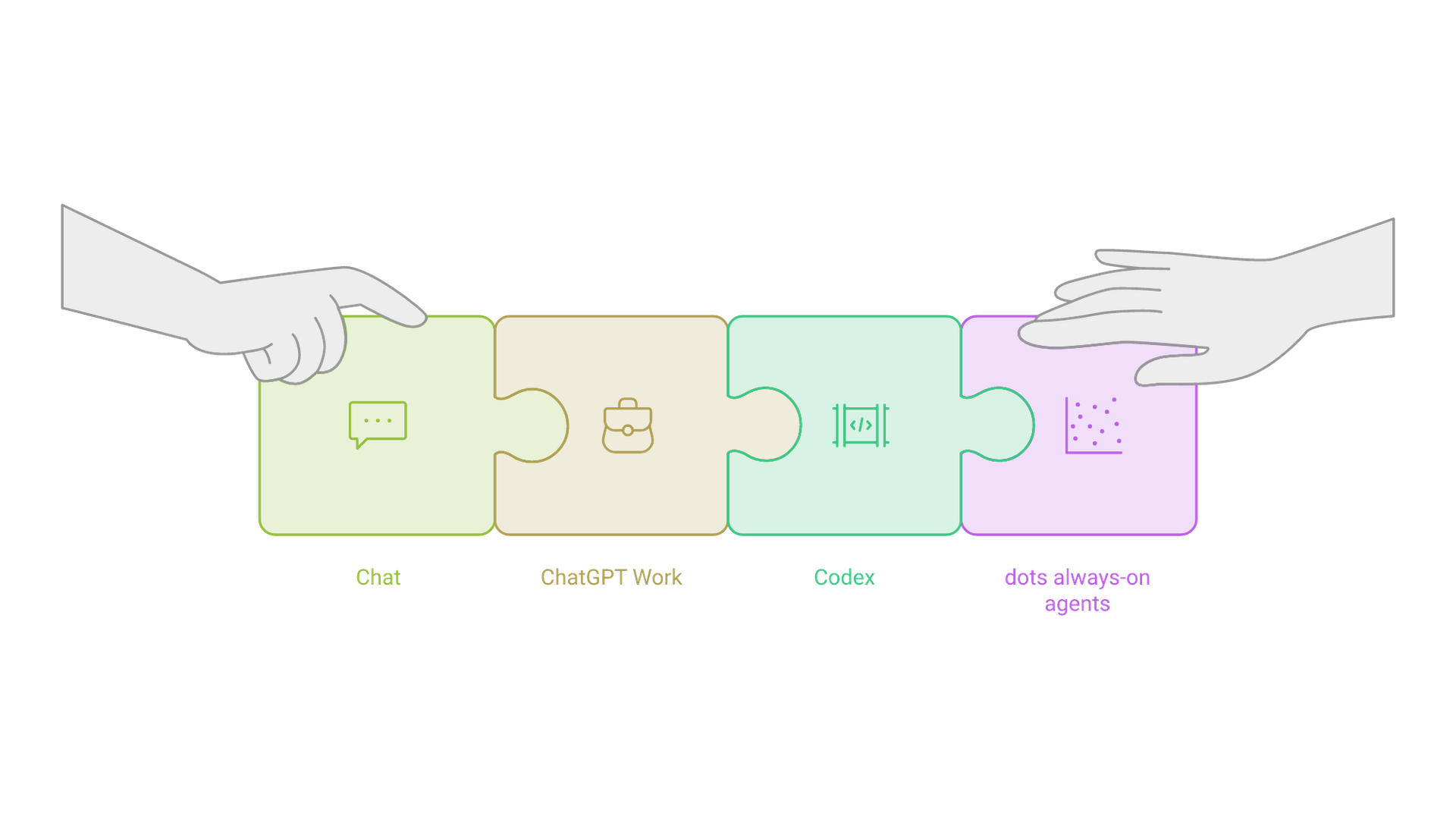
ChatGPT Enterprise is now available in AWS Marketplace as a SaaS offering sold by OpenAI and deployed on AWS infrastructure. As of 2026, enterprise organizations standardized on AWS can purchase, provision, and manage ChatGPT Enterprise directly through their existing AWS Marketplace relationship-bundling Chat, ChatGPT Work, Codex, and dots (always-on agents) into a single enterprise contract with security, privacy, and administrative controls built in.
If you're a technology leader, procurement lead, or architecture team member evaluating this offering, the core questions are straightforward: what exactly is included, how does procurement and billing work through AWS, and does this model satisfy your organization's security, compliance, and budgeting requirements? This guide addresses each of those questions with the level of detail enterprise teams need to make an informed decision.
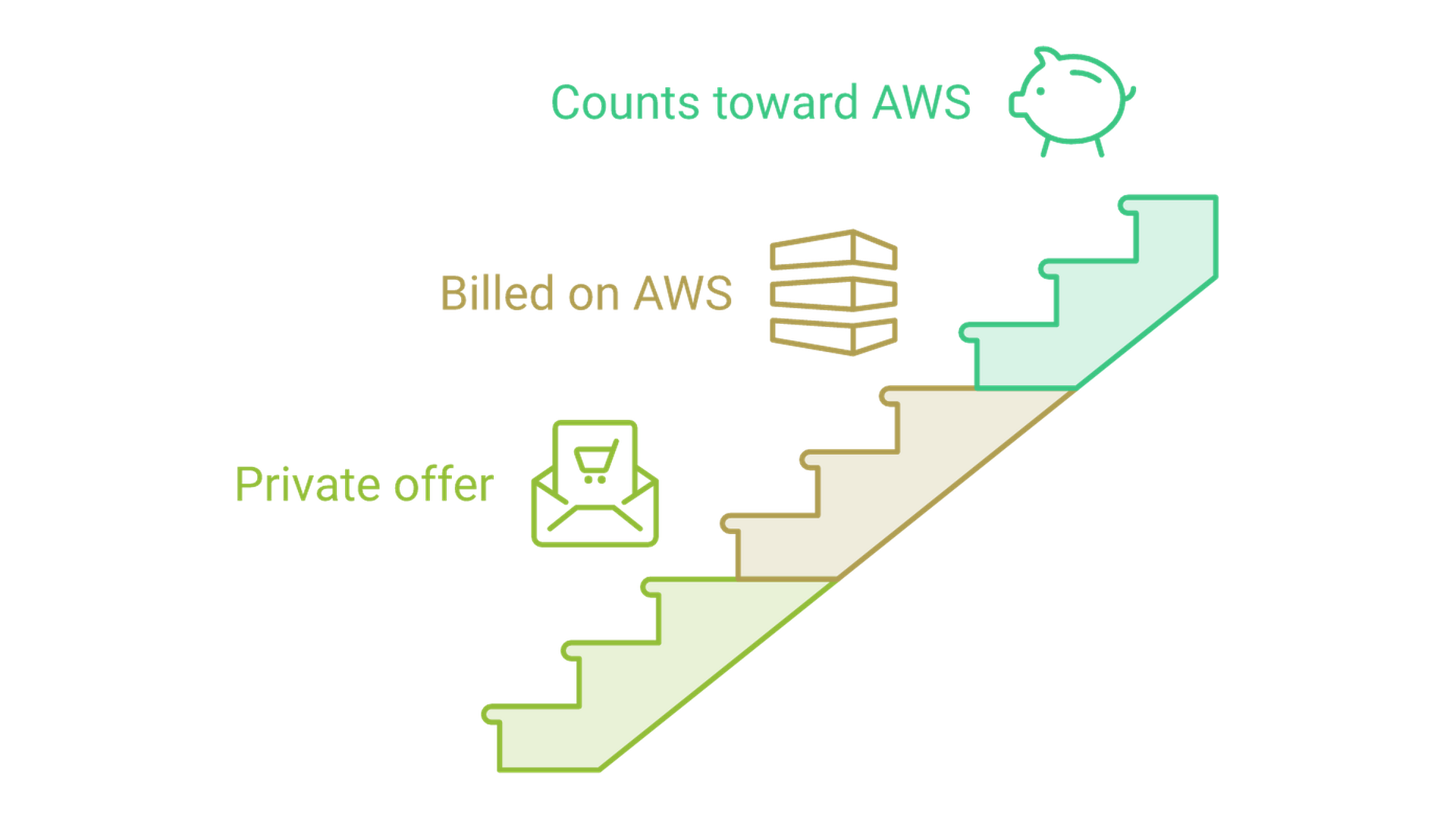
The direct answer: ChatGPT Enterprise is listed in AWS Marketplace with custom pricing delivered through private offers. There is no published fixed per-seat rate-each deal is tailored to seat count, geography, and feature scope. Eligible spend counts toward your AWS Enterprise Discount Program (EDP) or Private Pricing Agreement (PPA) commitments, subject to your specific AWS agreement. The product experience, enterprise controls, and security model are managed by OpenAI regardless of whether you buy through AWS Marketplace or directly.
This article is written for CIOs, CTOs, heads of engineering, procurement leads, and architecture teams in mid-market and enterprise organizations already running on AWS. It focuses exclusively on the AWS Marketplace version of ChatGPT Enterprise-not consumer ChatGPT plans, not ChatGPT Business plans, and not OpenAI models accessed through Amazon Bedrock APIs.
By the end, you will:
- Understand what's included in ChatGPT Enterprise on AWS Marketplace and how the four core components work together
- Know how AWS Marketplace procurement, billing, and EDP alignment actually function for this offering
- Have a clear picture of key security, privacy, and data residency considerations
- Follow a structured implementation process for IT and security teams
- See how Cognativ can help design and integrate an AI-first enterprise architecture around this offering
Understanding ChatGPT Enterprise on AWS Marketplace
ChatGPT Enterprise on AWS Marketplace is a SaaS enterprise product offered by OpenAI through the AWS Marketplace commerce channel. It bundles four capabilities-Chat, ChatGPT Work, Codex, and dots-under one enterprise SKU. Organizations can leverage existing AWS vendor agreements to simplify procurement processes, and the entire billing relationship flows through AWS, appearing on your standard AWS invoice.
For existing AWS customers, this matters because it allows you to centralize vendor management, use established procurement workflows, and align AI spending with your broader cloud commitments. Eligible spend for ChatGPT Enterprise can count toward existing AWS Enterprise Discount Program commitments, which means your investment in AI productivity tools works alongside-not against-your negotiated AWS discounts.
The relationship between OpenAI and AWS is important to understand clearly. OpenAI is the vendor and data processor. AWS serves as infrastructure provider, subprocessor, and commerce layer. OpenAI controls the product operations-model hosting, security architecture, administrative controls, and feature delivery. Purchasing through AWS Marketplace does not guarantee that all customer data remains on AWS infrastructure or within your AWS environment. OpenAI engages subprocessors, including AWS, to support the service as described in their Data Processing Addendum and subprocessor list.
Core Components: Chat, ChatGPT Work, Codex, and Dots
The AWS Marketplace listing packages four distinct capabilities into one enterprise offering. Each serves a different workflow need, and together they cover a wide range of knowledge work, development, and operational tasks:
- Chat: The conversational AI interface for day-to-day knowledge work. Employees use it for Q&A, drafting, summarization, deep research, brainstorming, and working through problems in natural language. It supports image generation and connects to workplace tools like Slack and Google Drive for contextual answers.
- ChatGPT Work: Built for multi-step projects that span hours or days. Work uses context from connected apps and files to create documents, presentations, spreadsheets, and reports. Teams can delegate research, analysis, and content creation-then review progress, steer the work, and approve important actions. Apps with sync index selected sources for faster answers.
- Codex: OpenAI's AI coding agent for developers and engineers. Codex can understand codebases, develop new features, fix bugs, run tests, write code, and review changes. It operates under the same workspace security boundaries as other components, keeping development workflows secure and governed.
- Dots (always-on agents): Persistent AI agents that live between conversations. Dots learn user preferences, track updates, keep documents and analyses current, and move projects forward autonomously-surfacing results and decisions that need human attention. They can delegate tasks to Work or Codex and follow Enterprise Agent Security policies for what they can access and what actions require approval.
All four capabilities are delivered as one enterprise SKU when purchased via AWS Marketplace. Enabling certain components-especially dots-may require additional admin configuration and approval steps within the ChatGPT Enterprise admin console.
How the AWS Marketplace Version Differs from Direct Enterprise Deals
The core product experience is the same whether you buy ChatGPT Enterprise directly from OpenAI or through AWS Marketplace. The admin console, security model, encryption standards, identity management (SSO, SAML, SCIM), role-based access, audit logs, and data processing terms are managed by OpenAI in both cases. What changes is how you procure, contract, and pay.
Purchasing through AWS allows for unified procurement and billing processes. Your ChatGPT Enterprise spend shows up on your AWS invoice, can be allocated using AWS cost center tagging, and-critically-can count toward your EDP or PPA commitments. Direct enterprise deals negotiated outside AWS Marketplace won't provide that financial alignment. AWS Marketplace also facilitates consolidated billing for software expenses across your organization.
On the legal side, buying through AWS Marketplace means you accept both AWS Marketplace SaaS purchase terms and OpenAI's product and data processing terms. Direct deals with OpenAI sales may allow more room for custom legal negotiation-additional contractual guarantees, indemnities, or tailored SLAs. For organizations where legal customization is a priority, this tradeoff is worth evaluating. Purchasing through AWS does not change the underlying service architecture of ChatGPT Enterprise.
Key Benefits of Using ChatGPT Enterprise via AWS Marketplace
Enterprise teams choose the Marketplace route for three primary reasons: speed of procurement, governance alignment with existing AWS operations, and the ability to scale deployment across business units without opening new vendor relationships. The benefits break down across financial, security, and operational dimensions.
Procurement, Billing, and EDP Alignment
Streamlined procurement is a key benefit of purchasing through the AWS Marketplace. Instead of running a separate vendor evaluation and contracting process with OpenAI, teams use their existing AWS customer-of-record structure and standard Marketplace terms-plus OpenAI's product terms. This can shorten procurement cycles significantly, especially in organizations where AWS is already an approved vendor.
OpenAI does not publish ChatGPT Enterprise pricing; third-party estimates commonly cite about $45 to $75 per user per month and a minimum of around 150 seats, figures OpenAI has not confirmed. Pricing is quote-based and delivered as a private offer in AWS Marketplace, tailored to seat count, geography, and feature mix. ChatGPT Enterprise includes advanced features drawing from a shared credit pool, and API access for ChatGPT is billed separately per million tokens. Multi year terms may be available depending on the negotiated agreement.
Usage of ChatGPT Enterprise on AWS can count toward your AWS EDP or PPA commitments, subject to each customer's agreement and eligibility criteria. The AWS Marketplace listing allows for efficient tracking and governance of software spending. Finance teams can allocate costs by AWS account or cost center using cost allocation tags, making usage analytics and budget management more transparent.
Enterprise-Grade Security and Governance
All business data processed through ChatGPT Enterprise is encrypted in transit and at rest. By default, customer content is not used to train OpenAI models-a critical requirement for organizations handling sensitive or proprietary information. ChatGPT Enterprise is SOC 2 Type II certified, supports GDPR compliance, and offers a HIPAA BAA on request for eligible workspaces. Enterprise Key Management allows control of encryption keys for organizations that need that level of oversight.
Administrative controls cover the full spectrum of enterprise identity and access management. SSO and SAML integration, SCIM provisioning for automated user lifecycle management, role-based access, workspace segmentation, and granular control over which connected apps and tools are permitted-all managed through the ChatGPT Enterprise admin console. Administrators can manage what agents like dots can access and which actions require human approval.
Governance features such as audit logs, conversation visibility, and agent activity tracking support compliance and internal risk management. ChatGPT Enterprise retains user chats until deleted by the owner, giving organizations control over data retention. For regulated industries, these controls support governance and auditability-but they do not by themselves guarantee compliance. Internal legal and InfoSec review remains essential.
Operational Efficiency and Developer Productivity
ChatGPT Work and dots reduce manual research, drafting, and tracking overhead across operations, finance, marketing, and support teams. ChatGPT Enterprise offers a range of tools for tasks like research, writing, and analysis-enabling employees to focus on thinking, decisions, and high-value work rather than repetitive document assembly.
For developers and engineers, Codex accelerates feature development, speeds onboarding to large or legacy codebases, automates test generation, and supports refactoring workflows. Using Codex within the same Enterprise workspace ensures consistent permissions and security, avoiding the shadow tool problem that emerges when individual developers adopt unmanaged AI coding tools.
Concrete workflow examples illustrate the impact:
- Compliance documentation: Dots monitor regulatory updates and connected repositories, flagging changes that require document revisions. Work then drafts updated procedures for human review and approval.
- Weekly business reviews: Work pulls data from connected apps (Salesforce, internal dashboards, S3-backed data stores) and generates operations briefs automatically, reducing hours of manual report assembly.
- Data pipeline refactors: Codex analyzes existing ETL code, identifies inefficiencies, writes tests for untested functions, and proposes refactoring changes-submitted as pull requests for engineer review.
These outcomes map to metrics executives care about: reduced cycle time, fewer context switches, lower defect rates, tighter SLA adherence, and increased throughput for content and development teams.
How ChatGPT Enterprise on AWS Fits into an AI-First Enterprise Architecture
ChatGPT Enterprise addresses one layer of an AI-first architecture: agentic assistants for knowledge work, development, and operations. It is not a replacement for custom LLM applications, embedded AI inside products, or domain-specific models. Most enterprise organizations will use ChatGPT Enterprise alongside other AI infrastructure, and the architecture decisions around integration, data governance, and security determine whether the investment delivers real value.
Typical Integration Patterns with AWS Services
Integration patterns vary by organization, but the most common scenarios Cognativ sees in production environments include:
- Document repositories: Connecting ChatGPT Work to knowledge stores backed by Amazon S3, SharePoint, Google Drive, Confluence, or internal wikis so that agents and Work sessions have access to relevant context. ChatGPT Enterprise connects to SharePoint, Google Drive, and Slack natively. ChatGPT Enterprise supports integration with Atlassian tools like Jira. Custom MCP connectors require internal developer resources to build.
- CI/CD pipelines: Tying Codex workflows into CI/CD systems running on AWS-CodePipeline, GitHub Actions, GitLab-so that Codex-generated tests, refactors, or bug fixes are submitted as pull requests and reviewed within existing development process controls.
- Downstream automation: Using outputs from ChatGPT Enterprise to trigger automation in AWS Step Functions, EventBridge, or custom APIs hosted on Lambda or ECS. For example, a Work-generated report could trigger a notification workflow, or a Codex code review could feed into a deployment gate.
- Identity integration: Leveraging corporate identity providers (Okta, Azure AD) already used for AWS IAM federation to align SSO and SCIM provisioning strategies across ChatGPT Enterprise and the rest of your cloud infrastructure.
The architectural pattern that matters most: keep sensitive data in governed stores while giving agents enough context to be useful. ChatGPT Enterprise allows direct integration into existing cloud infrastructure workflows.
Positioning vs Amazon Bedrock and Other AI Options on AWS
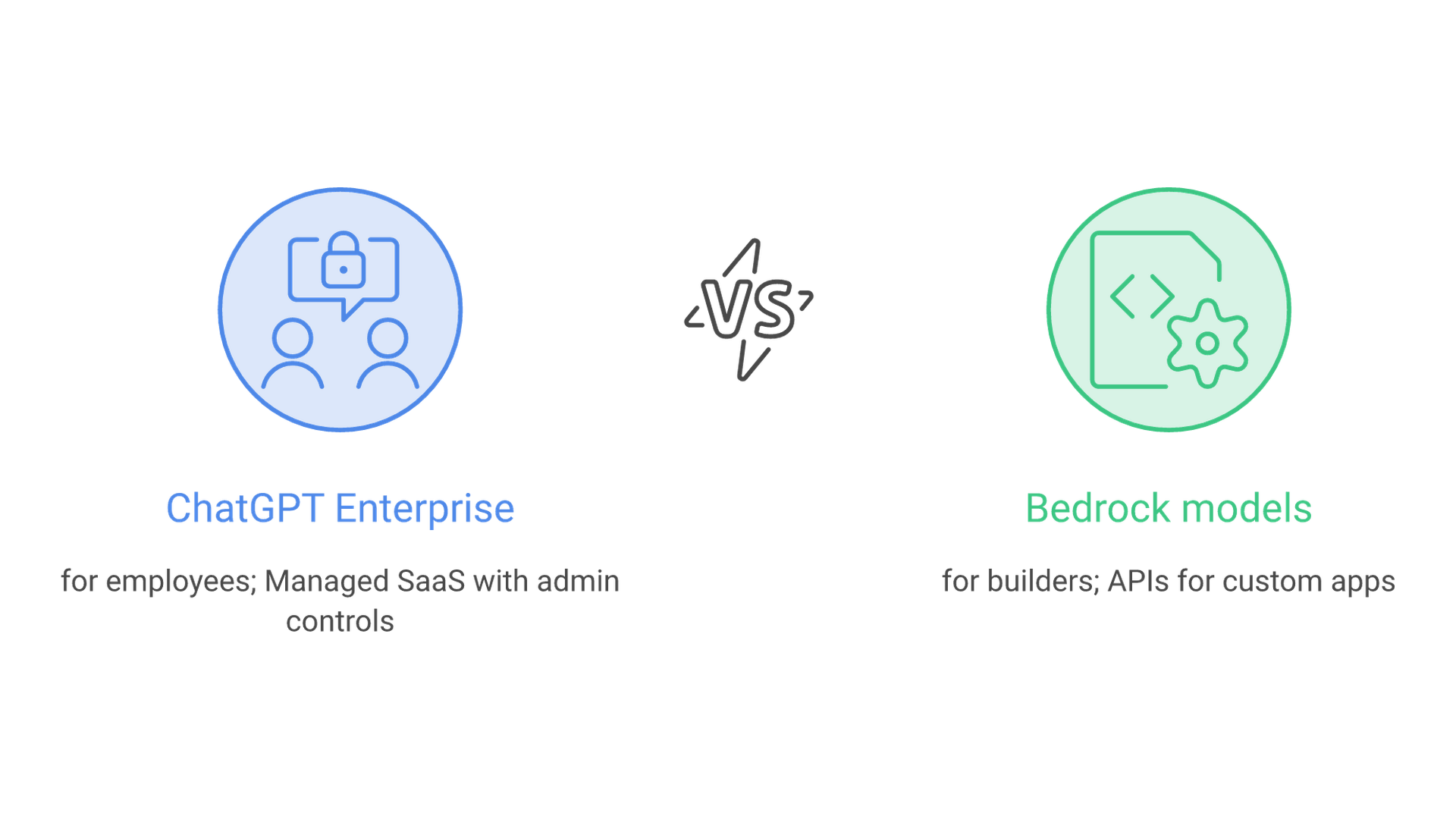
Enterprise teams often ask how ChatGPT Enterprise on AWS Marketplace relates to OpenAI models accessed through Amazon Bedrock. These serve fundamentally different purposes:
Criterion | ChatGPT Enterprise (AWS Marketplace) | OpenAI Models via Amazon Bedrock |
|---|---|---|
Delivery model | Fully managed SaaS with UI, agents, desktop app, and admin console | LLM APIs as infrastructure for custom application development |
Primary users | Employees across business functions-knowledge workers, developers, managers | Engineering teams building AI-powered products and internal platforms |
Use case | Horizontal productivity: research, writing, code, ongoing agent tasks | Embedded AI: custom apps, product features, automated pipelines |
Admin/governance | OpenAI-managed enterprise controls, SSO, audit logs | AWS-native IAM, CloudWatch, custom security controls |
Pricing | Per-seat + usage (private offer via Marketplace) | Per-token API usage via AWS billing |
ChatGPT Enterprise can complement OpenAI models used within Amazon Bedrock for custom applications. Many enterprises will use both: ChatGPT Enterprise for horizontal employee productivity and Bedrock-hosted models for embedded AI inside products and internal platforms. For organizations with complex legacy systems and multiple lines of business, a combined strategy is often the accurate path to complete coverage. From Cognativ's perspective, the recommendation depends on where the organization is in its AI implementation roadmap and what the highest-impact use cases are.
Industry-Specific Use Cases Cognativ Sees Most Often
Across industries, the pattern is consistent: new features like agents and Work unlock value only when paired with governance, approval workflows, and domain expert review. Cognativ's RAPID framework structures these rollouts to manage risk while accelerating time-to-value.
- Healthcare: Summarizing clinical policies for operations teams, supporting revenue cycle documentation by analyzing claims data, generating compliant patient communications-always with human review and legal oversight in HIPAA-eligible workspaces.
- Financial services: Assisting with policy interpretation, drafting internal procedures, aiding in regulatory change impact assessments using institution-specific documentation. Dots can monitor regulatory bulletins and flag policy deviations for compliance teams.
- Logistics and supply chain: AI agents that maintain SOPs, summarize carrier performance from multiple data sources, and prepare weekly operations briefs. Work connects to S3, internal APIs, and vendor portals to aggregate the data.
- Media and streaming: Supporting content operations teams with rights summaries, campaign briefs, and cross-channel content variations. Work handles the multi-step assembly; dots keep materials current as rights windows and campaign schedules shift.
Implementing ChatGPT Enterprise via AWS Marketplace: Step-by-Step
Implementation is not a single procurement action. It requires coordination among IT, security, procurement, and business stakeholders to ensure the deployment is secure, governable, and actually useful. The process below reflects how Cognativ typically guides enterprise AI implementations from procurement to production.
Procurement and Technical Onboarding Process
- Identify business use cases and success metrics. Define what you're solving-time-to-draft, ticket resolution speed, deployment frequency, report assembly hours-before engaging vendors. This shapes your seat count, feature requirements, and pilot scope.
- Engage your AWS account team. Confirm EDP or PPA eligibility and request that your AWS representative open a conversation with OpenAI for a private offer in AWS Marketplace. Understand which spend categories and regions qualify toward your commitment.
- Evaluate security, compliance, and data residency requirements. Work with InfoSec and legal to map your regulatory needs (HIPAA, GDPR, internal ISO/SOC controls) to OpenAI's Data Processing Addendum, subprocessor list, and available residency options.
- Negotiate the private offer. Determine seat counts, feature scope, and custom pricing. Validate how usage of Codex, dots, and advanced features is metered and reported-particularly whether token-based billing or flat-rate plans apply to your agreement.
- Complete the AWS Marketplace subscription. Link the product to the appropriate AWS accounts or organizations. Confirm cost allocation tagging and billing structure with your finance team.
- Configure the admin console. Set up SSO, SCIM provisioning, role structures, workspace segmentation, and data retention policies. Define which apps and tools are connected, which domains are accessible via cloud computer, and what actions require approval.
- Run a time-boxed pilot. Deploy to a small but representative group of users across business units. Instrument outcomes-hours saved, tasks completed, error rates, adoption patterns-and capture qualitative feedback.
- Plan scale-up. Based on pilot results, decide on broader rollout, change management plan, and integration roadmap across departments. Cognativ typically engages in defining use cases, integration planning, governance design, and team training during this phase.
Configuring Security, Privacy, and Data Residency
OpenAI offers two distinct residency controls for ChatGPT Enterprise customers:
- Data residency controls where supported customer content is stored at rest. Supported regions currently include the United States, Europe (EEA and Switzerland), United Kingdom, Canada, Japan, India, Singapore, South Korea, Australia, and UAE.
- Inference residency separately controls where model inference runs on GPUs. This is available in the United States, Europe (EEA and Switzerland), and UAE-though UAE has significant limitations, including no support for ChatGPT Work and disabled features like image generation.
These controls are not comprehensive. Not all data categories are covered by residency settings-metadata, workspace names, billing information, and certain system logs may still be processed or routed globally. Features like "Sites" have narrower regional support. Residency options only apply when enabled and are not available in all regions.
Key configuration decisions for security teams:
- Retention windows: Align data retention policies with internal requirements. In eligible workspaces with data residency or Enterprise Key Management, dot snapshots are wiped on a regular cycle.
- Connected app permissions: Define which repositories, tools, and third-party apps agents can access by default. Limit scope during initial deployment and expand based on risk assessments.
- Approval workflows: Configure auto-review and safety checks for consequential actions. Connected apps inherit the permissions of the owning user; dots follow Enterprise Agent Security policies.
- Local computer access: Decide whether to enable local-computer access for Work, which increases risk but may be necessary for data stored on local machines or in protected on-premises environments.
Cognativ can help map these options to specific regulatory expectations-whether that's HIPAA support, financial supervision, or internal governance controls-without overpromising certification.
Change Management, Training, and Governance at Scale
Technology deployment without organizational readiness produces shelfware. Building internal acceptable use policies-clear "dos and don'ts" for AI usage-is a prerequisite for broad rollout. These policies should address what types of data can be shared with ChatGPT Enterprise, when human review is required, and how outputs should be validated before use in customer-facing or regulated contexts.
Role-specific enablement drives adoption. Developers need guidance on Codex integration with their existing workflows. Analysts need prompt templates for recurring report types. Support agents need guardrails on what customer data they can process. Managers need visibility into usage analytics and team adoption. Generic training sessions don't produce these outcomes-tailored enablement by function does.
Governance structures ensure long-term value and risk management. Consider forming an AI steering committee with explicit decision rights covering procurement, security, architecture, and business outcomes. Periodic audits of usage patterns, incident response processes for AI-related errors, and clear escalation paths for edge cases all contribute to a secure, sustainable deployment. Cognativ's RAPID transformation framework helps align teams on priorities, pilot scopes, and scaling from pilot to program without regressions.
Common Challenges and How to Address Them
Enterprise teams consistently underestimate three things when deploying ChatGPT Enterprise: integration complexity, governance requirements, and true total cost. The challenges below reflect patterns Cognativ sees across mid-market and large enterprise implementations.
Unclear Ownership Between IT, Security, and Business Units
When no single team owns the ChatGPT Enterprise deployment, pilots stall and work gets duplicated. IT assumes security is handling governance. Security assumes the business owns use case definition. The business assumes IT is managing configuration.
Form a cross-functional AI working group with explicit decision rights covering procurement, security, architecture, and business outcomes. Assign an executive sponsor and a day-to-day owner-often the Head of Platform Engineering or Digital Transformation. Enterprise AI governance frameworks provide a model for structuring these decision rights clearly.
Data Leakage and Compliance Concerns
The most common fear: sensitive business data leaving the company, crossing borders, or being processed in non-compliant ways. ChatGPT Enterprise addresses many of these concerns-no model training on customer data by default, encryption in transit and at rest, administrative controls over connected tools and agent permissions-but policy and configuration choices still matter.
Practical safeguards for the initial deployment:
- Limit early pilots to low- and medium-risk content until confidence in controls is established
- Configure conservative access to repositories and connected apps
- Implement review steps for generated outputs in regulated workflows
- Verify data residency and inference residency settings match your legal requirements
Overestimating "Out-of-the-Box" Capabilities
A common misconception: ChatGPT Enterprise will immediately understand all proprietary processes, systems, and terminology without integration work. The system lacks inherent enterprise domain knowledge unless that knowledge is fed through content integrations, connected apps, or well-structured reference material.
Delivering real value requires:
- Connecting relevant document repositories, wikis, and tools so agents have accurate context
- Providing well-structured reference material for domain-specific tasks
- Defining standard prompts and templates for recurring workflows
This is where custom AI agent development and integration design make the difference between a pilot that impresses and one that disappoints.
Hidden Costs and Misaligned Expectations
Enterprises often focus on per-seat headline pricing and overlook the complete cost picture. ChatGPT Enterprise includes advanced features drawing from a shared credit pool, meaning heavy usage of Codex, dots, and Work can consume credits beyond base seat fees. Additional cost categories include:
- Token-based usage charges for plans where consumption is metered
- AWS infrastructure costs for surrounding systems, integrations, and data stores
- Internal costs for enablement, governance, change management, and ongoing quality assurance
- Developer time for building custom MCP connectors or integration workflows
Build a simple total cost of ownership model that includes licensing, usage credits, integration work, internal staff time, and expected productivity gains. This prevents budget surprises and gives leadership an accurate picture of ROI.
Conclusion and Next Steps
ChatGPT Enterprise is available on the AWS Marketplace as a consolidated enterprise SaaS offering, combining conversational AI, multi-step work delegation, a coding agent, and always-on agents-all with enterprise security and AWS-based procurement. For organizations already invested in AWS, this creates a direct path to deploying AI productivity tools without opening new vendor relationships or disrupting existing financial commitments.
Success depends on aligning procurement, security, architecture, and business workflows. Simply subscribing through AWS Marketplace is not enough-the organizations that get value are the ones that plan integration, governance, and change management before broad rollout.
Concrete next steps:
- Validate internal requirements: security posture, compliance obligations, EDP utilization targets, and priority use cases
- Engage your AWS account team and OpenAI to explore a private offer through AWS Marketplace
- Design a pilot program with clear metrics, scoped data access, and representative users across functions
- Plan integrations, governance structures, and change management before expanding beyond the pilot
If your organization is ready to move from evaluation to implementation, talk to Cognativ about designing an AI-first architecture around ChatGPT Enterprise on AWS-including modernizing legacy systems, building secure integrations, and creating measurable AI agent workflow automation on top of your existing AWS environment.
Additional Resources
- OpenAI's ChatGPT Enterprise documentation and security whitepaper: The most current source for feature availability, enterprise controls, data residency regions, and compliance certifications. Visit OpenAI's help center for details on dots, Work, and Codex configuration.
- AWS Marketplace product listing for ChatGPT Enterprise: Confirms the deployment model, private offer process, support terms, and delivery method. Use this to request a private offer and review legal terms.
- Cognativ's Enterprise Generative AI Strategy guide: A complete implementation guide for organizations planning AI-first architecture across regulated industries.
- Cognativ's AI Readiness Assessment Framework: A practical framework for mid-market teams to discover gaps in systems, governance, and team readiness before committing to large-scale AI deployment.
Start with a focused assessment of your systems, workflows, and constraints. The companies that succeed with ChatGPT Enterprise are the ones that treat it as an architecture decision, not just a software purchase.