
Google launches TPU 8tx: what it means for secure, high-context AI in 2026
Google's TPU 8tx brings hardware confidential computing to TPUs for secure inference and private fine-tuning. What regulated teams should know before adoption.
Google introduced TPU 8tx and TPU 8i Max on November 9, 2026, expanding its eighth generation TPU portfolio to four systems in a single year - the first time Google has shipped that many TPU systems in one annual cycle. TPU 8tx is a confidential computing TPU system built from the same silicon as TPU 8t and paired with 5th Generation AMD EPYC CPU hosts, designed for secure and confidential inference and small scale training on sensitive data and proprietary models. This article explains what TPU 8tx is, how it works, and how enterprises operating in regulated environments can put it to use.
The scope here is focused on TPU 8tx, with contextual coverage of TPU 8t, TPU 8i, and TPU 8i Max where comparisons are necessary. It's written for technical leaders - CTOs, heads of AI, and platform and infrastructure decision-makers - evaluating Google Cloud or hybrid TPU deployments for AI workloads that handle private data.
In short: TPU 8tx combines training-grade computing power with hardware level confidential compute, keeping data and model weights protected and isolated even while in active use during inference and fine-tuning. It delivers up to 2x lower latency than TPU 8t for multi-step agent workflows, with a near-zero performance penalty from the added security layer.
After reading this article, you will understand:
- The architecture and security model behind TPU 8tx, including how it differs from other eighth generation TPUs
- Which AI workloads TPU 8tx is optimized for - and which it is not
- How deployment models work across Google Cloud, customer data centers, and hybrid environments
- A structured evaluation and rollout process for adopting TPU 8tx in regulated enterprises
- How a partner like Cognativ can help integrate TPU 8tx into an AI-first architecture
Understanding Google's TPU 8tx launch in context
Tensor processing units (TPUs) are Google's family of custom AI accelerator chips, purpose-built for advanced AI workloads like large language models, reasoning models, and agentic systems. Designed over a decade ago to handle Google's own internal demands - voice recognition, language translation, and eventually training and serving Gemini models - TPUs have evolved into a rapidly growing business. TPUs now serve nearly 100 customers across various industries, including frontier labs, trading firms, retailers, and universities. TPU 8tx is the newest member of the eighth generation TPU family, and understanding where it fits requires context on the full 2026 lineup.
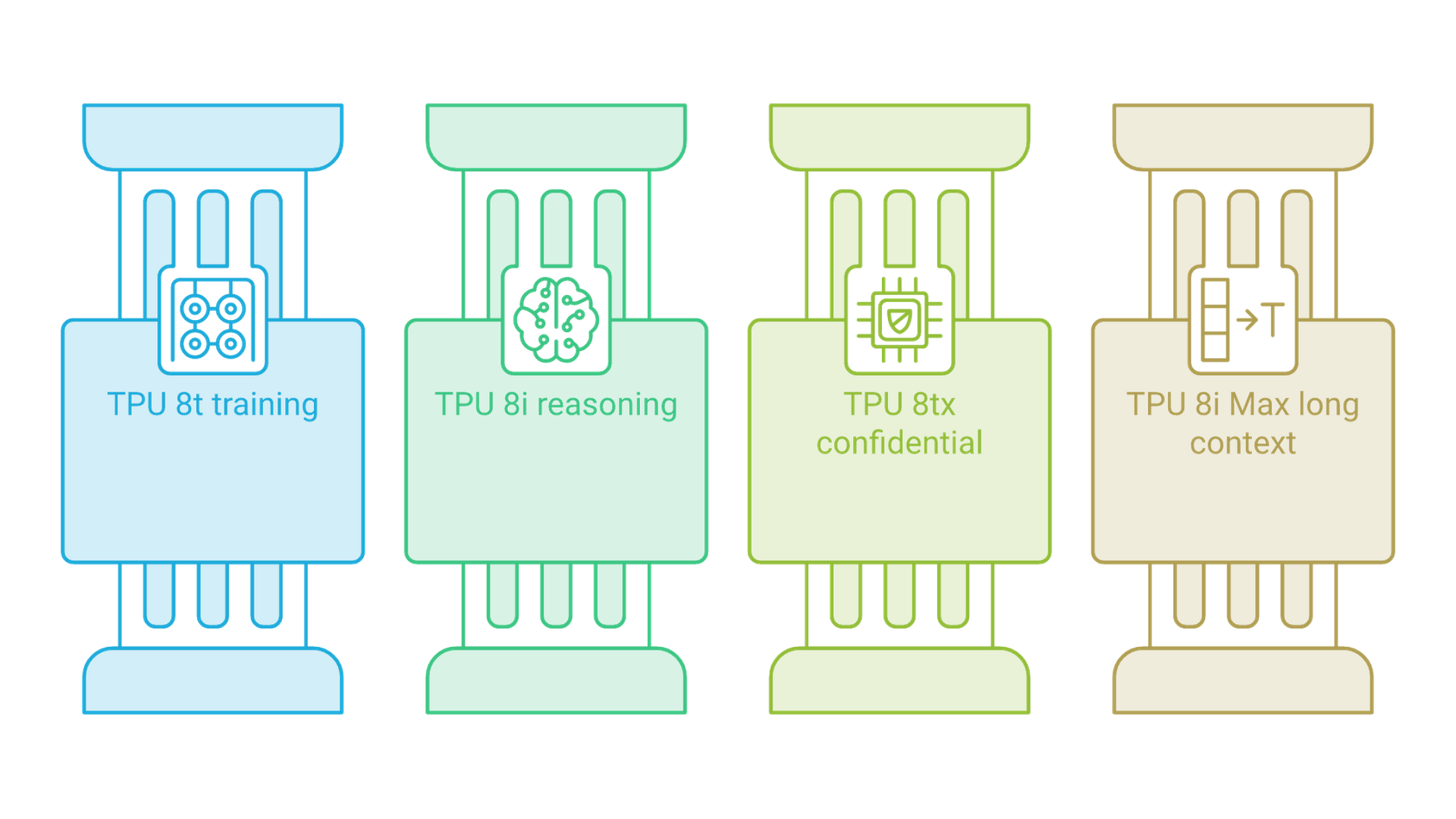
From TPU 8t and 8i to 8tx: the 2026 eighth-generation family
At Google Cloud Next in April 2026, Google introduced two specialized chips in the same generation: TPU 8t for large scale training and TPU 8i for real-time reasoning. TPU 8t was designed as a training powerhouse for massive foundation models, delivering up to 2.7 times better training performance versus the previous generation of TPUs. TPU 8i is the reasoning engine, built to break the memory wall and cut inter-chip communication delays by up to half, offering roughly 80% better inference price performance over its predecessor. Together, TPU 8t and TPU 8i established the baseline for eighth generation TPUs.
By late 2026, Google expanded this family with two additional new systems - TPU 8tx and TPU 8i Max - so that there are now four TPU systems in the eighth generation tpu portfolio, each targeting a distinct part of the AI lifecycle. This marks the first time four TPU systems launched in one year. TPU 8i Max combines two TPU 8i chips into a single package, fitting twice the silicon within the existing rack footprint. It delivers double the compute, double the SRAM, and double the HBM bandwidth of TPU 8i, purpose-built for massive context windows and the highest compute density per rack. TPU 8tx, meanwhile, addresses a fundamentally different requirement: hardware-level data security for inference and training workloads.
Critically, TPU 8tx reuses the same silicon as TPU 8t rather than introducing a brand-new chip. What changes is the system-level design: packaging, host CPUs, networking, and security architecture. This "build the computer around the chip" approach - a foundational bet Google made when it built its first TPU - allows engineers to rapidly adjust packaging, high-speed memory, optical networking, and security around existing silicon to deliver specialized supercomputers in months rather than years. It reflects a modular design philosophy where the chip is the building block, but the system is what solves the customer's problem.
What makes TPU 8tx different from earlier TPUs
TPU 8tx is a confidential computing TPU system optimized for secure and confidential inference and small scale training on sensitive data and proprietary models. Two core differentiators separate it from other tpu systems and generic accelerators.
First, hardware level confidential compute. Normally, data is encrypted when stored or sent over a network, but has to be unlocked in memory while a computer processes it. TPU 8tx builds security directly into the hardware layer, keeping sensitive data and model weights isolated even while in active use. The system pairs TPU 8t silicon with 5th Generation AMD EPYC CPU hosts that create secure enclaves for workload orchestration, key management, and attested execution. Only authorized, verified code can access decrypted models or data - extending protection beyond at-rest and in-transit encryption to cover the critical "in use" phase.
Second, a low-latency Boardfly network for multi-step agent workflows. Originally developed for TPU 8i's real-time reasoning workloads, the Boardfly topology is a flattened, high-radix interconnect that reduces hop count and tail latency. TPU 8tx adopts this same fabric, delivering up to 2x lower latency compared to TPU 8t with a near-zero performance penalty from the confidential computing layer.
To understand where TPU 8tx truly shines, it helps to examine the new patterns of agentic AI workloads emerging in 2026.
The agentic era and why TPU 8tx matters now
Agentic AI refers to autonomous or semi-autonomous AI agents that reason over large context windows, call external tools and APIs, maintain long-lived state, and execute multi-step workflows with minimal human intervention. These agents are rapidly moving from research prototypes into production systems - and they stress infrastructure in ways that traditional batch training or simple inference never did.
Agentic workloads involve frequent tool calls, long-running sessions, high concurrency, and a mix of fine-tuning and inference, often on highly sensitive enterprise data. A clinical documentation agent working with protected health information, a trading strategy agent processing proprietary market signals, or a supply chain optimizer handling confidential contract terms - all of these require infrastructure that can handle both the computational demands and the security constraints simultaneously.
This is exactly where TPU 8tx fits. Its confidential computing model keeps private data encrypted in memory during processing. Its training-grade silicon supports not just inference but private fine tuning, the ability to distill large models into smaller ones, and reinforcement learning - all without migrating sensitive data between separate clusters. And its fast Boardfly network keeps multi-step agents moving at low latency, even in regulated sectors like finance, healthcare, and government where data cannot move freely across infrastructure boundaries. The TPU 8tx targets regulated enterprises and governments that require strict compliance and data protection.
With that context established, the next section examines the architecture, capabilities, and security guarantees of TPU 8tx in greater technical detail.
Inside Google TPU 8tx: architecture, capabilities, and security model
Building on the positioning described above, this section dives into how TPU 8tx is constructed - chip, host, network - what workloads it handles best, and what its confidential computing guarantees look like in practice.
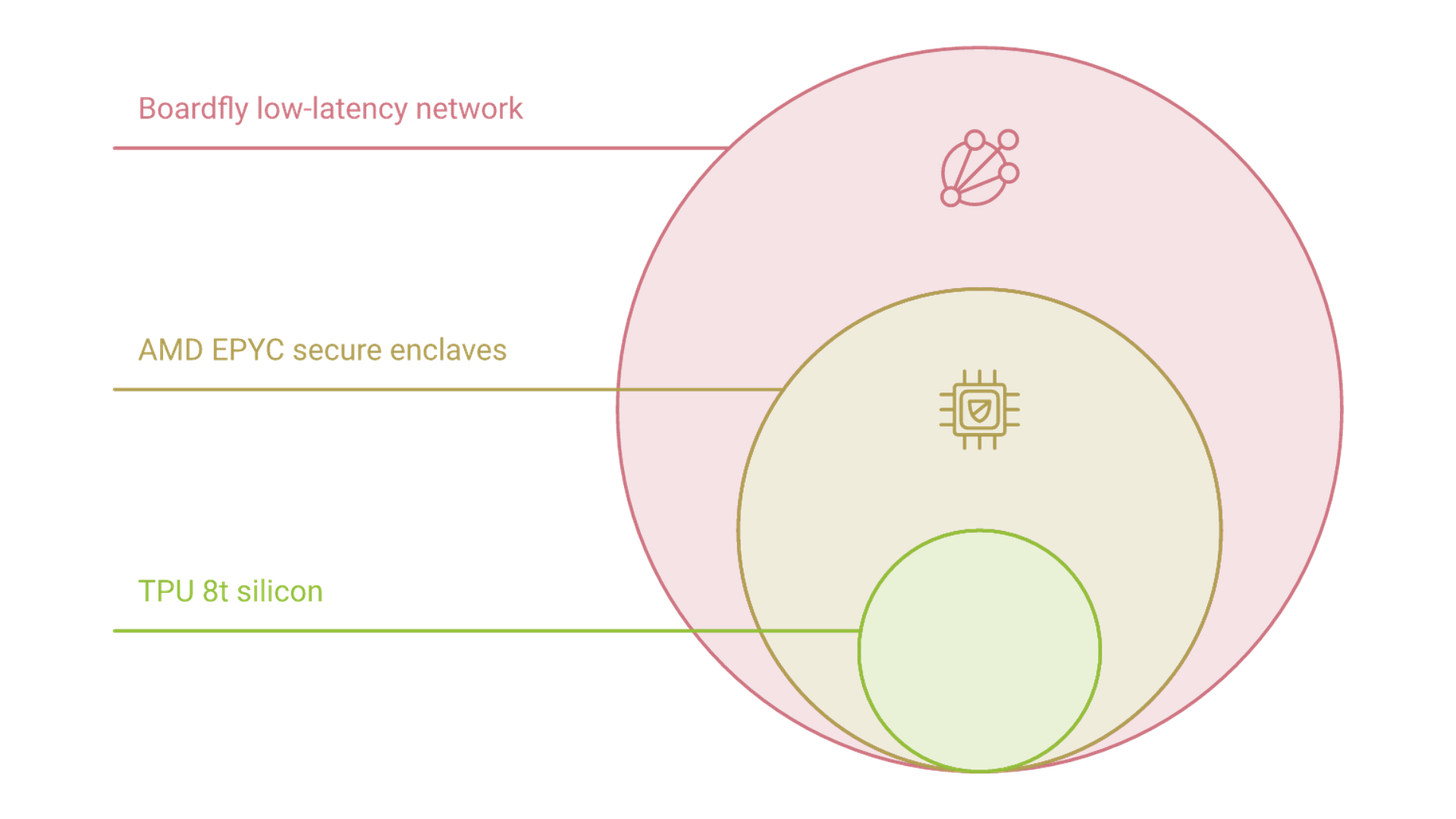
System architecture: TPU 8t silicon plus AMD confidential hosts
TPU 8tx uses the same core eighth generation TPU 8t die - training-grade silicon - but pairs it with a fundamentally different host environment. TPU 8tx utilizes custom AMD EPYC CPU hosts for processing capabilities. These 5th Generation AMD EPYC processors support hardware-level confidential computing through technologies like Secure Encrypted Virtualization (SEV), enabling cryptographic isolation of workloads from the host operating system, cloud provider operators, and other tenants.
The system's building blocks include TPU chips with high-bandwidth memory (HBM) and on-chip SRAM, host memory managed by the AMD EPYC CPUs, and the Boardfly interconnect providing low-latency, high-throughput communication between chips. Think of it as a layered architecture: the TPU die provides raw compute performance for AI models, the AMD host manages orchestration, key management, and secure enclaves, and the Boardfly fabric connects everything with minimal latency overhead.
Although Google has not publicly disclosed every specific memory or bandwidth figure for TPU 8tx, the system uses the same silicon as TPU 8t, so its raw training compute per chip is comparable. The key difference is in how those chips are packaged and networked - optimized not for massive scale pre-training clusters but for secure inference and small scale training where confidentiality is the primary requirement.
Confidential computing on TPU 8tx: how data stays protected
Confidential computing, in precise terms, refers to execution environments where code and data are cryptographically isolated from the host operating system, cloud provider operators, and other tenants, with attestation capabilities that let the workload owner verify the integrity of the environment before releasing keys or data.
TPU 8tx extends this model to AI workloads in a meaningful way. Standard cloud infrastructure encrypts data at rest (on disk) and in transit (over the network), but decrypts it in host memory during processing. TPU 8tx adds hardware-enforced protection of data and model weights while in use - in CPU memory and on the TPU itself. The AMD EPYC hosts create secure enclaves for workload orchestration and key management, ensuring that only attested, authorized code can access decrypted models or data.
For regulated industries, this changes the calculus significantly. It enables private fine tuning, reinforcement learning, and agent orchestration on protected health information, personally identifiable information, trading strategies, or proprietary source code - while meeting internal security and compliance expectations. Google aims to mitigate data exposure risks in regulated industries with TPU 8tx, though formal compliance (HIPAA, FedRAMP, PCI) still requires proper legal, security, and audit review specific to each deployment.
Boardfly network and latency profile for agentic workloads
The Boardfly topology, inherited from TPU 8i, is a flattened interconnect design that reduces network diameter and tail latency for all-to-all communication across chips. This design was originally created for real-time reasoning workloads where inter-chip communication delays directly impact inference latency.
TPU 8tx leverages this same low-latency fabric, delivering up to 2x lower latency compared to TPU 8t's training-optimized network. Google claims a near-zero performance penalty from the added security mechanisms - meaning that the confidential computing layer does not meaningfully degrade the latency advantages of the Boardfly interconnect.
For agent and tool-calling patterns, this translates to faster round-trips for multi-step reasoning, code generation, and workflow orchestration. When AI agents need to read and write from vector stores, databases, or external tools in tight loops, every millisecond of interconnect latency compounds across dozens of steps. The Boardfly fabric directly addresses this by minimizing the communication cost between chips during inference.
In summary, TPU 8tx combines training-grade compute from the 8t silicon, confidential computing from AMD EPYC hosts, and a fast inference network from the Boardfly topology - a combination that no other single TPU system in the portfolio provides.
What TPU 8tx is optimized for (and what it is not)
TPU 8tx is designed first for secure and confidential inference and small-to-medium scale training and fine-tuning, not for the largest frontier model pre-training runs. Those remain better suited to large TPU 8t superpods or mixed GPU/TPU fleets optimized for massive scale goodput.
The sweet-spot workloads for TPU 8tx include:
- Confidential inference of large language models and multi-agent systems handling sensitive data
- Private fine tuning on regulated datasets - clinical records, financial transactions, proprietary codebases
- Distillation of large internal models into smaller, deployable variants without exposing proprietary model weights
- Reinforcement learning with sensitive state, where the reward signals, environment data, or policy parameters are confidential
- Secure agent execution for autonomous agents that call tools, query databases, and maintain long-lived state across workflows
Workloads where TPU 8tx is typically not the primary choice include commodity, stateless inference on public data where security features add unnecessary complexity, and massively scaled pre-training where cluster size, network topology, and raw throughput dominate. For massive context windows involving million-token inputs, TPU 8i Max - with its double the compute and double the hbm bandwidth - is the more natural fit. And for pure scale up training of massive foundation models, TPU 8t superpods remain the standard.
How enterprises can use TPU 8tx: use cases, deployment patterns, and integration
TPU 8tx is not a research curiosity. It's aimed at enterprise and government teams with real regulatory and governance pressure - organizations that need to run AI agents on private data without compromising either performance or security. This section outlines concrete use cases, deployment options, and integration paths.
High-value use cases for TPU 8tx in regulated industries
Financial services. Trading firms and banks can deploy confidential inference for risk engines, trading strategy agents, and anti-fraud systems that process customer financial data. TPU 8tx enables these models to run on private data without exposing model weights or input data to the cloud infrastructure layer - a requirement that has historically pushed many financial AI workloads toward on-premises GPU clusters with significant operational overhead. Confidential TPU infrastructure provides a competitive advantage in the AI market for firms handling material non-public information.
Healthcare. Clinical documentation agents, coding assistants, and care-path recommendation systems that access protected health information can operate within TPU 8tx's secure boundaries. Google's TPU 8tx addresses challenges faced by regulated industries where even temporary exposure of unencrypted patient data during inference would create compliance risk.
Logistics and supply chain. AI agents optimizing routing and procurement use sensitive pricing, contract terms, and real-time operations data. TPU 8tx allows these workloads to run inference and fine-tune models without sensitive commercial data leaving a controlled environment.
Media and telecom. Code assistants and personalization agents that work across proprietary content libraries and subscriber metadata benefit from TPU 8tx's ability to keep both the model and the data confidential during processing - particularly valuable when multiple teams or external partners share infrastructure.
For each of these clusters, TPU 8tx changes what's possible compared to standard cloud inference: organizations can now run confidential, low-latency agent workloads on TPU-powered AI services without needing to build and operate separate on-premises GPU clusters solely for security purposes.
Deployment models: Google Cloud, customer data centers, and hybrid
As of late 2026, TPU 8tx supports several deployment options:
- Native Google Cloud deployments via the AI Hypercomputer, where TPU 8tx clusters are managed as part of Google's cloud infrastructure with integrated security, networking, and orchestration.
- Dedicated, customer-controlled regions or colocation models, where Google Cloud customers get isolated TPU capacity in specific geographical zones to meet data residency requirements.
- Customer data centers, reflecting Google's emerging capability to allow customers to deploy TPUs directly into their own data centers - giving organizations full physical control over the hardware handling their most sensitive workloads.
Hybrid architectures are a natural pattern: core agent logic and confidential model execution run on TPU 8tx, while non-sensitive analytics, batch workloads, or commodity inference run on GPUs/CPUs in existing on-premises or multi-cloud environments. The key design decision is which components handle sensitive data and therefore need confidential compute, versus which can operate on standard infrastructure.
This is where a partner like Cognativ fits - assessing existing workloads, data residency and compliance requirements, and then designing a business-aligned architecture that determines which components should land on TPU 8tx versus other infrastructure.
Integrating TPU 8tx with your AI software stack
From a developer's perspective, TPU 8tx leverages the same evolving software ecosystem as other eighth generation TPUs. Google open-sourced TorchTPU so that PyTorch code and Hugging Face models run natively on TPUs without code rewrites. Out-of-the-box TPU backends exist for leading open-source inference engines like vLLM and SGLang. The XLA Serving Engine allows teams to train models in Python and serve them in a low-latency C++ runtime across TPUs, GPUs, and CPUs.
A typical enterprise migration path to TPU 8tx might look like this:
- Start from an existing PyTorch or JAX model - including face models from Hugging Face or custom reasoning models developed internally.
- Use TorchTPU or XLA to target the TPU backend, taking advantage of Google's open-source TPU agent suite (now in preview) for automated onboarding, bottleneck diagnosis, and kernel autotuning through tools like Claude Code, Cursor, and Google Antigravity.
- Configure confidential computing settings and attestation flows on the AMD EPYC hosts.
- Validate latency and throughput on Boardfly-backed pods, using TPU Sync for memory hierarchy management across chip HBM, host DRAM, and shared storage.
Cognativ can help standardize this process across an organization - building shared components, observability, and governance so confidential TPU workloads are not ad-hoc experiments but part of a controlled modernization roadmap.
The next section outlines a structured approach to evaluation and adoption.
Planning and implementing TPU 8tx in your infrastructure
Even with strong business value, adopting TPU 8tx touches architecture, security, DevOps, and model engineering simultaneously. A structured approach reduces the risk of operational surprises and ensures that confidential compute capabilities translate into measurable outcomes rather than experimental overhead.
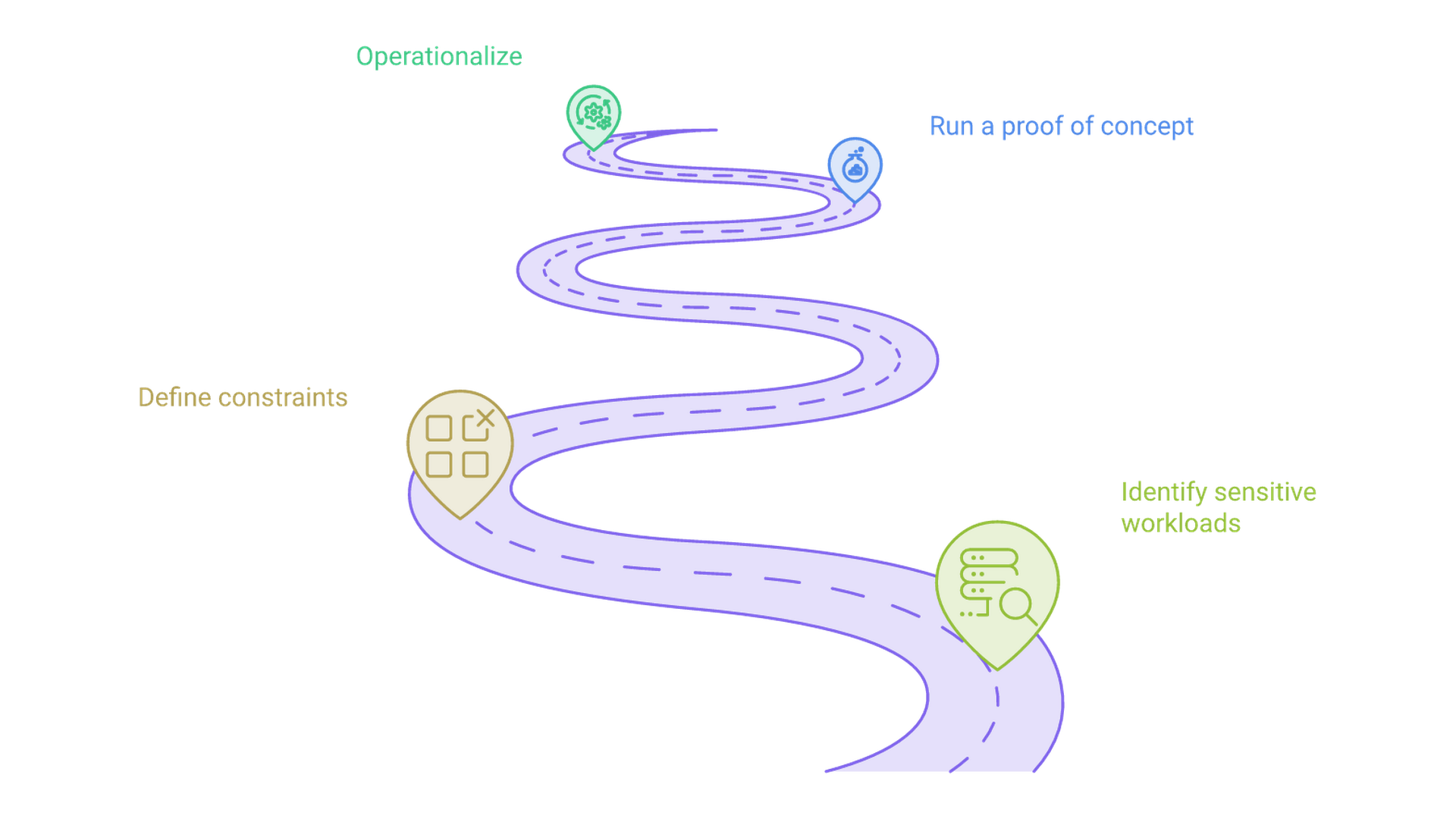
A structured evaluation and rollout process for TPU 8tx
The following process - aligned with the kind of structured assessment Cognativ uses when helping enterprises adopt new AI infrastructure - outlines how to evaluate and roll out TPU 8tx:
- Identify candidate workloads. Inventory agentic and LLM workloads that process high-sensitivity data or proprietary models and are bottlenecked on latency or security. Focus on workloads where data exposure risk is material - not every inference task needs confidential compute.
- Define constraints and objectives. Clarify compliance requirements, data residency rules, latency targets, expected token throughput, and budgetary constraints. Map these to TPU 8tx's security features and Boardfly latency profile.
- Architecture and topology design. Choose between cloud, dedicated region, or on-prem TPU 8tx deployment and design how it interfaces with existing data stores, identity systems, and observability infrastructure. Consider network proximity to vector stores and databases that agents will query.
- Proof of concept. Port a representative workload to TPU 8tx, enable confidential compute, and measure latency, cost per token, throughput, and security posture versus your baseline infrastructure. Measure wall-clock improvements alongside per-unit costs.
- Operationalization. Standardize deployment patterns - CI/CD, infrastructure as code, monitoring, guardrails - and integrate with governance processes. Use Cloud Pathways on Google Kubernetes Engine for orchestrating distributed TPU workloads and GKE dynamic slicing for on-demand topology reconfiguration.
A partner like Cognativ typically adds the most value during steps 2 through 5, translating business goals into a modern, AI-first architecture and validating ROI before scaling.
Comparing TPU 8tx to TPU 8t, 8i, and 8i Max for enterprise decisions
For many organizations, the real question is not "Should we use TPU 8tx?" but "Where does 8tx belong in our broader accelerator strategy alongside other TPUs?" The four systems in the eighth generation serve distinct purposes:
Criterion | TPU 8t | TPU 8i | TPU 8tx | TPU 8i Max |
|---|---|---|---|---|
Primary purpose | Large scale training of massive foundation models | Low-latency reasoning and inference | Confidential computing for secure inference and small scale training | Massive context windows, highest compute density per rack |
Network topology | Training-optimized | Boardfly (inference-optimized) | Boardfly (low-latency + security) | Boardfly (doubled bandwidth) |
Security model | Standard encryption | Standard encryption | Hardware level confidential compute with AMD EPYC | Standard encryption |
Host CPU | Not specified | Not specified | 5th Gen AMD EPYC | Not specified |
Ideal workloads | Frontier pre-training, scale up training | Real-time reasoning, low-latency agents | Regulated-data agents, private fine tuning, secure agent execution | Million-token contexts, codebase-scale reasoning |
Package design | Standard | Standard | TPU 8t silicon + confidential hosts | Two TPU 8i chips in single package |
TPU 8i Max delivers double the compute of TPU 8i and features double the SRAM and HBM bandwidth of TPU 8i, making it the choice for workloads that need significantly more computing power in the same rack space - but without confidential compute. TPU 8tx uses the same silicon as TPU 8t but in a fundamentally different system configuration. The choice should be driven by business risk, data classification, and latency/cost tradeoffs - not raw FLOPs alone.
For organizations running the full ai lifecycle - training, fine-tuning, inference, and agentic orchestration - the answer is often a combination: TPU 8t for central pre-training clusters, TPU 8i for production reasoning, TPU 8tx for regulated workloads with private data, and 8i Max for workloads requiring massive context windows.
Measuring success: KPIs for TPU 8tx adoption
When piloting and scaling TPU 8tx, organizations should track a focused set of metrics that connect infrastructure performance to business outcomes:
- Latency and throughput for key agentic workflows compared to previous infrastructure - particularly Time to First Token (TTFT) and end-to-end round-trip time for multi-step agent tasks
- Effective price-performance - cost per million tokens or per complex workflow completion, including any overhead from confidential compute, compared to GPU-based alternatives
- Security posture improvements - reduction in systems with direct access to decrypted sensitive data, improved auditability, and alignment with compliance frameworks
- Idle compute reduction - measured savings when combining TPU 8tx with Google's Agent Compute Engine, which automatically suspends and resumes idle agent sessions to cut operational infrastructure costs
- Deployment velocity - time from model readiness to secure production serving, tracked against baseline deployment timelines
These KPIs tie directly to modernization and AI-first architecture goals: faster agents, safer handling of critical data, and reduced operational friction. They should be framed in executive reporting as measurable improvements to risk exposure, customer experience latency, and infrastructure cost efficiency.
Common challenges when adopting TPU 8tx (and how to address them)
While TPU 8tx unlocks new capabilities, teams consistently encounter recurring obstacles related to skills, tooling, and governance. Most can be mitigated with the right approach.
Challenge 1: Skills and ecosystem familiarity with TPUs
Most enterprise ML teams are more familiar with Nvidia GPUs and CUDA. TPUs, XLA, and TorchTPU may feel unfamiliar, which can slow adoption and create resistance from engineering teams who fear rewriting production code.
Solutions: Start with PyTorch-based pilots using TorchTPU and vLLM - these require no code rewrites. Leverage Google's open-source TPU agent suite for automated onboarding and kernel autotuning. Build an internal "TPU champions" group or partner with a team like Cognativ that has hands-on TPU experience to accelerate the learning curve. TPUs are purpose-built for advanced AI workloads like large language models, and the software stack has matured significantly in 2026 to reduce adoption barriers.
Challenge 2: Integrating confidential compute with existing security and compliance processes
Security and compliance teams may not initially understand confidential computing primitives - attestation, secure enclaves, hardware-enforced memory encryption - making approvals slow or cautious. Existing risk management frameworks may not have categories for these capabilities.
Actionable approach: Run a joint architecture and risk workshop with security, compliance, and platform teams. Map TPU 8tx security features - encryption at rest, in transit, and in use, attestation chains, key management isolation - to existing controls in your security framework. Document how responsibilities are shared between Google Cloud, internal teams, and any consulting partners. Be transparent that formal compliance certification (HIPAA, FedRAMP) still requires specific legal and audit review on top of the hardware capabilities.
Challenge 3: Data and workflow locality for agentic systems
Agentic systems are highly sensitive to data locality. Latency to tools, databases, and vector stores can degrade end-to-end performance even when model compute is fast. Simply deploying a model onto TPU 8tx without rethinking data paths can produce underwhelming results.
Solutions: Redesign workflows so sensitive data stores are network-proximate to TPU 8tx clusters. Implement TPU Sync for large KV cache management - it reduces KV transfer latency and TTFT by more than 90% by turning chip HBM, host DRAM, shared storage, and the data center network into a single co-designed memory hierarchy. Use GKE dynamic slicing and Cloud Pathways to maintain throughput under hardware disruptions, with dynamic slicing slashing job startup times by up to 5x and fault recovery by up to 4.5x.
Challenge 4: Avoiding idle compute waste with long-running agents
Agentic workloads frequently lead to idle accelerators. AI agents are stateful - they pause for seconds or hours while waiting on a database lookup, an external software tool, or human feedback. This idle time undermines cost effectiveness and can make TPU 8tx deployments appear more expensive than they should be.
Recommendations: Use Google's Agent Compute Engine to automatically suspend and resume idle sessions, cutting operational infrastructure costs during pauses. Design workflows that batch and multiplex workloads - a partner like Cognativ can help architect agent orchestration patterns that improve fleet utilization by routing multiple agent sessions across the same TPU capacity dynamically.
With thoughtful architecture and operations, TPU 8tx moves from an experimental tool to a disciplined, ROI-positive infrastructure asset.
Conclusion and next steps
Google's launch of TPU 8tx in November 2026 gives enterprises a hardware-level confidential computing option that pairs training-grade TPU silicon with a low-latency Boardfly network - purpose-built for secure, agentic AI workloads in regulated environments. It combines training and inference capabilities within a single system, enabling teams to fine tune models, run confidential inference, and orchestrate autonomous agents without migrating sensitive data between separate clusters.
Successful adoption depends less on raw chip specs and more on how well teams align TPU 8tx deployments with business goals, data classifications, and workflow design. The four systems in the eighth generation - TPU 8t, TPU 8i, TPU 8tx, and TPU 8i Max - each serve a distinct purpose, and the right answer for most organizations involves a deliberate mix.
Actionable next steps:
- Audit current and planned AI workloads to identify candidates requiring both high security and low latency - particularly agentic systems handling private data in finance, healthcare, logistics, or telecom.
- Engage security, compliance, and architecture teams early to define requirements for confidential compute and map them to TPU 8tx's capabilities.
- Run a small, time-boxed proof of concept on TPU 8tx using an existing PyTorch or JAX model, measuring latency, cost, and security posture versus your current baseline.
- Consider a focused engagement with Cognativ to design an AI-first, TPU-aware architecture and modernization roadmap that positions confidential compute as a controlled, scalable capability rather than a one-off experiment.
Related areas worth exploring next include TPU 8i Max for massive context windows and highest compute density, GPU/TPU mixed fleets for organizations with diverse workload profiles, and workflow-specific automation patterns for agentic systems using tools like Cloud Pathways and Agent Compute Engine.
Additional resources
The following references and tools help technical leaders go deeper into TPU 8tx and related topics:
- Google's official blog post on TPU 8tx and TPU 8i Max - authoritative specs, positioning, and system diagrams from Google's SVP of AI and Infrastructure
- Google Cloud TPU documentation - detailed coverage of eighth generation tpu systems, confidential computing concepts, and deployment configurations
- TorchTPU, vLLM, and SGLang open-source repositories - hands-on experimentation with PyTorch and Hugging Face models on TPUs
- XLA Serving Engine - open-source C++ runtime for production model serving across TPUs, GPUs, and CPUs
- Cognativ's AI-first architecture services - secure platform design for regulated industries, AI infrastructure assessment, and modernization using accelerators