

Enterprise AI Infrastructure: How to Design a Practical, Scalable Stack
How mid-size companies plan an AI stack: compute, storage, data pipelines, serving, monitoring and governance, with sizing and cost controls for GPU spend.
Enterprise AI infrastructure is the foundation that determines whether your artificial intelligence investments deliver measurable business outcomes or stall at the pilot stage. This article is about designing, sizing, and operating an AI infrastructure stack purpose-built for mid-market and enterprise organizations-companies with 200 to 10,000 employees that need production-grade AI systems without the complexity or cost of hyperscaler-scale research clusters.
If you're here, you likely want to understand the key components of an AI infrastructure stack, figure out what your organization actually needs, and learn how to control cost, risk, and complexity across the entire AI lifecycle. You're not building a frontier model training facility. You're trying to run AI workloads reliably, securely, and affordably.
A mid-size company needs a modular, layered technology stack comprising compute and accelerators, data storage and management, data pipelines and feature platforms, model training and experimentation environments, model serving and orchestration, observability and FinOps, and a cross-cutting layer of security and compliance. Most organizations should right-size aggressively: own or dedicate infrastructure primarily for AI inference, handle fine-tuning on smaller clusters, and outsource or burst heavy training to the cloud.
This article focuses on practical enterprise AI infrastructure for organizations in the 200–10,000-employee range. It covers stack layers, sizing, deployment models (cloud, on-prem, hybrid), requirements checklists, and governance and cost controls. It does not dive deep into model architecture details (transformer internals, mixture-of-experts designs) or low-level GPU kernel optimization. The intended audience is CTOs, heads of engineering and data, platform teams, and IT leaders responsible for planning AI workloads and capital or cloud spend.
What you'll learn:
- How to think about the layers of an enterprise AI infrastructure stack and their responsibilities
- What components of AI infrastructure are required for model training vs inference-and when you can skip training entirely
- How to choose between cloud, on-premises, and hybrid approaches for your AI stack
- What must be on your AI infrastructure requirements checklist across performance, security, data governance, and cost controls
- How Cognativ approaches AI-first architecture and modernization using its RAPID framework
Understanding Enterprise AI Infrastructure
Enterprise AI infrastructure is the specialized combination of hardware and software-compute resources, storage systems, data pipelines, networking resources, orchestration platforms, security controls, and observability tooling-that supports AI workloads across training, fine-tuning, and inference. It encompasses classical machine learning, deep learning, and generative AI applications, deployed for both internal operations and customer-facing products. Enterprise AI infrastructure comprises hardware, software, data pipelines, and governance layers working as a unified system, not a collection of disconnected tools.
Unlike traditional IT infrastructure, which primarily relies on CPUs for processing transactional workloads like databases, web servers, and ERP systems, AI infrastructure is purpose-built for artificial intelligence workloads. AI workloads are data-heavy, GPU-intensive, demand high throughput and low latency networking, and require bursty compute resources that look nothing like steady-state enterprise application hosting. AI infrastructure includes GPUs, TPUs, and AI accelerators specifically designed to handle these demands.
Why does this matter now? Between 2024 and 2026, enterprises have shifted decisively from AI experimentation to production: deploying large language models, chatbots, generative agents, and RAG systems into real business workflows. Simultaneously, regulatory pressures around data privacy, AI governance, and auditability have intensified. And cloud GPU costs have risen steeply-many organizations are watching hyperscaler bills balloon well past initial projections. Robust AI infrastructure is essential for enterprise-scale AI adoption in this environment. Cognativ treats AI infrastructure as part of an AI-first architecture and modernization strategy, not an isolated "AI island" bolted onto existing systems.
Core Characteristics of Enterprise AI Infrastructure
Effective AI infrastructure must satisfy several non-functional characteristics that directly shape architecture decisions:
- Performance: GPU and accelerator throughput measured not just in FLOPS but in effective tokens per second for large language models or frames per second for vision workloads. AI inference demands low-latency responses-interactive applications typically require sub-200ms to 300ms P95 response times. AI infrastructure emphasizes low-latency, high-throughput networking to keep data flowing between compute nodes, storage, and serving endpoints. AI infrastructure requires high-speed networking for data transfer between distributed components.
- Scalability: The stack must support growth from a single pilot model for one business unit to dozens of AI workflows across the organization without a full replatform. AI infrastructure emphasizes elastic scalability for fluctuating workloads. Cloud-based AI infrastructure offers flexibility and scalability on demand, but on-prem clusters need multi-tenancy and quota management to achieve similar resource allocation efficiency. AI infrastructure can scale to handle increasing data volumes as adoption grows.
- Reliability: SLAs for uptime must cover model serving latency guarantees, data pipeline availability, and throughput under load. Redundancy in storage and networks, plus replay capability in data ingestion, protects against failures that would break AI operations.
- Security and compliance: Encryption at rest and in transit, identity and access control, audit trails, and data residency controls are non-negotiable. AI infrastructure requires encryption for data at rest and in transit. For regulated sectors-healthcare, finance, education-the stack must support HIPAA, GDPR, PCI-DSS, and emerging AI-specific regulations. Enterprise AI infrastructure supports data security by allowing private data management without leaks.
- Governance: Model lifecycle oversight including versioning, testing before deployment, rollback capability, and approval workflows for new models or data usage. AI systems require robust governance measures to ensure compliance with security standards.
- Cost transparency: Unit economics per GPU-hour, per token, per model run, and per environment (dev/staging/production). FinOps-style tagging, budget alerts, and mechanisms to cap runaway usage. AI workloads are expensive to run and require optimized infrastructure for cost efficiency.
These characteristics translate directly into concrete architecture needs: GPU pools with quotas and multi-tenancy, observability baked into every layer, and governance as a cross-cutting concern rather than an afterthought.
Training vs Inference in the Enterprise Context
Understanding the distinction between training and inference workloads is fundamental to right-sizing your dedicated AI infrastructure:
Training and fine-tuning runs are large, bursty, GPU-heavy jobs that often run in short, intense windows. They require dense GPU clusters with high-bandwidth memory, high-speed interconnects (NVLink, NVSwitch), and high-throughput storage capable of feeding large datasets-potentially billions of tokens or tens of terabytes-to the model. AI infrastructure supports large-scale data processing and model training as core capabilities.
AI inference is the steady, latency-sensitive workload that powers applications and APIs in production. It demands distributed, autoscaled deployment with attention to cold start times and P95/P99 latency. Inference infrastructure must handle variable traffic-from predictable steady-state to sharp spikes during campaigns or seasonal peaks. AI infrastructure enables organizations to deploy AI models at scale across business-critical workflows.
A realistic rule of thumb for mid-size companies: many can rely on managed training services or cloud bursting for heavy training jobs and own infrastructure primarily for inference and occasional fine-tuning or RAG enrichment. Establishing a workload-driven architecture avoids over-provisioning of resources in AI applications. Only when inference volumes are consistently high does owning dedicated GPU infrastructure make strong economic sense. Full-scale pretraining of foundation models is rarely justified-most enterprises will use pretrained models and focus on fine-tuning.
Understanding these workload types sets up why the stack must be layered and modular, with each layer independently scalable and governed.
The Enterprise AI Infrastructure Stack: Key Layers
Modern AI infrastructure is best understood as a layered stack, with clear responsibilities and well-defined interfaces between layers. From bottom to top, the layers are: Physical/Cloud Compute and Networking → Storage and Data Layer → Data Pipelines and Feature/Data Platform → Model Training and Experimentation → Model Serving and Orchestration → Observability and FinOps → Security and Governance overlay.
Each subsection below walks through a layer using concrete, enterprise-relevant examples-cloud GPUs, vector databases, Kubernetes, feature stores, and more. The goal is to give you a working vocabulary for each component of AI infrastructure and its role in supporting your AI initiatives.
Compute and Acceleration Layer
The compute layer encompasses the CPUs, GPUs, and specialized hardware-including TPUs and custom AI accelerators-that execute AI tasks. This is where raw processing power lives, and it's typically the most expensive and most scrutinized part of the stack. AI infrastructure requires specialized hardware like GPUs and TPUs to deliver the performance AI workloads demand.
For training and fine-tuning, you need GPU density, large VRAM capacity (80GB or more per GPU for serious LLM work), and fast interconnects. A 70B-parameter model in FP16 format requires approximately 140GB of VRAM just for weights-overhead for gradients and optimizer states pushes actual requirements higher, often necessitating multi-GPU configurations with 2×96GB GPUs or more. Typical enterprise GPU options in 2025–2026 include NVIDIA H100, L40S, and newer B200/B300 series, with newly shipping inference-optimized hardware like NVIDIA's Rubin architecture designed for better efficiency from GPU to rack.
For inference, the picture is different. Smaller GPU SKUs, CPU+GPU mixed configurations, or even CPU-only inference for lightweight machine learning models can be appropriate. Multi-instance GPU (MIG) partitioning allows a single high-end GPU to serve multiple tenants or workloads simultaneously. Multi-tenant GPU clusters provide efficient resource allocation across teams, while dedicated nodes serve performance-critical or sensitive data workloads.
Compute refresh cycles typically run 3–5 years. Maintenance and operations costs average 10–15% annually of hardware cost. Power consumption matters: high-end GPU servers draw 700W+ per GPU in SXM form factors, and liquid cooling can meaningfully reduce facility costs compared to air cooling.
For deeper inference-specific sizing and deployment considerations, see Cognativ's detailed guide on AI inference infrastructure considerations.
Storage and Data Infrastructure Layer
AI workloads demand scalable storage solutions for vast data volumes, and the storage layer must support multiple tiers matched to different access patterns:
- Hot storage for active training datasets and feature stores: high-performance NVMe SSDs, high-IOPS block storage, and optimized object or file storage. Training datasets may range from multiple terabytes to tens of terabytes, requiring throughput of hundreds of GB/sec for large parallel training jobs. High-performance storage systems can manage petabytes of structured and unstructured data efficiently.
- Warm and cold storage for historical data, archived model artifacts, logs, and embeddings. Cheaper object storage systems, tape, or cloud cold tiers serve this role, governed by lifecycle policies and data pruning rules.
- Vector databases and indexes for retrieval-augmented generation (RAG) scenarios. Tools like Pinecone, Weaviate, or Milvus store and retrieve embeddings at the speed RAG pipelines require. Scalable data storage and agile retrieval processes are essential for AI application performance.
The throughput and IOPS profile differs sharply between training and inference. Training demands sequential high-throughput access to large datasets. Inference uses mixed read patterns-small reads for features and embeddings, larger reads for model weights.
Data governance hooks belong in the storage layer: encryption at rest, data residency tags, lifecycle and retention policies, and immutability for audit logs. AI infrastructure must handle large-scale structured and unstructured datasets with governance baked in from the start. Data access should be unified to improve the quality of AI models across the organization.
Data Pipelines and Feature/Data Platform Layer
This layer is the connective tissue between source systems and AI models-responsible for data ingestion, transformation, and delivery in forms that machine learning frameworks and inference services can consume. Without it, even the most powerful compute resources sit idle.
Key components include:
- Data ingestion and streaming: Tools like Kafka, AWS Kinesis, or Azure Event Hubs bring data from operational systems, logs, and events into the AI stack in near real-time. AI infrastructure supports real-time data processing for critical applications that need fresh features or knowledge bases.
- Batch ETL/ELT pipelines: Airflow, dbt, Spark, or cloud-native equivalents move data into lakes and warehouses for large scale data processing and preparation.
- Feature stores and semantic layers: Platforms like Feast or Tecton provide reusable, governed features and embeddings that data scientists and ML engineers can share across AI projects, avoiding duplicated effort and inconsistent data handling.
- Data quality, lineage, and catalog tools: DataHub, Amundsen, Great Expectations, and similar tools ensure data is discoverable, trustworthy, and traceable through the entire AI lifecycle.
Enterprise-specific concerns dominate this layer: connecting legacy systems (on-prem SQL databases, ERPs, log files) and SaaS tools; handling PII and PHI through masking, pseudonymization, and data minimization before data reaches AI workloads. Data collection and preparation often consume more engineering effort than model development itself.
Model Training, Fine-Tuning, and Experimentation Layer
This layer is where data scientists and ML engineers experiment with AI models, fine-tune pretrained models, and evaluate model performance against business objectives. Software frameworks help automate model training, deployment, and resource management in AI across this layer.
Typical components include:
- Machine learning frameworks (PyTorch, TensorFlow, JAX) with GPU support. AI infrastructure utilizes machine learning frameworks like TensorFlow as foundational building blocks.
- Experiment tracking and model registry tools (MLflow, Weights & Biases) for versioned experiments, reproducibility, metrics logging, and artifact storage (model weights, tokenizers, configurations).
- Notebook environments (Jupyter, VS Code Remote) connected to the cluster-not running on individual laptops, which breaks reproducibility and governance.
- Reproducible environments via containers and infrastructure-as-code, ensuring that an experiment run today can be replicated months later.
Many enterprises can leverage managed LLM platforms (OpenAI, Anthropic, or cloud-provider-hosted models) and focus this layer on fine-tuning, RAG pipelines, and task-specific models rather than full pretraining. For organizations exploring how to approach this, Cognativ's guide on how to train your own LLM provides a practical starting point.
Model Serving and Orchestration Layer
Once models are trained or fine-tuned, the serving and orchestration layer is responsible for deploying AI models into production and keeping them running reliably:
- Packaging models as services: REST/gRPC APIs, event-driven triggers, or batch inference pipelines-whichever the consuming application needs.
- Autoscaling and load balancing: Handling variable traffic across business units without manual intervention. AI infrastructure enables organizations to build and manage AI models at scale.
- Deployment patterns: Canary releases, blue-green deployments, shadow testing, and rollback capabilities to reduce risk when updating production models.
- Workload scheduling: Container orchestration-typically Kubernetes with GPU scheduling plugins like the NVIDIA device plugin-manages compute resources across inference workloads. Cognativ has written extensively about how AI workloads demand a shift in infrastructure orchestration strategies.
Specialized model servers (Triton, TorchServe, BentoML) handle the nuances of serving large language models, while vector search services and online feature stores provide supporting data at inference time. Batch inference pipelines handle offline scoring for workflows that don't need real-time responses.
Cognativ's AI-first architecture expertise focuses on designing workflow-specific automation and integration into existing applications-contact centers, underwriting systems, logistics consoles-so that AI solutions deliver value where business processes actually run. For generative AI workloads, our US-based team designs and deploys these serving layers through Cognativ's enterprise LLM solutions.
Monitoring, Observability, and FinOps Layer
AI stacks need a dedicated observability and cost control layer that goes far beyond generic infrastructure management monitoring. Continuous monitoring of AI infrastructure is required to track performance and optimize costs across the stack.
Key dimensions to monitor:
- Infrastructure metrics: GPU/CPU/memory utilization, storage I/O performance, network latency, temperature. Idle GPUs represent wasted capital; overloaded GPUs mean degraded user experience.
- Model metrics: Latency distribution (P50/P95/P99), throughput (requests/sec or tokens/sec), error rates, drift detection (data drift, concept drift), and quality KPIs like accuracy, recall, and bias measures. Monitoring model performance continuously catches degradation before it impacts business outcomes.
- Cost metrics: Per-model, per-team, and per-use-case spend. GPU-hours consumed, storage tier usage, and cloud egress costs. Investing in AI infrastructure can lead to significant cost savings, but only with the visibility to identify waste and optimize.
Core capabilities include central dashboards and alerting for SRE/platform and data science teams, cost attribution via FinOps-style tagging per project and environment, and guardrails like budget alerts and automatic scale-down of idle compute resources. MLOps practices are critical for managing AI systems through development, deployment, and maintenance, and observability is the backbone that makes MLOps operational.
Security, Compliance, and Governance Layer (Cross-Cutting)
Security and governance overlay all layers of the AI infrastructure stack-they are not a separate silo or an afterthought. Structural AI governance helps ensure responsible use and compliance in AI operations across every component.
Must-have elements include:
- Identity and access management: Role-based access control (RBAC), single sign-on (SSO), and multi-factor authentication (MFA) for infrastructure, data, and model access. Role-based access control is essential for securing AI infrastructure at every layer.
- Encryption: TLS in transit, encryption at rest, and key management with clear ownership (HSM or cloud KMS). Data masking and pseudonymization for sensitive data.
- Data governance: Lineage tracking, consent and purpose limitations, retention policies, and the ability to purge data on request. Compliance with GDPR and HIPAA is critical for AI infrastructure in regulated domains. AI infrastructure must support data sovereignty to comply with regulations.
- Model governance: Approval workflows before deploying machine learning models to production, documentation of training data and processes, risk classification, periodic reviews, explainability, and audit logs for decisions in regulated domains. Regular security audits help identify vulnerabilities in AI systems.
- Vendor and third-party risk: When using managed APIs, foundation models, or hosted vector databases, organizations must assess the provider's compliance posture, data handling policies, and terms of service.
For regulated industries-healthcare, financial services, education-these controls must support audit readiness and data residency requirements from day one. AI infrastructure must support evolving requirements to avoid vendor lock-in and enhance flexibility in governance tooling.
With the stack layers defined, the next step is translating organizational goals into a concrete requirements checklist.
Enterprise AI Infrastructure Requirements and Checklists
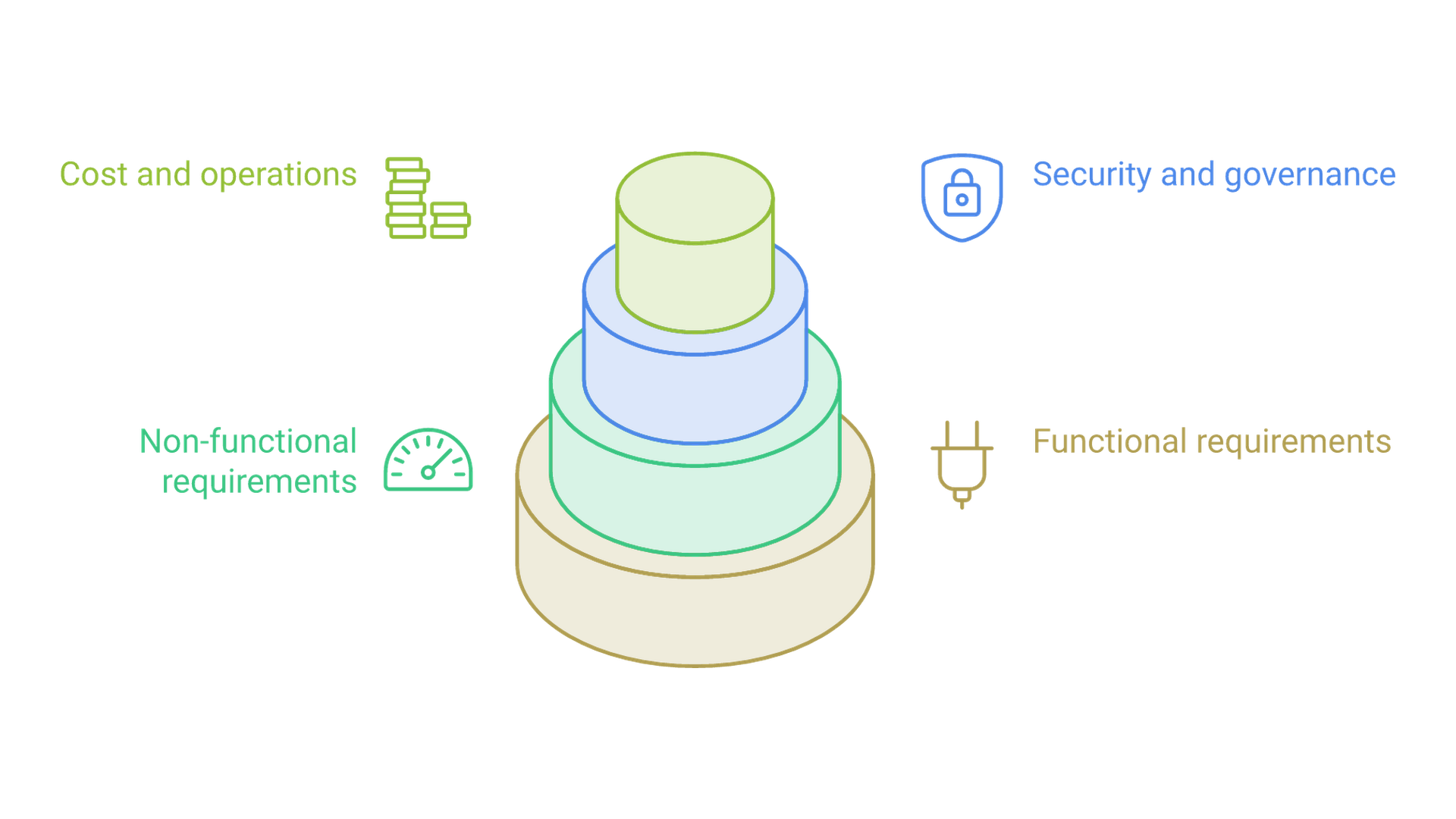
Before buying GPUs or signing multi-year cloud deals, enterprises should translate business objectives and constraints into concrete AI infrastructure requirements. Organizations should prioritize creating a centralized, cohesive AI infrastructure for better management of all AI initiatives. This section provides a structured requirements checklist across performance, reliability, security, governance, and cost control that you can adapt to your context.
Functional Requirements
Your AI infrastructure stack must support the specific AI workflows your organization plans to run. Use this as a starting checklist:
- Workload types: LLM-powered chatbots and copilots, RAG systems, recommendation engines, forecasting and time-series analysis, computer vision, anomaly detection, natural language processing pipelines
- Supported model sizes and families: Open-source LLMs in the 7B–70B parameter range, domain-specific smaller models, possibly larger foundation models accessed via managed API. The ability to fine-tune base or instruction-tuned versions of large language models
- Interfaces: REST and gRPC APIs for synchronous inference, batch job scheduling, event-driven or message bus triggers for asynchronous processing
- Integration points: Existing application stack, databases, data warehouses, SaaS tools, streaming data sources, and the ability to push predictions back into business systems
Enterprise AI infrastructure is essential for building, training, deploying, and scaling AI workloads across all of these scenarios. Effective AI infrastructure accelerates time-to-market for new features and capabilities.
Non-Functional Requirements
Non-functional constraints define how well the system performs, not just what it does:
Performance:
- Latency targets: sub-200ms P95 for customer-facing interactive AI applications; sub-300ms for internal tools; higher tolerance for batch or offline AI tasks
- AI infrastructure must support high-bandwidth, low-latency networking between compute, storage, and serving components
Scalability:
- Support for concurrent inference requests at peak volumes (queries per second)
- Ability to scale training jobs in parallel
- Capacity to handle burst traffic from campaigns, seasonal patterns, or viral adoption
- AI infrastructure enhances scalability and flexibility for growing data needs
Reliability:
- Availability SLAs: 99–99.9% for internal workloads; 99.9–99.99% for external or mission-critical AI applications
- Data freshness SLAs: seconds to minutes for RAG features and real-time inference; hourly or daily for batch features and training data
- Enterprise AI infrastructure must maintain reliability and compliance with emerging regulations
Security, Compliance, and Governance Requirements
This checklist should involve InfoSec, Legal, and Compliance teams early:
- Data classification: Define protection levels for PII, PHI, internal, and public data used in training and inference. Map which data classes may feed which AI workflows
- Regulatory regimes: Identify which regulations apply-GDPR/UK GDPR, HIPAA, PCI-DSS, sector-specific AI regulations (EU AI Act, evolving U.S. rules)
- Logging and auditability: Requirements for logging data access, model training and fine-tuning events, and inference inputs and outputs for regulated workloads
- Third-party and vendor risk: Data residency constraints (e.g., EU data must stay in-region), restrictions on external API usage, and assessment of cloud provider compliance posture
- Model risk classification: Map models to risk levels (low, medium, high) with corresponding approval workflows, documentation, and impact assessments
Cost, ROI, and Operational Requirements
Turn budgets and ROI expectations into infrastructure requirements:
- Budget envelopes: Define CapEx vs OpEx split for initial build vs ongoing operations (cloud, energy, licenses, staffing)
- Business KPIs: Tie AI infrastructure investment to explicit outcomes-reduced handle time, improved conversion rates, lower exception rates, faster defect detection
- FinOps and showback: Cost allocation to teams and use cases with dashboards, reporting, usage vs budget alerts. Organizations that lack cost attribution consistently overspend
- Operational maturity: Define support hours, SRE coverage, on-call rotations for production models, maintenance windows, and hardware refresh cycles
These requirements directly inform the next critical decision: where to deploy your AI infrastructure.
Cloud vs On‑Prem vs Hybrid for Enterprise AI Infrastructure
Most mid-market and enterprise teams end up with a hybrid pattern for their AI infrastructure stack, but it's important to intentionally decide which workloads live where rather than drifting into an accidental architecture. Cloud-based AI infrastructure offers flexibility and scalability on demand, but on-premises deployments offer control and cost predictability for steady-state workloads.
Deployment Model Comparison
Criterion | Cloud AI Infrastructure | On-Premises / Colocation | Hybrid |
|---|---|---|---|
Upfront cost | Low (OpEx model) | High CapEx (servers, GPUs, facility, cooling) | Moderate (split across both) |
Time-to-value | Fast-managed services available immediately | Slower-procurement, setup, staffing | Moderate-phased rollout |
Operational control | Limited to provider's options | Full control over hardware and software | Selective control where needed |
Compliance & data residency | Depends on provider regions and certifications | Full physical control | Flexible-sensitive data on-prem, rest in cloud |
Elasticity for spikes | Excellent-on-demand scaling | Limited by owned capacity | Cloud absorbs overflow |
Unit economics (steady-state) | Expensive for sustained high utilization | Cheaper by year 2–3 for high utilization | Optimized per workload type |
Cloud wins for bursty or uncertain workloads; on-prem wins when GPU utilization is consistently high.
For reference, Azure ND96isr instances with 8×H100 GPUs run approximately $98/hour on-demand; 1-year reserved commitments bring that to roughly $63/hour, and 3-year commitments to approximately $43/hour. These numbers make the case for reservations or on-prem ownership when utilization exceeds 40–50%.
Practical Patterns in Mid-Market and Enterprise Environments
Several patterns appear repeatedly across enterprise AI deployments:
Cloud-first inference and experimentation with strict data minimization: organizations keep sensitive data on-prem or in a private cloud segment, use cloud GPU clusters for running AI models that operate on anonymized or synthetic data, and leverage managed AI solutions for foundation model access.
Hybrid with clear workload segregation: Cloud GPU clusters handle heavy training and fine-tuning jobs. On-prem infrastructure serves low-latency inference for customer-facing applications or highly sensitive data use cases. This pattern balances advanced AI capabilities with compliance requirements.
On-prem primary with cloud overflow: Organizations in highly regulated industries maintain primary compute resources on-premises, using cloud capacity for seasonal spikes, special training runs, or experimentation with new model architectures. Companies are increasingly shifting from cloud-first to hybrid approaches as cost burdens and regulatory demands grow.
Cognativ can help evaluate these patterns using its RAPID framework-mapping constraints, workloads, compliance requirements, and ROI to determine the right deployment model. Our US-based team then plans and builds the chosen setup as part of Cognativ's AI infrastructure solutions.
Sizing Your AI Infrastructure: Training vs Inference
Two common infrastructure mistakes are overbuying GPU capacity "just in case" and underestimating inference workloads that end up powering mission-critical AI workflows. Sizing requires different approaches for training versus inference, and the cost difference between getting it right and getting it wrong compounds over years.
Right-Sizing for Training and Fine-Tuning
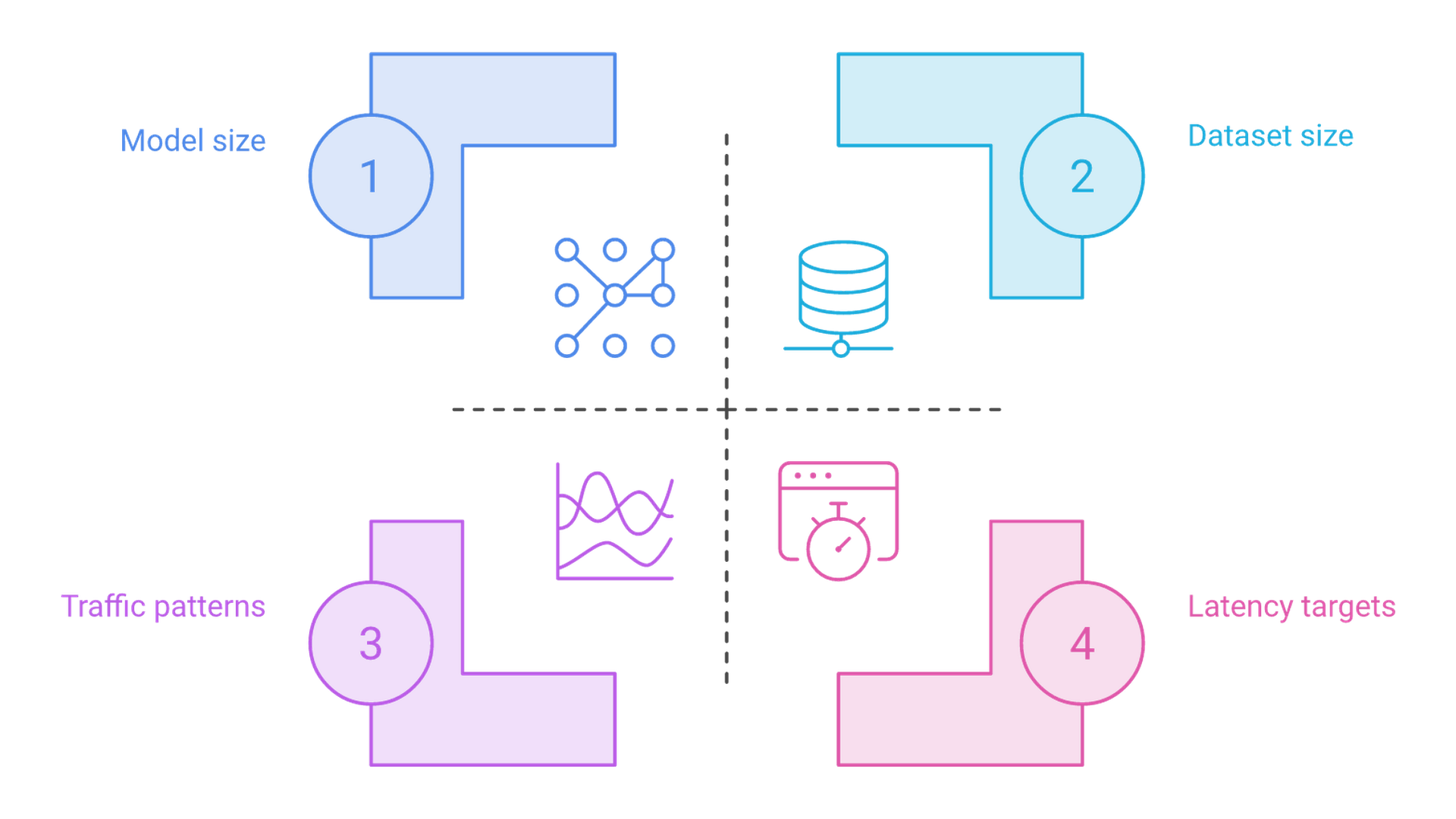
Factors that drive training and fine-tuning sizing include:
- Model type and size: A 7B-parameter model requires dramatically less compute than a 70B-parameter model. Domain-specific smaller models may need only a single GPU.
- Dataset size: Billions of tokens or multi-terabyte datasets demand high-throughput storage and multiple GPUs working in parallel.
- Training frequency: One-off fine-tuning runs can use burstable cloud GPU capacity. Weekly retraining or continual learning justifies a small, shared on-prem GPU cluster.
Rule-of-thumb guidance:
- Use burstable cloud GPU capacity when training is infrequent (monthly or less) and datasets are manageable
- A small 4-to-8 GPU on-prem cluster can handle ongoing fine-tuning and experimentation cost-effectively. Cognativ's guide on local AI server specs covers GPU, RAM, PSU, and storage tiers for these setups
- Consider external partners for very large or specialized training jobs that exceed internal capacity
Right-Sizing for Inference Workloads
Key drivers of inference sizing include:
- Traffic patterns: Average vs peak queries per second, diurnal patterns, seasonal variations. AI workloads require scalable storage systems for the large datasets that feed real-time inference.
- Latency SLOs: Internal users may tolerate 300ms; end customers expect sub-200ms for interactive generative AI applications.
- Model complexity: An 8B-parameter quantized model runs on a single mid-range GPU; a 70B-parameter FP16 model needs approximately 140GB of VRAM for weights alone-at least two 96GB GPUs with overhead for token caches and batch processing.
Guidance:
- Start with managed LLM APIs for early AI projects and migrate to self-hosted open source AI models as volume justifies the investment
- Use autoscaling (Kubernetes HPA, serverless inference endpoints) to align compute resources with actual demand
- CPU-only inference is sufficient and cheaper for smaller machine learning models and batch workloads
For a deeper discussion of inference-specific design decisions, see Cognativ's article on AI inference infrastructure considerations.
Cost Modeling and Capacity Planning
A practical approach to capacity planning:
- Estimate usage scenarios per use case: Agents per contact center seat, per-session token counts, daily prediction volumes, embedding generation frequency
- Translate into resource needs: GPU-hours, CPU-hours, storage volume, network egress
- Model 3-year TCO across cloud-only, on-prem, and hybrid options-include CapEx (servers, GPUs, racks, cooling, power, facility), OpEx (electricity, staffing, support, maintenance, refresh cycles), and cloud costs (instance hours, storage, egress, support tiers)
- Incorporate buffer capacity without doubling spend: plan for 20–30% headroom above projected peak, not 100%
Connect this to the observability and FinOps layer: initial capacity plans are hypotheses. Continuous recalibration based on real usage data-GPU utilization, actual request volumes, storage growth rates-keeps infrastructure management aligned with actual needs. Strong AI infrastructure requires ongoing measurement, not one-time planning.
Designing and Implementing an Enterprise AI Infrastructure Stack
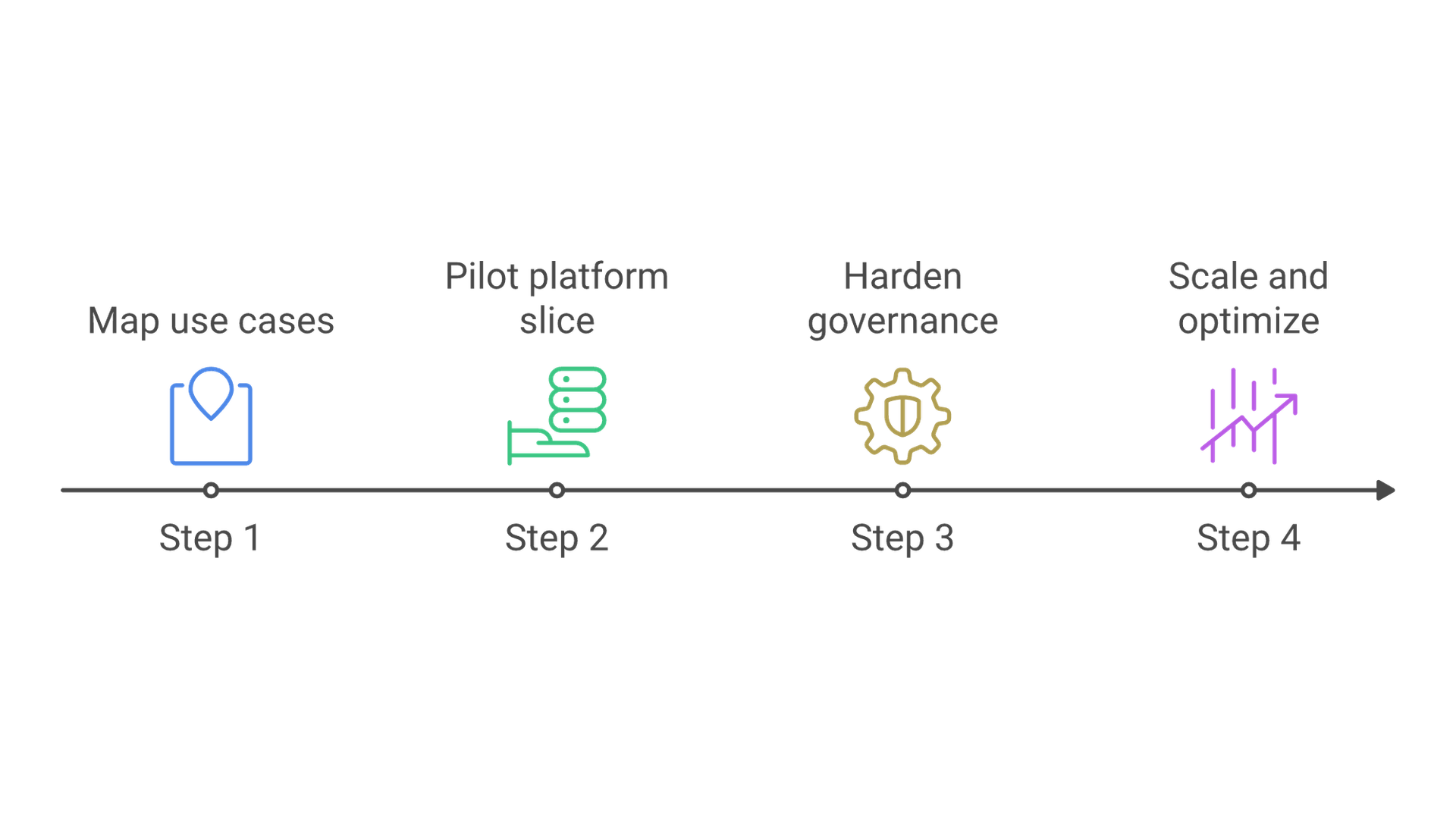
With the stack layers, requirements, deployment model, and sizing approach defined, the next step is designing and rolling out a practical implementation roadmap. This section outlines a phased process aligned with Cognativ's RAPID framework-structured enough to avoid chaos, flexible enough to adapt as real data comes in.
Step-by-Step Implementation Approach
- Map business use cases and constraints: Identify 3–5 priority AI workflows with clear KPIs and regulatory boundaries. This is where AI infrastructure work begins-not with GPU procurement.
- Assess current infrastructure: Catalog existing cloud and on-prem assets, data platforms, security controls, and team skills. Understand what you have before deciding what to build.
- Define target architecture: Choose stack layers, cloud/on-prem split, and integration patterns with core systems. Sketch the stack diagram with clear ownership per layer.
- Build a pilot platform slice: Implement a minimal viable stack that supports 1–2 high-value use cases end-to-end. Validate performance, cost, and governance assumptions with real AI workflows.
- Harden security and governance: Refine IAM, logging, data lineage, and approval workflows as usage grows and more sensitive data enters the pipeline.
- Scale horizontally: Onboard more teams and workloads, standardize patterns with templates, libraries, and platform APIs. This is where organizations should prioritize creating a centralized, cohesive AI infrastructure.
- Optimize cost and performance: Iteratively adjust instance types, autoscaling rules, and storage tiers based on real metrics. Optimize performance continuously rather than over-engineering upfront.
Cognativ's RAPID framework aligns with this process-from constraint identification and prioritization through structured execution and measurement. The AI implementation roadmap provides additional detail on moving from use case to production.
Cloud, On‑Prem, and Hybrid Reference Architectures
Three reference architectures illustrate how stack layers map to deployment models:
Cloud-centric stack: Cloud GPUs for all compute, managed object and block storage, managed Kubernetes for orchestration, cloud-native IAM and encryption. Suitable for organizations with flexible data residency requirements and mature cloud practices. All AI infrastructure relies on the provider's services, minimizing operational overhead.
Hybrid stack: On-prem data lake and data processing pipelines for sensitive data; on-prem inference services for latency-critical or regulated workloads. Cloud-based training clusters, less sensitive experimentation environments, and burst capacity. Distributed file systems and storage span both environments. This is the most common pattern for mid-market enterprises balancing security and compliance with agility.
On-prem-first stack: For highly regulated or data-sovereign environments needing tight physical control over AI data centers. All compute, storage, and orchestration self-managed. Cloud used only for non-sensitive experimentation or access to managed foundation model APIs. Requires significant staffing and facility investment.
Toolchain and Vendor Selection Principles
Rather than prescribing specific vendors, focus on principles that preserve flexibility:
- Favor open standards and portability to avoid hard lock-in. Container-based deployments, standard APIs, and open source machine learning frameworks reduce switching costs. AI infrastructure must support evolving requirements to avoid vendor lock-in and enhance flexibility.
- Check GPU and accelerator support across orchestrators, model servers, and storage systems before committing.
- Ensure integration with existing observability, IAM, and compliance tooling. Bolting on separate security stacks for AI creates gaps.
- Evaluate long-term TCO and replacement flexibility, not just upfront convenience. A cheaper managed service today may become an expensive dependency in year three.
Cognativ operates as a vendor-neutral partner that can weave these components into coherent platforms matched to each organization's constraints and business objectives.
Common Challenges in Enterprise AI Infrastructure (and How to Solve Them)
Most enterprises face similar pitfalls when building AI infrastructure: fragmented tooling, runaway costs, security and compliance gaps, and difficulty moving from pilots to production. Each challenge below names a specific problem and offers a practical solution.
Fragmented AI Tooling and Shadow IT
Problem: Multiple teams experiment separately with different clouds, tools, and models-leading to duplicated spend, inconsistent data handling, and governance gaps. Shadow AI projects bypass controls entirely.
Solution: Establish a core AI platform team, standardize on a reference stack, and provide internal "golden paths"-templates, SDKs, and platform APIs-so teams adopt shared infrastructure. This doesn't mean restricting innovation; it means channeling it through a strong AI infrastructure that enforces baseline governance.
Runaway Cloud and GPU Costs
Problem: GPU clusters and managed AI services accumulate costs faster than anticipated, especially after successful pilots scale to production. Cloud providers may charge $4–12 per GPU-hour for on-demand H100 instances.
Solution: Implement FinOps practices systematically:
- Tag all compute resources per team and use case
- Automate shutdown of idle clusters and scale-down during off-peak hours
- Use right-sized instances and reserved pricing where utilization justifies commitment
- Periodically re-evaluate managed API usage vs self-hosted models for high-volume AI workflows
Data Readiness and Quality Issues
Problem: AI models starve for reliable, well-governed data. Integrations with legacy systems are brittle. Unstructured data sits in silos without metadata or lineage. Data scientists spend most of their time on data preparation rather than model development.
Solution: Invest in the data and feature platform layer:
- Prioritize a small set of high-value data domains to clean and model first
- Introduce data contracts and quality SLAs between data producers and AI consumers
- Use catalogs and lineage tracking to make data discoverable and trustworthy
- AI workloads demand scalable storage systems for large datasets-plan storage solutions accordingly
Security and Compliance Gaps Around AI
Problem: Rapid experimentation bypasses existing security controls, leading to unapproved data usage and compliance risk. Sensitive data ends up in unmonitored environments.
Solution: Extend security and compliance controls into AI infrastructure explicitly:
- Define which data classes may be used for which AI workloads
- Integrate AI environments with corporate IAM and logging systems
- Establish review gates for new models touching regulated data
- Conduct regular security audits to identify vulnerabilities in AI systems
Difficulty Operationalizing Successful Pilots
Problem: Proofs of concept built on laptops or ad-hoc cloud instances don't translate into reliable, scalable production AI applications. Environments don't match, capacity planning is missing, and there's no rollback path.
Solution:
- Use consistent dev/stage/prod environments managed via infrastructure-as-code
- Adopt MLOps practices for deployment, versioning, and rollback. MLOps practices are critical for managing AI systems through development, deployment, and maintenance
- Have platform and SRE teams involved early in pilot design-not brought in after the demo
- Effective AI infrastructure accelerates time-to-market for new features and capabilities, but only when production readiness is designed in from the start
These challenges are solvable with disciplined architecture, the right tooling, and experienced partners.
Additional Resources
These resources help deepen specific aspects of enterprise AI infrastructure discussed in this article:
- AI inference infrastructure: Cognativ's detailed post on AI inference infrastructure considerations covers inference sizing, deployment patterns, and hardware selection in depth
- Kubernetes for AI orchestration: The de facto standard for container orchestration with GPU scheduling plugins. Essential for any team deploying AI models at scale across multiple workloads and teams
- MLflow and experiment tracking tools: Critical for model versioning, reproducibility, and governing the experiment-to-production pipeline across data science teams
- Vector databases for RAG: Tools like Pinecone, Weaviate, and Milvus enable retrieval-augmented generation pipelines that keep large language models grounded in enterprise data
- Internal runbooks: Develop operational runbooks for AI infrastructure operations, security incident response, model rollback procedures, and capacity scaling playbooks based on the patterns discussed in this article
Conclusion and Next Steps
Successful enterprise AI infrastructure is layered, right-sized, and governed-focused on real business workflows and measurable outcomes, not GPU counts or the latest benchmark scores. AI infrastructure enables organizations to deploy AI models at scale when every layer of the stack is intentionally designed and continuously managed.
Mid-size and enterprise organizations don't need hyperscaler-scale clusters. They need clear stack design with well-defined responsibilities per layer, strong data governance and cost controls baked in from the start, and incremental rollout aligned to business value-not a big-bang infrastructure project.
Actionable next steps:
- Inventory your existing infrastructure, data platforms, and candidate AI use cases
- Draft an initial AI infrastructure requirements checklist using the dimensions in this article-functional, non-functional, security, governance, and cost
- Sketch a first version of your stack diagram and cloud/on-prem split, mapping workloads to deployment models
- Run a focused pilot on a single, high-value workflow to validate assumptions about performance and cost
- Plan your AI infrastructure stack with Cognativ's AI infrastructure solutions to align architecture with business objectives
- Contact Cognativ to run a RAPID-based assessment of your current systems and AI readiness
- Explore Cognativ's LLM solutions for organizations focused specifically on generative AI and large language model workloads
To map this plan to your own systems, book a short assessment call with our US-based team.