

AI in Revenue Cycle Management: Where It Fits, What the Rules Allow and How to Start
How healthcare billing teams apply AI to eligibility, prior authorization, coding and denials, what the 2026 CMS rules change, and how to scope a first project.
Revenue cycle management (RCM) is the chain of administrative work that turns a patient visit into collected payment: checking coverage, getting approvals, coding the encounter, submitting the claim, working denials and billing the patient. Most of it is repetitive, rule-heavy and document-heavy, which is why it became one of the first places healthcare organizations put automation and, more recently, machine learning and generative AI.
In 2026 the practical questions are which steps a provider group or billing company should automate, what the evidence says about results, and how new federal payer rules and HIPAA shape the design. This guide covers each stage, the current data and a practical way to start.
What AI in Revenue Cycle Management Covers
The term bundles four kinds of tools that behave very differently, and confusing them is a common way a revenue cycle project ends up scoped too wide or measured against the wrong baseline.
The oldest layer is rules and robotic process automation (RPA): software that logs into a payer portal or fills a form exactly as a person would, predictable but broken by any changed screen. The second is predictive machine learning, which scores claims or accounts, such as the likelihood of a denial. The third is language technology, from natural language processing (NLP) to large language models, which reads notes, payer letters and policies and drafts appeals or patient messages. The newest is agents, which chain those pieces into a multi-step task such as assembling and submitting an authorization request.
Each layer needs a different control. A bot needs monitoring for broken steps, a model needs ongoing accuracy checks by payer, a language model needs review of what it writes, and an agent needs limits on what it can access and submit. For organizations that need to map these choices onto clinical and financial systems, see Cognativ's healthcare software and AI services.
Where AI Fits Across the Revenue Cycle
AI earns its place in the steps where staff repeat the same lookups and judgments thousands of times, and where an error caught early costs far less than a denial worked weeks later.
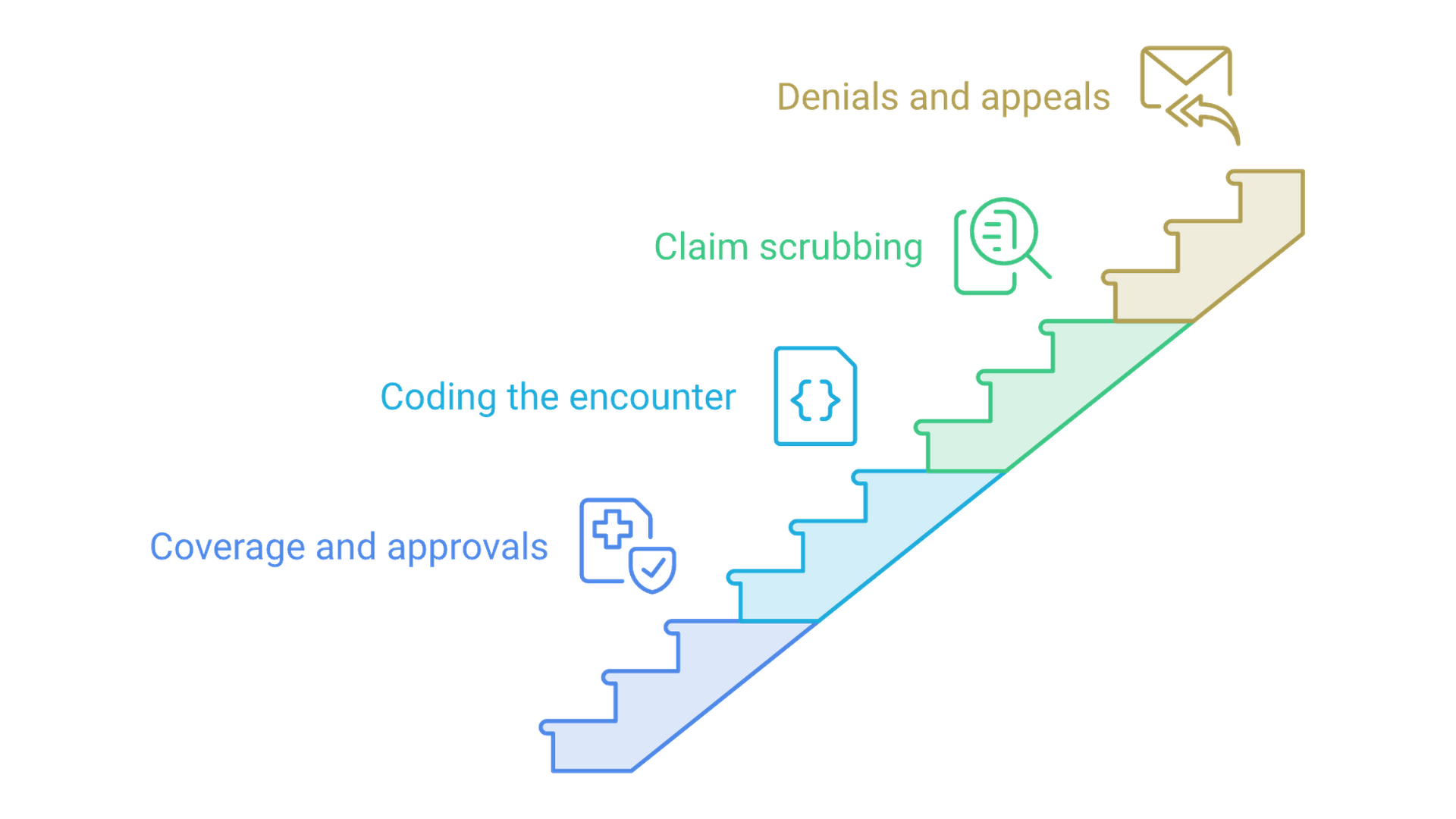
Eligibility and benefits verification
Front-end checks confirm that coverage is active, identify the right payer and plan, and surface copays, deductibles and authorization needs before the visit. Automation here mostly runs standard electronic eligibility transactions and portal lookups at scale, then flags mismatches such as a terminated policy or a missing secondary payer for a registrar to fix.
Prior authorization
Prior authorization is among the most manual steps for many practices. AI tools read the order and the clinical notes, compare them with the payer's documentation requirements, assemble the supporting evidence and track the request. Language models can draft the medical necessity summary, but a clinician or trained staff member should confirm that every statement is supported by the chart before it is sent.
Coding and clinical documentation
NLP and language models suggest diagnosis and procedure codes from the encounter documentation and point out gaps, such as a missing laterality or an unsupported level of service, while the note can still be corrected. The coder accepts, edits or rejects each suggestion, which guards against both undercoding and unsupported codes.
Claim scrubbing and submission
Before submission, rules engines and models check each claim against payer edits, modifier rules and the patterns of past denials for that payer. Claims with a high predicted risk go to a work queue instead of out the door. The baseline, first-pass acceptance by payer, already sits in clearinghouse data, so change is easy to measure.
Denials and appeals
After adjudication, models group denials by reason code and payer, route them to the right team and rank them by recoverable value and deadline. Language models draft appeal letters that cite the claim, the chart and the payer's own policy. The team still decides which denials to appeal and signs what goes out. Teams building these flows often combine bots, models and review queues, which is the kind of AI process automation that connects existing billing systems rather than replacing them.
Patient estimates and payments
On the patient side, AI produces cost estimates from benefits and contracted rates, answers billing questions through chat or voice, and suggests payment plans. Because these tools speak to consumers, wording, accuracy and a path to a person matter as much as collections.
What the Evidence Shows About AI and the Revenue Cycle in 2026
Independent data on adoption and on payer behavior has improved this year, while rigorous, independent measurement of AI's financial results in RCM is still thin and mostly case-level.
Adoption is real but uneven. The 2025 CAQH Index, released on February 19, 2026, reported that more than half of health plans and about a quarter of provider organizations use AI tools in administrative workflows. The same report estimated that electronic transactions and better data exchange avoided about $258 billion in administrative costs in 2024, and that a further $21 billion could be saved by fully automating manual and partially manual transactions. Payers are adopting AI faster than the providers who bill them.
The burden on the provider side has not eased. The American Medical Association's 2025 prior authorization survey of 1,000 physicians, released on May 13, 2026, found an average of 40 prior authorizations and 13 hours of physician and staff time per week, with 32% saying requests are often or always denied. Six in ten physicians in that survey expressed concern that AI may further increase denial rates.
Denials are frequent and rarely contested. KFF's analysis of HealthCare.gov plans, published on March 24, 2026, found that insurers denied 19% of in-network claims in 2024 and that fewer than 1% of denied claims were appealed. Administrative reasons accounted for 25% of denial reasons, and lack of prior authorization or referral for 9%. Those categories are precisely where front-end automation and better appeal triage apply.
Published results from individual providers exist but are best read as case reports. The American Hospital Association's Center for Health Innovation has relayed an October 2023 HFMA report on a Fresno, California community health network that used AI to flag claims likely to be denied and reported a 22% decrease in commercial prior authorization denials and an 18% decrease in denials for services not covered. Such results depend on payer mix, starting denial rate and workflow, so they are not a forecast for anyone else.
The Payer Rules and HIPAA Requirements That Shape RCM Automation
Since 2026, federal rules require Medicare Advantage, Medicaid, CHIP and federal-exchange plans to answer faster, give specific denial reasons and post public metrics, which changes RCM AI inputs.
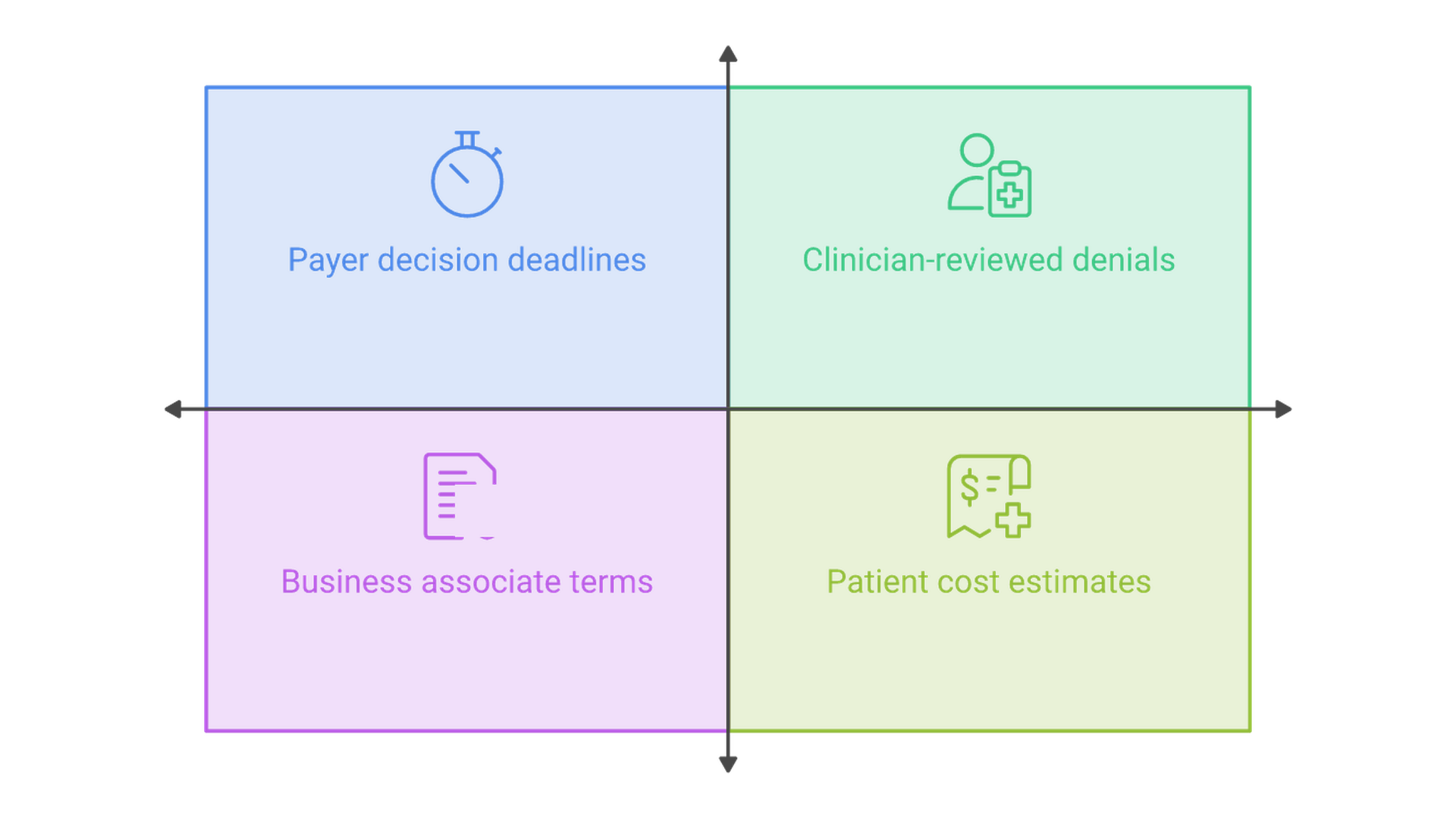
Prior authorization deadlines, denial reasons and public metrics
Under the CMS Interoperability and Prior Authorization Final Rule (CMS-0057-F), finalized January 17, 2024, Medicare Advantage organizations, Medicaid and CHIP programs and their managed care plans must decide prior authorization requests within 72 hours for expedited requests and seven calendar days for standard requests, starting January 1, 2026. Qualified Health Plan issuers on the Federally-facilitated Exchanges are excluded from those timeframes. From 2026, impacted payers must also give a specific reason when they deny a prior authorization, drugs excluded, and post prior authorization metrics on their websites each year, with the first set due by March 31, 2026. A Prior Authorization API, listing covered items and documentation requirements and supporting requests and responses, is required from January 1, 2027.
The first public metrics are already useful. KFF's August 13, 2026 analysis of the 2025 data found that 12% of standard requests were denied in Medicare Advantage, 14% in Medicaid managed care and 18% in Marketplace plans on the federal exchange, while 67%, 47% and 43% of appealed standard denials were overturned, respectively. KFF noted that insurers reported percentages without counts or service detail. For an RCM team, payer-level denial and overturn rates are a ready input for deciding where an appeal is worth drafting.
How payers may use algorithms
Payers are using AI too, and the public commitments around it keep a clinician in the decision. In traditional Medicare, the CMS Innovation Center's WISeR model, running from January 1, 2026 through December 31, 2031 in New Jersey, Ohio, Oklahoma, Texas, Arizona and Washington, has technology companies use AI and machine learning with human clinical review to assess medical necessity for selected services, such as skin substitutes and knee arthroscopy for osteoarthritis. CMS states that "all recommendations for non-payment are determined by appropriately licensed clinicians." In commercial coverage, the AMA's May 2026 release describes a June 2025 pledge by roughly 60 insurers that includes having medical necessity denials reviewed by a licensed clinician. Providers should document each case so that the human reviewer on the other side can follow it.
HIPAA and patient cost estimates
Under the HIPAA definition at 45 CFR 160.103, a vendor that performs claims processing, billing or practice management on a covered entity's behalf with protected health information is a business associate, so an AI vendor in the revenue cycle needs a business associate agreement and the safeguards the HIPAA rules require of business associates. That covers where prompts, logs and training data live; the trade-offs are covered in our guide on using an LLM with private data. For uninsured and self-pay patients, the No Surprises Act requires a good faith estimate of expected charges, and CMS's provider page, updated August 26, 2026, describes a dispute process when a bill exceeds the estimate by at least $400. An AI tool that drafts good faith estimates for these patients therefore has to meet those rules.
How a Provider Group or Billing Company Evaluates AI for RCM
A sound evaluation starts from the organization's own remittance and denial data, picks one bounded workflow and defines who reviews what before any vendor demo or build estimate.
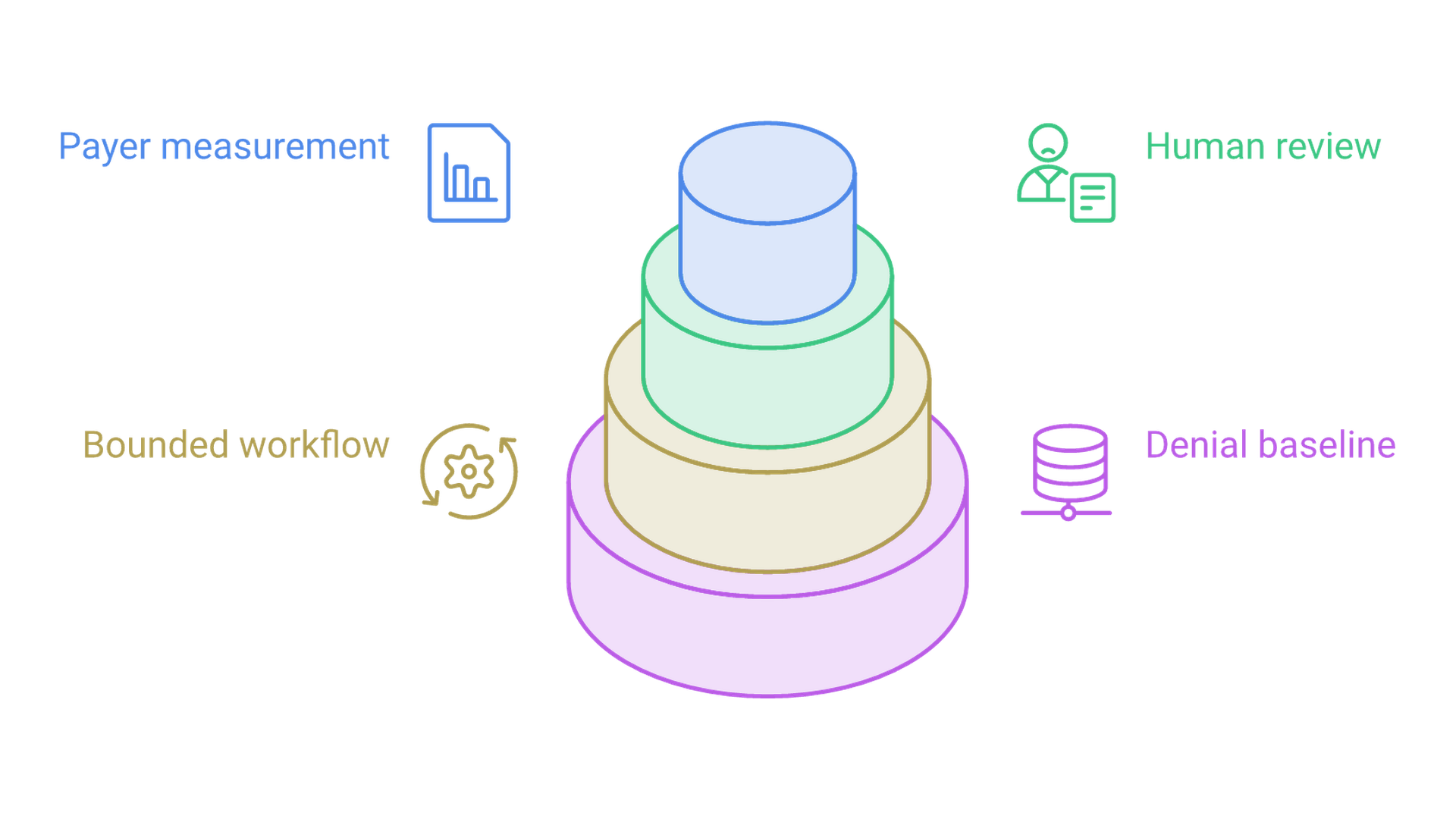
Build the baseline from your own data. Pull at least several months of remittances and group denials by payer, claim adjustment reason code and the step where the error originated. This shows where errors start and gives a before figure no vendor can redefine later.
Pick one workflow and one payer group. Eligibility rework, authorization tracking for a high-volume service line or appeal drafting for one denial category are typical first scopes. A narrow scope keeps accuracy measurable and review load manageable.
Decide the human checkpoints in advance. Write down which outputs a person approves before they leave the building (codes, medical necessity statements, appeals, patient messages) and which can run unattended (status checks, data entry, routing). Set a confidence threshold below which items go to a queue, and log who approved each item.
Control access as tightly as you would for a new employee. Agents and bots often need portal credentials, clearinghouse access and read rights in the EHR. Give each one its own identity, the narrowest permissions the task needs and an owner who reviews its activity; the patterns in AI agent permissions and least privilege apply directly to revenue cycle bots.
Ask vendors evidence questions. Which payers and specialties were the models validated on, how is accuracy reported by payer, how do policy changes reach the rules, will the vendor sign a business associate agreement, where are data and logs kept, and does customer data train shared models? Treat any headline percentage without a stated baseline as unverified.
Measure the way you built the baseline. Track first-pass acceptance, denial rate by category, days in accounts receivable, appeal overturn rate and staff hours, by payer, and expand only when the first workflow holds up for several cycles.
Mistakes That Turn Revenue Cycle Automation Into Rework
When RCM automation disappoints, the cause is often the workflow around the model: a process nobody redesigned, nobody owned or nobody monitored after the pilot ended.
The first mistake is automating a broken process: a bot that submits claims faster also submits registration errors faster, so fixing intake usually comes before any prediction model. The second is a denial model trained on someone else's payer mix. Payer behavior differs by region, plan and service line, so a model not checked against your own remittances may rank the wrong claims.
The third is unreviewed generated text. A language model can write a fluent appeal that cites a policy section that does not exist or overstates the chart. The fourth is coding automation that drifts toward levels of service the documentation does not support; audits of accepted suggestions catch it.
The fifth is treating bots as set-and-forget. Portals and policies change, and a script that fails silently can leave a queue untouched for days, so each workflow needs an owner, failure alerts and a manual fallback. The last is ignoring the patient: estimate and payment tools with unclear wording, or no way to reach a person, create disputes that cost more than they collect.
FAQs About AI in Revenue Cycle Management
These questions come up when revenue cycle leaders, practice managers and billing teams first consider AI for billing, coding, authorizations and denial work, and the body does not answer them.
Will AI replace medical coders and billers?
Current tools change the work more than they remove it. Coders and billers spend less time on lookups and data entry and more on reviewing suggestions, exceptions, audits and complex denials, with experienced staff still in charge of what is submitted.
What is the difference between RPA and AI in revenue cycle management?
RPA repeats fixed screen steps; AI handles inputs that vary. Many revenue cycle systems use both, with RPA moving data and AI making suggestions.
What is agentic AI in revenue cycle management?
Agentic AI plans and carries out several steps toward a goal instead of one task. From January 1, 2027, the Prior Authorization API that CMS-0057-F requires of impacted payers gives such tools a standard electronic route for requests and responses, so the remaining design work is permissions, logging and who approves each submission.
Is AI medical coding accurate enough to bill without review?
Accuracy varies by specialty, documentation quality and code set, and vendors measure it in different ways. A safe practice is to keep a coder in the loop for every suggestion, or at least for complex encounters, and to audit samples of accepted codes, because the provider remains responsible for every claim it submits.
Start With One Payer and One Denial Category
The practical route into AI for the revenue cycle is narrow and measurable: one workflow, one group of payers, a written review rule and a baseline taken from your own remittances.
The 2026 rules help that approach. Medicare Advantage, Medicaid, CHIP and federal-exchange plans now publish prior authorization denial and overturn rates and must explain denials, which gives provider teams better data for deciding where automation and appeals pay off.
If you are weighing where AI belongs in your billing, authorization or denial workflows, or how to connect it to the systems you already run, talk with Cognativ about your revenue cycle workflow.