

AI Knowledge Management: How AI Search, RAG Answers and Content Governance Fit Together
How AI search, cited answers and tagging change knowledge work, why ownership, freshness and permissions decide answer quality, and how to start and measure.
AI knowledge management is the use of language models, semantic search and automated classification to help people find, trust and reuse what an organization already knows. Instead of returning a list of documents, an AI knowledge system can answer a question in plain language and point to the passages it used.
That shift moves the hard problem. Retrieval and generation are now widely available; what decides whether answers are right is the content underneath them: who owns each document, whether it is current, and who is allowed to read it. This guide covers how these systems work, what has to be true of your content first, how to start and measure a program, and the failure modes to plan for.
What AI Knowledge Management Means, and What It Adds to Classic KM
Knowledge management predates AI by decades. What changes with AI is the interface and the workload: people ask questions, and software handles much of the filing, tagging and summarizing work.
Classic knowledge management is a discipline of capturing, organizing and sharing knowledge so the right people can act on it. ISO 30401, the international standard for knowledge management systems first published in October 2018, treats it as a management system with leadership, roles and continual improvement. That framing still holds, and a second edition reached its Draft International Standard ballot in 2026. An AI layer does not replace the discipline; it changes how people reach the knowledge and how much manual curation the program needs.
In practice the AI layer adds four capabilities on top of an existing intranet, wiki, ticketing system or document store:
- Semantic search: matching a query to content by meaning, so "parental leave rules" finds a policy titled "family leave."
- Answers with citations: composing a direct reply from retrieved passages and linking each claim back to its source.
- Summarization: condensing long threads, meeting transcripts and reports into something a reader can act on.
- Classification and tagging: assigning topics, owners, sensitivity labels and metadata as content arrives.
How an AI Knowledge System Answers a Question
Most enterprise systems follow the same pattern, called retrieval-augmented generation: find the relevant passages first, then let a language model write an answer limited to what was found.
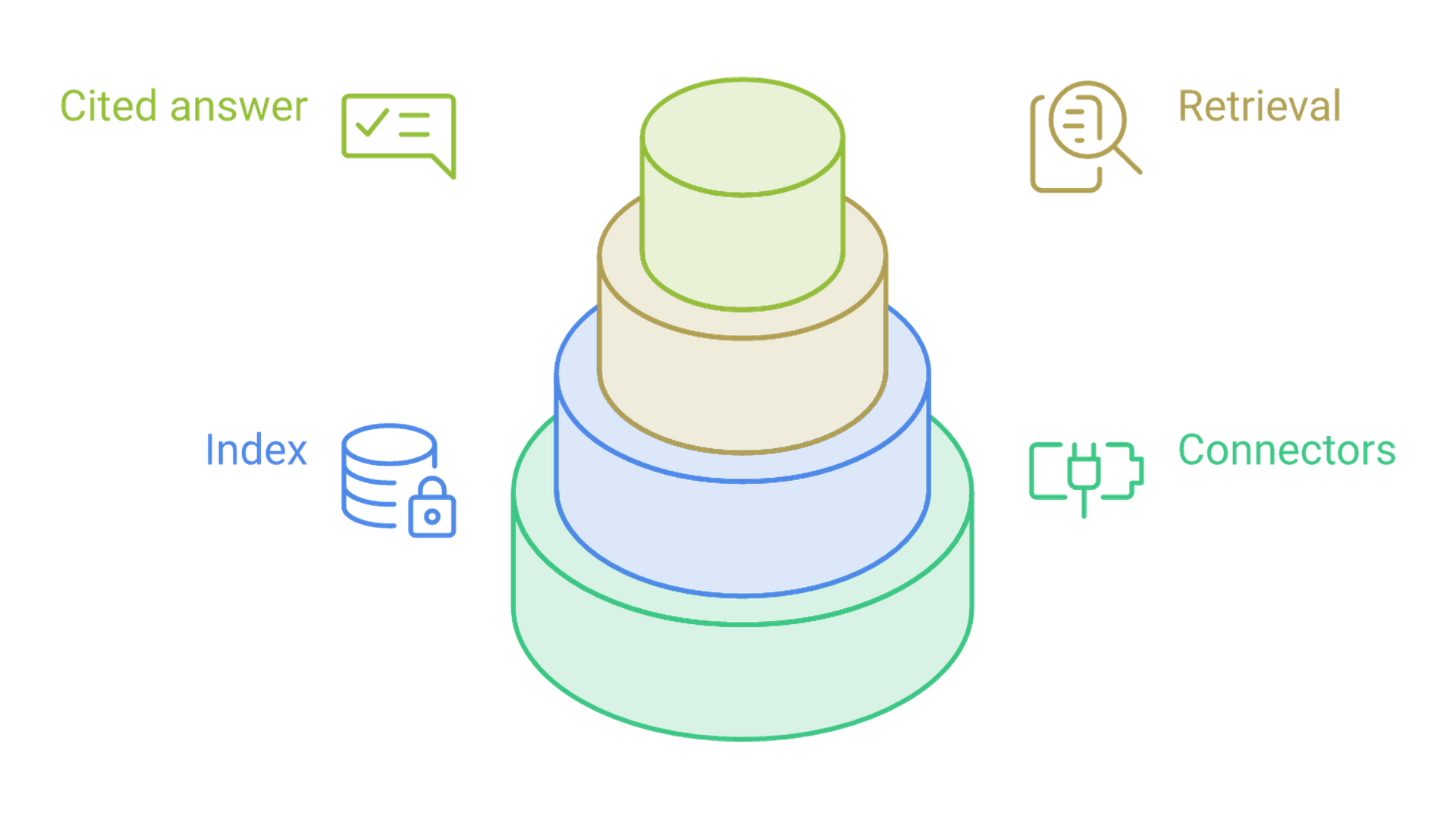
The pattern was formalized in a May 2020 research paper by Patrick Lewis and colleagues, which paired a language model with a searchable index so the system could draw on external text rather than only on what the model memorized during training. The same paper flagged provenance and keeping knowledge current as open problems, and those remain the central engineering concerns for knowledge systems.
Ingestion and enrichment
Connectors pull content from source systems such as SharePoint, Confluence, Google Drive, help desks and file shares. Each document is cleaned, split into passages, tagged with metadata such as owner, date and sensitivity, and copied along with the access permissions it carries in its source system.
Indexing and retrieval
Passages are converted into embeddings, numeric representations of meaning, and stored alongside a keyword index. When a question arrives, the system runs a hybrid search, filters results by what the asking user may see, and reranks the best candidates. A vector database that stores and searches those embeddings is usually the core of this layer, but metadata filters do as much of the work as similarity scores.
Grounded generation
The model receives the question plus the retrieved passages and an instruction to answer only from them, cite each source and say so when the passages do not contain the answer. That last instruction matters: a system that declines to answer is less harmful than one that fills a gap with fluent guesses.
Where AI Changes Day-to-Day Knowledge Work
The value shows up in a few repeatable jobs: answering, searching, summarizing, tagging and spotting gaps. Each job places a specific demand on the content it draws from.
| Job | What AI does | What the content must provide |
|---|---|---|
| Employee and customer questions | Answers from policies, manuals and past tickets, with citations | One approved version per topic and a named owner |
| Search across silos | Finds related material in several systems with one query | Connectors that carry source permissions intact |
| Summarization | Condenses threads, transcripts and long reports | Clear dates so summaries do not mix old and new decisions |
| Tagging and classification | Applies topics, sensitivity labels and owners at ingestion | An agreed taxonomy and label definitions |
| Gap detection | Flags questions that returned no answer or a weak one | A process for someone to write the missing content |
Much enterprise knowledge does not start as clean text. Contracts, scanned forms, slide decks and spreadsheets need extraction before any retrieval works well, and tables are a frequent weak point because splitting them into passages separates values from their headers. This step is worth scoping as a project of its own, using LLM document processing that turns unstructured files into structured, searchable data before the knowledge index is built.
Gap detection is easy to overlook. The questions people ask that the system cannot answer are a ready-made backlog for knowledge owners, and they show where documentation lags behind how the business actually works.
What Has to Be True of Your Content Before AI Reads It
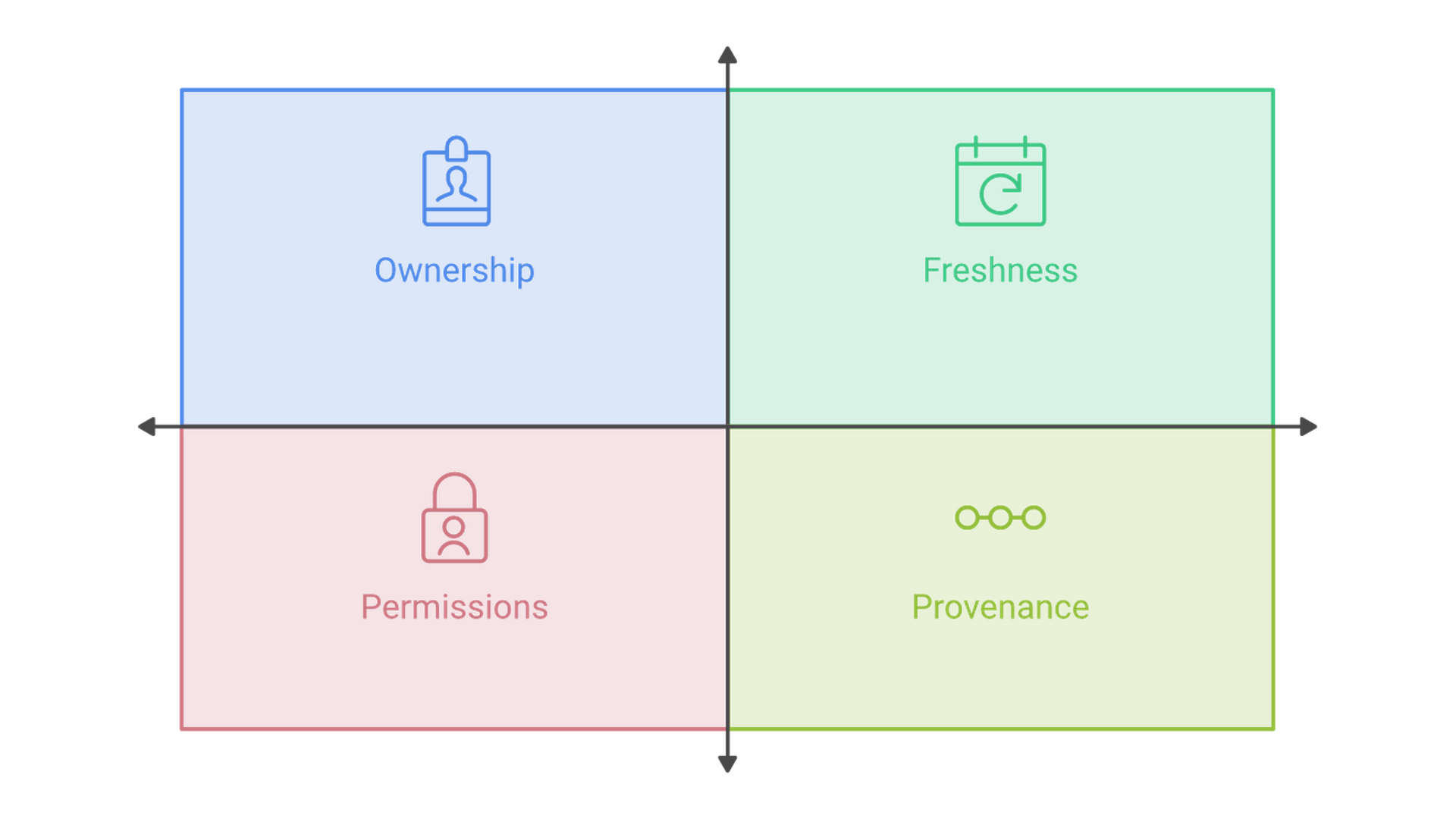
A retrieval system repeats whatever it finds, so content problems that people quietly worked around become visible answer problems. Four properties decide whether answers can be trusted.
Ownership
Every source collection needs a named owner who approves changes and retires outdated material. Without one, the system cannot tell an official policy from a draft someone saved in a shared folder, and neither can the reader looking at a cited answer.
Freshness
Each document should carry an effective date and a review date. Retrieval can then prefer current versions, and stale items can be flagged or excluded. Duplicates matter here too: two versions of the same procedure give the model two conflicting sources and no way to choose.
Permissions
The assistant must answer each user only from content that user is already allowed to open. That sounds automatic, but it depends on permissions being copied correctly at ingestion and kept in sync afterward. The OWASP GenAI Security Project lists vector and embedding weaknesses in its 2025 Top 10 for LLM Applications and recommends permission-aware vector stores with data partitioned by access level.
Provenance
Every passage in the index should trace back to a source document, version and system of record. Provenance is what makes citations possible, lets reviewers check an answer quickly and lets a removed document drop out of answers once the index is refreshed.
None of these four is a model setting. They are decisions about data ownership, classification and lifecycle, which is why a knowledge AI program tends to stall without data governance that assigns owners, labels and retention rules to the sources it reads.
Where AI Knowledge Management Fails
The common failures are predictable, and most trace back to the content and access layers rather than to the model. Knowing them in advance shapes what you test before launch.
Stale or conflicting answers
When an old policy and its replacement both sit in the index, the system may cite either. The answer looks authoritative because it carries a citation, which makes the error harder for a reader to spot than an obvious guess.
Access leaks through oversharing
An assistant that respects permissions still exposes whatever was shared too broadly in the first place. Files opened to "everyone" years ago become findable in seconds once search works by meaning. Permission cleanup can easily become the first real workload of a rollout.
Hallucinated answers despite retrieval
Grounding reduces fabrication but does not remove it. A Stanford study of legal research tools built on retrieval, first released in May 2024, found that the LexisNexis and Thomson Reuters tools it tested still hallucinated between 17% and 33% of the time. NIST's Generative AI Profile (NIST AI 600-1), published in July 2024, names confabulation as a core generative AI risk for the same reason. The causes and mitigations are covered in more depth in our guide to why large language models hallucinate and how to reduce it.
Poisoned or injected content
Anything the system ingests can carry instructions aimed at the model, such as hidden text in a document or a ticket written to redirect an assistant. NIST's profile lists information security among the same risks, and OWASP ranks prompt injection first in its 2025 Top 10 for LLM Applications. Accepting content only from trusted sources, logging retrievals and keeping assistants read-only by default limit the damage.
How to Start an AI Knowledge Program and Measure It
Pick one audience, one set of sources and one set of questions, prove the answers are correct against real questions, and only then widen what the system covers.
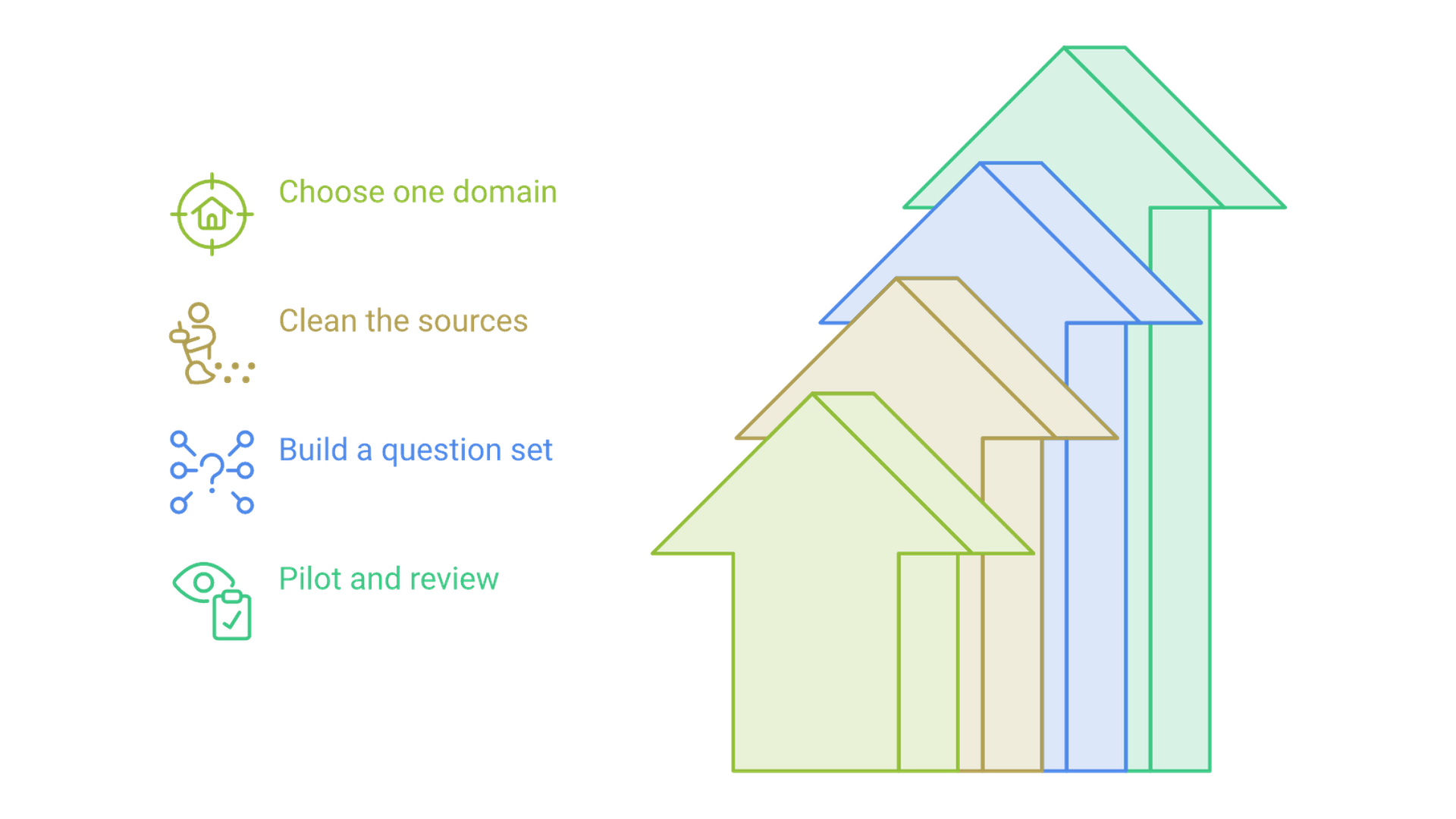
A workable sequence has four stages:
- Choose one domain: a support knowledge base, an HR policy library or an engineering runbook collection, with a known audience and an owner willing to fix content.
- Clean the sources: remove duplicates, add owners and dates, and review who can open what before anything is indexed.
- Build a question set: collect real questions from tickets, chat logs and search logs, and write the expected answer and source for each.
- Pilot and review: run the question set before launch and after every change to sources, prompts or models, and review failures with the content owner.
Measure the system on outcomes people can check:
- Retrieval quality: whether the right source appears among the passages handed to the model.
- Answer faithfulness: whether every claim in the answer is supported by a cited passage.
- Correct refusals: whether the system says it does not know when the sources do not cover a question.
- Permission tests: whether users with different roles get different answers where they should.
- Content health: the share of indexed documents with an owner and a review date that has not lapsed.
Usage numbers still matter for adoption, but a heavily used assistant that cites outdated policies is a liability. Track the quality measures first and the volume measures second.
AI Knowledge Management in 2026: From Answers to Agents
Two shifts define the current state: assistants are becoming agents that act on knowledge, and vendors now treat permission cleanup as a prerequisite for deployment.
On the connection side, the Model Context Protocol, an open standard for linking AI applications to tools and data sources, moved to the Linux Foundation's new Agentic AI Foundation in December 2025. The foundation's announcement cited more than 10,000 published MCP servers and adoption in Claude, ChatGPT, Gemini, Microsoft Copilot, Cursor and VS Code. For knowledge teams, this means agents can now reach many repositories through a common interface, which raises the stakes on the permissions those repositories carry.
On the governance side, Microsoft's deployment blueprint for Copilot, updated in November 2026, describes Copilot as grounding responses in data users already have permission to access and organizes deployment around three pillars: remediate oversharing, set up guardrails and meet regulations. Microsoft leads that guidance with content and access work, not with model features.
As assistants gain these connections, the work extends from answering questions to drafting documents, filing tickets and updating records.
FAQs About AI Knowledge Management
These questions come up often when teams compare AI knowledge tools with the wikis, intranets and help centers they already run, and each answer stays short and practical.
What is the difference between a knowledge base and an AI knowledge management system?
A knowledge base is the collection of articles, policies and documents. An AI knowledge management system is the layer that indexes that collection, answers questions from it, and helps maintain it through tagging and gap reports. Most organizations add the AI layer to an existing knowledge base rather than replacing it.
Can ChatGPT or another general chatbot be used for knowledge management?
Only when it is connected to your own sources with permissions enforced. A general chatbot answering from its training data does not know your policies and cannot cite them. Business editions of these tools offer connectors to company repositories, and those connectors are where governance work applies.
Is RAG the same thing as AI knowledge management?
No. Retrieval-augmented generation is one technique inside an AI knowledge system, the part that turns retrieved passages into an answer. Knowledge management also covers ownership, review cycles, taxonomy, access policy and measurement, none of which RAG provides by itself.
Will AI replace knowledge managers?
It shifts their work rather than removing it. Less time goes to manual filing and tagging, and more goes to deciding which sources are authoritative, reviewing failed answers, closing content gaps and setting access rules. Those decisions require judgment about the business that a model does not have.
How long does it take to see value from AI knowledge management?
It depends mostly on the state of the content. A single, well-maintained collection with clear owners can support a pilot quickly, while scattered sources with unclear permissions need cleanup first. Timelines quoted without looking at the sources are guesses.
Decide Who Owns the Knowledge Layer Before Choosing a Tool
The tool decision is easier once ownership is settled: who approves sources, who reviews failed answers, and who signs off on access before a new repository is connected.
Most AI knowledge platforms can search, answer and summarize. What separates a trusted system from an abandoned one is whether someone is accountable for the content it reads and whether answers are tested against real questions before and after each change. When you compare vendors, ask how each one carries source permissions, shows citations and reports unanswered questions.
If you are planning an AI knowledge system and want help scoping the sources, permissions and evaluation plan, talk to the Cognativ team about your knowledge management project.