


AI Hallucinations: What They Are, Why LLMs Hallucinate and How to Reduce Them
LLMs still invent cases, citations and code packages. See the research on why models guess instead of abstaining and the controls that cut hallucinations.
AI hallucinations are outputs from a large language model (LLM) or other generative AI system that are false, fabricated or unsupported, yet delivered with the same fluency and confidence as correct answers. A chatbot that invents a court case, a research assistant that cites a paper nobody wrote, or a coding assistant that recommends a software package that does not exist are all hallucinating.
The term is borrowed loosely from psychology. A model does not perceive anything, so it cannot misperceive. What it does is generate the most plausible continuation of text, and plausibility is not the same as truth. That gap is why hallucinations persist in even the most capable models released through 2026, and why anyone using AI for research, customer service, legal work, software or decision support needs to understand them.
What this guide covers: a clear definition and the main types of AI hallucination, documented real-world examples and their consequences, the technical reasons LLMs hallucinate (including recent research on how training and benchmarks reward guessing), the implications for users and organizations, and practical ways to reduce and detect hallucinations, from better prompts to grounded system design.
What Are AI Hallucinations?
An AI hallucination is any generated statement that is not supported by reality, by the source material the model was given, or by the conversation so far, presented as if it were. The defining feature is not simply that the model is wrong. Every system makes mistakes. The problem is that a hallucinated answer looks exactly like a correct one: it is grammatical, specific, confident and often internally consistent, so the error is hard to spot without independent verification.
Hallucinations show up across modalities. Text models fabricate citations, quotes, statistics, biographies and API parameters. Image generators produce anatomically impossible hands or garbled signage. Speech-to-text systems can insert words that were never spoken. The mechanics differ, but the pattern is the same: the model fills a gap with something that fits the learned pattern rather than something that is verified.
Intrinsic and Extrinsic Hallucinations
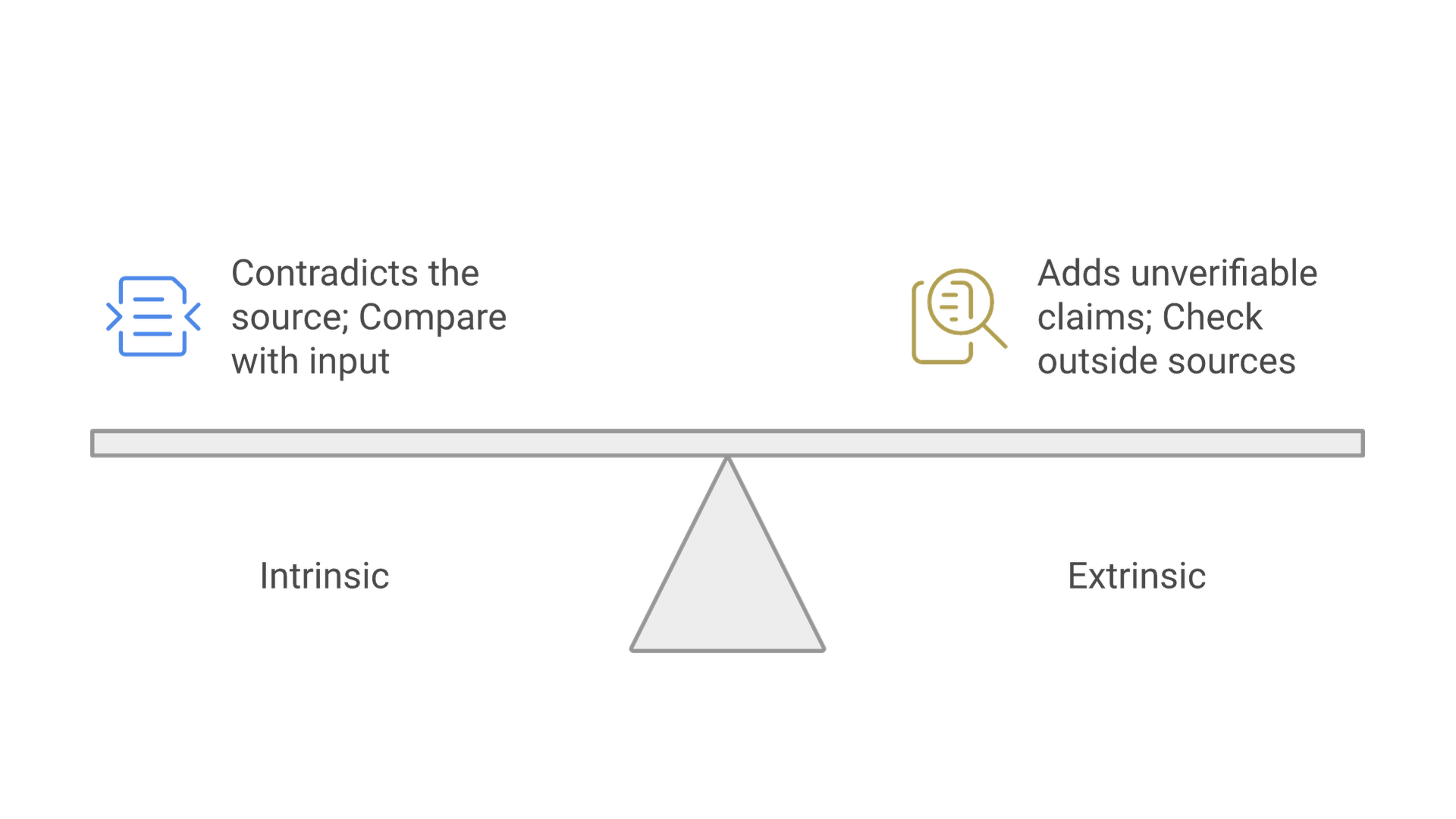
Researchers commonly split hallucinations into two categories, a taxonomy popularized by the Survey of Hallucination in Natural Language Generation by Ji and colleagues. Intrinsic hallucinations contradict the source the model was given. If you paste a contract into a chatbot and its summary states a termination date that differs from the document, that is intrinsic, and you can catch it by comparing the output with the input.
Extrinsic hallucinations add information that cannot be verified from the source at all: a fabricated study, an invented historical event, a made-up statistic. These are more dangerous because nothing in the conversation reveals them. You need an outside reference to discover that the claim is false.
Hallucination, Confabulation or Just an Error?
Some standards bodies avoid the word hallucination. The US National Institute of Standards and Technology lists "confabulation" as one of twelve risks in its Generative AI Profile (NIST AI 600-1), published July 26, 2024, and describes it as the production of confidently stated but erroneous or false content, colloquially known as hallucination. Whatever the label, the practical definition is the same: confident output that the evidence does not support. In this article the terms are used interchangeably.
Real-World AI Hallucination Examples and Their Consequences
Hallucinations stopped being a curiosity once generative AI moved into regulated and customer-facing work. A few documented cases show the range of consequences.
Fabricated Legal Citations
The case that made AI hallucinations front-page news was Mata v. Avianca in the US District Court for the Southern District of New York. On June 22, 2023, Judge P. Kevin Castel sanctioned two attorneys and their law firm after a brief cited judicial opinions that did not exist; the lawyers had used ChatGPT for research and did not verify the output, as Legal Futures reported. The problem did not fade with awareness. The AI Hallucination Cases database maintained by researcher Damien Charlotin listed more than 2,200 court and tribunal decisions involving hallucinated or AI-fabricated content as of October 31, 2026.
A Chatbot That Invented a Refund Policy
In Moffatt v. Air Canada, decided February 14, 2024, British Columbia's Civil Resolution Tribunal held the airline responsible after its website chatbot gave a customer wrong information about bereavement fares, according to CTV News. The tribunal rejected the idea that the company was not accountable for what its chatbot said. The amount was small; the precedent was not. An organization that deploys an assistant owns its answers.
Hallucinated Software Packages
Code assistants hallucinate too, and the results can become a security problem. A study presented at USENIX Security 2025 generated 576,000 code samples with 16 popular code LLMs and found that, on average, at least 5.2% of recommended packages from commercial models and 21.7% from open-source models did not exist, with 205,474 unique hallucinated package names. Attackers can register those names and wait for developers to install them, a tactic now widely called slopsquatting.
| Case | Date | What was hallucinated | Consequence |
|---|---|---|---|
| Mata v. Avianca (S.D.N.Y.) | June 2023 | Nonexistent court opinions in a legal brief | Sanctions against two attorneys and their firm |
| Moffatt v. Air Canada (BC CRT) | February 2024 | Incorrect bereavement fare policy from a chatbot | Airline held responsible for its chatbot's answer |
| Package hallucination study (USENIX Security) | August 2025 | Software packages that do not exist | Supply-chain attack surface for developers |
| AI Hallucination Cases database | Through October 2026 | Fabricated citations and quotes in filings | More than 2,200 court and tribunal decisions logged |
Why Do LLMs Hallucinate?
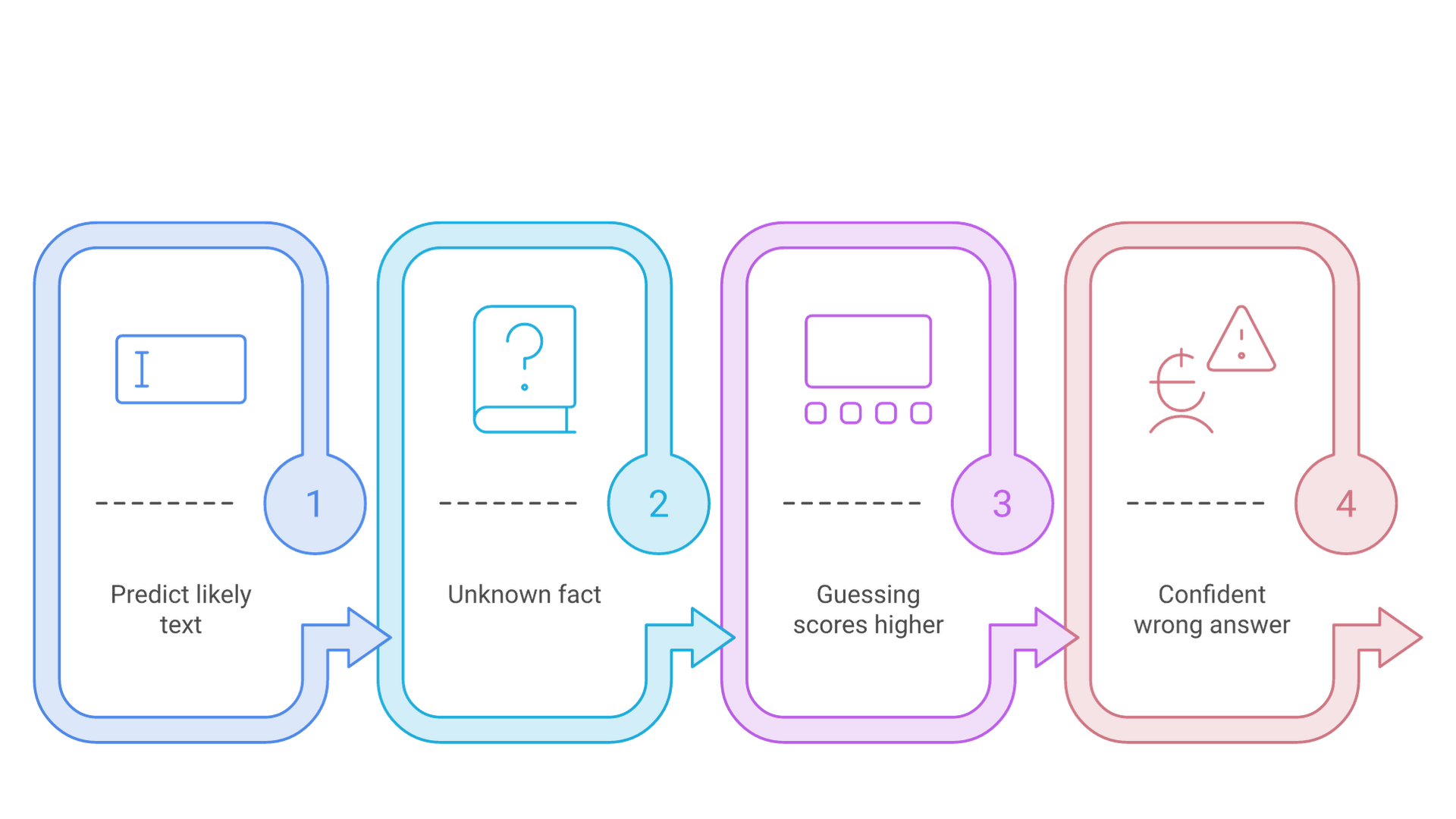
Why do LLMs hallucinate even as they get better at reasoning, coding and math? The short answer is that they are trained to produce likely text, then evaluated in ways that reward a confident guess over an honest "I don't know." Several causes stack on top of each other.
Next-Token Prediction Has No Built-In Truth Check
During pretraining, a language model learns to predict the next token in enormous amounts of text. It is never shown which statements are true and which are false; it only learns which continuations are statistically likely. Consistent patterns such as spelling, grammar and common facts are learned well. Arbitrary, low-frequency facts, like a specific person's birthday or the exact title of an obscure paper, cannot be inferred from patterns, so the model produces something that looks right in shape but is wrong in substance.
Training and Benchmarks Reward Guessing
The most influential recent explanation comes from OpenAI researchers Adam Tauman Kalai, Ofir Nachum, Santosh Vempala and Edwin Zhang. Their paper Why Language Models Hallucinate, released September 4, 2025, argues that hallucinations arise from ordinary statistical pressure in pretraining and are then reinforced because most benchmarks score answers as simply right or wrong. Under that scoring, abstaining earns zero while a guess sometimes earns credit, so models optimized to top leaderboards learn to be good test-takers who bluff. The authors propose changing mainstream evaluations to penalize confident errors more than expressions of uncertainty, rather than adding a few separate hallucination tests.
Data Gaps, Stale Knowledge and Noisy Sources
A model's knowledge is frozen at its training cutoff and limited by what its data covered. Questions about recent events, niche domains, internal company information or anything after the cutoff push the model beyond what it knows. If the training data contained errors, outdated facts or contradictions, the model can reproduce them fluently. Without retrieval or tools, it has no way to look anything up.
Decoding Settings and Context Limits
How text is sampled matters too. Higher sampling randomness makes outputs more varied and more likely to drift from the most supported answer; our guide to LLM temperature explains that trade-off. Long or cluttered contexts can also cause a model to miss or blend details, which produces intrinsic hallucinations in summaries and document question answering.
Implications of AI Hallucinations for Users and Businesses
For an individual user, a hallucination is an inconvenience until it is acted on. For an organization, it can become a legal, financial, security or reputational event. The cases above point to four practical implications.
Accountability does not transfer to the model. Courts and tribunals have consistently treated the person or company that relies on or publishes AI output as responsible for it. Professional duties to verify, and consumer protection obligations, apply whether a human or a chatbot wrote the text.
Confidence is not a signal of accuracy. Users tend to trust fluent, specific answers. Because hallucinated content carries the same tone as correct content, interfaces that show sources, flag uncertainty and make verification easy matter as much as the underlying model.
Hallucinations can become attack surface. Fabricated package names, URLs or API endpoints can be exploited by third parties. Any workflow where AI output is executed, installed or linked without review needs controls, not just good intentions.
Verification has a cost that belongs in the business case. The time spent checking AI output is real. Teams that assign clear ownership of review, decide which tasks need human sign-off and document those rules get more value than teams that either trust everything or check nothing. That is a governance question as much as a technical one, and an AI governance program is where those rules should live.
How to Reduce AI Hallucinations
No technique eliminates hallucinations, and the OpenAI researchers note that accuracy can never reach 100% because some questions are genuinely unanswerable. But the frequency and impact of hallucinations can be reduced substantially by combining better prompts, grounding and system design.
Prompting Techniques That Lower the Risk
Prompting is the cheapest lever. Anthropic's guide to reducing hallucinations recommends explicitly allowing the model to say it does not know, asking it to extract direct quotes from long documents before analyzing them, requiring a citation for each claim and retracting any claim it cannot support, and restricting answers to the documents provided. The guide also stresses that these methods reduce hallucinations without eliminating them. For broader patterns such as clear instructions, examples and structured output, see our prompt engineering best practices.
- State the task, the audience and what the model should do when information is missing.
- Provide the source material instead of asking the model to recall it.
- Ask for answers that separate quoted evidence from interpretation.
- Request a short list of claims that need human verification.
- Keep temperature low for factual tasks.
Ground the Model in Trusted Data
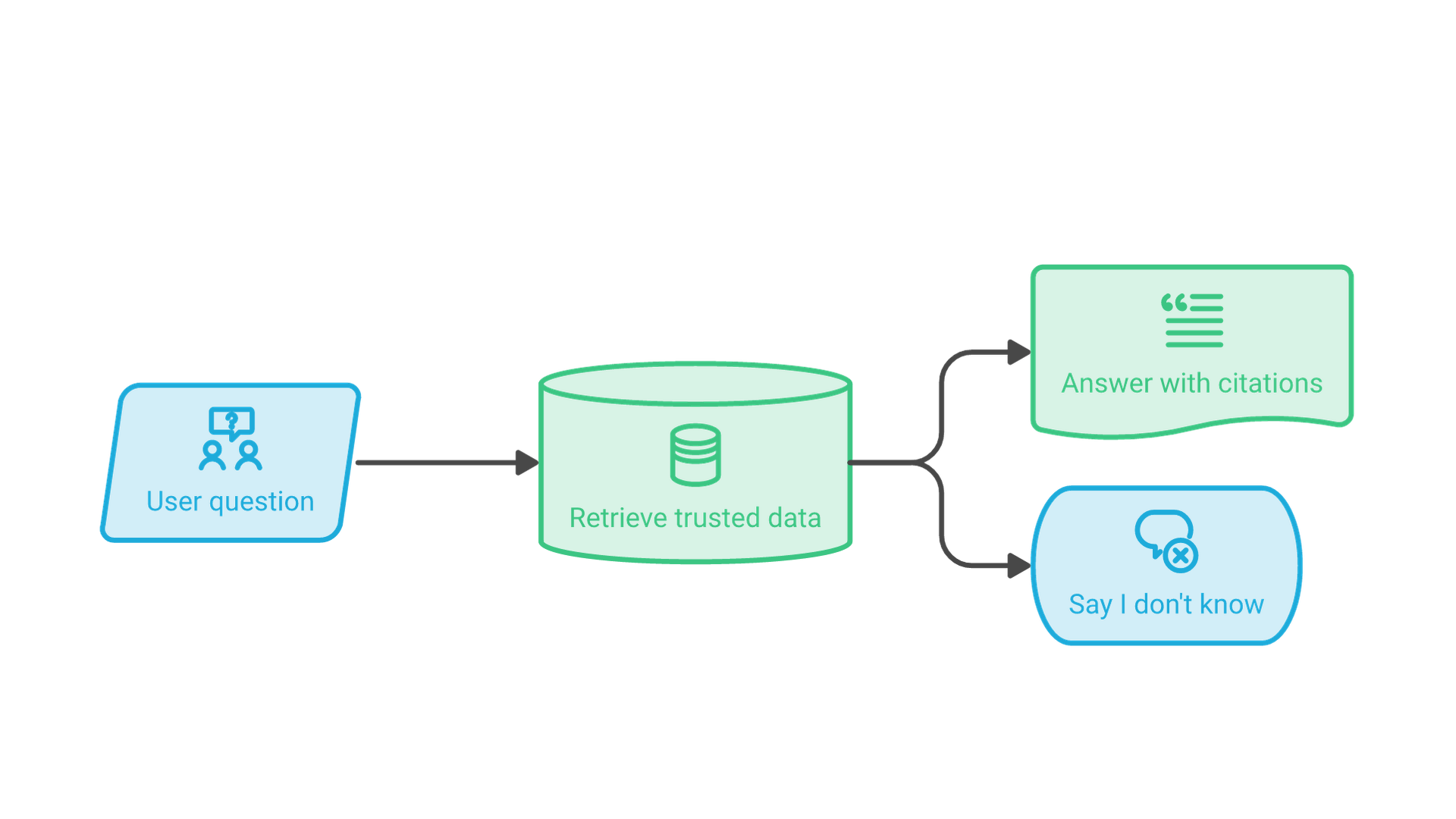
Retrieval-augmented generation (RAG), introduced by Lewis and colleagues in 2020, retrieves relevant passages from a trusted knowledge base and gives them to the model at answer time. Grounding turns many extrinsic hallucinations into checkable claims, because each answer can point to the passage that supports it. It works best when the retrieval index is current, permissioned and curated; our guide on using an LLM with private data covers the architecture choices. RAG does not make a model infallible: it can still misread a passage, combine sources incorrectly or answer when retrieval returns nothing relevant.
Design the System, Not Just the Prompt
Production reliability comes from architecture. Useful patterns include tool calls for facts that change (prices, inventory, account data), structured outputs validated against schemas, allow-lists for packages, links and actions, refusal paths when retrieval confidence is low, and human approval for high-stakes steps. Choosing models with strong abstention behavior and evaluating them on your own data matters more than headline benchmark scores. Teams building these systems often treat hallucination control as part of the core LLM solution design rather than an afterthought.
How to Detect and Measure AI Hallucinations
Reduction needs measurement. Without a way to detect hallucinations, you cannot tell whether a prompt change, a new model or a retrieval tweak actually helped.
Consistency and Uncertainty Checks
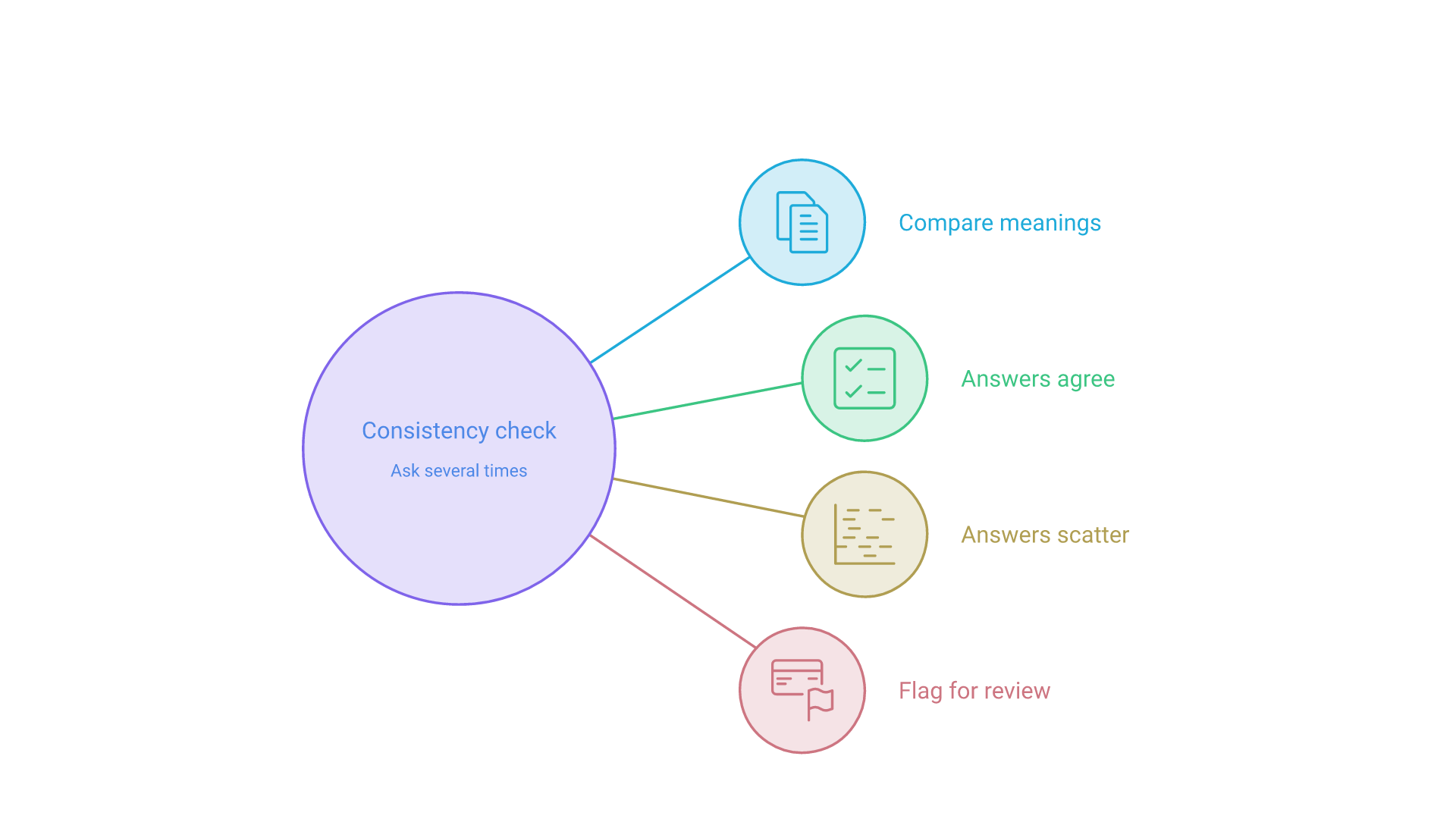
One family of methods asks the same question several times and compares the answers. A model that knows a fact tends to give the same meaning each time; a model that is guessing tends to vary. Research published in Nature in June 2024 by Farquhar, Kossen, Kuhn and Gal formalized this as semantic entropy, which measures uncertainty over meanings rather than exact wording and outperformed earlier methods at flagging likely confabulations. The authors note its limits: it adds compute cost, and it cannot catch errors the model makes consistently.
Source and Citation Verification
For grounded systems, check that every cited passage exists and actually supports the claim attached to it. This can be automated in part, with a second model or a rules-based checker comparing claims to retrieved text, and escalated to a human when support is missing. For code, verify that every dependency exists in the official registry before installation.
Evaluations That Reward Honesty
Build a test set from your own domain, including questions that have no answer in your data. Score abstentions separately from errors, and penalize confident mistakes more heavily, in line with the scoring change the 2025 OpenAI paper recommends. Track the error rate, the abstention rate and the share of answers with valid citations over time, and rerun the suite whenever the model, prompt or index changes.
Frequently Asked Questions
What are AI hallucinations?
AI hallucinations are false, fabricated or unsupported outputs from a generative AI system that are presented confidently, such as invented citations, wrong facts or nonexistent software packages.
Why do LLMs hallucinate?
LLMs are trained to predict likely text, not to verify truth, and most training and evaluation reward a confident guess over admitting uncertainty. Knowledge gaps, outdated data and sampling settings add to the problem.
Can AI hallucinations be eliminated completely?
No. They can be reduced substantially through grounding, better prompts, abstention and verification, but some questions are unanswerable and no current method guarantees zero errors.
How do you reduce AI hallucinations?
Give the model trusted source material, allow it to say it does not know, require citations for claims, keep randomness low for factual tasks, validate outputs and keep humans in the loop for high-stakes decisions.
What is an example of an AI hallucination?
In Mata v. Avianca in 2023, lawyers submitted a brief citing court opinions that ChatGPT had fabricated. A judge sanctioned the attorneys and their firm.
Does RAG stop hallucinations?
Retrieval-augmented generation reduces hallucinations by grounding answers in retrieved documents, but the model can still misread sources or answer when retrieval finds nothing relevant, so citation checks remain necessary.
Conclusion: Living With AI Hallucinations
AI hallucinations are a structural feature of how today's language models are trained and evaluated, not a rare glitch. Models learn to produce plausible text and are rewarded for answering, so they will sometimes answer confidently when they should not. The consequences are now well documented, from sanctioned lawyers and a liable airline to fabricated software packages that attackers can exploit.
The response is practical rather than fatalistic. Ground models in trusted data, let them abstain, require evidence for claims, measure hallucinations on your own questions and assign clear human ownership for decisions that matter. Treat AI output as a draft to be verified, and design systems so that verification is easy.
If you are planning an AI assistant, a RAG system or an evaluation program and want hallucination controls built in from the start, talk to Cognativ about your AI project.