
What Are the Best Enterprise Edge Platforms for Running AI/ML Inference Models?
No single edge AI platform wins everywhere. See how NVIDIA, AWS, Microsoft, Google, Red Hat and Intel stacks differ, what changed in 2026 and how to pick one.
Enterprises increasingly run AI and machine learning inference outside the public cloud: on factory floors, in stores, in hospitals and in sovereign data centers. Real-time decisions cannot wait for a cloud round trip, regulated data often has to stay on site, and shipping every camera frame upstream is expensive. The harder question is which platform should run those models once they leave the lab.
An enterprise edge platform is not a single chip or a single cloud service. It is the software and management stack that lets you provision edge hardware, deploy containerized models, push updates over the air, secure devices and keep thousands of sites consistent. In 2026 the main options come from NVIDIA, AWS, Microsoft, Google, Red Hat and Intel, and they solve different problems. This guide compares them using each vendor's own documentation and gives you selection criteria instead of an arbitrary ranking.
Short answer: there is no single best enterprise edge platform. The best fit depends on where your cloud and MLOps tooling already live, what class of hardware sits at your edge sites, how often those sites lose connectivity, and how long you need vendor support. GPU-heavy vision and robotics fleets tend to point toward the NVIDIA stack; AWS- or Azure-centric organizations usually start with those vendors' edge runtimes and on-premises extensions; sovereign or air-gapped workloads narrow the field to offerings built for disconnected operation; and teams that want an open, Kubernetes-based layer across vendors often evaluate Red Hat.
Key Takeaways
- Enterprise edge platforms are management stacks. Compare them layer by layer, not by headline compute figures.
- Edge deployments offer lower latency, data locality, lower bandwidth costs and outage tolerance, but add fleet operations work.
- The main 2026 options are NVIDIA Jetson, IGX and Fleet Command; AWS IoT Greengrass and Outposts; Azure IoT Edge, Azure IoT Operations and Azure Local; Google Distributed Cloud; Red Hat Device Edge and OpenShift AI; and Intel's Open Edge Platform with OpenVINO.
- Several older options have changed: AWS ended SageMaker Edge Manager in 2024 and Greengrass V1 support in October 2026, AWS stopped selling Outposts servers, and Azure IoT Edge 1.5 LTS support ends in November 2026.
- Cloud GPU services such as DGX Cloud, Vertex AI and Azure Machine Learning train and track models; they are not edge platforms.
Introduction to Enterprise Edge Platforms
Machine learning models are no longer confined to research labs; they sit inside fraud detection, medical imaging, quality inspection and predictive maintenance. The hard part is moving them into production environments where they must run reliably, often on hardware nobody can touch for months.
This is where enterprise edge platforms step in. Unlike consumer-grade edge tools, they are designed for fleets: hundreds or thousands of devices and servers spread across sites, each needing the right model version, the right drivers, security patches and monitoring. If you are still deciding where inference should physically run (on a device, an on-premises server, a near-edge or MEC site, or a regional cloud), start with our guide to which edge computing tier works best for AI workloads. This article assumes you know the tier and focuses on the platform that will manage it.
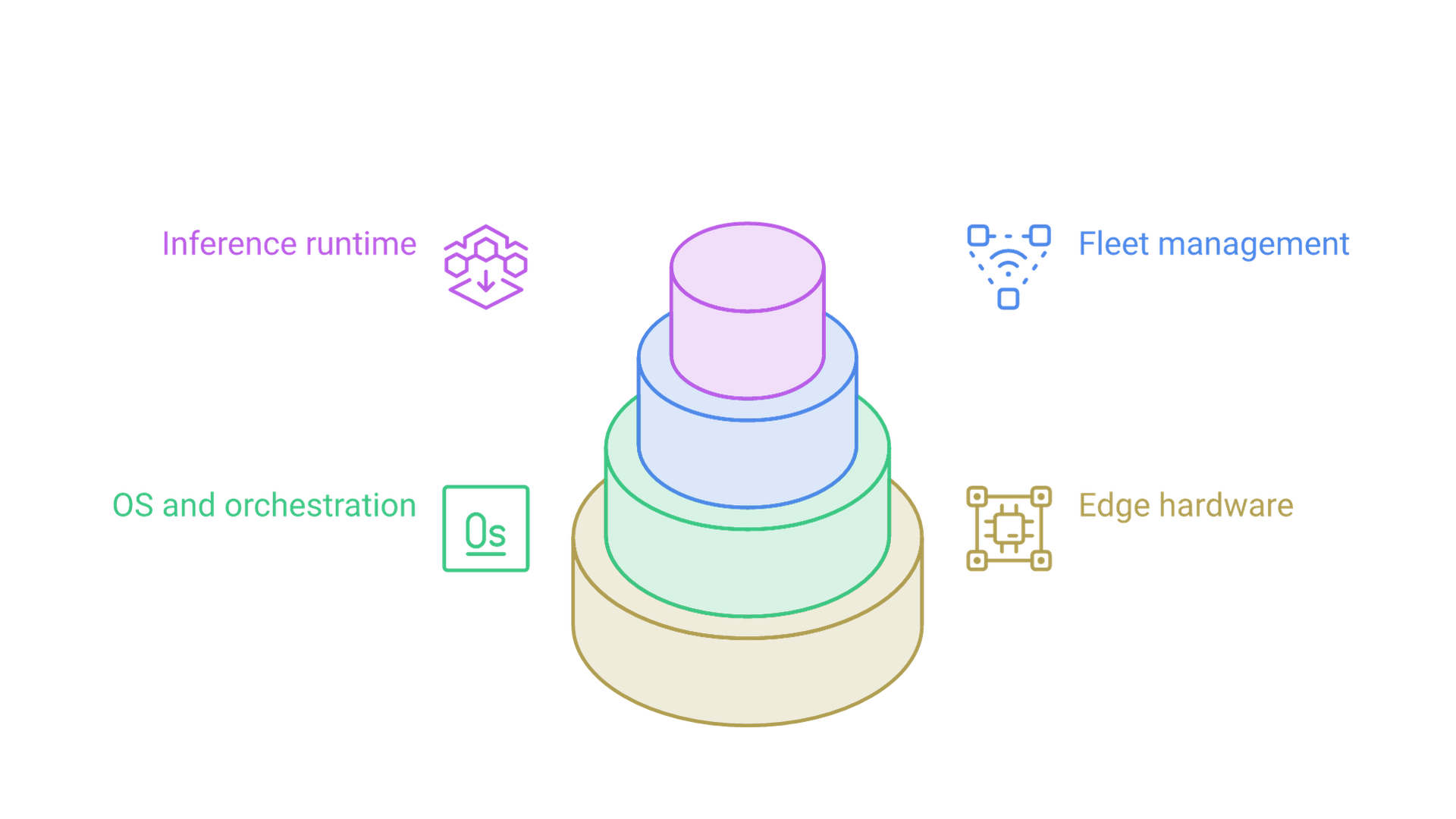
Most enterprise edge platforms can be understood as four layers. At the bottom is the edge hardware, from embedded modules to rack servers. Above it sits an operating system and an orchestration layer, increasingly a lightweight Kubernetes distribution or a container runtime. Next comes fleet management: provisioning, over-the-air (OTA) updates, remote access, policy and monitoring from a cloud or on-premises console. At the top is the inference runtime that actually executes the model, such as TensorRT, ONNX Runtime, OpenVINO or an LLM server like vLLM. Vendors differ mainly in which of these layers they own and how tightly they bind them together.
Benefits of Edge Deployments
Cloud inference remains the simplest option for many applications, but enterprises keep finding business reasons to deploy models closer to where data is generated.
1. Reduced Latency and Real-Time Decisions
Latency can be a dealbreaker. Industrial robotics, line-side machine vision and safety monitoring need responses more predictable than a wide-area network can guarantee. Local inference removes the network round trip from the critical path. A hospital system analyzing patient monitoring data, for example, should not depend on a distant cloud region for every prediction.
2. Stronger Data Privacy, Security and Sovereignty
Finance, defense, energy and healthcare operate under strict compliance requirements such as HIPAA and GDPR, along with sector-specific sovereignty rules. Transmitting sensitive data to a public region for inference may be prohibited or require extra controls. Keeping inference on premises keeps raw data local. Microsoft, for example, positions Azure Local for workloads with "strict sovereignty and regulatory requirements" and for local AI inferencing where data must be processed at the source, according to its Azure Local overview.
3. Cost Savings Through Localized Processing
Cloud costs add up when every video frame or sensor reading travels upstream. Filtering, aggregating and scoring data at the edge means only insights or exceptions go to the cloud. Microsoft's Azure IoT Edge documentation describes this pattern directly: clean and aggregate data locally so you avoid transferring large volumes of raw data. Whether that saves money overall depends on hardware, licensing and operations costs, so model total cost of ownership rather than bandwidth alone.
4. Greater Reliability in Production Environments
Connectivity drops, and cloud regions occasionally have incidents. Edge deployments let inference continue when the link is down. Platforms handle this differently: Azure IoT Operations, for instance, documents offline operation for a maximum of 72 hours with possible degradation, while Azure Local and Google Distributed Cloud air-gapped are designed for disconnected deployments. Check the documented offline behavior of any platform against your real outage patterns.
Core Features of Enterprise Edge Platforms
These features determine whether a platform can run AI workloads across a real fleet, not just on a single demo box. They range from fleet provisioning and over-the-air updates to container orchestration, accelerator support, security, lifecycle management and support for popular ML frameworks.
Fleet Provisioning and Over-the-Air Updates
Zero-touch or near-zero-touch provisioning, staged rollouts and rollback are the difference between a pilot and a fleet. NVIDIA says on its Fleet Command page that new devices are provisioned in minutes and that updates are pushed over the air to remote systems. Red Hat Device Edge pairs edge-optimized RHEL images with Red Hat Edge Manager for fleet management. AWS IoT Greengrass and Azure IoT Edge both deploy software as components or modules from a cloud console.
Container Orchestration and Kubernetes at the Edge
Most platforms package models as containers. Some use a device runtime (Greengrass components, IoT Edge modules); others run lightweight Kubernetes on site, such as MicroShift, Arc-enabled Kubernetes or GKE on Google Distributed Cloud.
Accelerator Support and GPU Partitioning
Look for accelerator driver management, GPU passthrough and partitioning. Fleet Command supports Multi-Instance GPU (MIG) so applications get dedicated GPU slices. Azure Local supports Discrete Device Assignment (documented as preview) of GPUs to Arc-enabled VMs, plus GPU node pools for AKS. Google notes that only select GDC connected hardware configurations support GPU workloads, so confirm GPU availability for the exact SKU you plan to buy.
Robust Security and Version Control
Edge devices sit in physically exposed locations, so secure and measured boot, encryption, signed artifacts, private registries and role-based access are baseline expectations; Fleet Command, for example, describes a zero-trust architecture. Version control matters just as much: every site should report which model and container versions it runs.
Lifecycle Management and Model Monitoring
Platforms should report device and application health, collect logs and send model telemetry back to MLOps tooling so drift can trigger retraining. AWS, for example, recommends using Greengrass V2 MQTT channels to send model telemetry back for SageMaker Model Monitor.
Support for Popular ML Frameworks and Runtimes
Flexibility matters. Teams train in PyTorch or TensorFlow and then export to an edge runtime such as TensorRT, ONNX Runtime, OpenVINO or LiteRT (formerly TensorFlow Lite). A platform that lets you bring any runtime in a container avoids lock-in to sample components. Greengrass, for instance, ships sample DLR and TensorFlow Lite components but lets you build custom components for any runtime.
Enterprise Edge Platform Comparison
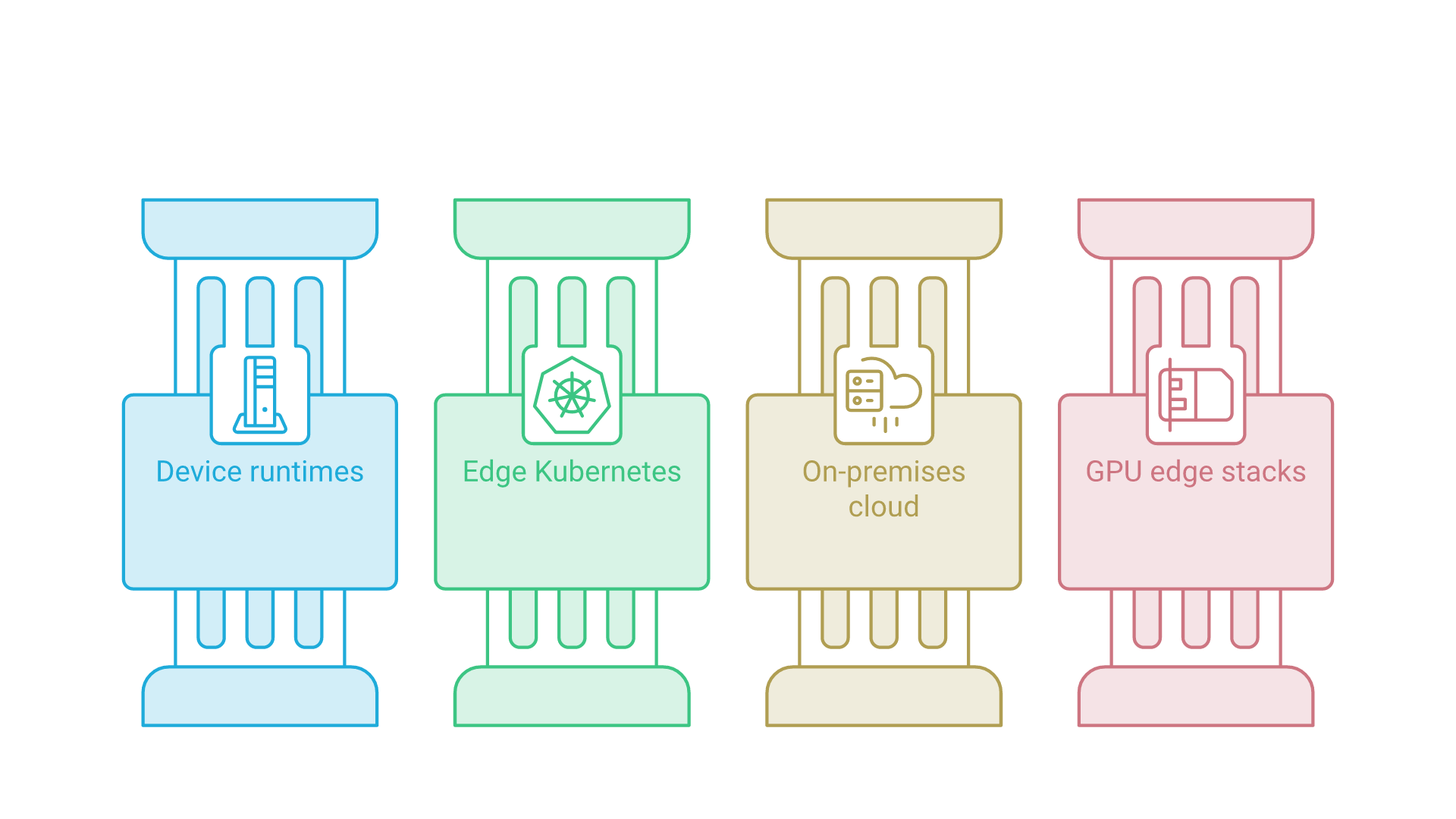
With so many options, it helps to sort them into four families. Device runtimes (AWS IoT Greengrass, Azure IoT Edge) run on gateways and embedded Linux devices and are managed from a cloud. Edge Kubernetes stacks (Red Hat Device Edge and OpenShift, Azure IoT Operations on Arc-enabled Kubernetes) bring cloud-native orchestration to the site. On-premises cloud extensions (AWS Outposts, Azure Local, Google Distributed Cloud) run a hyperscaler's services on hardware in your facility. GPU edge stacks (NVIDIA Jetson, IGX and Fleet Command) combine accelerated hardware with NVIDIA's software and management. The vendor sections below describe each, based on official documentation as of October 30, 2026.
NVIDIA Jetson, IGX and Fleet Command
NVIDIA covers the edge from embedded modules to industrial servers. The Jetson family now spans Jetson AGX Thor and the Orin series (AGX Orin, Orin NX and Orin Nano) and ships with the JetPack SDK, which bundles CUDA, cuDNN, TensorRT and a Jetson Linux OS. Application frameworks such as Isaac for robotics, Metropolis for vision AI and Holoscan for sensor processing sit on top. NVIDIA IGX targets industrial, robotics and medical environments; IGX Thor adds a dedicated Functional Safety Island and, according to NVIDIA, is designed to meet ISO 26262 and IEC 61508, while NVIDIA AI Enterprise supplies the software stack, including NIM microservices.
Fleet Command is NVIDIA's managed platform for container orchestration across distributed edge systems, with remote provisioning, OTA updates, remote access, monitoring and MIG support. NVIDIA's Fleet Command FAQ says it is currently compatible with NVIDIA-Certified Systems, so confirm hardware eligibility before planning around it. Best fit: GPU-intensive vision, robotics and medical workloads where NVIDIA hardware is already the standard. Watch for: a deeper dependency on one accelerator vendor.
AWS IoT Greengrass and AWS Outposts
AWS IoT Greengrass is an open source edge runtime and cloud service that deploys components, including Lambda functions, Docker containers and native processes, to devices and lets them run ML predictions locally. Its ML inference model splits a deployment into model, runtime and inference components; models trained in SageMaker AI can be stored in S3 and deployed as artifacts. AWS ended support for Greengrass V1 on October 7, 2026, so any remaining V1 fleets need to migrate to V2.
Two other AWS changes matter for anyone reading older comparisons. AWS discontinued SageMaker Edge Manager on April 26, 2024, and now suggests ONNX Runtime as a cross-platform edge runtime and Greengrass V2 for deployment and monitoring. And on the Outposts servers page, AWS says it has discontinued sales of the 1U and 2U Outposts servers and is helping affected customers move to Outposts racks. Outposts racks run services such as EC2, EKS, ECS and S3 on premises, and AWS lists G4dn as the accelerated instance option for ML inference, noting that more GPU-enabled instances are coming. Best fit: AWS-centric organizations, from small devices (Greengrass) to data-center-class sites (Outposts racks). Watch for: limited on-premises GPU choice on Outposts today.
Azure IoT Edge, Azure IoT Operations and Azure Local
Microsoft offers three layers. Azure IoT Edge is a device-focused runtime that deploys containerized modules from IoT Hub and runs on Linux and, through EFLOW, Windows. IoT Edge 1.6 LTS is the supported release, and Microsoft states that 1.5 LTS support ends on November 10, 2026. Azure IoT Operations is a newer unified data plane on Azure Arc-enabled Kubernetes, with an edge MQTT broker, OPC UA connectivity and data flows to Microsoft Fabric; it is primarily an industrial data platform rather than a model server.
Azure Local extends Azure to customer-owned hardware, uses Azure Arc as the control plane, supports connected or disconnected deployments and is priced per physical core. For inference, Azure Machine Learning can attach an Arc-enabled Kubernetes cluster as a compute target, so you can train in the cloud and deploy models on premises or at the edge from the same workspace. Microsoft documents limitations, including that Model Catalog models are not supported on Kubernetes online endpoints. Best fit: Microsoft-centric enterprises and OT environments. Watch for: keeping track of which Azure product owns which layer.
Google Distributed Cloud
Google Distributed Cloud (GDC) runs Google Cloud infrastructure in your locations. GDC connected comes in rack and server form factors that Google or a certified integrator supplies and maintains; Google remotely monitors and updates the deployment, workloads run on GKE clusters, and VMs and GPU workloads are available on select hardware configurations. An air-gapped variant targets fully disconnected environments. Google is also bringing Gemini models on premises: the Gemini on GDC connected documentation describes it as Public Preview, limited to evaluation and testing, and running only on Google-certified hardware. Best fit: Google Cloud customers and sovereign or regulated sites that want a Google-managed footprint. Watch for: preview status for on-premises Gemini and hardware-specific GPU support.
Red Hat Device Edge and OpenShift AI
Red Hat Device Edge combines edge-optimized RHEL images, MicroShift (a lightweight Kubernetes derived from OpenShift) and Red Hat Edge Manager for fleets of resource-constrained devices such as IoT gateways and industrial controllers. For model serving, Red Hat OpenShift AI uses vLLM and llm-d, supports deployment on premises, at the edge or in disconnected environments, and lists NVIDIA, AMD, Intel and Dell among its hardware partners. Best fit: organizations that want one open, Kubernetes-based operating model across clouds, data centers and edge sites. Watch for: the platform engineering skills Kubernetes demands.
Intel Open Edge Platform and OpenVINO
Intel's Open Edge Platform is a modular, mostly Apache 2.0 licensed stack that includes the Edge Microvisor Toolkit, Edge AI Libraries and OpenVINO-based inference. Its fleet layer needs caution: the Edge Manageability Framework repository states that the project is deprecated and was archived in June 2026, even though the 2026.0 documentation still describes it. OpenVINO itself remains widely used as an inference runtime on Intel CPUs, GPUs and NPUs, and other platforms can run it inside containers. Best fit: Intel-based edge hardware and teams comfortable assembling open components. Watch for: the status of the orchestration layer before relying on it.
Summary Table
| Platform | Family | Typical edge hardware | Management plane | Notable 2026 status |
|---|---|---|---|---|
| NVIDIA Jetson, IGX, Fleet Command | GPU edge stack | Jetson modules, IGX, NVIDIA-Certified Systems | Fleet Command (managed) | IGX Thor adds functional safety features |
| AWS IoT Greengrass | Device runtime | Linux and Windows devices | AWS IoT | V1 support ended October 7, 2026 |
| AWS Outposts racks | On-premises cloud extension | AWS-installed racks | AWS console | Outposts server sales discontinued |
| Azure IoT Edge | Device runtime | Linux devices, Windows via EFLOW | IoT Hub | 1.5 LTS support ends November 10, 2026 |
| Azure IoT Operations and Azure Local | Edge Kubernetes and cloud extension | Arc-enabled Kubernetes, validated servers | Azure Arc | Connected and disconnected options |
| Google Distributed Cloud | On-premises cloud extension | Google-supplied servers and racks | Google-managed | Gemini on GDC connected in preview |
| Red Hat Device Edge and OpenShift AI | Edge Kubernetes stack | Gateways, controllers, servers | Red Hat Edge Manager, OpenShift | vLLM and llm-d for model serving |
| Intel Open Edge Platform | Open components | Intel CPUs, GPUs, NPUs | Self-assembled | Manageability framework repo deprecated |
The table is a map, not a ranking: no independent, comparable benchmark covers these stacks, and real performance depends on your models, hardware and network. Enterprises must weigh ecosystem fit, support windows and workload fit to make the right choice.
Cloud GPU Providers and the Edge
Many comparisons, including earlier versions of this article, list cloud services such as NVIDIA DGX Cloud, Google Cloud Vertex AI and Microsoft Azure Machine Learning as edge platforms. They are better understood as the cloud half of an edge strategy. NVIDIA describes DGX Cloud as a fully managed AI training platform available through major cloud marketplaces and lists edge computing as a separate solution area.
Why Cloud GPUs Still Matter for Edge AI
Training and fine-tuning models for natural language processing, computer vision or recommendations usually needs more GPU capacity than an edge site offers. A GPU cloud platform provides multi-GPU training on demand, flexible billing and a model registry; the edge platform then pulls the approved artifact and serves it locally.
Matching Cloud and Edge Ecosystems
The tightest integrations stay within one vendor. Mixing ecosystems works when you standardize on containers and portable formats such as ONNX, but you will own more of the pipeline glue.
AI Inference Platforms and Runtimes
Running AI models in production requires a serving layer that turns a model file into a service applications can call. At the edge, that layer runs inside the containers your platform deploys, so the runtime choice is partly independent of the management platform.
Core Capabilities
An edge serving runtime should deliver predictable latency, use the local GPU, NPU or CPU efficiently, accept popular ML framework exports and expose health metrics the fleet manager can collect.
Popular AI Inference Runtimes for the Edge
NVIDIA's inference server, now called NVIDIA Dynamo-Triton (formerly Triton Inference Server), supports TensorRT, PyTorch, ONNX, OpenVINO and Python backends, runs on x86 and Arm CPUs as well as GPUs, and offers Jetson JetPack builds. ONNX Runtime is a cross-platform engine for cloud, edge, web and mobile across CPU, GPU and NPU hardware. OpenVINO targets Intel hardware, TensorRT targets NVIDIA GPUs, and LiteRT serves mobile and embedded devices. For edge LLMs on server-class hardware, vLLM is now a common choice and is the serving engine in OpenShift AI. TensorFlow Serving remains an option for TensorFlow-centric teams.
Serving engines trade off latency, throughput and cost per request at the edge as in the data center. Our guide to AI inference infrastructure considerations covers how to match serving stacks and hardware to real workloads.
Edge AI and Hardware Optimization
Edge hardware brings limited memory, power budgets, heat and sometimes no accelerator at all. Platform choice does not remove those constraints, but it determines which optimization toolchains are first-class.
Techniques for Optimization
- Quantization: reducing numeric precision to shrink models and speed up inference.
- Pruning: removing weights or channels that contribute little to accuracy.
- Knowledge distillation: training a smaller model to mimic a larger one.
- Compilation: converting models to TensorRT engines, OpenVINO IR or ONNX graphs tuned for the target hardware.
Hardware-Specific Considerations
Validate optimized models on the exact production hardware and runtime version, because accuracy and latency can shift after quantization or compilation. For a beginner-level walkthrough of devices, quantization and a first project, see how to use edge AI in practice. In enterprise fleets the extra challenge is keeping optimized model builds aligned with the drivers and runtimes installed across every site.
Deploying ML Models to Edge Fleets
The path from experiment to production is not straightforward. Deploying ML models to an edge fleet adds packaging, rollout and observability steps that a single cloud endpoint does not need.
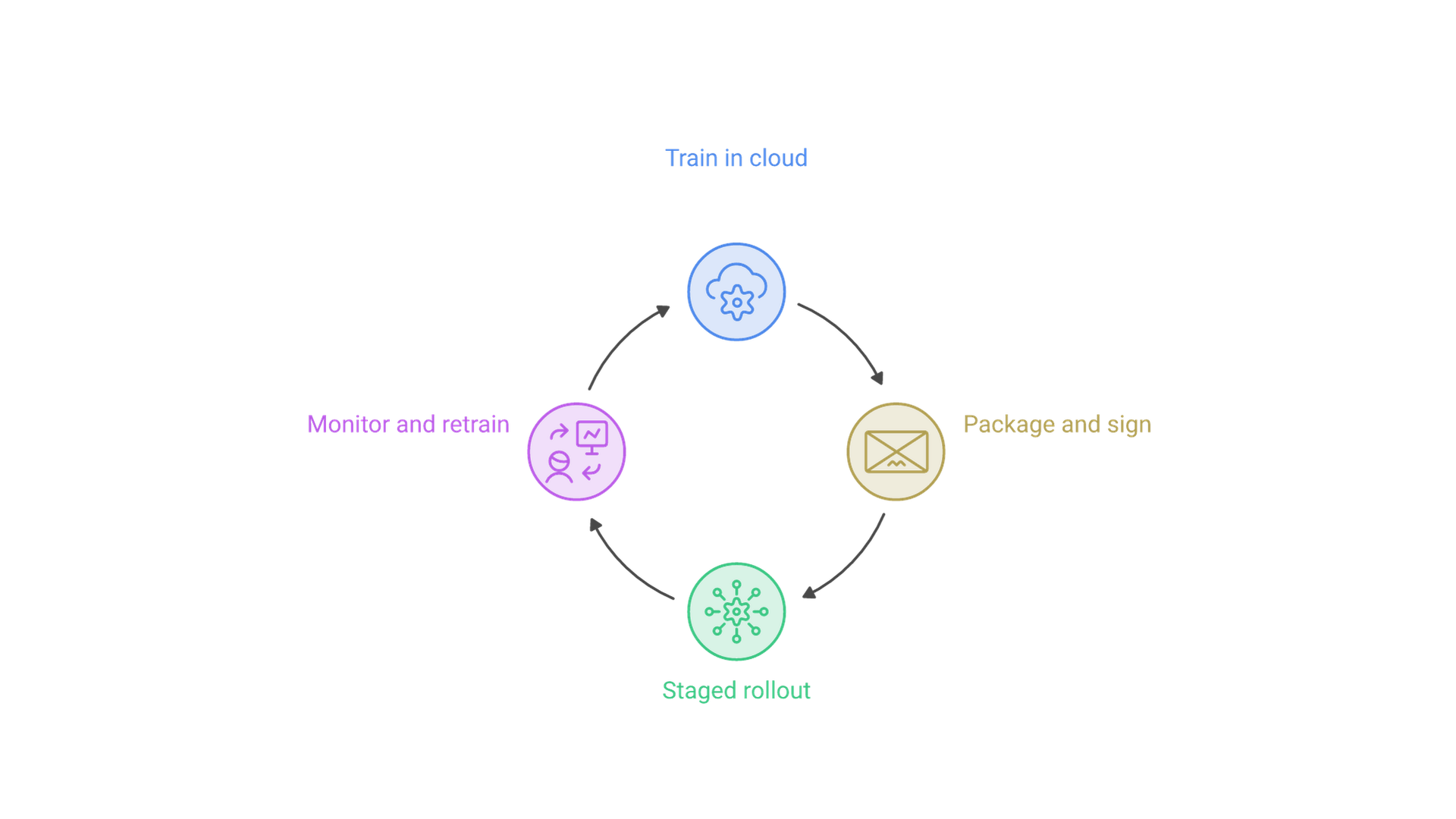
Stages of Deployment
- Data preparation: cleaning, labeling and versioning datasets, often with edge-captured samples.
- Model training: multi-GPU cloud or on-premises training and fine-tuning.
- Optimization and testing: exporting to the edge runtime and validating on target hardware.
- Packaging: building a signed container or component with model, runtime and inference code.
- Staged rollout: deploying to a canary group of sites before the full fleet.
- Lifecycle management: monitoring health and drift, retraining and retiring old versions.
Each platform maps these stages differently: Greengrass bundles model, runtime and inference components into one deployment, Azure Machine Learning deploys to Arc-enabled Kubernetes endpoints, and Fleet Command, Red Hat Edge Manager and GDC deploy containers to registered sites. What matters is fast rollback, version reporting from every site and telemetry that flows back to the model owners.
AI Deployment Strategies
No two enterprises deploy AI the same way. AI deployment strategies must reflect organizational structure, compliance requirements and workload types. Common strategies are outlined first, followed by a real-world example.
Common Strategies
- Train in the cloud, infer at the edge: the most common hybrid pattern.
- Extend the cloud on premises: run the same cloud APIs on Outposts, Azure Local or GDC hardware.
- Device fleets with cloud management: lightweight runtimes on gateways and embedded devices.
- Fully disconnected: air-gapped stacks for defense, intelligence or critical infrastructure.
Real-World Example
Consider a hypothetical financial firm that trains fraud models in the cloud, where GPU access is abundant, but serves them in its own data centers to keep transaction data local and latency low. The same reasoning applies to a retailer scoring store video or a manufacturer inspecting parts; only the hardware and connectivity assumptions change.
Whichever pattern you choose, design for the operating model you can staff: Kubernetes across hundreds of sites needs platform engineering, while a managed offering trades that work for tighter vendor coupling. If you need help designing that foundation, Cognativ's AI infrastructure services cover hybrid inference architectures from cloud to edge.
Data Science and Experiment Tracking
Without experiment tracking and model versioning, teams cannot explain which model runs at which site and why. The key features below link tracking dashboards, a model registry and labeling to an audit trail for every edge deployment.
Key Features
- Experiment tracking dashboards for accuracy, loss and resource usage.
- Model registry and versioning tied to deployment records.
- Data labeling integration for edge-captured samples.
- Audit trails linking each edge deployment to its training run.
Edge platforms generally consume this tooling's outputs rather than replace it: SageMaker AI, Azure Machine Learning, Vertex AI or OpenShift AI track experiments, and the edge platform deploys approved artifacts. Keep that hand-off automated and auditable, especially in regulated industries.
How to Choose an Enterprise Edge Platform
Use the following criteria to narrow the field before running a proof of concept on your own hardware and models. The six questions cover cloud and MLOps gravity, edge hardware, site connectivity, safety and compliance, fleet size and operations, and hardware service life.
1. Where Does Your Cloud and MLOps Gravity Sit?
If your data, identity and ML pipelines live in AWS, Azure or Google Cloud, that vendor's edge options integrate with the least effort. Multicloud teams often start with an open Kubernetes layer and portable runtimes.
2. What Hardware Sits at the Edge?
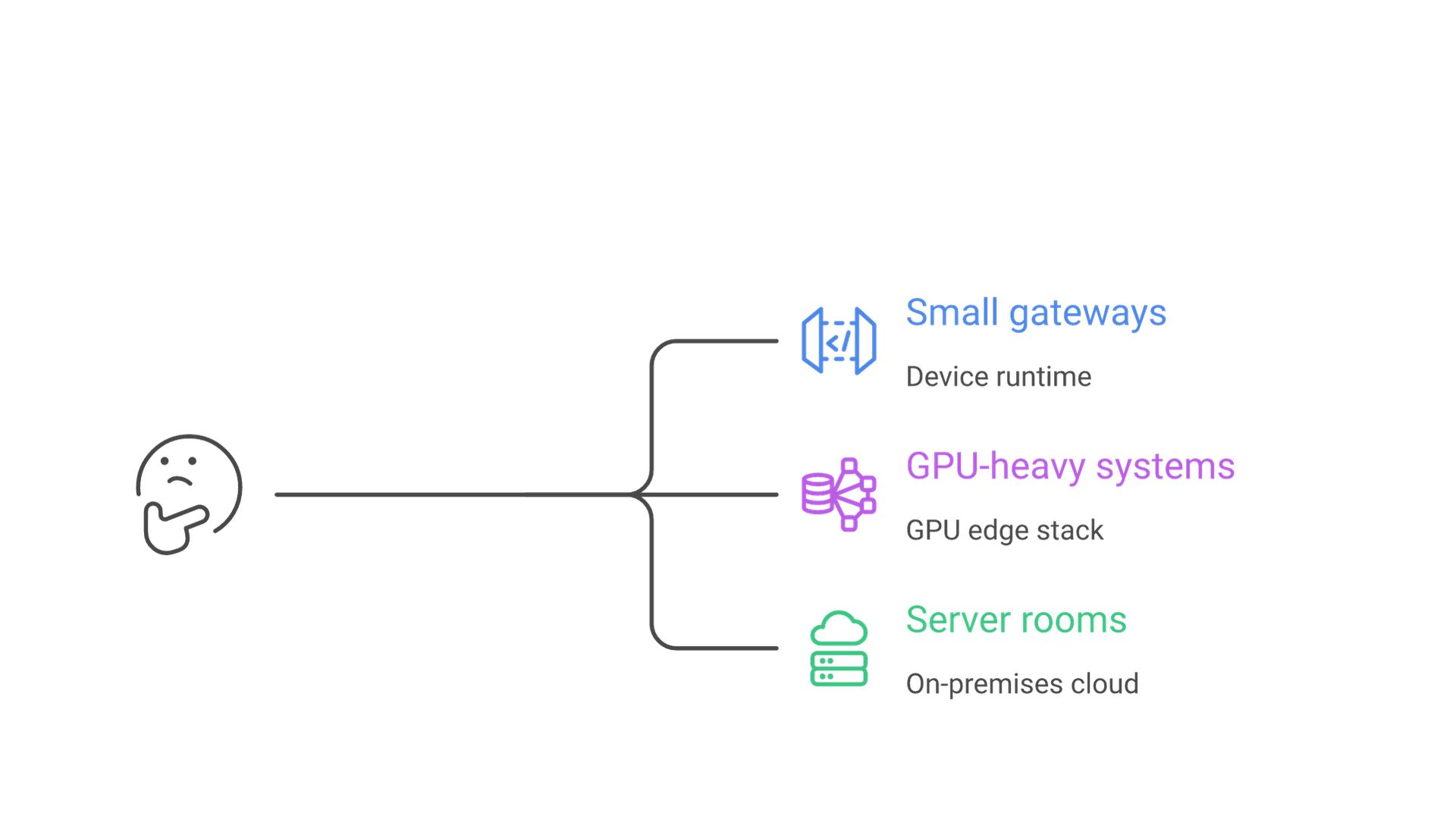
Embedded devices and gateways point toward device runtimes or MicroShift. GPU-heavy vision, robotics and medical systems point toward NVIDIA Jetson or IGX. Server rooms in stores, plants or branches fit on-premises cloud extensions or edge Kubernetes.
3. How Connected Are Your Sites?
Measure real outage frequency and duration. Azure Local and GDC air-gapped document disconnected modes; others tolerate shorter gaps, so read the specific limits.
4. What Are Your Safety and Compliance Requirements?
Functional safety, medical device rules and data sovereignty narrow the options quickly; sovereign deployments often require air-gapped or customer-controlled infrastructure.
5. How Large Is the Fleet and Who Will Run It?
Ten servers and ten thousand devices are different problems. Decide whether your team or the vendor will handle provisioning, patching and hardware replacement.
6. How Long Will the Hardware Stay in Service?
Edge hardware often outlives cloud instances. NVIDIA, for example, states that NVIDIA AI Enterprise on IGX includes up to 10 years of support. Match vendor support windows to your depreciation cycle and confirm product status. Recent changes, from Outposts servers to SageMaker Edge Manager and Intel's manageability framework, show why a platform's roadmap is part of the selection, not an afterthought.
Then test two candidates with a representative model, real data and a realistic network, measuring deployment time, rollback, latency and operational effort. For an independent assessment of your options, our cloud infrastructure consulting team can help structure the evaluation.
Frequently Asked Questions
What is an enterprise edge platform for AI?
It is the software and management stack for running AI inference outside the public cloud at scale: operating system, container orchestration, fleet provisioning, OTA updates, security and an inference runtime.
Is NVIDIA DGX Cloud an edge platform?
No. NVIDIA describes DGX Cloud as a managed AI training platform delivered through cloud providers. NVIDIA's edge offerings are Jetson, IGX and Fleet Command, often used with models trained in the cloud.
What replaced SageMaker Edge Manager?
AWS discontinued SageMaker Edge Manager on April 26, 2024. AWS suggests ONNX Runtime as a cross-platform edge runtime and AWS IoT Greengrass V2 for deploying and monitoring models on edge devices.
Can I run large language models at the edge?
Yes, on sufficiently capable hardware. Server-class edge systems can run LLMs with engines such as vLLM, and Google offers Gemini on GDC connected in preview. Smaller devices usually need compact or quantized models.
Should I use Kubernetes at the edge?
It gives a consistent deployment model from cloud to edge but adds operational complexity. It suits server-class sites; lightweight device runtimes often suit small gateways better.
Which edge platform is cheapest?
There is no general answer. Pricing models differ, from per-core licensing on Azure Local to hardware-inclusive offerings, and total cost includes hardware, support and operations staff time.
Conclusion: Choosing the Best Enterprise Edge Platform for AI Inference
Enterprise edge platforms are now a core part of AI deployment strategies. The leading options in 2026 come from NVIDIA, AWS, Microsoft, Google, Red Hat and Intel, and each combines hardware, orchestration, fleet management and inference runtimes in a different way. The best platform is the one that matches your cloud ecosystem, edge hardware, connectivity, compliance needs and operating model, and that its vendor will support for as long as your hardware stays in the field.
Start from the workload, shortlist two platforms against the criteria above and prove them on your own models and sites. Treat product status as a live input, since several familiar edge services have been retired or reshaped recently.
If you are planning edge inference for a fleet and want help choosing and designing the platform, talk to Cognativ about your edge AI project.