

Enterprise Software Development Process: 7–8 Stages, Deliverables, Roles, and Risks
How enterprise software projects move from multi-stakeholder discovery to phased rollout and ongoing improvement, with deliverables and owners at every stage.
The enterprise software development process is the structured sequence of stages that organizations follow to design, build, deploy, and evolve mission-critical platforms-ERP extensions, fintech engines, healthcare systems, logistics networks, and similar large-scale enterprise software. Unlike building a departmental tool or a standalone mobile app, this process must account for dozens of stakeholders, deep integrations with existing systems, strict regulatory compliance, and a system lifespan that often stretches 7–15 years or more.
This article is written for CIOs, CTOs, heads of product and operations, and senior IT leaders in mid-market and enterprise organizations who are planning a new platform build or legacy modernization in 2026–2027. Whether you are scoping a custom enterprise software project for the first time or rescuing one that has stalled, the framework here gives you a concrete, stage-by-stage process map you can adapt to your context.
The direct answer: A well-run enterprise software development project typically follows 7–8 stages-from multi-stakeholder discovery and enterprise architecture definition through incremental development, security hardening, phased rollout, and post-launch optimization. What separates this from a generic software development lifecycle is the added weight on integrations, security and compliance, data migration, change management, and formal governance at every decision point. For a broader view of the generic SDLC, see our separate guide on the software development life cycle and its 7 phases-this article builds on that foundation with the enterprise-specific layers.
Here is what you will take away:
- A practical 8-stage development process map tailored to enterprise contexts
- Typical timelines, from a 9-month focused module to a 24-month+ multi-domain platform
- Key roles and responsibilities at each development stage
- Risk hot-spots that derail enterprise software projects and how to mitigate them
- Concrete success metrics to track from discovery through continuous improvement
Understanding the Enterprise Software Development Process
The enterprise software development process is a disciplined, business-aligned way to move from a strategic pressure-regulatory change, margin compression, digital modernization, business growth-to a running enterprise platform with robust governance, seamless integration, and measurable ROI. It encompasses everything from the earliest stakeholder workshops through architecture decisions, sprint-based builds, data migration, phased rollout, and the years of continuous improvement that follow.
Where regular software development might involve a small team shipping a single application in weeks or months, enterprise application development operates at a fundamentally different scale. Enterprise systems must support complex business operations across multiple departments, geographies, and regulatory environments. They handle customer relationship management, enterprise resource planning, supply chain management, and other core business processes-often simultaneously. The development process must accommodate this complexity without sacrificing quality or speed.
At Cognativ, we approach this through a lens of business-aligned architecture, secure delivery, and AI-ready design baked into every stage. The goal is not just delivering software but delivering measurable outcomes that justify the investment. Our US-based team follows this process in custom enterprise software development, from stakeholder discovery through long-term platform support.
How Enterprise Projects Differ from Standard Software Projects
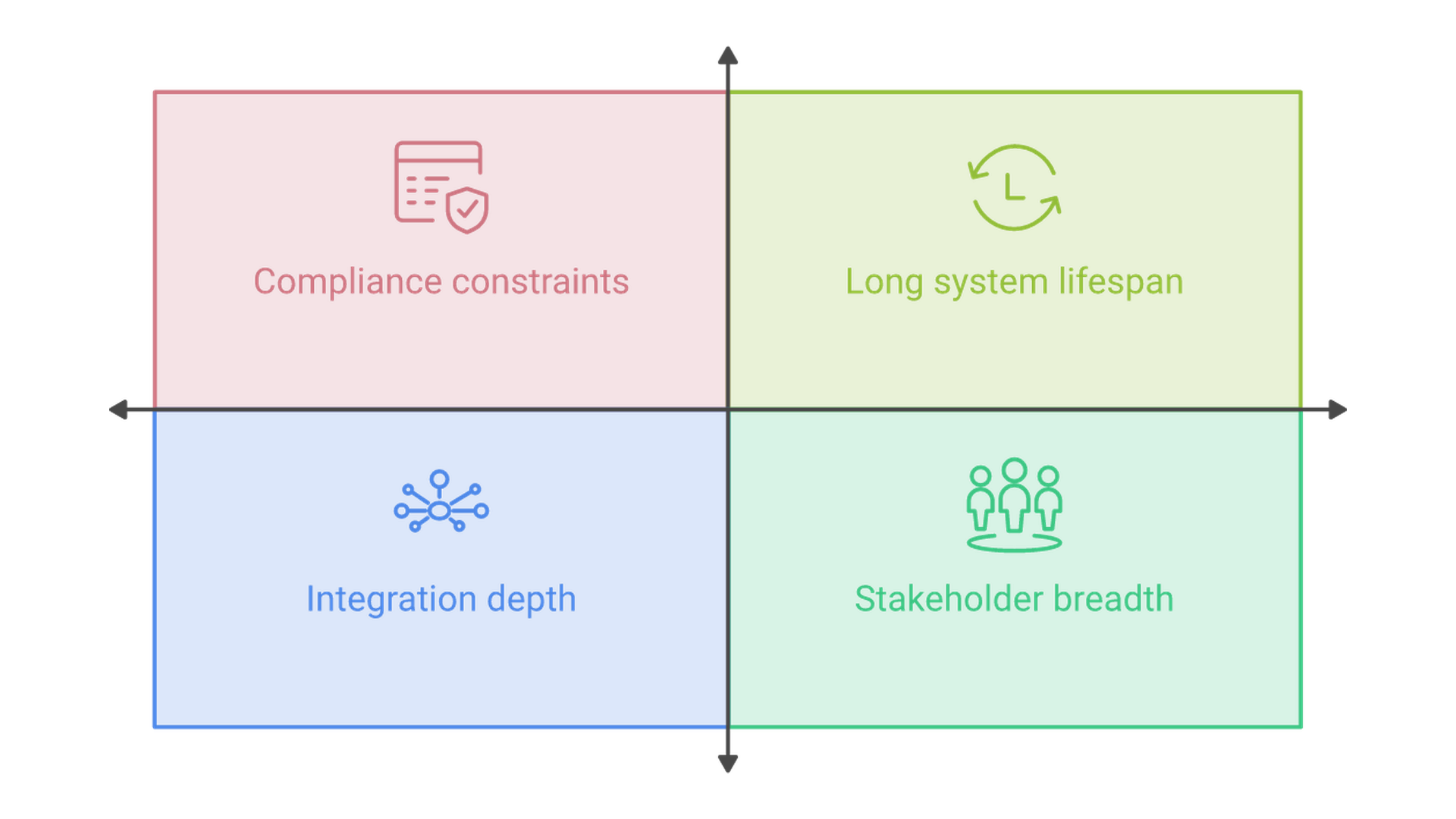
Enterprise software projects differ from standard application development along several critical axes:
- Stakeholder breadth. A departmental app might have one product owner and a handful of users. An enterprise solution involves executives, operations teams, IT, security, compliance, legal, and often external regulators-each with different priorities.
- Regulatory and compliance constraints. Compliance with regulations like HIPAA and GDPR is essential. Enterprise builds in healthcare, fintech, and government sectors face audit requirements that shape architecture, data management, and even deployment strategies.
- Integration depth. Enterprise software integrates with supply chain and CRM systems, ERP platforms, data warehouses, and other enterprise systems that may span decades of technology generations. Legacy systems often lack compatibility with modern technologies, making integration planning a first-class concern.
- Data criticality and volume. Enterprise software must handle 1,000,000+ records efficiently. Data quality, ownership, and migration from existing software introduce complexity that smaller projects rarely encounter.
- System lifespan. Enterprise platforms are expected to run for 7–15+ years. Maintenance can last for 10 years or more after deployment, and post-launch support is a significant part of the software lifecycle, consuming considerable budget-typically 15 to 20 percent of each development cycle's budget.
These differences mean that enterprise projects typically span months to years, with multiple releases, parallel workstreams for data migration and integration, and far more formal governance than a standard development cycle.
Core Principles Guiding a Modern Enterprise Process
Five principles underpin an effective modern enterprise development approach:
- Business-first requirements. Every technical decision traces back to a business objective. Quantifying requirements reduces disagreements during acceptance testing and keeps teams aligned on outcomes rather than features.
- Secure by design. Security must be built in from the start-not bolted on before launch. Security features include encryption and multi-factor authentication, and security and compliance must be considered from the beginning of the software development process.
- Integration-aware planning. Treat integration with existing infrastructure and data migration as dedicated workstreams, not afterthoughts.
- Measurable outcomes at each stage. Define quantitative and qualitative metrics per stage so that progress is visible and course corrections happen early.
- Iterative rollouts with feedback. Deployment strategies in enterprise software often involve phased rollouts to minimize risk, with each wave informing the next.
Cognativ's RAPID framework operationalizes these principles: Research, Analyze, Plan, Implement, and Decide. These principles come to life through the eight concrete stages that follow.
The 8 Stages of the Enterprise Software Development Process
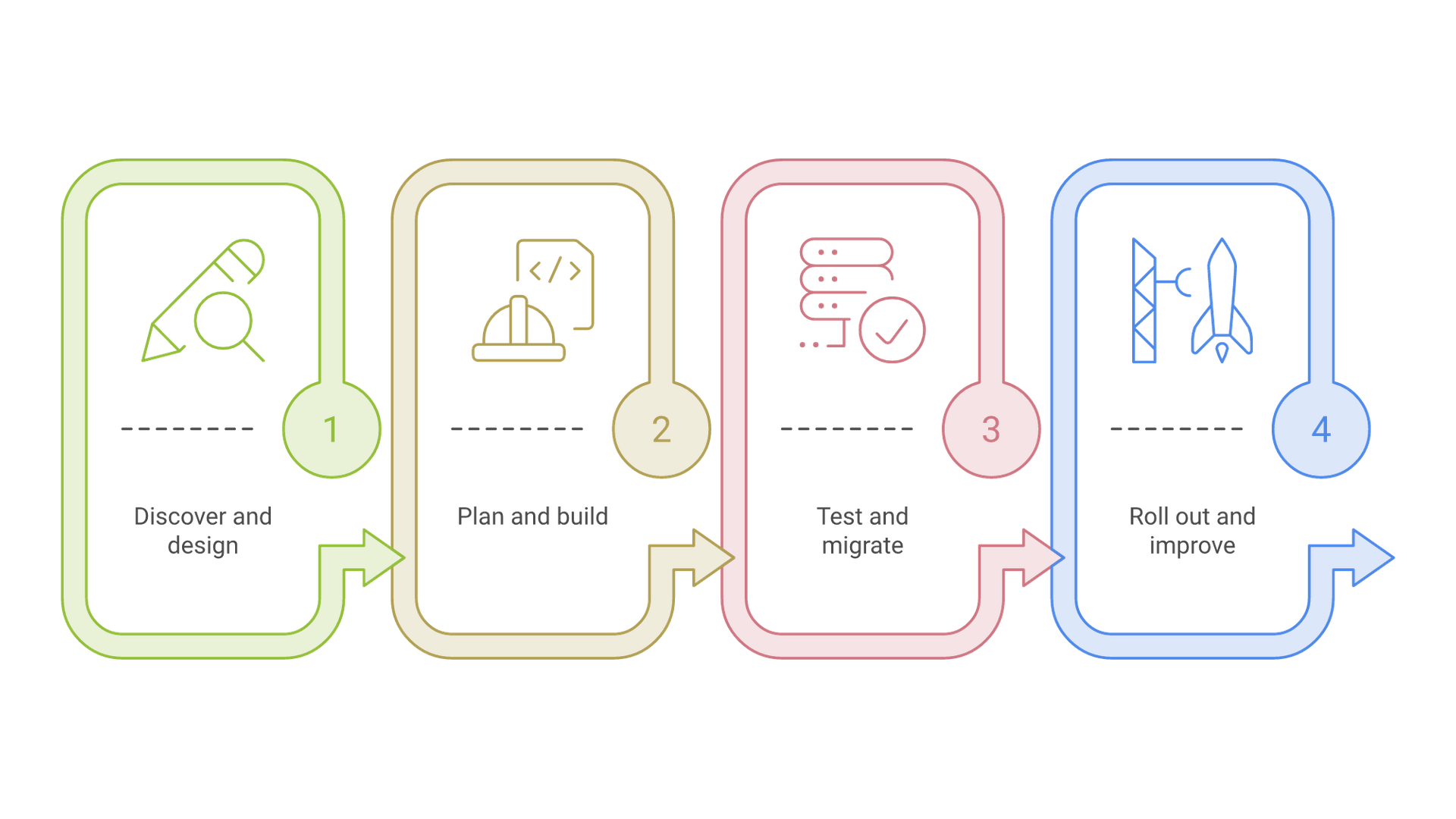
Cognativ's approach organizes enterprise initiatives into eight repeatable stages from discovery to continuous evolution. Each stage has defined goals, key activities, core roles, typical timelines, major risks, and success metrics. Together, they form a development process that balances speed with the governance and rigor that complex projects demand.
Stage 1: Multi-Stakeholder Discovery and Alignment
Purpose: Align executives, operations, IT, security, and compliance around business outcomes-not just feature lists. Discovery is where you define what success looks like and surface the constraints that will shape every subsequent decision.
Key activities:
- Stakeholder interviews and cross-functional workshops spanning business units
- Current-state mapping of systems, workflows, and data flows
- Pain-point analysis and dependency identification (e.g., regulatory deadlines, planned M&A activity)
- Documenting business objectives, non-goals, and preliminary success metrics
Deliverables: Problem statement, high-level business objectives, prioritized use cases, stakeholder map, preliminary success metrics (e.g., reduced cycle times, error rates, manual touches), and a discovery report.
Roles: Executive sponsor, product owner, domain SMEs, enterprise architect, business analyst, delivery lead.
Typical timeline: Requirement gathering typically lasts 3 to 6 weeks for a single domain such as claims processing. Multi-region or multi-business-unit scopes may extend to 6–12 weeks.
Risk points: Hidden stakeholders not surfaced during initial mapping; conflicting business objectives across departments; under-documented legacy systems that create surprises later. Mitigate these by ensuring executive sponsor involvement, running cross-functional workshops (not just one-on-one interviews), and performing early technical audits of existing systems.
Success measures: Signed-off business objectives and non-goals, >90% coverage of key stakeholder roles, baseline metrics established, and risk register created.
Stage 2: Requirements and Enterprise Architecture Definition
Purpose: Translate discovery insights into structured requirements and a target architecture that fits the wider enterprise ecosystem. Enterprise architecture involves designing a technical blueprint including technology stack, data models, integration patterns, and security controls.
Key activities:
- Functional and non-functional requirements capture
- Data and integration landscape analysis across existing systems
- Regulatory requirements review (HIPAA, PCI DSS, GDPR, and industry-specific rules)
- Threat modeling and security architecture
- Initial AI and analytics opportunities identification
Deliverables: Requirements specification, system context and component diagrams, target data model outline, integration inventory, threat model, high-level NFRs (performance, availability, security, auditability), and a high-level AI-readiness assessment.
Roles: Solution/enterprise architect, security architect, data architect, business analyst, compliance officer or legal representative.
Typical timeline: The planning phase usually takes 2 to 4 weeks for roadmap definition, while full requirements and architecture work spans 4–8 weeks depending on complexity and the number of integrations.
Risk points: Over-specifying "how" instead of "what," which locks teams into premature technical decisions. Ignoring data quality and ownership issues. Underestimating integration complexity with legacy systems. De-risk by keeping requirements outcome-focused, running early data profiling, and building proof-of-concept integrations for the highest-risk connections.
Success measures: Requirements traceable to business goals, architecture peer-reviewed and approved, agreed NFRs, integration inventory completeness, and threat model coverage.
Stage 3: UX, Workflow Design, and Prototyping
Purpose: Design interfaces and workflows that reflect real-world enterprise operations and drive adoption. User experience design enhances usability and accessibility in software, and effective UX design aligns with business goals and user needs.
Key activities:
- User and role definition across departments
- UX research sessions with representative users from frontline operations
- Journey mapping for critical workflows (e.g., order-to-cash, claims intake, patient scheduling)
- Wireframes and interactive prototypes for core screens
- Accessibility review against WCAG standards
Deliverables: Role-based UX flows, wireframes or clickable prototypes, design system guidelines, accessibility considerations, and initial usability test feedback.
Roles: UX/UI designer, product owner, domain SMEs, front-end architect, change management lead.
Typical timeline: UI and UX design can take 4 to 8 weeks, often overlapping with technical architecture work from Stage 2.
Risk points: Designing for edge cases at the expense of majority use; ignoring input from frontline users who will actually use the user interface daily; underestimating the training and change management friction that a new enterprise application introduces. Good UX design can significantly improve user adoption rates, while intuitive interfaces reduce training time for new users.
Success measures: Validated workflows with target user groups, sign-off on key journeys, usability scores from prototype testing, and a clear backlog of UX items for implementation.
Stage 4: Implementation Planning and Roadmapping
Purpose: Turn design and architecture into a realistic, phased delivery plan with clear milestones and governance. This planning phase is where software development processes get operationalized.
Key activities:
- Break epics into deliverable increments
- Define release strategy: MVP, pilot, phased rollout
- Plan sprint cadence and align with other programs (e.g., ERP upgrades or integrations planned for 2027)
- Define governance decision gates and environment strategy (dev/test/stage/prod)
Deliverables: Prioritized product backlog, delivery roadmap (6–12 month horizon), environment strategy, risk register with mitigations, and governance framework (steering committee, architecture board, review cadence).
Roles: Product owner, delivery manager/project manager, tech lead, enterprise architect, PMO representative.
Typical timeline: Planning phase duration is usually 2 to 4 weeks to define the roadmap for the first 6–12 months.
Risk points: Overly optimistic timelines that ignore cross-team dependencies; inadequate budget allocation for testing, security testing, and change management; failing to account for vendor selection time (which alone can consume ~20 weeks in some enterprise software development projects).
Success measures: Approved roadmap, feasible release plan, governance roles assigned, dependencies identified and addressed, and budget baselined.
Stage 5: Incremental Development and Integration
Purpose: Build the system iteratively while keeping quality, security, and integration in focus from day one. This is the core development phase where development teams turn plans into working enterprise software.
Key activities:
- Sprint-based agile development with regular code reviews
- Automated testing pipeline setup including unit testing and integration tests
- Building and validating integrations (APIs, message queues, ETL pipelines) with other enterprise systems
- Implementing business logic, data management layers, and initial AI or automation components
- Continuous integration and continuous deployment (CI/CD) practices reduce risks associated with deployment
Deliverables: Working software increments at the end of each sprint, updated technical documentation, CI/CD pipelines, integration stubs or fully working interfaces, and security gate evidence.
Roles: Back-end and front-end engineers, DevOps/platform engineers, test engineers, security engineer, integration specialists.
Typical timeline: Development phase can take 4 to 9 months for substantial applications. Enterprise programs often span multiple releases, with partial functionality going to pilot users while later modules are still in development.
Risk points: The "integration later" mindset is one of the most common causes of enterprise project delays. Technical debt management is crucial in maintaining enterprise software over time-teams that defer refactoring accumulate compounding costs. Security reviews postponed to the end create bottlenecks. Siloed development teams across domains produce software elements that don't work together. Poor collaboration between business and IT leads to project delays, and developer shortages can slow down enterprise software projects.
Success measures: Sprint burndown health and velocity predictability, integration test pass rates, adherence to security gates, escaped defects count, and stakeholder satisfaction during sprint demos. Automated testing improves software quality by integrating quality checks throughout the development lifecycle.
Stage 6: Data Migration, Security Hardening, and Pre-Production Testing
Purpose: Validate that the enterprise solution behaves correctly at scale, with real data and real-world security and compliance constraints. This development stage bridges the gap between "it works in dev" and "it works in production."
Key activities:
- Data profiling, cleansing, and migration rehearsal runs from existing software and legacy systems
- Performance and load testing at realistic volumes
- Testing includes load and penetration testing for vulnerabilities
- Compliance reviews and audit evidence preparation
- User acceptance testing with realistic scenarios and pilot user groups
Deliverables: Migration playbook and tested migration scripts, performance test reports, security and penetration test findings with remediations, UAT sign-off, and compliance/audit evidence packages.
Roles: Data engineers, QA/performance engineers, security team, compliance officer, pilot user group representatives.
Typical timeline: Testing and deployment typically require 6 to 10 weeks, potentially longer for heavily regulated or data-intensive systems. In compliance-heavy builds, additional time of 6–10 weeks may be needed for audit evidence and security review.
Risk points: Data quality surprises that surface only during migration rehearsals; missing rollback and recovery plans; discovering performance bottlenecks too late (e.g., end-of-month batch processing); compliance gaps that delay go-live. ISO 27001 certification ensures adherence to security management standards and can help structure security hardening activities.
Success measures: Successful dress-rehearsal migration, performance targets met under peak load conditions, zero critical security vulnerabilities, positive UAT feedback, and compliance readiness confirmed.
Stage 7: Phased Rollout, Change Management, and Training
Purpose: Introduce the new system safely across regions, business units, or user groups while protecting ongoing business operations. Enterprise software supports complex organization-wide workflows, and the rollout must respect that complexity.
Key activities:
- Implement go-live strategy (phased, parallel run, or big-bang-phased is most common for enterprise apps)
- Configure monitoring, observability dashboards, and alerting
- Deliver role-based training (playbooks, videos, live sessions)
- Decommission old workflows and legacy tools where appropriate
- Staff support model (L1/L2/L3)
Deliverables: Rollout plan by cohort (by location, department, or user role), cutover checklist, training materials, support staffing model, known-issues list, and monitoring dashboards.
Roles: Change manager, training lead, support team leads, product owner, operations managers.
Typical timeline: 2–8 weeks per major rollout wave. One wave might cover a single geography, business unit, or functional role.
Risk points: Lack of communication to end-users about what is changing and why; poor support coverage immediately post-go-live; simultaneous high-risk changes across the organization; failure to retire old tools (which leads to parallel workflows and confusion). User experience design impacts overall software performance and satisfaction-if the training doesn't match the interface, adoption suffers.
Success measures: Adoption rates per cohort, help-desk ticket volume and severity in the first 30–90 days, stability KPIs (errors, downtime), time to user proficiency, and early business metrics such as processing time reduction.
Stage 8: Continuous Improvement, Optimization, and Governance
Purpose: Ensure the platform evolves with the business, remains secure, and continues delivering measurable ROI. Measuring performance and outcomes is key to continuous improvement in enterprise software development.
Key activities:
- Monitor usage analytics and system performance against baselines
- Run regular backlog refinement based on user feedback and changing business needs
- Address technical debt through scheduled remediation
- Update for new regulations (e.g., evolving privacy rules, AI oversight requirements)
- Add new automation, business intelligence, or AI features where justified
- Enforce architecture governance to prevent ungoverned customization
Deliverables: Quarterly or semi-annual release plans, improvement backlog, technical-debt register with remediation schedule, updated documentation and runbooks, and governance reports.
Roles: Product management, engineering leadership, security/compliance teams, operations, and AI/analytics team where applicable.
Typical timeline: Ongoing, with release cycles every 1–3–6 months depending on governance model. Maintenance often requires 15 to 20 percent of each development cycle's budget.
Risk points: The "project is done" mindset, where organizations cut investment once the initial launch is complete. Underfunded maintenance leads to security vulnerabilities and degraded performance. Ungoverned customization by individual business units fragments the platform. Organizational rigidity limits software adaptability to changing needs.
Success measures: Sustained or improving KPIs vs. baseline established at discovery, reduced incident rates, predictable release cadence, cost of ownership trends, and demonstrated ROI (cost savings, operational efficiency gains, revenue uplift).
Mapping Roles, Timelines, and Risks Across the Process
With all eight stages defined, it is useful to see how responsibilities, timelines, and risks play out across the full enterprise software development process.
How responsibilities shift across the 8 stages:
- Business leadership (executive sponsor, steering committee): Heaviest involvement in Stages 1–2 (discovery, requirements) and Stage 7 (rollout decisions). They set business objectives, approve budgets, and make go/no-go decisions at governance gates. During Stages 5–6, their role shifts to periodic reviews and escalation handling.
- Product and operations (product owner, domain SMEs, change management): Active across all stages but most critical during discovery (Stage 1), UX design (Stage 3), UAT (Stage 6), and change management (Stage 7). They ensure the software addresses real business processes and that users are prepared.
- Engineering and IT (architects, developers, DevOps, QA, security): Provide input during architecture (Stage 2), then take primary delivery responsibility through Stages 4–6. They remain active in Stage 8 for ongoing releases, security updates, and technical debt remediation.
Typical total timeline patterns:
- A focused enterprise module (single domain, moderate integrations): 9–12 months from discovery through initial go-live
- A multi-domain platform (multiple business units, heavy legacy modernization): 18–24+ months with incremental releases along the way
- Mid-market enterprises ($50M–$1B revenue) complete full platform implementations faster than organizations above $1B revenue
- Cost for mid-size custom enterprise software solutions with moderate complexity and compliance requirements typically lands between $400,000–$1.2M+
"Red-zone" risk clusters that derail enterprise initiatives:
- Data migration from legacy systems. Undocumented data structures, poor data quality, and unwritten business logic in existing software routinely cause overruns.
- Integration with core enterprise systems. ERP systems centralize data from multiple departments, but connecting new platforms to them-especially when APIs are absent-demands dedicated effort.
- Compliance sign-off delays. Late-discovered regulatory gaps can halt a go-live for weeks. Effective integration reduces operational friction across business functions only when compliance is addressed early.
- Change management gaps. Even technically excellent enterprise software solutions fail if users resist adoption.
- Vendor lock-in and technology risk. Build vs. buy decisions have long-term implications for cost of ownership, control, and adaptability.
Cognativ's RAPID framework addresses these cross-cutting risks by embedding risk visibility into every stage, requiring architecture alignment before development begins, and maintaining prioritized backlogs that balance feature work with integration, security, and debt reduction.
How to Measure Success at Each Stage of the Enterprise Software Development Process
Enterprise leaders should define quantitative and qualitative metrics per stage-not just at go-live. Waiting until launch to assess whether the project is on track is how enterprise software development projects end up over budget and underperforming.
Stage-by-stage sample metrics:
- Stage 1 – Discovery: Stakeholder coverage (>90% of key roles interviewed), clarity and sign-off of business objectives, baseline metrics established (current processing times, error rates, manual touches)
- Stage 2 – Requirements & Architecture: Requirements traceable to business goals, architecture peer review completed, NFRs agreed, integration inventory completeness
- Stage 3 – UX & Prototyping: Number of user personas tested, usability scores from prototype sessions, key journeys approved by business stakeholders
- Stage 4 – Planning & Roadmap: Realism of estimates benchmarked against industry data, stakeholder approval of roadmap, dependencies identified and owned
- Stage 5 – Development & Integration: Sprint predictability (velocity vs. plan), escaped defects per release, integration test pass rates, security gate compliance
- Stage 6 – Pre-Production & Testing: Performance/load results under peak conditions, critical vulnerability count (target: zero), UAT pass rate, migration rehearsal success
- Stage 7 – Rollout & Change Management: Adoption rate per cohort, help-desk ticket volume and severity, stability KPIs in first 30–90 days, time to user proficiency
- Stage 8 – Continuous Improvement: Release cadence consistency, technical-debt ratio, incident rate trends, ROI vs. baseline
Establish baselines before work begins. Capture current processing times, error rates, cost of manual work, and regulatory findings during Stage 1. Without these, you cannot prove ROI after launch. In insurance, this might be average claim-handling time. In B2B ecommerce, it could be the order-to-cash cycle. In healthcare, patient intake time.
Common Challenges in the Enterprise Software Development Process (and How to Address Them)
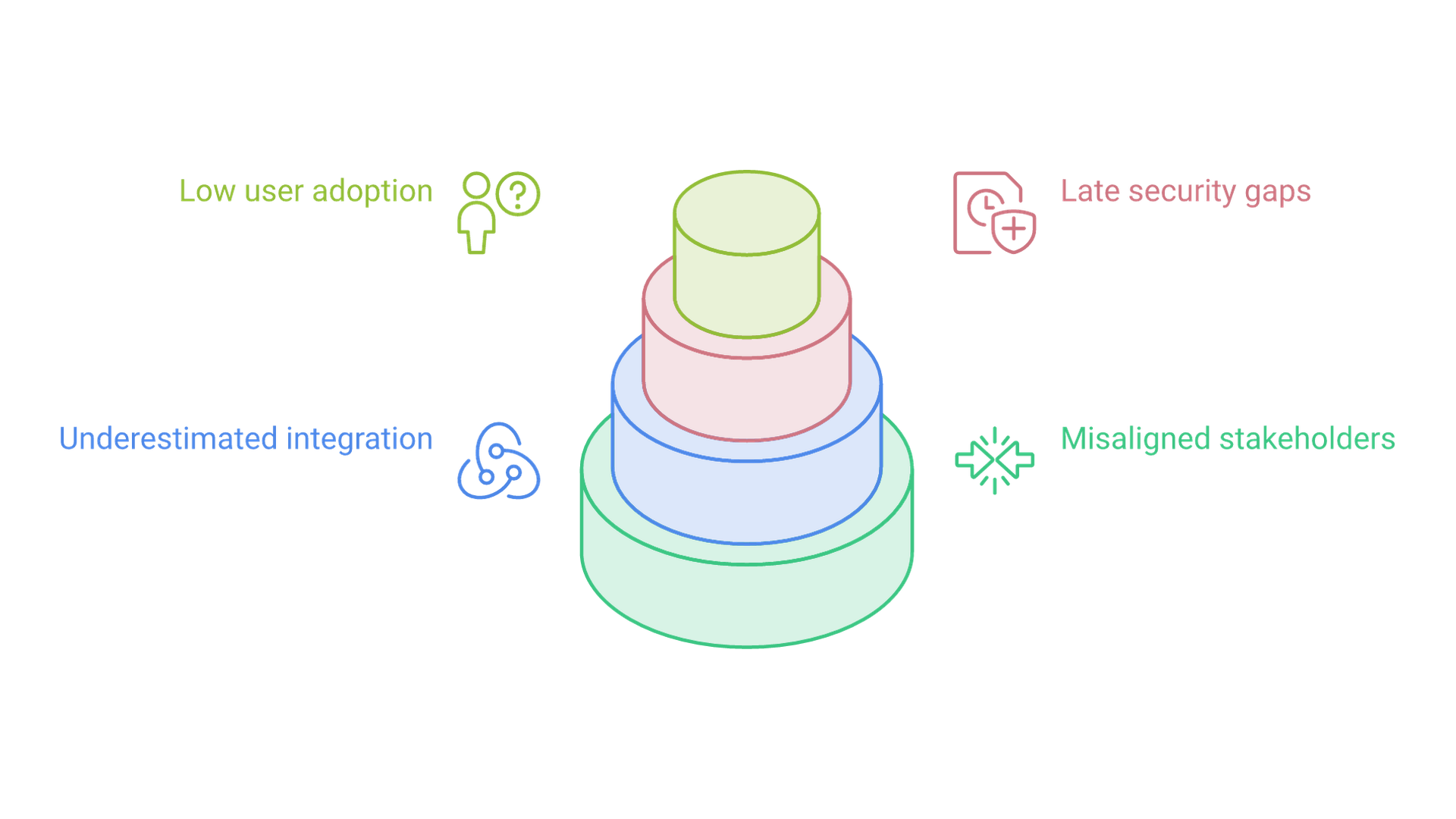
Most enterprise failures stem from predictable process issues rather than purely technical mistakes. Addressing these proactively is the difference between project success and costly rework. Cognativ's software engineering consulting helps enterprise teams catch these issues early by reviewing scope, integrations and governance before the build starts.
Misaligned Stakeholders and Scope Creep
Shifting priorities and new business stakeholders emerging mid-project are the most common sources of rework and delay. When objectives conflict-or when a previously uninvolved department discovers the project affects their workflows-scope expands unpredictably.
Actionable countermeasures: Establish governance early with a steering committee and clear escalation paths. Assign a single accountable product owner with authority to prioritize. Implement a formal change-control process tied to business value-every scope addition must demonstrate its impact on business goals before entering the backlog.
Underestimated Integration and Data Migration Work
Integration and data migration are often 30–50% of total effort in complex enterprise initiatives, yet they are frequently underbudgeted and underplanned. Seamless integration enhances efficiency and productivity in organizations, but achieving it requires treating these as dedicated workstreams.
Solutions: Allocate dedicated milestones, budgets, and quality assurance cycles for integration and migration. Run early data profiling to surface quality issues. Build proof-of-concept integrations for the highest-risk connections during Stage 2. For enterprise software integration strategy, plan as rigorously as you plan core feature development.
Security, Compliance, and Audit Gaps Discovered Too Late
Late-discovered security findings or compliance gaps are among the most expensive delays in enterprise development. A failed penetration test two weeks before go-live can push launch by months.
Solutions: Embed security threat modeling in Stage 2 architecture work. Run continuous security testing throughout the development phase, not just at the end. Engage legal and compliance teams early. Build audit trails and logging requirements into the architecture from the start. Security and compliance must be considered from the beginning of the software development process.
Low User Adoption After Go-Live
Even technically sound custom software fails if users do not adopt it. Common causes include insufficient UX focus, poor communication about changes, inadequate training, and failure to retire old software tools-leaving users with the option to revert to familiar workflows.
Solutions: Involve frontline users in design (Stage 3) and UAT (Stage 6). Co-create training materials with business leaders who understand daily workflows. Monitor adoption metrics post-launch and address gaps with targeted improvements. Streamline processes by retiring legacy tools on a defined schedule rather than leaving them running indefinitely.
Additional Resources on Enterprise Software Development
For teams building a deeper internal playbook, these areas are worth exploring further:
- Legacy modernization strategies for organizations with decades of technical debt locked in existing infrastructure-understanding when to refactor, re-platform, or replace
- Secure custom software development practices for regulated industries where security architecture must be designed alongside business logic
- AI-driven automation and business intelligence integration, especially for organizations designing platforms that need to support analytics and ML workflows from day one
- Supply chain management and CRM platform integration for enterprises connecting operational systems across partners and geographies-see our piece on transportation IT solutions for supply chain operations
Bring in external specialists when your initiative involves large-scale data migration design, security architecture in regulated industries (healthcare, fintech, energy), or AI-first architecture planning. Agile and DevOps methodologies are often adapted for enterprise software projects, but scaling them across multiple delivery teams requires experienced guidance. Common methodologies include Waterfall, Agile, Scrum, and DevOps-and most enterprise programs use a hybrid that combines iterative sprints with formal governance gates.
Conclusion and Practical Next Steps
A disciplined, 8-stage enterprise software development process reduces risk and directly links technology investment to measurable business outcomes. Each stage-from multi-stakeholder discovery through continuous improvement-produces specific deliverables, involves defined roles, and is measured by concrete metrics. The approach is not about adding bureaucracy; it is about ensuring that complex projects deliver the operational efficiency, compliance, and competitive advantage they promise.
If you are planning an enterprise software development project in the next 6–12 months, here are concrete steps to take now:
- Run a lightweight discovery. Spend 2–3 weeks interviewing key stakeholders, mapping current systems and data flows, and documenting baseline metrics.
- Inventory your integration landscape. Catalog every system the new platform must connect to, noting API availability, data formats, and ownership.
- Define success metrics before choosing a technology. Establish the business outcomes you need-cycle time reduction, error rate targets, compliance milestones-so that every technical decision traces to value.
- Choose a pilot domain. Select a bounded, high-impact area (e.g., one product line, one geography) for modernization first, then expand.
- Assess build vs. buy trade-offs. Determine where custom enterprise software development delivers differentiation and where packaged solutions suffice.
For a broader look at how software development methodologies apply across project types, our guide on system development methodology covers eight approaches and how to choose. When you are ready to apply the enterprise-specific process described here, this article gives you the stage-by-stage playbook.
If you need help structuring, accelerating, or rescuing a complex enterprise initiative, Cognativ's software development consulting team can work with you to build a pragmatic modernization roadmap grounded in your actual systems, workflows, and constraints.
Ready to assess your current systems, workflows, and constraints? Contact Cognativ for a focused assessment that produces a pragmatic modernization roadmap-not a generic report-tailored to your enterprise's specific tailored solutions and business operations.