
Nearshore vs Offshore: How to Choose the Right Software Development Model (and When Onshore Is Worth It)
Compare onshore, nearshore and offshore software teams on real total cost, overlap hours, legal exposure and governance, and see which model fits each project.
Nearshore vs offshore is the central question for any technology leader preparing to outsource software development - but it's rarely a binary choice. Onshore development deserves equal consideration, especially when regulatory exposure, intellectual property risk, or architectural complexity is high. This guide compares all three location-based delivery models across the dimensions that actually matter: total cost of ownership, time zones, communication efficiency, legal exposure, quality control, and governance.
This article is scoped to B2B, custom enterprise software, web platforms, and data/AI projects - the kind of work where the stakes are real and the wrong outsourcing model can cost far more than it saves. It is not about staff-leasing marketplaces or one-off freelancer engagements. The target audience is CIOs, CTOs, VPs of Engineering, and Heads of Product or Operations in mid-market and enterprise organizations, many operating in regulated or operationally complex environments.
Here is the short answer: for US-based companies, offshore development is usually best for stable, cost-sensitive, long-term builds with well-defined requirements; nearshore software development is strongest for high-collaboration agile work requiring real time collaboration; and onshore software development is worth the premium when regulatory, IP, or business risk is highest and justifies the cost.
By the end of this article, you will:
- Understand the key differences between onshore, nearshore, and offshore delivery models
- See a side-by-side comparison table covering cost, time zones, legal exposure, and quality
- Identify hidden costs beyond hourly rates that erode offshore savings
- Know which model fits which project type, phase, and risk profile
- Have a vendor-question checklist ready for your next RFP or partner evaluation
Understanding Location-Based Delivery Models in Software Development
Location-based delivery models - onshore, nearshore, and offshore - define where your software development team sits relative to your business. That geographic relationship directly shapes cost, control, risk, time-to-market, and your ability to respond to ambiguity or change during the development process. Choosing the right development model is not simply about finding the lowest rate; it is about optimizing total cost of ownership against your organization's actual constraints and risk tolerance.
Cognativ operates as a US-based onshore software development company that can work alongside clients' existing nearshore or offshore vendors rather than competing as a low-cost dev shop. This perspective - working alongside distributed teams and designing hybrid delivery structures - informs the practical guidance throughout this article.
What Is Onshore Software Development?
Onshore software development means your development teams are located in the same country as your organization. For a US company, this means US-based onshore developers working under the same legal system, sharing the same time zone, and operating within familiar regulatory frameworks.
The practical implications are significant: intellectual property ownership is governed by domestic law, data protection laws are consistent, in-person collaboration is straightforward, and there is no coordination tax from time zone differences. Onshore outsourcing refers to engaging an external partner - rather than building an internal local team - while retaining these geographic advantages. Domain understanding tends to be stronger when engineers share the same business reality, same language, and regulatory context as their stakeholders.
Onshore hourly rates are typically the highest. However, total cost of ownership may actually be lower for high-risk, high-ambiguity, or mission-critical initiatives once hidden costs in other models are accounted for.
What Is Nearshore Software Development?
Nearshore software development involves working with development teams in a nearby country, typically within 0–3 hours of time zone difference and with meaningful cultural alignment. For US firms, common nearshore destinations include Mexico, Colombia, Costa Rica, and Brazil. For Western European companies, Eastern Europe - countries like Poland or Romania - serves the same function.
Nearshore outsourcing involves countries within the same time zone or very close to it, which preserves the ability for daily standups, sprint reviews, and ad-hoc problem-solving without forcing anyone into inconvenient shifts. Nearshore outsourcing typically offers lower costs than onshore development. Travel for key workshops or kickoffs is measured in hours, not days.
That said, nearshore teams still operate under different legal systems and data regimes, which means contracts, NDAs, and governance structures must be carefully defined. Cultural similarities reduce misunderstandings in nearshore partnerships, but they don't eliminate the need for clear requirements and architectural guardrails.
What Is Offshore Software Development?
Offshore software development places your offshore team in a distant country with 5+ hours of time zone difference from your organization. For US-based companies, this typically means India, the Philippines, Vietnam, or - depending on the coast - eastern European countries. Offshore teams often operate in time zones 5+ hours apart from their client company, which fundamentally changes how collaboration works.
The main benefits are clear: offshore outsourcing provides access to a larger talent pool, enables large-team scaling, and delivers the lowest hourly labor costs.
The primary challenges are equally clear: time zone differences complicate project management in offshore outsourcing, coordination overhead increases, governance becomes harder to enforce from a distance, and IP and compliance exposure varies significantly depending on the jurisdiction. Communication hurdles in offshore outsourcing can lead to delays and misunderstandings, especially when requirements are ambiguous or evolving. Cultural differences can exacerbate time zone challenges in offshore outsourcing, compounding the friction.
Understanding these models conceptually is useful, but leaders need concrete comparison on cost, risk, and quality to make an informed decision. The next section provides exactly that.
Nearshore vs Offshore vs Onshore: Side-by-Side Comparison
This section compares all three models on the dimensions that actually drive total cost of ownership, risk, and project delivery outcomes. The choice between nearshore and offshore outsourcing depends on cost, communication, and project complexity - but also on factors many procurement teams underweight, like legal exposure and governance load.
Core Trade-Offs at a Glance
Dimension | Onshore (US) | Nearshore (LATAM / Eastern Europe) | Offshore (India, SE Asia) |
|---|---|---|---|
Working-hours overlap (US Eastern) | Full 8–10 hours | Near-full (LATAM); 3–5 hours (Eastern Europe) | Limited; often 1–3 hours shared window |
Communication & cultural proximity | Highest; shared business context and same language | Moderate to high; strong English proficiency in many LATAM/EE firms; cultural alignment is generally strong | Variable; language and cultural norms may differ significantly; requires more formalization |
IP & legal exposure | Domestic legal system; easiest enforcement | Cross-border contracts needed; moderate exposure; increasing standardization around compliance certifications | Higher variability; enforcement harder in some jurisdictions; greater due diligence on data privacy, export controls |
Quality control & predictability | Highest; direct oversight, immediate feedback loops | High potential with mature vendors; slightly more oversight needed | Greater risk of quality slippage; must rely heavily on metrics, QA gates, and testing automation |
Total cost drivers beyond hourly rate | Highest rate but fewest hidden costs; most predictable TCO | Moderate savings; some overhead from travel, governance, ramp-up; strong productivity from time zone overlap | Lowest baseline cost; higher overhead in coordination, rework, and turnover; hidden costs can erode savings significantly |
The core takeaway from this table: "cheapest hourly" does not equal lowest total cost. Offshore outsourcing can save on development costs at the rate-card level, but the gap narrows - sometimes dramatically - once you account for the full cost and communication efficiency picture.
Cost vs Total Cost of Ownership
Visible costs are straightforward: hourly rates, vendor margins, travel expenses, and tooling or license fees. These are what appear in proposals and purchase orders. Hidden costs are where companies outsource software development and then discover the real price: extra management layers, rework cycles caused by misalignment, slower decision cycles across time zones, turnover-driven knowledge loss, and onboarding overhead for replacement engineers.
The true loaded cost of offshore development can land well above the sticker rate once ramp-up, management overhead, and attrition are included.
Time Zones, Communication, and Collaboration
Overlapping working hours directly impact the speed and quality of agile ceremonies (standups, backlog grooming, sprint reviews), urgent production incident response, and stakeholder workshops - especially early in a project when requirements are still being shaped.
Onshore provides full overlap and the easiest ad-hoc collaboration. When a critical design question surfaces at 2 PM, your onshore team is available immediately. Nearshore offers high overlap - nearshore outsourcing supports real-time collaboration due to time zone alignment, making it ideal for daily collaboration with some flexibility for early-morning or late-afternoon ceremonies. Nearshore outsourcing allows for seamless communication due to proximity, and the modest travel distance means in-person workshops are practical for quarterly planning or project kickoffs.
Offshore requires explicit asynchronous workflows. Effective offshore collaboration requires a daily overlap of 1–3 hours, which means critical decisions often wait 12–24 hours for the next shared window. This latency is manageable for well-defined, stable work but becomes expensive when requirements shift frequently or production incidents demand immediate cross-team response.
Legal, IP, and Compliance Exposure
Jurisdiction shapes how enforceable your contracts are, how protected your intellectual property is, and whether your data handling meets sector-specific regulations. For enterprise software development in healthcare, financial services, or telecom, these aren't abstract concerns - they're audit findings and compliance violations.
Onshore development operates under domestic law: IP ownership is straightforward to enforce, data protection laws are consistent, and audit preparation is simpler. Nearshore teams often share similar data protection laws with clients, and nearshore outsourcing allows for easier audits and IP control, though cross-border contracts still require specific clauses addressing jurisdiction, dispute resolution, and data residency. Nearshore teams often provide better control over intellectual property than their offshore counterparts.
Data security concerns can complicate offshore outsourcing due to different legal regimes. Offshore contracts must explicitly address IP assignment, export controls (especially relevant for AI models and encryption), data residency requirements, and the practical reality of enforcing contract terms across distant jurisdictions. Managing quality and oversight may be more challenging in offshore outsourcing due to distance, making governance a non-negotiable investment.
Cognativ's approach centers on secure, compliant delivery and close collaboration with client legal and compliance teams - precisely because these issues compound when left to boilerplate contracts.
Quality Control and Governance
Distance and cultural differences influence adherence to coding standards, testing depth, documentation quality, and honest status reporting. The further removed a team is from direct oversight, the greater the risk of "green dashboard" bias - where metrics look healthy even as technical debt or defect rates quietly accumulate.
Onshore: Leaders can inspect work, attend demos, and enforce standards with minimal friction. Architecture review boards and security practices are easier to maintain when everyone operates in the same business context. Nearshore: Similar potential for quality, though in-person architecture workshops require modest travel planning. Nearshore development allows for easier communication and cultural alignment, which translates into more transparent reporting and fewer interpretation gaps. Offshore: Quality depends heavily on well-defined processes, metrics, and automated quality gates. Without strong governance structures, offshore companies may deliver against the letter of requirements while missing the intent - a costly distinction in complex software projects.
Having seen the differences across these dimensions, the next step is knowing which model fits which type of project.
Which Model Fits Which Project?
The question is not "which model is best?" but "which is best for this project, in this organization, at this moment?" The right outsourcing strategy matches delivery model to project phase, risk profile, collaboration intensity, and internal capabilities - and it may change as a project matures. Cognativ's US-based team provides software development outsourcing with onshore architecture, delivery and governance.
When Nearshore Makes the Most Sense
Nearshore outsourcing is suitable for complex projects requiring frequent collaboration. Specific scenarios where a nearshore partner typically delivers the best results include:
- Agile product development with frequent cross-functional collaboration - for example, a new B2B SaaS platform with weekly stakeholder demos and evolving requirements
- Customer-facing applications where rapid UX iteration is essential and feedback loops must be tight
- Projects requiring frequent joint workshops but without the budget for a full onshore team - nearshore strikes the balance between cost and communication efficiency
- Organizations with strong onshore product leadership and architecture that need an execution engine with predictable overlap in a nearby country
Industries where nearshore is often a strong fit include ecommerce, media, logistics, and technology companies building differentiated digital experiences. For regulated sectors, nearshore works when governance structures are robust and data handling requirements are explicitly addressed in contracts.
When Offshore Delivers the Best ROI
Offshore outsourcing is often best for well-defined tasks that can be completed asynchronously. The right outsourcing model leans offshore when:
- Long-term, stable product roadmaps with well-understood requirements and a strong backlog - for example, a multi-year platform build or an ongoing feature factory where the development process is mature
- Cost-sensitive modernization and re-platforming where specifications are clear and risk can be managed through architecture and automation
- Large-scale data engineering, test automation, or DevOps work where tasks can be defined clearly and batched for an offshore development team
- Access to niche specialized skills (specific cloud platforms, AI/ML stacks, integration frameworks) that are scarce domestically - offshore outsourcing provides access to a larger talent pool globally
Offshore is most effective when the client company has disciplined product management, thorough documentation, and release processes that don't depend on real-time decision-making. Without that discipline, offshore savings evaporate into rework.
When Onshore Is Worth the Premium
There are concrete scenarios where an onshore team is intentionally chosen over cheaper alternatives:
- Early-stage discovery and architecture for mission-critical platforms (e.g., healthcare workflows, payments systems, telecom orchestration) where missteps have outsized downstream costs
- AI-first automation or data initiatives where legal or reputational consequences of errors are significant - enterprise AI architecture demands trust, proximity, and governance that distance undermines
- Highly regulated environments requiring close collaboration with security, compliance, and legal teams, and preparation for audits where a chief technology officer or CIO needs direct oversight
- Projects with senior stakeholders who expect in-person or same-day decision cycles and cannot tolerate the latency of offshore coordination
Cognativ's view: use onshore for high-ambiguity phases (strategy, design, architecture, initial implementation), then optionally integrate nearshore or offshore capacity under that blueprint. The premium pays for itself in reduced rework, faster time-to-value, and risk containment.
Hybrid Models: Combining Onshore, Nearshore, and Offshore
Hybrid outsourcing models combine nearshore and offshore strategies for balanced advantages. Common configurations include:
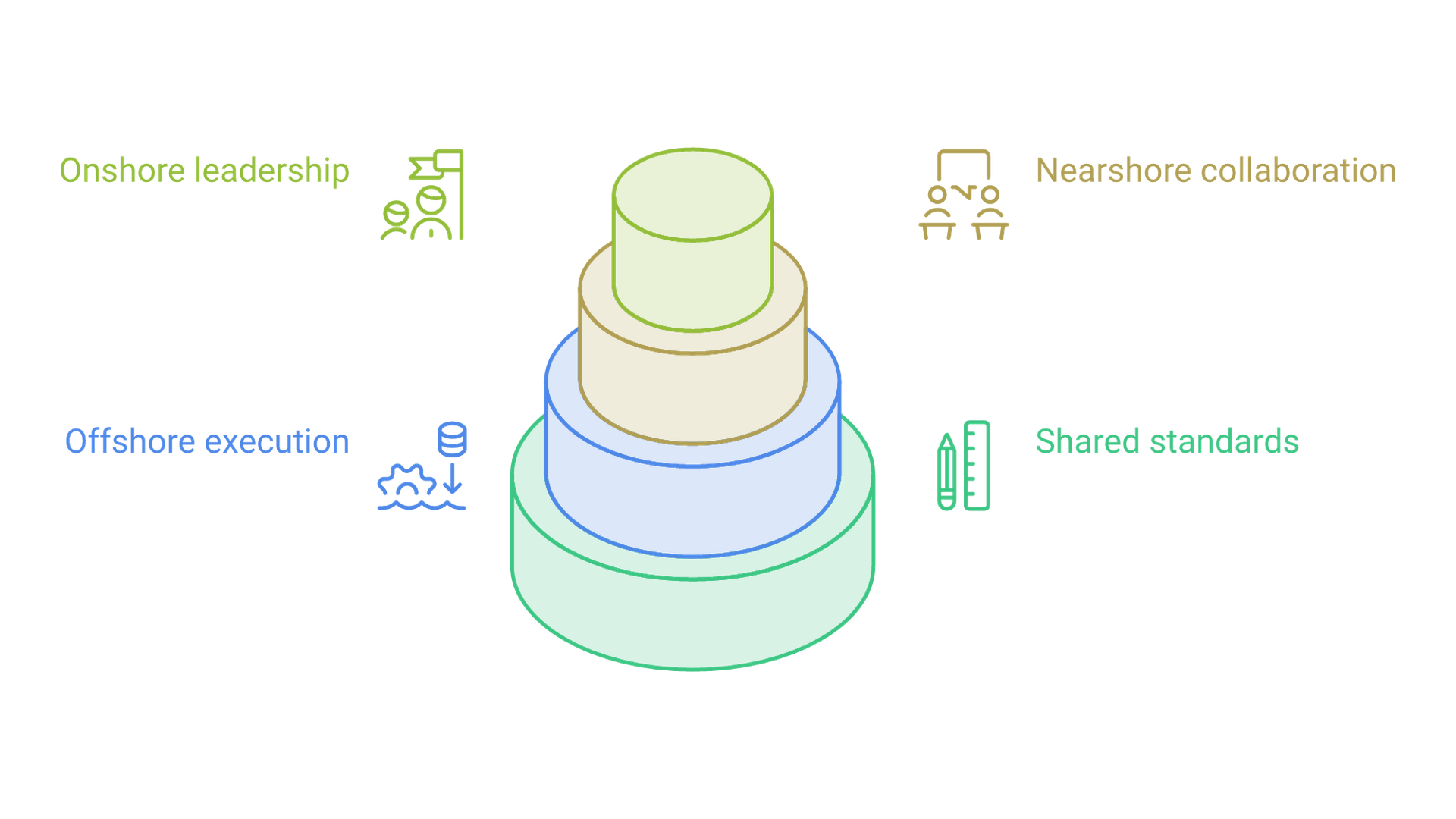
- Onshore leadership + nearshore development for collaboration-heavy, customer-facing frontends where the development teams need daily interaction with product owners
- Onshore product/architecture + offshore execution for well-defined services, integration layers, or QA where project complexity is lower and requirements are stable
- Multiple vendors integrated under an onshore "control tower" - a firm like Cognativ using a structured framework such as RAPID to manage architecture, integration, and roadmap continuity across distributed teams
Hidden Costs and Operational Risks to Watch For
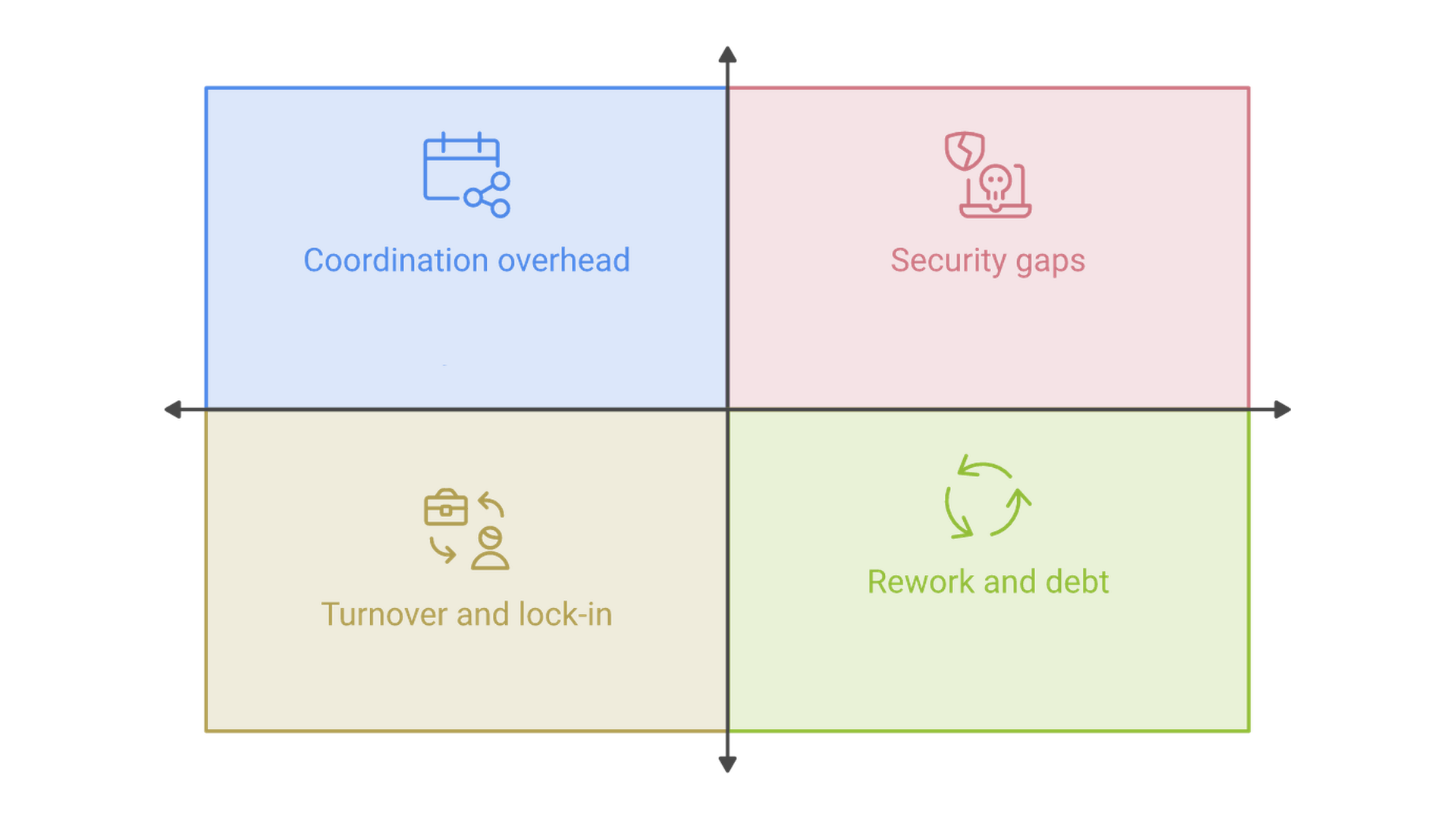
Many failed nearshore and offshore initiatives weren't underfunded - they were too loosely governed. The following risk areas represent the most common sources of cost overruns and delivery failures in underperforming engagements.
Management Overhead and Coordination Load
Time spent on handoffs, cross-time-zone meetings, and clarifications is rarely captured against the project budget. Senior internal people often become "shadow project managers," spending a significant share of their time translating between the offshore partner and internal stakeholders - time that quietly erodes the cost savings the outsourcing model was supposed to deliver.
Mitigation: Define clear ownership using a RACI matrix. Limit vendor layers between your product leadership and the engineers doing the work. Align agile ceremonies across time zones with a fixed schedule that respects overlap windows. Ensure your project manager has authority to make decisions without waiting for the next business day.
Rework, Technical Debt, and Quality Slippage
Lower hourly rates can mask increased defect rates, patch cycles, and production incidents. Architectural shortcuts taken to meet sprint commitments create future rewrite costs that never appear in the original estimate. Over time, these compound into the kind of technical debt that triggers full modernization programs.
Governance recommendations: Establish architecture review boards, enforce code quality metrics and secure development lifecycle practices, require security testing at every stage, and conduct periodic independent audits. An onshore partner like Cognativ can serve as the architecture and quality authority even when build teams are nearshore or offshore.
Turnover, Knowledge Loss, and Vendor Lock-In
Some offshore markets experience higher attrition among talented software developers, and when knowledge lives only in people's heads, each departure creates project risk. Vendor-owned knowledge - where the outsourcing partner controls documentation, infrastructure credentials, or deployment processes - creates lock-in that makes transitions painful and expensive.
Mitigation: Insist on documentation standards from day one. Require shared repositories, onboarding guides, and architecture decision records. Include explicit IP ownership and exit clauses in every contract, with defined timelines and deliverables for knowledge transfer at end of engagement.
Security, Data Protection, and Compliance Gaps
Key exposure points include remote access to production or sensitive test data, lack of unified identity and access management across vendors, and data residency conflicts when data crosses borders. For organizations in healthcare, finance, or education, these gaps can trigger regulatory violations.
Practical controls: Implement least-privilege access policies, segregate production and test environments, maintain comprehensive logging, require vendor security questionnaires and certifications (SOC 2, ISO 27001), and conduct regular access reviews. These controls apply regardless of whether your software development team is onshore, nearshore, or offshore - but enforcement becomes harder with distance.
How to Decide: A Practical Selection Process
Choosing between onshore vs offshore - or any combination - should be a repeatable decision process applied to each major project or program, not a one-time company-wide policy. Different initiatives within the same organization may warrant different models.
A 5-Step Decision Framework
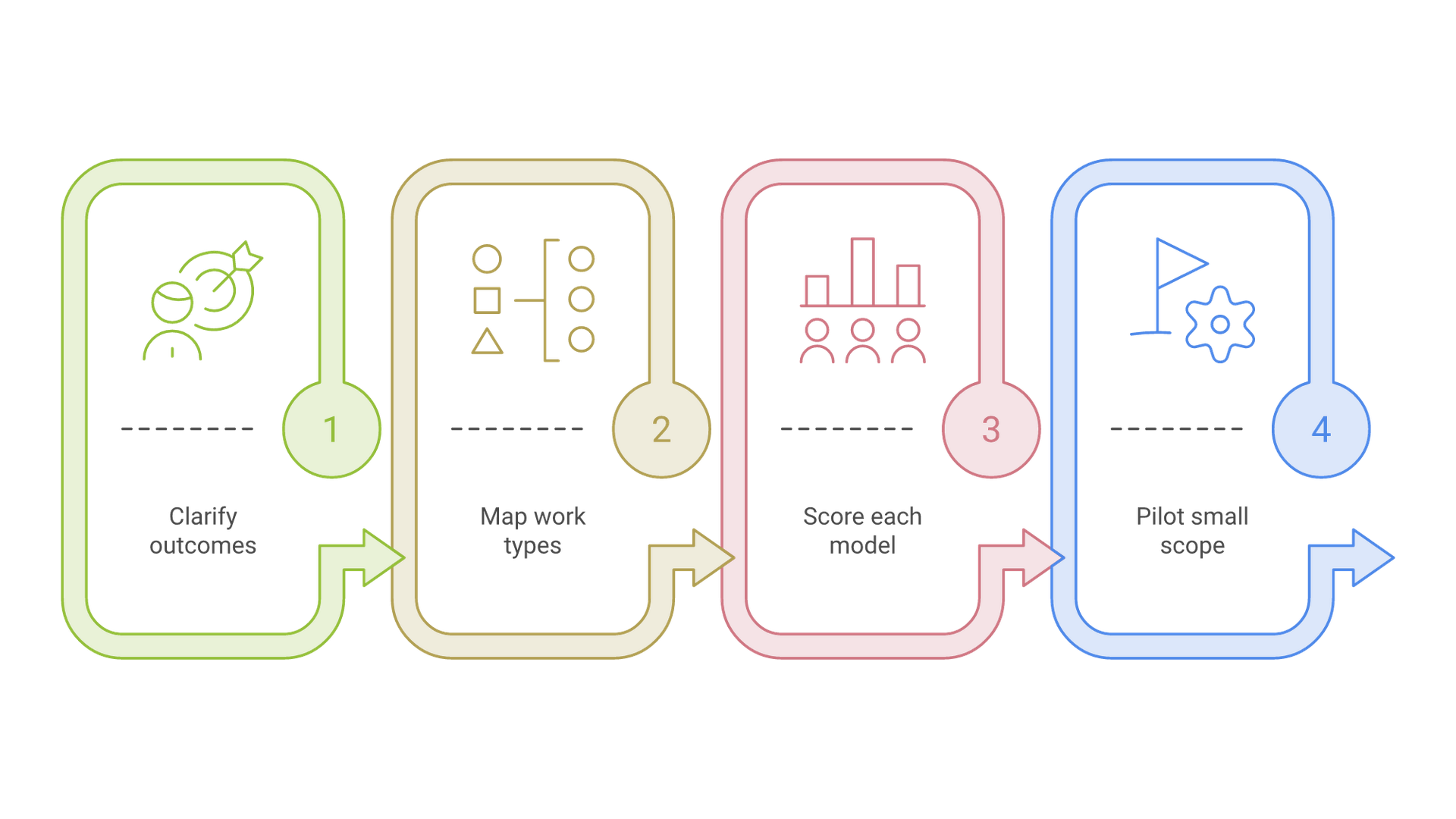
- Clarify business outcomes and constraints. Define time-to-market requirements, budget ceilings, risk tolerance, and regulatory context. A clinical workflow platform and an internal reporting dashboard have very different constraint profiles.
- Map work types and assess collaboration intensity. Break the program into work categories - discovery, architecture, build, integration, data/AI, support - and assess how collaboration-heavy each is. High-ambiguity, high-collaboration work points toward onshore or nearshore; stable, well-defined work can move offshore.
- Score each model against core dimensions. Evaluate onshore, nearshore, and offshore options against cost, time zone overlap, IP and legal exposure, quality control requirements, and your internal management capacity to govern distributed teams.
- Design a delivery model that matches project phases. Consider starting onshore for the first 3–6 months of discovery and architecture, then adding nearshore development capacity for feature build-out, or shifting well-defined modules to an offshore development team once requirements stabilize.
- Pilot with a small, measurable scope. Test the chosen model - or vendor - on a bounded piece of work before committing to a full program. Measure delivery velocity, defect rates, communication quality, and team satisfaction, then adjust based on data.
Cognativ's RAPID framework provides a structured approach to this assessment, helping organizations move from current delivery model pain points to a governed, phased plan built for early, actionable clarity.
Questions to Ask Any Nearshore or Offshore Vendor
The quality of your outsourcing partner matters far more than their latitude or longitude. A disciplined offshore vendor can outperform a sloppy nearshore one, and vice versa. Cultural compatibility is crucial for successful outsourcing partnerships, but so are process maturity, security posture, and contractual clarity. The following questions are designed to surface real capability - use them in RFPs, vendor interviews, or partner evaluations.
Delivery Model and Collaboration
- What working-hour overlap can you guarantee with US Eastern or Pacific time? How do you handle local holidays that differ from ours?
- How do your teams handle agile ceremonies (standups, retrospectives, sprint planning) across time zones?
- Will we work directly with engineers, or only through a project manager layer?
- How do you ensure continuity when team members roll off, are reassigned, or leave the company? What is your turnover rate among mid and senior software developers?
Quality, Security, and Compliance
- What coding standards, code review practices, and testing protocols (unit, integration, system) do you enforce?
- How do you handle security in the software development lifecycle - threat modeling, SAST/DAST, dependency scanning?
- Which security and compliance certifications do you hold (e.g., SOC 2, ISO 27001, HIPAA)? Can you share recent audit summaries?
- How will you support our industry-specific compliance needs in healthcare, financial services, or other regulated domains?
Contracts, IP, and Exit Strategy
- Which jurisdiction's law governs your contracts, and how are intellectual property rights assigned?
- How do you handle data residency requirements and cross-border data transfers under applicable data protection laws?
- What is your process and timeline if we decide to transition work away from your team?
- How do you ensure all deliverables, documentation, infrastructure credentials, and runbooks are transferred at end of engagement?
Cost Transparency and Total Cost of Ownership
- How is time tracked and reported across roles (developers, QA, PM, architecture)?
- What activities are billable versus non-billable? How do you handle internal meetings, onboarding, and knowledge transfer?
- What non-obvious costs have prior clients encountered - travel, tooling, training, license fees - and how were they handled?
- Can you share example productivity benchmarks and defect rates from similar software projects to help us model total cost?
Common Challenges and How to Address Them
These are recurring patterns in underperforming nearshore or offshore initiatives. Each represents a solvable problem - if addressed proactively.
Misaligned Expectations and Vague Requirements
Fuzzy scope leads to rework regardless of model, but the damage multiplies offshore where feedback loops are slower and cultural differences can cause teams to build what was literally specified rather than what was actually needed. Offshore outsourcing is often best for well-defined tasks - when tasks aren't well-defined, the model breaks down.
Solution: Invest in onshore or nearshore discovery phases. Produce clear user stories with acceptance criteria, architectural guardrails, and domain context documentation before scaling build teams. This upfront investment consistently pays for itself in reduced rework. Cognativ's software development consulting practice serves this exact function - establishing clarity before execution begins.
Fragmented Tooling and Visibility
Multiple vendors using different project management tools, repositories, CI/CD pipelines, and communication platforms create blind spots in delivery. When no one has a unified view, problems hide until they become crises.
Solution: Standardize on a common toolchain - Jira (or equivalent), Git, a shared CI/CD pipeline, unified observability dashboards - and require all teams to report against the same metrics and SLAs. Scaling from pilot to program depends on this kind of operational consistency across teams, regardless of where they sit.
Over-Reliance on a Single Vendor
Concentrating all critical systems development with one offshore or nearshore vendor creates a single point of failure. If that vendor experiences attrition, financial difficulty, or quality decline, your entire delivery program is at risk.
Solution: Design modular architectures that allow work distribution across multiple vendors where appropriate. Maintain an onshore owner responsible for architecture, integration standards, and roadmap continuity. This "control tower" model - whether staffed internally or through a partner like Cognativ - ensures that no single outsourcing company holds the keys to your platform.
These patterns directly inform how leaders should move forward once they've chosen a model or mix of models.
Additional Resources
For readers looking to go deeper into outsourcing strategy, delivery model design, and modernization planning:
- Software development outsourcing - Cognativ's approach to outsourcing strategy and partner integration for enterprise organizations
- Custom enterprise software development - how platform control and architectural ownership reduce long-term risk regardless of delivery model
- Vendor platform selection after clarity - a practical framework for choosing platforms and partners once business requirements are understood
Related topics worth exploring: how legacy system modernization intersects with location model choices and migration risk; how AI-first architecture requires specific governance when development teams are distributed; and how workflow-specific automation and tool stack consolidation reduce operational friction across multi-vendor environments. Leaders who need a structured, business-first approach can use Cognativ's RAPID framework to move from current delivery model pain points to a governed, hybrid plan.
Conclusion and Next Steps
Nearshore vs offshore vs onshore is a trade-off grid, not a one-time verdict. The right answer depends on project phase, risk profile, collaboration requirements, and your organization's internal capabilities to govern distributed work. There is no universally superior model - only the right outsourcing model for a given initiative at a given moment.
What is consistent: onshore partners like Cognativ deliver the most value where risk is high, ambiguity is significant, and architecture and governance are the difference between successful projects and expensive failures. When the foundation is right, nearshore and offshore capacity can be layered on safely and cost-effectively.
Actionable next steps:
- Audit your current and planned projects against the cost, risk, and collaboration dimensions outlined in this article
- Identify project phases where onshore leadership would reduce risk or accelerate outcomes - discovery, architecture, and security-sensitive modules are common starting points
- Design a pilot engagement to test a nearshore or offshore partner under stronger governance before committing to a full program
- Apply the vendor question checklist from this article in your next RFP or partner evaluation to surface hidden costs and capability gaps
- Explore Cognativ's software development outsourcing capabilities, or contact us to discuss structuring a delivery model roadmap grounded in measurable ROI
To map the right delivery model for your next program, talk to our US-based team.
FAQs: Nearshore vs Offshore vs Onshore
These answers address the most common quick questions decision-makers ask when evaluating location-based delivery models for software development.
What is the difference between nearshore and offshore software development?
Nearshore software development means partnering with teams in a nearby country - typically within the same time zone or 0–3 hours difference - such as a US company working with developers in Mexico or Colombia. Offshore software development involves teams in a distant country with 5+ hours of time zone difference, such as India or Vietnam. Nearshore teams typically share the same time zone or have minor differences, enabling real-time collaboration and cultural alignment, while offshore prioritizes cost savings and access to a larger talent pool at the expense of synchronous communication.
How does onshore compare to nearshore and offshore on cost and risk?
Onshore development has the highest hourly cost but offers the lowest legal and IP complexity, full time zone overlap, and direct oversight. For regulated, mission-critical work, onshore often delivers the lowest total cost once rework, compliance gaps, and governance overhead in other models are considered. Nearshore balances moderate cost reduction with manageable risk, while offshore offers the deepest cost savings but requires the most governance investment.
Is nearshore always better than offshore for agile development?
Not always. Heavy real-time collaboration - frequent design reviews, daily stakeholder interaction, rapid pivots - typically favors nearshore or onshore because of time zone alignment and cultural proximity. However, disciplined offshore teams with strong asynchronous practices, clear documentation, and mature product ownership can succeed in agile environments. The key factors are the team's process maturity and the project's tolerance for communication latency, not geography alone.
How should I factor in total cost of ownership, not just hourly rate?
Look beyond rate cards. The main hidden costs to evaluate include: rework caused by miscommunication or vague requirements, management overhead from coordinating across time zones, travel expenses for workshops and onboarding, security and compliance investment required for cross-border work, and turnover-driven knowledge loss. Offshore outsourcing typically offers cost savings on labor rates, but the total project cost gap with nearshore is often much narrower than the rate gap suggests.
When should I involve an onshore partner like Cognativ?
Consider an onshore partner when you're deciding between delivery models for a new program, designing a hybrid delivery structure, modernizing legacy systems where architectural missteps carry outsized risk, or rescuing a struggling nearshore or offshore initiative. Cognativ can also help when organizations need governance, architecture, and security oversight across distributed development teams - serving as the onshore control tower that ensures successful projects regardless of where the code is written. If any of these apply, reach out for an assessment.