

Project Handoff Checklist: Handoff Mapping, Handover Documents and Transition Plans
Map every point where work changes hands, then use a checklist, a handover document and a transition plan so each new owner can act correctly from day one.
A project handoff checklist is the list of items a team must transfer, confirm and sign off before another person or team takes responsibility for the work. It sounds administrative, but most handoff problems are not caused by missing paperwork. They come from unclear ownership, context that lived only in someone's head, and a receiver who never got a chance to ask questions.
This guide covers handoff mapping, the main types of handoffs, how to write a project transition plan and a handover document, a practical checklist, common mistakes and how handoffs are changing in 2026.
What Is a Project Handoff?
A project handoff is the moment responsibility for work, decisions or a deliverable moves from one owner to another. The giver stops being accountable and the receiver starts. Everything that the receiver needs to act correctly, from current status to open risks to who to call, has to cross that boundary with it.
"Handoff" and "handover" are used interchangeably in most organizations. Some teams reserve "handover" for the formal end of a project and "handoff" for smaller transfers along the way, such as design to engineering. The mechanics are the same: define what moves, transfer the knowledge, confirm the receiver can act, and record the change of ownership.
Unlike a status update, which informs someone, a handoff changes who is responsible. That is why it should end with an explicit acceptance.
Why Handoffs Fail
Handoffs fail at the boundary between two people who each assume the other has covered something. The giver knows the background so well that they leave it out. The receiver does not know what they do not know, so they cannot ask for it.
Healthcare has studied this more rigorously than any other field because handoff failures there can harm patients. The patient safety primer on handoffs and signouts from AHRQ PSNet summarizes the evidence: communication failures between providers are a leading cause of preventable error, and standardized handoff processes, structured tools and protected time for questions improve information transfer. The Joint Commission issued a Sentinel Event Alert on inadequate hand-off communication in 2017, recommending that handoffs cover a status assessment, a summary, a to-do list and contingency plans, and happen face to face when possible.
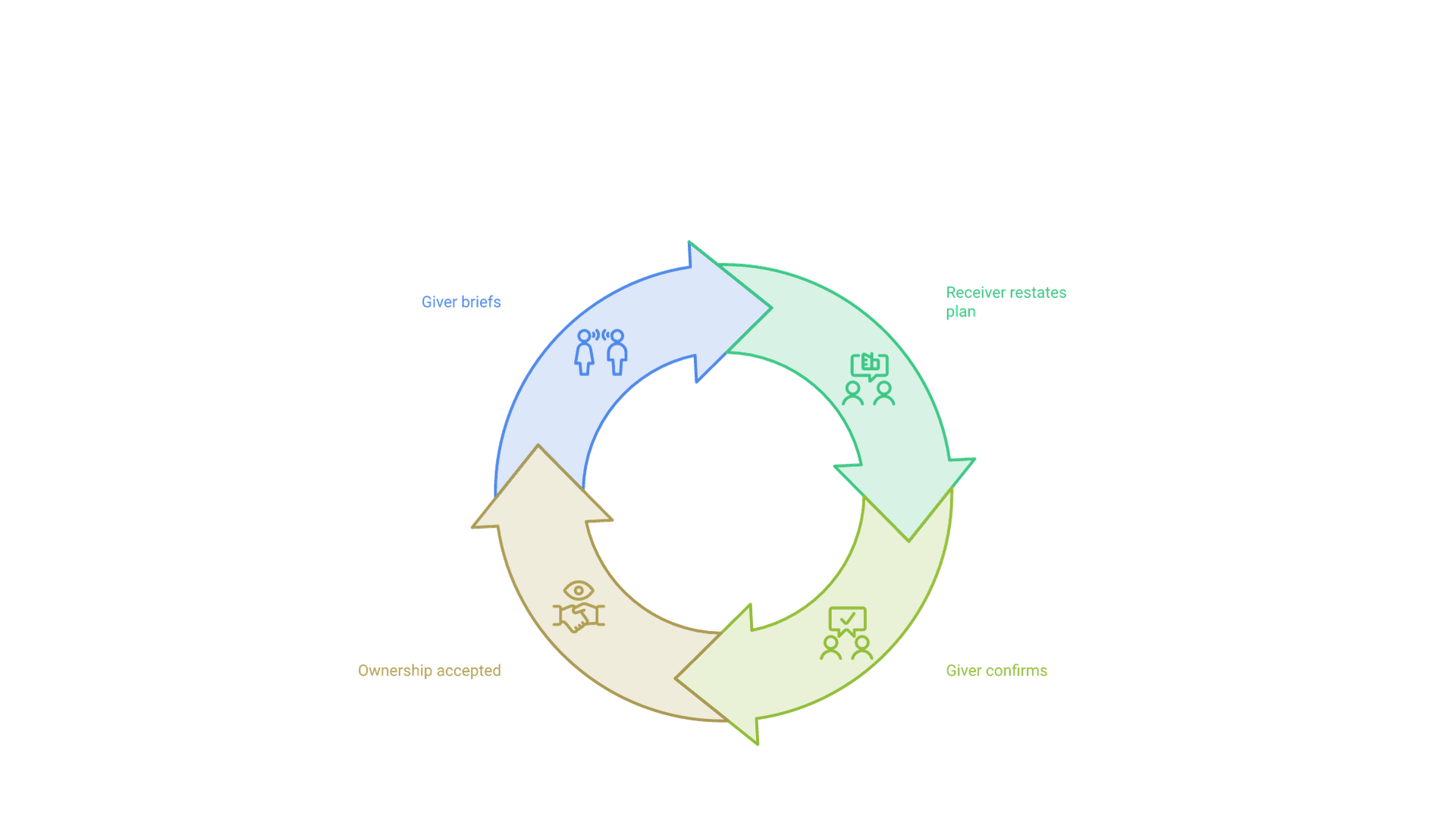
The best known structured method, I-PASS, stands for illness severity, patient summary, action list, situation awareness and contingency planning, and synthesis by the receiver. In a multicenter study published in the New England Journal of Medicine in 2014, adopting the I-PASS bundle across nine pediatric residency programs was associated with a 23 percent drop in medical errors and a 30 percent drop in preventable adverse events. The lesson for project teams: structure, training and a receiver who restates the plan make handoffs safer.
Software operations reached the same conclusion. The Google SRE book's chapter on managing incidents recommends that incident command be handed off live, that the outgoing commander state the transfer explicitly, and that they not leave until they receive firm acknowledgment from the new commander.
What Is Handoff Mapping?
Handoff mapping is the practice of drawing every point in a process where work, information or a decision passes from one person, team or system to another, then examining each transfer for delay, rework and risk. It is a focused form of process mapping. It documents the seams between tasks, where waiting and errors accumulate.
A typical handoff map is a swimlane diagram with one lane per role or team. Each arrow that crosses a lane is a handoff. For each one, record what is transferred, in what format, how long it waits, how often it comes back for rework and who confirms receipt.
How to map handoffs step by step
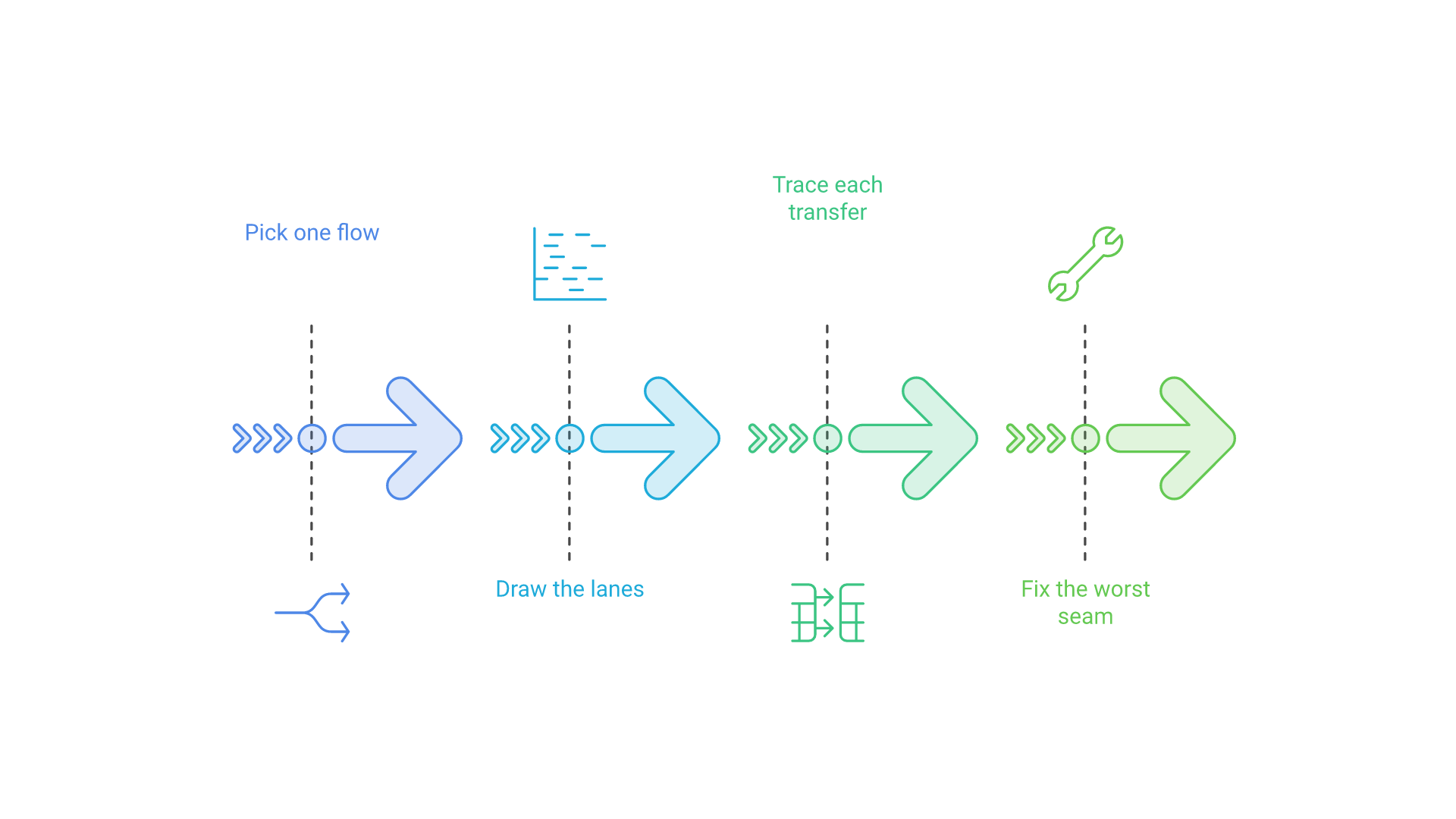
- Pick one end-to-end flow, such as a customer request from intake to delivery, not a whole department.
- List the roles and systems that touch the work and give each a lane.
- Trace real items through the flow and draw every transfer between lanes.
- Annotate each handoff with the artifact passed, the wait time, the rework rate and the acceptance step.
- Decide what to do with each handoff: remove it, merge the roles, standardize it with a template, or automate it.
Handoff maps often reveal a structural problem: if a request crosses six teams before anyone can act, a better template will not fix it. That is a question of team boundaries, decision rights and accountability, which is the territory of operating model design.
Types of Project Handoffs
Not every handoff needs the same rigor. A shift change needs a short format; a project-to-operations handover needs weeks of preparation. The table summarizes common types and where each tends to break.
| Handoff type | Giver and receiver | Typical artifacts | Main risk |
|---|---|---|---|
| Phase handoff | Design team to build team | Specifications, designs, acceptance criteria | Intent lost between design and build |
| Sales to delivery | Account team to project team | Contract, scope, client contacts, promises made | Commitments the delivery team never heard |
| Project to operations | Delivery team to support team | Runbooks, architecture, access, support model | Support team cannot run what it inherits |
| Vendor to client | External partner to internal owner | Source code, documentation, licenses, credentials | Knowledge leaves with the vendor |
| Shift or on-call | Outgoing to incoming responder | Active issues, recent changes, pending actions | An issue nobody owns overnight |
How to Build a Project Transition Plan
A project transition plan schedules the handover so it is a process rather than an event. It defines who receives what, by when, how readiness will be judged and how long the original team stays available. Start it well before the project ends.
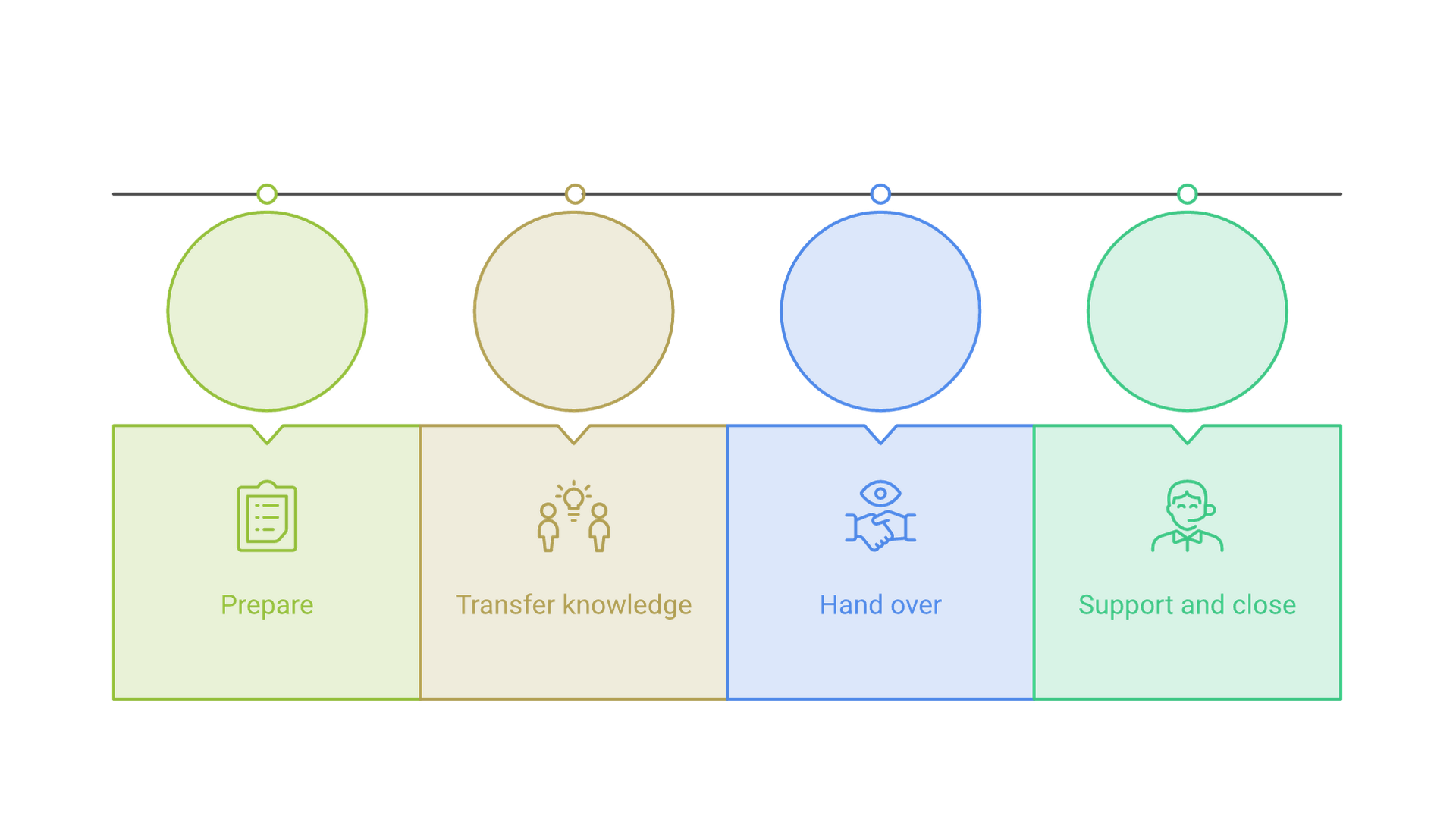
Plan the transition in four stages
Prepare. Name the receiving owner and get their agreement. Define the scope of the transfer and the acceptance criteria the receiver will use. Inventory documentation, systems, access and open work.
Transfer knowledge. Run walkthroughs, demos and paired working sessions. Documents alone rarely carry judgment, so let the receiver shadow the current owner and then lead while the giver watches.
Hand over. Hold a formal handover meeting. Walk through the handover document, open risks and pending decisions, and ask the receiver to restate the plan in their own words. Record the acceptance and the effective date.
Support and close. Agree on a support window during which the original team answers questions. At the end, review what was missing and feed it back into the template.
Give each stage an owner and a date, and decide in advance what happens if acceptance criteria are not met on time.
The Project Handoff Checklist
Use this handoff checklist as a starting point and trim it to the type of handoff. Every item should have an owner and a yes or no answer before acceptance.
Ownership and scope
- Receiving owner named and has agreed to take responsibility
- Scope of the transfer written down, including what is explicitly excluded
- Effective handoff date and support window agreed
- Acceptance criteria defined and shared with both sides
Status and open work
- Current status of every deliverable and milestone
- Open tasks, defects and requests, each with an owner
- Pending decisions and who has authority to make them
- Commitments made to clients or stakeholders that are not yet fulfilled
Risks and context
- Risk and issue log with impact, likelihood and mitigation
- Known workarounds and fragile areas
- Key decisions already made and the reasons behind them
Access, assets and documentation
- System, tool and repository access transferred through approved channels
- Credentials rotated or reassigned, never pasted into the handover document
- Architecture, runbooks, user guides and support procedures
People and communication
- Stakeholder and contact list with roles and escalation paths
- Knowledge transfer sessions completed and recorded
- Receiver has restated the plan and asked their questions
- Sign-off recorded with date and names
What to Include in a Handover Document
The handover document is the written record behind the checklist. Its test is simple: could a capable person who was not on the project act correctly using only this document and the people it names? Keep it short enough to read in one sitting and link to detailed material rather than copying it.
A practical outline has seven parts: a one-paragraph summary of the work and its purpose; the scope of the transfer; current status by deliverable; open items with owners and dates; risks, issues and known workarounds; key decisions with their rationale; and contacts, access arrangements and support terms. Add a short "if this happens, do this" section for the situations the receiver is most likely to face in the first weeks, the project equivalent of the contingency planning in I-PASS.
The document supports the conversation; it does not replace it. Treat questions raised in the live walkthrough as gaps to fix before sign-off.
Standardizing and Automating Handoffs
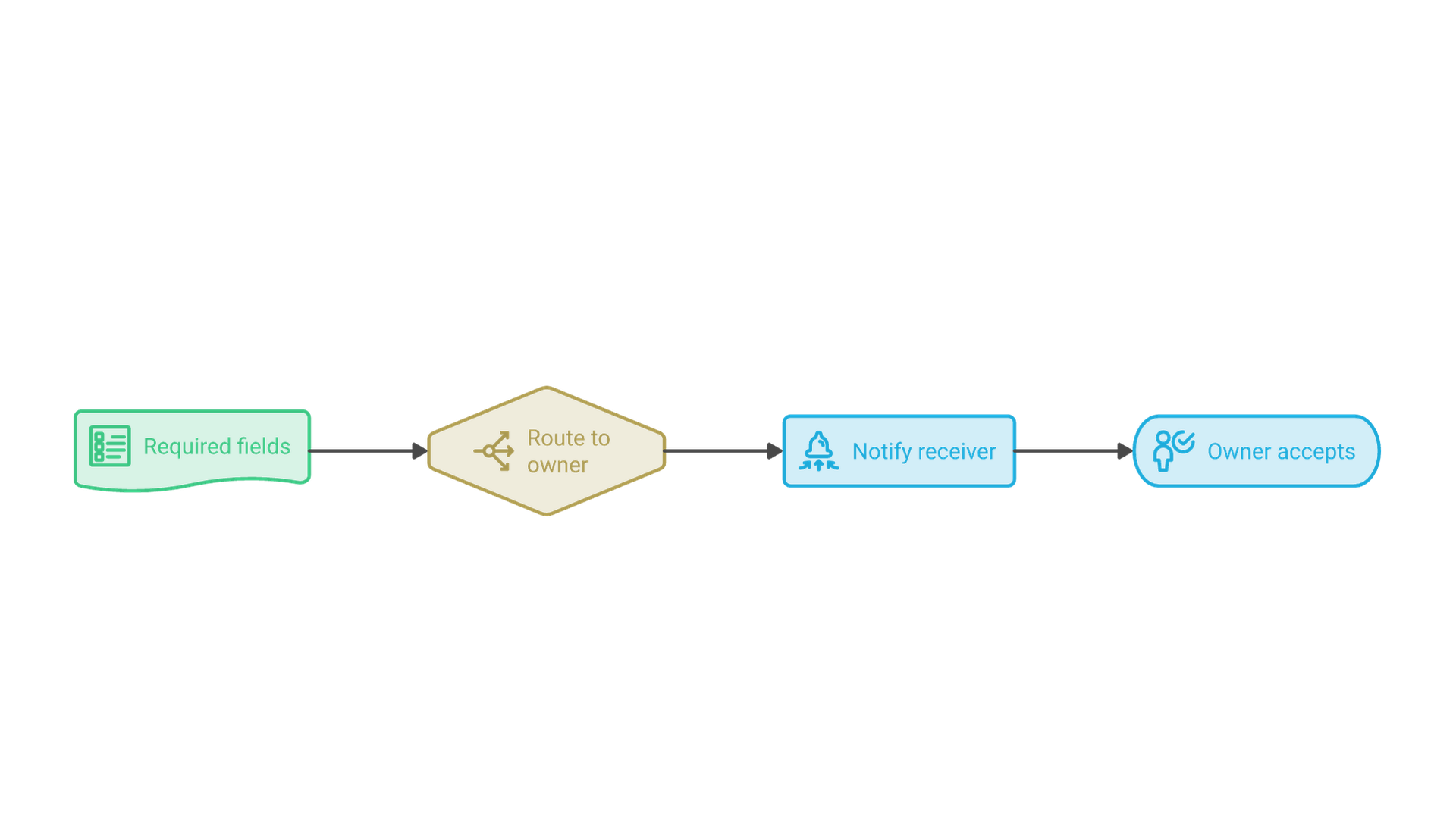
Once a handoff is mapped and its checklist is stable, much of it can be built into the tools teams already use. Templates turn a blank page into a structured form. Required fields prevent a ticket from moving to the next team without an owner, a due date or acceptance criteria. Status changes can notify and assign the receiver, so waiting time becomes visible.
Automation suits repetitive, rules-based transfers such as intake, approvals and escalations, not judgment-heavy handovers where the conversation matters most. Where routing, approvals and notifications follow clear rules, workflow automation can remove manual handoffs entirely rather than just speeding them up.
Whatever you automate, keep an explicit acceptance step.
Common Handoff Mistakes to Avoid
- Starting too late. Last-week planning leaves no time for knowledge transfer.
- Handing off by email. A message is not an acceptance. Without a live conversation and confirmation, ownership is ambiguous.
- Documenting tasks but not decisions. Receivers can see what was built but not why, so settled questions get reopened.
- No named receiver. Handing work to "the support team" rather than a person means nobody is accountable on day one.
- Sharing credentials in documents. Transfer access through proper access management and rotate secrets after ownership changes.
- Ending support at sign-off. The first weeks surface questions no checklist anticipated. Keep the giver reachable for an agreed period.
Project Handoffs in 2026
As of 2026, three shifts are changing how teams handle handoffs. First, distributed and hybrid teams rely more on asynchronous handoffs in shared documents and chat, which makes structure more important, because there is less chance to catch a gap in a hallway conversation. Second, collaboration and work management platforms increasingly use AI to draft handover summaries from tickets, meeting notes and repositories. These drafts summarize what was written down, not what someone knows, so the giver must still review them.
Third, AI agents now perform parts of some workflows, which creates handoffs between people and software. The same rules apply: define what the agent owns, what it passes back to a person, how exceptions escalate and who confirms the result. A human-to-agent boundary with no named owner is just another handoff nobody accepted.
Frequently Asked Questions
What should a project handoff checklist include?
At minimum: the named receiver and scope, deliverable status, open tasks with owners, pending decisions, risks, access and documentation, contacts, knowledge transfer and a recorded sign-off.
What is the difference between a handoff and a handover?
In practice the terms are interchangeable. Some teams use "handover" for the formal transfer at the end of a project and "handoff" for smaller transfers between phases or roles, but both mean moving responsibility from one owner to another.
What is handoff mapping?
Handoff mapping is drawing every point in a process where work passes between people, teams or systems, usually on a swimlane diagram, and assessing each transfer for wait time, rework and risk so you can remove, standardize or automate it.
How do you write a handover document?
Write a short summary of the work, the scope of the transfer, status by deliverable, open items with owners, risks and workarounds, key decisions with reasons, and contacts and support terms. Link to detailed material and review it live with the receiver.
What is a project transition plan?
A project transition plan schedules the transfer of a project to its new owner. It names the receiver, defines acceptance criteria, sets dates for knowledge transfer and handover, and agrees how long the original team will provide support.
How long should a project handover take?
A shift handoff can take minutes; a project-to-operations handover often spans several weeks. Plan the duration from the acceptance criteria, not a fixed date.
Conclusion: Make Every Handoff an Explicit Acceptance
Good handoffs share a few traits regardless of industry: a named receiver, a clear scope, structured content, a live conversation in which the receiver restates the plan, and a recorded acceptance followed by a period of support. Handoff mapping shows where transfers happen and which should not exist; a project handoff checklist and handover document make the rest repeatable. Start with the flow that causes the most visible delays.
If you are redesigning how work moves between teams or want to automate the handoffs that slow your operations, talk to Cognativ about your project.