

AI in Banking: Use Cases, Examiner Expectations and Adoption for US Banks in 2026
How US banks and credit unions apply AI to fraud, AML alerts and core operations, what supervisors published in 2026, and how smaller banks vet AI vendors.
AI in banking is no longer a question of whether a bank or credit union uses machine learning. Many already do, often inside a fraud screen, a payments monitor or a core vendor feature that nobody inside the institution trained. The harder questions are which work the models touch, who answers for them in an exam and how far the data in a decades-old core system can travel.
This guide is written for US banks and credit unions, from community institutions to regionals. It covers where AI earns its place in deposit, payments and compliance operations, what supervisors have actually published as of November 2026, how vendor and fintech relationships change the risk, and how a smaller institution can adopt AI without building a data science department first.
What AI in Banking Covers at a Bank or Credit Union
The phrase covers three kinds of systems with very different risk, and a bank that treats them as one category will either over-control simple tools or under-control the ones that act.
The oldest group is predictive models: scoring a card transaction for fraud, ranking an anti-money laundering alert, estimating the chance that a deposit account is a mule account. These models produce a number that a rule or a person acts on, and banks have validated them for years.
The second group is generative AI: large language models that summarize a case file, draft a suspicious activity narrative for an investigator to edit, answer a policy question for a branch employee or read a scanned document. They produce text, not scores, so the controls shift toward source data, accuracy review and what staff are allowed to paste into them.
The third group is agentic AI, where a model plans steps and calls other systems, such as pulling account history, opening a case or sending a message. The value is fewer handoffs; the risk is that the agent can do things. For a bank, a working definition of AI in banking is any of these three sitting between customer data and a decision that a regulator, an auditor or a customer may later question.
Where Banks Use AI Across Deposits, Payments and Compliance
Bank use cases cluster around the operations that generate the most alerts, documents and repetitive reviews, which is why fraud and financial crime work still leads the list.
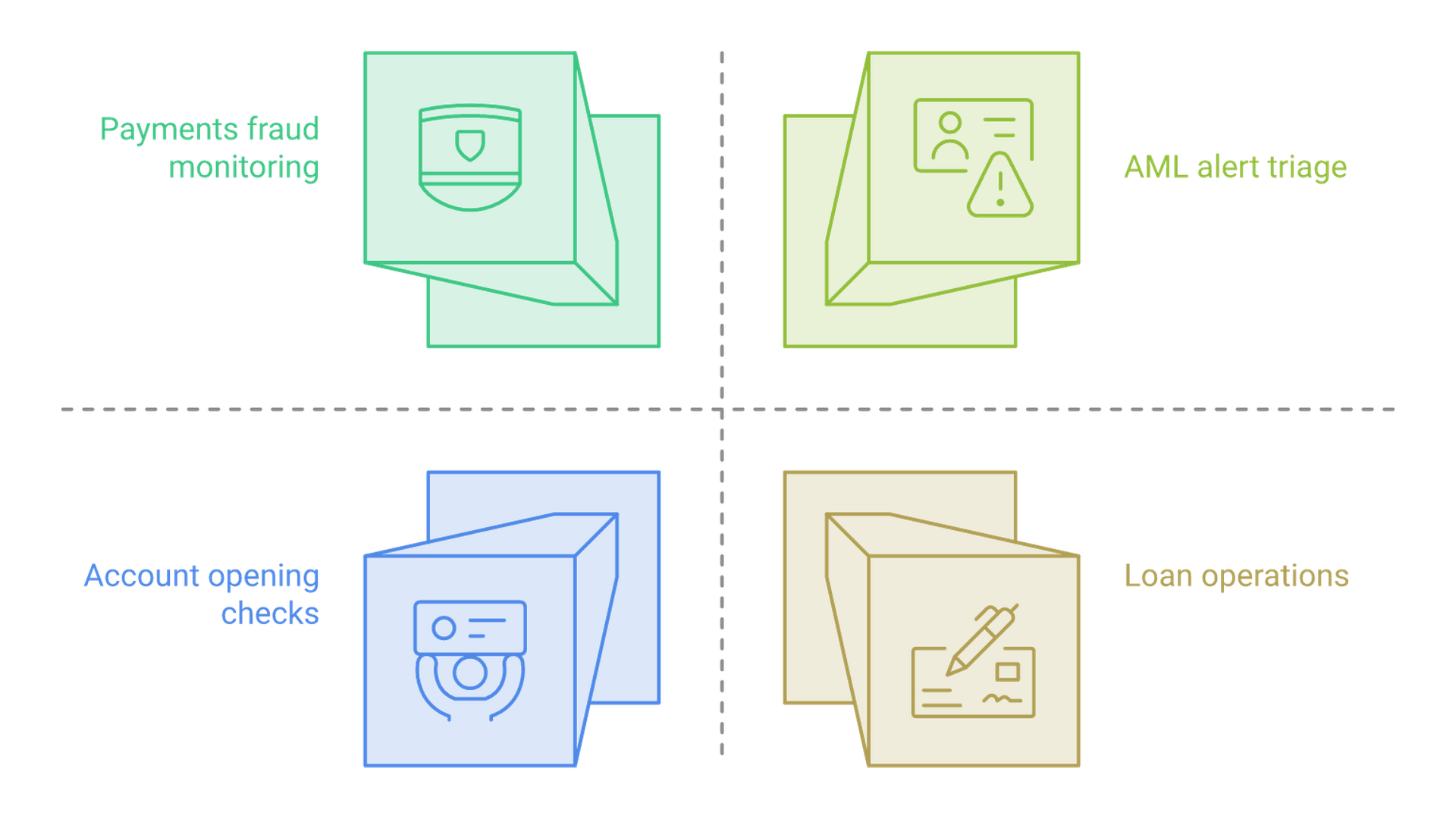
Fraud and payments monitoring
Card, ACH, wire and instant payment fraud is the most mature use. Models score each payment against the customer's normal behavior and the device, channel and counterparty involved, and they matter more as instant payments remove the time a bank once had to recall a transfer. Our guide to AI in payments fraud detection and risk covers the payment-side mechanics in more depth.
BSA/AML alert triage and investigations
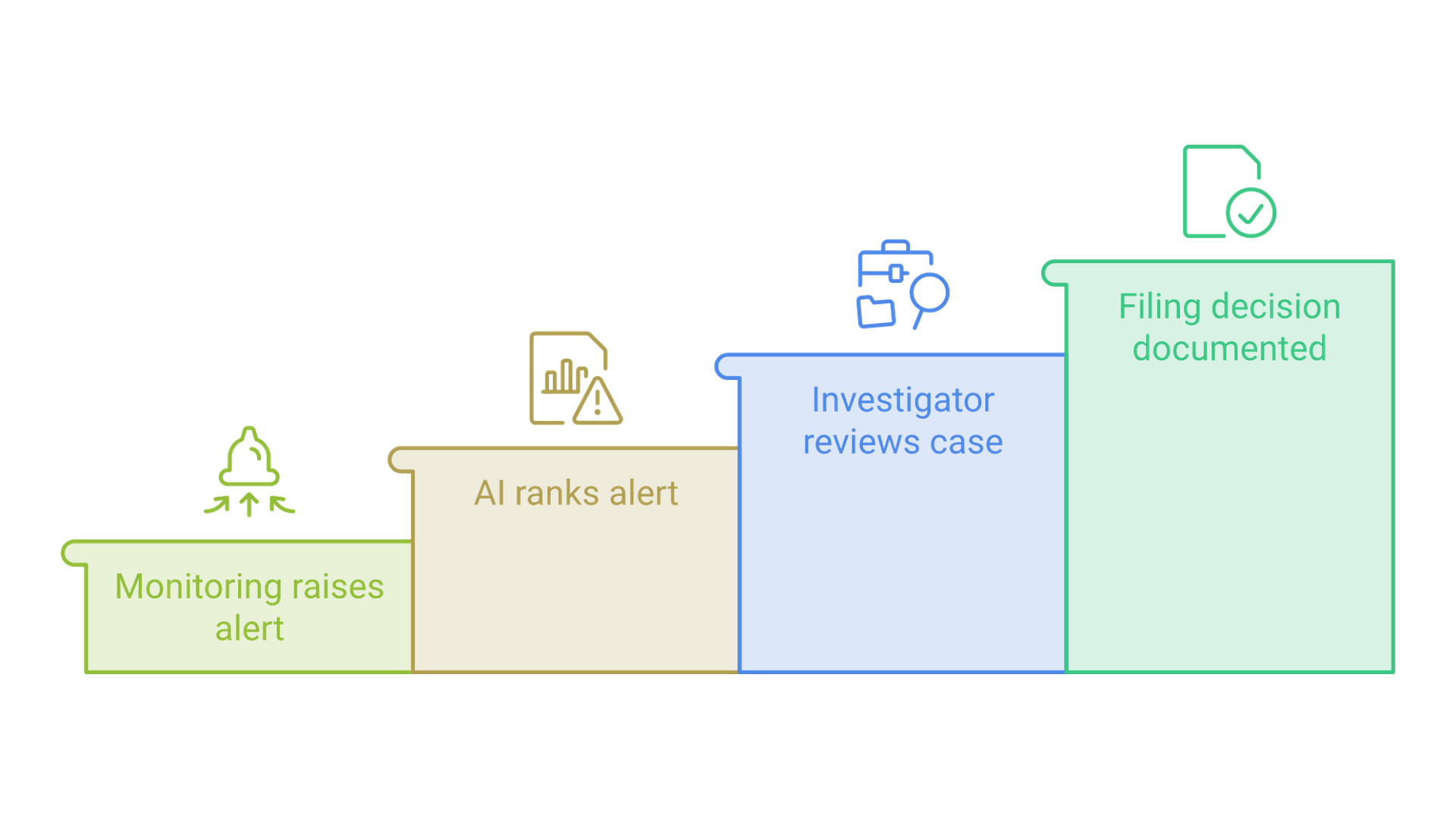
Transaction monitoring systems generate large alert queues, and investigators spend much of their day clearing alerts that never become a filing. Machine learning can rank alerts, group related accounts and surface network links, while generative AI can assemble the case file and a first draft of the narrative. The decision to file stays with a trained person.
Account opening and identity checks
Onboarding is also a target for generative AI on the criminal side. FinCEN issued an alert on November 13, 2024 about fraud schemes that use deepfake media, including fabricated identity documents built to get past verification and authentication. Document forensics, liveness checks and behavioral signals at account opening are now part of the defense, alongside the manual review of anything those tools flag.
Lending operations and back office work
Banks use AI to extract data from tax returns and financial statements, spread commercial borrowers' financials, check loan files for missing documents and answer employee questions from the policy manual. Credit decisions themselves carry fair lending obligations that deserve their own review; many institutions start with the operational work around them.
Which of these an institution builds first depends on its charter, its core platform and its customer base, so the useful first step is an inventory of systems and data, not a model.
BSA/AML Is Where AI Meets the Examiner First
Anti-money laundering work pairs high alert volumes with written supervisory expectations, so it is where regulators have said most about new technology and where rules shift in 2026.
The starting point is older than generative AI. On December 3, 2018, the Federal Reserve, FDIC, FinCEN, NCUA and OCC issued a joint statement encouraging banks to try innovative approaches to Bank Secrecy Act compliance. The Federal Reserve's release named artificial intelligence as one example, and the statement itself, published as SR 18-10, says banks that do not adopt such approaches will not be penalized or criticized for that choice.
Two changes in 2026 matter more. First, the April 17, 2026 interagency model risk guidance (SR 26-2 at the Federal Reserve) superseded SR 21-8, the 2021 statement on model risk management for BSA/AML systems, so monitoring models now sit under the general, risk-based model guidance rather than a BSA-specific statement. Second, on April 7, 2026, FinCEN proposed a rule to fundamentally reform AML/CFT program requirements. According to FinCEN's April 2026 announcement of the proposed program rule, it separates deficiencies in how a program is designed from failures in how it is carried out, lets institutions move resources toward higher risks and sets up notice and consultation between FinCEN and bank supervisors before significant AML/CFT actions.
The FDIC, NCUA and OCC issued a companion proposal the same day for the banks and credit unions they supervise, with comments due 60 days after Federal Register publication, according to OCC News Release 2026-25. Comments on FinCEN's proposal closed June 9, 2026, and FinCEN's news releases through November 17, 2026 list no final rule, so the current BSA program rules still apply. On November 17, 2026, FinCEN also proposed changes to customer due diligence requirements, with a 60-day comment period after publication.
For AI, the takeaway is that a bank should be able to show how a model changed alert handling and why that is more effective, with the investigator's judgment documented at the filing decision.
Core Banking Systems Decide What AI Can Reach
Many US banks and credit unions run on a core platform licensed from a large processor, and that contract, not the model, usually sets the limits on data access, latency and where AI can run.
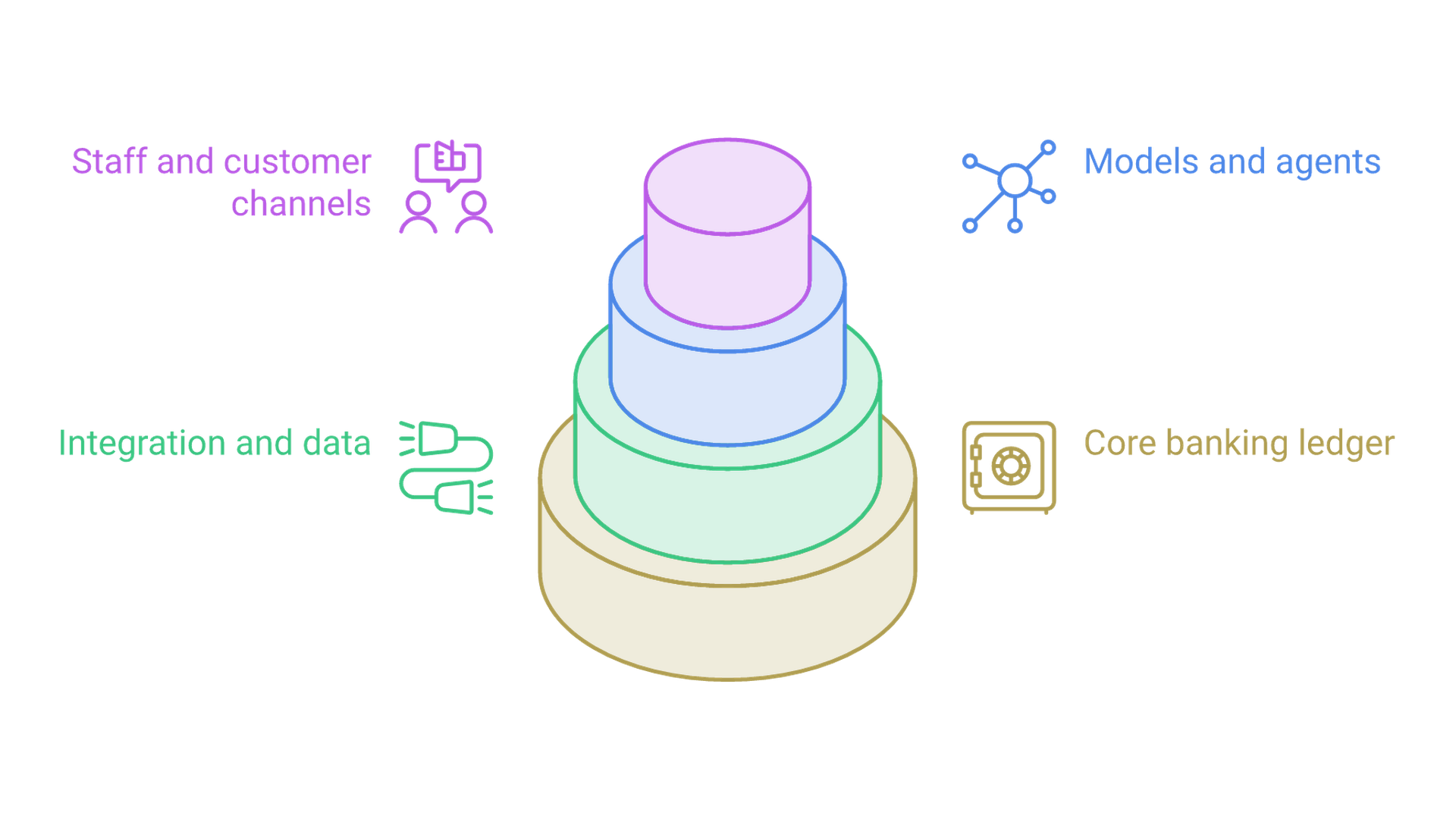
A core system holds the ledger: deposit and loan accounts, balances, holds and transaction history. Many still process parts of their work in overnight batches, while fraud and instant payment decisions need data in seconds. An AI use case that needs real-time behavior data must therefore read from the payment switch or a streaming feed, not from yesterday's core extract.
That is why the common pattern is an overlay. Instead of replacing the core, the institution places an integration and data layer beside it, using the APIs and extracts the core provider supports, and lets models and agents read from that layer. The design questions are concrete: which fields the vendor exposes, whether write access exists at all, how customer data is masked before it reaches a language model, and how lineage is kept so an examiner can trace an output back to the records behind it.
The overlay also contains risk. If an agent can only read case data and open a ticket, a wrong answer costs review time. If it can change an account or release a hold, the same error reaches a customer, which is why write access deserves a separate approval. Mapping those boundaries is the core of banking technology work for US institutions, before any model is chosen.
Third-Party Risk When AI Comes From a Core Vendor or Fintech Partner
Many community institutions buy AI inside a vendor product or get it through a fintech partnership instead of building it, and supervisors treat that as a relationship the bank still owns.
The governing document for banks is the interagency guidance on third-party relationships issued June 7, 2023 (SR 23-4 at the Federal Reserve) by the Federal Reserve, FDIC and OCC. It applies risk management across the life of a relationship, scaled to the institution's size and the relationship's risk.
For smaller institutions, the same three agencies published a companion resource in May 2024. The OCC's bulletin on the community bank third-party risk guide describes it as voluntary and organized around each stage of the relationship. For an AI feature, due diligence means asking the vendor what data trains and feeds the model, whether the bank's customer data is used to improve it, how changes are announced, what testing results the bank can see and what happens to the data at exit.
Credit unions face an extra gap. The GAO reported on May 19, 2025 that NCUA, unlike the other banking regulators, lacks authority to examine technology service providers, which credit unions increasingly rely on for AI. NCUA's own AI resource page says credit unions using vendor-provided AI must do their own due diligence on how the product works and the risks it introduces.
What Examiners Expect From Bank AI in 2026
No federal banking agency has issued an AI-specific rule for banks. Supervisors apply existing laws and guidance to AI, and the 2026 model risk update left generative and agentic AI outside its scope.
The GAO's 2025 review found that federal financial regulators oversee AI mainly through existing laws, regulations, guidance and risk-based examinations. NCUA states on its AI resource page, last updated November 18, 2026, that it has not issued AI-specific rules and that its regulations are technology-neutral, so information security standards apply whether or not a tool uses AI. NCUA's 2026 supervisory priorities letter (26-CU-01) names fraud prevention and detection, payment systems and BSA/AML programs among its focus areas.
The April 2026 model risk guidance leaves generative and agentic AI out of scope. As of its April 2026 statement, the OCC said the agencies planned a request for information on model risk management with particular attention to banks' use of AI.
That leaves a smaller bank with a documentation task rather than a checklist. Treasury's December 19, 2024 report on AI in financial services recommended reviewing each AI use case for compliance with existing laws before deployment and reassessing it over time. A short AI governance program sized to the institution turns that into an inventory, an owner per use case and a review record an examiner can read.
How a Community Bank or Credit Union Adopts AI Step by Step
Adoption at community scale works as a sequence: low-risk internal uses first, vendor features vetted like any other service, and access controls that grow before models gain autonomy.
Start with an inventory. List the AI already running inside fraud, monitoring, document and service tools, including features a vendor switched on in an upgrade. Each entry gets an owner, the data it touches and whether it informs a person or acts by itself.
Choose first projects that support staff rather than replace a decision: policy search for branch employees, document extraction in loan operations, case summaries for BSA investigators. They produce visible time savings and keep a trained person at the point where a regulator expects judgment.
Set rules for generative tools before people use them on their own. Staff need to know which tools are approved, what customer information may never be entered and how outputs are checked. Agents need stricter limits, and the principles in our guide to AI agent permissions and least-privilege access apply directly: read before write, narrow scopes and a named owner for every agent account.
Finally, measure against the old process. Alert closure time, false positives, document error rates and customer complaints are numbers the institution already tracks, and they give the board and the examiner the same evidence.
FAQs About AI in Banking
These are the questions bankers and credit union leaders ask most often about AI, answered with what regulators have published instead of predictions about where the technology goes next.
Can a small community bank afford to use AI?
The cost that grows is oversight, not software, and it can be tiered. The 2024 community bank guide ties the depth of review to each relationship's risk, so a low-risk document tool needs lighter diligence than a vendor model that scores payments, even when both arrive inside a platform the bank already licenses.
Do banks need regulator approval before using AI?
GAO's 2025 review describes AI oversight mainly through existing laws, guidance and risk-based exams, with no separate approval step. The agencies also announced in their 2018 joint statement that they had or would set up innovation offices as points of contact, so a bank planning a significant change can raise it with its supervisor before launch.
Can bank employees use ChatGPT or other generative AI tools?
Treat the chat provider as a vendor first. NCUA's AI page expects due diligence on how a vendor's AI product works and the risks it introduces, and the same logic applies to a bank: the provider's data use and retention terms belong in the contract review before any customer information is typed in.
How can banks spot deepfake fraud at account opening?
FinCEN's November 2024 alert gives red-flag indicators for deepfake schemes and reminds institutions of their Bank Secrecy Act reporting obligations. That makes a suspected deepfake application a suspicious activity question for the BSA team, not only a fraud loss for the onboarding team.
Where AI in Banking Stands at the End of 2026
At the end of 2026, AI in banking runs on existing law, a proposed AML reset, open supervisory questions about generative tools and third-party rules that put vendor AI on the bank's books.
The direction is clear even with rules still in motion. FinCEN's program proposal points toward judging effectiveness over paperwork, and the model risk update said it is most relevant to institutions above $30 billion in assets. The banks and credit unions in the strongest position are the ones that know every model they run, know who owns each one and treat AI vendors with the same diligence as any other critical provider.
If your institution is mapping where AI fits around its core, payments and compliance work, talk with Cognativ about your bank's AI plans and the integration and governance work behind them.