


Apple Expands AI Chip Production in Arizona and AI Server Manufacturing in Houston
Apple's Houston plant ships Private Cloud Compute servers while TSMC Arizona makes Apple silicon. See the suppliers, the timeline and the 2026 updates.
Apple's AI chip production in Arizona and its new AI server factory in Houston are the two most concrete pieces of the company's push to make more of its hardware in the United States. In October 2025, Apple said its Houston facility had started shipping American-made servers for Apple Intelligence, months ahead of the 2026 target it set in February 2025. At the same time, TSMC's Arizona fab, where Apple is the first and largest customer, was producing tens of millions of Apple chips on one of the most advanced process technologies in the country.
First published in November 2025 and updated through October 31, 2026, this article explains what Apple announced, how Arizona and Houston fit together, what has happened since, and what it means for enterprise AI buyers.
What Apple Announced About U.S. AI Chip and Server Production
The story unfolded in three steps during 2025. On February 24, 2025, Apple said it would spend and invest more than $500 billion in the U.S. over the next four years, which Tim Cook described as the company's largest-ever spend commitment. The plan included a 250,000-square-foot server facility in Houston, a multibillion-dollar commitment to produce advanced silicon at TSMC's Fab 21 in Arizona, a doubling of Apple's U.S. Advanced Manufacturing Fund from $5 billion to $10 billion, and about 20,000 new U.S. hires focused on R&D, silicon engineering, software and AI/ML (Apple Newsroom, February 2025).
On August 6, 2025, Apple raised the total to $600 billion with a new $100 billion commitment and launched the American Manufacturing Program (AMP), designed to bring more of its supply chain and critical components into the country. Apple said its U.S. silicon supply chain was on track to produce more than 19 billion chips for its products in 2025 (Apple Newsroom, August 2025).
Then in late October 2025, COO Sabih Khan confirmed that the Houston plant had begun shipping servers ahead of schedule, as 9to5Mac reported on October 23, 2025. That shipment milestone is the news event behind the original version of this article.
Apple and TSMC Arizona: How the AI Chip Production Works
Apple designs its own silicon but does not own chip fabs. Its chips are manufactured by TSMC, so "Apple chip production in Arizona" means Apple-designed processors made at TSMC's Arizona site north of Phoenix. TSMC says its first Arizona fab entered high-volume production on its N4 (4-nanometer class) process in the fourth quarter of 2024. In February 2025, Apple described itself as the largest customer of that fab, which then employed more than 2,000 people.
These chips matter for AI because Apple's on-device features and its server fleet both run on custom silicon, and domestic production reduces exposure to a single region. For background on how the wider accelerator market is shaped, see our analysis of Nvidia's competitive edge in the AI chip market.
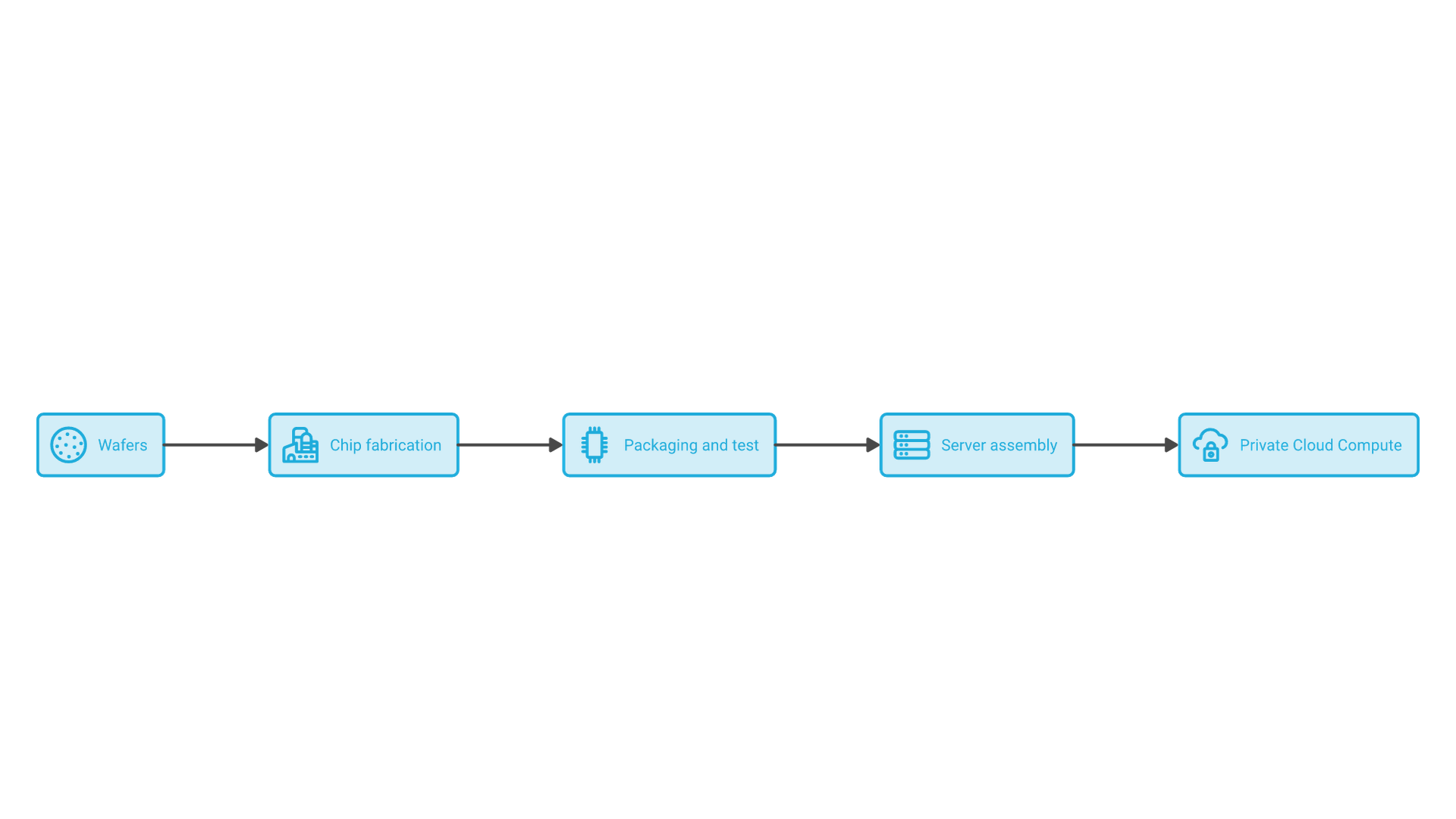
From wafer to finished chip
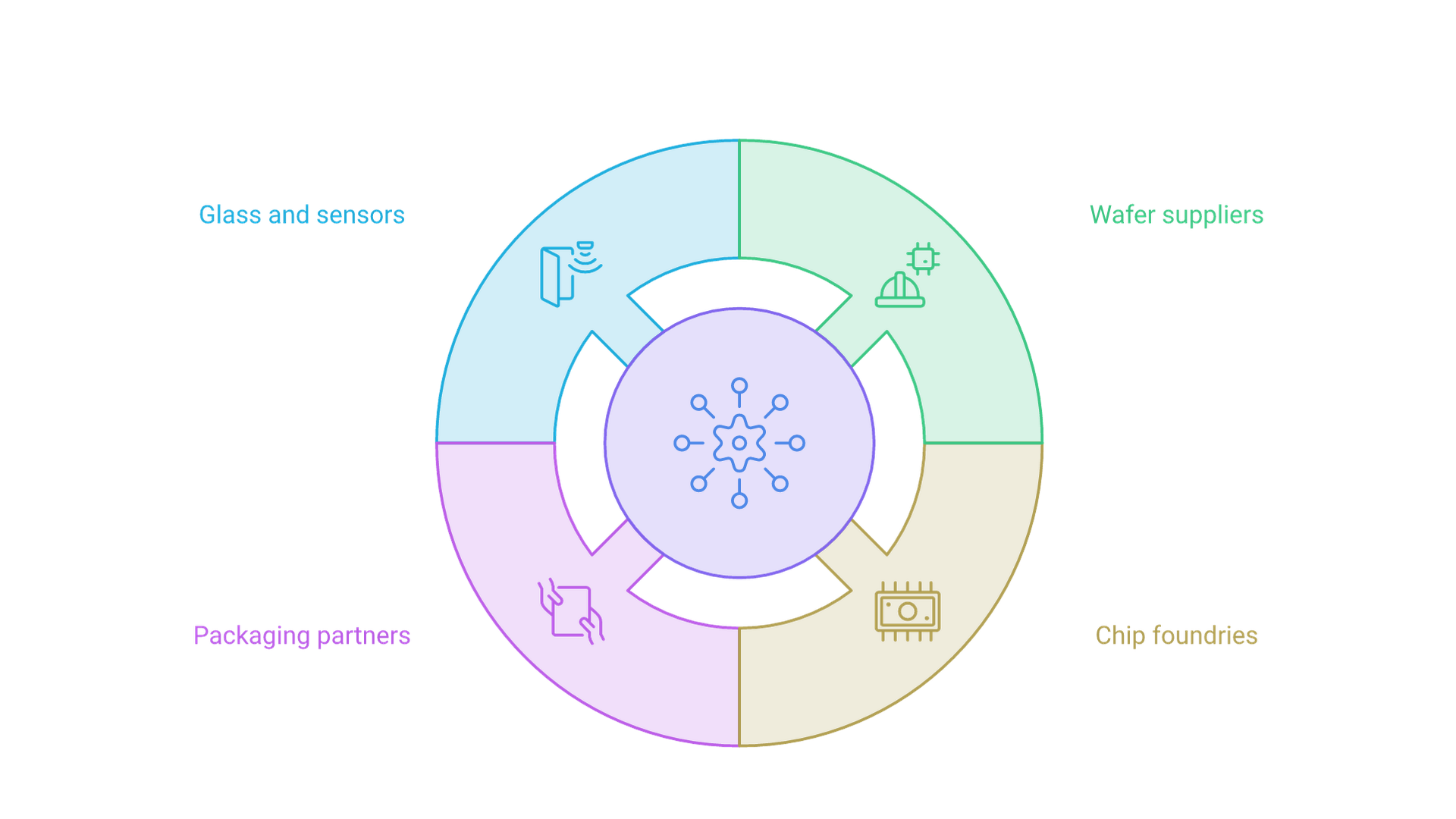
A finished chip passes through several stages, and Apple's program now touches most of them on U.S. soil. GlobalWafers America produces 300mm wafers in Sherman, Texas. TSMC fabricates logic in Arizona, Samsung's Austin fab is introducing a new chipmaking technology for Apple, and Texas Instruments makes foundational analog and power chips in Texas and Utah. Amkor is building an advanced packaging and test facility in Peoria, Arizona, that will package chips made at the nearby TSMC fab, with Apple as its first and largest customer.
The scale in 2026
In its February 24, 2026 update, Apple said it had exceeded its 2025 target, sourcing more than 20 billion U.S.-made chips from 24 factories in 12 states. It added that in 2026 it is on track to buy well over 100 million advanced chips from TSMC's Arizona facility, a significant increase from 2025 (Apple Newsroom, February 2026). The 20 billion figure counts U.S.-made chips of every kind, so the advanced-chip number is the better gauge of leading-edge AI silicon.
Apple's Houston AI Server Factory and Private Cloud Compute
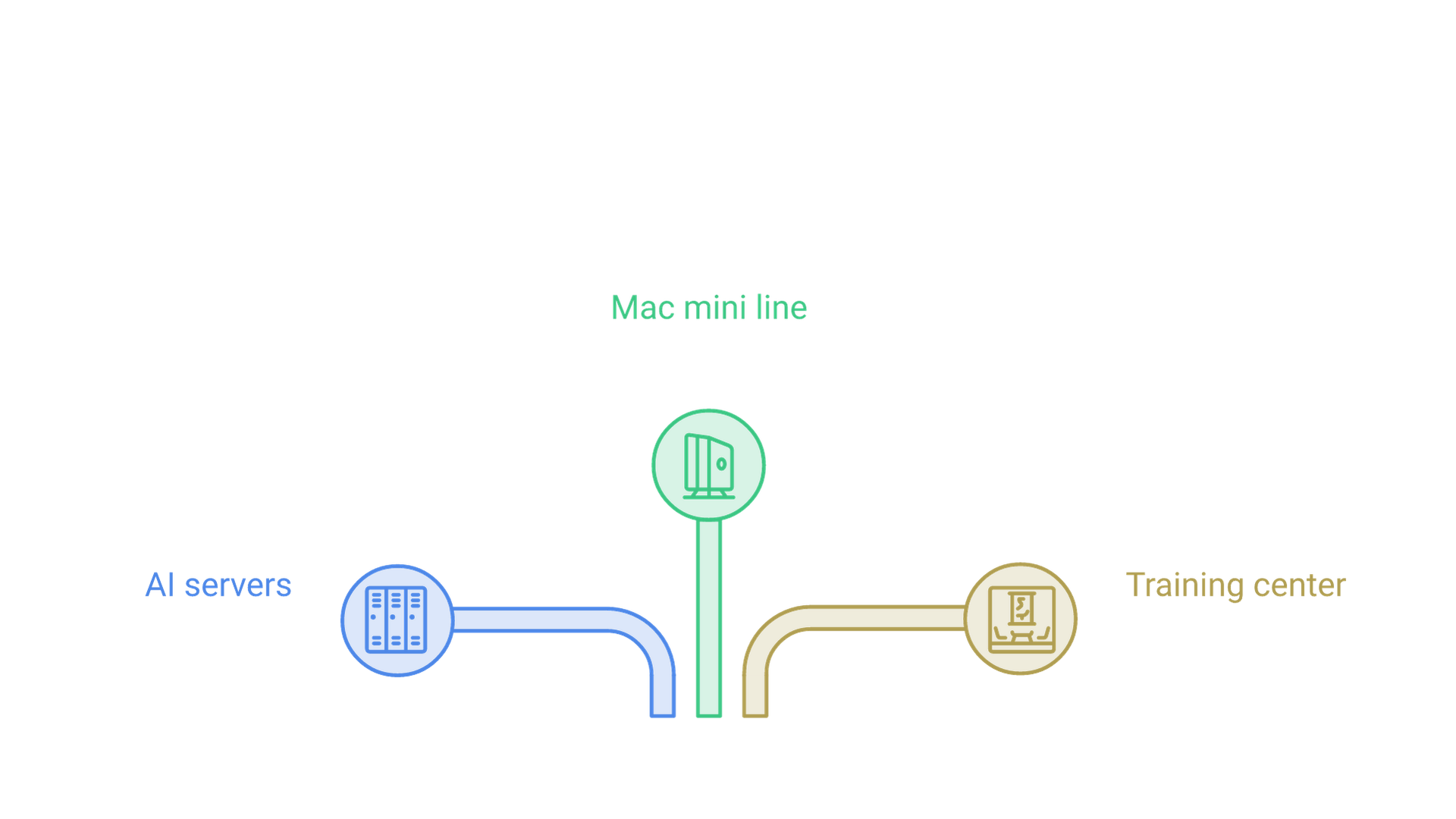
The Houston facility assembles the servers that run Private Cloud Compute, the cloud layer Apple uses when an Apple Intelligence request is too large to handle on the device. Apple said the plant produced its first test unit in July 2025 and was slated for mass production in 2026. It shipped earlier, and Apple's February 2026 update says the servers, including logic boards made on site, are now used in Apple data centers across the U.S. Apple has not disclosed server volumes.
Reporting identifies Foxconn as the operator of the north Houston site; Apple's releases refer only to "manufacturing partners."
Mac mini and the Advanced Manufacturing Center
In February 2026, Apple said Mac mini production would move to a new factory on the Houston site later in 2026, doubling the campus footprint and marking the first U.S. assembly of that product. On August 13, 2026, Apple opened a roughly 20,000-square-foot Advanced Manufacturing Center inside the same facility to offer free training to small and mid-sized manufacturers (Apple Newsroom, August 2026). As of October 31, 2026, we found no Apple statement confirming that Mac mini units have started shipping from Houston.
For enterprises, the server story is a reminder that inference capacity is a physical supply-chain question as much as a software one. Our guide to AI inference infrastructure considerations covers the hardware, power and placement trade-offs in more detail.
Apple's American Manufacturing Program Partners
AMP is the mechanism that turns Apple's spending pledge into supplier capacity. The first group named in August 2025 included Amkor, Applied Materials, Broadcom, Coherent, Corning, GlobalFoundries, GlobalWafers America, MP Materials, Samsung and Texas Instruments.
| Partner | U.S. location | Role for Apple |
|---|---|---|
| TSMC | Phoenix, Arizona | Advanced logic chips (Apple is first and largest customer) |
| Amkor | Peoria, Arizona | Advanced packaging and test for chips made at TSMC Arizona |
| Samsung | Austin, Texas | New chipmaking technology for power and performance |
| Texas Instruments | Sherman, Texas; Lehi, Utah | Foundational analog and power semiconductors |
| GlobalWafers America | Sherman, Texas | 300mm wafers for U.S. fabs |
| Corning | Harrodsburg, Kentucky | Cover glass for iPhone and Apple Watch |
| Foxconn (reported) | Houston, Texas | AI server assembly and planned Mac mini production |
On March 26, 2026, Apple added Bosch, Cirrus Logic, TDK and Qnity Electronics to the program, with $400 million planned for these new efforts through 2030. TDK will make sensors for Apple in the U.S. for the first time, Bosch sensing chips will be produced at TSMC's Washington fab, and Cirrus Logic will work with GlobalFoundries in New York on chips for Face ID (Apple Newsroom, March 2026).
Timeline: Apple's U.S. Chip and Server Manufacturing
| Date | Milestone |
|---|---|
| Nov 15, 2024 | U.S. Commerce Department finalizes up to $6.6 billion in CHIPS Act funding for TSMC Arizona |
| Feb 24, 2025 | Apple pledges more than $500 billion in U.S. spending, including Houston servers and TSMC Arizona silicon |
| Mar 4, 2025 | TSMC raises its planned U.S. investment to $165 billion |
| Aug 6, 2025 | Apple raises its commitment to $600 billion and launches the American Manufacturing Program |
| Oct 2025 | Houston begins shipping AI servers, ahead of the 2026 target |
| Feb 24, 2026 | Apple reports more than 20 billion U.S.-made chips sourced in 2025 and announces Mac mini production in Houston |
| Mar 26, 2026 | Bosch, Cirrus Logic, TDK and Qnity join AMP |
| Jul 16, 2026 | TSMC adds $100 billion, lifting its planned Arizona investment to about $265 billion |
| Aug 13, 2026 | Apple opens the Advanced Manufacturing Center in Houston |
Government Support and the CHIPS Act
A common misreading is that Apple received CHIPS Act money. It did not. The Commerce Department finalized up to $6.6 billion in direct funding, plus up to $5 billion in proposed loans, for TSMC's Arizona fabs in November 2024, paid out as project milestones are met (Reuters via The Korea Times). Apple's contribution is demand: as an anchor customer it gives TSMC and Amkor the volume commitments that make U.S. capacity economically viable.
Support has continued across administrations: TSMC raised its planned U.S. investment to $165 billion in March 2025 (TSMC Form 6-K, March 2025), and Commerce Secretary Howard Lutnick spoke at Apple's August 2026 Houston opening.
What Has Changed Since: TSMC Arizona in 2026
Capacity in Arizona has kept growing. On July 16, 2026, TSMC announced another $100 billion for U.S. chipmaking alongside record quarterly earnings, bringing its planned Arizona investment to about $265 billion and adding four fabs aimed at 2-nanometer and more advanced processes (AP via WTOP). TSMC did not give dates for the new fabs.
For the earlier fabs, TSMC's Arizona page lists the second fab (N3) for volume production in the second half of 2027 and the third fab (N2 and A16) by the end of the decade. That matters for Apple: today's Arizona output uses a mature N4-class node, while Apple's newest flagship chips use more advanced processes that TSMC currently runs in Taiwan. The gap between U.S. and Taiwan nodes narrows only as these later fabs come online.
Keep two caveats in view: Apple's figures are self-reported, and U.S. production supplements rather than replaces Asian manufacturing.
What It Means for Enterprise AI Buyers and Builders
Domestic fabs and packaging lines reduce one class of geopolitical risk, yet leading-edge capacity remains concentrated and in high demand. Export rules can also shift quickly, as our coverage of the U.S. export ban on Nvidia Blackwell chips shows.
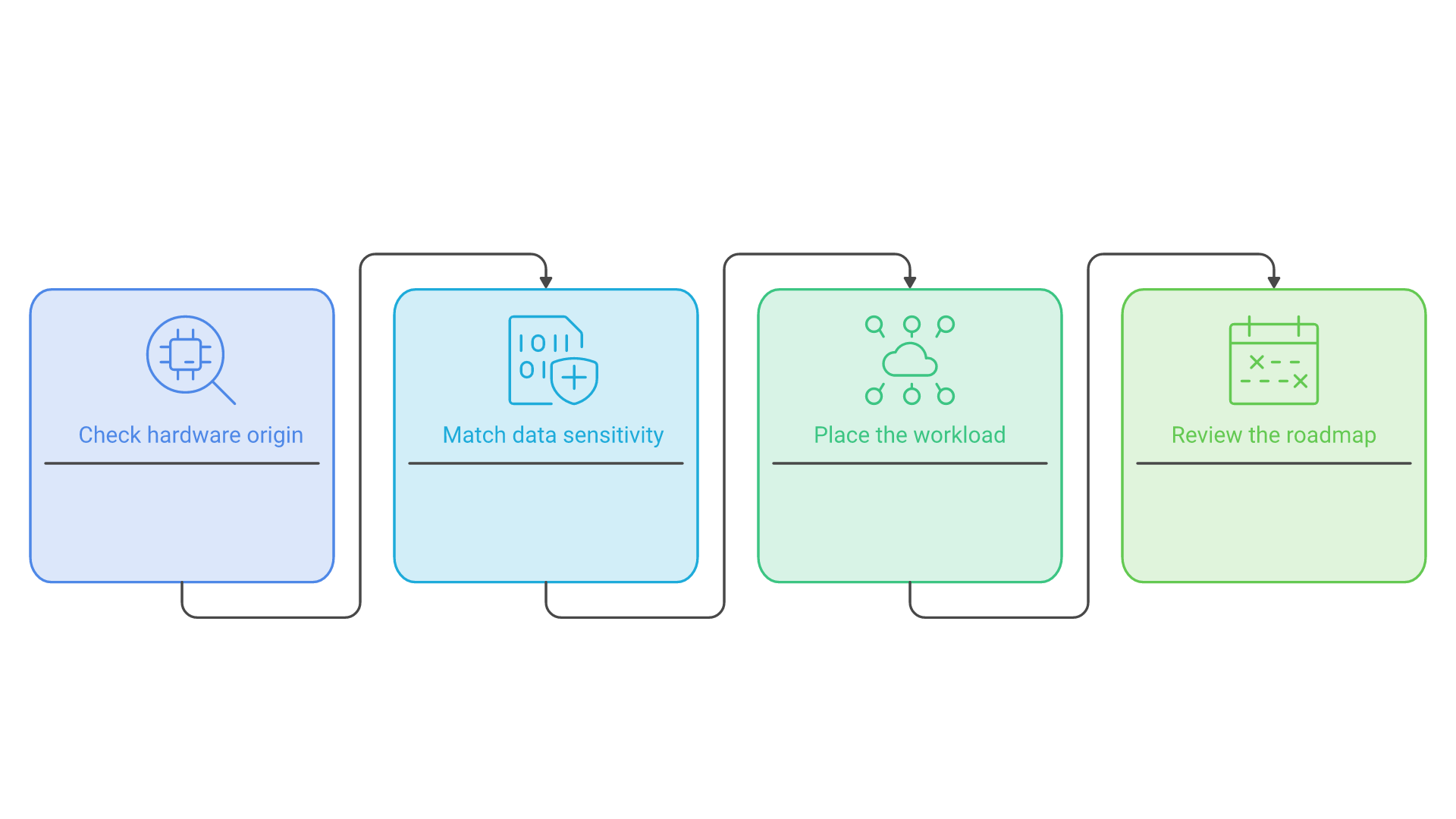
Practical steps
Treat hardware origin and lead times as part of AI vendor due diligence, especially for regulated workloads. Split workloads between on-device, private cloud and public cloud based on data sensitivity, much as Apple does with Private Cloud Compute. Our AI infrastructure services help teams size and place that capacity, and our technology strategy consulting helps leaders build sourcing and architecture decisions into a multi-year roadmap.
Frequently Asked Questions
Does Apple make chips in Arizona?
Apple designs the chips and TSMC manufactures them at its Arizona site north of Phoenix. Apple is the first and largest customer of TSMC's first Arizona fab, which produces chips on an N4-class process.
What does Apple's Houston factory make?
It assembles the servers that power Private Cloud Compute and Apple Intelligence, including logic boards made on site. Apple has also announced Mac mini production there starting later in 2026.
When did Apple start shipping servers from Houston?
Apple confirmed in October 2025 that the Houston facility had begun shipping servers, ahead of the 2026 mass-production target it set in February 2025.
What is Apple's American Manufacturing Program?
Launched in August 2025, it is Apple's program to bring more of its supply chain and critical components into the U.S. through partners such as TSMC, Amkor, Samsung, Texas Instruments, Corning and GlobalWafers America.
How much is Apple investing in the U.S.?
Apple says it will invest $600 billion in the U.S. over four years, up from the more than $500 billion it announced in February 2025.
Did Apple receive CHIPS Act funding?
No. The up to $6.6 billion CHIPS Act grant was awarded to TSMC for its Arizona fabs. Apple supports those fabs as a customer and investor.
Conclusion: Apple's U.S. AI Hardware Push One Year On
A year after the Houston servers began shipping, Apple's U.S. manufacturing push has moved from pledges to working capacity: Arizona fabs making Apple silicon, a Houston plant building Private Cloud Compute servers, and a growing set of suppliers making wafers, packaging, glass and sensors domestically. The harder test comes in 2027 and beyond, when more advanced Arizona fabs are scheduled to start and Apple's newest chips could be made closer to home.
For enterprises, the lesson is to plan AI infrastructure with the supply chain in mind, not just the model. If you are weighing where your AI workloads should run and what hardware risk you can accept, contact Cognativ to talk through an architecture that fits your timeline.