


How Can NVIDIA Maintain Its Competitive Edge in the AI Chip Market?
NVIDIA's AI chip lead rests on more than market share. This analysis weighs customer-built chips, AMD rack-scale systems and export policy, with a 2026 update.
Originally published on August 24, 2025. Updated on October 30, 2026 with a dated section, "Where Things Stand in October 2026," based on company filings, newsroom releases and official government notices. The original analysis is preserved, lightly edited for clarity.
NVIDIA sits at the center of the AI chip market. Its graphics processing units (GPUs) power everything from hyperscale data centers to autonomous driving and generative AI platforms, and the company's value comes not only from its market share but from its ability to set the pace of innovation for the whole industry.
That position invites a simple question: how can NVIDIA maintain its competitive edge when its largest customers are designing their own chips, AMD is shipping competitive rack-scale systems and governments are shaping where advanced accelerators can be sold? This analysis looks at the sources of NVIDIA's advantage, the competitive threats it faces and the strategic paths that could keep it ahead.
NVIDIA's Current Strengths in the AI Chip Market
Unlike many big tech companies that were still experimenting with AI technology, NVIDIA brought decades of GPU expertise to the moment, which allowed it to scale quickly when the AI wave hit. The company has evolved from making graphics cards for gaming into a leader in AI computing and AI infrastructure.
Key aspects of NVIDIA's dominance
- Early adoption of artificial intelligence use cases, long before generative AI became mainstream.
- Investment in AI research and in ecosystems for AI developers.
- A strong grip on data centers, which account for the largest part of NVIDIA's revenue.
- Industry-defining platforms such as NVIDIA AI Enterprise, which packages AI software, management tools and accelerated infrastructure for enterprise-scale deployments.
This ecosystem effect means NVIDIA benefits not just from selling AI chips but from the integrated AI systems that surround them: networking, software libraries, reference designs and the developer habits built on top of them.
GPU Architecture and Innovation
At the core of NVIDIA's success is a GPU architecture that has been steadily specialized for AI workloads. Centralized CPU servers were once the default way to run machine learning; NVIDIA built cutting-edge GPUs optimized for the dense matrix math that neural networks require, raising computing power while working to improve performance per watt.
Highlights of NVIDIA's GPU technology
- Massively parallel computing through GPUs designed for AI workloads rather than only for rendering images.
- Proprietary platforms such as CUDA (Compute Unified Device Architecture), which lock in developers and enable accelerated computing across industries.
- Specialized platforms for autonomous driving, robotics, PCs and edge deployments.
- Energy efficiency improvements through optimized GPU design, which reduce operating costs at data center scale.
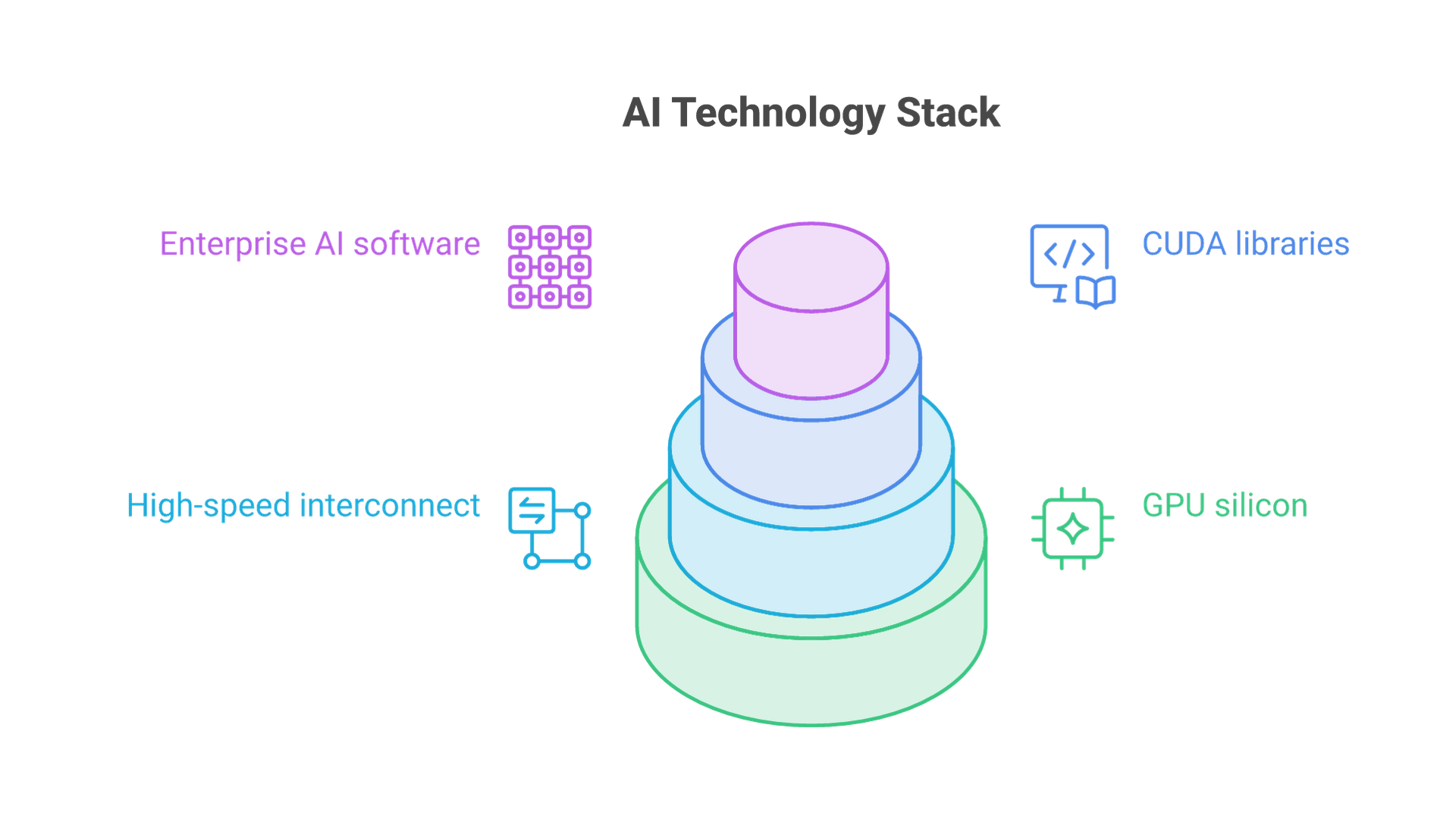
The more important shift is that NVIDIA no longer sells a chip so much as a system. A modern AI cluster depends on the GPU, the high-speed links between GPUs, the network that connects racks, and the software that schedules and optimizes the work. NVIDIA designs all of those layers, which means that a rival matching one chip's raw performance still has to match the rest of the stack. For teams sizing their own hardware, the same logic applies at small scale, as our guide to local AI server specs explains: memory capacity, bandwidth and software support matter as much as peak compute.
AI Research and Development
If GPU architecture is the foundation, AI research is NVIDIA's growth engine. The company reinvests heavily in new AI models, AI software and partnerships that encourage AI developers to stay inside its ecosystem.
Areas of focus in NVIDIA's AI research include:
- Generative AI: supporting the training of massive models that fuel the next wave of AI applications.
- Domain platforms: specialized NVIDIA hardware and software for robotics, healthcare and edge AI scenarios.
- AI factories: data centers designed as production lines for intelligence, in which GPUs continuously train and serve AI models.
- Collaboration: close work with AI startups, universities and cloud providers to accelerate AI adoption.
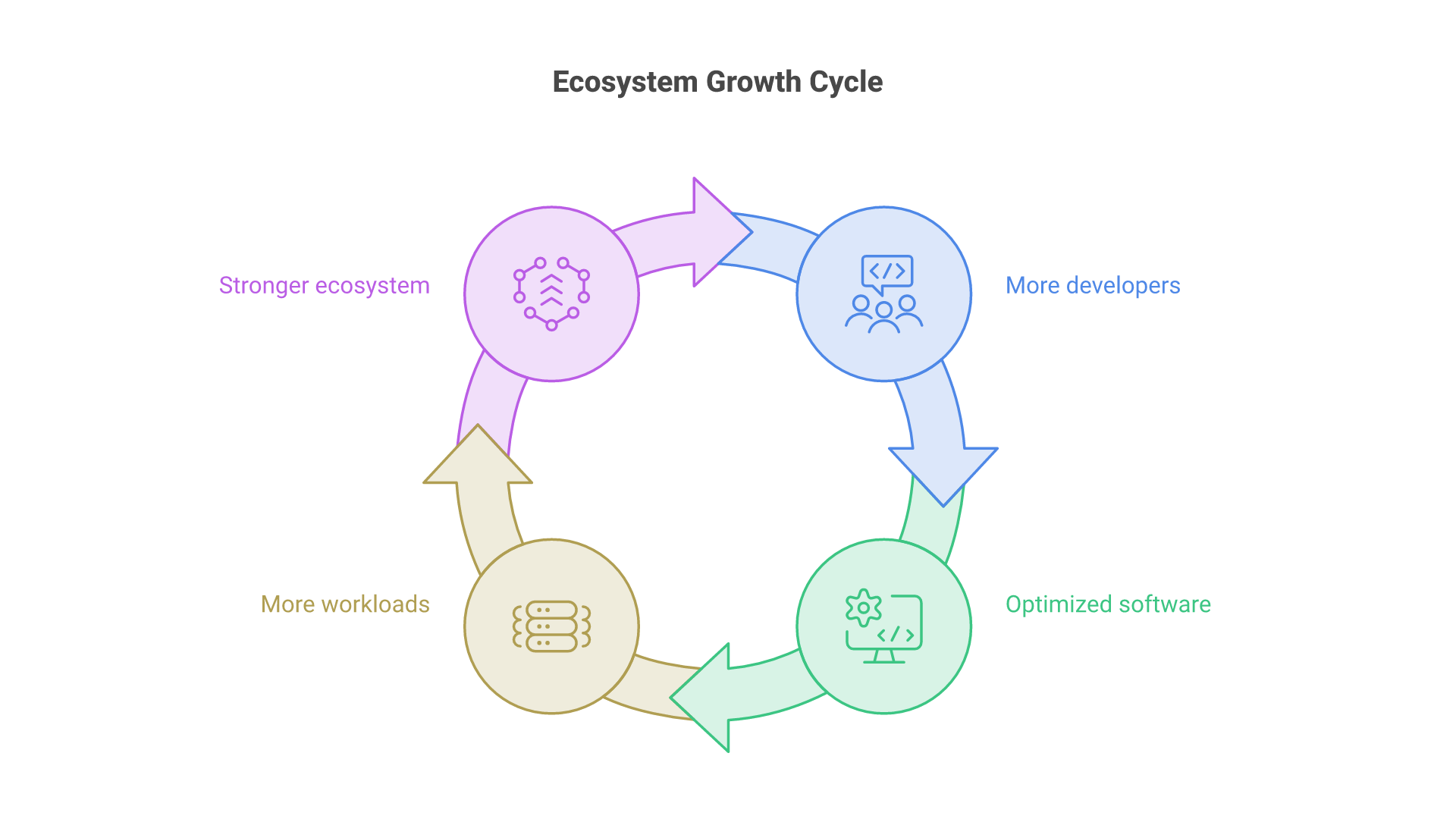
This dual strategy of in-house research plus external collaboration creates a self-reinforcing cycle. As more AI developers train on NVIDIA GPUs, more AI workloads and libraries are optimized for its chips, which attracts more developers and deepens NVIDIA's dominance. Breaking that flywheel requires a competitor to win developers, not only benchmarks.
Strategic Investments for Growth
Beyond AI research, NVIDIA has been deliberate in making strategic investments that expand its reach:
- Acquisitions: investments in networking and software companies ensure NVIDIA is not only about GPU hardware but about a full, integrated ecosystem.
- Startups: funding promising AI startups gives NVIDIA early visibility into generative AI breakthroughs and keeps those companies building on its platform.
- Enterprise solutions: NVIDIA AI Enterprise ties together AI software, models and accelerated infrastructure into one platform for corporations.
- Cloud partnerships: collaboration with Google Cloud, Microsoft Azure, AWS, Oracle and specialized GPU clouds means that even tech giants building their own silicon still offer NVIDIA systems to their customers.
These investments secure NVIDIA's role not just as a chip maker but as a backbone of AI infrastructure.
NVIDIA's Competitive Edge Today
So how does NVIDIA maintain its competitive edge right now? Four levers stand out:
- Leveraging its position in data centers, the largest and most profitable segment of AI workloads.
- Providing specialized platforms and accelerators for industries such as autonomous driving and robotics.
- Maintaining deep developer lock-in through CUDA and its libraries, which makes it costly to port mature AI pipelines elsewhere.
- Turning GPU technology into a platform business rather than a commodity component.
Even as other tech giants try to reduce their dependence on NVIDIA by designing their own chips, NVIDIA holds the advantage of an integrated ecosystem built over decades.
The Growing Competition in the AI Chip Market
The AI chip market is heating up as other tech giants, including Google, Amazon, Microsoft and Apple, move aggressively into designing their own chips. These companies see NVIDIA's dominance and want to reduce their reliance on a single supplier for their most expensive infrastructure.
- Google has developed Tensor Processing Units (TPUs) for internal workloads and for Google Cloud customers, particularly for generative AI.
- Amazon Web Services offers Inferentia and Trainium chips, targeting the same AI workloads that NVIDIA chips dominate.
- Microsoft has been building its own Azure Maia accelerators to run Microsoft AI services on its own silicon.
- Apple continues to expand its custom chips to power AI applications in consumer devices.
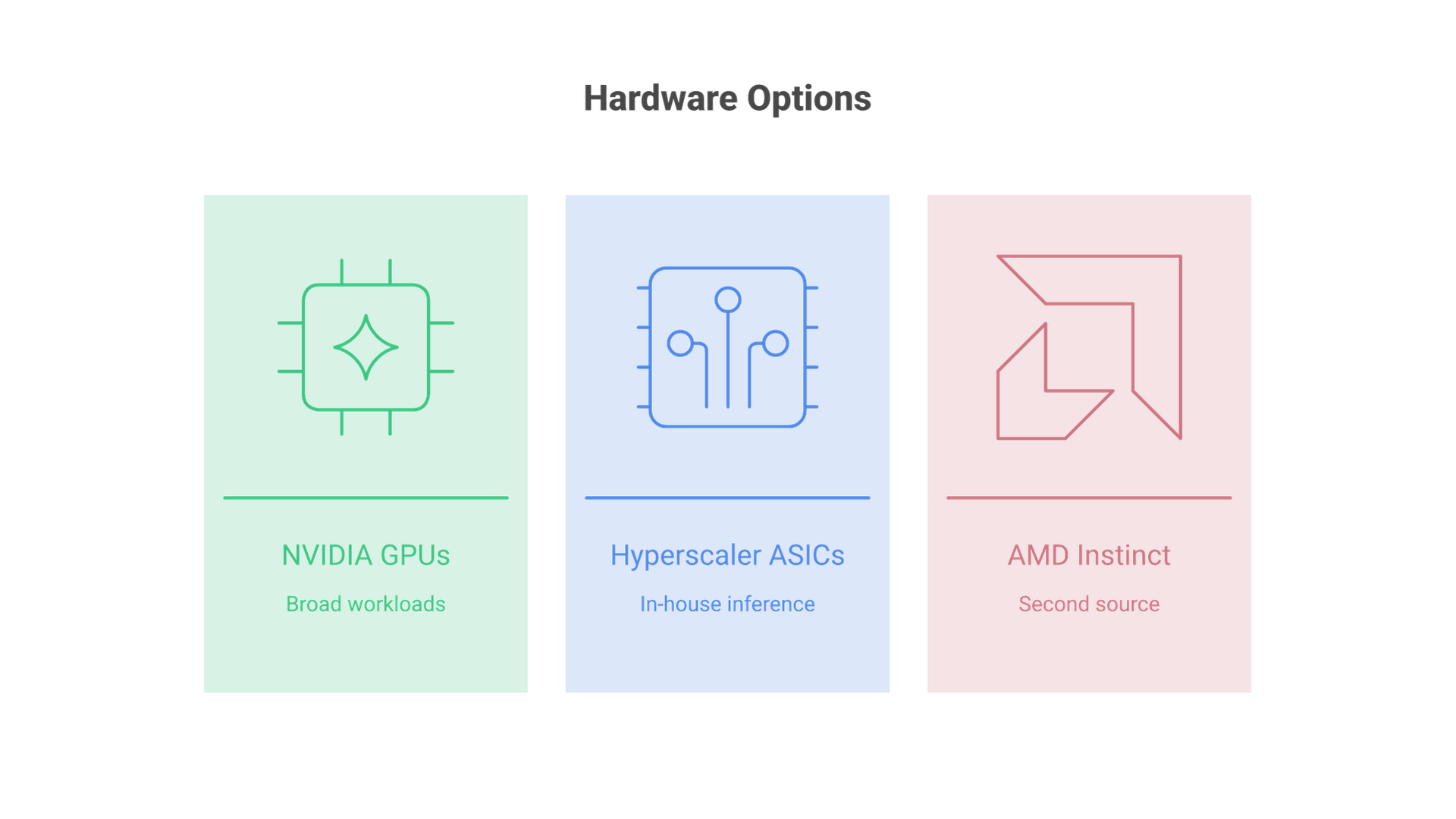
AMD is the most direct merchant-silicon rival. Its Instinct GPU line competes for the same data center buyers, and its open ROCm software stack is its answer to CUDA. The strategic threat is real: if hyperscalers succeed in shifting a large share of their own workloads to in-house chips, NVIDIA's data center revenue growth could slow even while overall AI spending rises.
Threats from Custom Chips
Custom silicon, usually called an application-specific integrated circuit (ASIC), is one of the most pressing threats. Custom chips offer:
- Potentially lower cost per watt and per token than general-purpose GPUs on the workloads they were designed for.
- Optimized performance for very specific AI tasks, such as generative AI inference at high volume.
- Tight integration with the owner's cloud services, networking and data center design.
The trade-off is flexibility. A GPU runs almost any model and framework a customer brings, while an ASIC pays off when its owner controls the workload. That is why the threat is concentrated in hyperscalers serving their own models, rather than in the long tail of enterprises and model builders. If cloud providers scale custom chips effectively, they could reduce demand for NVIDIA GPUs for their internal workloads. NVIDIA's counter has been to make its full stack, from software to rack design, harder to replace.
For companies running AI on rented infrastructure, this competition is good news: more choice of accelerators across clouds and more pressure on price. Planning a portable architecture that can use more than one accelerator family is now part of sound cloud infrastructure consulting rather than an edge case.
The Role of Generative AI in NVIDIA's Strategy
The generative AI boom has given NVIDIA both an opportunity and a challenge.
Opportunities
- Training large AI models requires massive computing power, and NVIDIA GPUs have been the industry's reference platform for it.
- Many generative AI labs and startups train and serve their models on NVIDIA hardware, directly or through cloud providers.
- The trend toward AI factories and continuously updated models supports long-term demand for accelerated computing.
Challenges
- Competitors may build AI infrastructure tuned specifically for generative AI inference.
- If custom chips from big tech companies become the default for serving their own models, NVIDIA risks losing part of the next wave of demand.
NVIDIA's response
- Aggressively optimize GPU architecture and rack-scale systems for generative AI training and inference.
- Expand AI research into large language models and AI software stacks.
- Invest in strategic partnerships with AI startups and enterprise AI customers.
The economics differ between the two phases of a model's life. Training is a large, periodic investment, which is why understanding how to train your own LLM starts with compute planning. Inference is a continuous operating cost that grows with every user and every agent call, and it is where custom chips and specialized accelerators compete hardest. Hardware choices for serving open-weight models, covered in our guide to gpt-oss-120b hardware requirements, show how much memory capacity and bandwidth now drive the decision.
Data Centers and NVIDIA's Revenue
The biggest driver of NVIDIA's revenue is data center adoption. Data center revenue has surged as companies build AI infrastructure at scale, and the segment now dwarfs the rest of the business (see the dated figures in the October 2026 section below).
Why do data centers matter?
- They represent the largest single segment of the AI chip market.
- NVIDIA's general-purpose GPUs are versatile, powering both training and inference across industries.
- Data-heavy workloads in finance, healthcare and autonomous vehicles create sustained demand for accelerated computing.
There is also risk in that concentration. Cloud providers that run their own chips may favor them for internal workloads. Stock price volatility reflects investor concern about dependence on a single segment, and a small number of very large customers account for a significant share of purchases. If hyperscalers succeed in moving workloads in-house, they could narrow NVIDIA's competitive edge.
Where Things Stand in October 2026
Fourteen months after first publication, NVIDIA still leads and competition has intensified on every front. The facts below come from primary sources; financial figures come only from official company releases.
NVIDIA's current platforms
NVIDIA introduced its Rubin platform at CES on January 5, 2026, describing six new chips: the Vera CPU, Rubin GPU, NVLink 6 Switch, ConnectX-9 SuperNIC, BlueField-4 DPU and Spectrum-6 Ethernet switch. The flagship Vera Rubin NVL72 system combines 72 Rubin GPUs and 36 Vera CPUs in one rack, and NVIDIA claims inference at up to 10x lower cost per token than Blackwell, according to its Rubin platform announcement. On May 31, 2026, NVIDIA said Vera Rubin was ramping into full production, with production shipments set to begin in the fall.
NVIDIA has also moved directly into dedicated inference hardware. In December 2025, Groq announced a non-exclusive inference technology licensing agreement with NVIDIA, under which Groq's founder and other team members joined NVIDIA while Groq continued as an independent company. By August 2026, NVIDIA listed the NVIDIA Groq 3 LPX inference accelerator as being in full production. NVIDIA now sells a specialized inference accelerator alongside its GPUs.
The financial picture
In its second-quarter fiscal 2027 results, released on August 26, 2026, for the quarter ended July 26, 2026, NVIDIA reported revenue of $96.2 billion, up 106% from a year earlier. Data Center revenue was $89.0 billion, up 117%, and the company now reports a separate Edge Computing segment, which brought in $7.2 billion. NVIDIA guided third-quarter revenue to $108.0 billion, plus or minus 2%, and said it was not assuming any Data Center compute revenue from China in that outlook. The same release said Vera Rubin racks were running at partners including CoreWeave, Google Cloud, Microsoft Azure, Oracle Cloud Infrastructure and Nebius.
AMD's position
AMD reported second-quarter 2026 results on August 4, 2026: revenue of $11.5 billion, up 50% year over year, with Data Center revenue of $6.7 billion, up 107%. AMD said it had launched the Instinct MI400 Series, including the MI455X, and that its Helios rack-scale system is being deployed by AI labs and cloud providers including Anthropic, Meta, Microsoft, OpenAI and Oracle. The release also announced a partnership with Anthropic to deploy up to 2 gigawatts of MI450 Series GPUs in Helios racks. This builds on the AMD and OpenAI agreement of October 6, 2025 to deploy 6 gigawatts of AMD GPUs over multiple generations, starting with a first gigawatt of MI450 GPUs in the second half of 2026. AMD guided third-quarter revenue to about $13 billion, plus or minus $300 million, and is scheduled to report those results on November 3, 2026.
Custom accelerators from hyperscalers
Google's seventh-generation TPU, Ironwood, reached general availability as TPU7x on March 31, 2026, according to the Cloud TPU release notes. At Google Cloud Next in April 2026, Google announced two eighth-generation TPUs: TPU 8t for training and TPU 8i for inference and agentic workloads, both described as coming to general availability later in the year.
AWS made Trainium3 UltraServers available at re:Invent in December 2025, scaling to 144 Trainium3 chips per system. Microsoft introduced Maia 200, an accelerator built for inference, on January 26, 2026, and on October 12, 2026 said Maia 200 is now in production across the United States, Europe and Australia, with Maia 300 production deployments planned for 2027. Performance comparisons in these announcements are vendor claims and have not been independently verified here. What matters strategically is that every major cloud now runs its own accelerator in production while also offering NVIDIA systems.
Export controls and China
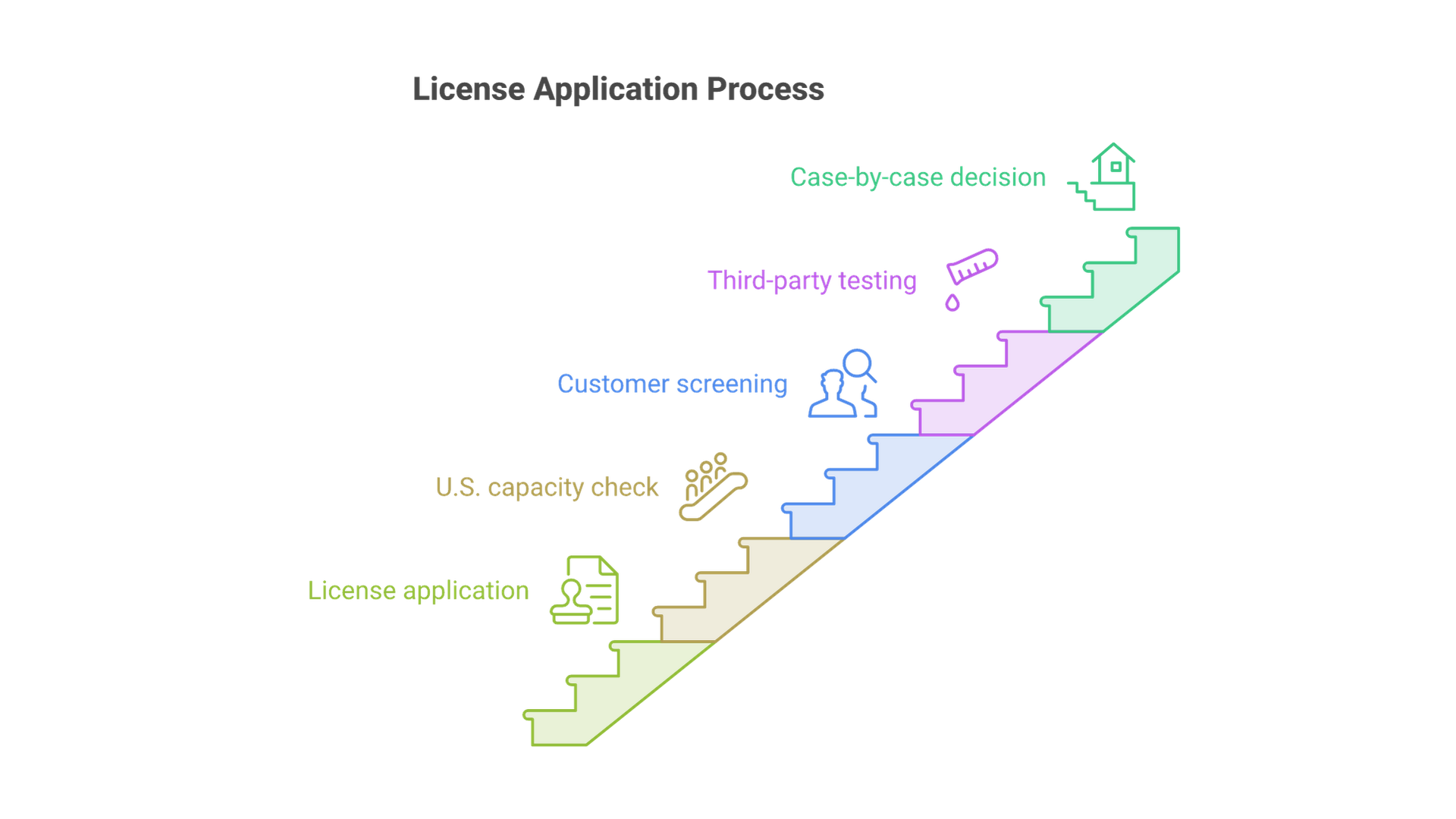
On January 13, 2026, the U.S. Commerce Department's Bureau of Industry and Security revised its license review policy so that export applications for the NVIDIA H200, AMD MI325X and similar chips to China are reviewed case by case rather than under the stricter prior policy. Applicants must show that the exports will not reduce production capacity available to U.S. customers, that the Chinese buyer has export compliance procedures including customer screening, and that the product has passed independent third-party testing in the United States. The final rule text is published in the Federal Register. Despite that opening, NVIDIA's August 2026 outlook assumed no Data Center compute revenue from China, so the market remains an upside scenario rather than a planning assumption.
Strategic Paths Forward
So how does NVIDIA maintain its competitive edge against rising competition? The paths identified in the original analysis still apply, and the October 2026 picture shows the company pursuing most of them.
Expand NVIDIA AI Enterprise
Offer a complete AI stack of software, models, GPU hardware and management tools, so that switching away from NVIDIA becomes as costly and complex as possible.
Deepen ecosystem lock-in
Enhance CUDA and its libraries so AI developers keep building on NVIDIA, and provide developer tools, model hubs and AI frameworks. Portable frameworks such as PyTorch, JAX and vLLM now run on rival hardware, which makes this harder.
Energy efficiency leadership
Invest in GPU and system design that cuts power per unit of work while scaling performance. With capacity now planned in gigawatts, performance per watt increasingly decides purchases.
AI factories and AI infrastructure
Promote the concept of AI factories in which NVIDIA systems act as industrial-scale engines for AI workloads, and position the company as the backbone of generative AI worldwide.
Strategic alliances with cloud providers
Partner with Google Cloud, Microsoft Azure and AWS even as they build their own chips, and secure deals in which NVIDIA remains essential in hybrid deployments.
Diversify beyond data centers
Expand into autonomous driving, edge AI, robotics and PC chips, so that other markets sustain growth if data center demand slows. NVIDIA's decision to report a separate Edge Computing segment reflects this priority.
For enterprises, the practical lesson is to treat accelerator choice as an architecture decision rather than a purchasing detail. Capacity, software portability, data location and cost per token all depend on it, and a well-planned AI infrastructure strategy keeps those options open as the market shifts.
Long-Term Challenges
Several challenges are likely to shape NVIDIA's position over the next few years:
- Big tech companies will keep expanding custom chips for their own workloads.
- AMD's rack-scale systems and multi-gigawatt customer agreements give buyers a credible second source.
- Governments shape the market through export controls and industrial policy, and policy can change quickly.
- NVIDIA relies heavily on data centers, a segment that may shift if hyperscalers prefer their own chips.
- Supply of advanced packaging and high-bandwidth memory constrains how fast any vendor can ship.
- The stock price can swing sharply with every change in perceived market share.
None of these threats is new, but in 2026 competitors are shipping at scale rather than announcing roadmaps.
Frequently Asked Questions
Why does NVIDIA dominate the AI chip market?
NVIDIA combines leading GPUs with networking, rack-scale systems and the CUDA software ecosystem. Most AI frameworks and libraries were optimized for its hardware first, which makes it the default platform for training and serving large models.
What is NVIDIA's moat?
The moat is the full stack rather than any single chip: CUDA and its libraries, high-speed interconnects, system designs and a large developer base. A competitor has to match all of these to win workloads that already run on NVIDIA.
Who are NVIDIA's biggest competitors in AI chips?
AMD is the main merchant GPU rival with its Instinct line and Helios racks. Google, AWS and Microsoft build their own accelerators (TPU, Trainium and Maia), and several startups focus on specialized inference chips.
Can custom chips from Google, Amazon and Microsoft replace NVIDIA GPUs?
They can replace GPUs for workloads their owners control, especially high-volume inference of in-house models. All three clouds still offer NVIDIA systems, because customers bring a wide variety of models and frameworks that GPUs handle more flexibly.
What is NVIDIA Vera Rubin?
Vera Rubin is NVIDIA's platform after Blackwell, combining the Rubin GPU, Vera CPU and new networking chips. NVIDIA introduced it in January 2026 and said in May 2026 that it was ramping into full production.
How do export controls affect NVIDIA?
U.S. rules limit which accelerators can be sold to China. Since January 2026, licenses for chips such as the H200 are reviewed case by case under conditions, but NVIDIA's August 2026 outlook assumed no Data Center compute revenue from China.
Conclusion: NVIDIA's Competitive Edge
NVIDIA's ability to maintain its competitive edge depends on its integrated ecosystem, spanning GPU architecture, AI research, strategic investments and AI software platforms. Other tech giants are now shipping custom chips at scale and AMD has won major rack-scale commitments, yet NVIDIA's strength across AI workloads and its hold on AI developers still give it a powerful lead.
The future of the AI chip market will hinge on how quickly competitors scale their own chips, how effectively NVIDIA keeps innovating across GPUs, inference accelerators and systems, and whether its software stack remains the standard AI infrastructure for enterprises. If NVIDIA balances hardware innovation with ecosystem lock-in, it can sustain its dominance even in a market where big tech companies fight to carve out their share.
If you are weighing GPU, cloud ASIC or hybrid options for your own AI workloads, talk to Cognativ about your AI infrastructure plans.