


How to Train Your Own LLM: A Step-by-Step Guide for Beginners
Training your own LLM usually means fine-tuning, not pre-training from scratch. A beginner walkthrough of both phases, LoRA methods, tooling and deployment.
Large language models (LLMs) are a class of artificial intelligence systems that read, write and reason with human language. They draw on natural language processing and machine learning to turn input text into coherent, context-aware output. When you train your own LLM, you take a general-purpose language model and teach it to speak your domain's dialect, follow your policies and solve your specific tasks.
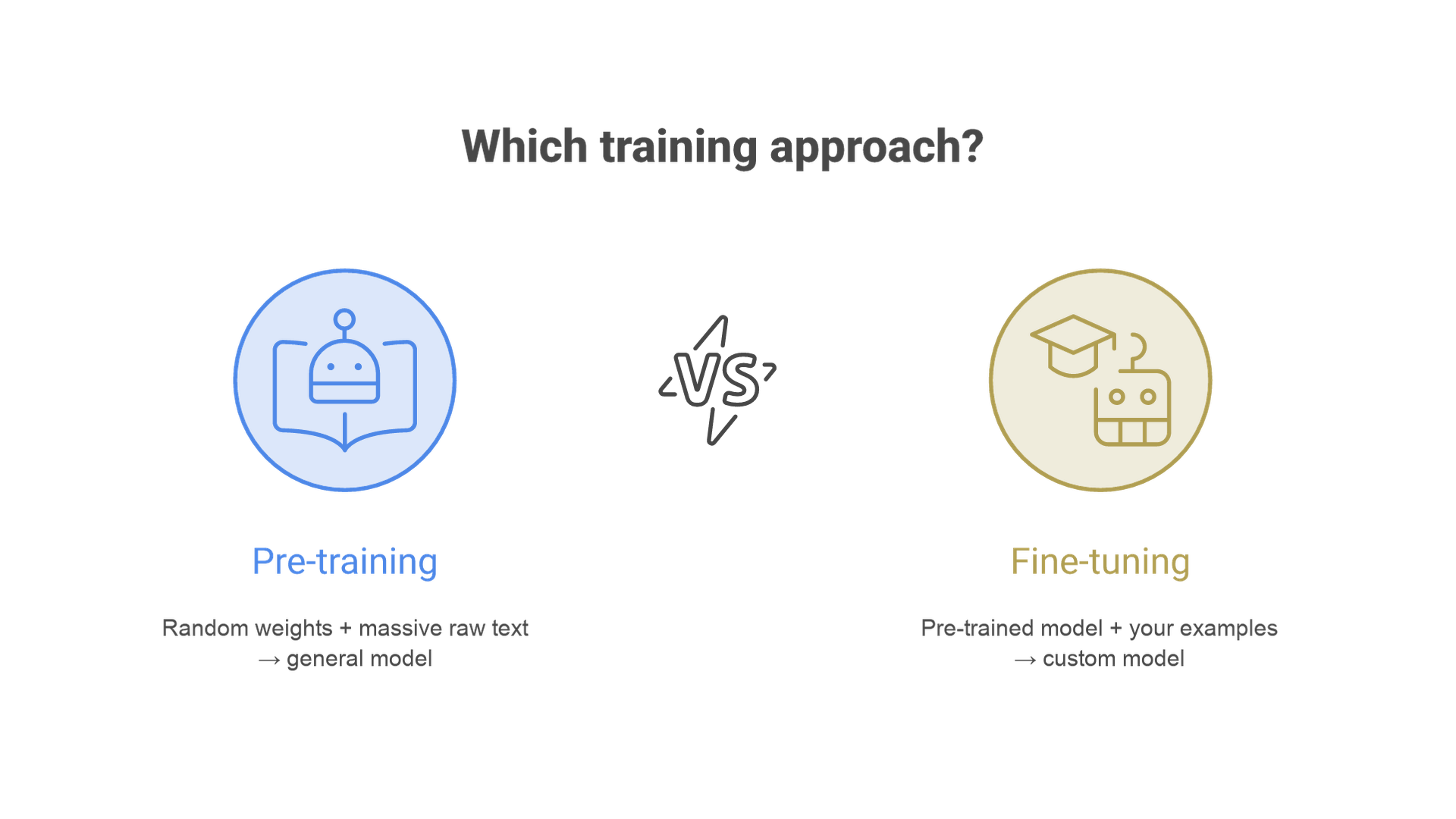
At a high level, the training process has two phases: pre-training on very large datasets of generic raw text to learn broad language patterns, and fine-tuning on narrower data so the model adapts to your products, tone and workflows. As a beginner you will almost always start from a pre-trained model and fine-tune it. Pre-training from scratch is still worth understanding, and it is now possible as a small learning project, but it is rarely the right way to build something useful.
This guide walks from "nothing" to a working custom model you can evaluate and deploy. It reflects the tooling available in October 2026: open-weight model families such as Gemma 4, Qwen3.5 and gpt-oss, parameter-efficient methods such as LoRA and QLoRA, and libraries such as Hugging Face TRL and Unsloth.
Why train your own LLM?
A stock, general-purpose model is great for demos, but production use often needs fine-grained control. Customizing a model can give you more consistent formatting, a house tone, reliable refusals and better handling of domain vocabulary in real-world scenarios such as customer support, policy-constrained summaries or domain-specific text generation. Running an open-weight model on infrastructure you control can also reduce exposure of sensitive information to third parties.
Training is not the only way to customize a model, and it is not always the first one to try. Careful prompting changes behavior without touching weights, and retrieval-augmented generation (RAG) gives a model access to current documents at answer time. Fine-tuning earns its cost when you need the model to behave differently every time: a fixed output schema, a specialized writing style, a narrow classification or extraction task, or a smaller model that matches a larger one on a single job. If your main problem is that the model lacks up-to-date facts, retrieval is usually the better fit, and the two are often combined.
A good reason to train your own model also includes a deployment story. If you want to run it privately, it helps to understand what a local LLM is and how teams use one before you choose a base model, because the target hardware constrains every later decision.
What training your own LLM means: pre-training vs. fine-tuning
People use "train an LLM" for three different jobs, and the difference decides your budget.
Pre-training from scratch
Pre-training starts from random weights and teaches a transformer to predict the next token across a very large text corpus. This is where the model learns grammar, facts and general reasoning patterns. The compute-optimal scaling work behind DeepMind's Chinchilla model found that model size and the number of training tokens should be scaled equally, so a bigger model needs proportionally more data, not just more GPUs (Hoffmann et al., 2022). That is why pre-training a competitive general model is a project for well-funded labs, not a first project.
Continued pre-training
Continued pre-training takes an existing base model and keeps training it on raw, unlabeled domain text, such as legal filings or technical manuals, before any instruction tuning. It helps when your vocabulary is far from web text, but needs far more data and compute than fine-tuning.
Fine-tuning
Fine-tuning starts from a pre-trained (and usually instruction-tuned) checkpoint and trains it on a comparatively small set of task examples. With parameter-efficient methods, you update only a small fraction of the model's parameters. This is what most beginners, and most companies, mean when they say they trained their own model, and it is where the rest of this guide focuses.
The path at a glance
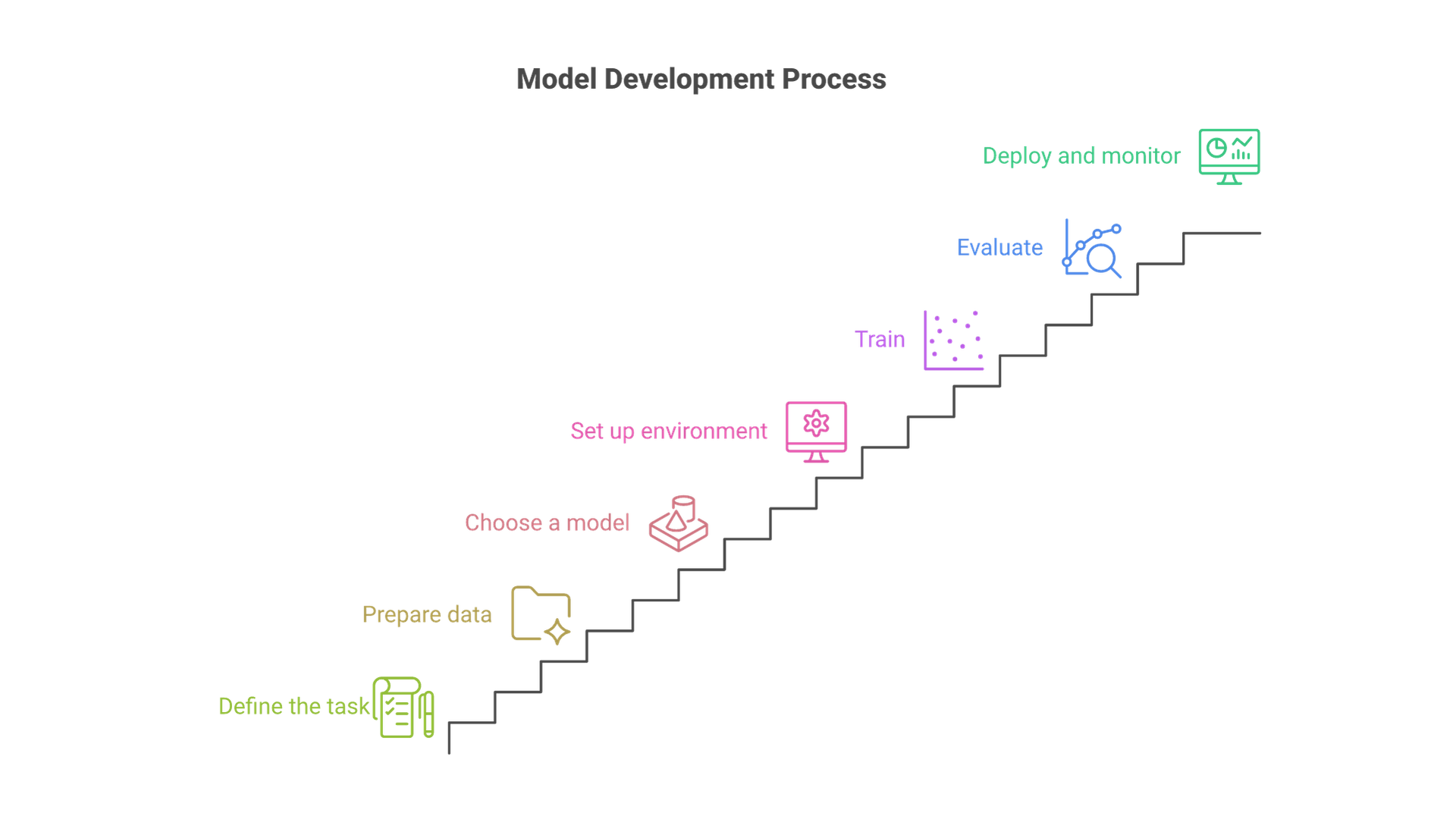
You will define the task, prepare a training dataset, choose the right model and model architecture, stand up a training environment, run model training, evaluate with automated metrics and human feedback, and finally deploy and monitor. Each step is small and testable, which keeps risk and cost under control.
The most important step is the first one. Write down the input your model will receive, the output you expect, and how you will decide whether an answer is good. If you cannot describe a correct answer, no amount of GPU time will fix that.
Preparing Your Own Data
Your model can't learn what it doesn't see. The single most important investment is high-quality data that reflects your goals, and the fine-tuning guide from Unsloth puts it plainly: the quality and amount of your data will largely shape the end result (Unsloth documentation).
Collect relevant data
Gather text from help center articles, tickets, chats, specs, internal wikis and knowledge bases. Prioritize authoritative, current documents; stale inputs teach stale behavior. Use only data you have the right to use for training, and keep a record of where every source came from.
Respect privacy and compliance
Classify and protect sensitive information such as personal, financial and health data. Redact or tokenize identifiers and store provenance. If regulations apply, confirm consent and retention policies before any training run, because information learned into model weights is hard to remove later.
Clean, normalize, and deduplicate
Fix formatting issues such as broken markup and boilerplate footers, collapse whitespace, and run a deduplication pass both within and across your data splits. Duplicates make a model memorize rather than generalize, and duplicates that leak into your test set make it look better than it is.
Tokenize with the base model's tokenizer
Always use the tokenizer that ships with your base model, loaded through the same library you train with, such as Hugging Face Transformers. Most modern tokenizers use byte pair encoding or a similar subword algorithm, and a mismatch silently wastes context and degrades the model's performance. Instruction-tuned models also expect a specific chat template; TRL's SFTTrainer applies the model's chat template automatically when you give it a conversational dataset (TRL SFTTrainer documentation).
Create task-ready examples
For supervised fine-tuning, build input-output pairs: the prompt your assistant will receive and the answer you want. Store them as conversations with system, user and assistant messages so they match the chat template. Include edge cases, error states and policy-driven refusals, and tag each sample with its source so you never evaluate on data you trained on.
Choosing the Right Model Architecture
You don't need a very large model to get good results. Picking the right model means balancing quality, latency, memory, license terms and the hardware you will serve on.
Pre-trained models vs. custom models
A beginner should treat "custom model" as "a pre-trained open-weight model plus your adapter or fine-tuned weights." A new architecture adds risk without value for almost every business task; the custom part is your data, evaluation and adapter.
Model size and budget
Start with the smallest model that can plausibly do the task, measure it, and move up only when the metrics justify it. Mixture-of-experts (MoE) models activate only a subset of their parameters per token. Google describes its Gemma 4 26B MoE model as activating about 3.8B parameters during inference, and OpenAI's gpt-oss-20b has about 21B total and 3.6B active parameters (Google, gpt-oss-20b model card). Active parameters drive speed, but all of the weights still have to fit in memory.
Architecture fit
For generation, chat and tool use, choose a decoder-only, instruction-tuned model. For pure classification, entity extraction or search, a smaller encoder model can be cheaper and faster than any generative LLM. Check the context length you need, whether you need image input, and whether the model's license permits your commercial use.
Current open-weight model families (October 2026)
These families are common starting points for fine-tuning as of this writing. Always read the license file published with the exact weights you download, because terms can differ between families and versions.
- Gemma 4 (Google). Released April 2, 2026 in E2B, E4B, 26B MoE and 31B dense sizes under Apache 2.0, with documented fine-tuning paths through Transformers, TRL, Unsloth and other tools.
- Qwen3.5 and Qwen3.6 (Alibaba Qwen). A broad range from 0.8B up to large MoE models, released through 2026 on Hugging Face and ModelScope.
- gpt-oss (OpenAI). Open-weight MoE reasoning models under Apache 2.0; the 20B model runs within 16 GB of memory and is described as fine-tunable on consumer hardware.
- Llama 4 (Meta). Scout (109B total, 17B active) and Maverick (400B total, 17B active) MoE models released in April 2025 under Meta's own license terms.
The sizes and release dates above come from the publishers: the Gemma 4 announcement, the Qwen3.5 repository, the gpt-oss-20b model card and Meta's Llama 4 announcement. For a first project, a small dense model is easier to train, debug and serve than a large MoE model.
Setting Up Your Environment
Hardware and cloud
Memory is the binding constraint. QLoRA's authors showed that 4-bit quantization plus LoRA reduces memory enough to fine-tune a 65B-parameter model on a single 48 GB GPU while preserving 16-bit fine-tuning performance (Dettmers et al., 2023). Small models need much less: Unsloth states its notebooks can fine-tune small models with as little as 3 GB of VRAM. For a first run, a free or low-cost cloud notebook with a single GPU is enough to learn the workflow. Teams that plan to train repeatedly on private data often move to dedicated hardware; Cognativ's guide to setting up a local AI server covers that step.
Orchestration tools and storage
Version datasets, configs, checkpoints and evaluation results together so every model traces back to the data that produced it, and use an experiment tracker to log loss curves and hyperparameters.
Libraries and frameworks
The standard open-source stack in 2026 is PyTorch underneath Hugging Face Transformers, PEFT for adapters and TRL for training loops. TRL provides trainers for supervised fine-tuning, DPO preference training and GRPO reinforcement learning, and every trainer accepts a PEFT configuration (TRL PEFT integration). Unsloth wraps a similar workflow with memory-saving kernels and ready-made notebooks, and Axolotl and LLaMA-Factory offer config-file-driven training. For pre-training experiments, Andrej Karpathy's nanochat provides a compact end-to-end harness.
Selecting and Loading a Base Model
Shortlist two or three candidate checkpoints and run your evaluation set against each one before training anything. The baseline shows how much fine-tuning must improve, and sometimes that a better prompt already meets your bar.
Prefer the instruction-tuned variant for chat and task work; use a base (non-instruct) checkpoint only for continued pre-training. Load the model and tokenizer from the same repository and pin the exact revision in your experiment log.
Model Training Basics
Fine-tuning is ordinary supervised learning: the model sees an input, predicts the target tokens, and the optimizer nudges trainable weights to reduce the loss.
Training parameters to tune
Learning rate, number of epochs, batch size, sequence length and LoRA rank matter most. Start from documented defaults rather than inventing your own. TRL's documentation suggests a learning rate around 2.0e-4 for supervised fine-tuning with LoRA, roughly ten times the full fine-tuning rate, and Unsloth recommends one to three epochs to avoid overfitting. Change one parameter at a time and compare against your baseline.
Efficiency tricks
Mixed precision (bfloat16) halves memory compared with 32-bit weights. Gradient accumulation simulates larger batches on limited memory, and gradient checkpointing trades compute for lower activation memory. Profile memory early so you don't hit an out-of-memory error halfway through an epoch.
Fine-Tuning Strategies
Choose the method that matches your data, your hardware and the behavior you need to change.
Supervised fine-tuning (SFT)
SFT trains on curated prompt-and-answer pairs. It is reliable for structured tasks such as classification, extraction and templated replies, and for teaching a model to generate human-like text in your style. It is the right first step for almost every beginner project.
Instruction tuning
Instruction tuning exposes a model to a wide variety of task instructions with high-quality answers, which improves instruction following, tone and formatting. Current instruct checkpoints already include it, so you usually add only task-specific SFT.
Low-rank adaptation (LoRA)
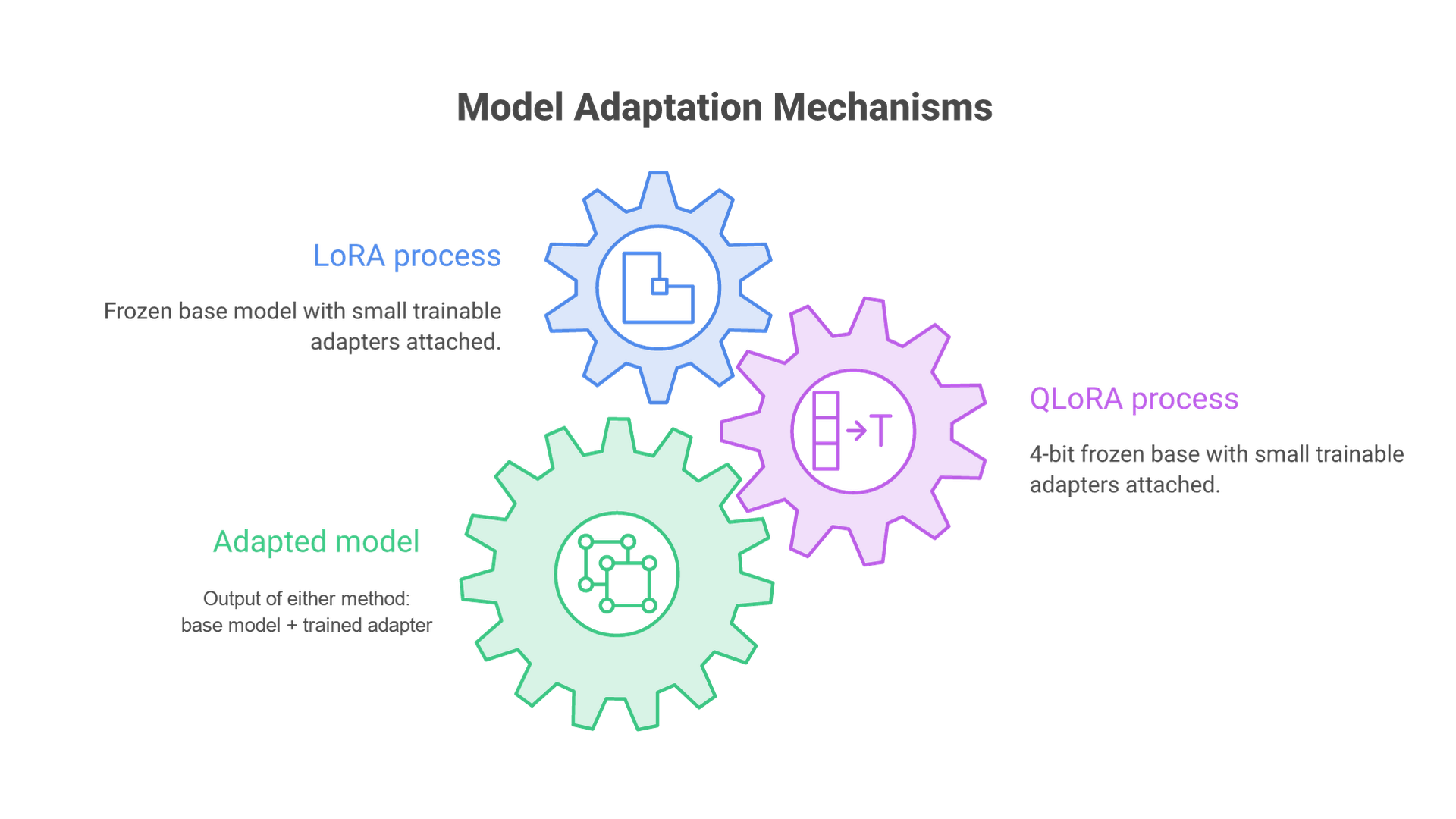
Low-rank adaptation freezes the original weights and trains small adapter matrices injected into the network. In the original paper, LoRA reduced trainable parameters by 10,000 times and GPU memory needs by three times compared with full fine-tuning of GPT-3 175B (Hu et al., 2021). Adapters also let you keep several domain variants of the same base model. Research from Thinking Machines Lab found that LoRA can match full fine-tuning on small-to-medium supervised datasets when adapters are applied to all layers, including the MLP layers, rather than attention only (Schulman et al., 2025).
QLoRA
QLoRA loads the frozen base model in 4-bit precision, using the NF4 data type, and trains LoRA adapters in higher precision on top. Its paper also introduced double quantization and paged optimizers to reduce memory spikes. In TRL you enable it by passing a 4-bit quantization config alongside the LoRA config. QLoRA is the usual answer when a model is slightly too large for your GPU.
Reinforcement learning (advanced)
After SFT, some teams align a model with preferences. Direct Preference Optimization (DPO) trains on pairs of a preferred and a rejected answer using a simple classification-style loss instead of the separate reward model and reinforcement learning loop of classic RLHF (Rafailov et al., 2023). GRPO and related methods use reward signals, such as passing a test or matching a verifiable answer, to improve reasoning. These steps are optional for beginners; good data and SFT get you most of the way.
Building the Training Dataset
Think coverage before size. A smaller, well-curated set of examples usually beats a huge, noisy one. Include canonical answers, ambiguous cases and strict refusal examples where your assistant must not act. Use consistent templates for repetitive tasks so outputs stay uniform.
Split your data into training, validation and test sets before you start, and keep the test set untouched. Unsloth's guide suggests holding out a portion of the data, such as 20%, for testing. Keep labels consistent; annotators who disagree teach the model to be inconsistent. Synthetic examples from a larger model can fill gaps, but review them and check that model's terms first.
Evaluating Your LLM
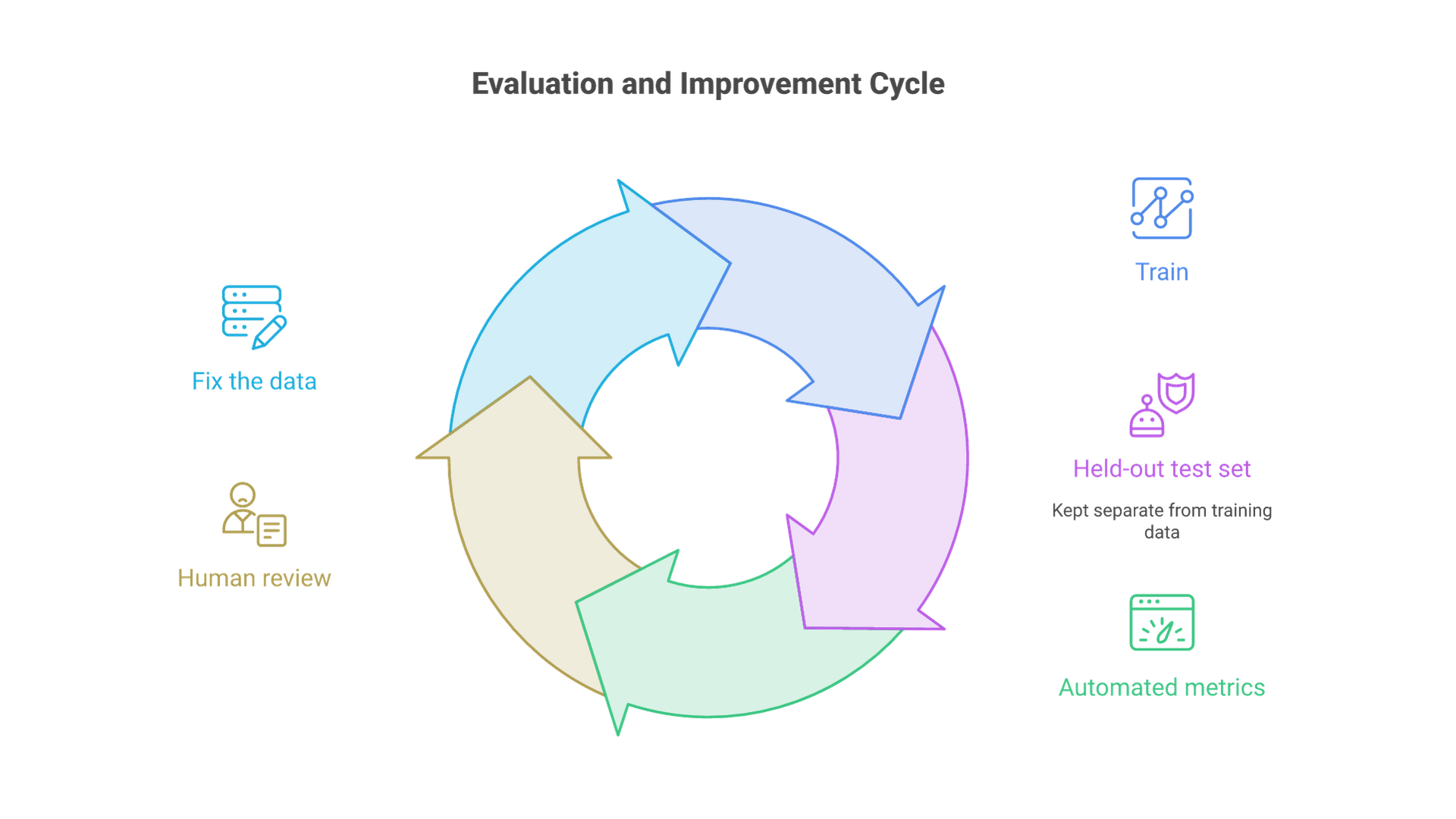
Evaluation is continuous, not an afterthought. Build the evaluation set before training so you can measure the base model first.
Automated metrics
Track validation loss during training, accuracy or F1 for classification and extraction, exact-match or schema checks for structured output, and rubric scores for open-ended generation. EleutherAI's lm-evaluation-harness can run standard benchmarks against a Hugging Face model with a PEFT adapter attached, which helps you check that fine-tuning did not damage general skills.
Human feedback loops
Sample outputs after each run and collect lightweight human ratings for correctness, clarity, safety and helpfulness. Side-by-side comparisons are often easier than absolute scores, and those pairs can later become DPO training data.
Don't test on the same data
Never evaluate on the data you trained on. Keep a held-out test set that reflects real-world scenarios. If training loss keeps falling while test performance stalls or drops, the model is overfitting.
Deploying Your LLM
Serving patterns
You can merge the adapter into the base weights or serve it alongside the base model. vLLM can serve multiple LoRA adapters on one base model and select the adapter per request (vLLM documentation), which suits multi-tenant or multi-domain setups. For a laptop or single workstation, converting the model to GGUF for llama.cpp, Ollama or LM Studio is the common path. Cognativ's guide to setting up a local LLM for optimal performance covers the runtime tuning that follows.
Monitoring and safety
Track latency, error rates, user ratings and override or escalation rates. Filter prompts for personal data and policy violations, and keep a fallback path when the model fails.
Privacy and governance
Document data use, model versions, adapters and decision logs. Keep proprietary data isolated. If legal requirements restrict retention, prefer retrieval over teaching facts into the weights, because a retrieval index is easier to update or purge than a trained model.
Can a Beginner Train an LLM From Scratch?
Yes, as a learning exercise. Building a small GPT-style model yourself is one of the best ways to understand tokenization, attention and the training loop. Karpathy's nanochat covers tokenization, pre-training, fine-tuning, evaluation and inference in one repository, and its README states that a GPT-2-capability model can be trained for about $48, roughly two hours on a single 8xH100 cloud node (nanochat on GitHub). Sebastian Raschka's book Build a Large Language Model (From Scratch) takes a slower, code-along route.
A model trained this way is a learning tool, not a replacement for current open-weight models trained on vastly more data and compute. For a production task, the practical choice is to fine-tune an existing checkpoint, and if you need help deciding which route fits your product, Cognativ's LLM solutions team works through that choice with clients.
Troubleshooting and Common Pitfalls
It sounds great but answers are wrong. Fine-tuning teaches format and behavior more reliably than facts. Add retrieval with citations for knowledge, and expand task coverage in your training samples.
Training loss falls, validation plateaus. Reduce the learning rate or the number of epochs, add regularization, or revisit noisy labels.
The model forgot general skills. Lower the learning rate, train for fewer steps, or mix some general instruction data into the training set, then rerun your general benchmarks.
The output format breaks. Check that training and inference use the same chat template and special tokens.
It won't fit in memory. Choose a smaller model, switch to QLoRA, shorten sequences or increase gradient accumulation.
Cost Management and Optimization
Start small, prove value, then scale. Most of the cost of a first project is people's time spent on data and evaluation, not GPU hours. Use adapters to train cheaply, run short test jobs before full runs, and stop experiments whose validation scores stop improving.
GPU prices vary by provider and region, so price your own runs. Measure the cost per training run and per thousand inferences, and tie spend to business outcomes such as tickets resolved or hours saved. If you serve the model yourself, inference usually costs more than training over time, which is why picking a smaller model that meets your bar pays off. Planning AI infrastructure early avoids rebuilding the serving stack once usage grows.
Responsible and Secure AI
Responsible use is part of quality. Test for biased outcomes across user groups, add refusals for harmful content, and document limitations, intended use and failure modes in a model card. Fine-tuning can weaken the safety behavior a base model shipped with, so rerun safety tests after every training run rather than assuming they still pass. In regulated settings, the versioning that makes experiments reproducible also makes audits possible.
Roadmap: From Prototype to Production
Prototype with a few hundred to a few thousand reviewed examples and LoRA on a small instruction-tuned checkpoint. Evaluate against the untuned base model and your best prompt-only baseline. Expand coverage where errors cluster and iterate. Pilot with guardrails and measure business KPIs. Then harden, document and roll out gradually.
A minimal starter recipe
Build a small chat-format dataset plus a separate test set. Load a small instruction-tuned model and its tokenizer, run SFT with LoRA (or QLoRA if memory is tight) using TRL or Unsloth defaults, evaluate, iterate on data before hyperparameters, and deploy the adapter behind a monitored API.
Frequently Asked Questions
How much data do I need?
Enough to cover your task and its edge cases. A few hundred to a few thousand carefully reviewed examples is a common starting range for a narrow task. Relevance and consistency matter more than raw volume.
Which model should I start with?
Pick an actively maintained, instruction-tuned open-weight model that fits your hardware, latency and license needs, such as a small Gemma 4 or Qwen3.5 checkpoint. Add capacity only when your metrics justify it.
Can I train on confidential documents?
Yes, if you have the rights to use them and enforce privacy controls. Redact personal data, keep training and artifacts on infrastructure you control, and remember that data learned into weights is hard to remove.
Do I need very large models?
Not for most applications. A smaller model fine-tuned on good data often handles a narrow task well and is cheaper and faster to serve than a much larger general model.
How long does training take?
It depends on model size, dataset size, sequence length and hardware. A LoRA run on a small model and a modest dataset can finish in minutes to hours on a single GPU; larger models and datasets take longer.
Can I keep full control on-premises?
Yes. Open-weight models can be trained and served entirely on your own hardware, with the cloud used only for burst capacity if needed.
Conclusion and Next Steps
Training your own LLM is achievable for beginners when you treat it as fine-tuning a strong pre-trained model rather than building one from scratch. Define the task, curate data that reflects it, measure a baseline, and apply parameter-efficient methods such as LoRA or QLoRA with well-documented tools. Keep the loop tight: measure, learn and iterate.
As you gain confidence, explore preference tuning, distillation and a from-scratch learning project. With good data, a sensible model choice and modest compute, you can build a custom language model your users trust.
If you want help choosing a base model, designing the dataset or running a fine-tuning pilot on infrastructure you control, talk to Cognativ about your LLM project.