

Artificial Intelligence Books: 10 Essential Reads for 2026
Building an AI reading list for your team? Start here: foundations, deep learning, language models, reinforcement learning and ethics, matched to each role.
Artificial intelligence (AI) continues to reshape industries, influence strategic decisions and accelerate digital transformation across enterprises. For CIOs, CTOs, CISOs, data leaders and the engineers who report to them, books remain one of the most efficient ways to build durable understanding: a well-written book gives you a structured mental model that a stream of news, demos and vendor announcements cannot.
This guide lists ten essential artificial intelligence books, then expands into further reading on foundations, large language models, ethics and specialized topics such as reinforcement learning and computer vision. Whether your interest lies in learning AI's basics, building applications with language models or understanding the ethical implications of automated decisions, the list is organized so you can pick the right starting point for your role.
Every title, author, edition and year below was checked on October 30, 2026 against the publisher's or author's official page, and several of the best books on AI are free to read online from those pages. This update also corrects outdated editions and removes titles we could not verify.
The 10 Essential Artificial Intelligence Books at a Glance
The table gives the short version. The ten books cover four needs that most enterprise readers share: a foundation in how AI works, a working grasp of deep learning and language models, practical guidance for shipping AI applications, and a clear view of the social and ethical stakes.
| # | Book | Author(s) | Edition and year | Best for |
|---|---|---|---|---|
| 1 | Artificial Intelligence: A Modern Approach | Stuart Russell and Peter Norvig | 4th edition, Pearson, 2020 | A complete map of the field |
| 2 | Deep Learning: Foundations and Concepts | Christopher M. Bishop and Hugh Bishop | Springer, 2024 | Modern deep learning, including transformers |
| 3 | Deep Learning | Ian Goodfellow, Yoshua Bengio and Aaron Courville | MIT Press, 2016 | Classic neural network theory |
| 4 | Speech and Language Processing | Dan Jurafsky and James H. Martin | 3rd edition draft, August 2026 | Natural language processing and LLMs |
| 5 | Build a Large Language Model (From Scratch) | Sebastian Raschka | Manning, 2024 | Seeing how a GPT-style model works in code |
| 6 | AI Engineering | Chip Huyen | O'Reilly Media, 2025 | Shipping applications on foundation models |
| 7 | Artificial Intelligence: A Guide for Thinking Humans | Melanie Mitchell | Farrar, Straus and Giroux, 2019 | A clear-eyed, nontechnical view of AI |
| 8 | Co-Intelligence: Living and Working with AI | Ethan Mollick | Portfolio, 2024 | Leaders adopting generative AI at work |
| 9 | Weapons of Math Destruction | Cathy O'Neil | Crown, 2016 | Algorithmic bias and accountability |
| 10 | Reinforcement Learning: An Introduction | Richard S. Sutton and Andrew G. Barto | 2nd edition, MIT Press, 2018 | Decision-making and learning from reward |
Four of these books are available to read free from their authors' or publishers' sites: the online edition of Deep Learning by Goodfellow, Bengio and Courville, the full PDF of Sutton and Barto, the draft chapters of Jurafsky and Martin, and a free-to-use online version of the Bishops' book. That makes it practical to start a team reading group before anyone buys a copy.
How to Choose the Right AI Book for Your Role
No single artificial intelligence book suits every reader. The best choice depends on what you need to decide or build, how much math you are comfortable with and how much time you can invest. Start from your role and the questions you need to answer this year.
AI Books for Beginners and Business Leaders
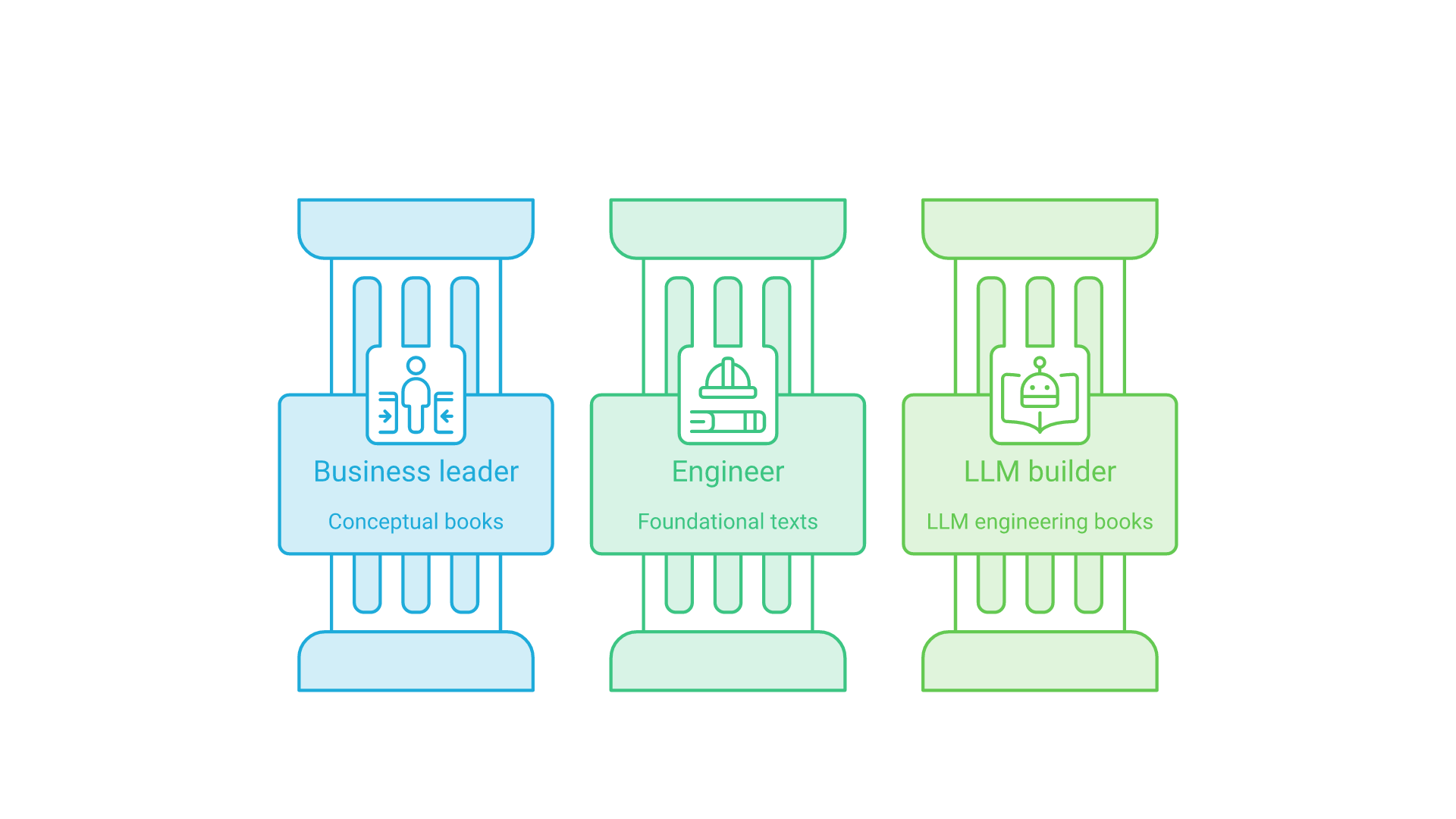
If you are new to the subject or need to make decisions about AI rather than build it, start with Melanie Mitchell and Ethan Mollick. Mitchell explains what today's systems can and cannot do without requiring a computer science background. Mollick focuses on how people and organizations work alongside generative AI tools. Add Cathy O'Neil to understand how automated scoring and ranking systems can cause harm at scale, which is essential context for anyone approving an AI use case.
AI Books for Engineers and Data Scientists
Engineers usually get the most value from a combination of breadth and depth. Russell and Norvig give the breadth: search, knowledge representation, planning, probabilistic reasoning, machine learning and the philosophical and ethical questions that frame the field. The Bishops' book or Goodfellow, Bengio and Courville give the depth on neural networks. Raschka and Huyen then connect theory to the large language model systems most teams are building in 2026.
How Much Math Do You Need?
Math is the backbone of machine learning. The technical titles on this list assume comfort with linear algebra, probability, statistics and some calculus, and several include introductory chapters that review those prerequisites. If the math feels heavy, read the conceptual chapters first, then return to the derivations once a practical project gives you a reason to care about them. Leaders can get substantial value from the nontechnical books without any of this background.
Key Concepts, Basic Concepts, and Foundational Books
Understanding the basics of artificial intelligence is critical for informed decision-making in enterprise environments, and it is equally important for students seeking foundational knowledge. The foundational books on this list are written by leading researchers and professors, and they cover machine learning, deep learning, neural networks and natural language processing with academic rigor while remaining accessible to motivated readers.
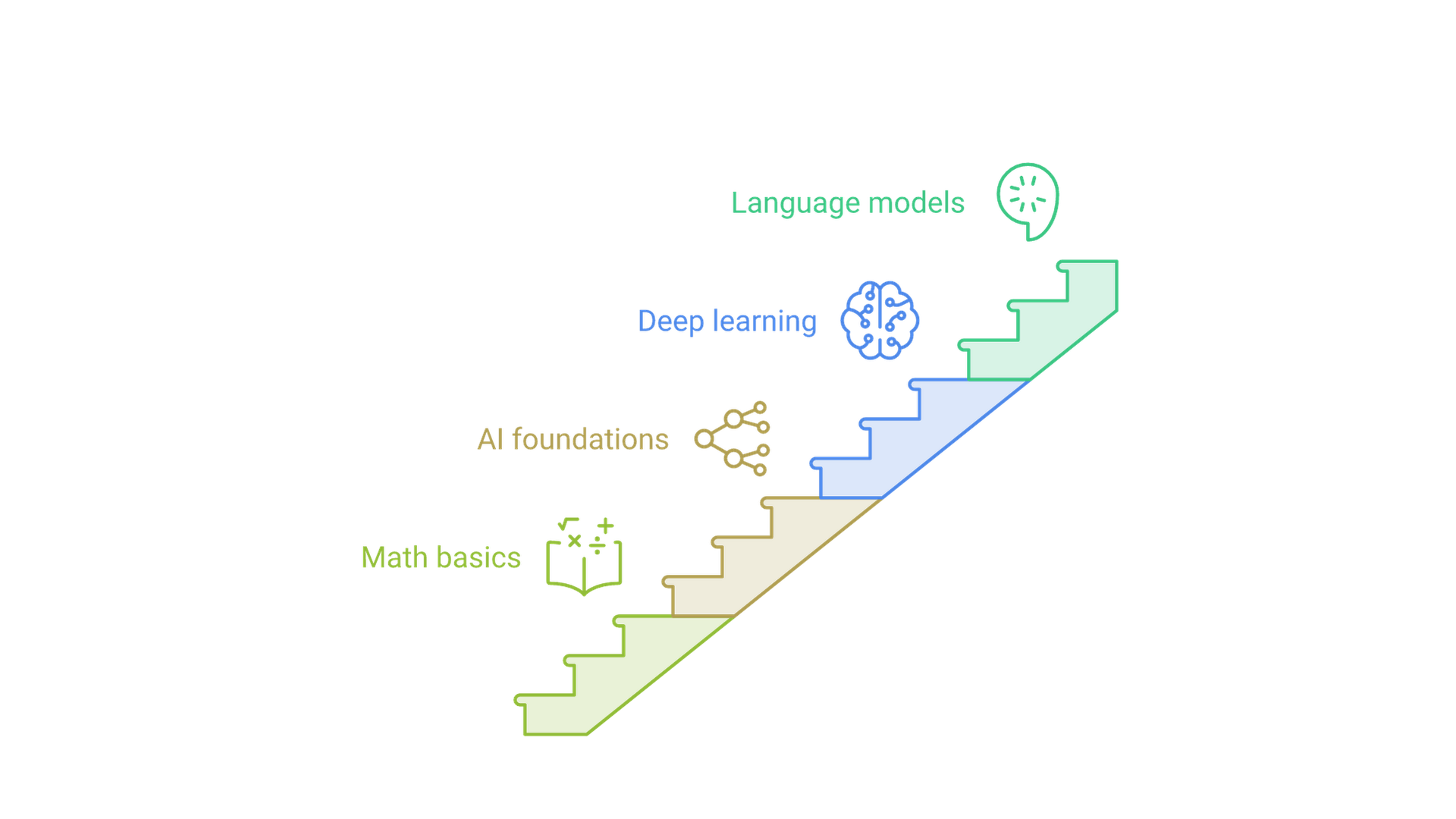
Foundational reading should give you four things: a clear introduction to the basic concepts of AI and machine learning, the mathematical underpinnings that make algorithms understandable, a sense of the history of the field and how earlier ideas shaped today's systems, and enough vocabulary to follow current research. The three books below cover those needs from different angles.
1. Artificial Intelligence: A Modern Approach
Stuart Russell and Peter Norvig's textbook is the most widely cited general introduction to the field and a standard text in university AI courses. The fourth edition, published by Pearson, is listed on the official AIMA site at Berkeley and in Pearson's catalog, which dates the print edition to 2020. It treats AI as the study of intelligent agents and moves from search and logic through probabilistic reasoning, machine learning, deep learning, natural language and robotics. Read it when you want the whole map rather than one region of it.
2. Deep Learning: Foundations and Concepts
Christopher M. Bishop and Hugh Bishop wrote this book as a modern companion to Bishop's earlier Pattern Recognition and Machine Learning. According to the authors' book site, a free-to-use online version is available, and the Springer listing gives a 2024 copyright. It focuses on ideas expected to stay relevant, including the transformer architectures behind current language models, which makes it the more up-to-date choice for readers starting deep learning in 2026.
3. Deep Learning
Ian Goodfellow, Yoshua Bengio and Aaron Courville's Deep Learning, published by MIT Press in 2016, remains an authoritative reference on neural networks, optimization and regularization. Its official site states that the complete online version will remain free to read. It predates the transformer era, so pair it with a newer title for language models, but its treatment of the fundamentals has aged well.
Recommended Books on Key Concepts and Foundations
| Book | Author | Edition and year | Why read it? |
|---|---|---|---|
| Artificial Intelligence: A Modern Approach | Stuart Russell and Peter Norvig | 4th edition, 2020 | Comprehensive introduction to AI basics, machine learning and deep learning, used widely in academia and industry. |
| Deep Learning: Foundations and Concepts | Christopher M. Bishop and Hugh Bishop | 2024 | Current treatment of neural networks, including transformers, with a free online version. |
| Deep Learning | Ian Goodfellow, Yoshua Bengio and Aaron Courville | 2016 | Authoritative resource on deep learning concepts and neural networks, free to read online. |
| Pattern Recognition and Machine Learning | Christopher M. Bishop | 2006 | In-depth, mathematically rigorous coverage of machine learning algorithms, suited to readers with a math background. |
| Natural Language Processing with Python | Steven Bird, Ewan Klein and Edward Loper | O'Reilly, 2009; online edition revised for Python 3 | Hands-on introduction to classic NLP techniques using Python and NLTK. |
Bishop's 2006 textbook is offered as a PDF on his Microsoft Research book page, and the NLTK book site hosts a version revised for Python 3 and NLTK 3 under a Creative Commons license, while noting the first edition was published by O'Reilly in 2009. Together these books provide a solid foundation in artificial intelligence, from neural networks and natural language processing to the mathematical principles underneath them.
Books on Large Language Models and Generative AI
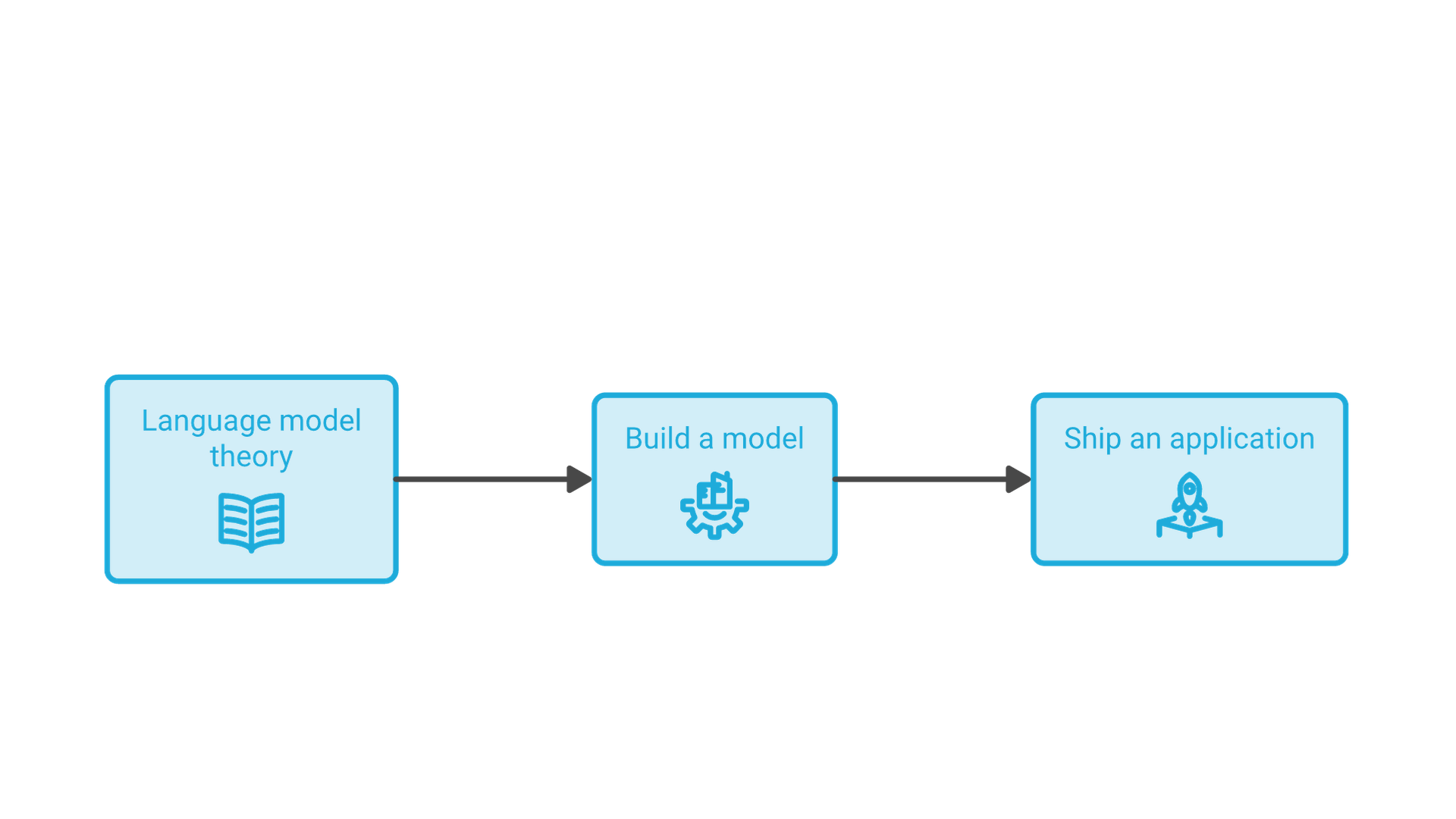
Generative AI changed what most organizations mean when they talk about AI, and the reading list has to reflect that. The three books in this section move from theory, to building a model, to shipping an application. Check the official pages for new editions before you buy.
4. Speech and Language Processing
Dan Jurafsky and James H. Martin's textbook is a long-standing reference for natural language processing. The third edition is still published as a free online draft, and the official book page at Stanford lists a release dated August 19, 2026, with a subtitle that now explicitly includes language models. It covers tokenization, embeddings, transformers, large language models, retrieval and speech. For a short primer on one of those building blocks, see our explainer on what a token is in an LLM.
5. Build a Large Language Model (From Scratch)
Sebastian Raschka's book, published by Manning in September 2024 according to the publisher's page, walks through implementing a GPT-style model step by step. It is the most direct way on this list to see how attention, pretraining and fine-tuning fit together in working code. Readers who want to understand where encoder models such as BERT fit next to GPT-style decoders can continue with our guide on whether BERT is an LLM.
6. AI Engineering
Chip Huyen's AI Engineering, published by O'Reilly Media in 2025 according to the author's book repository, addresses the work most teams actually do: building applications on top of foundation models. The author describes it as focusing on prompt engineering, context construction and parameter-efficient fine-tuning, and positions it as a companion to her earlier book on traditional machine learning systems. It is the most practical title on this list for engineering leaders.
Reading about language models is a good start, but deciding whether to prompt, retrieve, fine-tune or train is an architecture decision with cost and risk implications. Our step-by-step guide on how to train your own LLM explains the difference between pre-training and fine-tuning, and teams that need help with that choice can review our LLM solutions for production use cases.
Ethical Implications of AI
As artificial intelligence becomes woven into daily life and business operations, the ethical considerations surrounding its development and deployment have never been more critical. Machine learning, generative AI, deep learning and neural networks now influence everything from computer vision in healthcare to large language models in customer service. With these technologies come serious questions about their impact on people, businesses and society.
Bias, Fairness and Inequality
One of the most pressing ethical challenges is the risk of perpetuating bias through AI algorithms. When machine learning models are trained on data that reflects historical prejudices or lacks diversity, the resulting systems can reinforce discrimination without anyone intending it. Cathy O'Neil's work shows how opaque models used for schooling, credit, insurance and hiring decisions can be hard to challenge and can widen inequality. Addressing these biases is essential to building trust in AI-driven decisions.
Privacy, Work and Accountability
Privacy is another major concern as AI systems analyze vast amounts of personal data. Computer vision, natural language processing and large language models raise questions about data security, consent and the boundaries of surveillance. Automation also brings economic and social implications, from changes to job content to the need for reskilling, which is why forward-thinking organizations invest in education and lifelong learning.
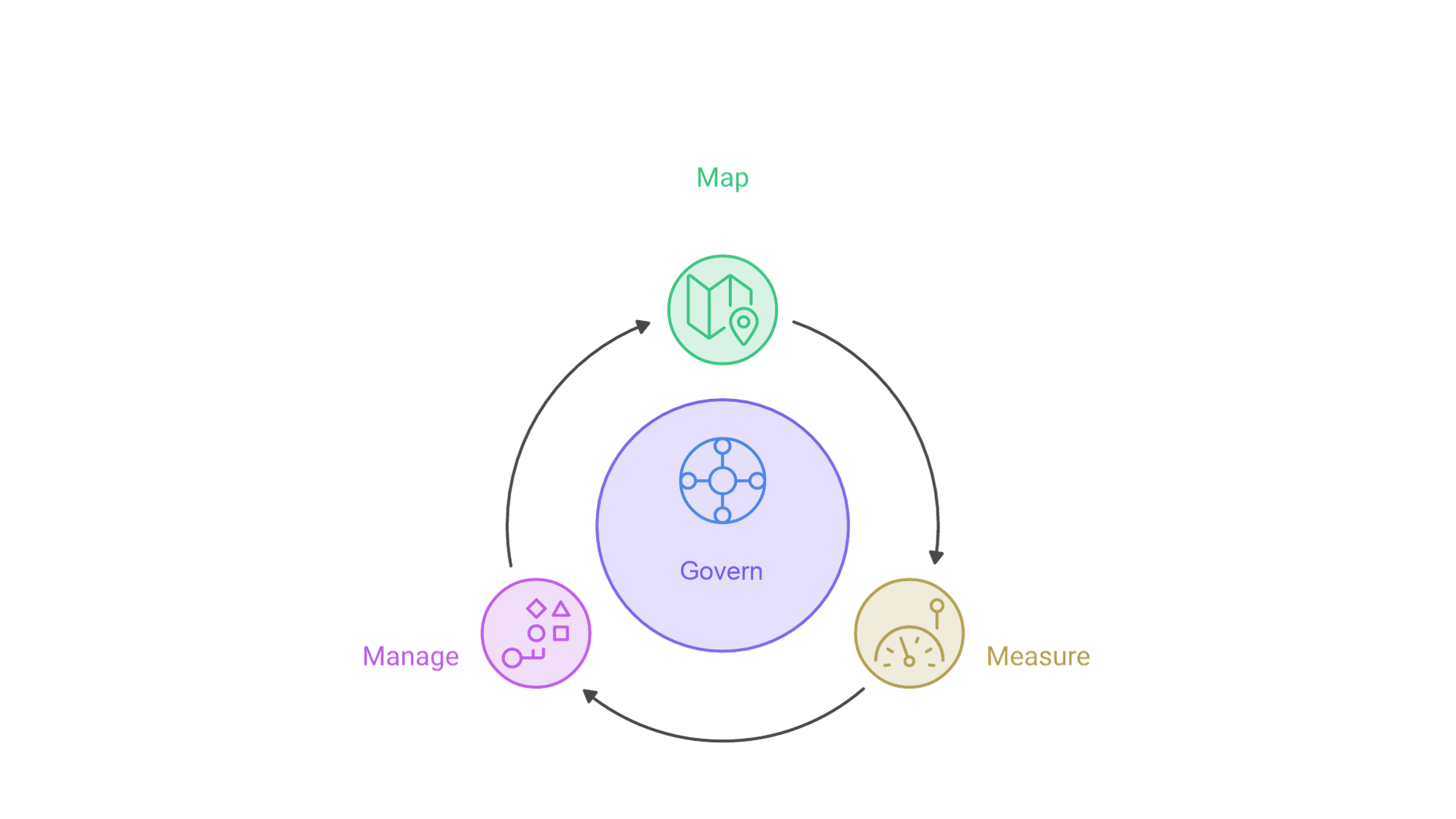
Transparency and accountability are foundational to ethical AI. As systems become more autonomous and complex, leaders need clear guidelines for responsible development and deployment, along with collaboration across computer science, ethics, law and the social sciences. The NIST AI Risk Management Framework, released on January 26, 2023 and extended by a Generative AI Profile in July 2024, organizes this work into four functions: govern, map, measure and manage. NIST notes that the framework is being revised, so check the current version. Organizations that need to turn principles into controls can explore our approach to AI governance.
7. Artificial Intelligence: A Guide for Thinking Humans
Melanie Mitchell's book, published by Farrar, Straus and Giroux in 2019 according to the author's book page, offers a balanced and accessible exploration of what AI systems actually understand, where they fail and why claims of human-level intelligence deserve scrutiny.
8. Co-Intelligence: Living and Working with AI
Ethan Mollick's book was published by Portfolio on April 2, 2024, according to Penguin Random House. The publisher describes an approach that treats AI as a co-worker, co-teacher and coach while keeping human judgment in charge. Rather than viewing AI as a replacement for human intelligence, Mollick emphasizes collaboration between people and machines. An earlier version of this article listed an incorrect subtitle; the one shown here matches the publisher's page.
9. Weapons of Math Destruction
Cathy O'Neil's Weapons of Math Destruction: How Big Data Increases Inequality and Threatens Democracy was first released by Crown in September 2016, with a paperback in 2017, according to Penguin Random House. It examines how biased or unaccountable algorithms damage individuals and communities, and it remains one of the clearest arguments for auditing automated decisions.
Recommended Books on Ethical Implications of AI
| Book | Author | Edition and year | Why read it? |
|---|---|---|---|
| Artificial Intelligence: A Guide for Thinking Humans | Melanie Mitchell | 2019 | Balanced, accessible exploration of AI's capabilities, limits and ethical challenges. |
| Co-Intelligence: Living and Working with AI | Ethan Mollick | 2024 | Human-AI collaboration and responsible adoption of generative AI at work. |
| Weapons of Math Destruction | Cathy O'Neil | 2016 | How biased algorithms harm people and why accountability matters. |
| Race After Technology: Abolitionist Tools for the New Jim Code | Ruha Benjamin | Polity, 2019 | The intersection of race and technology and systemic bias in automated systems. |
| Ethical Artificial Intelligence | Bill Hibbard | First edition, 2016 (free PDF) | Mathematical frameworks for specifying and avoiding harmful AI behavior. |
Ruha Benjamin's book is listed on her official site as published by Polity in 2019. Bill Hibbard's book is a free PDF hosted by the University of Wisconsin-Madison Space Science and Engineering Center, where the first edition is dated January 27, 2016; an earlier version is permanently available on arXiv. It is more technical and more speculative than the other titles in this table.
AI Bonus: Specialized Topics and Advanced Books
As AI technologies mature, specialized knowledge becomes increasingly important for teams building their AI capability. The books in this section go deeper into reinforcement learning, computer vision and language models. They are best read after a foundational text, and each one rewards readers who work through the exercises rather than skimming.
10. Reinforcement Learning: An Introduction
Richard S. Sutton and Andrew G. Barto's text is the foundational reference on reinforcement learning, the branch of machine learning concerned with learning from reward and making sequential decisions. The second edition, published by MIT Press in 2018, is available as a full PDF from the authors' book page. Older lists cite the 1998 first edition. Reinforcement learning ideas also appear in how modern language models are tuned with feedback, which keeps this book relevant beyond robotics and games.
Computer Vision: Algorithms and Applications
Richard Szeliski's book covers the techniques computers use to interpret images and video, from image formation and feature detection to deep learning for recognition and 3D reconstruction. The author's book page lists a second edition with a 2022 copyright and offers an electronic version free for personal use. It is important reading for teams in healthcare, manufacturing, logistics and retail where visual data drives automation.
Recommended Books on Specialized Topics and Advanced AI
| Book | Author | Edition and year | Why read it? |
|---|---|---|---|
| Reinforcement Learning: An Introduction | Richard S. Sutton and Andrew G. Barto | 2nd edition, 2018 | Foundational text on reinforcement learning, explaining key concepts and algorithms in detail. |
| Computer Vision: Algorithms and Applications | Richard Szeliski | 2nd edition, 2022 | Comprehensive coverage of computer vision techniques for processing visual data. |
How to Turn AI Books Into Working Knowledge
Reading alone rarely changes how a team builds or governs AI. Treat artificial intelligence books as a structured curriculum with a practical outcome, and revisit the fast-moving language model titles each year, since official book pages are the best place to check for new editions and free drafts.
Build a Reading Path, Not a Pile
A sensible sequence for a mixed team is to start with a conceptual book such as Mitchell or Mollick, move to a foundational text such as Russell and Norvig, then branch into depth according to role: the Bishops or Goodfellow for model builders, Jurafsky and Martin or Raschka for language model work, and Huyen for application teams. Ethics reading belongs early in the path, not at the end, because it shapes which use cases are worth pursuing.
Pair Each Book With a Small Project
Each technical book becomes more useful when it is tied to a concrete exercise: reproduce a small model from a chapter, evaluate a prompt against a test set, or write a one-page risk assessment for a proposed use case. Many of these books publish code or exercises on their official sites.
Frequently Asked Questions
What is the best book to learn artificial intelligence?
For a complete introduction, Artificial Intelligence: A Modern Approach by Stuart Russell and Peter Norvig is the most widely used choice. For a nontechnical start, Melanie Mitchell's Artificial Intelligence: A Guide for Thinking Humans is more accessible.
Which AI books are free to read online?
Official free versions exist for Deep Learning by Goodfellow, Bengio and Courville, Reinforcement Learning by Sutton and Barto, Speech and Language Processing by Jurafsky and Martin, Deep Learning: Foundations and Concepts by the Bishops, and Szeliski's Computer Vision for personal use.
Do I need math to read AI books?
For technical books, yes: linear algebra, probability, statistics and some calculus help a lot. Conceptual books such as Mitchell, Mollick and O'Neil require no math and are well suited to leaders.
What AI book should a business leader read first?
Co-Intelligence by Ethan Mollick is a practical starting point for leaders adopting generative AI, and Weapons of Math Destruction by Cathy O'Neil adds the risk and accountability perspective.
Are there good books on large language models?
Yes. Speech and Language Processing covers the theory, Build a Large Language Model (From Scratch) shows the implementation, and AI Engineering covers building applications on foundation models.
Can you learn AI from books alone?
Books give the structure and concepts, but most people need hands-on projects, exercises and code to turn that knowledge into skill. Pair each technical book with a small, practical project.
Conclusion: Building Your AI Reading List
Exploring artificial intelligence books is one of the most reliable ways to understand the evolving world of AI, from basic concepts to the latest advances in machine learning, deep learning, reinforcement learning and large language models. The ten essentials in this guide cover the technical foundations, the practical engineering and the ethical considerations that shape the present and future of AI technology.
While the pace of AI development can feel overwhelming, a steady, structured approach to learning builds deeper knowledge than chasing every announcement. Whether you are a student, a practitioner or a business leader, choose two or three books that match your role, pair them with a real project and revisit the fast-moving titles each year.
If your team is moving from reading about AI to deciding where it fits in your products or operations, talk to Cognativ about your AI project.