

LLM Optimization: How to Improve Model Performance, Costs, and AI Visibility in 2026
Use model routing, caching, prompt trimming and KV cache compression to make LLMs faster and cheaper, and structure content so AI search engines cite you.
LLM optimization is the discipline of making large language models faster, cheaper, and more visible across the AI platforms that increasingly shape how customers discover products and services. As modern LLMs need optimizations to handle billions of parameters efficiently, organizations in 2026 face pressure on three fronts simultaneously: inference performance that meets real-time user expectations, cost structures that don't erode margins at scale, and content strategies that ensure AI-generated answers reference the right brand. This article covers all three pillars with concrete techniques, benchmarks, trade-offs, and implementation guidance.
The scope here is practical optimization for teams building or integrating LLMs into products-whether through hosted APIs like OpenAI and Anthropic, or self-served open-source AI models such as Llama 3 and Mistral. This is not a guide to training foundation models from scratch. The target audience is engineering leaders, product owners, and marketing teams at mid-market and enterprise organizations who need faster, cheaper, and more discoverable AI systems.
In short: LLM optimization refers to techniques that improve language model performance across inference speed, resource efficiency, and AI search visibility, enabling organizations to deliver better experiences while controlling costs and ensuring their brand appears in AI responses from ChatGPT, Perplexity, Gemini, and other major AI search engines.
By the end of this article, you will understand:
- How quantization, pruning, and KV cache strategies reduce inference latency and GPU spend with real benchmark data
- When and how to route queries to the right model to achieve up to 3× token efficiency
- How to structure content so AI engines cite your brand instead of competitors
- Where governance constraints shape which optimization techniques are acceptable
- How a structured process like Cognativ's RAPID framework connects optimization to measurable ROI
Understanding LLM Optimization
LLM optimization encompasses three interconnected pillars: model and inference optimization (making the model run efficiently), usage and cost optimization (spending tokens and compute wisely), and content and brand optimization-often called LLMO or generative engine optimization (GEO)-which ensures AI systems surface and cite your content. Together, these pillars determine whether an AI-powered product delivers fast responses, operates within budget, and remains visible where decisions are increasingly made: inside AI-generated answers.
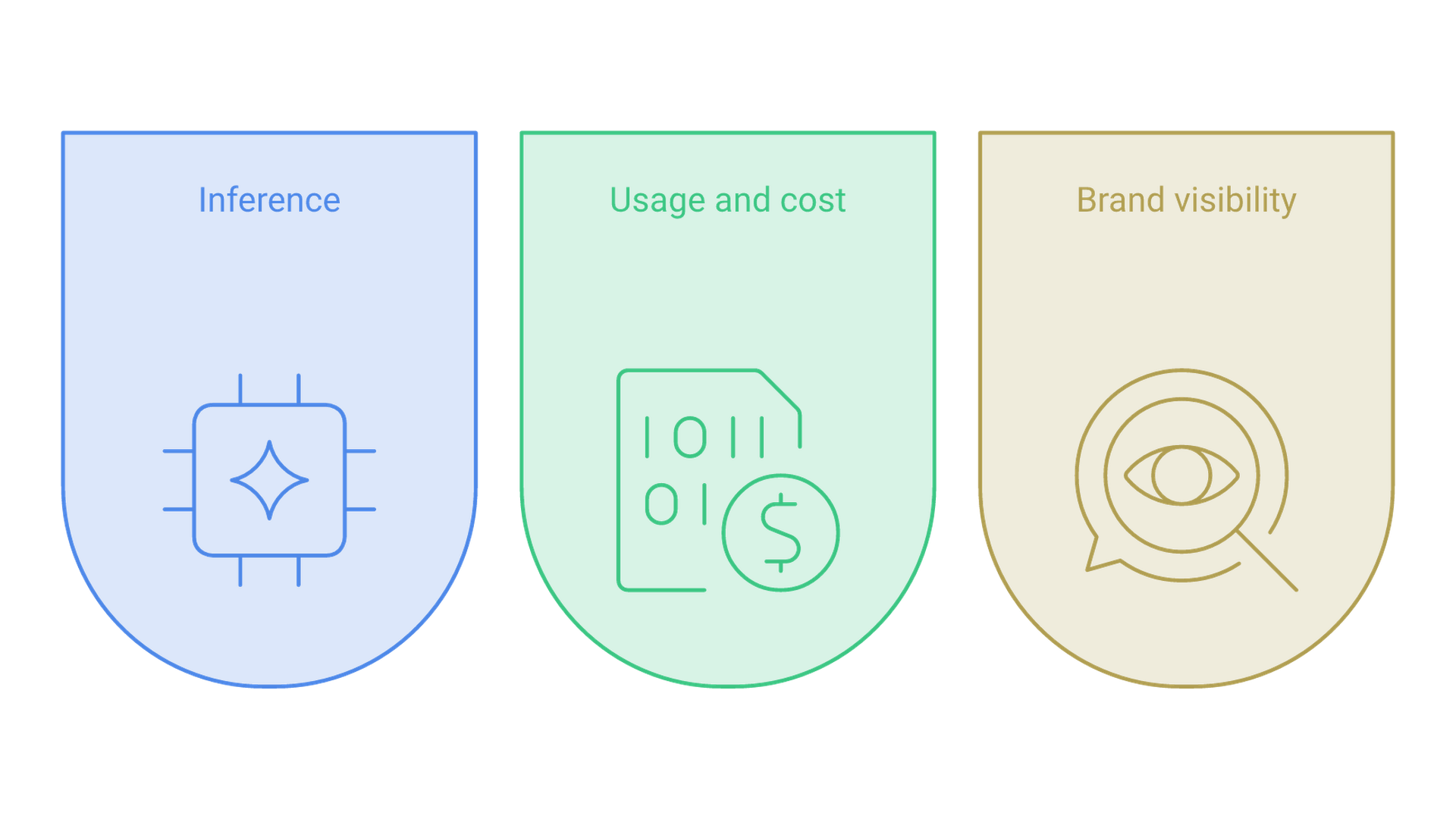
For enterprise teams, these pillars matter collectively. Optimizing inference alone cuts latency but does nothing if every query burns through a frontier model unnecessarily. Cutting costs through aggressive routing saves money but fails if output quality drops. And even a perfectly tuned application loses commercial value if AI search platforms never mention the company's products. Governance, user experience, and long-term brand visibility all depend on treating these pillars as a unified discipline.
Model & Inference Optimization: The Technical Core
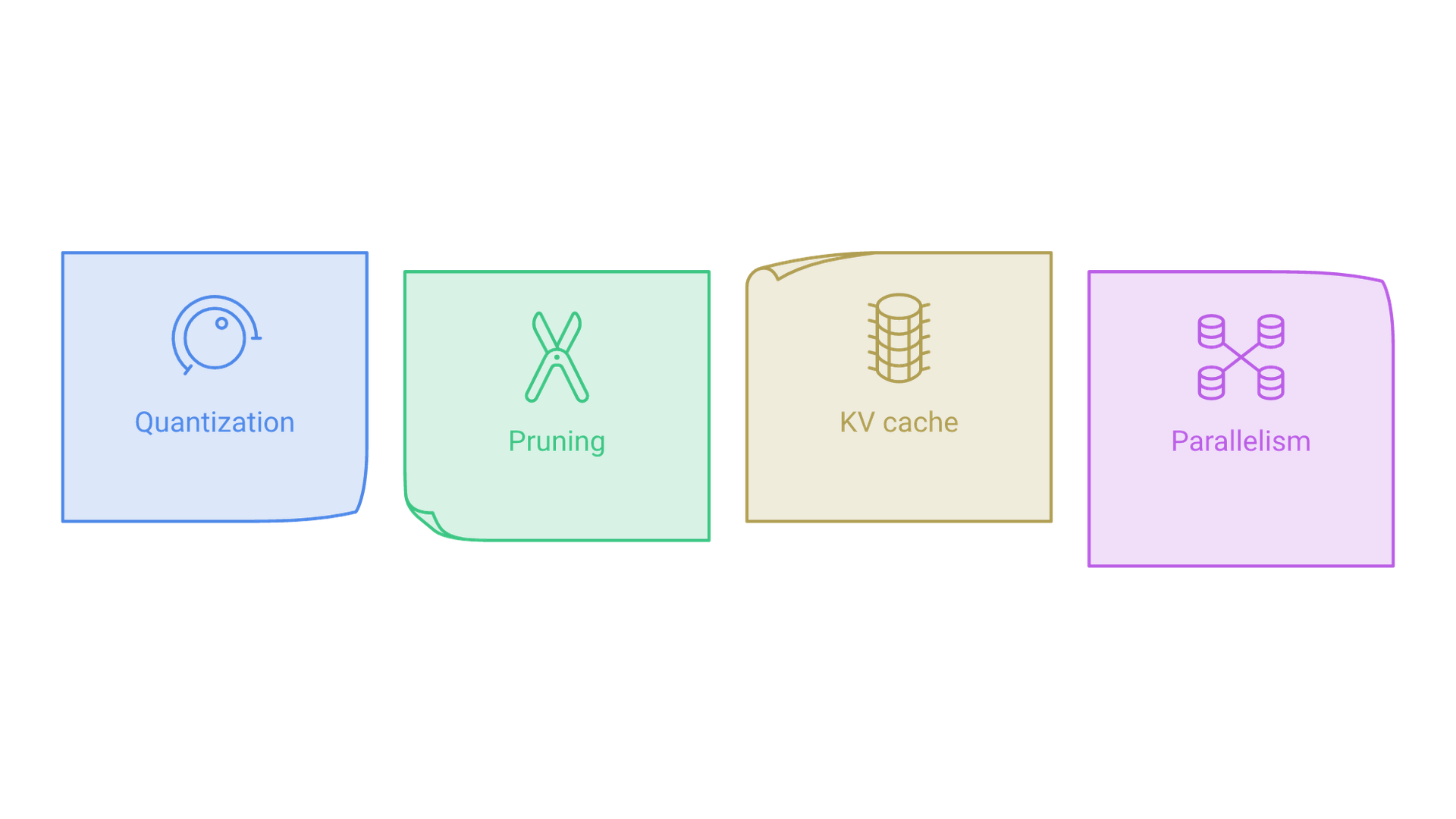
Inference optimization improves how models execute at run time: lowering latency, increasing throughput, shrinking memory footprint, and maintaining reliability across GPU and CPU deployments. The primary levers include quantization (reducing numerical precision of model weights to decrease memory usage), sparsification and pruning (removing redundant parameters from neural networks to enhance efficiency), KV cache strategies for long-context workloads, and parallelism for distributing large models across hardware.
These techniques operate on popular stacks such as NVIDIA GPUs with TensorRT-LLM, vLLM, or DeepSpeed, and they directly determine whether an application can serve thousands of concurrent users without degradation. Without efficient inference, cost and user-experience goals are impossible at scale-every millisecond of latency and every gigabyte of VRAM consumed compounds across sessions, users, and regions.
Usage & Cost Optimization: Making Every Token Count
Usage optimization focuses on reducing unnecessary tokens, avoiding overpowered models for trivial tasks, and designing smarter orchestration around LLM calls. LLMs can exhibit reduced operational costs through optimization strategies such as model routing (sending simple queries to smaller models), prompt and context engineering (trimming bloated context and using retrieval-augmented generation instead of static context stuffing), caching repeated responses, and tool offloading-delegating deterministic tasks like math and lookups to specialized services rather than consuming expensive tokens.
These patterns translate directly into smaller cloud bills and more predictable capacity planning. When Snowflake tested dynamic model routing in its AI gateway, it achieved up to 3× greater token efficiency compared to routing everything through a frontier model.
Content & Brand Optimization (LLMO / GEO)
LLM visibility refers to how brands appear in AI-generated answers-and in 2026, this visibility increasingly determines whether a company is considered during a prospect's research phase. AI visibility measures brand mentions in AI-generated answers, which means brands compete for inclusion in AI responses, not just traditional search rankings. Generative engine optimization structures and publishes content so that AI systems can understand, trust, and cite the brand.
Core concepts for LLMO include entity clarity (consistent brand and product naming), content structure (clean headings, tables, FAQs, schema markup), and authority signals (original research, third-party citations, domain depth). AI visibility impacts brand consideration before user clicks ever happen-AI-generated answers can influence purchase decisions before users visit websites.
Even the best-optimized application fails commercially if AI agents never surface the company's content or products. The following section dives deeper into each optimization pillar with concrete techniques and trade-offs.
Three Pillars of LLM Optimization in Practice
Consider a real deployment scenario: an enterprise running an internal knowledge assistant for employees alongside a public-facing customer support bot. Both systems face latency targets, cost constraints, and the need for the company's content to appear when prospects ask ChatGPT, Perplexity, or Gemini about relevant topics. Each of the three pillars addresses a different dimension of this challenge.
Improving Model & Inference Performance
Latency is a critical performance metric for real-time NLP applications. Enterprise teams should define explicit targets-for example, p95 response time under 1.5 seconds for interactive chat, with higher throughput tolerance for batch document processing. Improved scalability allows optimized models to serve more simultaneous users effectively, making performance tuning a prerequisite for production readiness.
Quantization is typically the first lever. Quantization reduces numerical precision of model weights to decrease memory usage, and the gains are substantial. On an NVIDIA L40S GPU, moving from BF16 to INT8 reduced model size by approximately 46%, increased concurrency by around 29%, and boosted output throughput by roughly 44%, with a one-third reduction in latency under synchronous load. For teams exploring deeper compression, FP4 formats like SharQ (combining activation sparsity with FP4 quantization) yield 2.2–2.4× latency reduction over FP16 and 1.2–1.4× throughput improvement over FP8 on supported hardware. For a detailed comparison of quantization methods like PTQ, GPTQ, AWQ, and GGUF, see Cognativ's dedicated guide.
Sparsification and pruning remove less important weights to cut down active parameters. Pruning removes redundant parameters from neural networks to enhance efficiency, and structured sparsity patterns (such as 2:4 sparsity on NVIDIA Ampere and Hopper hardware) can yield throughput improvements comparable to moderate quantization. However, optimization must balance between improved speed and maintained accuracy-tasks depending on rare token patterns or long-tail knowledge suffer more from pruning than from quantization.
KV cache management is critical for long conversations and multi-session workloads. Google's TurboQuant compresses KV caches to 3 bits without observable accuracy loss, achieving a 6× reduction in cache memory and up to 8× faster attention-logits computation on H100 GPUs. Inference engines like vLLM use paged-attention and chunked attention windows to manage cache size dynamically, and understanding vLLM KV cache offloading can unlock substantial memory savings in production.
Parallelism patterns-tensor parallelism, pipeline parallelism, and sequence parallelism-remain essential when serving large models like Llama-3-70B or Mixtral across multiple GPUs. Hardware interconnect bandwidth and memory bandwidth often become bottlenecks, especially for large context windows, and teams should evaluate their AI inference infrastructure before selecting a parallelism strategy.
Optimizing Usage & Cost Across Models
Model routing delivers some of the largest cost savings available. Enterprises routing simple tasks (classification, rewriting) to smaller models like Llama-3-8B or Mistral-7B-Instruct, while reserving GPT-6 Astra or Claude Fable 5.1 for complex multi-step reasoning, routinely observe 2–3× token efficiency improvements. The key is building routing logic-often a lightweight classifier or rule set-that reliably distinguishes task complexity, with fallback and escalation paths for edge cases.
Prompt and context engineering yields consistent savings regardless of hosting model. Trimming boilerplate system prompts, using retrieval-augmented generation (RAG) instead of static context stuffing, and compressing conversation histories commonly reduce token usage by 20–40% with minimal impact on output quality. Retrieval-augmented generation combines LLMs with external knowledge systems, pulling in only the information relevant to the current query rather than loading entire document sets into context. Teams building RAG pipelines benefit from understanding vector databases for LLMs as the retrieval backbone.
Caching strategies include response caching for repeated prompts and semantic caching for near-duplicate questions. In regulated environments, guardrails must prevent stale answers from being served when underlying data changes.
Tool offloading delegates deterministic tasks-math, lookups, workflow orchestration-to specialized services or internal APIs. This avoids the overhead and unpredictability of having the LLM compute everything via tokens. Fewer tokens, reduced prompt complexity, fewer hallucinations. Enterprises integrating cost dashboards find that overuse of "judge" or "checker" models can add a large share of token spend unless carefully optimized.
Scaling Content & Brand Visibility (LLMO) for AI Search
AI search engines like ChatGPT, Perplexity, Gemini, Google AI Overviews, and Microsoft Copilot pull from the open web, APIs, and proprietary sources to compose ai answers. AI visibility tools track brand mentions across AI platforms, and understanding how these systems select and cite content is now a core marketing competency.
Clear content structure makes pages more "chunkable" for retrieval systems and embeddings. AI-generated answers often prioritize structured content with specific claims-well-formatted H1/H2 hierarchies, tables, FAQs, and schema.org markup all increase the likelihood that a retrieval model selects your content over a competitor's. Content quality influences AI-generated brand mentions significantly.
Entity alignment means maintaining consistent use of brand name, product names, industry terms, and differentiators across site pages, documentation, and third-party listings. Inconsistent naming fragments your brand's entity graph in the models' understanding, reducing the chance of citation across chatgpt perplexity gemini and other major ai platforms.
AI visibility monitoring is the emerging feedback loop. AI visibility tracking tools measure mentions, citations, and sentiment across multiple AI engines. Only 11% of domains are cited by both ChatGPT and Perplexity, highlighting the importance of tracking visibility across platforms rather than optimizing for a single answer engine. Many brands are not cited in AI-generated answers at all-AI visibility gaps can self-reinforce, deepening brand authority disparities over time.
Key recap of the three pillars:
- Inference: Quantization, pruning, KV cache compression, and parallelism for speed and resource efficiency
- Usage: Model routing, prompt engineering, caching, and tool offloading for cost control
- Visibility: Structured content, entity alignment, and ai visibility tracking for share of voice in ai search
The next section details concrete implementation steps and frameworks for bringing these pillars together.
Implementing LLM Optimization in an Enterprise Stack
Consider a 2026 enterprise scenario: a financial-services firm deploying an internal AI assistant on Azure OpenAI for employee knowledge queries, plus a public-facing chatbot for customer support. The internal assistant handles sensitive data under GDPR and PCI DSS constraints; the public bot must deliver fast, accurate answers while ensuring the firm's official guidance-not a competitor's blog post-appears when prospects query ai search platforms. Optimization spans engineering decisions, cloud economics, and marketing operations.
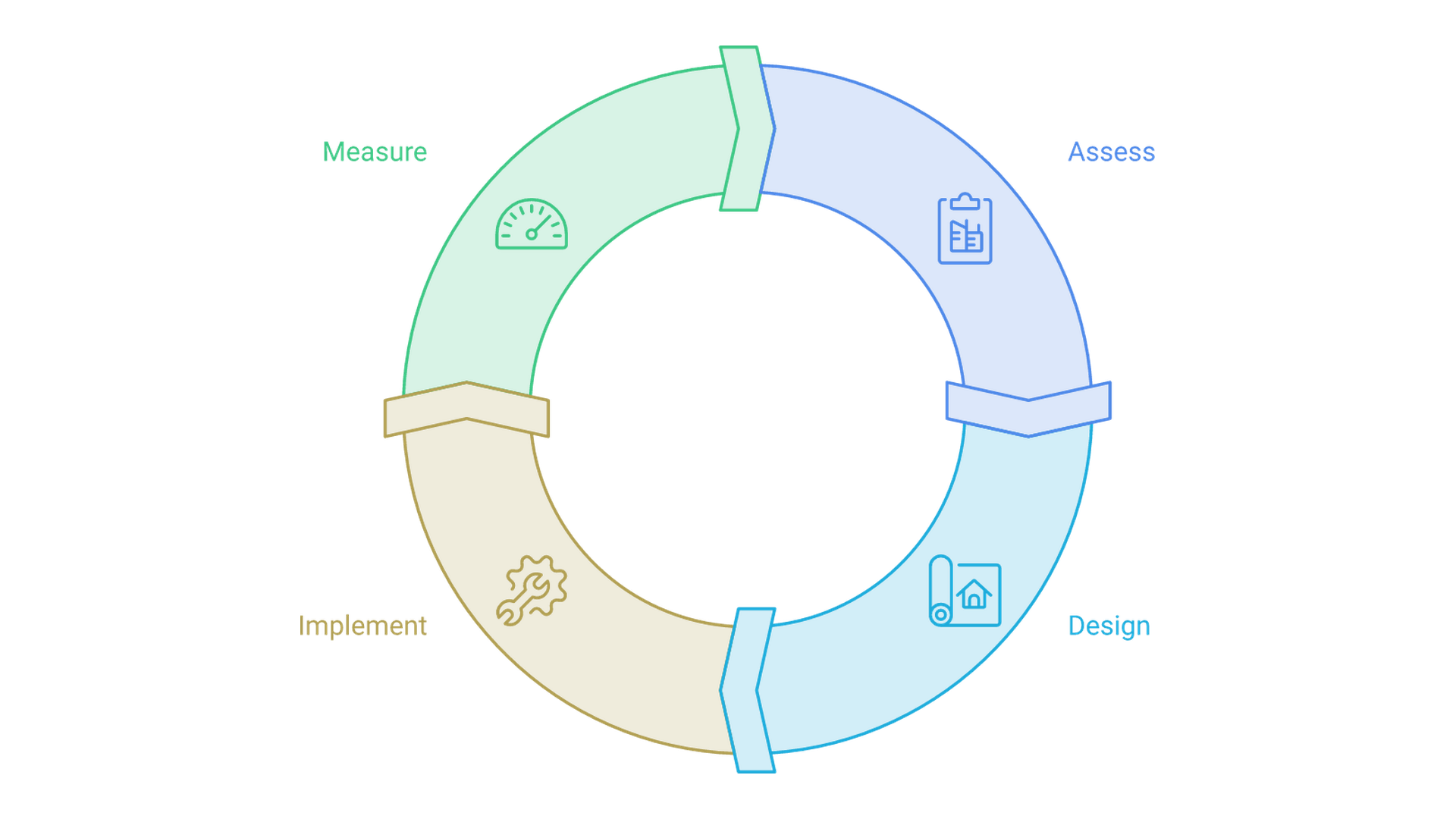
A structured process is essential to connect these domains. Without one, teams optimize in silos-engineering reduces latency while marketing has no visibility into how AI engines represent the brand-and the overall ROI remains invisible.
A Practical LLM Optimization Process
The following steps outline a repeatable process adaptable regardless of cloud provider (AWS, Azure, GCP). This aligns with Cognativ's RAPID framework for digital transformation, applied specifically to LLM optimization.
- Assess: Baseline current latency (p50, p95, p99), error rates, token usage, GPU costs, and AI visibility for a specific product or workflow. Run sample queries across chatgpt google ai overviews and Perplexity to document where the brand appears today. Robust evaluation is essential to measure optimization effectiveness.
- Prioritize: Rank optimization opportunities by impact and risk using business metrics-cost per conversation, cost per resolved ticket, or lead-to-opportunity conversion. A prompt-slimming exercise may deliver 25% cost reduction in a week; full quantization may take months but cut GPU spend by 50%.
- Design: Choose model sizes, routing logic, quantization targets, and content optimization priorities. Document constraints: compliance requirements, PII handling rules, data residency mandates, and acceptable accuracy thresholds. The enterprise AI architecture should be defined before model selection.
- Implement: Apply technical changes-quantize the model, adjust context windows, restructure key content pages, deploy routing logic-behind robust feature flags. Start with one workflow to contain blast radius.
- Measure: Compare KPIs pre- and post-change: latency percentiles, GPU hours, API spend, ai citations share in AI tools, and user satisfaction scores. Validate quality with human review and domain-specific evaluation sets.
- Iterate: Build a quarterly optimization cadence with clear owners across engineering, data science, content/SEO, and compliance. More frequent reviews (monthly) are warranted during major launches or usage spikes.
Choosing Between Large, Medium, and Small Models
The model portfolio decision depends on task complexity, data control requirements, and cost tolerance. Knowledge distillation trains a smaller "student" model to mimic a larger "teacher" model, enabling purpose-built alternatives that approach frontier quality at a fraction of the cost.
Criterion | Frontier (GPT-6 Astra, Claude Fable 5.1) | Mid-Scale Open (Llama-3-70B) | Small / Task-Specific (Llama-3-8B, Phi-3, fine-tunes) |
|---|---|---|---|
Latency per request | Higher (100–300ms+ TTFT via API) | Moderate (depends on GPU count) | Low (single GPU, <50ms TTFT) |
Approximate cost per 1M output tokens | $10–$50 (API pricing, 2026) | $0.50–$3 (self-hosted, GPU-dependent) | $0.10–$0.50 (self-hosted) |
Reasoning and multi-step tasks | Strongest across domains | Strong with fine-tuning | Limited; best for narrow tasks |
Data control / on-prem feasibility | API only (SaaS) | Full control (open weights) | Full control; optimized models can fit within hardware constraints for on-device deployment |
Compliance and auditability | Provider-dependent; limited logging | Full audit trail possible | Full audit trail; easiest to govern |
When an enterprise has a clear mix of simple and complex tasks with measurable cost pressure, implementing a model portfolio with routing outperforms centralizing on a single model. For early pilots or low traffic, a single reliable model may be simpler-routing adds orchestration overhead that must be justified by volume.
Aligning LLM Optimization with Governance and Security
Governance constraints directly influence which optimization techniques are acceptable. In healthcare (HIPAA), payments (PCI DSS), or data-residency-bound environments (GDPR), certain layers or workflows may require higher precision-aggressive quantization to FP4 may be prohibited for medical triage or financial advice outputs. Teams must map regulatory requirements to technical decisions before optimizing.
Safe logging of prompts and outputs supports observability without storing sensitive raw content unnecessarily. This means redacting PII before persistence, using tokenized session identifiers, and maintaining separate audit trails for compliance review.
Human-in-the-loop validation remains essential for regulated workflows. Red-team exercises, domain-specific evaluation datasets, and bias checks should be integrated into every optimization cycle-not treated as an afterthought. Parameter-Efficient Fine-Tuning (PEFT) adapts models by training only a subset of parameters, which can help regulated organizations fine-tune LLMs safely within data-handling constraints.
The next section addresses the specific challenges teams encounter when optimizing LLMs in live products.
Common Challenges and Solutions in LLM Optimization
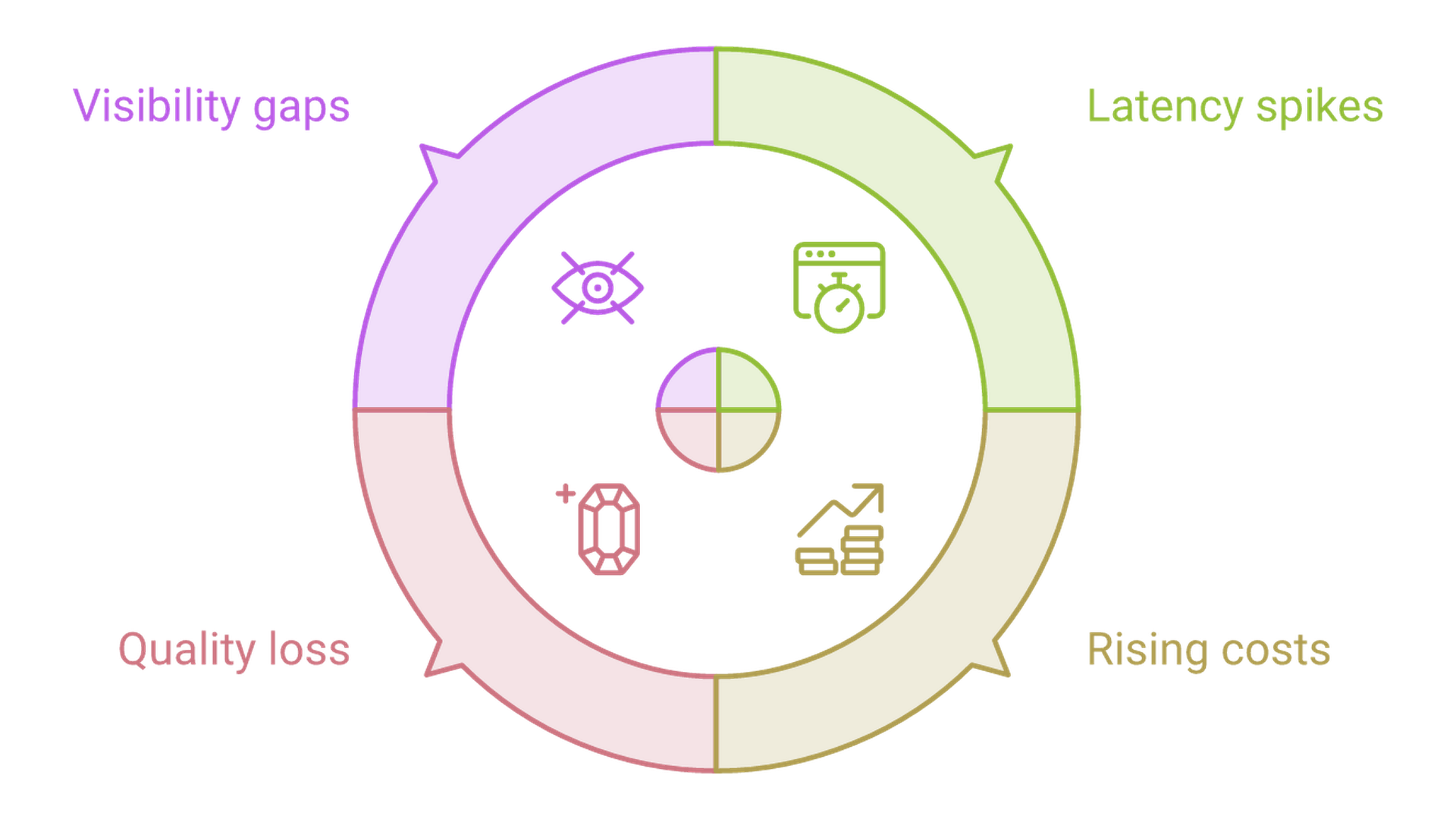
Even sophisticated enterprise teams in 2026 struggle with trade-offs among speed, cost, accuracy, and ai search visibility. The following problems recur across industries, and each has proven solutions.
Problem 1: Latency Spikes and Unpredictable Response Times
Real-world causes include model cold starts, overloaded GPUs, long context windows expanding KV cache memory, and noisy-neighbor effects in shared SaaS environments. Optimization techniques can lead to reduced latency for real-time applications, but only when implemented systematically.
Solutions: maintain warm pools of model replicas, set autoscaling thresholds based on queue depth rather than CPU alone, aggressively trim context to reduce per-request compute, use continuous batching (which allows dynamic grouping of incoming requests for better resource use), and deploy regional failover for critical workloads. FlashAttention optimizes memory use during attention computation to enhance speed and should be enabled by default where supported.
Problem 2: Soaring API or GPU Costs as Usage Scales
Drivers include overuse of frontier models for simple tasks, verbose system prompts repeated on every call, including full chat history without truncation, and lack of response caching.
Solutions: implement model routing to direct simple ai queries to smaller models, enforce max-token limits and truncation policies, design slim system prompts, use RAG with smaller retrieved contexts instead of stuffing entire documents, and cache high-frequency responses. Speculative decoding uses a smaller model to predict tokens for a larger model's verification, reducing the number of expensive forward passes through frontier models.
Problem 3: Quality Degradation After Quantization or Pruning
Symptoms include subtle reasoning mistakes, hallucinations on niche topics, or regression in domain-specific tasks after moving from FP16 to INT8 or FP4. On prosumer GPUs without INT4 tensor cores, INT4 inference can actually be slower and less energy efficient than the FP16 baseline due to software dequantization overhead.
Remedies: build task-specific evaluation sets reflecting real workloads (support questions, contract clauses, medical triage prompts) and run A/B tests pre- and post-quantization. Use mixed-precision layers-keeping higher precision for safety-critical components while quantizing aggressively elsewhere. Layer-bit allocation methods assign different precisions to different layers based on sensitivity, yielding better latency for a given quality budget. FP8 appears effectively lossless in many enterprise use cases and is a conservative starting point.
Problem 4: Brand Content Ignored or Misrepresented by AI Assistants
Common issues: ChatGPT citing competitors' how-to guides, Perplexity relying on outdated reviews, Google AI Mode Gemini not surfacing official documentation. AI visibility tracking reveals how brands are cited by AI tools-and gaps can be stark. Competitor benchmarking reveals visibility gaps in ai search results and is crucial for effective optimization.
Solutions: publish well-structured canonical guides with schema markup, update content regularly to prevent stale citations, secure coverage on authoritative third-party sites, standardize product naming across all channels, and start tracking ai citations and brand mentions share across major ai platforms. SEO and AI visibility tracking require different strategies-traditional SEO relies on user clicks to gauge success, while AI visibility measures how the brand appears in ai generated answers before any click occurs.
Problem 5: Difficulty Proving ROI of LLM Optimization Work
Leadership often sees token savings or better latency but not their connection to revenue, risk reduction, or employee productivity. Without baseline metrics, improvements are invisible.
Solutions: set explicit baselines-cost per resolved ticket, time-to-answer, lead-to-opportunity conversion-before optimization begins. Tag each release with the optimization applied, and report measurable deltas after each cycle. Track ai visibility data alongside operational metrics: if the brand's citation share in Perplexity and Google AI Overviews increases from 30% to 70% of high-intent queries, that is a measurable business outcome. Disciplined measurement and governance unlock sustainable optimization, not just one-off tuning.
Conclusion and Next Steps
LLM optimization in 2026 requires balancing inference performance, smart usage and routing, and LLMO for long-term ai search visibility. No single lever-quantization, prompt engineering, or content restructuring-solves every problem, and the trade-offs shift as models, hardware, and AI search surfaces evolve quarterly. Optimization is an ongoing practice, not a one-time project.
To begin:
- Run a 2-week baseline on latency, token usage, and model costs across one critical workflow.
- Implement at least one low-risk cost lever-prompt slimming or response caching-and measure savings.
- Audit 10–20 high-intent prompts across ChatGPT, Gemini, and Perplexity to see how your brand appears today and where competitor visibility exceeds yours.
- Draft a 90-day optimization roadmap covering model choices, routing logic, and priority content updates aligned with your digital transformation framework.
- Engage a specialist partner like Cognativ if internal teams lack bandwidth or need an AI-first architecture review and RAPID-style roadmap to reduce delivery risk.
Related topics worth exploring next include RAG architectures, evaluation frameworks for LLMs, AI governance for regulated industries, and content operations for LLMO.
Additional Resources
These resources support but are not required to understand the concepts above:
- Cognativ's guide to LLM quantization (PTQ, GPTQ, AWQ, GGUF) for a deep dive into precision formats and tooling
- NVIDIA TensorRT-LLM and vLLM documentation for inference optimization on GPUs, including paged-attention and continuous batching
- 2025–2026 benchmark reports from Arena (formerly Chatbot Arena) and Stanford HELM for model performance and cost trade-off data
- Cognativ's RAPID framework overview for connecting LLM optimization to broader digital transformation and modernization initiatives
LLM Optimization FAQ
What is the difference between LLM optimization and traditional ML optimization?
LLM optimization focuses on inference efficiency, orchestration across multiple ai models, and content visibility for massive pretrained models. Traditional ML optimization typically centers on training pipelines and model accuracy for narrower, task-specific models. The scale of parameters, the role of prompt engineering, and the emerging need for ai seo and brand visibility monitoring are unique to the LLM context.
Can I optimize LLMs if I only use hosted APIs like OpenAI and Anthropic?
Yes. Most optimization levers-prompt design, model routing, caching, usage policies, and LLMO content strategies-apply even when the model itself is managed by a provider via api access. Infrastructure-level tactics like custom quantization and parallelism are more relevant when serving open-source models locally, but cost and visibility optimization are universal.
How do I know if quantization is safe for my use case?
Build a small evaluation set reflecting real tasks-support questions, contract clauses, medical triage prompts-and run A/B tests pre- and post-quantization. Safety-critical or regulated workflows may require keeping higher precision for key layers or sticking to conservative formats like FP8 or INT8, where accuracy losses are typically 1–3% on standard benchmarks. Benchmarks on Llama-3.1-8B show Q4 models reduce VRAM substantially, but the accuracy impact must be validated per domain.
When should I invest in model routing instead of a single "best" model?
Model routing makes sense when there is a clear mix of simple and complex tasks, measurable cost pressure, and enough query volume to justify orchestration complexity. For early pilots or low traffic, a single reliable model may be simpler. Once volume grows, routing simple classification or rewriting tasks to smaller models while reserving frontier models for complex reasoning can yield 2–3× cost improvements.
How does LLM optimization relate to Generative Engine Optimization (GEO) and LLMO?
GEO and LLMO are the content-side discipline of improving how ai engines discover, interpret, and cite your brand. LLM optimization covers both application-side performance and cost plus content-side visibility-and both should be planned together. Brands must optimize content for AI citation to improve visibility, and many ai visibility tools now help track brand mentions across chatgpt perplexity google ai and other ai search platforms.
How often should we revisit our LLM optimization strategy?
At least quarterly, because model offerings, pricing, and ai search behavior change rapidly-major model updates from OpenAI, Anthropic, Google, Meta AI, and Mistral all shifted the landscape in 2025–2026. Monthly reviews are warranted during major product launches, usage spikes, or when new ai overviews google ai mode features alter how content is surfaced.
When does it make sense to bring in an external partner like Cognativ?
External help is most valuable when teams face complex legacy systems, regulated data environments, multi-region rollouts, or need an AI-first architecture and RAPID-style roadmap to reduce delivery risk. Cognativ connects LLM optimization to broader modernization, workflow automation, and ROI measurement-particularly for generative AI implementation in enterprise contexts where governance and scalability constraints are non-negotiable.