

What Does LLM Stand For? Large Language Models, Law Degrees, and Modern AI
LLM can mean a Large Language Model or a Master of Laws degree. This guide explains both, then covers how AI language models work and how firms adopt them.
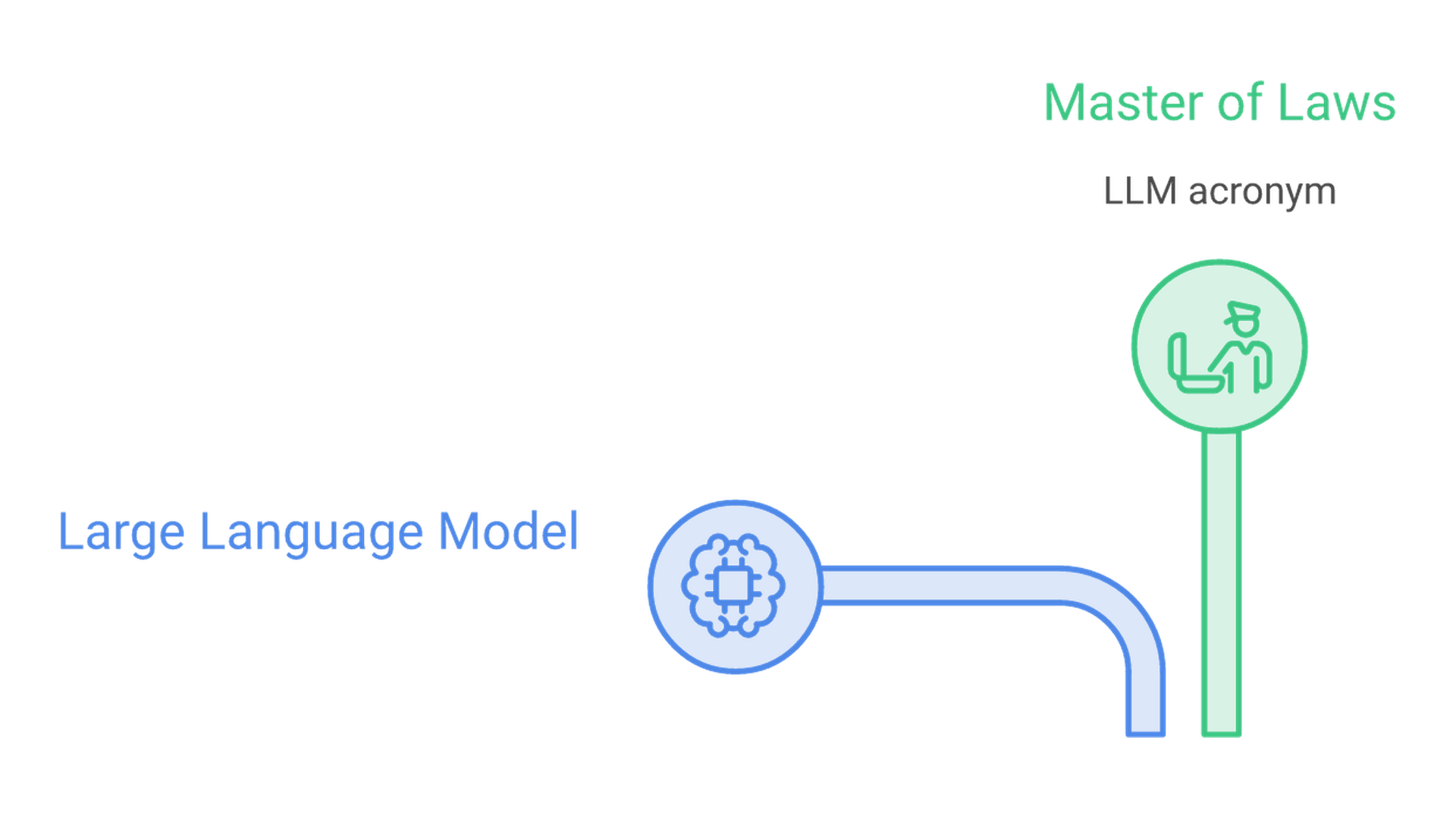
LLM stands for Large Language Model in artificial intelligence and Master of Laws in legal education. These two meanings dominate usage of the acronym, and context determines which one applies: in technology, business strategy, and AI conversations, LLM almost always refers to a Large Language Model - a type of artificial intelligence system trained on massive amounts of text data to understand, summarize, translate, and generate human-like language. In law schools and legal practice, LLM (often styled LL.M.) refers to a postgraduate professional degree for lawyers seeking specialization.
This article focuses primarily on large language models in a business and enterprise context, with a brief explanation of the Master of Laws meaning to prevent confusion. It is written for business and technology leaders, product owners, and operations executives who encounter the term "LLM" in AI conversations and need to understand what it means, how these systems work, and what adopting them involves. Understanding LLMs is now essential for organizations pursuing AI-driven automation, digital transformation, and data-informed decision-making.
Here is what you will gain from this LLM guide:
- A clear understanding of both meanings of LLM and when each applies.
- A technically credible but accessible explanation of how large language models work.
- Practical enterprise use cases showing how LLMs impact workflows across industries.
- Awareness of limitations, risks, and governance considerations around LLM adoption.
- Guidance on when to involve a partner like Cognativ to plan or implement LLM-based systems.
Understanding What "LLM" Stands For
The acronym LLM carries two dominant meanings, and the surrounding context tells you which one is intended. In technology, media, and digital transformation discussions - particularly since the generative AI wave that accelerated around 2022 - LLM almost always refers to a Large Language Model. In academic, legal, or law school settings, LLM refers to the Master of Laws degree. Misreading the intended meaning in strategy documents, vendor conversations, or compliance policies can lead to genuine confusion, so it is worth establishing both clearly before going deeper.
LLM as Large Language Model (AI Meaning)
A Large Language Model is an AI system - typically built on deep neural networks called transformers - trained on vast amounts of text data to understand and generate human language. These language models process natural language prompts and produce human like text in response, handling language tasks such as summarization, translation, question answering, code generation, and sentiment analysis.
The "large" in large language models refers to two things: the enormous volume of training data (often thousands or millions of gigabytes of text, code, and documentation) and the sheer number of parameters - the learned numerical weights that encode grammar, facts, reasoning abilities, and language nuances. Modern large models range from billions to over a trillion parameters. Well-known examples include OpenAI's GPT-6, Google Gemini (a multimodal model handling text, images, and more), Anthropic's Claude, Meta's Llama 4, and models like Mistral, Qwen, and DeepSeek.
At a high level, most LLMs work through tokenization - breaking input data into small units called tokens - and then predicting the most probable next token in a sequence. This next-word prediction mechanism, powered by the transformer architecture and its self-attention mechanisms, is what enables LLMs to generate text that reads naturally and responds coherently to user inputs. The process is probabilistic: the model calculates likelihoods rather than retrieving verified facts, which is a critical distinction for enterprise adoption.
For organizations exploring AI-driven automation, workflow optimization, and knowledge management, understanding context around what makes LLMs powerful - and where they fall short - is foundational to making sound investment decisions.
LLM as Master of Laws (Legal Degree Meaning)
The Master of Laws (LL.M. or LLM) is a postgraduate law degree designed for individuals who already hold a first professional degree in law, such as a J.D. in the United States or an LL.B. in most countries. It allows lawyers to specialize in a particular area of legal practice - common concentrations include tax law, international law, business law, human rights, and environmental law. Many law schools globally have offered LL.M. programs since at least the mid-20th century.
Programs are typically one year full time (for example, Harvard requires approximately 23 credits across the fall, winter, and spring terms, while UCL's LLM runs 10 months full-time). Law students pursuing an LL.M. are often licensed lawyers seeking deeper expertise, foreign lawyers wanting familiarity with another jurisdiction's legal system, international students preparing for practice in a host country, or academics pursuing research oriented careers. Some LL.M. holders use the degree to qualify for the bar exam in certain U.S. states, though eligibility varies. Graduation requirements usually include coursework in basic legal principles within the chosen specialized area, and sometimes a dissertation or research project. Many programs also require students to pass english language tests as part of admission.
This article is not about law school admissions or LL.M. program selection. The legal education meaning is included here to prevent confusion in AI discussions. Consider the difference: "We're building an LLM-based contract review tool" versus "She completed an LLM in international arbitration in London in 2023." Same acronym, entirely different worlds.
Other, Less Common Uses of the LLM Acronym
LLM can occasionally stand for other things in niche contexts - for example, "Long-Lived Memory" in certain computing frameworks or company-specific internal abbreviations - but these uses are rare compared with Large Language Model and Master of Laws. If the conversation involves artificial intelligence, machine learning, or automation, assume Large Language Model. If the discussion is about legal education, law degree programs, or legal practice, assume Master of Laws. In a small number of cases you may encounter domain-specific meanings, but context will almost always make the intended meaning clear.
With both meanings established, the rest of this article focuses on what large language models actually are, how they work, and what they mean for modern organizations.
What Is a Large Language Model in Practice?
Moving from definition to practical understanding: for most modern business and technical conversations, "LLM" refers to the AI systems that power tools like ChatGPT, enterprise copilots, and an expanding range of workflow automation platforms. These are not simple computer programs doing keyword matching - they are sophisticated neural network systems that have absorbed patterns from vast amounts of written language, programming languages, and other forms of structured and unstructured content.
Core Characteristics of LLMs
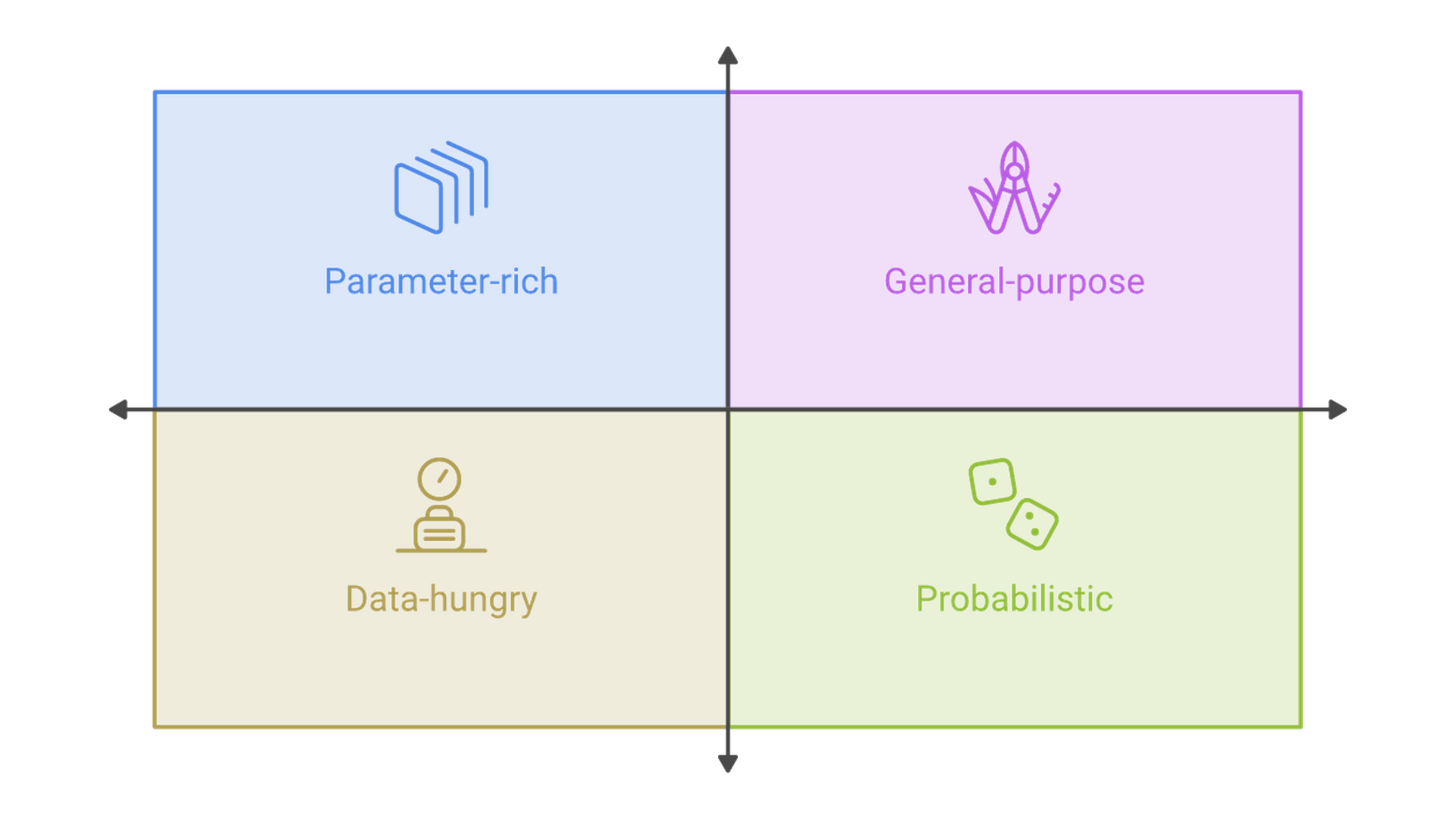
Large language models share several defining characteristics:
- Data-hungry. LLMs are trained on internet-scale corpora - books, articles, code repositories, documentation, and curated datasets. Large language models are trained on vast datasets of text, often spanning thousands or millions of gigabytes. Meta's Llama 3.1, for example, was trained on over 15 trillion tokens.
- Parameter-rich. These models contain billions to potentially trillions of learned numerical weights (parameters) that store patterns of grammar, semantics, factual associations, and reasoning. In 2021, Google Brain released a model with over one trillion parameters. Newer architectures like Mixture of Experts (MoE) may have hundreds of billions of total parameters but only activate a subset per token, improving efficiency.
- Probabilistic. LLMs predict the most likely next token in a sequence - they do not retrieve verified facts from a database. This distinction matters enormously for enterprise reliability.
- General-purpose. A single model can handle conversation, summarization, translation, code generation, content creation, and basic reasoning, among other tasks. LLMs can generate essays and poems in response to prompts, assist programmers by writing and completing code, and answer questions across domains.
Think of an LLM as a remarkably sophisticated autocomplete system - one that has processed almost every pattern of written language and can generate responses that feel natural. But "feeling natural" is not the same as "being correct," which is why understanding context, oversight, and architecture matters.
How LLMs Work at a High Level
LLMs use transformer models to understand context in language. Here is how the process works, in accessible terms:
Tokenization. The model breaks input text (and sometimes images or audio in the case of a multimodal model) into tokens - subword units that map to numerical vectors. This step converts human language into a format the neural network can process. The choice of tokenizer affects vocabulary size and model performance.
Transformer architecture. Most LLMs are built on the transformer model architecture, which uses self-attention mechanisms to weigh the importance of different words or tokens relative to each other. Stacked layers of attention and feed-forward networks gradually build richer representations of meaning - somewhat analogous to how different areas of the human brain process language at varying levels of abstraction. For example, Llama 3.1 405B uses 126 layers with 128 attention heads, processing information through deeply stacked representations.
Training phases. Training happens in stages:
- Pretraining on massive amounts of text data to learn language patterns, grammar, and broad world knowledge. This is where the model absorbs statistical language models of how language works.
- Fine tuning narrows the model's behavior for specific tasks or domains, using supervised learning or curated instruction datasets. Techniques like reinforcement learning from human feedback (RLHF) align outputs with human expectations and values. You can explore how to fine tune LLMs for more detail on this process.
Context window. Every model has a limit on how many tokens it can consider at once - its context window. Early models handled 8,000 or 32,000 tokens; modern frontier models support 128,000 tokens or more. Some production models have pushed context windows to 1 million tokens. Longer context windows enable processing full documents, extended conversations, and complex regulatory filings in a single pass.
The computational resources required for training are substantial. Training GPT-2 cost approximately $50,000 in 2019, while training PaLM in 2022 cost roughly $8 million - illustrating how rapidly infrastructure demands have scaled.
Examples of Popular Large Language Models
Several large language models dominate enterprise and consumer use today:
- OpenAI GPT-6: General-purpose foundation models behind many chatbots, copilots, and enterprise applications. Available via API with large context windows and strong alignment standards.
- Google Gemini: A multimodal model integrated across Google Workspace and cloud services, capable of processing text, images, and other forms of input data.
- Anthropic Claude: A safety-focused LLM family designed for enterprise knowledge work, emphasizing responsible AI behavior and compliance readiness.
- Meta Llama 4: An open-weight model family frequently deployed in private or hybrid environments. Llama 3.1 405B, with 405 billion parameters, is one of the largest openly available dense models.
- Mistral, Qwen, DeepSeek: Strong open or regional models used for specialized, cost-optimized, or privacy-sensitive scenarios. DeepSeek-V3, for instance, uses a MoE architecture with 671 billion total parameters but only approximately 37 billion active per token.
Some of these models are available only through managed APIs, while others offer open weights that organizations can deploy locally or in private cloud environments. This distinction matters significantly when evaluating data control, compliance, and cost - topics covered in the implementation section below.
How LLMs Are Used in Modern Organizations
Large language models enable AI-driven automation and workflow optimization across industries including healthcare, finance, logistics, media, and ecommerce. But value comes from targeted, workflow-specific LLM applications - not from "using AI" in the abstract. Common uses of LLMs include customer service, content creation, and software development, and the range of practical applications continues to expand as organizations move beyond experimentation.
Common Business Use Cases
Knowledge management and search. Organizations use semantic search and retrieval-augmented generation (RAG) to let employees query internal knowledge bases - policies, SOPs, contracts, and documentation - through chat-style interfaces grounded in verified internal data sources. Vector databases play a key role in powering these retrieval pipelines.
Workflow automation. LLMs can automate language-related tasks across various industries: drafting emails and reports from structured data, summarizing support tickets into standardized formats, converting unstructured text into structured records, and generating responses to routine inquiries. LLMs are used in customer service chatbots for automated responses, and they save time by processing large amounts of information efficiently. LLMs can respond to unpredictable and unstructured queries, making them well suited to customer-facing applications.
Decision support. Analysts use LLMs to generate scenario analysis summaries, risk overviews, and policy comparisons. LLMs assist with regulatory research - always with human oversight for high-stakes decisions. LLMs can perform sentiment analysis for customer feedback, helping organizations track brand perception and customer satisfaction at scale.
Software development. LLMs assist programmers by writing and completing code, generating tests, documenting legacy systems, and supporting migration planning. This is one of the most mature enterprise use cases, with measurable productivity improvements.
Education and training. LLMs assist in personalized tutoring and create study materials, adapting content to individual learning paths and knowledge gaps.
In every case, framing matters: LLMs support and assist human workflows rather than replacing judgment entirely, especially in regulated domains. LLMs can generate text in response to user prompts, but the quality and accuracy of that output depends heavily on how the system is designed, what data grounds it, and where humans review the results.
Industry-Specific Examples
Healthcare. LLMs support summarizing visit notes, assisting with prior-authorization documentation, and structuring unstructured clinical narratives. These applications must support compliance requirements (e.g., HIPAA) and require clinical and legal review. LLMs require human oversight for important decisions in regulated industries - healthcare is a clear example.
Financial services. LLMs assist with policy interpretation, translating complex product terms into plain language, and powering internal query bots for compliance procedures. Data sensitivity is high, and organizations need strong governance around what information flows through model pipelines.
Logistics and supply chain. Natural-language interfaces help track shipments, flag delays, manage inventory exceptions, and handle SLA documentation. LLMs process chain-of-custody records and regulatory filings across jurisdictions.
Ecommerce and retail. LLMs power product description generation, FAQ drafting, and personalized shopping assistance - with rules-based guardrails to prevent false promises or policy violations. Image generation capabilities in multimodal models are beginning to support visual content creation as well.
Media and education. Content summarization, tagging, recommendation engines, and learning support tools are common LLM applications in these sectors.
These examples connect to Cognativ's positioning: custom, workflow-specific implementations that deliver measurable outcomes and ROI rather than generic AI experiments. LLMs provide measurable outcomes and ROI through language automation when deployed with clear use-case boundaries and proper architecture.
Where LLMs Fit in an AI-First Architecture
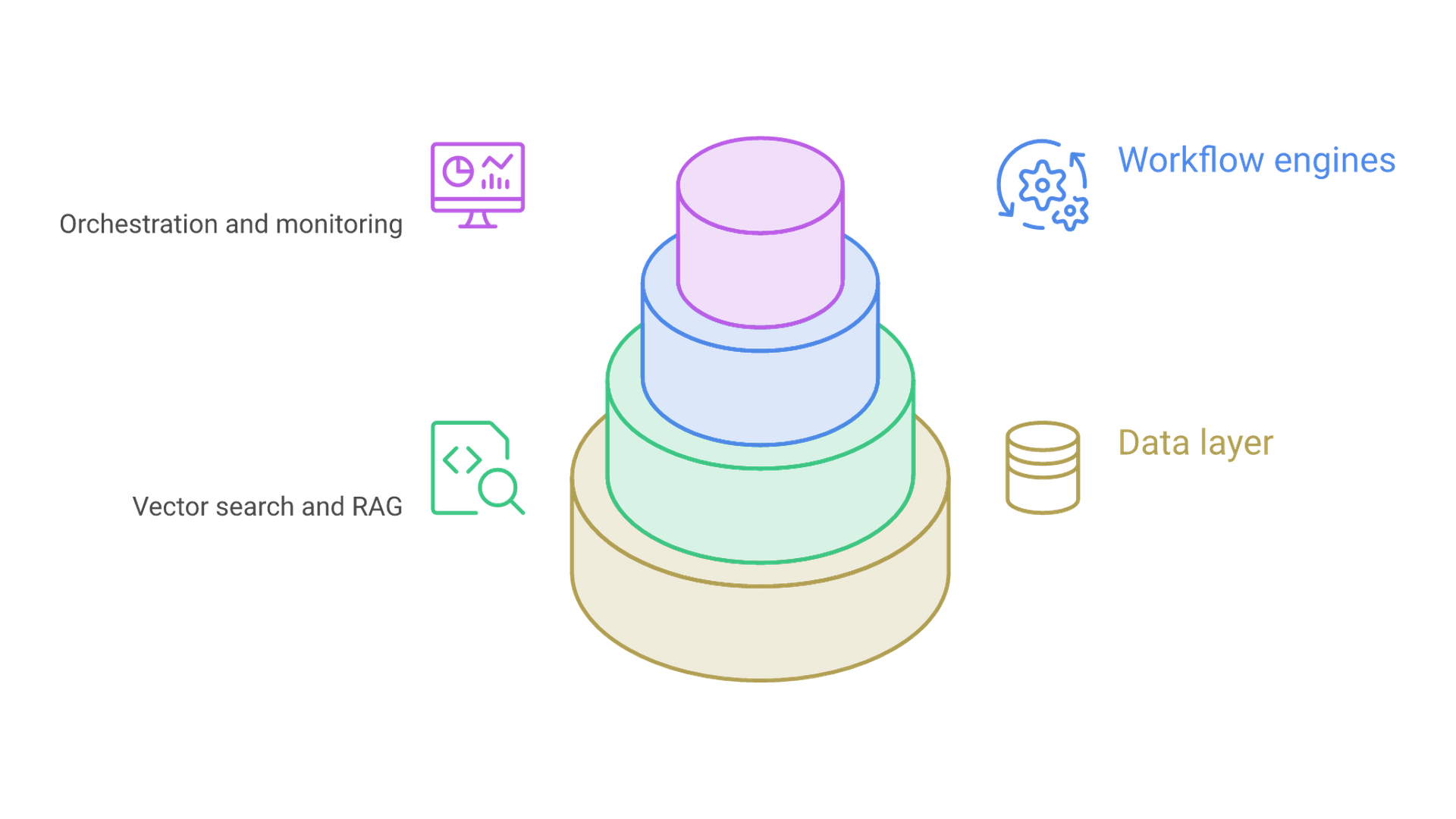
LLMs are one component in an AI-first enterprise architecture, sitting between data sources, orchestration logic, and end-user interfaces. Supporting pieces include:
- Data layer: Data warehouses, operational databases, and document stores providing the raw material that grounds LLM outputs in organizational reality.
- Vector databases and RAG pipelines: These retrieve relevant documents at inference time so responses reflect the organization's own data rather than generic training knowledge.
- APIs, event buses, and workflow engines: These trigger and consume LLM-generated actions, connecting the AI model to CRMs, ERPs, case management systems, and other operational tools.
- Orchestration and monitoring: Defining when the LLM is called, how outputs are validated, where human review is required, and how errors are handled.
Understanding language makes human-computer interaction easier with LLMs, but the surrounding architecture determines whether that interaction is reliable, secure, and compliant. LLMs improve automated virtual assistants like Alexa and Siri, and they power enterprise copilots - but in every case, the value depends on thoughtful integration, not just the model itself.
Implementing LLMs: From Concept to Secure Enterprise Systems
Moving from experimentation with public chatbots to governed, production-grade LLM solutions is where most organizations encounter real complexity. This is also where Cognativ's RAPID framework - Research, Analyze, Plan, Implement, Decide - and disciplined implementation methodology provide the most value.
Practical Steps to Start an LLM Initiative
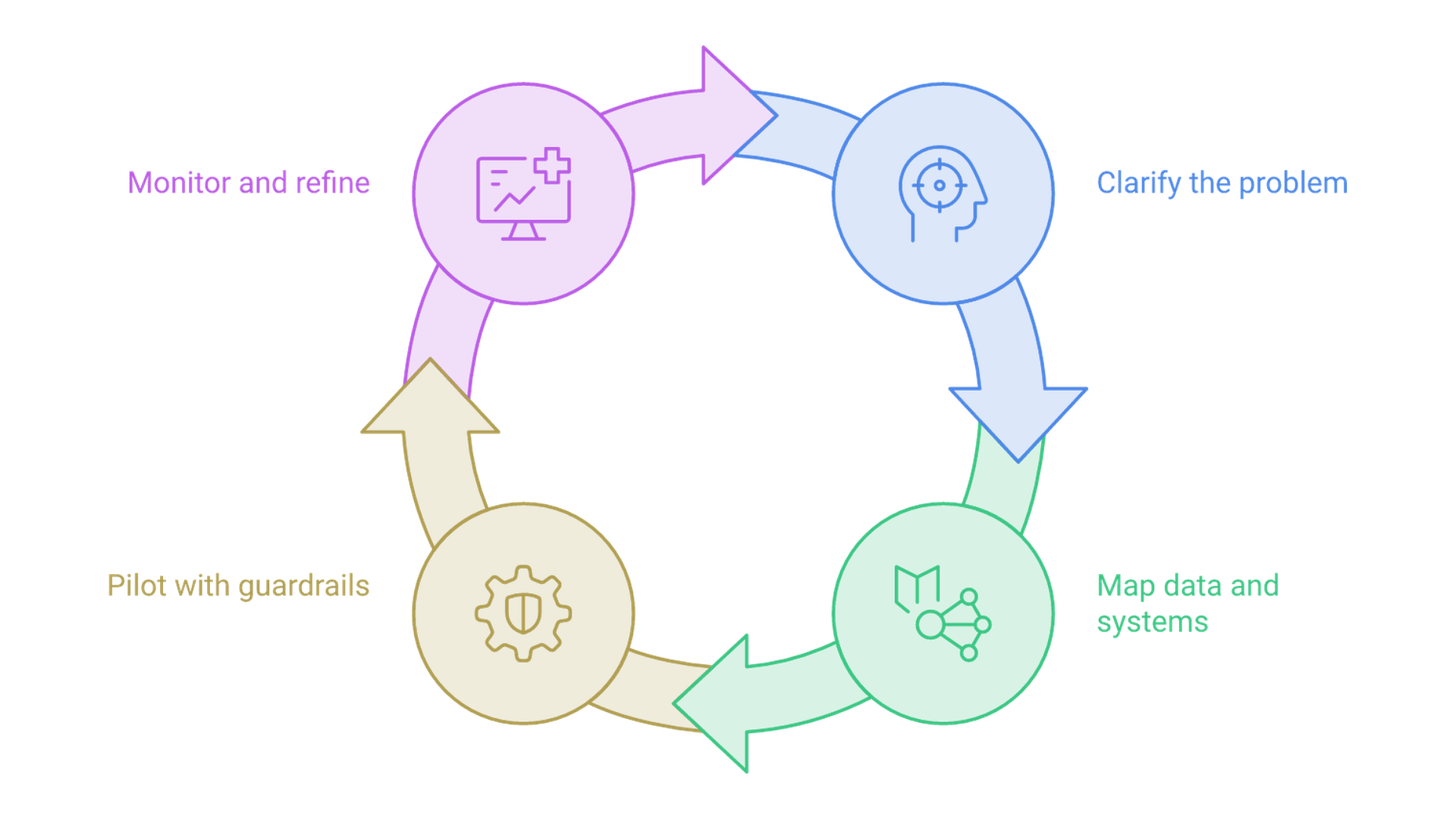
Organizations should start with a focused use case rather than broad "AI transformation." Here is a practical sequence:
- Clarify the business problem. Identify specific bottlenecks, manual workflows, or decision points where language is central. Measure current throughput, error rates, and manual effort to establish a baseline.
- Map data and systems. Inventory relevant documents, databases, and tools. Assess data quality, sensitivity classifications (PHI, PII, financial records), ownership, and access controls. Clean, well-governed data is essential for grounding LLM outputs.
- Choose an LLM approach. Decide between public SaaS models (easiest to adopt, tradeoffs in data control), self-hosted open-weight models (more control, higher engineering effort), or hybrid approaches. Most LLMs can be accessed via API, but organizations handling sensitive data may need private deployment.
- Design the workflow. Define where humans stay in the loop, approval steps, exception handling, and what the model is - and is not - allowed to generate. This is especially critical for regulated domains.
- Pilot with guardrails. Launch a controlled pilot, track quality, latency, cost, and risk metrics, and refine prompts and policies based on real usage. LLMs can generate text in response to user prompts, but pilot results reveal where generating responses meets expectations and where it falls short.
- Operationalize and monitor. Integrate into production systems with logging, access controls, model performance monitoring, and compliance oversight. Plan for model updates, retraining cycles, and governance reviews.
A consulting partner like Cognativ provides the most value at use-case selection, architecture design, security planning, and measurement - the stages where implementation challenges are most likely to derail progress.
Build vs Buy vs Hybrid: Choosing LLM Deployment Models
Three main deployment options exist, each with distinct tradeoffs:
Criterion | Public Managed API (e.g., GPT-6, Claude via SaaS) | Self-Hosted / Open-Weight (e.g., Llama 4, Mistral on your cloud) | Hybrid (public LLM + private components) |
|---|---|---|---|
Data control & privacy | Lower; data may traverse third-party servers | High; full control over environments and model weights | Moderate to high; sensitive data stays private |
Compliance posture | Dependent on vendor guarantees; may not meet all data residency or regulatory requirements | Easier to enforce internal policies and auditability | Must manage dual compliance obligations |
Customization flexibility | Limited to prompt engineering and vendor-allowed fine tuning | High; can modify architecture, fine-tune deeply, adapt behavior | Flexible per workload type |
Latency & cost predictability | Vendor handles infrastructure; costs scale per token | Infrastructure cost borne internally; requires GPU/TPU provisioning | Combined; adds coordination complexity |
Engineering effort | Low upfront; less operational overhead | High upfront; ongoing maintenance, security patching | Moderate; managing both SaaS integration and private stack |
Cognativ typically evaluates these tradeoffs based on a client's regulatory environment, data sensitivity, existing infrastructure, and strategic timeline. A common pattern: start with lower-risk workloads on managed services, then evolve toward more controlled architectures as LLM capabilities prove value and organizational readiness matures.
Common Challenges and Risks with LLMs (and How to Address Them)
While LLMs are powerful, they introduce real risks around accuracy, bias, security, and governance. Responsible implementation is not optional - it is essential, especially for healthcare, finance, and other regulated domains where the consequences of errors are severe.
Hallucinations and Reliability
LLMs can produce hallucinations, generating plausible but incorrect information - invented citations, fabricated statistics, or misinterpreted policies delivered with apparent confidence. LLMs sometimes 'hallucinate' by creating fake information, and LLMs can provide false information if trained on incorrect data.
Solutions include:
- Grounding outputs with retrieval-augmented generation (RAG) from approved internal documents and verified data sources.
- Implementing human-in-the-loop review for high-impact decisions and external-facing content.
- Restricting the system to summarizing and classifying internal content rather than answering open-ended questions without source material.
- Using output validation pipelines that cross-reference generated claims against trusted references.
Bias, Safety, and Misuse
LLMs can amplify biases present in their training data. Gender bias in LLMs associates teaching roles with women and engineering with men. Political bias in LLMs may favor certain ideologies over others. A 2026 study found speciesist bias in LLMs regarding animal treatment, illustrating how bias extends beyond the most commonly discussed categories. LLMs can also be manipulated by malicious inputs to produce harmful responses, including generating harmful content.
Mitigations include:
- Policy and prompt design emphasizing neutrality and compliance with organizational guidelines.
- Regular auditing of outputs for bias, inappropriate content, and safety violations.
- Access controls and usage monitoring to reduce misuse or jailbreak attempts.
- Incorporating diverse, representative data during fine tuning to counterbalance training data skew.
Security, Privacy, and Compliance Concerns
Enterprise teams face several critical concerns: whether prompts and data are used to train external models, data residency requirements, logging and retention obligations, and potential exposure of confidential or regulated data. LLMs may expose confidential data through user inputs if proper controls are not in place.
Practical mitigations include:
- Using enterprise-grade offerings with data isolation guarantees and contractual clarity on data usage.
- Redacting or tokenizing sensitive data before sending it to an LLM when appropriate.
- Keeping the most sensitive workloads on self-hosted or VPC-isolated models.
- Ensuring security and compliance teams are involved in architecture review before any rollout.
LLMs typically require substantial infrastructure for training and serving, and cost scales with context length, parameter count, and token volume. Organizations must plan for these computational resources and associated budgets. Governance gaps remain common - fewer than 25% of business leaders report having formal AI governance in place, creating risk of inconsistent behavior, compliance failures, and reputational damage.
Understanding what LLM stands for includes understanding its impacts and constraints. The acronym carries weight - and so does the responsibility of deploying these systems well.
Conclusion and Next Steps
LLM most often stands for Large Language Model in today's artificial intelligence context - a transformer-based AI model trained on massive amounts of text data to understand and generate human like language. It also stands for Master of Laws in legal education, a postgraduate law degree for specialization in areas like tax law, international law, or business law. For executives, technology leaders, and operations teams, understanding LLMs as AI systems is now critical for modern digital transformation strategy.
Immediate next steps:
- Clarify terminology internally. Ensure strategy documents and team communications specify which meaning of LLM is intended - avoid ambiguity between AI systems and legal degrees.
- Identify high-value workflows. Find 1–2 specific areas where language is a bottleneck - document processing, customer support, regulatory research - and evaluate whether LLM support could deliver measurable improvement.
- Engage security and compliance stakeholders early. Before piloting any LLM tools, involve data governance, legal, and security teams in the evaluation process.
- Consider a focused assessment. A partner like Cognativ can help map AI opportunities, risks, and architecture options through a structured assessment aligned with business outcomes.
Related topics worth exploring next include prompt engineering best practices for enterprise teams, designing retrieval-augmented generation (RAG) for internal knowledge bases, and modernizing legacy applications to integrate safely with LLM services.
Additional Resources
The following resources provide deeper context on topics covered in this article:
- LLM foundations and architecture: For a deeper understanding of how tokenization, transformer architecture, and self-attention mechanisms work, see our guides on what is a token in an LLM and whether BERT qualifies as an LLM. BERT was developed by Google in 2018 and represents an important milestone in understanding how transformer models evolved.
- Training and fine-tuning: Our guide on how to train your own LLM covers pretraining, fine tuning, and alignment techniques. For organizations exploring deep learning techniques and custom model development, this is a practical starting point.
- Enterprise implementation: Cognativ's enterprise generative AI strategy guide covers architecture planning, governance, and ROI measurement for LLM-driven automation initiatives.
- Governance and risk management: Our AI governance frameworks guide addresses compliance, monitoring, and risk controls relevant to LLM deployment in regulated sectors.
- LL.M. degree information: For readers who arrived with a legal education intent - seeking information about the Master of Laws degree, law schools, or practice law requirements - university program pages from institutions like Georgetown, Harvard, and UCL provide comprehensive admissions and curriculum details. Cognativ does not offer educational admissions services.