
RAG vs Fine-Tuning: How to Choose the Right LLM Strategy for Your Business
A business guide to choosing between retrieval and fine-tuned models: trade-offs, a worked internal assistant example, a decision checklist and hybrid patterns.
Deciding between RAG vs fine tuning is one of the most consequential architecture choices facing teams that are adopting large language models in production. Both approaches customize a base model for enterprise work, but they solve fundamentally different problems-and picking the wrong one first can waste months of engineering effort and budget.
This guide is written for heads of engineering, CTOs, product leaders, and AI leads at mid-market and enterprise companies evaluating LLM adoption. If you are scoping your first production AI system or planning to scale an existing pilot, this article will help you make a grounded decision.
The short answer: retrieval augmented generation (RAG) is the stronger first step when your data changes frequently or your knowledge base is large and unstructured. Fine tuning is the better investment when you need consistent output formats, domain-specific tone, or high-throughput behavior on specific tasks. Mature setups often combine both in a hybrid architecture-fine tuned models consuming retrieved data for the best of both worlds.
This article covers definitions of both approaches, a side-by-side comparison table, cost and maintenance trade-offs, accuracy and hallucination dynamics, privacy considerations, a worked example (internal knowledge assistant), and a reusable decision checklist. It does not go deep into low-level training code or model selection benchmarks.
By the end, you will be able to:
- Distinguish what RAG and fine tuning each solve and where they overlap
- Estimate rough cost, timeline, and team impact for each approach
- Identify which of your use cases should start with RAG, fine tuning, or a hybrid
- Apply a practical decision checklist to scope your next LLM project
- Understand privacy and compliance implications for regulated environments
Cognativ's AI-first architecture supports both patterns-from retrieval pipelines over internal knowledge bases to parameter efficient fine tuning of private models. We can implement rag and fine tuning strategies for enterprises, and the framework in this article reflects how we approach that work.
Understanding LLM Customization: RAG vs Fine-Tuning
Both RAG and fine tuning are methods of adapting foundation models-such as Llama 3, GPT-6, or Mistral-to enterprise needs without building a model from scratch. They sit at different points on the customization spectrum, and understanding what each one actually does is essential before evaluating trade-offs.
What Is Retrieval-Augmented Generation (RAG)?
Retrieval augmented generation is a technique where a pre trained language model generates answers using context that is retrieved at query time from an external knowledge source. When a user query arrives, the system converts it into an embedding, searches a vector database for the most relevant documents, and injects those document chunks into the prompt before the LLM generates a response.
How does RAG work in practice? The model itself is never retrained. Instead, a pipeline of embeddings, semantic search, document chunking, and orchestration feeds up to date information into the prompt window. RAG connects LLMs to external knowledge bases-Confluence pages, SharePoint libraries, ticketing systems, regulatory databases-so the model can ground its answers in retrieved data rather than relying solely on the model's pre trained knowledge.
Businesses favor RAG systems because they enable near-real-time updates: when a policy document or product FAQ changes, you re-index the new data and the assistant immediately reflects it. RAG systems can cite sources for transparency in responses, which supports auditability and trust. RAG is effective for domains with rapidly changing information, such as customer support, and is ideal for applications needing real-time information access. RAG typically incurs lower upfront costs than fine-tuning because there is no model training involved.
A typical RAG stack includes an embedding model, a vector database, an orchestration layer handling retrieval and prompt construction, and the foundation LLM itself-all components that fit naturally into an AI-first architecture.
What Is Fine-Tuning an LLM?
Fine tuning means continuing the training process of a pre trained model on a smaller, domain-specific dataset so that the model weights encode desired behavior, vocabulary, or reasoning patterns. Fine-tuning requires high-quality, labeled training data-typically hundreds to thousands of question-answer pairs or example outputs that represent ideal responses.
The fine tuning process can involve full fine tuning, where the entire model's parameters are updated, or parameter efficient fine tuning (PEFT) methods like LoRA and QLoRA that only adjust a small subset of model weights. LoRA inserts trainable low-rank matrices into each layer, modifying roughly 0.1–1% of parameters while keeping the base model frozen. QLoRA extends this by quantizing the base model to 4-bit formats, reducing GPU memory requirements further. Parameter-efficient fine-tuning methods reduce training costs significantly compared to full fine tuning while delivering performance within 1–2% of a fully fine-tuned model on many domain specific tasks.
Fine-tuning is best for improving specific model behaviors or styles, such as tone adaptation, output format, domain vocabulary, and default reasoning patterns. Fine tuned models outperform base models in specific domains because the behavior is encoded directly in the weights. Fine-tuning adapts models for domain-specific tasks and is suited for applications needing consistent output structure and behavior. Fine-tuning excels in generating medical reports and legal documents where strict formatting matters.
The key trade-off: updating knowledge in a fine-tuned model requires new training runs with additional training data, while a RAG model reflects new data simply by re-indexing documents.
How RAG and Fine-Tuning Complement Each Other
Both RAG and fine tuning sit on top of a base model and can coexist in a single system. Understanding the distinction is critical: RAG is primarily about what information the model can access at inference time, while fine tuning is primarily about how the model reasons, formats, and responds.
RAG provides real-time data access without retraining. Fine-tuning adjusts model parameters for domain-specific tasks. Both RAG and fine-tuning can be combined for enhanced AI performance in enterprise applications-a pattern explored in depth later in this article. Research on domain-tuned embeddings paired with LoRA-adapted generator models shows cumulative gains: embedding tuning improves retrieval precision while fine tuning the generator improves answer coherence and format.
With definitions established, the next section moves into the concrete business trade-offs-costs, accuracy, update speed, and privacy-that determine which approach (or combination) fits your situation.
RAG vs Fine-Tuning: Business-Level Trade-Offs
This section is the comparative core for decision-makers evaluating rag vs fine tuning at the business level. The comparison covers accuracy, latency, update cadence, cost, data volume, and governance across both approaches.
Side-by-Side Comparison Table
The table below summarizes how RAG and fine tuning compare across the criteria that matter most for enterprise adoption.
Criterion | RAG | Fine-Tuning (incl. PEFT) |
|---|---|---|
Primary purpose | Deliver up-to-date, relevant information from external data sources | Shape model behavior, tone, format; encode domain specific knowledge into weights |
Best for | Large, fast-changing document corpora (policies, regulations, support docs) | Stable domains with strict format, style, or classification requirements |
Time to first prototype | Days to low weeks (set up ingestion, vector DB, orchestration) | Weeks (data curation, training process, evaluation) |
Ongoing maintenance | Re-indexing pipelines, document version control, retrieval monitoring | Retraining when knowledge drifts or base model upgrades; updating training data |
Explainability & citations | Strong-can show which relevant documents contributed to each answer | Weak by default-behavior is internal to model weights; hard to trace fact origin |
Data requirements | Unlabeled document corpus; metadata for access control; minimal labeled examples | Labeled datasets for supervised training; ideally hundreds of high-quality Q&A pairs |
Typical latency profile | Higher-embedding + retrieval + LLM inference; extra token overhead from retrieved context | Lower when using a small fine-tuned model or merged adapters; inference similar to base model |
Fit for regulated data | Strong-sensitive data stays in controlled stores; documents can be deleted or updated; access control at retrieval layer | Higher risk-data is baked into weights; harder to remove specific records; lineage harder to track |
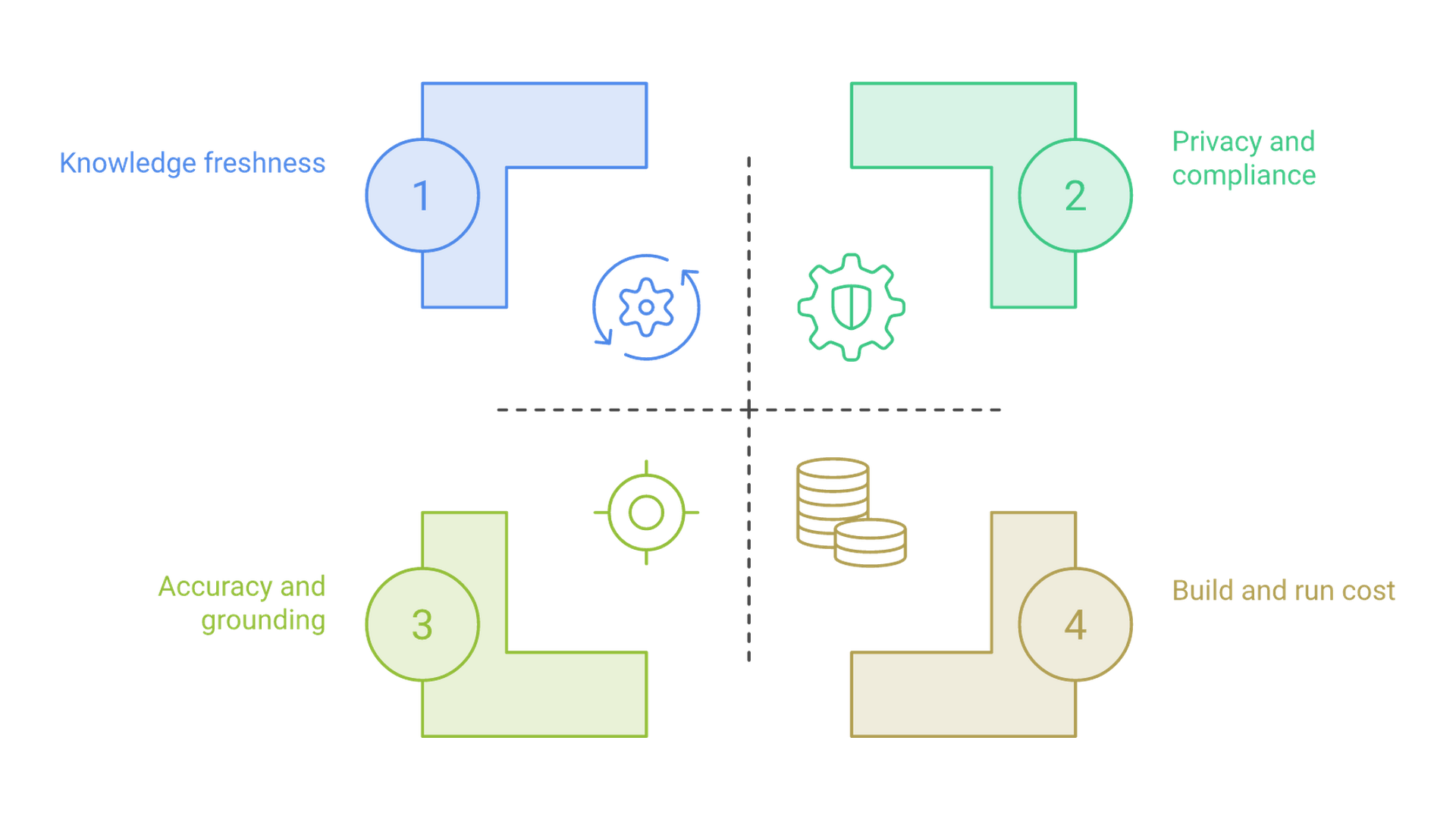
Interpreting the trade-offs: for enterprise AI systems, RAG tends to win on knowledge freshness, governance, and flexibility-especially in regulated sectors. Fine tuning wins on consistent behavior, structured output, and cost efficiency at high inference volumes. The optimal choice often depends on how frequently your content changes, your acceptable latency, and whether you need citations or strict formatting in responses.
Knowledge Freshness and Update Speed
RAG reflects a new policy PDF or product update within minutes or hours after ingestion and re-indexing. RAG is ideal for applications needing frequent data updates. In industries like finance (interest rate changes, compliance bulletins), healthcare (clinical protocol updates), and logistics (route and capacity changes), frequently updated data makes RAG the natural baseline. RAG enhances model accuracy by integrating current data from external data sources.
Fine tuning, even with parameter efficient fine tuning methods, requires curating domain specific data, scheduling GPU time, running the training process, and validating results-often a cycle measured in weeks. Missing an update window means the model serves stale stored knowledge until the next training run.
For slow-changing content-an organization's editorial voice, underwriting philosophy, or internal code style conventions-fine tuning is sufficient and cheaper to maintain because the behavior rarely drifts.
Accuracy, Grounding, and Hallucinations
RAG reduces hallucination by grounding responses in retrieved data. When the retrieval pipeline surfaces accurate data from well-maintained internal documents, the model can generate answers with citations and references, supporting audit and trust. RAG is appropriate for applications that require real-time factual accuracy. RAG allows models to cite sources for generated responses, enhancing transparency.
Fine tuning can improve accuracy on narrow, well-defined specialized tasks but may still hallucinate facts when prompted outside its training distribution. Fine-tuning improves model consistency and output format, which matters when the shape of the answer is as important as its content.
However, retrieval quality is the linchpin of RAG accuracy. Poor document chunking, low-quality embeddings, or indexing lag will harm results even with a strong model. Data quality in the retrieval pipeline deserves the same rigor as data quality in a fine tuning dataset.
Costs: Build, Run, and Maintain
Costs break down into three buckets: upfront build, per-query run costs, and ongoing maintenance.
RAG costs: No model training cost, but significant infrastructure investment-vector databases, ingestion pipelines, embedding compute, taxonomy and security design. RAG systems incur ongoing operational expenses for data retrieval infrastructure. Per-query costs include embedding the user query, running vector search, and processing additional tokens from retrieved context. Research shows RAG pipelines can roughly double time-to-first-token compared to direct model inference, which adds up at scale.
Fine tuning costs: Fine-tuning requires significant computational resources for training. Full fine tuning of a 7–70B parameter model can require well over 100 GB of GPU memory and training costs in the hundreds to low thousands of dollars per run. Parameter-efficient fine-tuning reduces training costs significantly-LoRA or QLoRA runs often need only 4–16 GB of GPU memory. However, data curation and recurrent retraining dominate total cost over time. Fine-tuning can lower per-inference costs by using specialized models-a smaller fine-tuned model can replace a larger general-purpose one for specific tasks, reducing computational resources per query.
The real cost calculus depends on expected query volume, acceptable latency, and how often content changes. High-volume, stable-behavior use cases favor fine tuning's lower per-inference cost. Lower-volume, fast-changing-knowledge use cases favor RAG's flexibility despite higher per-query overhead.
Privacy, Security, and Compliance Considerations
RAG supports data residency and access control by keeping sensitive documents-customer data, private data, proprietary data-in controlled stores. Documents are only retrieved when needed and can be scoped by user permissions at the retrieval layer. RAG connects LLMs to real-time external data sources while keeping those sources under your governance. You can delete or redact specific documents without retraining anything, which directly supports compliance requirements like GDPR's right to be forgotten.
Fine tuning on sensitive data introduces different risks. Training data is baked into model weights, making it harder to prove data lineage and nearly impossible to remove specific records post-training. For regulated sectors-healthcare, banking, legal document analysis-this creates challenges around provenance, bias evaluation, and auditability. Fine-tuning requires proper review by legal and compliance teams before using PII or regulated data in the training process.
A governed RAG framework can enforce regional controls, language-specific policies, and department-level access restrictions-making it the safer first step in environments with strict governance requirements. Our US-based team builds this governed retrieval into Cognativ's private LLM solutions, hosted on infrastructure you control.
When to Use RAG, Fine-Tuning, or Both
This section provides prescriptive guidance for teams deciding when to choose fine tuning, when to invest in retrieval augmented generation for business use cases, and when a hybrid is the right move.
Scenarios Where RAG Is the Better First Step
RAG should be your default starting point in these enterprise scenarios:
- Internal knowledge assistant over policies, SOPs, and tickets. When internal documents change monthly or faster and you lack labeled training data, RAG lets you surface relevant information from existing knowledge bases without curating a fine tuning dataset. RAG can enhance customer support bots with updated knowledge bases.
- Customer support using product and FAQ documentation. RAG is effective for domains with rapidly changing information, such as customer support. Product features ship frequently; a rag model that retrieves from the latest documentation keeps answers current.
- Legal or compliance research over regulation libraries. When regulations are updated regularly, RAG lets legal teams retrieve relevant documents and receive answers grounded in the latest rules-with citations for verification.
- Analytics teams querying reports and dashboards. When teams need answers drawn from periodically refreshed market data, internal reports, or operational dashboards, RAG provides real time data retrieval without retraining.
Across all four, RAG wins because the content is large and unstructured, updates are frequent, labeled examples are scarce, and document-level governance is required. RAG pilots also generate real-world query logs that later inform fine tuning datasets-making RAG a practical precursor to fine tuning.
Scenarios Where Fine-Tuning Delivers More Value
Fine tuning is clearly advantageous in these situations:
- High-volume classification or routing tasks. Triaging millions of support tickets or categorizing inbound requests requires consistent, fast behavior on specific tasks. A fine-tuned smaller model reduces latency and prompt complexity. Fine-tuning is best for tasks requiring consistent output formats.
- Document generation with strict templates. Credit memos, clinical summary reports, and compliance disclosures demand rigid structure. Fine-tuning excels in generating medical reports and legal documents where output format must be precise and repeatable.
- Brand-specific content creation. Marketing copy, editorial tone, and internal communications that must align with company voice across thousands of outputs benefit from fine tuning aim to encode style directly into weights.
- Organization-specific code generation. When naming conventions, internal library usage, and architectural patterns must be consistent, fine tuning encodes those domain specific knowledge patterns without relying on prompt engineering.
In these cases, response structure and behavior consistency matter more than up-to-the-minute documents. Fine-tuned models reduce prompt complexity and latency by encoding the behavior directly in model weights, avoiding the overhead of retrieval pipelines.
Hybrid Approach: Combining RAG and Fine-Tuning
A typical hybrid pattern pairs a fine-tuned model-trained via PEFT to encode domain language, response formats, and reasoning heuristics-with RAG providing current facts, references, and relevant data from external knowledge sources.
The fine tuning handles how to reason and respond; RAG handles what to reason about.
Many mature enterprise deployments evolve toward this hybrid architecture. Studies on joint adaptation-domain-tuned embeddings plus LoRA-adapted generators-show cumulative gains that often match or exceed what either approach achieves alone. The architecture can be staged: start with a RAG pilot, observe real-world patterns, then invest in fine tuning for the highest-value flows.
Worked Example: Choosing RAG vs Fine-Tuning for an Internal Knowledge Assistant
This worked example walks through the decision process for a common enterprise scenario: an internal assistant covering HR policies, IT documentation, SOPs, and historical tickets.
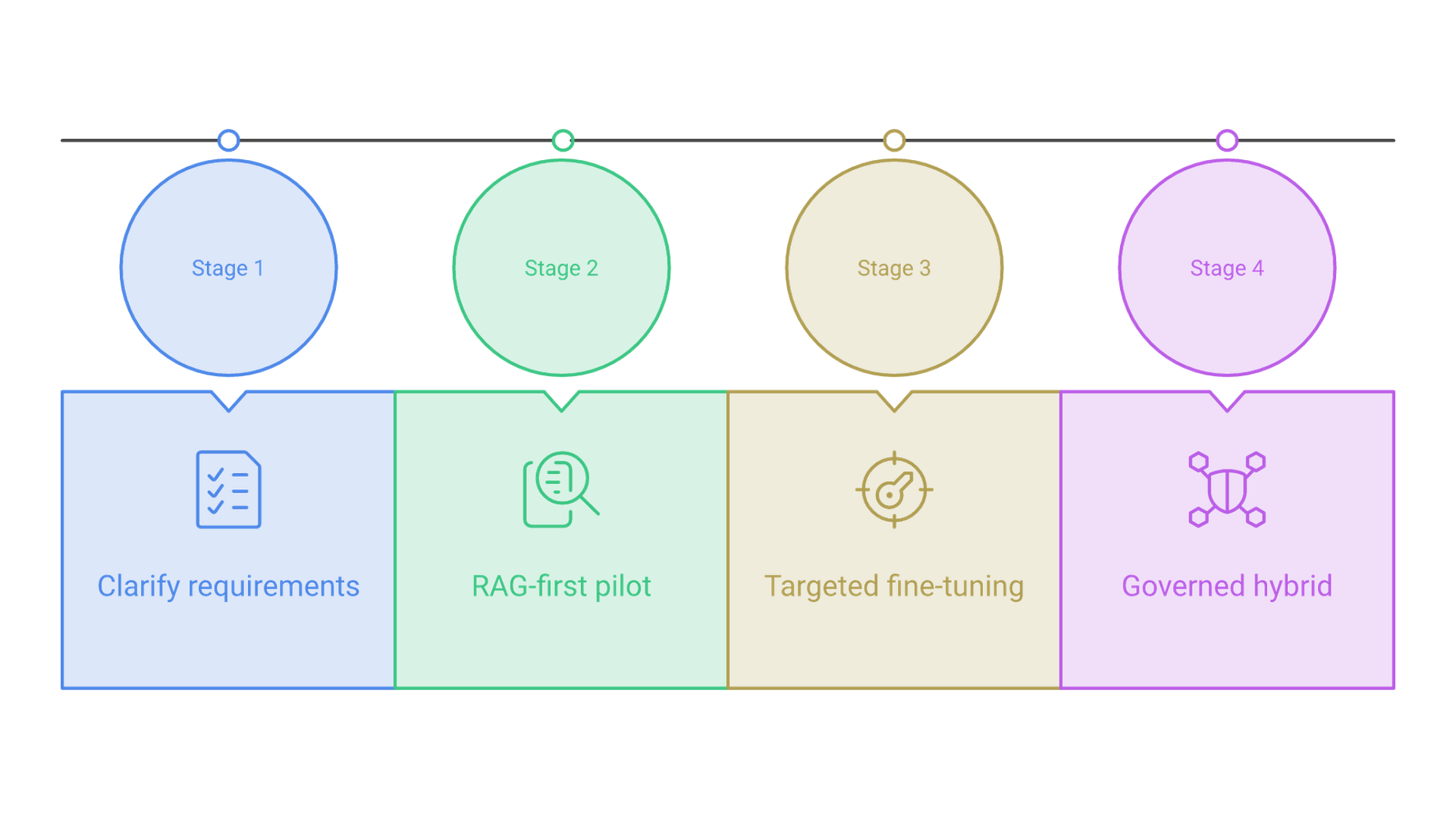
Step 1: Clarify Requirements and Constraints
Before choosing an architecture, map the problem concretely:
- Users: employees across HR, IT, and operations departments
- Needs: answer policy questions (leave, benefits), surface procedures (access requests, escalation paths), suggest next steps for common workflows
- Constraints: data is sensitive (employee info, contracts), policies change monthly, responses must cite source documents, auditability is required, and different departments have different document access rights
Common KPIs for this type of assistant include reduced HR/IT ticket volume, faster employee onboarding, improved time-to-answer, and employee satisfaction scores.
Step 2: Evaluate a RAG-First Implementation
A RAG-based assistant would work as follows:
- Ingest and chunk internal documents from Confluence, SharePoint, and ticketing tools-optimal chunk sizes typically fall in the 200–500 token range
- Generate embeddings and store them in a vector database with metadata for department and access level
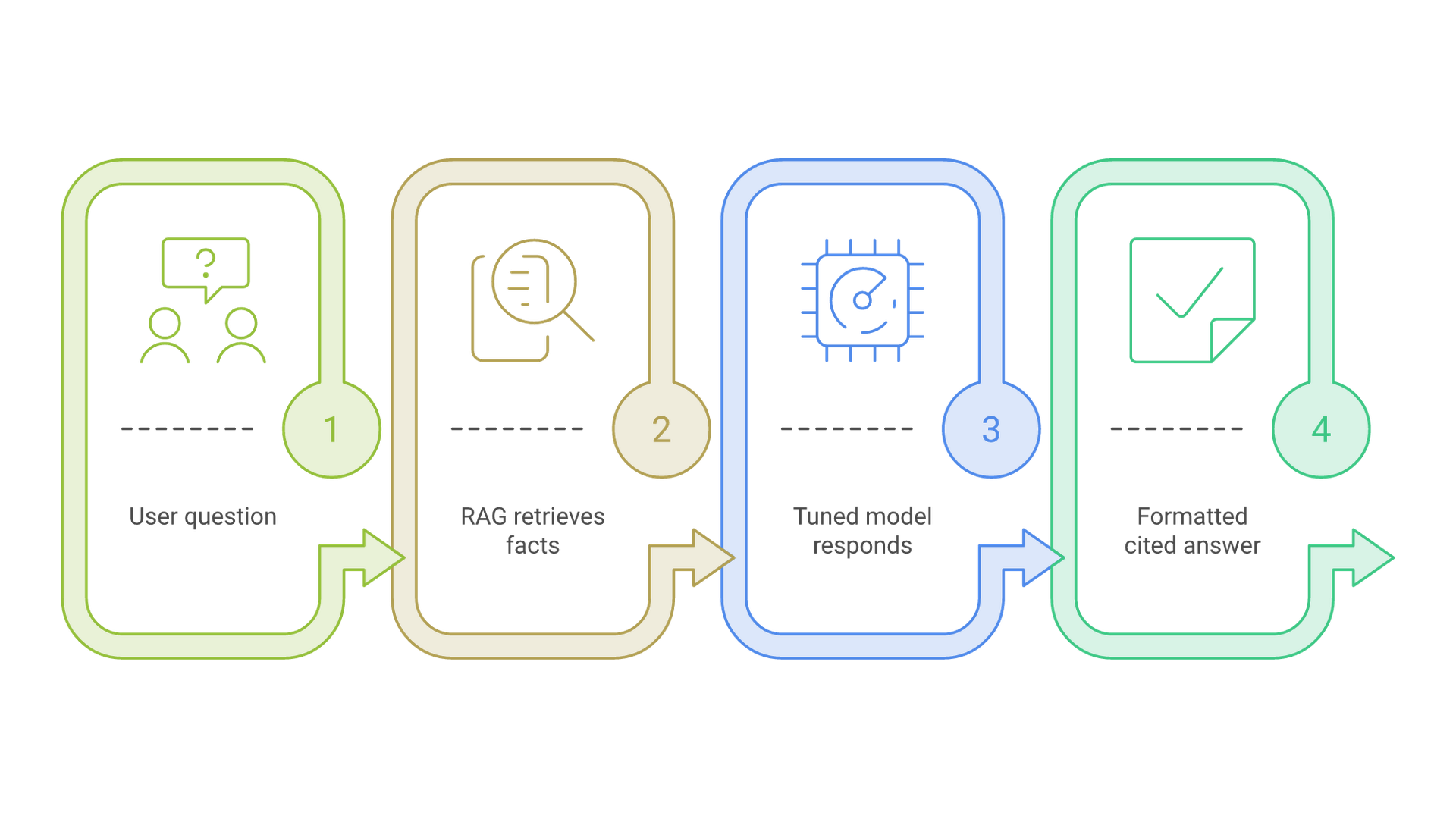
- At query time, the user query is embedded, semantic search retrieves the top-k most relevant chunks, and the orchestration layer constructs a prompt combining retrieved context with the question
- The LLM generates an answer with citations and links back to source pages
Strengths: Very fast to adapt when HR policies change-re-index the updated document and the assistant reflects it immediately. Easy to restrict access by department or region using metadata filters. Minimal need for labeled training data. RAG provides real-time data access without retraining the model.
Limitations: Tone and format may be inconsistent across responses. Some answers are too verbose. The model may not follow rigid internal formats like "always answer in a 3-step checklist." These limitations point directly toward where fine tuning adds value.
Step 3: Identify Where Fine-Tuning Adds Value
After running the RAG pilot for several weeks, review query logs and user feedback to identify patterns:
- Repeated failure modes: the model uses generic language instead of internal terminology
- Teams request standardized answer templates (e.g., "3-step checklist" format for IT procedures)
- High-volume repetitive questions could be answered more efficiently with a smaller, faster model
To address these, spin up a fine tuning project:
- Collect 500–1,000 high-quality Q&A pairs where support experts have written ideal answers in the preferred format
- Fine-tune a smaller base model using LoRA or QLoRA to learn tone, structure, internal vocabulary, and preferred phrasings
- Keep RAG in place for factual grounding-the fine-tuned model consumes retrieved data but responds in a standardized way
Improved outcomes: more consistent responses, lower latency (smaller model + no prompt engineering overhead), and easier continuous monitoring of quality against internal answer guidelines.
Step 4: Resulting Hybrid Architecture and Governance
The final architecture combines both approaches:
- RAG retrieves the most relevant documents, scoped by user permissions and department metadata
- The fine-tuned model uses that context to generate answers in a standardized, on-brand format
- Audit logs store which documents were used, the retrieved chunks, and the generated answer for compliance review
This staged approach-RAG pilot first, then targeted fine tuning for high-value flows-reduces risk and lets real usage data guide the fine tuning investment. At Cognativ, our RAPID framework structures this progression: initial assessment, architecture design, pilot deployment, rollout, and measurement of business impact.
Practical Decision Checklist: RAG vs Fine-Tuning for Your Next Project
This section provides a concise, reusable rubric for teams scoping new LLM use cases. Run through these questions for each candidate project to determine your starting architecture.
Questions That Point You Toward RAG
- Does the relevant knowledge change weekly or faster?
- Is most of your data unstructured documents rather than labeled examples?
- Do you need citations or document links for every answer?
- Do different users have different permissions on the underlying data?
- Is sufficient data for fine tuning (hundreds of labeled Q&A pairs) unavailable today?
- Does the use case span a large, diverse corpus (thousands of documents across topics)?
- Do you need to integrate external data sources like regulatory feeds or market data?
- Is the project a first pilot where speed to prototype matters most?
The more "yes" answers, the stronger the case for a RAG-first approach. RAG also generates the query logs and usage patterns that later become valuable training data for fine tuning.
Questions That Point You Toward Fine-Tuning
- Do you need highly consistent answer formats or templates at scale?
- Do you plan to serve millions of similar queries per day where latency and cost efficiency matter?
- Is latency under a strict threshold a hard requirement?
- Do you have or can you create hundreds to thousands of high-quality labeled examples?
- Is the fine tuning aim to encode brand voice, domain-specific reasoning, or proprietary terminology?
- Are you replacing a larger model with a smaller, specialized one to reduce inference costs?
- Is the knowledge domain relatively stable (updates quarterly or less)?
- Do you need model performance on knowledge intensive tasks where the base model underperforms?
When budgets or GPU access are constrained, start with parameter efficient fine tuning methods like LoRA or QLoRA. They deliver strong model performance on domain specific tasks while keeping training costs and computational resources manageable.
When You Should Plan a Hybrid from Day One
Plan for a hybrid architecture when you see these signals:
- Mixed knowledge dynamics: some content changes daily (operational data, ticket histories) while other content is stable (brand guidelines, output templates)
- Both format and freshness matter: responses must follow strict structures and reference up to date information from live data sources
- Regulated or cross-border environments: compliance regimes require both factual freshness (accurate data from current documents) and behavioral consistency (standardized disclosures, audit-ready formatting)
- Multi-department deployment: different teams need different styles and access scopes, but share a common platform
Even in hybrid scenarios, staging is practical: deploy RAG first to establish the knowledge pipeline and gather real-world queries, then layer fine tuning onto the highest-value, highest-volume flows.
Implementation Considerations for Enterprise Teams
Beyond architecture choices, successful enterprise AI systems require attention to operational realities: who needs to be involved, what systems change, and what to monitor post-launch.
Data, Governance, and Privacy
Before using any data in either RAG or fine tuning:
- Inventory and classify all candidate data sources. Distinguish between data suitable for retrieval (internal documents, knowledge bases) and data that could be used as training data for fine tuning
- Define access boundaries. Apply role-based access control on the retrieval layer so that sensitive private data and customer data are only surfaced to authorized users
- Address right-to-be-forgotten. Region-specific retention policies and GDPR requirements are handled more flexibly in RAG-delete or redact a document-than in baked-in model weights where removal is impractical
- Ensure data quality. Whether you are building a retrieval corpus or a fine tuning dataset, the quality of your data directly determines the quality of your outputs
For organizations handling proprietary data in regulated industries, a secure AI implementation framework is essential before any production deployment.
Team Skills and Operating Model
Each approach requires different skill sets:
- RAG: data engineers, backend engineers experienced with vector databases and ingestion pipelines, and some MLOps capability for monitoring retrieval performance and pipeline health
- Fine tuning: ML engineers with deep learning experience familiar with fine tuning techniques, PEFT methods, and evaluation frameworks, plus MLOps for managing model versions and deployment
Many mid-market teams lack both profiles in-house. Cognativ acts as a partner rather than a commodity dev shop-aligning AI architecture with enterprise workflows and ROI targets, then building the operational muscle to sustain the system independently. Our US-based team covers both skill profiles through Cognativ's AI software development services.
Measuring Success and ROI
Define concrete KPIs before launch and measure them consistently:
- For assistants and support bots: resolution time, ticket deflection rate, grounding accuracy, user satisfaction
- For operational efficiency: latency and cost per 1,000 queries, infrastructure spend relative to baseline
- For business impact: fewer manual review hours, faster onboarding time, reduced compliance preparation cycles
Encourage A/B testing-RAG-only vs hybrid vs baseline prompts-to quantify the value of each layer. Schedule periodic evaluations as data sources, usage patterns, and model performance evolve over time. Continuous monitoring of both retrieval quality and output quality is non-negotiable for production ai systems.
Additional Resources
These resources are optional deep dives for teams moving from concept to implementation:
- Building retrieval pipelines: our guide to vector databases for LLMs covers how semantic search and embedding storage work in practice
- Parameter efficient fine tuning methods: learn how LoRA and low-rank adaptation reduce training costs while maintaining optimal performance on domain specific tasks
- Fine tuning best practices: our practical guide to fine tuning LLMs covers dataset preparation, evaluation, and common pitfalls
- Enterprise architecture: before selecting models or methods, review our perspective on enterprise AI architecture decisions
- Getting started: Cognativ's AI services and LLM solutions pages are practical starting points for assessments and workshops
These resources help teams de-risk early LLM projects and align them with governance expectations and measurable ROI.
Conclusion and Next Steps
RAG solves "what information should the model see right now?" Fine tuning solves "how should the model behave?" Understanding this distinction-and knowing when each approach (or both) is appropriate-is the foundation of every successful enterprise LLM deployment.
Your immediate next steps:
- Map your top 2–3 candidate use cases to the decision checklist in this article
- Pilot a RAG-based assistant over your existing documentation and internal knowledge bases-it is the fastest path to real user feedback
- Identify one high-volume workflow where consistent output format or specialized behavior may justify fine tuning
- Evaluate whether a hybrid architecture is needed from day one based on your mix of dynamic and stable content
- Establish governance and measurement before launch, not after
Think in terms of phased adoption rather than one-off projects. RAG pilots generate the query data that informs fine tuning datasets. Fine tuning investments compound over time as your labeled corpus grows. Both approaches benefit from an AI-first architecture that treats knowledge pipelines and model behavior as complementary, evolving capabilities.
If you are ready to scope a secure, governed LLM deployment, Cognativ can help. Explore our private LLM solutions, learn more about our AI software development services, or get in touch to discuss your specific use case.
For more on how local and private models fit into RAG and fine tuning strategies, see our guide on local LLM models: how to choose, set up, and use them.
To scope your own RAG or fine-tuning project, talk to our US-based team.