
Remanence Raises $30 Million to Turn AI Agent Traces Into Models Companies Own
Paris startup Remanence closed a $30M seed to retrain open-weight models on agent logs. See its four-step loop and what a company needs before owning a model.
Every run of a production AI agent leaves a record: the tools it called, the step where it went wrong, the fix a human applied. Paris-based Remanence raised a $30 million seed round on November 17, 2026 on the bet that those records are training data, and that a company can use them to post-train an open-weight model it owns instead of paying a frontier lab for every call.
The funding is the news; the harder question for a US company already running agents is whether owning a specialized model beats prompting a rented one, and what has to be in place before that choice is even open. This article covers the deal briefly, then works through that decision.
A $30M Seed for the Team That Post-Trained H Company's Holo Models
The investors and the founding team are confirmed by Remanence's own site and by EQT Ventures' post on the deal; the wider investor list comes from trade coverage.
EQT Ventures and FirstMark co-led the round. Coverage by Dealroom, ActuIA and Tech Funding News lists Zero Prime, Emblem, Drysdale, Global Founders Capital and Yellow as participants, plus angels including Datadog CEO Olivier Pomel and Synthesia co-founders Victor Riparbelli and Steffen Tjerrild. The three founders came from H Company, the French computer-use AI lab: CEO Pierre-Louis Cedoz, previously H's CTO and earlier on Gemini post-training at Google DeepMind; CTO Hamza Benchekroun, who led H's post-training; and CPO Axel Moyal, who led agent and evaluation work there, according to EQT.
That background is the pitch. EQT says H's Holo models set the state of the art on the OSWorld-Verified computer-use benchmark in March 2026. The money goes to a dedicated GPU cluster in Europe, research hires mainly in Paris, and early teams in London and San Francisco. Cedoz announced the round on X the same day.
Today we’re announcing Remanence and our $30M seed round, co-led by EQT Ventures and FirstMark. AI agents generate data on every tool call, failure and correction. Almost all of it is thrown away, and the next run makes the same mistakes at the same cost. 🧵 pic.twitter.com/W1PgrJZPzy
From Agent Traces to Model Weights in Four Steps
Remanence does not sell a model. It sells a loop that turns a customer's agent logs into training tasks, then into a specialized model that is retrained as new logs arrive.
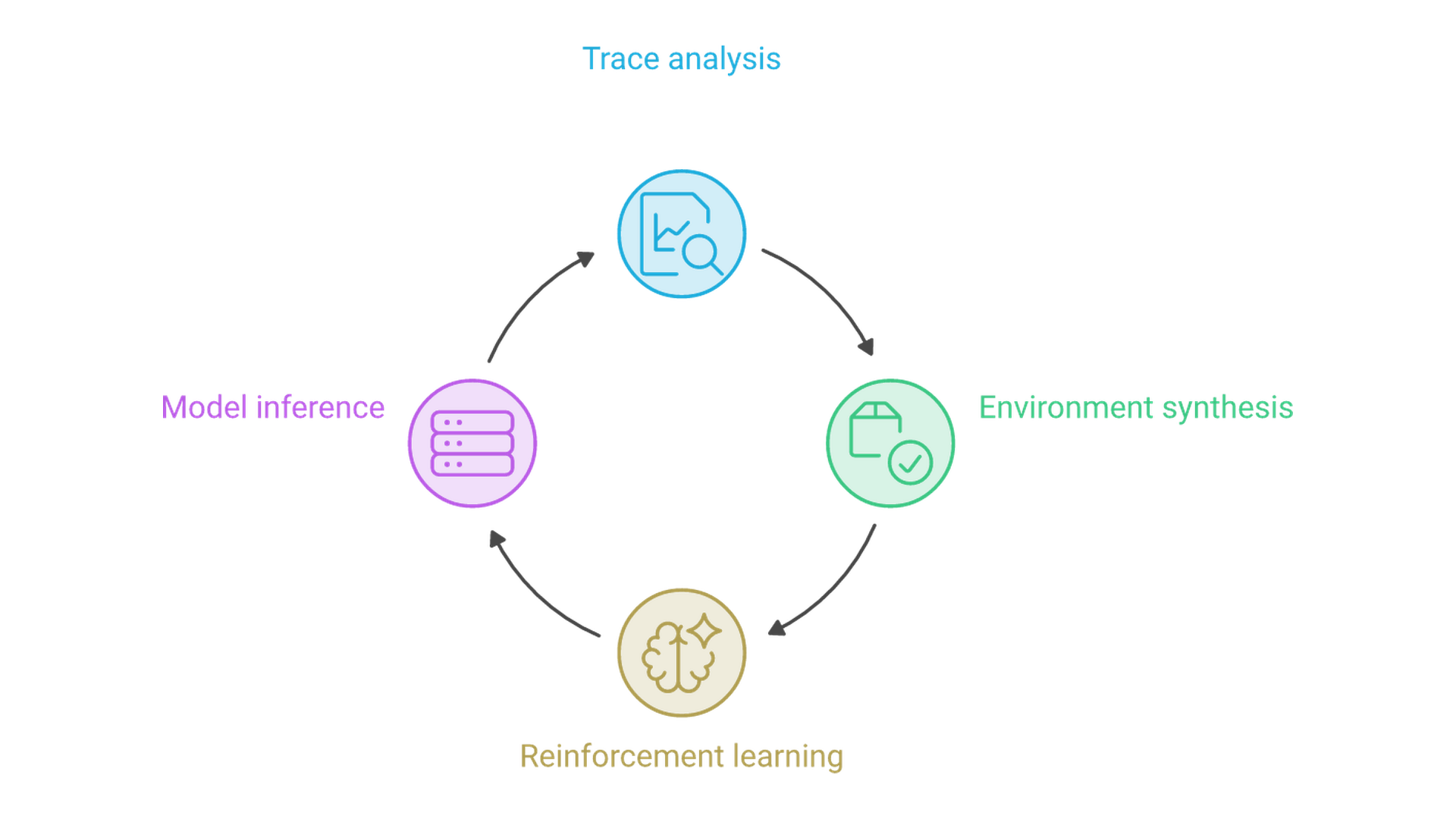
Remanence's site describes four stages. Trace analysis connects to the customer's observability tooling to find where an agent fails. Environment synthesis builds new tasks and verifiers from those traces and runs them in a sandbox that mirrors the customer's application. Long-horizon reinforcement learning then trains an open-weight model against the customer's current baseline. Inference runs either fully managed or in the customer's own cloud.
The verifier is the piece that matters most. Reinforcement learning only works when software can score whether a task was done correctly, and EQT's investment note argues that hand-built environments and verifiers, not the training run, are now the bottleneck. The company says customers keep the weights and data can stay inside the customer's boundary. It has not said which open-weight base models it uses, only that training works on any of them.
Prompting, Retrieval, Then Post-Training: Where Each Fix Stops
Remanence itself frames specialization as the step after prompt and tool tuning, not a replacement for them. That ordering is the useful part for a buyer deciding where to spend next.
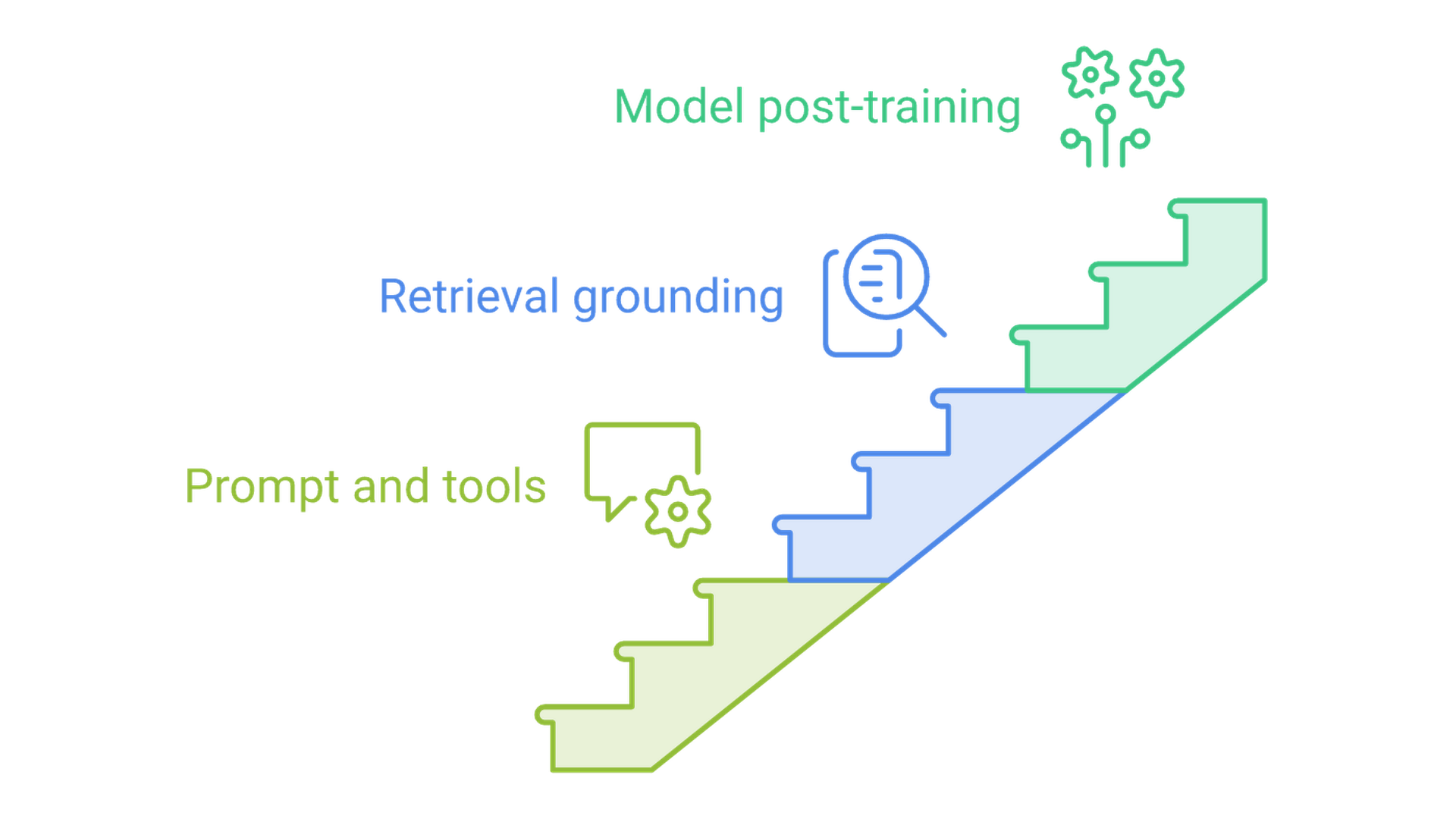
Prompt and tool changes fix instructions and access: the agent was told the wrong thing or could not reach the right system. Retrieval fixes knowledge: the agent lacked a current contract clause or a product spec, and grounding it in your documents closes the gap without touching the model. Post-training changes behavior: the agent knows the facts and has the tools, yet still picks the wrong sequence of steps on a long task, the same way, run after run.
Only that third failure pattern is what Remanence targets, and it is visible only in traces. A support agent that keeps escalating tickets it could close, or a contract-review agent that skips the same check, are behavior problems; a missing policy document is a retrieval problem. Sorting your failures into those buckets before buying anything is where any LLM solutions engagement should start, because retraining a model to fix a knowledge gap wastes compute and still misses the next document update.
The Cost Case Comes From Survey Data, Not From Remanence
Remanence says a post-trained open model can match frontier models on a customer's tasks at a fraction of the cost. It has published no figures of its own and names no customers to back that up yet.
The broader market numbers are real. A Capgemini survey of 500 executives at companies with more than $1 billion in revenue, reported by Reuters on November 12, 2026, found 59% said AI spending over the past year ran well above expectations or budgets, by 24% on average. Nearly six in ten plan to use more open-weight models next year, and Capgemini puts open-weight tokens at 87% cheaper on average than closed ones.
The same survey cuts the other way too: half of respondents would keep closed models where task complexity justifies the price. FirstMark's Matt Turck said, in comments carried by ActuIA and Tech Funding News, that enterprise AI is going hybrid, with closed lab models working alongside models companies own. Cedoz's version is blunter: "AI companies spend more on intelligence every quarter and own none of it." Both point to the same plan for a mid-market company: a specialized model for the high-volume, repetitive agent task, and a frontier API for the rare, open-ended one.
Four Things a US Company Needs Before Owning a Model
Remanence's design partners are in legal, customer support and enterprise software across Europe and the US, according to Dealroom and ActuIA. Those are fields with repeatable, checkable agent work.
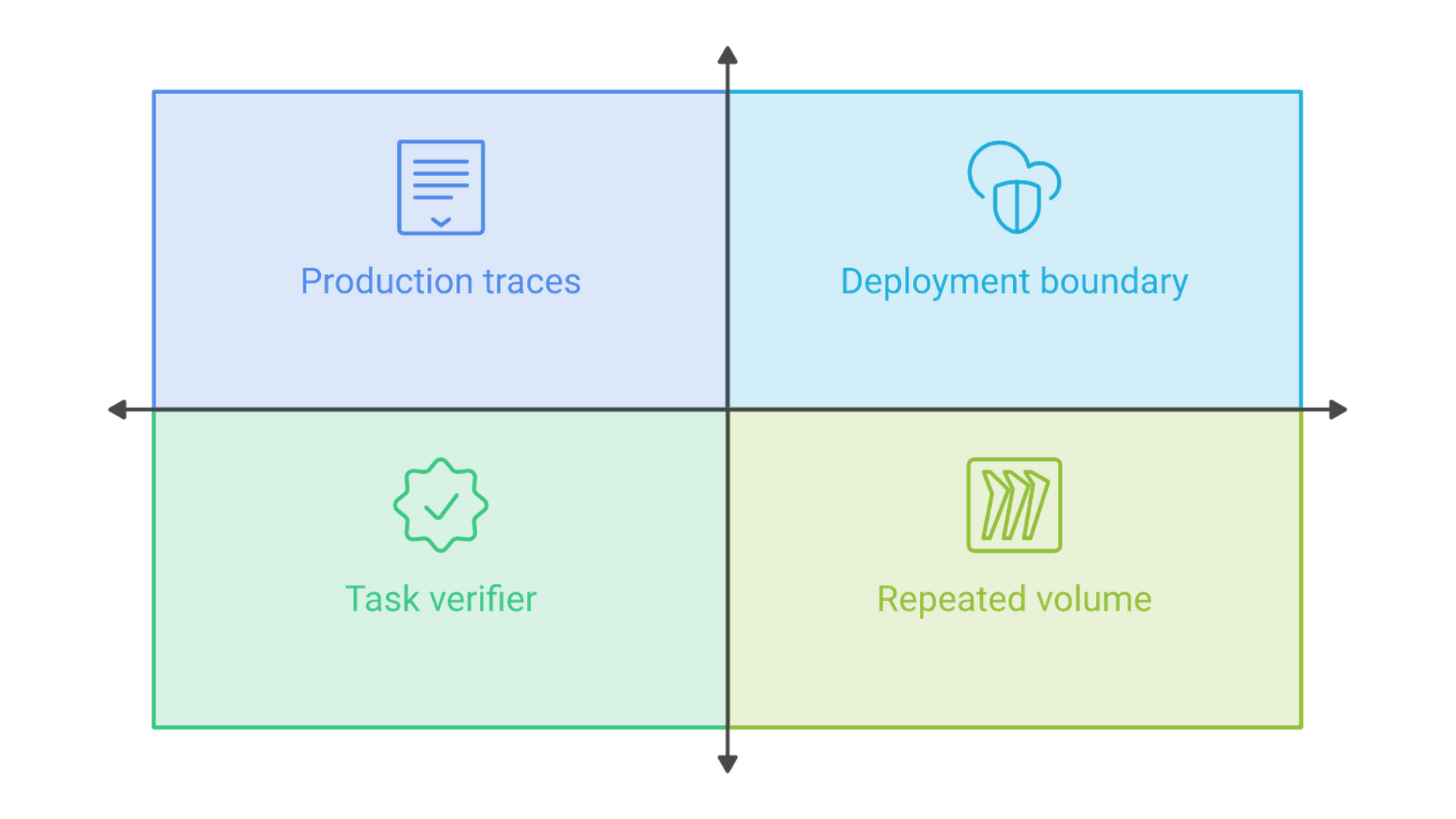
The four prerequisites follow directly from how the loop works. First, traces: an agent in production with observability that records tool calls and outcomes, since an agent still in a pilot has nothing to learn from. Second, a verifiable task: a way for software to score success, such as a ticket resolved without reopening or a clause matched to a playbook. Third, volume: enough repeated runs of the same task that a cheaper specialized model pays back its training. Fourth, a deployment boundary: a decision on whether training and serving run in Remanence's managed service or in your own cloud account.
The fourth is likely to take regulated US firms in legal, healthcare or financial services the longest to settle. Running training and inference inside your own VPC means GPU capacity, access controls and monitoring you operate, which is the scope of Cognativ's AI infrastructure work. Pricing, minimum volumes and US availability dates have not been published, so any comparison against a frontier API bill has to wait for a quote.
FAQs About Remanence's $30M Seed
Short answers to the searches that follow the Remanence news: what the company is, how post-training differs from fine-tuning, and what it has not disclosed yet.
What is Remanence AI?
Remanence is a Paris startup that calls itself a continual-learning platform for companies running agents in production. Ventureburn describes the $30 million round on November 17, 2026 as its exit from stealth.
Is post-training the same as fine-tuning?
Fine-tuning is one kind of post-training. Post-training covers any training applied after a model's initial pretraining, including supervised fine-tuning on examples and reinforcement learning against a scoring function, which is the method Remanence emphasizes.
Has Remanence named any customers?
No. Coverage describes unnamed design partners, and the company's site shows no customer names. No pricing has been published either.
Is Remanence part of H Company?
No. Remanence is a separate startup. Its three founders previously worked at H Company, a French computer-use AI lab, where coverage says they led post-training of the open-weight Holo models.
Keep the Traces Now, Decide on Ownership Later
Whether Remanence delivers on its cost claims will show only when its design partners go public with results, and the company has given no date for publishing customer outcomes or its pricing.
The decision it raises does not have to wait. Any company running agents can start storing complete traces and defining what a successful run looks like, which keeps post-training, retrieval and a better prompt all open as options.
If your agents are in production and you want to sort which failures call for a specialized model and which do not, talk with the Cognativ team about your agent traces.